
五年级下册英语教案Unit 7 Chinese festivals(Story time) 译林版(三起)
5B Unit 7 Chinese festivals(Story time)教学目标:1. 能听懂、会读、会说节日单词:Spring Festival, Dragon Boat Festival, Mid- Autumn Festival Double Ninth Festival.2. 能听懂、会读、会说不同节日的传统食物和活动。
3. 能正确的理解并朗读课文,并尝试复述课文内容。
4. 在教师的引导和帮助下,会运用本节课学习的句型来介绍自己了解的中国节日。
教学重、难点:1. 能正确理解并朗读课文,并尝试复述课文。
2. 在教师的引导和帮助下,会运用本节课学习的句型来介绍自己了解的中国节日。
教学准备:PPT教学过程:Step 1: Pre-reading1.Sing a song2.Free talk(1) What is this song about?(2) How many months are there in a year?(3) What are they?(4) Which month is your favorite? Why?3.Present the titleStep2: While-reading1.Watch and find out the four festivalsT: What festivals are there in the story?2.Learn the name of these four festivals(1) What does “Spring” mean? How many seasons are there in a year? What are they?(2) Dragon means “龙”. Why we call it Dragon Boat?(3) Mid means “中间”. Why we call it Mid- Autumn Festival?(4) What does “double”mean? Double Ninth 九月九日, so two nine means “double”. We have learned a Chinese poem about the Double Ninth Festival? Do you remember? Can you recite it?3.Learn Spring festival firstT:Spring Festival, Dragon Boat Festival, Mid- Autumn Festival Double Ninth Festival, they are Chinese festivals. Among these four Chinese festivals, which is the most important one in China?Ss: Spring Festival.T: So we are going to learn the Spring Festival first. Open your books to page 56, read the first part and then tell Miss Liu what do you know about Spring Festival?(1) Spring Festival is in January or February.What does it mean? It’s according to Chinese lunar calender. For example, last Spring Festival is in January, and next Spring Festival is inFebruary.T: So we can say we know the month/ activity/ food of Spring Festival.(2) We know the Spring Festival well. Now look at the blackboard, we can talk about Spring Festival from three aspects: the month, the activity and the food. So when you want to know the month/ activity/ food of a festival, how can you ask?4.Learn the other three festivals in groupsStep1. Read and discussStep 2. Ask and answer or make a report5.Read the story(1) Read after the computer(2) Read in group of four and choose one way to read6.Retell the storyT: I think you’re all familiar with the four Chinese festivals. Now let’s try to retell the text. Work in group of four and choose one way to retell. While retelling you can look at the blackboard.Step 3: Post- reading1.观察内容的选择,我本着先静后动,由近及远的原则,有目的、有计划的先安排与幼儿生活接近的,能理解的观察内容。
随机观察也是不可少的,是相当有趣的,如蜻蜓、蚯蚓、毛毛虫等,孩子一边观察,一边提问,兴趣很浓。
我提供的观察对象,注意形象逼真,色彩鲜明,大小适中,引导幼儿多角度多层面地进行观察,保证每个幼儿看得到,看得清。
看得清才能说得正确。
在观察过程中指导。
我注意帮助幼儿学习正确的观察方法,即按顺序观察和抓住事物的不同特征重点观察,观察与说话相结合,在观察中积累词汇,理解词汇,如一次我抓住时机,引导幼儿观察雷雨,雷雨前天空急剧变化,乌云密布,我问幼儿乌云是什么样子的,有的孩子说:乌云像大海的波浪。
有的孩子说“乌云跑得飞快。
”我加以肯定说“这是乌云滚滚。
”当幼儿看到闪电时,我告诉他“这叫电光闪闪。
”接着幼儿听到雷声惊叫起来,我抓住时机说:“这就是雷声隆隆。
”一会儿下起了大雨,我问:“雨下得怎样?”幼儿说大极了,我就舀一盆水往下一倒,作比较观察,让幼儿掌握“倾盆大雨”这个词。
雨后,我又带幼儿观察晴朗的天空,朗诵自编的一首儿歌:“蓝天高,白云飘,鸟儿飞,树儿摇,太阳公公咪咪笑。
”这样抓住特征见景生情,幼儿不仅印象深刻,对雷雨前后气象变化的词语学得快,记得牢,而且会应用。
我还在观察的基础上,引导幼儿联想,让他们与以往学的词语、生活经验联系起来,在发展想象力中发展语言。
如啄木鸟的嘴是长长的,尖尖的,硬硬的,像医生用的手术刀―样,给大树开刀治病。
通过联想,幼儿能够生动形象地描述观察对象。
T: Today we have learned four traditional Chinese festivals. Do you know some other Chinese festivals?Ss: Lantern Festival, Tomb sweeping DayT: Can you introduce it to us? Work in group of four.Step 4: Homework1. Listen and read the story.2. Tell your friend about Chinese festivals.3. Search more information about Chinese festivals from the Internet.反思:1. 在小组合作的时候给学生学习的时间不长,学生学习不充分,所以在语言输出的时候不是很理想,不管是对话还是报告,学生都说的不是很流畅。
但是在阅读课文部分花了很长时间。
所以在以后的上课中,对课堂环节时间的把控还有待提高。
2. 在课堂中,教师用语不够清晰明确,有的学生听不明白,不知道老师要自己做什么。
所以,教师的课堂用语要简单明了。
在学生不理解的时候,可以自己先作个示范,或者利用手势,或者用中文解释一下,让学生清楚的明白自己接下来要做什么,怎么做。
或者像有的老师建议的那样,先跟老师学,在小组学,然后自学。
通过这样一步一步的分解,学生逐步了解怎么做。
3. 在整个文本中,词汇的教学比较欠缺。
有些生词是老师带着读的,有的生词是放手让学生在小组合作中解决的。
但是在学生小组合作中,老师也没有给予学生如何学习生词的指导。
我想以后应该教会学生各种学习单词的方法,可以教师先示范,然后再放手让学生去自学。
要练说,得练听。
听是说的前提,听得准确,才有条件正确模仿,才能不断地掌握高一级水平的语言。
我在教学中,注意听说结合,训练幼儿听的能力,课堂上,我特别重视教师的语言,我对幼儿说话,注意声音清楚,高低起伏,抑扬有致,富有吸引力,这样能引起幼儿的注意。
当我发现有的幼儿不专心听别人发言时,就随时表扬那些静听的幼儿,或是让他重复别人说过的内容,抓住教育时机,要求他们专心听,用心记。
平时我还通过各种趣味活动,培养幼儿边听边记,边听边想,边听边说的能力,如听词对词,听词句说意思,听句子辩正误,听故事讲述故事,听谜语猜谜底,听智力故事,动脑筋,出主意,听儿歌上句,接儿歌下句等,这样幼儿学得生动活泼,轻松愉快,既训练了听的能力,强化了记忆,又发展了思维,为说打下了基础。
观察内容的选择,我本着先静后动,由近及远的原则,有目的、有计划的先安排与幼儿生活接近的,能理解的观察内容。
随机观察也是不可少的,是相当有趣的,如蜻蜓、蚯蚓、毛毛虫等,孩子一边观察,一边提问,兴趣很浓。
我提供的观察对象,注意形象逼真,色彩鲜明,大小适中,引导幼儿多角度多层面地进行观察,保证每个幼儿看得到,看得清。
看得清才能说得正确。
在观察过程中指导。
我注意帮助幼儿学习正确的观察方法,即按顺序观察和抓住事物的不同特征重点观察,观察与说话相结合,在观察中积累词汇,理解词汇,如一次我抓住时机,引导幼儿观察雷雨,雷雨前天空急剧变化,乌云密布,我问幼儿乌云是什么样子的,有的孩子说:乌云像大海的波浪。
有的孩子说“乌云跑得飞快。
”我加以肯定说“这是乌云滚滚。
”当幼儿看到闪电时,我告诉他“这叫电光闪闪。
五年级下册英语教案-Unit7 Chinese festivals Story time |译林版(

五年级下册英语教案-Unit7 Chinese festivals Story time |译林版(三起)一、教材分析1.1 教材背景本单元的教学内容主要是让学生了解中国的传统节日,并通过学习“Story time”中的故事进一步了解节日的起源、过程和相关习俗,加深学生对中国文化的理解。
1.2 教材目标通过本单元的学习,学生应该能够:•了解中国的传统节日,如清明节、端午节、中秋节等;•通过“Story time”的故事了解节日的起源、过程和相关习俗;•听、说、读、写有关节日的相关单词和句子;•培养学生的想象力,提高学生的语言表达能力和阅读能力。
1.3 教材内容本单元的教材内容主要包括:•单词:tradition, ancestor, grave, sticky, rice dumpling, give, respect, lantern, mooncake, reunion;•句子:What do people do on Clear and Bright Festival? They visit their ancestors’ graves.;•故事:Story time“中的故事主要涉及中国传统节日的起源、过程和相关习俗。
二、教学策略2.1 任务型教学法本单元的教学以任务型教学法为主,通过给学生布置任务并设置标准,激发学生的积极性,培养学生的合作精神和自学能力,从而达到学生对知识的深入理解和掌握。
2.2 合作学习本单元的教学中采用合作学习的方法,让学生在小组内互相交流、讨论、合作完成任务,培养学生的合作精神和团队意识,提高学生的学习效率。
三、教学步骤3.1 导入•教师可以通过展示有关中国传统节日的图片或视频,让学生先对节日有一定的了解和印象。
•教师可以让学生自由谈论自己最喜欢的节日,并引导学生通过对自己喜欢的节日的描述,逐渐了解和理解各种节日的不同特点和文化内涵。
3.2 教学重点本单元的教学重点在于教学故事和相关单词和句子,故事情节生动有趣,带有浓郁的中国文化气息,能够引起学生的兴趣和好奇心。
五年级下册英语教案Unit7 Chinese festivals (Story time)译林版(三起)
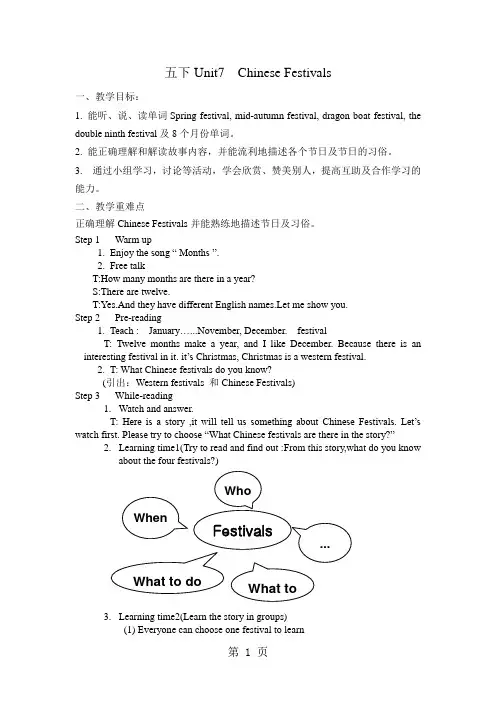
五下Unit7 Chinese Festivals一、教学目标:1. 能听、说、读单词Spring festival, mid-autumn festival, dragon boat festival, the double ninth festival 及8个月份单词。
2. 能正确理解和解读故事内容,并能流利地描述各个节日及节日的习俗。
3. 通过小组学习,讨论等活动,学会欣赏、赞美别人,提高互助及合作学习的能力。
二、教学重难点正确理解Chinese Festivals 并能熟练地描述节日及习俗。
Step 1 Warm up1. Enjoy the song “ Months ”.2. Free talkT:How many months are there in a year?S:There are twelve.T:Yes.And they have different English names.Let me show you.Step 2 Pre-reading1. Teach : January…...November, December. festivalT: Twelve months make a year, and I like December. Because there is an interesting festival in it. i t’s Christmas, Christmas is a western festival.2. T: What Chinese festivals do you know?(引出:Western festivals 和Chinese Festivals)Step 3 While-reading1. Watch and answer.T: Here is a story ,it will tell us something about Chinese Festivals. Let’s watch first. Please try to choose “What Chinese festivals are there in the story?”2. Learning time1(Try to read and find out :From this story,what do you know about the four festivals?)3. Learning time2(Learn the story in groups)(1) Everyone can choose one festival to learn What to do What toFestivals When Who...(2) Talk about the festivals in group.(3) Try to read the new words4.Learning time3(Introduce the festivals)When is the … Festival?What do people do at…?What do people eat at…?Step 4 Showing time1.Try to say .(1)What festival do you like? Please choose one to say.I like... ...is in...At this festival, people ...We eat...It's interesting/...(2)What do you like about the festivals?I know a lot about the Chinese Festivals.The Spring Festival is in…The …is in…The…is in…I love Chinese Festivals.2.Emotional development.Love our family. Love our Chinese festivalsStep 5 Homework1.Listen to Story time, read it and introduce the festivals to your parents or your friends.2.Make a poster about one of the four festivals.(选择一个节日,做一张英文海报。
Unit7ChineseFestivals(教案)译林版英语五年级下册(1)
Students try to introduce the time,food and activities about the other Chinese festivals.
Students tell the reasons.
Ss: Yes.
When’s...?
What do people usually do at ...?
小学(五)年级(英语)学科
课题
Unit7 Chinese festivals
教师
班级
日期
教学目标
1.通过对传统节日的描述与问答,学生能熟练运用本单元核心词汇与句型,并能对节日进行多维度地思考与表达。
2.通过阅读、讨论,学生能发现并梳理出文章清晰的结构、丰富的内容及准确的表达,逐步总结提炼出相关的写作流程与标准。
Read the writings.
Discuss in a group of 4, then tell the reasons.
Find the structure of writing.
Read the writing again ,then discuss with partners.
Ss; can, also, but...
Write the passage according
to the writing criteria.
Give an assessment.
S1:I think she writes well.
She writes beautifully.
S2: She uses the link words.
S3: I like this sentence…
T: What aspects does ... introduce?
最新译林牛津版小学五年级下册英语Unit7-Chinese-Festivals教案
5Bunit7 Chinese Festivals(Sound time&Culture time&Cartoon time)教学内容:unit7 So und time&Culture time&Cartoon time教学目标:1、了解字母组合th在单词中的读音/θ/2、了解万圣节的相关内容3、能够理解并表演cartoon time内容4、能够体会在母亲节所表达的情感,在即将到来的母亲节向母亲节表达感情教学重点:1、字母组合th在单词中的读音/θ/2、能够理解并表演cartoon time内容教学难点:能够理解并表演cartoon time内容教学准备:PPT,卡通版块表演相关道具教学过程:Step1:Wariming up and revision1、song: twelve months2、Brain-storming复习月份和节3、talk about your favourite festivalStep2:Culture time1、师介绍自己喜欢的节日Halloween.在介绍过程中教授新单词:halloween ,dress up, knock, trick or treat2、PPT呈现一些万圣节的图片让学生进一步感知万圣节相关知识[来3、跟读录音。
4、介绍万圣节Step3:Sound time1、Play trick or treat game生说trick or treat,PPT呈现礼物:a songbird(一只鸣鸟),从门内出现更多的鸣鸟,直到33只,出现单词thirty-three2、PPT呈现图片,教授单词,词组Q:What are the songbirds doing?They are sing ing songs to Mike.Q: Why?Because today is Mike’s birthday.在讨论图片的过程中,朗读singing songs,birthday。
五年级下册英语教案-Unit7 Chinese festivals Sound time |译林版(三起)
There are seven days in a week. What are tThursday, Friday, Saturday and Sunday.
2)就表格中的信息内容,师生问答,操练本单元句型
3.领读并引导学生理解句子:
People also call it Chinese New Year.
At this festival, people get together with their families.
Some people eat dumplings.
T: How many seasons are there in a year?
Ss: There are four seasons.
T: What are they?
Ss: They’re spring, summer, autumn and winter.
T: Does the Spring Festival come in spring?
S2: (手指重阳糕图片)
T: Yes. It’s a rice cake.
cake.
T: When do we usually eat rice cakes?
Ss: We usually eat rice cakes at the Double Ninth Festival.
T: They’re sweet. They’re round or square. They’re made of flour, fruit and nuts. We eat them at the Mid-Autumn Festival. What are they?
五年级英语下册 U7 Chinese festivals

【设计意图:课堂伊始,播放短片《Our festivals》,在视觉冲击下,学生储备的有关中国节日信息被激活了,这样的导入较好地建立起了文本与学生已有知识经验的联系,为下面的阅读教学做好铺垫。】
环节二:
教师活动2Step2. Presentation
1. Play a game.
T: Today we’re going to learn Unit 7 Chinese festivals.
【目标预设】
知识目标:
能听懂、会说、会读、会写The Spring Festival is in January or February.
People eat rice dumplings at this festival.
能听懂、会说、会读、会写January,February,call,May,June,September,
学习者分析
与学生对话谈论,展现学生更丰富的节日活动;观看“赛龙舟”视频,更直观形象的了解端午节的习俗;特别是在解读Double Ninth Festival时,我凸显了“What can we do for old people”来引领学生弘扬中国尊老爱老的传统美德,以进一步发掘文本的内在价值。在课的尾声,我抛出“Why do we always have a big dinner at these festivals”让学生明白“Festivals are for gathering”,提倡学生love Chinese festivals, love our families,进一步渲染传承中国传统文化的重要性,升华学生的情感。在这里,中国传统文化和英语表达有机结合了,也较有层次、有效的体现了学科价值。
五年级下册英语教学设计-Unit7 Chinese festivals Sound time |译林
五年级下册英语教学设计 - Unit 7 Chinese Festivals Soundtime | 译林版(三起)一、教学目标1.知识目标:学生能够掌握 Unit 7 中关于中国传统节日的词汇及表达方式,如 Dragon Boat Festival,Mid-Autumn Festival,Lantern Festival 等。
2.技能目标:学生能够运用所学词汇及表达方式,进行口语表达及书面表达。
3.情感目标:学生能够在学习中体验到中国传统节日的文化内涵,增强文化认同感和文化自信心。
二、教学重难点1.重点:掌握 Unit 7 中的关键词汇、表达方式及相关句型。
2.难点:理解中国传统节日的文化内涵。
三、教学内容及时间安排1. 自主学习(预计 20 分钟)1.让学生在课前自主阅读 Unit 7 的课文内容,理解和记忆相关的词汇及表达方式。
提醒学生要注意生词和难点。
2. 导入新课(预计 10 分钟)1.利用图片或视频资料向学生介绍中国传统节日的内容和活动形式,激发学生的学习兴趣。
2.引入 Unit 7 中的重点词汇和表达方式,并与学生一起探讨其含义和用法。
3. 合作探究(预计 20 分钟)1.让学生自由组合,合作完成 Unit 7 的相关练习,如课文填空、翻译和多项选择等。
2.教师巡回指导,同时要鼓励学生之间的互相合作和交流。
4. 交流分享(预计 15 分钟)1.让学生分组表演中国传统节日的场景,演绎相关的活动形式,并用 Unit 7 中的词汇和表达方式进行表达。
2.教师提供表演指导,同时要对学生表演过程中的错误进行纠正和指导。
5. 拓展延伸(预计 15 分钟)1.教师进行课堂总结,强调 Unit 7 中的重点和难点,并对学生在学习过程中的表现进行评价。
2.提供相关拓展材料,如课堂讨论和小组研究等,使学生对中国传统节日有更深入的了解。
四、教学方法及运用1.自主学习法:让学生在课前独立完成 Unit 7 的相关阅读任务,提高学生自主学习和探究的能力。
译林版英语五年级下册 Unit 7 Chinese festivals (Story time) 赛课教案
译林版英语五年级下册Unit 7 Chinese festivals (Story time) 赛课教案Unit7 Chinese festivalsStep1 Free talk1. What’s your hobby?/ What do you like doing?Step2 Presentation and preparation1. I like visiting museums. Today, I will show you a special museum. Let’s go.2. What museum is it? It’s a museum about Chinese festivals.3. There are 4 rooms. Each room introduces one festival. What are they? ——Spring Festival, Dragon Boat Festival, Mid-Autumn Festival and Double Ninth Festival.4. Which one do you like best?Step 3 Learn four festivals1. Spring Festival(1). Open the red door.(2). Listen to a passage and find the answer to these questions.A. When is the festival?B. What do people do?C. What do people eat?(3) Read after T and work in pairs2. Mid-Autumn Festival(1). Open the blue door.(2). Let’s watch and try to ask(3). Let’s look at the picture, fill in the blanks.(4). Read together.3. Dragon Boat Festival(1). Open the green door.(2). Let’s listen to a passage and do T or F questions.(3). Read together.4. Double Ninth Festival(1). Open the yellow door.(2). Watch the cartoon.(3). Choose the right answers.(4). Read togetherStep4 Happy reading1. Read together.2. Choose one festival to read in your groups.Step5 Do the tasks1. Task 1: Guide wanted: We need a guide for Chinese Festival Museum.2. Task 2: Make a brochure: Take out the papers and work in your groups.3. Enjoy our Chinese festivals, and love our families.Step 6 Homework1. Dragon Boat Festival is coming, try to learn how to makea rice dumpling.Finish the brochure and show it to your friends.。
五年级下册英语教案Unit7Chinesefestivals(Storytime)译林版(三起)
5B Unit 7 Chinese festivals(Story time)教学目标:1. 能听懂、会读、会说节日单词:Spring Festival, Dragon Boat Festival, Mid- Autumn Festival Double Ninth Festival.2. 能听懂、会读、会说不同节日的传统食物和活动。
3. 能正确的理解并朗读课文,并尝试复述课文内容。
4. 在教师的引导和帮助下,会运用本节课学习的句型来介绍自己了解的中国节日。
教学重、难点:1. 能正确理解并朗读课文,并尝试复述课文。
2. 在教师的引导和帮助下,会运用本节课学习的句型来介绍自己了解的中国节日。
教学准备:PPT教学过程:Step 1: Pre-reading1.Sing a song2.Free talk(1) What is this song about?(2) How many months are there in a year?(3) What are they?(4) Which month is your favorite? Why?3.Present the titleStep2: While-reading1.Watch and find out the four festivalsT: What festivals are there in the story?2.Learn the name of these four festivals(1) What does “Spring” mean? How many seasons are there in a year? What are they?(2) Dragon means “龙”. Why we call it Dragon Boat?(3) Mid means “中间”. Why we call it Mid- Autumn Festival?(4) What does “double” mean? Double Ninth 九月九日, so two nine means “double”. We have learned a Chinese poem about the Double Ninth Festival? Do you remember? Can you recite it?3.Learn Spring festival firstT:Spring Festival, Dragon Boat Festival, Mid- Autumn Festival Double Ninth Festival, they are Chinese festivals. Among these four Chinese festivals, which is the most important one in China? Ss: Spring Festival.T: So we are going to learn the Spring Festival first. Open your books to page 56, read the first part and then tell Miss Liu what do you know about Spring Festival?(1) Spring Festival is in January or February.What does it mean? It’s according to Chinese lunar calender. For example, last Spring Festival is in January, and next Spring Festival is in February.T: So we can say we know the month/ activity/ food of Spring Festival.(2) We know the Spring Festival well. Now look at the blackboard, we can talk about Spring Festival from three aspects: the month, the activity and the food. So when you want to know the month/ activity/ food of a festival, how can you ask?4.Learn the other three festivals in groupsStep1. Read and discussStep 2. Ask and answer or make a report5.Read the story(1) Read after the computer(2) Read in group of four and choose one way to read6.Retell the storyT: I think you’re all familiar with the four Chinese festivals. Now let’s try to retell the text. Work in group of four and choose one way to retell. While retelling you can look at the blackboard.Step 3: Post- reading1.T: Today we have learned four traditional Chinese festivals. Do you know some other Chinese festivals?Ss: Lantern Festival, Tomb sweeping DayT: Can you introduce it to us? Work in group of four.Step 4: Homework1. Listen and read the story.2. Tell your friend about Chinese festivals.3. Search more information about Chinese festivals from the Internet.反思:1. 在小组合作的时候给学生学习的时间不长,学生学习不充分,所以在语言输出的时候不是很理想,不管是对话还是报告,学生都说的不是很流畅。
下Unit7Chinesefestivals教案.docx
Unit 7 Chinese festivals单元教学分析:本单元的话题是中国的传统节日。
教师可结合五上 Christmas 引入,课前可要求学生搜集一些关于中国的传统节日的信息,包括日期、食物和风俗习惯等,为课堂教学做准备。
本单元的词汇除了节日名词和食物之外,还包括十二个月份,教师可帮助学生复习季节类和星期类的词汇。
为了方便教学和操练,师生可准备日历本。
本单元的句型有两个,都是一般现在时态,一个是用来表达节日的日期,一个是用来描述人们在不同节日里的常见活动和庆祝方式。
教学目标:1.能听懂、会说、会读单词spring festival, mid-autumn festival, dragon boatfestival, the double ninth festival, rice cake, dumpling等。
2.能听懂、会说、会读、会写单词January,February, May, June,September,October 等。
3.能听懂、会说、会读、会写句型 The spring festival is in January or February.People eat dumplings at this festival.4.能知道字母 th 在单词中的读音。
教学重难点:1. 句型: The spring festival is in January or February. People eat dumplings at this festival.2.语音:字母组合 th 在单词中的读音。
课时安排: 5 课时第 1 课时: Story time第2 课时: Fun time &, Grammar time第3 课时: Cartoon time第4 课时: Sound time and Checkout time第5 课时: Ticking time(review)第 1 课时 Story time教学目:1.能听懂、会、会日: Double Ninth Festival, Dragon Boat Festival, Mid-AutumnFestival, Spring Festival.2.能听懂、会、会不同日的食物和活。