
五年高考语法专项分类汇编:动词及动词短语
【2012·浙江卷·T12】
According to scientists, our mental abilities begin to ______from the age of 27 after reaching the highest level at 22. A. differ B. shrink C. fail D. decline 【解析】选D。考查动词辨析。句意为:据科学家所说,我 们的智力在22岁时达到高峰,在27岁后开始下降。differ不 同,相异;shrink收缩,减少;fail失败,失灵,不及格;decline拒 绝,下降,衰落。
【2012·辽宁卷·T35】
Mum, I was wondering if you could lend me a few dollars until I ________ on Friday. A. get paid B. got paid C. have paid D. had been paid 【解析】选A。考查系表结构。句意为:妈妈,我在想你能 否借我几美元直到我星期五领薪水。get paid 为系表结构, 而B项时态不对。
【2012·湖南卷·T22】
Finally, my thanks go to my tutor, who has offered a lot of suggestions and comments on my paper and ________ every page of my draft. A. approved B. quoted C. polished D. folded
5年高考语法分类汇编
——代词专题专练
2012年各地高考对动词及动词短语的考查
【2012·湖南卷·T21】
Two lawyers have donated $50,000 to _______ our school’s campaign “Help the Needy”, which was started by our former headmaster three years ago. A. sponsor B. launch C. organize D. plan 【解析】选A。考查动词词义辨析。句意为:两名律师 捐赠了五万美元来资助我校的前任校长在三年前发起 的“帮助有需要的人”这一运动。sponsor资助,赞 助;launch发射;organize组织;plan计划。捐钱当然应该 是“资助”,所以正确选项为A。
【2012·陕西卷·T19】
He had to pause from time to time to wipe the sweat from his forehead, because the air-conditioning system _______. A. broke in B. broke up C. broke out D. broke down 【解析】选D。考查动词短语辨析。句意为:他不得不不时 地停下来擦额头上的汗,因为空调坏了。break in“破门而入, 插话”。break up“分手,(关系)破裂;解散等”。break out“战争(火灾)爆发,发生”。break down“谈判等失败;(机 器等)发生故障;(人精神)崩溃等”。根据句意可知D项符合 题意。
【2012·安徽卷·T28】
The athlete’s years of hard training ________ when she finally won the Olympic gold medal. A. went on B. got through C. paid off D. ended up 【解析】选C。考查动词短语。句意为:当这位运动员最 终获得奥运金牌时,她多年的艰苦训练终于有了回报。A 项意为“继续进行”;B项意为“经历;通过;完成”;C项意 为“取得成功;奏效;(努力等)有了回报”;D项意为“结 束”。
【2012·江西卷·T24】
I’ve ________ the habit of calling in on my grandparents on my way home from school. A. come into B. gone into C. got into D. run into 【解析】选C。考查动词短语搭配。句意为:我已养成了 在放学回家的路上看望祖父母的习惯。get into the habit of意为“养成……的习惯”,是固定搭配。其他选项和the habit of 不构成短语搭配。
【2012·江苏卷·T26】
—OK, I’ve had enough of it. I give up. —You can’t ________ your responsibilities. A. run off with B. run up against C. run out of D. run away from 【解析】选D。考查动词短语。句意为:——好吧,我受够 了。我放弃。——你不能逃避责任。A项表示“携带…… 逃跑”;B项表示“意外地碰到(困难)或偶然碰到(人)”;C 项表示“用光,耗尽”;D项表示“逃避,避开”。
【2012·四川卷·T20】
It’s surprising that your brother ________ Russian so quickly—he hasn’t lived there very long. A. picked up B. looked up C. put up D. made up 【解析】选A。考查动词短语辨析。句意:真令人惊讶,你 哥哥这么快就学会了俄语——他已经很长时间不住在那 里了。pick up 拾起,捡起,学会;look up 仰望,查阅,尊敬,拜 访;put up 举起,张贴,提供,建造,推举,提名,供给……住 宿;make up组成,化妆,整理,弥补。
【2012·福建卷·T29】
You had better ________ some time every day for sports so that you can keep yourself energetic. A. set aside B. take up C. put away D. give out
【2012·天津卷·T13】
Parents and children should communicate more to ________ the gap between them so that they can understand each other better. A. open B. narrow C. widen D. leave 【解析】选B。考查动词辨析。句意为:父母和孩子应该 多交流,以缩小他们间的隔阂,以便他们能更好地相互理解。 open敞开;narrow缩小,使变窄;widen变宽;leave留下。根 据句意选B。
【2012·浙江卷·T15】
Armed with the information you have gathered, you can ______ preparing your business plan. A. set out B. set about C. set off D. set up 【解析】选B。考查动词短语辨析。句意:有了你收集的 这些信息,你就可以开始准备你的商业计划了。set out意 为“动身,着手”,后面常跟不定式; set about意为“开始, 着手”,后面常跟doing; set off出发,引起; set up建立。
【解析】选A。考查动炼,这样你就可以保持精力充沛。set aside 放到一边,留出; take up占据,从事; put away收起来放好; give out用完,用尽。故选A。
【2012·全国卷II·T12】
We ________ to paint the whole house but finished only the front part that day. A. set about B. set up C. set out D. set down 【解析】选C。考查动词短语。句意:那天我们开始粉刷 房子,可是只完成了房子的前面部分。 set out to do sth. 开始干某事,符合语境;set about需要跟doing sth. 表示开 始干某事;set up建立,创立,成立;set down写下,记下。故 选C。
【2012·全国卷1·T35】
If she doesn’t want to go, nothing you can say will ________ her. A.persuade B.promise C.invite D.support 【解析】选A。考查动词辨析。句意:如果她不想去,你说什 么也不能劝服她。persuade劝服;promise许诺;invite邀 请;support支持,赡养。由句意可知选A。
【2012·全国卷I·T27】
Mary is really good at taking notes in class. She can _______almost every word her teacher says. A. put out B. put down C. put away D. put together 【解析】选B。考查动词短语辨析。句意:玛丽的确擅长 在课堂上记笔记。她几乎能把老师说的每个词都记下来。 put out扑灭; put down放下,写下; put away放好; put together放在一起。根据句意可知选B。
【解析】选C。考查动词词义辨析。句意为:最后,我要感 谢我的导师,他为我的论文提供了很多建议和看法并且润 色了我的每一页草稿。approve同意; quote引用; polish修 改, 润色;fold折叠。根据句意可知正确选项为C。
【2012·湖北卷·T23】
Walking alone in the dark, the boy whistled to ________ his courage. A. hold up B. keep up C. set up D. take up 【解析】选B。考查动词短语辨析。句意为:独自一人在 黑暗中走,那个男孩吹口哨给自己打气。hold up举起,耽 搁,延迟;keep up保持,维持;set up建造,创立;take up占据, 开始从事。keep up one’s courage 保持勇气,鼓起勇气。
高中英语语法分类总结--动词及动词短语

pay
attentionBto our table manners. (05江苏卷)
A. demanded B. reminded C. allowed D. hoped 3. --- Ow! I’ve burnt myself! — How did you do that?
④问句形式:
一般问句:Is/Was it + 被强调部 分
+ that + ----
Is it the dictionary that you are looking for?
Was it yesterday that he was fired?
特殊问句:疑问词+is/was +it +that +-----
B.referring to
C.looking for
D.trying on
2、What shall we use for power when all the oil in the
world A
has ______? (05山东卷)
第一A.题gi只ve需n o要ut正B确. 理pu解t o句ut意C就. h不el难d u发p现答D案. 。use第d 二up题
主 一致 谓语 语
① 主谓一致:被强调部分作主语 时,其形式与谓语动词在人称和数 上保持一致。
It is Mary who oftehne_lp___ (help/helps) me witsh my English.
It is I that a_m___ (be) against you.
备战高考英语语法专项突破训练:专题09-动词和动词短语
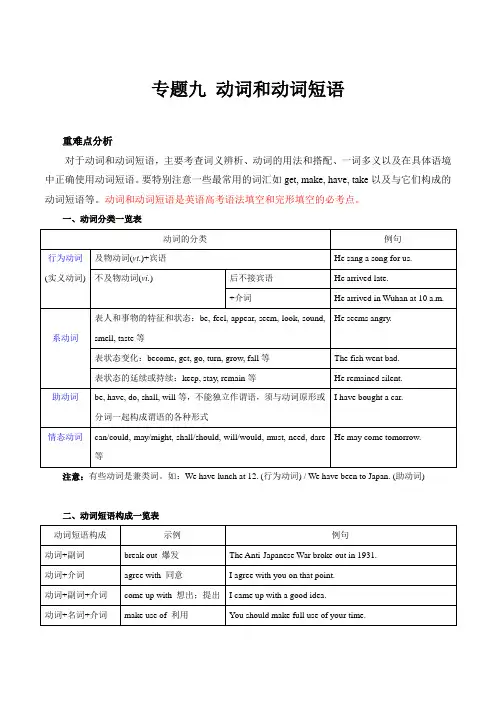
专题九动词和动词短语重难点分析对于动词和动词短语,主要考查词义辨析、动词的用法和搭配、一词多义以及在具体语境中正确使用动词短语。
要特别注意一些最常用的词汇如get, make, have, take以及与它们构成的动词短语等。
动词和动词短语是英语高考语法填空和完形填空的必考点。
一、动词分类一览表注意:有些动词是兼类词。
如:We have lunch at 12. (行为动词) / We have been to Japan. (助动词)二、动词短语构成一览表三、常用动词短语归纳常用动词come, go, keep, look, make, put, take, turn, get的相关搭配1. comecome about 发生;造成come across 偶然遇到come after 追踪;跟在……后面come along 一道走;赶快come at 向……扑过来come from 来自come on 跟随;上演;赶快;加油come out 出来;出版;结果是come to (oneself) 苏醒;总共;达到;涉及come to an agreement 达成协议come to a close/an end 终止;结束come to life 活过来come to light 泄露;被发现come to mind 想起;回忆起come to the point (讲话、写文章等)切中要害come to the/one’s rescue 营救;帮助come true 实现;变成现实come up with 想出;提出come into being/existence 出现;开始形成;成立come in 进来;上市;流行起来;(比赛中)得……名次(come in second 得第二名) 2. gogo about 此处走动go after 追赶;追捕;追求go ahead 前进;说吧;走吧;做吧(口语) go all out to do sth. 全力以赴做某事go beyond 超出;超出……的能力go by 从……经过/通过;时间流逝go back to 追溯到;回顾go down 下降;下跌go in for 参与;从事;爱好go into 进入;从事go off 离开某地;爆炸go over 复习;超过期限;审阅;仔细查看go out 熄灭;出去;过时go through 穿过;经受go too far 太过分;走得太远go with 相配(同义词match)go well with 协调;相配go wrong 出错;发生故障go around/round 绕道;四处走动;(故事、消息等)传开;萦绕3. keepkeep away 不靠近;远离keep back 向后退;保留keep in mind 记住;把……记在心里keep in order 保持整齐;使井井有条keep in touch with 保持联系keep one’s ears open 留心细听;倾听keep one’s eyes open 留心;注意keep out 不让入内;不要进来keep out of 不参与;不牵涉进去;置身事外keep quiet 保持安静keep up your courage 鼓起勇气;保持勇气keep up with 跟上keep off 不接近;保持距离;避开;回避(某话题) 4. looklook about/around 四周环顾look after 照顾look ahead 向前看;展望未来look at 看look back 回顾;回过头看look down upon 看不起look down one’s nose at 傲慢;轻视某人look forward to 期待look into 调查look like 看起来像look out (of) 当心;小心;向外看look through 浏览;看穿look up 仰视;查找(字典、电话本等) look up to sb. 尊敬look up and down上下打量(某人) look to 指望;寄望;依靠look on 袖手旁观look over 仔细检查5. makemake sense 说得通;有意义;言之有理make up 构成make up for 弥补;补偿make up one’s mind 下决心;决定make an effort to / make efforts to 努力;尽力make oneself heard 让自己被别人听到make good sense / no sense 有意义/没意义make fun of 嘲笑;取笑be made up of 由……组成/构成make tea/coffee 泡茶/泡咖啡make a living 某人make a difference 有影响;有关系make full use of 充分利用make excuses 超借口;辩解make a contribution to 为……做贡献make a complaint 提出投诉make a deep impression on sb. 给某人留下深刻印象6. putput away 放好;收起来put aside 放在一边;暂时不做;留出put back 放回原处put down 放下;拒绝;写下来put forward 提出(计划、建议等) put off 推迟;延期;脱掉(衣服等) put into use 投入使用put on 穿上;上演put out 扑灭;吹灭put up 举起;张贴put up with 忍受;忍耐put one’s heart into 全心全意投入put in prison 投入监狱put on weight 增肥put through 做完;完成;接通电话(=get through) 7. taketake away 拿走;带走take back 拿回来take A for B 把A误认为是B take part in 参加take advantage of 利用take care of 照顾take charge of 负责;管理take a chance 碰运气take hold of 抓住;掌握take notice of 留心;注意take the opportunity of 抓住机会take the place of 代替take the risk of 冒……的险take off 脱下;起飞take up 占据(时间、地方等);从事于take in 吸收;欺骗take in turn 依次take a shower 冲凉take pride in = be proud of 为……感到骄傲8. turnturn against 背叛;反对turn around 转身;转过来turn up 调大声;出现turn down 调小声;拒绝turn on 打开turn off 关掉turn…into… 把……变成……turn in 上交(=hand in)turn out to be 结果是;结局是turn over 翻动;翻过turn to 转向;求助于turn right/left 右转/左转turn away 解雇;把……打发走turn back 折回9. getget accustomed to 习惯于get across 度过;通过;说服;使理解get ahead of 胜过;超过get on/along well with 与……相处融洽get away with侥幸逃脱;避免受罚get away from 拜托get back 取回;回来;报复get down to 认真对待;静下心来get familiar with 熟悉get hold of 获得;取得get into trouble 陷入麻烦get into bad habits 染上恶习get off 下车get on 上车get out of 从……出来get over 越过;克服get ready for 为……作准备get rid of 除去;去掉;免除;摆脱get through 通过;及格;接通get together 积聚;积累get up 起床;起立get used to 习惯于考点练透一、短语翻译根据句意将下列句子划线部分的英文翻译成中文。
高中英语知识点归纳动词与动词短语
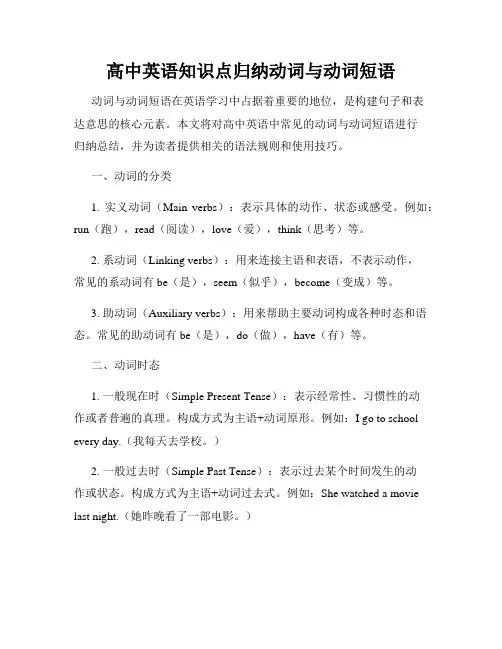
高中英语知识点归纳动词与动词短语动词与动词短语在英语学习中占据着重要的地位,是构建句子和表达意思的核心元素。
本文将对高中英语中常见的动词与动词短语进行归纳总结,并为读者提供相关的语法规则和使用技巧。
一、动词的分类1. 实义动词(Main verbs):表示具体的动作、状态或感受。
例如:run(跑),read(阅读),love(爱),think(思考)等。
2. 系动词(Linking verbs):用来连接主语和表语,不表示动作,常见的系动词有be(是),seem(似乎),become(变成)等。
3. 助动词(Auxiliary verbs):用来帮助主要动词构成各种时态和语态。
常见的助动词有be(是),do(做),have(有)等。
二、动词时态1. 一般现在时(Simple Present Tense):表示经常性、习惯性的动作或者普遍的真理。
构成方式为主语+动词原形。
例如:I go to school every day.(我每天去学校。
)2. 一般过去时(Simple Past Tense):表示过去某个时间发生的动作或状态。
构成方式为主语+动词过去式。
例如:She watched a movie last night.(她昨晚看了一部电影。
)3. 现在进行时(Present Continuous Tense):表示正在进行的动作。
构成方式为主语+be动词(am/is/are)+动词现在分词。
例如:They are playing football now.(他们正在踢足球。
)4. 过去进行时(Past Continuous Tense):表示过去某个时间正在进行的动作。
构成方式为主语+过去时的be动词(was/were)+动词现在分词。
例如:I was studying when she called me.(她给我打电话时,我正在学习。
)5. 一般将来时(Simple Future Tense):表示将来某个时间会发生的动作。
2025届高考英语语法复习-动词的分类知识讲解 讲义
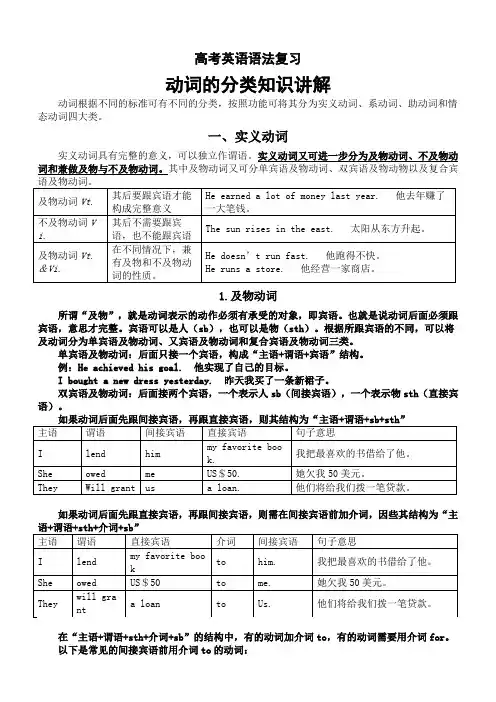
高考英语语法复习动词的分类知识讲解cry 哭泣disappear 消失go 走,趋于live 生存,居住rise 上升,增强shiver 颤抖,哆嗦sparkle 闪耀appear 出现decay 衰退exist 存在happen 发生occur 发生,出现roar 咆哮,喧闹sigh 叹息swim 游泳arise 出现,产生deteriorate 恶化fall 落下hesitate 犹豫scream 尖叫sit 坐,位于travel 旅行collapse 倒塌die 死亡flow 流动laugh 笑quiver 颤抖smile 微笑sneeze 打喷嚏lie 躺,位于,说谎age (使)成熟,变老break 打破(记录)close 关闭,结束decrease 减少,减小end 结束,终止grow 种植,生长meet 满足,对付;相遇shake 动摇,发抖spread 散布,铺开,传播stop 断绝,停止widen 加宽,变宽begin (使)开始burn 烧毁,燃烧continue (使)继续double (使)加倍finish 完成,终结improve 改善,加强open 打开,开始show 演示,说明;显示stand 忍受,抵抗;站立tear 撕毁,流泪stretch (使)伸展;使用,消耗boil (使)蒸发,沸腾change (使)改变cook 烹饪,做菜dry 弄干,变干fly 使飘扬,飞行increase 增加run 经营,运转slow 放慢,阻碍,变慢start 启动,出发turn 使旋转,转动。
高中英语语法知识点 动词和动词短语

考点07 动词和动词短语高考频度:★★★★★英语动词根据其意义和句法作用,可分为实义动词、连系动词、助动词和情态动词四大类。
实义动词又称行为动词,为表示动作或状态的动词,可以单独充当句子的谓语,实义动词有及物动词和不及物动词两类。
英语中的动词短语通常由动词加介词、副词、名词等构成,在句中起动词的作用。
高考设题时往往都是给出四个不同的动词或短语来测试考生在具体语境中对动词短语词意的辨析及其理解和运用能力。
考向一常用动词辨析1.advise,persuade,suggestadvise用作及物动词,表示"劝告,忠告,建议",强调提醒或引起注意;persuade表示"说服",强调劝说成功,主要搭配是:persuade sb.to do sth.说服某人做某事(相当于persuade sb.into doing sth.);如表示劝说但不一定成功,则使用try to persuade sb.to do sth.或advise sb.to do sth.。
suggest用作及物动词,意为"建议",后接名词、代词、动名词或从句,从句中的谓语用"should+动词原形",should可以省略。
2.bring,take,carry,fetchbring"带来,拿来,取来",强调从别处带人或物到说话人所在地。
take"拿走,带走",强调把人或物从说话者身边带走,方向与bring相反。
fetch"去拿来,去取来",强调从甲地出发到乙地取物或人后,又回到甲地,相当于go and bring。
carry"携带,搬运,运送",强调用人力或车辆把人或物从一地运到另一地。
3.win,beat,defeatwin表示"赢得,战胜"时,宾语多是比赛项目等。
win sb.则指"赢得人心"。
beat/defeat意为"打败,击败",其宾语只能是人或由人组成的机构。
如:beat sb.打败某人;defeat their team/ the country/the enemy击败了他们的队/国家/敌人。
高考高频动词及动词短语
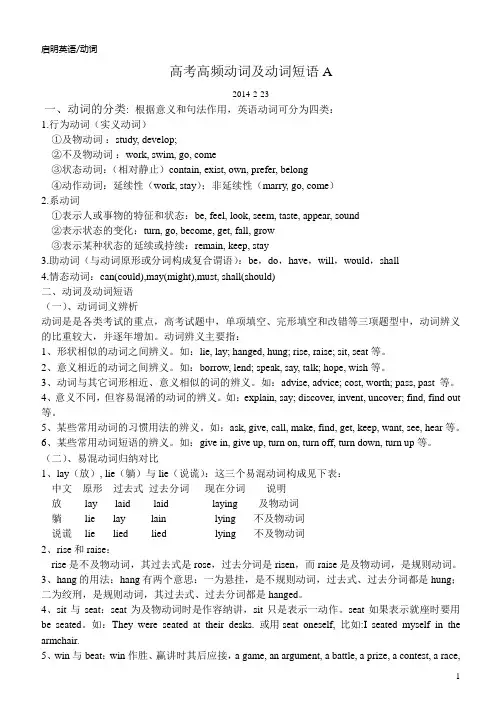
高考高频动词及动词短语A2014-2-23一、动词的分类: 根据意义和句法作用,英语动词可分为四类:1.行为动词(实义动词)①及物动词:study, develop;②不及物动词:work, swim, go, come③状态动词:(相对静止)contain, exist, own, prefer, belong④动作动词:延续性(work, stay);非延续性(marry, go, come)2.系动词①表示人或事物的特征和状态:be, feel, look, seem, taste, appear, sound②表示状态的变化:turn, go, become, get, fall, grow③表示某种状态的延续或持续:remain, keep, stay3.助动词(与动词原形或分词构成复合谓语):be,do,have,will,would,shall4.情态动词:can(could),may(might),must, shall(should)二、动词及动词短语(一)、动词词义辨析动词是是各类考试的重点,高考试题中,单项填空、完形填空和改错等三项题型中,动词辨义的比重较大,并逐年增加。
动词辨义主要指:1、形状相似的动词之间辨义。
如:lie, lay; hanged, hung; rise, raise; sit, seat等。
2、意义相近的动词之间辨义。
如:borrow, lend; speak, say, talk; hope, wish等。
3、动词与其它词形相近、意义相似的词的辨义。
如:advise, advice; cost, worth; pass, past 等。
4、意义不同,但容易混淆的动词的辨义。
如:explain, say; discover, invent, uncover; find, find out 等。
5、某些常用动词的习惯用法的辨义。
如:ask, give, call, make, find, get, keep, want, see, hear等。
高中英语关于高考高频动词及动词短语用法的总结
关于高考高频动词及动词短语用法的总结【考纲解读】1、重点动词所接成分的解读;2、重要短语的构成方法。
【知识点梳理】一、高考高频动词用法分类1. 常接不定式作宾语的动词:afford买得起;有能力做 agree同意 arrange安排ask 要求;让 beg请求 fail失败choose选择 decide决定 demand要求determine决定 expect期待 fear害怕hope希望 manage设法 offer提出plan计划 pretend假装 promise许诺refuse拒绝 want想要 wish希望He can't afford to buy a new computer.他买不起一台新电脑。
They managed to avoid an accident.他们设法避免了一起事故。
2. 常接动名词作宾语的动词:admit承认 advise建议 allow允许appreciate感激 avoid避免 consider考虑delay推迟 deny否认 enjoy喜爱escape逃避 finish完成 forbid禁止imagine想象 keep继续 mind介意miss错过 permit允许 practise练习risk冒险 stand忍受 suggest建议The twin brothers always enjoy going to the concert.这一对双胞胎弟兄对听音乐会总是兴致勃勃的。
You should practise speaking English as much as possible.你应该尽可能多地讲英语。
3. 常接不定式作宾补的动词:advise建议 allow允许 beg请求 cause导致encourage鼓励 expect期望 force强迫 get使;要intend打算 invite邀请 oblige迫使 order命令persuade说服 prefer宁愿 remind提醒 teach教want想要 warn警告The doctor advised me to take more exercise.医生建议我多锻炼。
高考英语动词及动词短语考点详解
高考英语动词及动词短语考点详解一、【专项直击】【考情分析】动词是英语词汇中的核心,而动词及其构成的短语一直是高考中的热点和难点,特别是在完型填空题型及语法单项选择题中,有关动词及动词词组辨析的题就相当高频。
它的用法最灵活,其种类比较多,形式复杂。
每年高考中对动词短语和动词的考查都会30- 40% 的出现率,难度也比较大。
预测今后高考中特别要注意动词及其和介词、副词的搭配,以及构成的固定短语,要注意这些短语的意思,同时要在具体的语境中灵活地加以使用。
【知识要点】动词和动词短语是英语中最灵活、最难掌握的词之一,在历年高考题中所占比例也最大,设题时往往都是给出四个不同的动词或短语来测试考生在具体语境中对动词短语意义的理解和运用能力。
主要出现在单项选择及完形填空中。
要求考生构建以下比较完整的知识网络。
I.动词的分类根据意义和句法作用,英语动词可分为四类:1.行为动词(实义动词)①及物动词:带宾语的动词②不及物动词:不带宾语的动词注意:英语里及物动词和不及物动词不是截然分开的,有的动词既可以是及物动词也可以是不及物动词。
It is important for you to learn how to learn.第一个learn是及物动词,后面有宾语how to learn;第二个learn是不及物动词。
不及物动词向及物动词转化需要借助于介词、副词等构成短语动词。
He is working hard at English .③状态动词(相对静止):contain, exist, own, prefer, belong④动作动词:延续性(work, stay);非延续性(marry, go, come)2.系动词①表示人或事物的特征和状态:be, feel, look, seem, taste, appear, sound②表示状态的变化:turn, go, become, get, fall, grow③表示某种状态的延续或持续:remain, keep, stay注意:绝大多数连系动词又是实义动词,在解题时要正确区分,否则就会出错。
高考语法专题4动词和动词短语
专题四动词和动词短语一、动词英语动词根据其意义和句法作用,可分为实义动词、连系动词、助动词和情态动词四大类。
实义动词又称行为动词,为表示动作或状态的动词,可以单独充当句子的谓语。
实义动词有及物动词和不及物动词两类。
In some parts of London, missing a bus means waiting for another hour.Brian told you that there wasn't anyone in the room at that time, didn't he?In order to make our city green, we must plant more trees.二、动词短语英语中的动词短语通常由动词加介词、副词、名词等构成,在句中起动词的作用。
Mr Reed made up his mind to devote all he had to setting up some schools for poor children.In order to catch up with the advanced countries, we must keep learning.动词在句中作谓语或谓语的一部分时,其形式要随主语的人称和数的变化而变化。
高考对动词和动词词组的考查主要在以下几个方面。
1.对不及物动词的考查不及物动词本身意思完整,不需要跟宾语,也没有被动语态。
You are supposed to arrive on time.We went to Canada to travel and my cousin acted as our guide.2.对及物动词的考查及物动词本身意思不完整,后面需要接宾语。
In our childhood, we were often reminded by parents to pay parents to study hard.—Julia said she sent you a birthday card yesterday. Have you got it?—Oh, really! I haven't checked my mailbox yet.3.对连系动词的考查连系动词虽有一定的词义,但不完全,不能独立充当谓语,必须和作表语的词(名词、形容词等)连用。
高考英语高频动词短语及句型归纳汇总
调 制 和 不 连 续 SVPWM 调 制 2 种 ,其 中 不 连 续 SVPWM 调制可以保持各相开关管在半个周波中 有 60°不动作,开关频率较连续调制而言可降低 1/3 左右,另外,对不连续 SVPWM 调制策略进行 优化组合,还可有效提高输出波形质量[3-5]。
对于二极管嵌位式(NPC)三电平逆变器,存 在直流侧中点电位波动的问题,中点电位波动会 导致逆变器输出波形畸变、开关管电压应力不一 致、开关管寿命缩短等问题[6-13]。连续型 SVPWM 调制可以通过动态调整冗余小矢量的作用时间 实现中点电位动态平衡,而不连续 SVPWM 调制
关键词:不连续调制;中点电位平衡;电荷平衡;三电平逆变器;二级式 中图分类号:TM464 文献标识码:A DOI:10.19457/j.1001-2095.dqcd19381
Coordination Control of Three-level Boost-inverter Considering Neutral-point Potential Balance ZENG Jiang,HUANG Zhonglong,QIU Guobin
作者简介:曾江(1954-),男,博士,副教授,Email:Zengxy@ 通讯作者:黄仲龙(1993-),男,硕士,Email:1007337215@
38
Copyright©博看网 . All Rights Reserved.
曾江,等:考虑中点电位平衡的三电平 Boost-逆变器协调控制
(School of Electric Power,South China University of Technology,Guangzhou 510640,Guangdong,China)
Abstract: In order to reduce the switching loss of the inverter and control the neutral-point potential balance,a novel discontinuous space vector modulation was proposed for the typical two stage TL- Boost converter and threelevel inverter. Based on charge balance principle,the charge compensation of the TL-Boost converter was quantitatively calculated,and the adjustment of duty ratio was deduced,the total amount of charge flowing through the neutral-point was controlled to be zero. Through the coordinated control strategy of two stage,not only the advantage of the lowswitching loss of the discontinuous modulation could be play,but also the neutral- point potential fluctuations was suppressed,and modulation complexity of inverter was reduced. Finally,the effectiveness of the control strategy was