
牛津译林版七年级英语上册Unit1知识点梳理及练习
牛津译林版七年级英语上册Unit 1 知识点梳理(上)复习导入知识点梳理一.词汇&短语:WORDS&PHRASES1. What’s your name? 你叫什么名字?My name is Hobo. 我的名字叫霍波。
What’s your name ?是询问对方名字的一句问话。
其回答句是___My name is__________,也可以用如:或者说“And what’s your name?”_____I’m________。
如想反问对方时可说:“And you”_____________________________你叫什么名字?What’s your name_____________________________我叫米莉My name is Millie【拓展】询问对方名字还可以说:你能告诉我你的名字吗?_____________________________Could you tell me your name?我可以知道你的名字吗?_____________________________May I have your name?2. ——Are you my master?你是我的主人吗?——Yes, I am. 是的,我是。
__Are you______这是一个一般疑问句,要用yes或no来回答。
肯定回答是___Yes,I am_____________,I am不能缩写。
否定回答是____No, I’m not____________。
这一句句型可以用来询问姓名,职业或者其他情况。
如:——____Are you____Sandy?你是桑迪吗?是的,我是。
/不,我不是。
——___Yes, I am _____ /_No, I’m not_______——___Are you_____a teacher? 你是老师吗?——Yes, I am. 是的,我是She is good at playing the piano.(改为一般疑问句)_____Is she good at playing the piano___________________3. Good morning.早上好Good morning意为“早上好”,是人们上午见面时经常说的一句问候语。
当对方向你说“Good morning”时,你也应该问对方说_____Good morning ___________同样,下午或者晚上问候语用_____Good afternoon___________ 或_____Good evening_________。
对方也用同样的内容回答。
如:——____Good afternoon____________。
下午好——____Good evening____________。
晚上好4. Hello. 你好Hello意为“你好,喂”,表示问候或唤起。
它用于较熟悉的同学获朋友之间,语气较随便。
其后可接称呼语,有时也可以用hi来代替。
如:——______Hello/Hi__________,Amy!你好,埃米——_____ Hello/Hi ___________,Kitty!你好,基蒂5. Nice to meet you.认识你很高兴这是两个人初次见面相识后的短语,意思是“认识你很高兴”。
其回答:“______Nice to meet或者是____Me too______意思是:我也是。
初次见面还可以说:____Glad to see you ,too___________________”you____________而Nice to meet you是互相认识的两人见面用语。
如:——____ Glad to see you ____________,Daniel.很高兴见到你,丹尼尔。
——_____ Glad to see you ___________,Eddie.见到你也很高兴,埃迪。
6.Welcome to Class 1,Grade 7!欢迎来到七年级一班1.Welcome作感叹词时,意思是__欢迎__________,主要是用来对已经到达的客人表示欢迎,后接介词to,再接指代地点的名词;或者直接加副词__back______ 或__home______。
如:____Welcome________ to our home!欢迎来到我们家!____ Welcome ________home/back!欢迎回家/来!【拓展】1、welcome 作动词,意思是“欢迎”,其常用句型结构为:welcome+sb.+to+地点,意为“欢迎某人到某地来”。
____ Welcome ________ you to my house.欢迎你到我的新家来。
2、welcome 作形容词时,意思是“受欢迎的”,可作表格或定语。
如:____ Welcome ________news 好消息3、welcome 可作名词,意为“欢迎”。
The old man gives us a warm ____ welcome ________这位老人给予我们热烈的欢迎。
4、You are __ welcome __________!别客气(回答对方道谢时用语)2、Class1和Grade7都是专有名词,第一个字母都要大写。
并按英语习惯名词在前、数词在后。
英语中习惯由小到大的说法,先说班级,再说年级。
班级和年级中间还要有逗号,这点与汉语不同。
如:I’m in ___Class Three____, _Grade eight___________=I’m in Class3,Grade 8我12岁了7. I’m 12 years old.来表示“某人多大年龄了。
”years old可以省略。
如:…years old意为“……岁(年龄)”,常用“…be+数词+years old”Sandy is 12 ____years old________=Sandy is 12.桑迪12岁了。
【拓展】英语中常用“How old…?”来询问年龄,意思是“多大年龄或几岁了”,回答是:…be (am,is,are)+数词+years old。
如:——____How old___________ is Millie?米莉几岁了?——She is 12___years old_______. 她12岁了8. I love reading.我喜欢阅读1、love 是动词,意为“爱,热爱,喜欢”。
其后通常可跟名词、代词,接动词时要用动词-ing或带to的动词不定式形式,love doing sth.表示一种习惯,一种爱好,love to do sth.表示想做某事,是一个一次性的动作。
如I _ _love_____my mother.我爱我妈妈Eddie __ _loves playing_____________ football.埃迪喜欢踢足球。
I __ _love to swim_____ ___this afternoon.下午我想去游泳。
【拓展】love 还可以作名词,意为“热爱;挚爱”。
__lovely__________形容词,意为“美丽的;动人的”,____lover______ 名词,意为“爱好者;情人”。
2、reading意为“读书,阅读”,常构成短语____do some reading____________读书,阅读。
Reading是由动词read加ing构成的名词,也叫_____动名词_______,可作主语、宾语等。
类似的还有:___dancing________跳舞;___swimming_________游泳My brother often __does some reading__________。
我弟弟经常读书。
9. I often play football after school. 我经常放学后踢足球。
1.play football踢足球,play意为___参加_________,后接表示“球类”的名词时不用冠词。
如:Play __ __basketball________/___volleyball_________/___baseball_________打篮球/排球/棒球play__ __table tennis________/___tennis_________打乒乓球/网球;play ___football/soccar_________踢足球【拓展】play的不同搭配1.play+棋类表示“下/打……”,棋类名词前不用冠词。
如:___play chess_________下棋2.“play+the+乐器”表示“弹/拉……”,乐器名词前要用定冠词the。
如:__play the piano__________弹钢琴;___play the violin_________拉小提琴;10.This is Sandy.这是桑迪这一句是第三者为互相不认识的双方作介绍时的用语。
第三者为双方介绍时,应该遵循英美人的习“This is……”在这个句型中,惯;通常先把年幼、位低者介绍某人时,习惯用“___This is_________”,而不用”She/He is ……”this指人不指物。
如:Mum,this is my teacher.妈妈,这是我的老师。
、。
11. He is from Nanjing.(他来自南京)be from 意为“由什么地方来,是什么地方人”,有祖籍在哪里的意思。
如:I ___am from________ China. 我是中国人。
Lily _____is from_______ Shanghai. 莉莉来自上海。
【拓展】come from“从什么地方来”,只能简单说在哪里的意思。
如:I __come from__________ China. 我来自中国。
be from 和come from 可以互换,如:。
牛津译林版七年级英语上册Unit1归纳知识点汇总
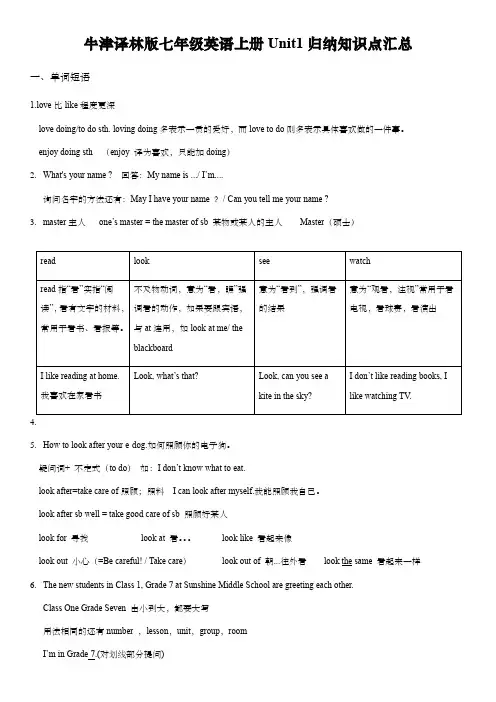
牛津译林版七年级英语上册Unit1归纳知识点汇总一、单词短语1.love比like程度更深love doing/to do sth. loving doing多表示一贯的爱好,而love to do则多表示具体喜欢做的一件事。
enjoy doing sth (enjoy 译为喜欢,只能加doing)2.What's your name ? 回答:My name is .../ I’m....询问名字的方法还有:May I have your name ?/ Can you tell me your name ?3.master主人one’s master = the master of sb 某物或某人的主人Master(硕士)4.5.How to look after your e-dog.如何照顾你的电子狗。
疑问词+ 不定式(to do)如:I don’t know what to eat.look after=take care of照顾;照料I can look after myself.我能照顾我自己。
look after sb well = take good care of sb 照顾好某人look for 寻找look at 看。
look like 看起来像look out 小心(=Be careful! / Take care)look out of 朝...往外看look the same 看起来一样6.The new students in Class 1, Grade 7 at Sunshine Middle School are greeting each other.Class One Grade Seven 由小到大,都要大写用法相同的还有number ,lesson,unit,group,roomI’m in Grade 7.(对划线部分提问)What/ Which grade are you in?Our school has six grades.我们学校有6个年级。
Unit+1+知识要点梳理总结 牛津译林版七年级英语上册
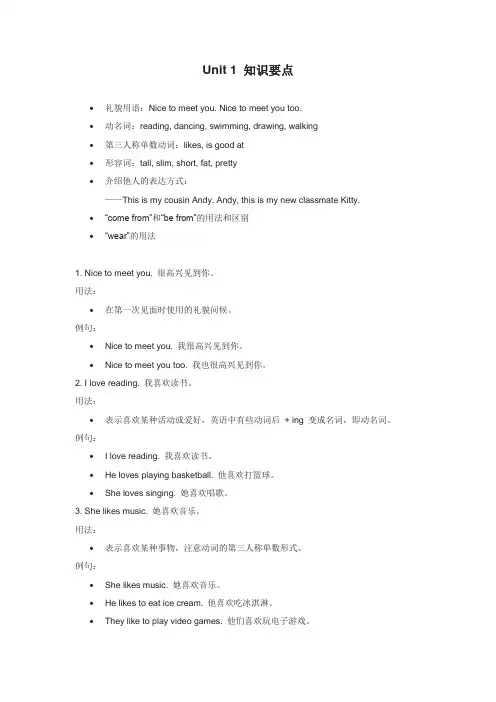
Unit 1 知识要点•礼貌用语:Nice to meet you. Nice to meet you too.•动名词:reading, dancing, swimming, drawing, walking•第三人称单数动词:likes, is good at•形容词:tall, slim, short, fat, pretty•介绍他人的表达方式:——This is my cousin Andy. Andy, this is my new classmate Kitty.•“come from”和“be from”的用法和区别•“wear”的用法1. Nice to meet you. 很高兴见到你。
用法:•在第一次见面时使用的礼貌问候。
例句:•Nice to meet you. 我很高兴见到你。
•Nice to meet you too. 我也很高兴见到你。
2. I love reading. 我喜欢读书。
用法:•表示喜欢某种活动或爱好,英语中有些动词后+ ing 变成名词,即动名词。
例句:•I love reading. 我喜欢读书。
•He loves playing basketball. 他喜欢打篮球。
•She loves singing. 她喜欢唱歌。
3. She likes music. 她喜欢音乐。
用法:•表示喜欢某种事物,注意动词的第三人称单数形式。
例句:•She likes music. 她喜欢音乐。
•He likes to eat ice cream. 他喜欢吃冰淇淋。
•They like to play video games. 他们喜欢玩电子游戏。
4. He is good at Maths. 他数学很好。
用法:•表示擅长某方面。
例句:•He is good at Maths. 他数学很好。
•She is good at dancing. 她跳舞很厉害。
•They are good at playing football. 他们踢足球很厉害。
Unit1知识点梳理2023-2024学年牛津译林版英语七年级上册
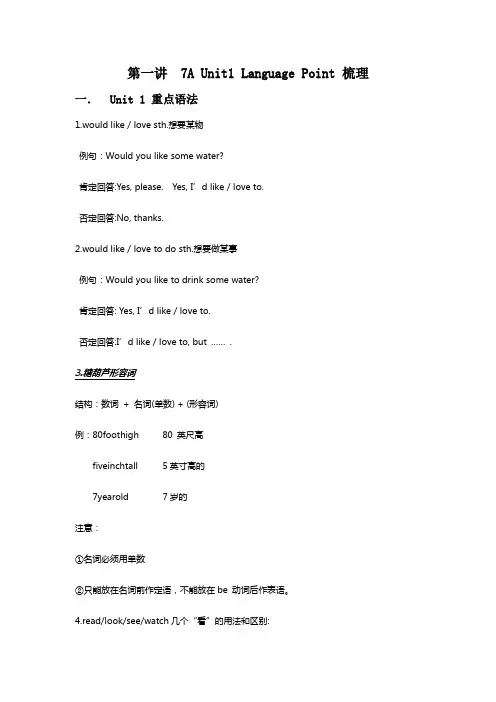
第一讲 7A Unit1 Language Point 梳理一.Unit 1 重点语法1.would like / love sth.想要某物例句:Would you like some water?肯定回答:Yes, please. Yes, I’d like / love to.否定回答:No, thanks.2.would like / love to do sth.想要做某事例句:Would you like to drink some water?肯定回答: Yes, I’d like / love to.否定回答:I’d like / love to, but …… .3.糖葫芦形容词结构:数词+ 名词(单数) + (形容词)例:80foothigh 80 英尺高fiveinchtall 5英寸高的7yearold 7岁的注意:①名词必须用单数②只能放在名词前作定语,不能放在be 动词后作表语。
4.read/look/see/watch几个“看”的用法和区别:look 强调看的动作①系动词。
译作看起来,后接形容词。
She looks happy.②不及物动词。
译作看,词组:look at…,用副词修饰。
Tom looked at me angrily.see 及物动词,译作看到,无进行时态,强调看的结果。
watch 及物动词,译作观看,注视。
强调观看正在进行中的,发生变化的活动过程,常用于看电视、看球赛、看演出等。
read 及物动词,译作阅读。
强调看文字内容的东西,常用于看书、看报纸、看杂志等。
5.疑问代词what、which、who 及疑问副词how、when 、where可以和动词不定式连用。
what to do 做什么which to do 做哪个who to do 如何做how to do 谁做when to do 什么时候做where to do 在哪里做6.“疑问词+ to do” 结构经常放在know,learn,see ,ask等动词后做宾语。
值得推荐牛津译林版7年级上册Unit1知识点整合 词汇句型语法练习
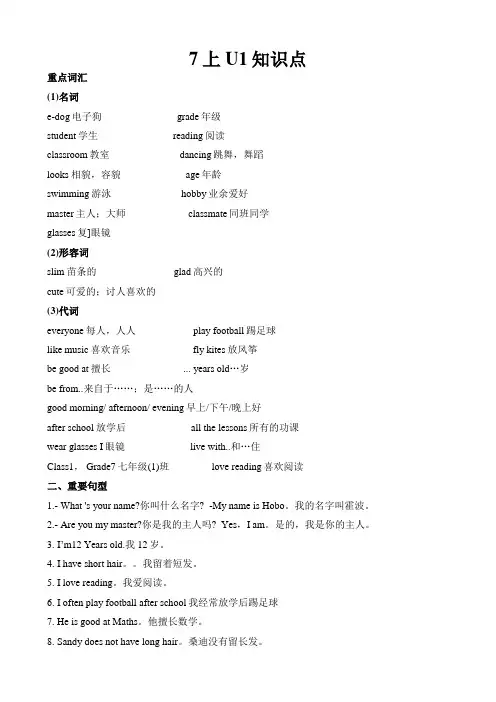
7上U1知识点重点词汇(1)名词e-dog电子狗 grade年级student学生 reading阅读classroom教室 dancing跳舞,舞蹈looks相貌,容貌 age年龄swimming游泳 hobby业余爱好master主人;大师 classmate同班同学glasses复]眼镜(2)形容词slim苗条的 glad高兴的cute可爱的;讨人喜欢的(3)代词everyone每人,人人 play football踢足球like music喜欢音乐 fly kites放风筝be good at擅长 ... years old…岁be from..来自于……;是……的人good morning/ afternoon/ evening早上/下午/晚上好after school放学后 all the lessons所有的功课wear glasses I眼镜 live with..和…住Class1, Grade7七年级(1)班 love reading喜欢阅读二、重要句型1.- What 's your name?你叫什么名字? -My name is Hobo。
我的名字叫霍波。
2.- Are you my master?你是我的主人吗? Yes,I am。
是的,我是你的主人。
3. I’m12 Years old.我12岁。
4. I have short hair。
我留着短发。
5. I love reading。
我爱阅读。
6. I often play football after school我经常放学后踢足球7. He is good at Maths。
他擅长数学。
8. Sandy does not have long hair。
桑迪没有留长发。
9. Sandy is tall and slim。
桑迪又高又苗条。
10.Are you happy?你/你们高兴吗? Yes. I am/we are是的,我/我们高兴。
Unit1Thisisme!(知识梳理)-七年级英语上册精品课堂(牛津译林版)

Unit 1 This is me!一、重点词组二、重点语言点1. Like(1) like ——would like to do想要做某事enjoy 只能加doing(2) like v.——dislike like prep. ——unlike like n.—— dislikee. g. Soccer is one of my likes.对比:Football is one of my favourites.(3) be like= look like长相三问What is he like?(性格人品优先)What does he look like?How does he look?*(4) 问态度How do you like..? = What do you think of…?(7B)e.g. ---How do you like the film?---It’s wonderful.e.g. ---How much do you like the film?--- Very much.e.g. --- How would you like your coffee?--- Black/ The stronger the better.2. look(1) 感官系动词+ adj.(2) 实义动词e.g. Look! He ___looks____(look) happy. 系动词无进行e.g. He looks _unhappy_____ (happy) because he lost his wallet. 翻译到最后一个单词e.g. He looks __happily____(happy) at 47. look at 实义动词(3) look词组look at 看look after (well)= take (good) care of 照顾(好)look up 向上看;查阅look up a word in the dictionary在字典当中查单词look down 向下看;鄙视look for 寻找*find;find outlook forward to doing 期待look through 浏览(newspaper)look over*look out 当心= take care= watch out= be careful---look out for; look out at; look out of(7B)e.g. look out for the stepse.g. look out at the treee.g. look out of the window3. be good at擅长(1)be good at= do well in +doing介词后+doing否定疑问do不可省*反义be bad at= be poor at= be weak in(2) 对···友好be good to= be nice/ friendly/ kind to*(3)对···有益be good for= be beneficial to反义be bad for= be harmful to= do harm to(9A)4. 穿(1) 3动词:wear 穿着put on 穿上*dress sb/oneself给···穿衣服*盛装打扮dress up (in); dress up as+人/身份(7AU5)eg: dress up in white as a ghost*wear= be dressed in= be in(2) 3介词:in+衣服/颜色in a red dress=in redwith+ 饰品/头发*on + sbe.g. The girl is beautiful in a red dress.The red dress looks beautiful on you.谓语动词唯一原则(3)提问The boy in black is my brother.Which boy…?The boy in black is my brother.Who is…?5. 就近就远原则(1)there be将来时e.g. There __is going to be___ (be) a concert this afternoon, isn't there? *(2)就远原则(with; along with; together with; as well as)(3)就近原则(there be; *not only..but also…)6. 冠词(1) 字母前a/an规则:Mr. Li has an e-fox.(2)u的发音辨析_an__ umbrella_a__ European country__a_ university_an__ ugly dog__a_ usual reason__/_ unusual news其他常考:hour;honeste.g. 任务型原文:Recently scientists have discovered a strange plant named fedtschenkoi (玉吊钟) may help.表格:It is an __________ plant named fedtscchenkoi.a strange plant= an unusual plant(3) play西洋乐器前有the非西洋乐器前无the玩玻璃球play with a glassball7. 一般现在时注意易错点:(1)特殊疑问词作主语,谓语动词用三单(2)不定代词作主语,谓语动词用三单(3)并列句e.g. Tom is good at math and play s basketball well.(4)one of +N 复数+ V单数其他:1. 来自2. 七年一班(1) 如果一个名词加上数字,首字母都要大写。
牛津译林版七年级上册英语Unit1知识点总结
牛津译林版七年级上册英语Unit1知识点总结Unit 1 This is me!1.How to look after your e-dogIf you want to take care of your electronic dog。
you need to know how to do it。
"How to" is a n word followed by an infinitive verb。
"Look after" means to take care of something or XXX.2.Good evening.Good evening" XXX。
It is different from "good night," which is used when XXX.3.XXXIf you enjoy playing football after school。
you can say that you love it。
"Love/like doing something" XXX。
while "love/like to do something" emphasizes a one-time n.For example。
"She loves watching TV。
but today she loves to listen to music." "Love" can be used as a verb to mean "like" or "enjoy," as in "He loves his parents" or "She loves music." It can also be used as a noun to mean "n" or "beloved," as in "a mother's love for her children" or "fall in love with XXX."nally。
牛津译林版七年级英语上册Unit 1语法讲解及练习
牛津译林版七年级英语上册Unit 1语法讲解及练习一.重点语法:一般现在时1. 定义:表示现在经常发生的事情2. 时间状语:often, usually, always, sometimes, never, every (Sunday, morning, week...), on Sundays3. 基本用法:◆表示现在的事实、状态或动作,或者主语现在存在的状态Millie lives in Beijing. 米莉住在北京I live in Nanjing. 我住在南京◆表示习惯性动作,常与sometimes, often, every day, always, usually等时间状语连用Simon often plays football after school. 西蒙经常放学后踢足球The students usually play football after school. 学生们通常放学后踢足球◆表示不变的真理、格言或事实,不能和特定时间连用Cats eat fish. 猫吃鱼The earth goes round the sun. 地球绕着太阳转◆表示主语的性格、特征,或者心理状态、情感Millie is a pretty girl. 米莉是一个漂亮的女孩He wants to go with me. 他想要和我一起去I want to have a party. 我想要举办一场聚会◆用于以here/there 开头的句子。
Here comes Miss Green. 格林老师来了There goes the bus. 公共汽车走了4. 基本结构●主语+ be动词(am, is, are)注意:be动词后面不能再有行为动词be动词(am, is, are)的使用:1. We use ‘am’ when the subject is _I____ .2. We use ‘are’ when the subject is _we ___, _ you __ or ___they __ .3. We use ‘is’ w hen the subject is __he __, __she or __ it ___ . be动词的使用口诀:我用am,你用are, is连着他、她、它,单数形式用is, 复数形式要用are●主语+ 行为动词行为动词的第三人称单数形式的变化规律:1、直接在词尾加s如:look-looks play-plays2、以辅音字母加y结尾, 去y为i加es如:fly-flies study-studiestry-tries carry-carries3、以sh、ch、s、x、o结尾加es如:guess-guesses wash—washescatch-catches mix-mixesgo-goes do-does★ have的第三人称单数形式是has二.语音知识:(见教材)三.随堂练习-----语法专练用相应的be动词填空1. I an English teacher.2. Sandy from China.3. He polite.4. We in Class 3, Grade 7.5. Mrs Fang and Mr Liu doctors.6. The girls in the classroom.7. Our football team the best in the city.8. Mr. Li our Maths teacher.9. Simon a member of the Reading Club?10. Simon and Millie friends?选择填空:( )1. —What ______ your uncle? —He’s a policeman.A. isB. areC. doD. does( )2. The girl doesn’t like the skirt ______ red flowers.A. haveB. hasC. withD. and( )3. It is going to rain. He must ______now .A. runs to homeB. run to homeC. runs homeD. run home ( ) 4.Do you often go in summer ?A.swimB.swimsC.swimingD.swimming ( ) 5.I usually go in the morning.A.runB.runsC.runingD.running ( ) 6.Simon with his friends football on Tuesday afternoon.A.playB.playsC.play theD.plays the ( )7.Sam his homework at school.A.do esn’tB.doesn’t doC.don’t doD.doesn’t does ( )8.After he breakfast, he always his dog for a walk.A.have / takesB.has / takeC.haves / takesD.has / takes 用所给动词的适当形式填空1.Daniel (wear) a pair of glasses.2.There are six (fish) in the bag.3.Alice (study) English at school.4.I always go (run) in the morning.5.She (go) to work by bike every day.6.Sometimes Sandy (fly) a kite at weekends.7.My father often (watch) TV in the evening.8.His mother usually (wash) the clothes on Sundays.9.We often have dinner at my (grandparents) home.10.He enjoys .He often goes in the (swim) pool.11. __________your aunts good at __________ (make) cakes?12. He __________ (not like) __________ (drink) milk.13. How __________ (be) your grandfather?14. My little cat really __________ (want) __________ (eat) fish.15. He __________ (not know) where __________ (sit).16. Each of us can __________ (sing) an English song.17. Who __________ (bring) the dog here?18. There are lots of things for ________ (he) ________ (do) now.19. Our teacher always __________ (say) every student can ________ (be) very good.20. ________(not late) for school next time.句型转换:1.I do my homework in the evening. (改为否定句)I my homework in the evening.2.He does his homework at home.(改为一般疑问句,并作肯定回答)he his homework at home ? , he .3.They play football after school .(对画线部分提问)they football ?4.She goes to school by bus .(对画线部分提问)she to school ?。
牛津译林版七年级上册英语Unit1知识点汇总
牛津译林版七年级上册英语Unit1知识点汇总7A Unit 1 This is me!一.【精选短语】1. how to look after your e-dog如何照顾你的电子狗(1)疑问词+动词不定式(2)look after=take care of 照顾,照料2. Good evening.晚上好。
(晚上见面问候语)→比较:Good night.晚安。
(晚上分别时用语)3. love playing football after school喜爱放学后踢足球【知识链接】Love/like doing sth.喜欢做某事,强调习惯上的喜欢;Love/like to do sth.强调的是某一次的行为。
e.g. She loves watching TV, but today she loves to listen to music. Love的用法⑴vt.喜爱e.g. ①He loves his parents. (不能用like代替love)②She loves music.她爱好音乐。
⑵vt.热爱e.g. We love our motherland.我们热爱祖国。
⑶n.爱;挚爱a mother’s love for her children母亲对孩子的爱②fall in love with sb爱上…,e.g. He fell in love with her.③我们可在书信的结尾处看到例如Love Mary这样的署名,意思是With my love, Mary,一方面表示情感,一方面表示道别。
【用法拓展】lovely美丽的;可爱的e.g. lovely hair秀发,a lovely girl美丽的少女4. be good at sth/doing sth=do well in sth/doing sth擅长;在某方面表现好【知识链接】⑴He is good at telling funny jokes.⑵She always does well in English.5. wear glasses戴眼镜→ wear后接服装、装饰品等,表示“穿、戴”。
牛津译林版七年级英语上册全册知识点汇总(Unit1-8)
牛津译林版七年级英语上册全册知识点汇总(Unit1-8)Unit 1 This is me!知识点归纳汇总Words & Phrases:(结合音标记忆)master/'mɑːstə/、bicycle/'baɪsɪkl/、Excuse/ɪkˈskju:s; ɪkˈskju:z/、hobby/'hɒbɪ/、welcome/ˈwelkəm/、swimming/'swɪmɪŋ/、music/'mjuːzɪk/、polite/pə'laɪt/、chinese/tʃaɪˈniːz/、badminton /'bædmɪnt(ə)n/、cousin/'kʌz(ə)n/enjoy doing、work hard、be good at doing、like to do/doing、look up/after/like/out、help sb do sth、want to do sth、come from、be from、love doing、take sb for a walk、be born in sp、fly a kite with sb、walk to sp = go to sp on foot.Common phonetic:(常见音标)other/'ʌðə/ boat/bəʊt/ phone/fəʊn/ old/əʊld/bread/bred/ great/greɪt/ heavy/'hevɪ/ head/hed/that /ðæt; ðət/ thing /θɪŋ/ these/ðiːz/ those/ðəʊz/dog/dɒg/ shop/ʃɒp/ short /ʃɔːt/ long /lɒŋ/Sentences:1、What is your father ? 提问职业。
牛津译林版七年级英语上册Unit-1单元知识点归纳
牛津译林版七年级英语上册Unit 1 This is me一.Comic strip- Reading(一)重点短语、交际用语1.read this book 读这本书2. look after 照顾,照看3. play football 踢足球4. after school 放学后5. be from 来自......6. be good at 擅长7. good morning 早上好,上午好8. good afternoon 下午好9. good evening 晚上好10. What's your name? 你叫什么名字?11. Nice to meet you. 见到你很高兴。
12. Nice to meet you too. 见到你也很高兴。
(二) 语言知识梳理1. Oh, I love e-dogs. 哦,我喜爱电子狗。
【知识点1】love 的用法句中的love 是实义动词,表示“喜爱,热爱,喜欢”,love 有强烈的感情色彩,相当于like...very much, 其后可以直接接名词、代词、动名词或动词不定式做宾语。
例如:We should love the students. (接名词)我们应该关爱学生。
Do you love me, mom? (接代词)妈妈,你爱我吗?My friend Bill loves to listen to music. (接不定式)= My friend Bill loves listening to music. (接动名词)我的朋友比尔喜爱听音乐。
【知识拓展】love 做名词的用法love 本身也可做名词,表示“爱”。
例如:My mother's love for me is very deep. 妈妈对我的爱是很深的。
【知识点2】e-dog 的含义e-dog 做名词,是由electronic, dog 两个单词合并而成的,electronic 可译为“电子的”。