
译林版牛津英语七年级上册期末复习知识点修订稿
译林版牛津英语七年级上册期末复习知识点 Document number【SA80SAB-SAA9SYT-SAATC-SA6UT-SA18】译林版牛津英语七年级上册期末复习知识点整理Units1--4重点知识点总结n.名词 v.动词 vt.及物动词 vi.不及物动词 adj.形容词adv.副词 prep.介词 pron.代词 conj.连词1、喜欢like / love / enjoy / be interested in / be crazy about (痴迷于)/ havefun / have a good time +doing sth. 动词+doing 的还有Go doing sth. / finish doing sth./Be good at doing sth./ do well indoing sth. How/what about doing sth./practise doing sth.2、“四大看”read vt.看读物(read books/newspaper/magazines/a map等) look vi. 瞧常用短语look at/ for/around/after/out/over/up see vt.看见,强调结果 I cansee you.watch vt.带有欣赏性的观看watch TV/ a film / a football game3、“五大穿着”Put on 强调“穿上”的动作eg. He ____a coat and goes for a walk.Wear 强调“穿着”的状态;进行时态表示暂时的情况eg. She is wearing a new skirt now. / wear glasses Dress (1) dress sb. (2) dress oneself (3) dress up as (4) get dressed In (穿戴)后接颜色(或衣服),表示状态look!Lucy is_____a red skirt and a pair of pink shoes. On 后接人指衣服穿在某人身上看出区别来。
The red coat looks nice on you.4、“四大花费”Spend:sb.(人) + spend + 时间/金钱 + on sth.sb.(人) + spend + 时间/金钱+(in) doing sth. pay:sb.(人)+pay + 金钱+for sth. cost:sth.(物) + cost + sb.+金钱 Doing + sb.+时间take:it takes sb. +时间+ to do sth.5、“三大地点副词”Home / there /here 前不加任何的介词 welcome home / come here / go there 6、“三大使役动词”Make sb. do sth./ have sb. do sth. / let sth.7、见面打招呼用语(1)Nice to meet you . (2) Glad to meet you . (3) How are you (4) How are you doing (5)How is it going (6)How is everything going (7) What’s up8、基数词+year(s)+old 表示“…岁”提问用“how old”名词性短语数词-year-old 也表示年龄,但其为形容词性短语“前有冠词后有名(词)” Eg. Helen is 11 years old = Helen is an 11-year-old girl.9、Let’s 与let us 的区别Let’s do sth. 指包括听者(对方)和说者(我们)都在内,表示建议Let us do sth.指“让(允许)我们做某事”而听者(对方)不做,只有“我们”做10、play+the+乐器类名词. Play the pianoPlay + 球类运动 play+ football / play cards / play chess11、She comes from Shanghai= She is from Shanghai . 注:如何提问Shanghai 及如何改一般疑问句12、be good at =do well in = be clever at = study sth. wellBe good at (反) be bad at do well in (反) be poor in13、介词over的用法(1)”在…正上方” There is a bridge over the river. (2)”越过” A plane flies over the house(3)”超过” There are over 20 boys in this class. (4)”结束” Class is over! / Game is over.14、every one 与everyone 辨析区别(1)Every one 可以与of 连用,而everyone 却不能与of连用 one of the children likes playing the computer games. (2) everyone 只指人=everybody而every one 既指人又可指物共同点:谓语动词都要用“三单”15、family 的用法:“家庭”作为整体谓语动词用“单数”He has a big family. “家人”强调成员,是复数含义,谓语动词用“原形” My family are at home.拓展:集体名词有people、class、police、sheep、deer、furniture等16、all/ both/ each/every/neither/ either 的用法all (1)三者或三者以上“全部、都”(2)all + the + 名词(all the afternoon = the whole afternoon)(3)all 放在行为动词前,名词前;be 动词后 (4) all of +宾格/名词复数Both(1)两者都(2)后可跟of +宾格/名词复数Both sides of the street are grown trees. Each 指两个或两个以上“每一个”个体Each side of the street is grown trees.Every指许多人或事物的“全体”后接名词单数 Every student is here . 所有人都在。
Neither指两者都不 neither of you will go to the party.Either指两者中任意一人意为“要么.要么” Either you or your brotherwill go to the party.17、Walk 的用法(1)作为及物动词;意为“遛(动物);陪着某人走”walk the dog = take the dog for a walk(2)作为不及物动词;意为“走、步行”walk to school =go to school onfoot(3)作为名词;意为“步行、走”take a walk after supper =go walkingafter supper(4)walking作为动名词常做主语 Walking is good for you.18、含有o 结尾的名词变成复数加es的有:黑人(Negro)英雄(hero)喜欢吃芒果(mango)、西红柿(tomato)和土豆(potato)19、系动词中的感官类动词:look(看起来) sound(听起来)smell(闻起来)taste(尝起来)feel(摸起来)后加形容词20、make的两种用法:(1) make + sb. + adj. eg. Make me happy (2) make sb.+do sth.21、hope 的用法(1)不及物动词 hope to do sth. I hope to hear from you soon.(2) 后加that从句 I hope you can finish your work soon. 注意:无hope do sth. 用法;只有wish sb. to do sth.22、week/weekday/weekend的用法Week 周;指from Monday to Sunday weekday 工作日;指from Monday to Friday Weekend 周末;指 Saturday and Sunday (at /on weekends)23、else 与 enough 的用法else 放在不定代词、疑问代词后面如:what else / anyone elseenough形容词放在enough 前面;名词放在enough后面,简称“形前名后”lucky enough enough time24、one、it用法辨析One“同类不同一”只可代指可数名词单数 I don’t like the yellow bike , show me a red one. Ones 是one 的复数;Would you like a toyYes, I’d like new ones = I’d like new toys. It 代指“同一物品”I havea car. It is red.25、What’s the date today what day is it today What’s the time =what time is it26、in front of 与in the front of 区别In front of 在个体外部的前面(反)behind in the front of 在物体内部的前面(反) at the back of27、help 的用法(1) help sb. (to) do sth. (2)help sb. with sth.28、say hello to sb. / say sorry to sb./ say goodbye to sb./ say thanks to sb.29、open 的用法(1)及物动词,“打开” open the box (2) 形容词“开着的” The window is open. Close 的用法(1)及物动词,“关上”close the door 过去式、过去分词皆为closed (2)形容词为closed The shop is closed all the morning.30、两“借”lend 与borrow的用法A lendB sth. = A lend sth. to B (A 把东西借出去借给了B ) lend his bike to meA borrow sth. fromB (A 向B 借了某物,A 为借入) borrowed a book from the library.31、far away from=be far from但两者前皆不可跟具体距离 My home is far (away ) from my sister’s .Away from 前可跟具体距离 My home is ten miles away from the park.32、few / a few / little / a little 的区别Little / a little + 不可数名词 few/ a few + 可数名词A few / a little 表示肯定(一点/一些) few/little 表示否定(几乎没有)33、Exercise 动词或名词“锻炼”不可数。
江苏省连云港市牛津译林版七年级上册units1-4期末复习重点知识点总结
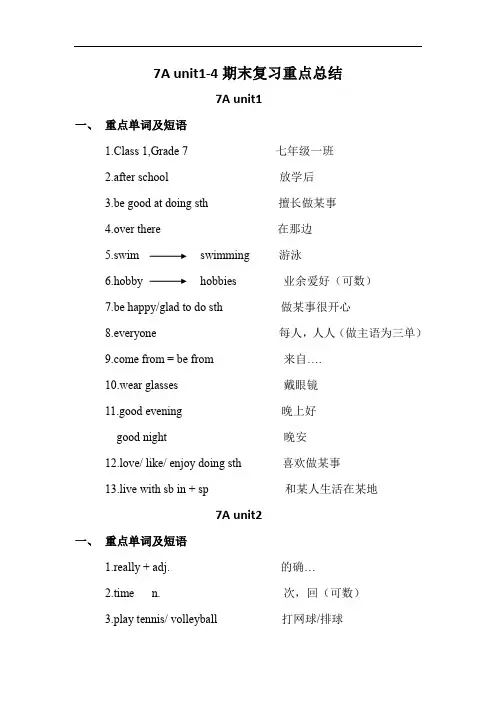
7A unit1-4期末复习重点总结7A unit1一、重点单词及短语1.Class 1,Grade 7 七年级一班2.after school 放学后3.be good at doing sth 擅长做某事4.over there 在那边5.swim swimming 游泳6.hobby hobbies 业余爱好(可数)7.be happy/glad to do sth 做某事很开心8.everyone 每人,人人(做主语为三单)e from = be from 来自….10.wear glasses 戴眼镜11.good evening 晚上好good night 晚安12.love/ like/ enjoy doing sth 喜欢做某事13.live with sb in + sp 和某人生活在某地7A unit2一、重点单词及短语1.really + adj. 的确…2.time n. 次,回(可数)3.play tennis/ volleyball 打网球/排球play + 球类运动play + the + 乐器4.enjoy doing sth 喜欢做某事5.player n. 运动员(可数)6.a member of… ….的一员7.Reading Club 阅读俱乐部8.in one’s free time 在某人空闲时间9.hope to do sth 希望做某事hope that + 从句e true 变为现实11.at/on the weekends=at/on the weekend 在周末12.of course 当然13.else adv. 另外,其他(与疑问词连用)what/ who else…14.a lot of = lots of 许多15.talk about/of 谈论16.match n. 比赛,竞赛(可数)17.hero heroes 偶像,英雄(可数)18.good adj. 好的(修饰名词)Well adv. 好地(修饰动词)19.make sb happy 让某人开心20.want to do sth 想要做某事21.make /let sb do sth 让某人做某事make me feel great22.play…with… 和…玩…7A unit3一、重点单词及短语1.best 最好地(well最高级)2.geography 地理(作为科目时首字母大)like Geography best3.parents’ meeting 家长会4.at the school gate 在学校门口5.so + adj. 非常…6.show them around 领他们参观(代词放中间)7.in front of… 在…的前面(范围外)in the front of…在…的前面(范围内)8.on the ground floor 在底层,在一楼9.diary diaries 日记(可数)10.after class 下课后11.on the phone 通电话12.from…to… 从…到…13.It takes sb sometime to do sth 做某事花了某人多长时间14.get up 起床15.go to school 去上学16.all kinds of … 各种各样的…17.borrow…from… 向…借…18.few + 可数名词复数不多的,很少(否定)little + 不可数名词不多的,很少(否定)a few+ 可数名词复数一些,少量(肯定)a little + 不可数名词一些,少量(肯定)19.far away from… 远离…20. on foot = walk to 步行21.have meetings 开会22.the man in a white shirt 穿白色衬衫那个男的23.open v. 开,打开open the door 开门open adj. 开着的be open 开门,营业(与一段时间连用)24.Thank you for doing sth 感谢你做某事7A unit4一、重点单词及短语1.wake him up 把他叫醒(代词放中间)2.seldom 很少,不常(表否定)3.go out 出去4.have breakfast/supper/dinner 吃早/中/晚饭5.need v. 需要need sth 需要…need to do sth 需要做某事6.have fun=have a good time 玩的高兴,过得愉快7.do after-school activities 做课外活动8.homework 家庭作业(不可数)9.be late for 迟到10.in the morning/afternoon/evening在上午/下午/晚上11.chat with sb 和某人聊天12.each other 互相,彼此13.practise doing sth 练习做某事14.would like to do sth 想要做某事--Would you like some…?--Yes, I’d like/love to --No, thanks15.wish sb to do sth 希望某人做某事16.good luck to … 祝…好运17.twice 两次18.have/ go on a picnic 野餐19.get ready for… 为…准备好20.learn to do sth 学习做某事21.don’t know how to have fun 不知道如何享乐22.It’s time for sth 到了该…的时候了It’s time to do sth 到了该做某事的时候了23.do morning exercises 做早操do eye exercises 做眼保健操24.be nice/kind to sb 对某人好25.a quarter past ten 十点十五A quarter to ten 九点四十五26.on + 具体时间在…on a cold morningon the evening of..27.How often……? …多长时间一次?(对频率提问)。
译林版牛津英语七年级上册期末复习知识点

译林版牛津英语七年级上册期末复习知识点花费时间/金钱在某事上)XXX.Cost:sth.(物)+ cost + 价格(钱数)eg。
This shirt costs 50 dollars.Pay:sb.(人)+ pay + 价格(钱数)+ for sth.(为某事付款)eg。
He paid 100 yuan for the book.Afford:sb.(人)+ afford + 价格(钱数)(有足够的钱去买某物)eg。
I can't afford to buy a car right now.5、一般现在时一般现在时表示经常性的动作或状态,或者客观事实。
构成:主语+动词原形(第三人称单数动词要加-s或-es)eg。
She likes music。
/ The sun rises in the east.6、一般过去时一般过去时表示过去某个时间发生的动作或状态,常和表示过去的时间状语连用。
构成:主语+动词的过去式XXX weekend.7、现在进行时现在进行时表示现在正在进行的动作,常和now。
XXX。
currently等时间状语连用。
构成:主语+be动词(am/is/are)+动词-XXX.8、一般将来时一般将来时表示将来某个时间要发生的动作或状态,常和表示将来的时间状语连用。
构成:主语+will/shall+动词原形eg。
I will go to Beijing next month。
/ She shall visit her XXX.9、情态动词情态动词有can/could。
may/might。
must。
shall/should。
will/would。
ought to等。
它们的用法有所不同,但都表示某种语气或情态。
eg。
You should study hard for the exam。
/ She must be at home now.10、被动语态被动语态表示动作的承受者在句子中作主语,动作的执行者在句子中用by引出。
牛津译林版七年级上英语期末复习全册知识点归纳
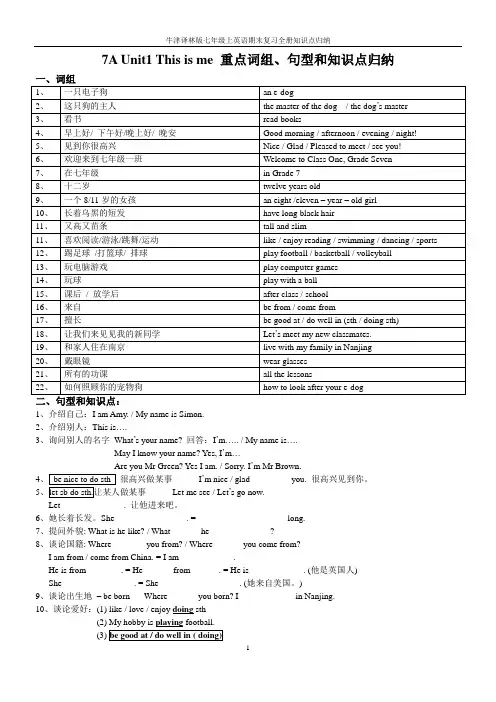
7A Unit1 This is me 重点词组、句型和知识点归纳1、介绍自己:I am Amy. / My name is Simon.2、介绍别人:This is….3、询问别人的名字What’s your name? 回答:I’m….. / My name is….May I know your name? Yes, I’m…Are you Mr Green? Yes I am. / Sorry. I’m Mr Brown.4很高兴做某事I’m nice / glad _________you. 很高兴见到你。
5Let me see / Let’s go now.Let ______________. 让他进来吧。
6、她长着长发。
She _____ _____ _____. = _______ ______ ______ long.7、提问外貌: What is he like? / What ______ he ______ _______?8、谈论国籍: Where _______ you from? / Where ______ you come from?I am from / come from China. = I am ____________.He is from _______ . = He ______ from ______. = He is ____________. (他是英国人)She ________________. = She __________________. (她来自美国。
)9、谈论出生地–10、谈论爱好:She is good at swimming. = She does well in dancing. = She ______ ______.= She is a _____ _______.注意do well in 的否定句例如:他不擅长跳舞。
七年级英语译林牛津版上学期期末复习(一)

【本讲教育信息】一、教学内容:期末复习(一)二、教学目标:掌握unit1-unit6重要词组三、教学重难点:掌握unit1-unit6重要词组四、教学过程:重点词组Unit 1—Unit 31. be born 出生2. wake up 醒醒3. work hard 努力工作4. wear glasses 戴眼镜5. love dancing 爱跳舞6. at lunchtime 在午饭时间7. take the bus 乘公共汽车8. at the weekend 在周末9. look happy 看上去高兴10. have a good time 过得愉快11. be good at swimming 擅长游泳12. twice a week 一周两次13. meet up with…与……约好见面14. knock on the door 敲门15. have fun 有乐趣16. play a trick on them 捉弄他们17. like listening to music 喜欢听音乐18. play for 为……玩19. have lessons 上课20. have breakfast 吃早饭21. in winter 在冬天22. on October 1st在10月1日23. at Christmas 在圣诞节24. dress up as a ghost 装扮成一个鬼25. go running for half an hour 跑步半个小时26. take my dog for a walk/ walk my dog 带我的狗去散步27. spend…(in)doing…花(时间或金钱)干某事28. enjoy playing computer games 喜欢玩电脑游戏29. give us some candy as a treat 用一些糖果招待我们30. a member of the Swimming Club 游泳俱乐部的一位成员31. watch football matches on TV 观看电视里的足球赛32. know a lot about computers 知道许多有关电脑(的知识)33. on the evening of October 31st 在10月31日的晚上34. on the other side of the flash card 在幻灯卡的另一面35. look forward to something / doing something 期盼某事/ 期盼做某事Unit 4—Unit 61. many times a day 一天多次2. walk to 步行3. need a lot of energy 需要许多能量4. be/get tired 疲劳的5. a top student 优秀学生6. have a healthy meal 吃一顿健康的饭7. keep fit 保持健康8. eat…for breakfast/lunch/supper/dinner早/中/晚/正餐吃……9. on the Internet 在网上10. in front of 在……前方11. a packet/kilo/piece of 一袋/公斤/张……12. go roller skating 去滑旱冰13. less/more than 少/多于14. not at all 根本不15. not any more 不再16. stay healthy 保持健康17. be free 有空的18. just a minute 请稍等一会儿19. never mind 不要紧20. look for 寻找21. go well with 与……很相配22. clothes/shoe/sports/book shop 衣/鞋/运动/书店23. be good for 有益于24. invite …to 邀请……去25. wait for 等待26. pay for 为……付钱27. at the moment 此刻28. a pair of 一双29. try on 试穿30. raise money for 为……筹集钱31. donate …to 为……捐钱32. enough games 足够的比赛33. 10 more minutes 再多10分钟34. stay in bed 卧床35. from the 1970s 来自20世纪70年代36. wear one’s hair in a 1990s style 梳着20世纪90年代的发型37. be made of 由……制作38. buy sb. sth./buy sth. for sb. 买某东西给某人39. good luck to sb./with sth. 祝愿某人/某事好运【典型例题】( ) 1. One sock is on the bed. Where’s ________________?A. othersB. the other oneC. anotherD. the others答案: B( ) 2. ______________ she is dancing!A. What beautifulB. How beautifulC. What beautifullyD. How beautifully答案:D( ) 3. This room is ________________.A. Jack and Simon’sB. Jack’s and Simon’sC. Jack’s and SimonD. Jack and Simon答案:A( ) 4. Mother has made a big cake _____________ her children.A. toB. forC. ofD. on答案:B( ) 5. The manager looks _____________ today.A. nicelyB. friendlyC. politelyD. kindly答案:B( ) 6. Where can I find a ____________________ box?A. cheap plastic bigB. plastic big cheapC. cheap big plasticD. big plastic cheap答案:C( ) 7. Many roses ____________ very well on this farm.A. growB. growsC. growingD. is growing答案:A( ) 8. —_________ is your car, sir?—The red one on the left outside the gate.A. WhoseB. WhichC. WhenD. What答案:B( ) 9. What is the hat made of ?A. Last year.B. In my hometown.C. Wool.D. Woolen答案:C( )10. There’s a discount _____________ these shoes.A. inB. onC. forD. of答案:B( )11. Someone sees you ____________ into that restaurant.A. to runB. runsC. runningD. ran答案:C( )12. It’s strange. Why ________ the monkey __________ its head all the time?A. does, shakeB. did, shakeC. is, shakingD. will, shake答案:C( )13. My cousin, Amy, __________ goes to the cinema. She has been to the cinema only two or three times since she went to school.A. oftenB. neverC. seldomD. usually答案:C( )14. My bike is broken today. Could you __________ yours to me?A. lendB. borrowC. to lendD. to borrow答案:A( )15. ____________ does the teacher give the students a talk? Once a week.A. How longB. How manyC. HowD. How often答案:D()16. My grandpa is 65. But he ____________ young.A. lookB. looksC. areD. /答案:B()17. My cousin ______________ with me on Sunday.A. likes playB. enjoys playingC. like playingD. enjoys to play答案:B()18. Are they good at ____________?A. drawB. to drawC. drawsD. drawing答案:D()19. My mother ______________ our games but my father ____________ them.A. don’t watch , watchB. doesn’t watch, watchC. doesn’t watch, watchsD. doesn’t watch, watches答案:D( ) 20. How much do you ______________ on the new digital camera?A. spendB. cost C pay D. take答案:A【模拟试题】(答题时间:45分钟)一、单项选择( )1. I’m looking ______ a birthday gift _______ my brother.A. for, forB. at, toC. after, toD. for, to( )2. He doesn’t have money ________ the computer.A. buyingB. for buyC. to buyD. on*( )3. “I love the new cards better.” Means “______________.”A. I like the new cards.B. My favourite is the new cards.C. I prefer the new cards.D. I like the new cards most.( )4. Kitty doesn’t want to take the same things _______ Amy did.A. asB. likeC. howeverD. before( )5. I think the shop needs ________ more food.A. someB. anyC. not anyD. not( )6. Amy is talking with her pen friend _____ the phone.A. inB. onC. overD. Both B and C( )7. Which of the following is not a kind of stationary?A. notebooksB. bank cardsC. writing paperD. rubbers( )8. I really need _________________ my homework.A. some helps toB. any help withC. some help withD. any help to ( )9. It’s noisy now. We can’t hear __________________.A. your wellB. her wellC. her clearD. his well*( )10. There is a boy waiting for me __________ the game.A. finishB. finishesC. to finishD. finishing( )11. I’m very hungry, but I __________ bread. So I want to buy _________.A. have some, someB. have no, someC. don’t ha ve any, oneD. have any, some( )12. The fancy dress ________ her new boots very ________.A. match, muchB. is match, wellC. matches, wellD. matches, much ( )13. I think the hair clip is pretty. Please _____________.A. try it onB. try on itC. try them onD. try on them ( )14. The poor woman is calling 110 ______ help.A. toB. forC. inD. by( )15. — ________ do you want? — I want a size 30.A. WhatB. How bigC. How sizeD. What size二、动词填空1. He never ________(watch) TV in the evening.2. There ________(be) lots of milk in the kitchen. But _________ (not put) the milk in the fridge.3. Look! The old women __________(practise) Tai Chi in front of the house.4. — What _____ their father often _______(do) on Sunday afternoon?— He _______( read) newspapers. But he ________(clean) his car now.5. The park is a good place ___________(fly) kites.6. She likes ________(buy) some snacks before _________(see) a film.7. I don’t have much time __________ (discuss) it with you.8. Will the boy play computer games after he ____________ (finish) his work?9. She likes fish, but she doesn’t like ______________ (eat) meat.10. —When will they send these letters?—You’d better ___________ (ask) Ms. Liu for her decision.三、完形填空The earth is our home. We must take care of it. That is to say we must keep the land, air and ___1___ clean.But man has begun to pollute(污染)the earth ___2___ he first made a fire, washed his clothes in the river and threw dirty things ___3____. Many years ago, pollution was not so serious because there were not ___4___ many people. There was enough clean air, land and water. When the land or the river was dirty in one place, man ___5___ another place, But now man is slowly polluting the whole world and there is ___6___ enough clean air, nor clean land, nor clean water. More people, more ___7___.When is this all to ___8___? Is it possible to get rid of (消除) pollution? We are glad to say that people have come to know the ___9___ of pollution and ___10___ them are working hard to protect (保护) our earth.( ) 1. A. river B. sea C. lake D. water( ) 2. A. before B. while C. since D. when( ) 3. A. on the ground B. into the air C. into space D. near the buildings( ) 4. A. such B. so C. too D. as( ) 5. A. lived B. flew to C. left to D. moved to( ) 6. A. no B. neither C. either D. not any( ) 7. A. luck B. clean places C. pollution D. dirty cities( ) 8. A. end B. start C. over D. develop( ) 9. A. dangerous B. importance C. danger D. use*( )10. A. much of B. a lotC. the large number ofD. a large number of【试题答案】一、1~5 A C C A A 6~10 D B C B C 11~15 B C A B D二、1. watches 2. is, don’t put 3. are practising 4. does, do; reads, is cleaning5. to fly6. buying, seeing7. to discuss8. finishes9. eating 10. ask三、1~5 D C A B D 6~10 B C A C D。
牛津译林版英语七年级上册期末考试知识点梳理unit1-4(可编辑修改word版)

Unit1-4 知识点总结1、喜欢like / love / enjoy / be interested in / be crazy about (痴迷于)/ have fun / have a good time +doing sth.动词+doing 的还有Go doing sth. / finishdoingsth./Be good at doing sth./ do well in doing sth.How/what about doing sth./practise doing sth.2、“四大看”readvt.看读物(read books/newspaper/magazines/amap 等)look vi. 瞧常用短语look at/ for/around/after/out/over/upseevt.看见,强调结果I can see youwatchvt.带有欣赏性的观看watch TV/ a film / a football game3、“五大穿着”Put on 强调“穿上”的动作eg. He a coat and goes for a walk.Wear 强调“穿着”的状态;进行时态表示暂时的情况eg. She is wearing a new skirt now. / wear glasses Dress (1)dress sb. (2) dress oneself (3) dress up as (4) get dressedIn (穿戴)后接颜色(或衣服),表示状态look!Lucy is a red skirt and a pair of pink shoes. On 后接人指衣服穿在某人身上看出区别来。
The red coat looks nice on you.4、“四大花费”Spend:sb.(人)+ spend + 时间/ 金钱+ on sth.sb.(人)+ spend + 时间/金钱+(in) doing sth.pay:sb.(人)+pay + 金钱+for sth.cost:sth.(物) + cost + sb.+金钱Doing sth.costs + sb.+时间take:it takes sb. +时间+ to do sth.5、“三大地点副词”Home / there /here 前不加任何的介词welcome home / come here / go there6、“三大使役动词”Make sb. do sth./ have sb. do sth. / let sb.do sth.7、见面打招呼用语(1)Nice to meet you . (2) Glade to meet you . (3) How are you ? (4) How are you doing ?(5)How is it going ? (6)How is everything going? (7) What’s up?8、基数词+year(s)+old 表示“…岁”提问用“how old”名词性短语数词-year-old 也表示年龄,但其为形容词性短语“前有冠词后有名(词)”Eg. Helen is 11 years old = Helen is an 11-year-old girl.9、Let’s与let us 的区别Let’s do sth. 指包括说话人在内,表示建议Let us do sth.指“让(允许)我们做某事”而对方不做,只有“我们”做10、play+the+乐器类名词eg. Play the pianoPlay + 球类运动play+ football / play cards / play chess11、She comes from Shanghai= She is from Shanghai . 注:如何提问Shanghai 及如何改一般疑问句12 、be good a t =do well in = be clever at = study sth. wellBe good at (反) be bad at do well in (反) be poor in13、介词over 的用法(1)”在…正上方” There is a bridge over the river.(2)”越过” A plane flies over the house(3)”超过” There are over 20 boys in this class.(4)”结束” Class is over! / Game is over.14、every one 与everyone 辨析区别(1)Every one 可以与of 连用,而everyone 却不能与of 连用Eg.every one of the children likes playing the computer games.(2) everyone 只指人=everybody 而every one 既指人又可指物共同点:谓语动词都要用“三单”15、family 的用法:“家庭”作为整体谓语动词用“单数”He has a big family.“家人”强调成员,是复数含义,谓语动词用“原形” My family are at home.拓展:集体名词有people、class、police、sheep、deer、furniture 等16、all/ both/ each/every/neither/ either 的用法all (1)三者或三者以上“全部、都”(2)all + the + 名词(all the afternoon = the whole afternoon)(3)all 放在行为动词前,名词前;be 动词后(4) all of +宾格/名词复数Both(1)两者都(2)后可跟of +宾格/名词复数Both sides of the street are grown trees. Each 指两个或两个以上“每一个”个体Each side of the street is grown trees.Every 指许多人或事物的“全体”后接名词单数Every student is here .所有人都在。
最新牛津译林版七年级英语上册各单元知识点提炼汇总 期末复习资料(含单词短语语法等)
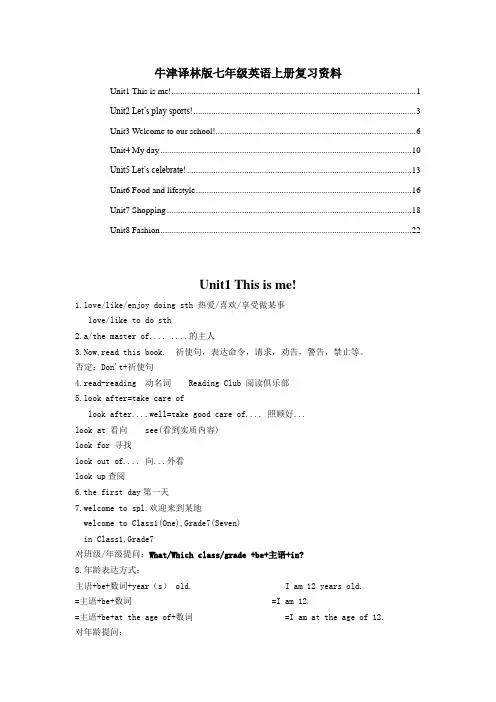
牛津译林版七年级英语上册复习资料Unit1 This is me! (1)Unit2 Let’s play sports! (3)Unit3 Welcome to our school! (6)Unit4 My day (10)Unit5 Let’s celebrate! (13)Unit6 Food and lifestyle (16)Unit7 Shopping (18)Unit8 Fashion (22)Unit1 This is me!1.love/like/enjoy doing sth 热爱/喜欢/享受做某事love/like to do sth2.a/the master of.... ....的主人3.Now,read this book. 祈使句,表达命令,请求,劝告,警告,禁止等。
否定:Don't+祈使句4.read-reading 动名词 Reading Club 阅读俱乐部5.look after=take care oflook after....well=take good care of.... 照顾好...look at 看向 see(看到实质内容)look for 寻找look out of.... 向...外看look up查阅6.the first day第一天7.welcome to spl.欢迎来到某地welcome to Class1(One),Grade7(Seven)in Class1,Grade7对班级/年级提问:What/Which class/grade +be+主语+in?8.年龄表达方式:主语+be+数词+year(s) old. I am 12 years old.=主语+be+数词 =I am 12.=主语+be+at the age of+数词 =I am at the age of 12.对年龄提问:How old+be+主语? How old are you?=What’s sb’s age? =What’s your age?xx-year-old ....岁的 a 12-year-old girl 一位12岁的小女孩9.play+球类运动 play footballplay the+乐器名词 play the piano10.after class/school/lunch....11.be from=come from 来自Where +be+主语+from?=Where+助动词+主语+come from?12.be good at (doing ) sth=do well in (doing) sth 擅长做某事(=do sth well)13.★Be动词的一般现在时14.at the age of... 在...岁时15.go walking➡go+v-ing=go for a walkgo swimming=go for a swim16.glad/nice to meet you. ➡It's glad/nice to meet you.It’s+adj.+to do sth做某事....17.I see.我明白了。
译林版牛津英语七年级上册期末复习知识点整理,推荐文档
译林版牛津英语七年级上册期末复习知识点整理Units1--4 重点知识点总结整理教师:Mr Sunn. 名词v. 动词vt. 及物动词vi. 不及物动词adj. 形容词adv. 副词prep. 介词pron. 代词conj. 连词1、喜欢like / love / enjoy / be interested in / be crazy about ( 痴迷于)/ have fun / have a good time +doing sth.动词+doing的还有Go doing sth. / finish doing sth./Be good at doing sth./ do well in doing sth.How/what about doing sth./practise doing sth.2、“四大看”read vt. 看读物(read books/newspaper/magazines/a map 等)look vi. 瞧常用短语look at/ for/around/after/out/over/upsee vt. 看见,强调结果I can see you.watch vt. 带有欣赏性的观看watch TV/ a film / a football game3、“五大穿着”Put on 强调“穿上”的动作eg. He _____ a coat and goes for a walk.Wear 强调“穿着”的状态; 进行时态表示暂时的情况eg. She is wearing a new skirt now. / wear glasses Dress (1)dress sb. (2) dress oneself (3)dress up as (4) get dressedIn (穿戴)后接颜色(或衣服), 表示状态look!Lucy is _ a red skirt and a pair of pink shoes. On 后接人指衣服穿在某人身上看出区别来。
七年级英语译林牛津版上学期期末复习(一)
【本讲教育信息】一、教学内容:期末复习(一)二、教学目标:掌握unit1-unit6重要词组三、教学重难点:掌握unit1-unit6重要词组四、教学过程:重点词组Unit 1—Unit 31.beborn出生ﻩ2.wake up ﻩﻩﻩ醒醒ﻩ3. work hardﻩﻩ努力工作4. wear glassesﻩ戴眼镜5. lovedancing ﻩ爱跳舞ﻩﻩ6.atlunchtimeﻩﻩ在午饭时间ﻩ7. takethebus ﻩ乘公共汽车ﻩﻩﻩ在周末8.at the weekendﻩ9. lookhappyﻩﻩ看上去高兴ﻩﻩ10. have a goodtime ﻩﻩ过得愉快11. be good atswimming ﻩﻩ擅长游泳ﻩ12.twice a week一周两次13. meet up with…与……约好见面14. knockon the door 敲门15. have funﻩ有乐趣ﻩ捉弄他们ﻩ16.playa trick onthemﻩ17.like listeningto music ﻩﻩ喜欢听音乐ﻩ18. play for为……玩19.have lessons ﻩﻩ上课ﻩﻩ20.have breakfast 吃早饭21. inwinterﻩ在冬天ﻩﻩﻩ22.on October1stﻩﻩﻩ在10月1日ﻩ23. at Christmas在圣诞节24.dress upas aghostﻩﻩﻩ装扮成一个鬼25.go running forhalf an hour 跑步半个小时26.takemy dogfor a walk/ walkmy dog ﻩ带我的狗去散步27. spend…(in)doing…ﻩﻩ花(时间或金钱)干某事28. enjoy playingcomputer games ﻩ喜欢玩电脑游戏29. give ussome candyasatreat ﻩﻩ用一些糖果招待我们30. a member of the Swimming Club ﻩ游泳俱乐部的一位成员31. watch footballmatches on TV ﻩ观看电视里的足球赛32. know a lot about computersﻩﻩﻩ知道许多有关电脑(的知识)33. onthe eveningof October 31st ﻩﻩﻩ在10月31日的晚上34.on the other side of theflashcard ﻩﻩ在幻灯卡的另一面35. lookforwardto something /doing something 期盼某事/期盼做某事Unit 4—Unit 61. manytimesa day 一天多次2. walk to ﻩ步行3.need a lot of energy需要许多能量4. be/get tiredﻩ疲劳的5.a top studentﻩ优秀学生6. haveahealthy meal 吃一顿健康的饭7. keep fit保持健康8. eat…for breakfast/lunch/supper/dinner ﻩ早/中/晚/正餐吃……9.on theInternetﻩ在网上10.in front of 在……前方11. a packet/kilo/pieceof ﻩ一袋/公斤/张……12. go roller skating去滑旱冰13. less/more than 少/多于14.not at allﻩ根本不15.notanymoreﻩ不再16.stay healthy保持健康17. be freeﻩ有空的18. justaminute 请稍等一会儿19.never mind不要紧20. look for寻找21. go well with 与……很相配22. clothes/shoe/sports/book shop衣/鞋/运动/书店23.be good for 有益于24. invite …to邀请……去25. wait forﻩ等待26. pay for ﻩ为……付钱27. at themoment此刻28. a pairofﻩ一双29.try on试穿30. raise moneyfor为……筹集钱31.donate…to 为……捐钱32.enough games ﻩ足够的比赛33. 10more minutes再多10分钟34. stay in bedﻩ卧床35.fromthe1970sﻩ来自20世纪70年代36. wearone’s hair ina1990sstyle梳着20世纪90年代的发型37.be made of ﻩ由……制作38. buy sb.sth./buysth.for sb. ﻩ买某东西给某人39.good luck tosb./with sth. 祝愿某人/某事好运【典型例题】() 1. Onesock is on the bed. Where’s ________________?A.othersB. the otheroneﻩC.another D.theothers答案:B( ) 2. ______________ she isdancing!A.WhatbeautifulﻩﻩﻩB. HowbeautifulC. What beautifullyﻩﻩﻩﻩD.How beautifully答案:D() 3.This roomis ________________.A. Jack and Simon’sﻩﻩﻩB. Jack’s andSimon’sﻩC.Jack’s and Simonﻩﻩﻩﻩ D. Jack andSimon答案: A( ) 4. Mother hasmade a big cake_____________herchildren.A. toﻩﻩ B. for ﻩﻩC.ofﻩﻩﻩD.on答案: B() 5. The managerlooks _____________today.A. nicely ﻩﻩﻩB.friendlyﻩﻩﻩC.politely ﻩD. kindly答案:B() 6. Where can I find a ____________________ box?A.cheap plastic bigﻩﻩﻩﻩB. plastic bigcheapﻩﻩC.cheapbig plastic ﻩﻩﻩD. bigplastic cheap答案:C( ) 7.Many roses____________ very well onthis farm.A. growﻩﻩﻩB.grows ﻩﻩC. growing ﻩD. is growing答案:A()8.—_________ is your car, sir?—The red oneon the left outside the gate.A. Whose ﻩB. Which ﻩ C. WhenﻩD. What答案: B() 9.What is the hat made of ?A.Lastyear.ﻩB. In my hometown. C. Wool. ﻩD. Woolen答案:C( )10. There’s a discount_____________ these shoes.A.inﻩﻩﻩ B.onﻩﻩﻩC. for ﻩﻩD. of答案:B()11.Someoneseesyou____________ into that restaurant.A. to run ﻩB.runs ﻩC. runningﻩD.ran答案:C()12.It’s strange.Why ________the monkey __________itshead all the time?A.does, shakeﻩﻩB.did, shakeﻩC.is,shaking ﻩD.will,shake答案:C()13. My cousin, Amy,__________ goes to the cinema.She has beent othe cinemaonlytwo or three timessince she went to school.A.often ﻩﻩB. never ﻩﻩC.seldomﻩﻩD. usually答案:C( )14.Mybike isbroken today. Couldyou __________ yours to me?A. lendﻩﻩﻩB. borrowﻩC. to lendﻩﻩD.to borrow答案: A()15. ____________does theteacher give the students a talk? Onceaweek.A. How longﻩB. How manyﻩC. How ﻩ D. Howoften答案:D()16. My grandpa is 65. Buthe ____________ young.A. lookﻩﻩﻩB.looksﻩﻩC.are ﻩD. /答案:B( )17. Mycousin______________ with meonSunday.A. likes play ﻩB. enjoys playingﻩC. like playing ﻩD. enjoysto play答案:B()18.Arethey good at ____________?A. drawﻩﻩB. to drawﻩC.drawsﻩﻩD. drawing答案:D()19.My mother______________our games but myfather____________ them.A. don’t watchﻩ, watch ﻩﻩﻩﻩﻩB. doesn’t watch, watchC.doesn’t watch, watchsﻩﻩﻩD.doesn’t watch, watches答案:D( )20. How much do you ______________on the newdigitalcamera?A.spendﻩﻩﻩB. cost C pay ﻩ D. take答案:A【模拟试题】(答题时间:45分钟)一、单项选择( )1. I’m looking ______ a birthday gift _______my brother.A. for,forﻩB. at, to ﻩC.after, toﻩD. for, to ( )2.He doesn’thavemoney ________the computer.A. buying ﻩB. for buy C.to buy D.on*( )3. “I lovethe newcards better.” Means“______________.”A. I like the new cards. ﻩB.Myfavourite is thenew cards.C. I prefer the newcards.ﻩ D. Ilikethe newcards most.()4.Kittydoesn’twant to take the same things_______Amy did.ﻩ C.however ﻩD. before A. as B. likeﻩ()5.I think theshopneeds ________more food.A. some ﻩﻩﻩB. any ﻩﻩC. not anyﻩD. not()6. Amy istalking with her pen friend_____ the phone.ﻩ C.overﻩﻩﻩD.Both BA.in ﻩB.onﻩand C( )7. Which of thefollowing isnot akindof stationary?A.notebooksﻩB. bank cards C.writing paperﻩD. rubbers( )8. I reallyneed _________________myhomework.A.some helps toﻩB.any help with ﻩC.somehelp withD. any helpto( )9. It’snoisynow. We can’t hear __________________.A. yourwellﻩB.herwell ﻩﻩﻩC. herclear ﻩD. his well *()10.There isa boy waiting for me__________the game.A. finish ﻩﻩ B.finishesﻩﻩC. to finishﻩD. fin ishing( )11. I’m very hungry,but I __________ bread. So I wantto buy _________.A.have some,someﻩﻩ B. haveno, someC.don’t haveany,oneﻩﻩﻩﻩﻩD.have any, some( )12. The fancydress ________ her newboots very________.A.match, muchﻩB. is match,well ﻩC. matches, wellﻩD.matches, much( )13. Ithink the hairclip is pretty.Please _____________.A. try it on ﻩB. try onit C. try them on ﻩD. try on them()14. The poorwoman iscalling 110 ______help.A. to B.forﻩC. inD.by ( )15. — ________do you want? —I wantasize30.A. WhatB.HowbigﻩC. HowsizeﻩﻩD.Whatsize二、动词填空1.He never________(watch) TV inthe evening.2. There________(be)lotsofmilk in the kitchen. But_________ (notput) the milk in the fridge.3. Look! Theoldwomen__________(practise) Tai Chi infront of thehouse.4. —What_____ theirfather often_______(do) on Sunday afternoon?— He_______( read)newspapers. Buthe ________(clean) his carnow.5. The park is a good place ___________(fly)kites.6.She likes ________(buy) some snacks before_________(see) a film.7. I don’t havemuch time __________ (discuss) it with you.8. Will theboy playcomputer games after he____________ (finish) his work?9.She likesfish, but she doesn’t like______________(eat) meat. 10. —Whenwill they sendthese letters?—You’dbetter___________ (ask) Ms.Liufor her decision.三、完形填空Theearthis ourhome. We must take care ofit. That is to say wemust keep the land,air and ___1___ clean.But manhas begun topollute(污染)theearth___2___hefirst made afire, washedhis clothes inthe river and threw dirty things ___3____. Many y ears ago,pollution was not soseriousbecause there were not ___4___ many people.Therewas enoughclean air, land andwater.When the la nd orthe riverwas dirty in one place, man___5___another place,But now manis slowly polluting the whole world and there is ___6___ enough clean air, nor cleanland, nor clean water. Morepeople,more ___7___.When is thisall to___8___? Is it possible toget ridof (消除) pollution? We are glad tosay thatpeoplehave come to know the___9___ of pollution and___10___them are working hard toprotect (保护)our ear th.() 1. A.river ﻩB.seaﻩﻩC. lakeﻩD. water( ) 2. A.beforeﻩB.while ﻩ C. sinceﻩﻩ D.when( ) 3.A. onthe groundﻩB. into theair C. intospace ﻩD. near thebuildings( )4.A.suchﻩ B. so ﻩﻩC.too ﻩD. as( ) 5. A.lived ﻩﻩB. flew toﻩﻩC.left toﻩD.moved to() 6. A.no ﻩB. neitherﻩﻩﻩC. eitherﻩﻩD. notany() 7. A. luckﻩﻩB.clean placesﻩC.pollutionﻩ D.dirty cities ( ) 8.A. end B. startﻩﻩC.overﻩﻩ D.develop( ) 9. A.dangerousﻩﻩB. importanceﻩC.dangerﻩD.use*()10. A. muchofﻩﻩB. a lot ﻩC.the large numberofﻩﻩD. a large number of【试题答案】一、1~5 A C CAA6~10 D BC B C 11~15 B C A B D二、1.watches 2. is,don’t put 3. arepractising4.does,do; reads, is cleaning5. tofly6. buying, seeing7. to discuss8.finishes9.eating10. ask三、1~5DCA B D6~10 B C A CD。
牛津译林版英语七年级上册期末考试知识点梳理unit14
Unit1-4知识点总结1、喜欢like / love / enjoy / be interested in / be crazy about (痴迷于)/ have fun / have a good time +doing sth.动词+doing 的还有Go doing sth. / finishdoingsth./Be good at doing sth./ do well in doing sth. How/what about doing sth./practise doing sth.2、“四大看〞readvt.看读物〔read books/newspaper/magazines/amap等〕look vi. 瞧常用短语look at/ for/around/after/out/over/upseevt.看见,强调结果I can see youwatchvt.带有欣赏性的观看watch TV/ a film / a football game3、“五大穿着〞Put on 强调“穿上〞的动作eg. He ____a coat and goes for a walk.Wear 强调“穿着〞的状态;进展时态表示暂时的情况eg. She is wearing a new skirt now. / wear glassesDress 〔1〕dress sb. (2) dress oneself (3) dress up as (4) get dressed In (穿戴)后接颜色〔或衣服〕,表示状态look!Lucy is_____a red skirt and a pair of pink shoes.On 后接人指衣服穿在某人身上看出区别来。
The red coat looks nice on you.4、“四大花费〞Spend:sb.〔人〕+ spend + 时间/金钱+ on sth.sb.〔人〕+ spend + 时间/金钱+(in) doing sth.pay:sb.〔人〕+pay + 金钱+for sth.cost:sth.(物) + cost + sb.+金钱Doing sth.costs + sb.+时间take:it takes sb. +时间+ to do sth.5、“三大地点副词〞Home / there /here 前不加任何的介词welcome home / come here / go there 6、“三大使役动词〞Make sb. do sth./ have sb. do sth. / let sb.do sth.7、见面打招呼用语〔1〕Nice to meet you . (2) Glade to meet you . (3) How are you (4) How are you doing〔5〕How is it going 〔6〕How is everything going (7) What’s up8、基数词+year〔s〕+old 表示“…岁〞提问用“how old〞名词性短语数词-year-old 也表示年龄,但其为形容词性短语“前有冠词后有名〔词〕〞Eg. Helen is 11 years old = Helen is an 11-year-old girl.9、Let’s 及let us 的区别Let’s do sth. 指包括说话人在内,表示建议Let us do sth.指“让〔允许〕我们做某事〞而对方不做,只有“我们〞做10、play+the+乐器类名词eg. Play the pianoPlay + 球类运动play+ football / play cards / play chess11、She comes from Shanghai= She is from Shanghai . 注:如何提问Shanghai 及如何改一般疑问句12、be good a t =do well in = be clever at = study sth. wellBe good at (反) be bad at do well in (反) be poor in13、介词over的用法(1)〞在…正上方〞There is a bridge over the river.(2)〞越过〞 A plane flies over the house(3)〞超过〞There are over 20 boys in this class.(4)〞完毕〞Class is over! / Game is over.14、every one 及everyone 辨析区别(1)Every one 可以及of 连用,而everyone 却不能及of连用Eg.every one of the children likes playing the computer games.(2) everyone 只指人=everybody而every one 既指人又可指物共同点:谓语动词都要用“三单〞15、family 的用法:“家庭〞作为整体谓语动词用“单数〞He has a big family.“家人〞强调成员,是复数含义,谓语动词用“原形〞My family are at home.拓展:集体名词有people、class、police、sheep、deer、furniture等16、all/ both/ each/every/neither/ either 的用法all 〔1〕三者或三者以上“全部、都〞〔2〕all + the + 名词〔all the afternoon = the whole afternoon〕〔3〕all 放在行为动词前,名词前;be 动词后(4) all of +宾格/名词复数Both〔1〕两者都〔2〕后可跟of +宾格/名词复数Both sides of the street are grown trees.Each 指两个或两个以上“每一个〞个体Each side of the street is grown trees. Every 指许多人或事物的“全体〞后接名词单数Every student is here . 所有人都在。
牛津译林版七年级上册英语期末语法重难点复习大纲
牛津译林版七年级上册英语期末语法重难点复习大纲考试特别易错要小心的:所有格(一)后面是否有名词,或者表达…的。
1.Do you know the two _________ (play) names?2.The coat is one of the _________(偶像).(二)花钱和花时间的搭配与运用1.人+spend+时间+on sth.2.人+spend+时间+(in) doing sth.3.It takes sb. time to do sth.4.人+pay+钱+for+sth.5.物+cost+人+钱.(三)The teacher tells us _______( not watch) too much TV.【分析】tell sb to do sth.非谓语否定在to前面加not , 答案not to watch .(四)Daniel waits for his parents _________ (bring) him the bag.【分析】关键不是for,答案容易写成bringing,本题考察目的,两个动作短语之间用to do 所以答案为to bring.(五)This computer is our _________ (teacher) .【分析】电脑是老师,对吗?肯定不通,应该说电脑是老师的,答案teacher’s.(六)He is well.这里的well,是形容词,指身体好。
一般问题是How is sb.?(七)She makes him does homework.She is inviting Mr Wu comes to her birthday party.【分析】这个句子错的原因一样,都是看的是him和Mr Wu.答题的,首先一个句子只能有一个谓语,再根据谓语动词的句型来填,make sb. do sth. Invite sb to do sth.正确:does改成do ,comes 改成to come【新增三个问题】(八)two hundreds of students 两百个学生(×)【分析】口诀:hundred 前面基数词two,后面不加s和of ,前面没有基数词后面加s和of.【正确】two hundred students 几百个学生hundreds of students 数百个学生(九)exercise 什么时候可数,什么时候不可数【分析】只有翻译成锻炼、运动时不可数;翻译成练习(语文,数学,钢琴等)可数,早操,眼保健操。