
【原创】仁爱英语九年级上Unit 1 Topic 3 Section B
2017
He bought a computer in 2007. He has had a computer since 2007. = He has had a computer for ten years.
[‵helpə(r)] 助手 [klʌb] 俱乐部 Xiao Lin is a member of the Helpers’ Club.
manager (n.): a person who is managing a
company.
A: They skate so well. How can they manage it?
B: Well, they received a hard training and
improved a lot.
Read through Sections A-C and fill in the blanks with the correct words.
I really __h_a_t_e__ going to a place like that. __S_o_ do I.
So + be/情态动词/助动词+主语
club [klʌb] n. join a club a chess/film/football club
secretary n. A person who works in an office for another person, dealing with letter, telephone calls,etc.
-- Do you like the weekly talk show, The Reader,
on CCTV?
-- Sure. It’s a great TV program ____B__ brings the
habit of reading back into the public. (2017福建)
3. The program also trains those people in need to help them find jobs again . ( T)
4. It is important to let homeless people feel good about themselves . ( T)
1
one sixth
6
2 two ninths 9
7 seven twentieths 20
_T_h_an_k_s_ to the policy, China is developing quickly and …
the one-child policy
on the phone = over the phone
offer sb. sth.=offer sth. to sb. 主动提出帮助 provide sb. with sth.=provide sth. for sb. 5. … so that they can find jobs again. 以便于 so that 引导一个目的状语从句 等于in order that He works very hard so that he can enter the best school 6. feel good about oneself 对自己感觉良好 7. The world has changed for the better.
China _h_a_s_ the largest population in the world, and about one _f_if_t_h_ of the people in the world live in China.
7 6 5 4 3 2 1 0
the population
the world China
[‵triːtm(ə)nt]
[‵构m词æ法n:ɪd派ʒ生] 法: 后缀-ment常构成名词 manage (v.) :to succeed in doing sth difficult.
trmeaatn(va.g)-e--to tdreoasttmh.ent(n.) mEagn:aTghee (bvo.)x--w- asmsaonahgeeamvyenbtu(tnh.)e managed to gcoavrerryni(tvu.)p(s管ta理irs;. 支配)--- government(n.)
A. who B. that C. what
3. How do they manage it? manage to do sth 成功地做了……
4. Once they find … offer them help. once 连词,一旦, 引导时间状语从句
Once you start, you will never give up. (主将从现) once副词, ①曾经; ②从前;一次 ① Once he lived in America, but now he lives in China ②He comes to see us once a week.
Unit 1 The Changing World
Topic 3 The world has changed for the better Section B
Present Perfect (II)
I have ___ju__s_t called you. I’ve _n_e_v_e__r been there__b_e_f_o_r_e_.
He can offer help to people immediately. [ɪ‵miːdɪətlɪ] 立刻、立即
fisherman
secretary n.秘书
soldier
wound n.创伤
v.伤,伤害
engineer n.工程师
1992 His father died in 1992. His father has been dead for many years.
1b Listen to 1a and mark T(true) or F(False).
1. Maria and Jane are talking about a program in China . ( F )
2. The program helps the homeless people in many ways . (T )
The woman left home at 8:00. She has been away from home since 8:00. = She has been away from home for 2 hours.
for ten years
短暂性动词 → 延续性动词
past
present
→ buy have 2007 since 2007
世界已经变得更好了。
Байду номын сангаас
1c Read 1a and fill in the blanks .
There is a wonderful program that helps
_h_o_m__e_le_s_s__people in Canada. The program not only _p_r_o_v_i_d_e_s_enough foodm,__e_d_i_c_a_l_t_r_e_a_t_m_e_n_atnd homes for the homeless people, but also _tr_a__in_s_ them in order to help them(_to_)__g_e_t_/f_i_n_d__jo__b_speople
2002 He left the army because of a leg wound in 2002. He has been away from the army for twelve years because of a leg wound.
Neither / Nor + be/情态动词/助动词+主语
It is increasing __b_y__ 80 million every year.
80
increase by 增加了……
80
increase to 增加到……
80
6800
… the population in developing countries is __la_r_ge_r__t_ha_n__ that in developed countries.
China has __a_lr_e_a_d_y_ carried out the one-child policy to control the population.
Have you found him _y_e__t _? Have you _e__v_e_r_ been to the cinema nearby?
again. Thanks to the program, the homeless people
feel _g_o_o_d__about themselves.
for 2 hours
短暂性动词 → 延续性动词
past
present
leave →8:00besinacew8:a00y fro10m:00
homeless=home+less homeless people the homeless
构词法:派生法: 后缀-less 不能够…没有…缺少…
careless/ useless/ helpless
TV program 方案;节目
The program is about giving the people in need medical treatment.
2. The homeless people get enough food, homes and medical treatment.
仁爱版九年级英语上册Unit1 Topic3课件(共78张PPT)
months. 5. Tom has kept a book _s_i_n_c_e_ 5:00 a.m.
2 Listen to the passage and fill in the blanks with the
• 1 How do you like (doing) sth.?=What do you think of ...?
• 你认为……怎么样 • e.g. How do you like the weather in Beijing? • 你认为北京的天气怎么样? • =What do you think of the weather in Beijing? • How do you like playing basketball now? • 你认为现在打篮球怎么样?= • What do youthink of playing basketball now?
1.I have lived in Beijing __f_o_r__ three years. _s_in_c_e__2011.
2. He has waited for Tom _s_i_n_c_e_ two hours ago. __fo_r___ two hours.
3. We have learned chemistry _fo_r_ one month. s_in_c_e_ the new term
了)。只用于一般过去时。
• e.g. He used to be a quiet boy. • 他过去是个不太爱说话的男孩。 • be used to do sth.被用于做某事
仁爱英语九年级上册Unit1 Topic 3 SectionB课件

for a week
past
present
last week for + 时间段
e.g. I have been in the new school for a week.
since last Friday
past
present
last Friday
since + 时间点
e.g. Lily has been away from home since last Friday.
3. He __c_a_m__e__ (come) to Beijing in 2003. He _h_a__s_b_e_e__n_i_n_ (be in) Beijing since 2003.
4 He _j_o_i_n_e_d__ (join) Helpers’ Club in 2004. He _h__a_s_b_e__e_n_ (be) a member of Helpers’ Club since 2004.
The woman left home at 8:00. She has been away from home since 8:00. = She has been away from ee years
短暂性动词 延续性动词
past
present
A. have been to
B. have been in
C. have gone to
D. have been
5. His uncle ______ for more than 9 years.
5. He _b_o__u_g_h_t_ (buy) a house in 2005. He __h_a_s__h_a_d__ (have) a house since 2005.
仁爱英语九年级教材讲解Unit3知识点击
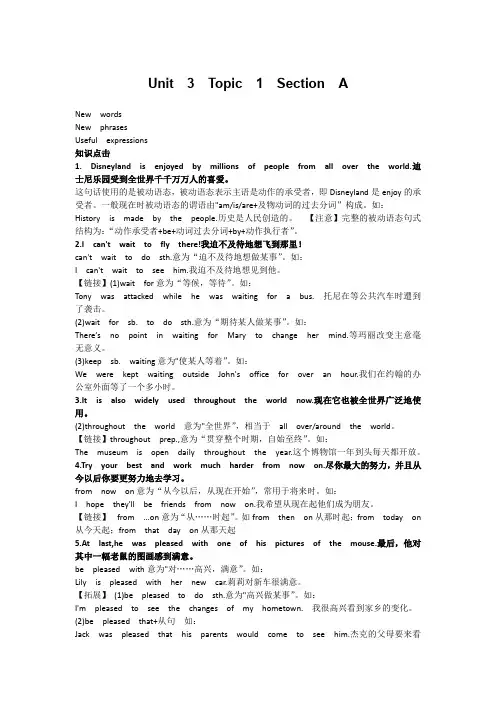
Unit 3 Topic 1 Section ANew wordsNew phrasesUseful expressions知识点击1. Disneyland is enjoyed by millions of people from all over the world.迪士尼乐园受到全世界千千万万人的喜爱。
这句话使用的是被动语态,被动语态表示主语是动作的承受者,即Disneyland是enjoy的承受者。
一般现在时被动语态的谓语由"am/is/are+及物动词的过去分词”构成。
如:History is made by the people.历史是人民创造的。
【注意】完整的被动语态句式结构为:“动作承受者+be+动词过去分词+by+动作执行者”。
2.I can't wait to fly there!我迫不及待地想飞到那里!can't wait to do sth.意为“迫不及待地想做某事”。
如:I can't wait to see him.我迫不及待地想见到他。
【链接】(1)wait for意为“等候,等待”。
如:Tony was attacked while he was waiting for a bus. 托尼在等公共汽车时遭到了袭击。
(2)wait for sb. to do sth.意为“期待某人做某事”。
如:There’s no point in waiting for Mary to change her mind.等玛丽改变主意毫无意义。
(3)keep sb. waiting意为"使某人等着”。
如:We were kept waiting outside John's office for over an hour.我们在约翰的办公室外面等了一个多小时。
3.It is also widely used throughout the world now.现在它也被全世界广泛地使用。
仁爱九年级上册Unit1Topic3重要知识点,作文范文!

仁爱九年级上册Unit1Topic3重要知识点,作文范文!仁爱版英语九年级上Unit 1 Topic 3知识点梳理Section A重点短语1. 1) Helen is talking with Bob on the phone.(提问)How is Helen talking with Bob?2) I often chat with my good friend on the Internet. (提问)2. How do you like … ?= what do you think of?eg:1) How do you like the movie?= What do you think of the movie?2) How do you like living there? (同义句)= What do you think of living there?3. get used to doing sth= be used to doing sth习惯于做…eg: 1) Lily is used to going to bed early.= Lily gets used to going to bed early.2) My father is / gets to (smoke). It’s bad for his lungs.4. 含有used的句子变成一般疑问句时在句首加Did, 加了Did之后,后面的used去掉d还原成use;含有used的句子变成否定句时,在used的前面加didn’t,加了didn’t之后,后面的used去掉d 还原成use。
eg:1)I used to enjoy listening to pop music. (改为一般疑问句)Did you use to enjoy listening to pop music?2) My sister used to play the piano. (改为否定句)My sister didn’t use to p lay the piano.3) Jane used to be a teacher. (改为一般疑问句)Did Jane use to be a teacher?5. Isn’t it dangerous there? 在那儿难道它不危险吗?这是一个反问句,在英语中,反问句也可称为否定疑问句,常译为难道不…吗?结构为:be / 助动词 /情态动词的否定 + 主语 + 谓语+ …eg:1)Didn’t he go to the park yesterday?2) Can’t Lily pla y the piano?3) Hasn’t Jim been to the Great Wall?4) Won’t they go climbing next Sunday?注意:在回答反问句时,要反着译即Yes译为No, No译为Yes.1) Didn’t he go to the park yesterday?Yes, he did. / No, he didn’t.不,他去了。
Unit1+Topic+3+课文详解课件2023-2024学年仁爱版九年级英语上册

Section B
• Maria: What are you reading, Jane? be动词+V.ing (现在进行时)
• Jane: I’m reading a newspaper from Canada. Martin showed me an interesting article.
街区
事实上=in fact
wonderful place to live. Near our block, there are beautiful parks, good schools,
famous museums and excellent restaurants. And you can go to plays, concerts and
Lesson Three
Topic3 A-B
Words and passages
单词认读
背诵词汇
背诵词汇
词汇 1. with the money 2. so that 3. so...that... 4. in fact/as a matter of fact 5. come for a visit 6. in need 7. decide on sth. 8. provide sth. for sb./provide sb. with sth. 9. feel good about... 10. lend sth. to sb/lend sb. sth.
It is about a program that helps homeless people. show sb.sth.= show sth. to sb.
定语从句:从句充当形容词,修饰前面的program
给某人展示某物
仁爱英语九年级上Unit 1 Topic1--3同步教学导学案
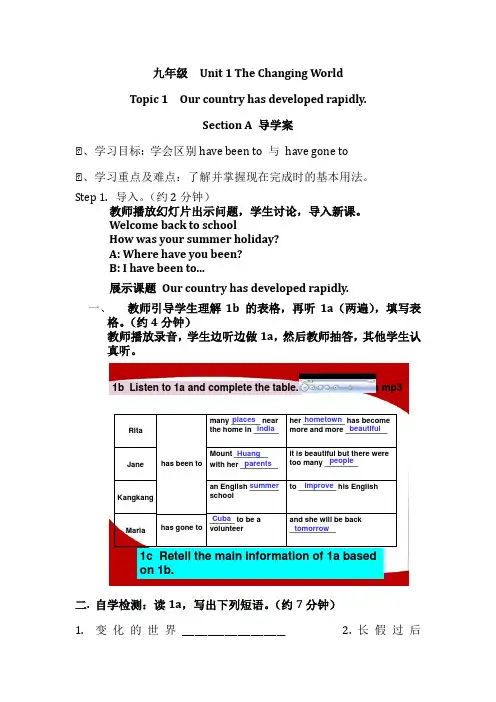
九年级 Unit 1 The Changing WorldTopic 1 Our country has developed rapidly.Section A 导学案Ⅰ、学习目标: 学会区别have been to 与 have gone toⅠ、学习重点及难点:了解并掌握现在完成时的基本用法。
Step 1. 导入。
(约2分钟)教师播放幻灯片出示问题,学生讨论,导入新课。
Welcome back to schoolHow was your summer holiday?A: Where have you been?B: I have been to...展示课题 Our country has developed rapidly.一、 教师引导学生理解1b 的表格,再听1a (两遍),填写表格。
(约4分钟)教师播放录音,学生边听边做1a ,然后教师抽答,其他学生认真听。
1b Listen to 1a and complete the table.has gone to to _________ his English it is beautiful but there were too many ________her __________ has become more and more __________Maria Kangkang Jane Rita has been to and she will be back _________________ to be avolunteer an English _______schoolMount ________ with her _________many _______ nearthe home in ______places India hometown beautiful Huangparentspeople summer improve Cuba tomorrow 1c Retell the main information of 1a basedon 1b.P1 1a mp3二. 自学检测:读1a ,写出下列短语。
仁爱版英语九年级上册Unit1Topic3 知识点总结
九年级上册仁爱版第一单元T3知识点总结Topic 3一、重点词汇:二、重点短语get used to 习惯于as a matter of fact 事实上come for a visit 来参观millions of 数以百万计的a lot of 许多的hundreds of 数以百计的in need 在困难时decide on 选定……provide sb with sth 给某人提供某物so that 以便in order to 为了……pick up 接(人);患病on purpose故意aid to do sth 帮助某人做某事in the future 在将来as a result 结果make a contribution to 为……做贡献pay for 赔偿……;为……付出代价according to 据……所说in the past 在过去come for a visit 来参观live a normal life 过着正常的生活medical treatment 医疗a short period of time短时期have a problem with sth 在某方面有困难have a problem (in) doing 在做某事上有困难one another 互相(each other)三、课文重要知识点Section A1.on the phone考点:用介词on常见情况:on TV on the Internet on the radio2.You have been in New York for a long time.考点:现在完成时1)区别:have/ has been in 在某地呆了多长时间have/ has been to 去过某地(已回)have/ has gone to 去了某地(未回)2)区别(重点):for+时间段since+时间点Since的四种用法:since+过去某时间点,指具体的年,月,日,时,星期等He has been here since 1999. since+一段时间+ago 自……时间开始至今He has been here since five years ago.since+一般过去时从句。
Unit3Topic1《EnglishiswidelyusedthroughouttheworldSectionB》教案1(仁爱英语九年级上)
九年级上仁爱版英语Unit 3 Topic 1 English is widelyused throughout the world Section B 教案The main activities are 1a and 2a. 本课重点活动是1a 和2a 。
Ⅰ. Teaching aims and demands 教学目标1. Master some new words and useful expressions:on business, similar, be similar to, possible, conversation, translate, translate …into, company, general, in general, besides, once in a while, whenever2. Go on learning the simple present passive voice.3. Talk about languages around the worldⅡ. Teaching aids 教具录音机,幻灯片或小黑板Ⅲ. Five-finger Teaching Plan 五指教学方案Step 1 Review 第一步 复习(时间:10分钟)1. (教师检查作业,复习被动语态。
)T: Good morning, boys and girls!Ss: Good morning, teacher.T: We learnt passive voice yesterday. Let ’s check your homework.S 1: Trees are planted by people every year.S 2: Homework is done by us every day.S 3: …(尽可能让学生多说句子,调动学生积极性,营造和谐课堂气氛。
)(教师进行归纳总结后,让学生独立完成3,并板书于黑板上,纠正出现的错误,让学生更准确地掌握被动语态。
仁爱版英语九年级上册Unit 1 Topic 3《The world has changed for
仁爱版英语九年级上册Unit 1 Topic 3《The world has changed for the better》SectionD 教学设计一. 教材分析仁爱版英语九年级上册Unit 1 Topic 3《The world has changed for the better》Section D主要讲述了全球化对人们生活的影响。
通过本节课的学习,学生能够了解全球化所带来的各种变化,提高他们的英语听说读写能力。
本节课的内容与学生的生活息息相关,有利于激发他们的学习兴趣。
教材内容主要包括对话和阅读理解,通过这些材料,学生可以了解到全球化对饮食、交通、通信、教育等方面产生的影响。
二. 学情分析九年级的学生已经具备了一定的英语基础,能够进行简单的听、说、读、写操作。
但对于全球化这个概念,部分学生可能还比较陌生。
因此,在教学过程中,教师需要帮助学生建立起对全球化的基本认识,并通过生动有趣的例子让学生感受到全球化对生活的影响。
此外,学生可能在听力、阅读和口语表达方面存在一定的困难,教师需要针对这些困难进行有针对性的教学。
三. 教学目标1.知识目标:–学生能够掌握与全球化相关的词汇和短语;–学生能够理解对话和阅读材料,概括出全球化对人们生活的影响;–学生能够运用所学知识进行简单的交流和表达。
2.能力目标:–学生能够提高听力、阅读和口语表达能力;–学生能够通过合作学习,提高解决问题的能力。
3.情感目标:–学生能够认识到全球化的重要性,树立全球观念;–学生能够关爱社会,关注全球问题。
四. 教学重难点•学生能够掌握与全球化相关的词汇和短语;•学生能够理解对话和阅读材料,概括出全球化对人们生活的影响;•学生能够运用所学知识进行简单的交流和表达。
•学生能够熟练运用所学知识进行听力、阅读和口语表达;•学生能够深刻理解全球化对生活的影响,形成自己的观点。
五. 教学方法1.情境教学法:通过设定情境,让学生在实际语境中学习、运用英语;2.交际法:鼓励学生进行互动交流,提高他们的口语表达能力;3.任务型教学法:引导学生参与各种任务,培养他们的合作精神和解决问题的能力;4.启发式教学法:教师引导学生思考,激发他们的学习兴趣和求知欲。
Unit 1 Topic 3 Section B 公开课教学设计(九年级英语上册仁爱版)
Unit 1 The Changing WorldTopic 3 The world has changed for the better.Section B教学设计一、教学目标1. 能根据已学语音、音标及发音规则,正确朗读下列词汇并在实际的对话操练中加以应用:program, homeless, manage, treatment, training, immediately, secretary, helper, club, engineer, wound2. 继续学习现在完成时(短暂性动词与延续性动词的转换)。
3. 能够正确朗读句子,注意句子中的重读、弱读、连读以及停顿。
4. 能听懂有关社会问题和社会服务的对话,并能从中提取相关信息,做出正确判断。
5. 能正确运用现在完成时谈论有关社会服务的话题。
6. 通过整合对话内容,提升综合语言运用能力。
7. 关注社会问题,关注社会服务工程,培养乐于助人的良好品德和爱国意识。
二、教学重点及难点重点:1. 能根据已学语音、音标及发音规则,正确朗读下列词汇并在实际的对话操练中加以应用:program, homeless, manage, treatment, training, immediately, secretary, helper, club, engineer, wound2. 继续学习现在完成时(短暂性动词与延续性动词的转换)。
难点:1. 能在具体语境中,将短暂性动词转换成延续性动词,正确使用一般过去时和现在完成时。
2. 能通过本课所学,正确运用现在完成时对日常活动进行描述。
三、教学准备教师:教学课件;家乡变化的图片;多媒体设备学生:课前预习四、教学过程Step 1 Warming-upWork in groups. One student say a sentence with “have done”. The others add time adverbial with “for” or with “since”, and go on practicing.【设计意图】通过句子接龙的活动,活跃课堂气氛,在复习的同时为后面学习短暂性动词转换为延续性动词提供语境,做好铺垫。