
牛津译林版英语必修二Unit3Grammarandusage教案
牛津高中英语教学设计单元:Unit 3 Amazing people板块:Grammar and usageThoughts on the design:本节课是语法教学课。
以观察——发现——讨论——归纳——运用为主要教学模式,充分利用本单元语言素材,通过多种图示和语法规则的呈现,让学生比较全面系统地掌握过去完成时(Past perfect tense)的用法、一般过去时(Simple past tense)与过去完成时的用法区别及现在完成时(Present perfect tense)与过去完成时的用法区别。
语法规则的归纳与讲解所选用的语言材料和所涉及的练习与本单元话题(Amazing people)相联系。
力求让学生在语篇中灵活运用所掌握的语法规则,避免学生死抠语法,生搬硬套。
Teaching aims:After learning this lesson, the students will be able to understand sentences in which the past perfect tense is used. They are also expected to distinguish the past perfect tense from the simple past and the past perfect tense from the present perfect tense. At the same time, they will read some passages in which the simple past tense, the past perfect tense or the present perfect tense is used.Teaching procedures:Step 1 Lead in (PPT4-5)1.What’s the topic of Unit3? (Amazing people)2.How many amazing people have we read about in this unit? Who are they? (Mother Teresa, Bill Gates,Beethoven, Zhang Heng, Howard Carter.)3.Can you tell me something about Howard Carter? (Howard Cater is one of the most famous explorersthe world has ever known. He was brave and adventurous. …Not long after the tomb of King Tutankhamen had been opened, people in Carter’s team began to fall ill and die strangely.)4.What verb tenses are used in the sentence? (the simple past tense and the past perfect tense) [Explanation]教师充分利用教材中的语言素材,既引导学生温习已学的内容,又激起学生对已学内容中出现的语法现象(the past perfect)的关注。
Step 2 Presentation (PPT6-7)1.How can we form the past perfect? (By using“had +the verb-ed form”)2.Page 42-43: Reread the passage “The curse of the mummy” and underline the sentences in which thepast perfect tense is used.By the 1920s, he had become an explorer, searching for the tombs of the Egyptian kings.He had received money from Lord Carnarvon, a British man who was very interested in Egypt.It was the most important tomb that had ever been found.The tomb contained more riches, gold and jewels than any of us had ever seen before.Not long after the tomb of King Tutankhamen had been opened , people in Carter’s team began to fall ill and die strangely.Upon entering the tomb, Carter’s lucky pet bird, which had led him to the place, was eaten by a snake.A few months after Carter had opened the tomb, Lord Carnarvon, who was also present when the tomb was opened, fell ill with a fever and died in Egypt.[Explanation]通过进一步复读课文,让学生发现过去完成时在语篇中的运用,以加强对过去完成时的感性认识。
Step 3 The usage of the past perfect1. Upon entering the tomb, Carter’s lucky pet bird, which had led him to the place, was eaten by a snake.Summary: The past perfect tense is often used with the simple past tense. If one action happens before another in the past, the past perfect tense is used. (PPT8-9) 2. “We emptied the tomb of everything it contained,” said Carter.Carter said that they had emptied the tomb of everything it contained.Summary: The past perfect tense is often used in reported speech. (PPT10) 3. I had done my homework this morning before I went to the museum.Summary: The use of the past perfect tense simply indicates that an action comes before another past action. It does not mean that the past action happened a long time ago. (PPT11)PresentPast PresentPastPresentPastPresentPastCarter’s lucky pet bird had led Carter to the site.Carter’s lucky pet bird was eaten by a snake.The past perfect tense shows us “过去的过去”PastThey had emptied the tomb of everything it contained. Carter said I had done my homework this morning. I went to the museum.4. By the 1920s, he had become an explorer, searching for the tombs of the Egyptian kings.Summary: The past perfect tense is often used with time expressions such as when, after, before, as soon as, until, by, for and already. (PPT12) [Explanation]借用学生所熟知的语境及相关图示,让学生充分理解过去完成时的本质——“过去的过去”。
Step 4 Practice: the simple past tense and the past perfect tense1. Show some pictures of another amazing person ---Amelia Earhart.2. Read the notes about Amelia Earhart on page 49 and then tell us what happened to her. Let studentsknow that whether the simple past tense or the past perfect tense is used depends on the sequence of the events.3. Complete the story on page 49.4. Complete the article on page 50 so that the students know more about the differences between thesimple past tense and the past perfect tense.Summary: Whether the simple past tense or the past perfect tense is used depends on the sequence of the events. (PPT13-20) [Explanation]让学生学会在语境中正确使用过去完成时,并了解过去完成时与一般过去时的区别。
2018-2019学年高中英语(译林牛津版)必修二教案 Unit3 Amazing people-grammar and usage
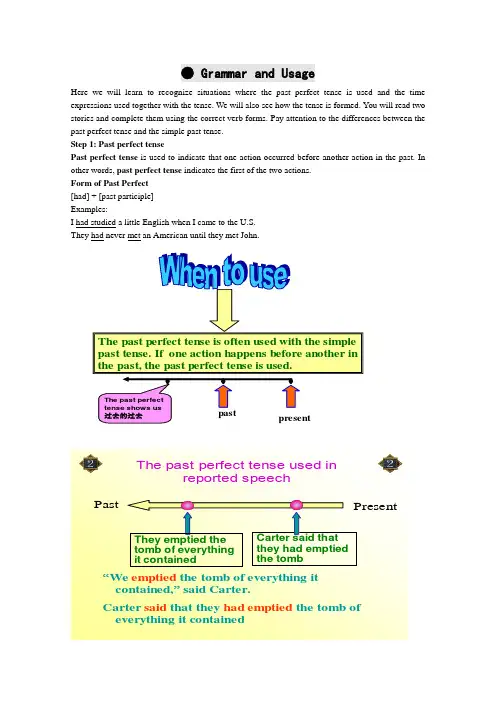
● Grammar and UsageHere we will learn to recognize situations where the past perfect tense is used and the time expressions used together with the tense. We will also see how the tense is formed. You will read two stories and complete them using the correct verb forms. Pay attention to the differences between the past perfect tense and the simple past tense.Step 1: Past perfect tensePast perfect tense is used to indicate that one action occurred before another action in the past. In other words, past perfect tense indicates the first of the two actions.Form of Past Perfect[had] + [past participle]Examples:I had studied a little English when I came to the U.S.They had never met an American until they met John.The use of the past perfect tense simply indicates that an action comes before anotherpast action.happen beforeI had done my homework thismorning before I went to themuseum.used with time expressions suchas when, after, before, as soon as,until, by, for and alreadyCarter opened KingTutankhamun ’stomb Then a few months after Carter had openedthe tomb, Lord Carnarvon fell ill with a feverand died.Lord Carnarvon diedPast PresentNote : When you are using a verb tense with more than one part such as Past Perfect (had met), adverbs often come between the first part and the second part (had never met).USE 1Completed Action Before Something in Past The Past Perfect expresses the idea that something occurred before another action in the past. It can also show that something happened before a specific time in the past.Examples:I had never seen such a beautiful beach before I went to Kauai.Had you ever visited the U.S. before your trip in 1992?Yes, I had been to the U.S. once before in 1988.USE 2Duration Before Something in the Past(Non-continuous Verbs)With Non-progressive Verbs and some non-progressive uses of Mixed Verbs, we use the Past Perfect to show that something started in the past and continued up until another action in the past. Examples:We had had that car for ten years before it broke down.By the time Alex finished his studies, he had been in London for over eight years.IMPORTANT Specific Times with the Past PerfectUnlike the Present Perfect, it is possible to use specific time words or phrases with the Past Perfect. Although this is possible, it is usually not necessary.EXAMPLE:She had visited her Japanese relatives once in 1993 before she moved in with them in 1996.If the Past Perfect action did occur at a specific time, the Simple Past can be used instead of the Past Perfect when before or after is used in the sentence. The words before and after actually tell you what happens first so the Past Perfect is optional. Both sentences below are correct.EXAMPLE:She had visited her Japanese relatives once in 1993 before she moved in with them in 1996.She visited her Japanese relatives once in 1993 before she moved in with them in 1996. HOWEVERIf the Past Perfect action did not happen at a specific time, Past Perfect MUST be used at all times. Compare the two sentences below.EXAMPLE:She had never seen a bear before she moved to Alaska. CorrectShe never saw a bear before she moved to Alaska. Not CorrectACTIVE / PASSIVE FORMS of Past PerfectEXAMPLESGeorge had repaired many cars before he received his mechanics license. ACTIVEMany cars had been repaired by George before he received his mechanics license. PASSIVEStep 2: Practice1. Read Point 1 on page 48 to see which action happens first in the sentence given. Note that the past perfect tense is often used with the simple past tense. If one action happens before another in the past, the past perfect tense is used. So these two tenses are often used together.Look at the diagram in Point 1 first, and then read the example sentence. Note how the past perfect tense is used with the simple past tense.2. Read the following two sentences to see how the predicate is changed when the sentence is turned from the direct speech into the indirect speech.Toby said, “I will/shall not be in London next week.”Toby said that he would not be in London the next week.Next let’s look at another two sentences:Toby said, “I went to Africa a month ago.”Toby said that he had gone to Africa a month before.So you see if a sentence which uses the simple past tense in the direct speech is changed into the indirect speech, it will use the past perfect tense. Now go over Point 2 on page 48.3. Go over Point 3 to see in what situation the past perfect tense can be used.4. Please talk about what time expressions can be used with the past perfect tense and how the tense is formed. Then we’ll go over Points 4 and 5 on page 48.Step 3:Present perfect or past perfect?We’ve learned both the present perfect tense and the past perfect tense, but do you know when to use the present perfect and when the past perfect.1. Please go over the guidelines and the example sentences on page 51 and identify the differences between the present perfect tense and the past perfect tense.Look at the examples:Howard Carter is one of the most famous explorers the world has ever known.Not long after the tomb had been opened, people in Carter’s team began to fal l ill and die strangely.Now from the following diagrams you can see the different times of each example sentence given.Howard Carter became famousFuturePresentPastThe tomb had People began to fallbeen opened. ill and die strangely.2. Please read the following two sentences and identify the differences between them:Toby said, “I have stayed in Africa for more than a month.”Toby said that he had stayed in Africa for more than a month.Note that when we change a sentence from the direct speech into the indirect speech like this, the tense will be changed from the present perfect tense to the past perfect tense.Step 4: Consolidation1. Go over the notes about Amelia Earhart on Page 49 to see who she was and what happened to her2.Look at the four pictures with sentences in the direct speech. Then complete the article using the4. To know more clearly about the differences between the simple past and the past perfect, do Part5. Fill in the blanks with proper forms of the verbs.(1)I asked him to let me drive as he ___________ for hours. (drive)(2) Since you ________ the rules, you can correct these grammatical mistakes by yourselves. (learn)(3) They _______ because their schoolbags are still in their desk. (not leave)(4) Mr Bell,, who I ___________ to London, still lives in Liverpool. (think, move)(5) When the noise _______ down, the schoolmaster began his speech. (die)(6) It _________ cold this year, I wonder when it is going to get warmer. (be)(7) I _________ cakes. That’s why my hands are all covered with flour. (make)(8) When I got back, they _______ down most of the houses in the street. (pull)(9) It was not until I _________ your letter that I knew the truth. (read)(10)The lady has been to the shop several times, but she ___________ anything. (buy, never)I. Relative items in recent years’ college entrance examinations:1.All morning as she waited for the medical report from the doctor, her nervousness______.A. has grownB. is growingC. grewD. had grown2.The news came as no surprise to me. I _______ for some time that the factory was going to shutdown.A. had knownB. knewC. have knownD. know3.I thought Jim would say something about his school report, but he _______ it.A. doesn’t mentionB. hadn’t mentionedC. didn’t mentionD. hasn’t mentioned4.I arrived late; I ______ the road to be so icy.A. wouldn’t expectB. haven’t expectedC. hadn’t expectedD. wasn’t expecting5.My mind wasn’t on what he was saying so I’m afraid I ______ half of it.A. was missingB. had missedC. will missD. missed6.The crazy fans _______ patiently for two hours, and they would wait till the movie star arrived.A. were waitingB. had been waitingC. had waitedD. would wait7.He kept looking at her, wondering whether he ______ her somewhere.A. sawB. has seenC. seesD. had seen8.---George and Lucy got married last week. Did you go to their wedding?---No. I _______. Did they have a big wedding?A. was not invitedB. have not been invitedC. hadn’t been invitedD. didn’t invite9. I ______ Bill this morning, but I ______ him since.A. have seen; haven’t seenB. saw; haven’t seenB. saw; didn’t see D. had seen; haven’t seen10. ---Dad, do you know I had long been looking forward to your staying with me for the lastweekend?---Sorry, son. I ______, but I was just too busy.A. had really wanted toB. have planned toC. have intended toD. had hoped me to11. He _________ more that 5,000 English words when he entered the university at the age of 15.A. has learnedB. would have learnedC. learnedD. had learned12. When the old man ______ to walk back to his house ,the sun _____ itself behind the mountain.A.started ;had already hidden B.had started ;had already hiddenC.had started ;was hiding D.was starting; hid13. The young girl sitting next to me on the plane was very nervous. She before.A. hasn't flownB. didn't flyC. hadn't flownD. wasn't flying14. I was giving a talk to a large group of people, the same talk I_______ to a dozen other groups.A. was givingB. am givingC. had givenD. have given15. John, a friend of mine, who got married only last week, spent $3,000 more than he _______ for the wedding.A. will planB. has plannedC. would planD. had plannedII. Filling the blanks with proper tense.(Simple Past / Present Perfect / Past Perfect)1. When I (arrive) ______home last night, I discovered that Jane (prepare) ______a beautiful candle-lit dinner.2. Since I began acting, I (perform) ______in two plays, a television commercial and a TV drama. However, I (speak, never even) _______publicly before I came to Hollywood in 1985.3. By the time I got to the office, the meeting (begin, already) ______without me. My boss (be)_____furious with me and I (be) ______fired.4. When I (turn) _____the radio on yesterday, I (hear) ______a song that was popular when I was in high school. I (hear, not) ______the song in years, and it (bring) _____back some great memories.5. When Jack (enter) ______the room, I (recognize, not) ______him because he (lose) ______so much weight He looked totally different!6. The Maya established a very advanced civilization in the jungles of the Yucatan; however, their culture (disappear, virtually) _____by the time Europeans first (arrive) ______in the New World.7. I (visit) ______so many beautiful places since I (come) ______to Utah. Before moving here, I。
Unit 3 Grammar and usage示范教学设计【译林版英语高中必修第二册(新课标)】
《英语》(必修·第二册)Unit 3 Festivals and customsGrammar and usage 教教教教I. Learning objectivesBy the end of the lesson, students will be able to:1. master when to use future in the past;2. know how to form future in the past;3. apply the rules in new situations;4. understand more about gift-giving.II. Key competence focus1. Master the basic rules of future in the past.2. Comprehend some stories about gift-giving.III. Predicted area of difficulty1. Use future in the past correctly.2. Create a passage based on given topics and sentence structures.IV. Teaching proceduresStep 1 Dictation1. T shares some personal experience about gift-giving and asks Ss to write down what is being said. T repeats the text three times.T: I’m very happy today because my husband called me last night. He said the next day would be my birthday and that he would come back to see me. He told me the train to Zhuzhou was leaving at 8 a.m. and that he would arrive at 4 p.m. He also said he was going to give me a surprise. I guessed it would be a gift.2. T asks Ss to analyse the sentences above and pay special attention to the verb tense.T: In this paragraph, the tense forms would do and was going to do are used to express the idea that in the past he or I thought something would happen in the future, and we call this kind of tense future in the past.【设计意图:简短语篇分享个人经历,并让学生听写,通过该语篇导入目标语法——过去将来时。
高中英语Unit2LanguageGrammarandusage教学设计牛津译林版必修3
单元: Unit 2 Language板块: Grammar and usage讲堂设计指导思想:万事皆有规律,规律是事物必定的、内在的、稳固的、固有的联系。
语言学习中的规律则是语法。
语法是乏味的规律,但在这些规律指导下的语言是丰富多彩、生动开朗的。
语法的教课既要讲透规律,更要帮助学生经过多种门路,加深关于规律的感性认识,从而帮助学生将规律内化为语言使用的范式,从而成为自觉的语言综合运用的能力。
本节语法课从学生已有认知开始,率领学生温故知新,体验新的学习,并经过多种门路推进学生对语法例律的感性认识。
Teaching aims:1.To learn all noun clauses and help students judge different noun clauses.2.To learn question words in noun clause.3.To learn how to use it as an empty subject.Teaching procedures:Step 1 Lead-inI. Go over the different noun clauses such as subject clause, object clause, predictive clause, and appositive clause.1.You know that I am a teacher of English. (object clause)2.That I am a teacher of English is known to you all. (subject clause)3.It is known to you all that I am a teacher of English. (subject clause)4. The fact that I am a teacher of English is known to you all. (appositive clause)5.I am worried about whether you can do well in the exam. (object clause)6.What I am worried about is whether you can do well in the exam.(subject clause)(predictive clause)II. Introduc e all question words in noun clauses, such as what, which, who, whom, where, when, how, why, and whose. Tell students to pay attention to the orderof noun clauses and don’ t leave out question words.Conjunctions of Noun Clauses:连结词: that, whether, if, as if (as though)连结代词: what, whatever, who, whoever,whom, whose, which(作主语/宾语)连结副词: when, where, how, why(作状语)【设计说明】由于这是语法名词性从句的second period,因此一开始先对上一单元语法的 first period 进行简单复习与回首:名词性从句的种类及语法成分,而后对名词性从句的连词进行归类,过渡到本课内容:由疑问词指引的名词性从句。
高中英语牛津译林版 必修第二册 Unit 3 Grammar and usage 课件

1. ----Lily is in hospital. ---- Really? I didn’t know. I ___B______ go and visit
her.
A. am to B. shall C. am going to D. am about to
过去将来时表示从过去某一时间看将要发生的动作或成为的状态。 即“立足过去,着眼未来”, 常用于主句是一般过去时的宾语从句 和间接引语中。
Future in the past 过去将来时
1. shall/will do 2. be going to do 3. be to do 4. be about to do 5. be doing
Future in the past 过去将来时
• We use future in the past to describe an action _i_n__th_e__fu_t_u_r_e__ (in the future/in the past) from the perspective of some point ___in__th_e__p_a_s_t__ (in the future/in the past).
一般将来时
4. is /am /are doing 基本用法:1)表示正计划要做的事情;2)非
延续性动作表示即将要发生的事情 1. I ’m having porridge for supper. 2. -- Supper is ready, baby!
-- OK, I ’m coming.
5) __b_e__a_b_o_u__t_t_o_d__o__: “马上要做某事/正要做某
2018-2019学年高中英语(译林牛津版)必修二教案 Unit3:Grammar教案
模块二Unit3:Grammar教案模块2 Unit3 Grammar过去完成时(The past perfect tense)含义:过去完成时可以表示过去某一时刻或某一动作之前完成的动作或呈现的状态。
也就是说发生在“过去的过去”。
构成:had+done被动式:had been done时间状语法:当状语从句中出现by、by the end of +过去的时间,主句一般用过去完成时1)He ________ (wash) all the clothes by 6:00 this morning.2) By the end of last month, I ________ (read) three books.3) By the 1987, he __________ (work) in this school句型法:1)主语+过去完成时+when / before/by the time 引导的从句(从句用1)The thieves _______ (run) away, when the police arrived.2)I had brushed my teeth, before he ______ (get) up.3)I __________ (finish) my homework by the time I had supper.2)This/ It was the first/ second ….time+ that 从句(从句用过去完成时)This /It is the first/ second ……time + that从句(从句用现在完成时)1)That was the second time that she _________ (see) her grandfather.2)It was the second time I __________(visit) Shanghai.1. 主语+had+hardly(scarcely)+过去分词+when(before)+主语+一般过去时。
译林版高中英语选必二Unit3 Grammar and usage 教案

《英语》(选择性必修·第二册)Unit 3 Fit for lifeGrammar and usageI. Learning objectivesBy the end of the lesson, students will be able to:1. learn about the definition and verb form of the present perfect continuous tense;2. summarize the general rules of present perfect continuous tense;3. apply the rules in new situations appropriately.II. Key competence focusDevelop the thinking ability by analyzing and summarizing the general rules of present perfect continuous tense.III. Predicted area of difficulty1. Use present perfect continuous tense freely and properly in their writing and speaking.2. Explore the rules of present perfect continuous tense.IV. Teaching proceduresStep 1 Warming upT asks Ss to read part A on page 34 and answer the following questions.(1) How did the girl feel at the beginning when she was equipped with an artificial hand? Suggested answer: She felt it did not feel like part of her.(2) What has the girl been doing since she got her new hand?Suggested answer: She has been cooking for her family again.(3) What does the girl feel about the robotic hand in the end?Suggested answer: She is so grateful for all the new possibilities her robotic hand has opened up. 【设计意图: 老师首先通过分享一位佩戴机械手的残疾女孩的自述,设置回答问题的练习,让学生在具体的情境中提前感知本节课的语法知识,很自然地引入本堂课的语法内容,同时引入了话题,也为本堂课的终极任务做好了铺垫。
牛津译林版高中英语 Unit 2 Grammar and usage 教案
Grammar and usage教案Target language1. 重点词汇和短语nursery, rhythm,recite,run out of2. Ability goals 能力目标Enable the students to learn to use the subjunctive mood.3. Learning ability goals 学能目标Help the students learn how to use the subjunctive mood。
Teaching important &difficult pointsThe subjunctive mood.Teaching methodsTask—based activities。
Teaching aidsA computer and a projector。
Teaching procedures &waysStepⅠGrammar FocusTalk about “subjunctive mood”.T:During the previous periods, we learned a lot about nursery rhymes for which we practiced a lot on the “if I 。
.。
" pattern。
The “If I .。
” poem works so well because it allows you to follow one of the first rules of writing: Write about the things you know. Write about something that you feel very strongly about. Next we are going to talk about the “if” pattern.Show the following to the students.Ask the students to read the following examples repeatedly. (1) If anything had happened, he would have let her know。
牛津译林版高中英语Module 2 Unit 3 Grammar and usage教学课件
Usages of past perfect tense
1. We use the simple past tense to talk about a past action. When we want to talk about something that happened at an even earlier time in the past, we use the past perfect tense.
I finished my homework this morning. I went to the museum.
I ________ had done my homework this morning before I went to the museum.
4. We often used the past perfect tense with time expressions such as when, after, before, as soon as, until, since, by, for and already.
Explorer Robert Ballard ⑻ _____________ had searched (search) for the Titanic for more than 20 year before he found it. ‘When new technology was used developed, we ⑼________(use) it to send cameras down into the sea. Finally, we found the ship .’ With his cameras, he was able to find the hole along the side of the ship which had caused (10)______________(cause) it to fill with water and sink.
新译林牛津高中英语必修二U3L3 Grammar and usage 课件
Was/Were going to do and would do can be used to introduce apologies. It can introduce an excuse or explanation of why an event didn’t happen as planned.
Was/Were doing can also be used to describe an action in the future from the perspective of some point in the past. This happens especially with verb such as go, come, start, leave and arrive.
Unit 3 Festivals and customs
Grammar and usage
Various forms of future in the past
Step 1 Perceiving the rules
Read the following sentences and focus on the tense in each of them.
I __w_a_s_a_b_o_u_t _to_r_e_p_o_rt_ him missing when he walked through the door.
It was announced that the president ___w_a_s_t_o_v_is_i_t __ (visit) Thailand in July.
牛津译林版高中英语必修2Unit 3Amazing Peoplegrammar and usage教案1
● Grammar and UsageHere we will learn to recognize situations where the past perfect tense is used and the time expressions used together with the tense. We will also see how the tense is formed. You will read two stories and complete them using the correct verb forms. Pay attention to the differences between the past perfect tense and the simple past tense.Step 1: Past perfect tensePast perfect tense is used to indicate that one action occurred before another action in the past. In other words, past perfect tense indicates the first of the two actions.Form of Past Perfect[had] + [past participle]Examples:I had studied a little English when I came to the U.S.They had never met an American until they met John.Note: When you are using a verb tense with more than one part such as Past Perfect (had met), adverbs often come between the first part and the second part (had never met).USE 1Completed Action Before Something in PastThe Past Perfect expresses the idea that something occurred before another action in the past. It can also show that something happened before a specific time in the past.Examples:I had never seen such a beautiful beach before I went to Kauai.Had you ever visited the U.S. before your trip in 1992?Yes, I had been to the U.S. once before in 1988.USE 2Duration Before Something in the Past(Non-continuous Verbs)With Non-progressive Verbs and some non-progressive uses of Mixed Verbs, we use the Past Perfect to show that something started in the past and continued up until another action in the past. Examples:We had had that car for ten years before it broke down.By the time Alex finished his studies, he had been in London for over eight years. IMPORTANT Specific Times with the Past PerfectUnlike the Present Perfect, it is possible to use specific time words or phrases with the Past Perfect. Although this is possible, it is usually not necessary.EXAMPLE:She had visited her Japanese relatives once in 1993 before she moved in with them in 1996.If the Past Perfect action did occur at a specific time, the Simple Past can be used instead of the Past Perfect when before or after is used in the sentence. The words before and after actually tell you what happens first so the Past Perfect is optional. Both sentences below are correct.EXAMPLE:She had visited her Japanese relatives once in 1993 before she moved in with them in 1996.She visited her Japanese relatives once in 1993 before she moved in with them in 1996. HOWEVERIf the Past Perfect action did not happen at a specific time, Past Perfect MUST be used at all times. Compare the two sentences below.EXAMPLE:She had never seen a bear before she moved to Alaska. CorrectShe never saw a bear before she moved to Alaska. Not CorrectACTIVE / PASSIVE FORMS of Past PerfectEXAMPLESGeorge had repaired many cars before he received his mechanics license. ACTIVEMany cars had been repaired by George before he received his mechanics license. PASSIVEStep 2: Practice1. Read Point 1 on page 48 to see which action happens first in the sentence given. Note that the past perfect tense is often used with the simple past tense. If one action happens before another in the past, the past perfect tense is used. So these two tenses are often used together.Look at the diagram in Point 1 first, and then read the example sentence. Note how the past perfect tense is used with the simple past tense.2. Read the following two sentences to see how the predicate is changed when the sentence is turned from the direct speech into the indirect speech.Toby said, “I will/shall not be in London next week.”Toby said that he would not be in London the next week.Next let’s look at another two sentences:Toby said, “I went to Africa a month ago.”Toby said that he had gone to Africa a month before.So you see if a sentence which uses the simple past tense in the direct speech is changed into the indirect speech, it will use the past perfect tense. Now go over Point 2 on page 48.3. Go over Point 3 to see in what situation the past perfect tense can be used.4. Please talk about what time expressions can be used with the past perfect tense and how the tense is formed. Then we’ll go over Points 4 and 5 on page 48.Step 3:Present perfect or past perfect?We’ve learned both the present perfect tense and the past perfect tense, but do you know when to use the present perfect and when the past perfect.1. Please go over the guidelines and the example sentences on page 51 and identify the differences between the present perfect tense and the past perfect tense.Look at the examples:Howard Carter is one of the most famous explorers the world has ever known.Not long after the tomb had been opened, people in Carter’s team began to fal l ill and die strangely.Now from the following diagrams you can see the different times of each example sentence given.Howard Carter became famousFuturePresentPastThe tomb had People began to fallbeen opened. ill and die strangely.2. Please read the following two sentences and identify the differences between them:Toby said, “I have stayed in Africa for more than a month.”Toby said that he had stayed in Africa for more than a month.Note that when we change a sentence from the direct speech into the indirect speech like this, the tense will be changed from the present perfect tense to the past perfect tense.Step 4: Consolidation1. Go over the notes about Amelia Earhart on Page 49 to see who she was and what happened to her1.Please read Part B on page 50 and complete the passage using the simple past tense or the past(1)I asked him to let me drive as he ___________ for hours. (drive)(2) Since you ________ the rules, you can correct these grammatical mistakes by yourselves. (learn)(3) They _______ because their schoolbags are still in their desk. (not leave)(4) Mr Bell,, who I ___________ to London, still lives in Liverpool. (think, move)(5) When the noise _______ down, the schoolmaster began his speech. (die)(6) It _________ cold this year, I wonder when it is going to get warmer. (be)(7) I _________ cakes. That’s why my hands are all covered with flour. (make)(8) When I got back, they _______ down most of the houses in the street. (pull)(9) It was not until I _________ your letter that I knew the truth. (read)(10)The lady has been to the shop several times, but she ___________ anything. (buy, never)Step 5: Grammar execisesI. Relative items in recent years’ college entrance examinations:1.All morning as she waited for the medical report from the doctor, her nervousness______.(2003全国)A. has grownB. is growingC. grewD. had grown2.The news came as no surprise to me. I _______ for some time that the factory was going to shutdown.(2003北京)A. had knownB. knewC. have knownD. know3.I thought Jim would say something about his school report, but he _______ it.(2003上海)A. doesn’t mentionB. hadn’t mentionedC. didn’t mentionD. hasn’t mentioned4.I arrived late; I ______ the road to be so icy. (2004北京春招)A. wouldn’t expectB. haven’t expectedC. hadn’t expectedD. wasn’t expecting5.My mind wasn’t on what he was saying so I’m afraid I ______ half of it.(2004全国,30)A. was missingB. had missedC. will missD. missed6.The crazy fans _______ patiently for two hours, and they would wait till the movie star arrived.(2004重庆,22)A. were waitingB. had been waitingC. had waitedD. would wait7.He kept looking at her, wondering whether he ______ her somewhere.(2004 湖北,22)A. sawB. has seenC. seesD. had seen8.---George and Lucy got married last week. Did you go to their wedding?---No. I _______. Did they have a big wedding? (2004湖北,33)A. was not invitedB. have not been invitedC. hadn’t been invitedD. didn’t invite9. I ______ Bill this morning, but I ______ him since.A. have seen; haven’t seenB. saw; haven’t seenB. saw; didn’t see D. had seen; haven’t seen10. ---Dad, do you know I had long been looking forward to your staying with me for the lastweekend?---Sorry, son. I ______, but I was just too busy.A. had really wanted toB. have planned toC. have intended toD. had hoped me to11. He _________ more that 5,000 English words when he entered the university at the age of15.(2005北京卷)A. has learnedB. would have learnedC. learnedD. had learned12. When the old man ______ to walk back to his house ,the sun _____ itself behind the mountain.(2005湖北卷)A.started ;had already hidden B.had started ;had already hiddenC.had started ;was hiding D.was starting; hid13. The young girl sitting next to me on the plane was very nervous. She before. (2006广东)A. hasn't flownB. didn't flyC. hadn't flownD. wasn't flying14. I was giving a talk to a large group of people, the same talk I_______ to a dozen other groups. (2006湖南)A. was givingB. am givingC. had givenD. have given15. John, a friend of mine, who got married only last week, spent $3,000 more than he _______ for the wedding. (2006全国II)A. will planB. has plannedC. would planD. had plannedII. Filling the blanks with proper tense.(Simple Past / Present Perfect / Past Perfect)1. When I (arrive) ______home last night, I discovered that Jane (prepare) ______a beautiful candle-lit dinner.2. Since I began acting, I (perform) ______in two plays, a television commercial and a TV drama. However, I (speak, never even) _______publicly before I came to Hollywood in 1985.3. By the time I got to the office, the meeting (begin, already) ______without me. My boss (be)_____furious with me and I (be) ______fired.4. When I (turn) _____the radio on yesterday, I (hear) ______a song that was popular when I was in high school. I (hear, not) ______the song in years, and it (bring) _____back some great memories.5. When Jack (enter) ______the room, I (recognize, not) ______him because he (lose) ______so much weight He looked totally different!6. The Maya established a very advanced civilization in the jungles of the Yucatan; however, their culture (disappear, virtually) _____by the time Europeans first (arrive) ______in the New World.7. I (visit) ______so many beautiful places since I (come) ______to Utah. Before moving here, I。