
四年级英语上册Module10Unit1(2)教案外研版
外研版四年级上册英语Module 10 The MonthsUnit 1 There is one
birthday in May.
一、准备阶段:
Ⅰ 教学目标:
情感目标:培养学生学习英语的兴趣。
知识目标:学习句型There are/is … birthday in January及一至六月份英语的名称。
.
能力目标:培养学生运用There is 或是There are 来谈论与月份有关的情况。
Ⅱ 教学重点:
1 学习句型There is /are… birthdays in …
2 掌握单词及词组: January/ February/March/ April/ May/ June
Ⅲ 教学难点:
能够掌握运用一至六月份英语名称。
Ⅳ 辅助资源:
挂图、录音机、磁带、图片、一至六月份的挂历
二、教学过程:
I. Warming up
听歌曲 The Months
II. Revision:
1. Do duty report.
2. 学生报数
III. Presentation:
1.让学生猜教师的生日在几月份,引出“My birthday is in January.”
2.出示一月份日历,教说January及句型“My birthday is in January”.
3.请一月份过生日的同学说句型。
(通过教师的生日引出本课的知识点,使学生学习的兴趣高涨。
因为学生对教师的情况是非
常关注的。
日历的出现,使学生对句子的理解毫无障碍。
)
4.当一月份过生日的学生说完句型后,教师提问:”How many birthdays are there in
January?” 帮助学生数一数,得到答案。
“ There are four birthdays in January.板
书句型,学生学说。
5.学说单词February, 提出问题:”How many days are there in February?”
There are 28 or 29 days in February.
6.由问题 How many days are there in March? 引出单词March 的教学。
学生谈论What
can the children do in March?
(通过学生谈论What can the children do in March? 可以为学生创设运用英语的真实语境,使学生有机的将新旧知识紧密结合。
)
7.教授单词April,并请同学猜一猜How many birthdays are there in April? 请四月
份过日的同学起立,揭示答案。
8.通过猜谜语的形式引出单词May 的教学。
“There are 31 days. It’s warm.
There is a seven-day holiday in it.
And the Labor’s Day, too
IV. Practice:
1.教师说月份单词,学生用手指表示相应月份。
引出新单词June, 学说。
(回顾1至5月份刚刚学过的单词,既是一个小的复习,又起到了承上启下的衔接作用,可谓一举两得。
)
2.学生同桌间谈论他们最喜欢的月份,并说出原因。
3.游戏活动:听音做一做。
Whose birthday is in January? Please point to the door.
Whose birthday is in May? Please clap five.
Whose birthday is in April? Please jump two times.
……
Whose birthday is in June? Please point to the Lingling.
(通过这个游戏活动中,可以检查学生对新知的接受、理解情况,还可以有效的巩固重点内容,化解教学难点。
并引出课文教学。
)
4.Lingling 在哪里?请学生看书,听课文录音。
5.跟录音磁带朗读课文。
6.讲解语境语 count/ parties
7.活动:
给每一个学生发一张心型的红色卡片,让他们在上面写上自己的名字。
然后,边说“My
birthday is in …” 边贴在相应的挂历上。
然后,两人一组,进行谈论“How many
birthdays are there in …? There is/ are … birthdays in …
V. Summary:
Read the main sentences on the blackboard, and the new words..
VI Homework
Go on talking with your friends about the amount of the birthdays in your class.。
(外研版)四年级英语上册教案Module10unit1
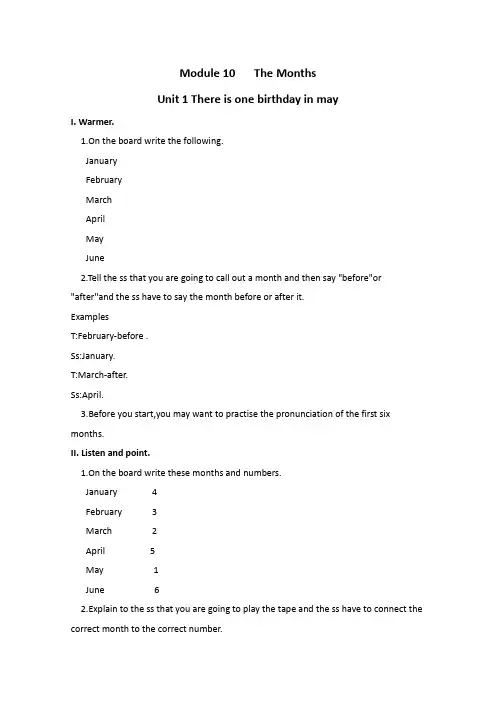
Module 10 The MonthsUnit 1 There is one birthday in mayI. Warmer.1.On the board write the following.JanuaryFebruaryMarchAprilMayJune2.Tell the ss that you are going to call out a month and then say "before"or "after"and the ss have to say the month before or after it.ExamplesT:February-before .Ss:January.T:March-after.Ss:April.3.Before you start,you may want to practise the pronunciation of the first six months.II. Listen and point.1.On the board write these months and numbers.January 4February 3March 2April 5May 1June 62.Explain to the ss that you are going to play the tape and the ss have to connect the correct month to the correct number.3.The numbers represent the amont of birthday parties that Lingling is going to go to.4.Tell the ss to close their books.5.They may need to listen to the tape two or three times.6.Tell the ss to open their books and to check if they have got the numbers correct.7.Now play the tape again and get the ss to follow the complete dialogue in their books.III. Point,ask and answer.1.Write the six months on large pieces of paper.2.Invite six ss to the front and tell them to stand in a circle.3.Give each student the name of one of the months.4.Explain that you are going to call out two months and the ss holding those two months must move to the center of the circle,swap pieces of the paper and say the months ,and then go back to where they were standing before.5.The teacher then calls out another two months and so on.6.The rest of the class must listen and ,if the teacher says a month that is not included in the the circle ,like"July",then the rest of the class must stand up and say "No".7.This is a great way of getting lots of practice with the months and also a fun activity.8.Now do the activity in the book.Get the ss to work in pairs .They should ask and answer questions about the number of birthdays in each month.。
(外研版)四年级英语上册教案Module10 unit1
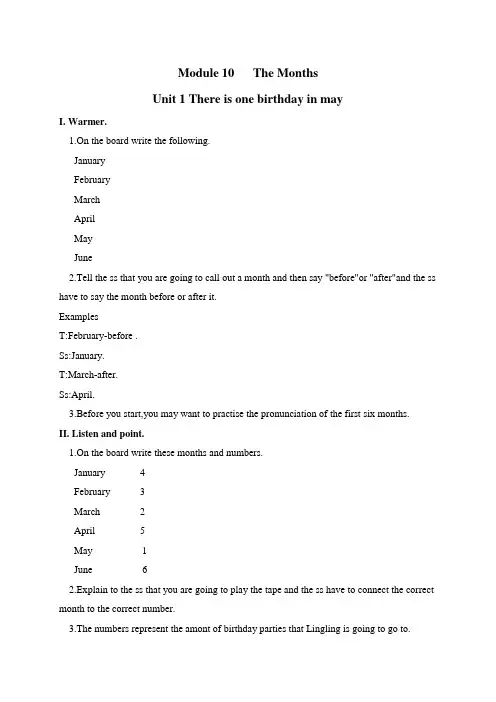
Module 10 The MonthsUnit 1 There is one birthday in mayI. Warmer.1.On the board write the following.JanuaryFebruaryMarchAprilMayJune2.Tell the ss that you are going to call out a month and then say "before"or "after"and the ss have to say the month before or after it.ExamplesT:February-before .Ss:January.T:March-after.Ss:April.3.Before you start,you may want to practise the pronunciation of the first six months.II. Listen and point.1.On the board write these months and numbers.January 4February 3March 2April 5May 1June 62.Explain to the ss that you are going to play the tape and the ss have to connect the correct month to the correct number.3.The numbers represent the amont of birthday parties that Lingling is going to go to.4.Tell the ss to close their books.5.They may need to listen to the tape two or three times.6.Tell the ss to open their books and to check if they have got the numbers correct.7.Now play the tape again and get the ss to follow the complete dialogue in their books. III. Point,ask and answer.1.Write the six months on large pieces of paper.2.Invite six ss to the front and tell them to stand in a circle.3.Give each student the name of one of the months.4.Explain that you are going to call out two months and the ss holding those two months must move to the center of the circle,swap pieces of the paper and say the months ,and then go back to where they were standing before.5.The teacher then calls out another two months and so on.6.The rest of the class must listen and ,if the teacher says a month that is not included in the the circle ,like"July",then the rest of the class must stand up and say "No".7.This is a great way of getting lots of practice with the months and also a fun activity.8.Now do the activity in the book.Get the ss to work in pairs .They should ask and answer questions about the number of birthdays in each month.。
外研版(一起)四年级英语上册教案Module10Unit2(1)

外研版(一起)四年级英语上册教案Module 10 UNIT 2 I've got a stomach ache一、教学目标:1. Continue to learn expressing illness.2. Learn a new English song二、教学重点和难点:1. Words of describing illness.headache cold toothache fever2. An English song.教学用具:The recorder and some pictures教学方法:Demonstration and Performance三、教学内容及过程:1. 导入:Play the game “Simple Simon says”. Tell the students that they have to follow the teacher instructions. They must have only follow the instruction when it is preceded by the words “Simple Simon says”.T:Simple Simon says touch your head.Ss: (touch their heads)T: Touch your stomachs.Ss: (don’t touch their stomachs).四、教学步骤及操练:Step1.Have the students look at the pictures, and told them : I am at home. I am not at school. Why? Let them guess.Step2.Listen to the tape carefully and try to know what happened to them? Listen to the tape again and repeat these sentences.Step3.Write down the key sentences on the board and explain them, when and how to use it.Step4.Ask them some questions such as: What happened to Li Jie/ WangFei/ Shanshan/Mingming?Step5.Learn to sing.Play the spoken version of the song and get the students to repeat the words.Play the second version and let the students listen to the melody or they can sing along with the music.五、教学小结:Talk about the illness.To learn the sentences.六、家庭作业:Listen to the tape three timesWrite the words two times.Headache cold toothache fever七、板书设计:Module10 Unit 2Wang Fei’s got a cold.Li Jie at home got a headache.Wang Fei at home got a cold.Shanshan at home got a toothache.Mingming at home got a fever.。
外研版英语备课4年级上册模块1-10教案

知识整合点 教学重点
学会描述路线的功能句型 Where is the Train 1? It's up/down the hill./It's near the houses./It's at the station. 1. station, train 的音、义、形的掌握。
导
It’s…
station
near the houses at the 反
图
思
课 题 Module 2 Unit 1 She’s reading a book
教 知识目标 学 目 能力目标 标
情感目标
学习单词和短语" picture 、friend 、take pictures 、talk to 、little 、play with" 和句型"This is...He's/She's…" 能够听、说、认读单词,能够讲 述正在发生的事情。
培养学生学习英语的兴趣,激励 学生积极参与活动,逐步养成自觉学习的好习惯。
知识整合点
教学重点 教学难点 课时安排
掌握本课语言结构。能听、说、 认读单词和短语,并能熟练运用新知识。 灵活运用知识讲述正在发生的事情。
1
教学准备
多媒体课件、卡片
4
主备内容
我的修正
(一)、热身活动,前置复习 1.Greetings, Free talk 老师和学生互相问好。在自由谈话中,随机
2.点读笔导读课本第一部分,然后听一遍录音 后跟读。
(二) 、 激情导入,学习新知
四年级英语上册教案Module10 Unit1 外研版一起

Module 10 Unit 1Go to bed early.教学设计教材分析:本模块着重学习一些动词短语,同时复习动词过去式的用法。
在Unit1里,以Sam 感冒看医生的故事为线索, 通过故事,学习一些表示建议的动词短语,能够根据语境给予相关建议。
教学目标:1. Students learn some special verbs phrases and some sentence patterns.Go to bed early/drink a lot of water/do some exercise/take this medicine …2. Help the students use these words and sentences in activities and daily life.3. Students will practice their ability of speaking and communication.教学重难点:1. To master the basic sentence pattern “go to bed early.”2.To know how to give advice for their health.3.To master some verbs like play/take/drink/do…教学准备:Multimedia, cards, ppt, and CD-ROM.教学过程:1.Warm-up1). Free talk: “When do you get up in the morning?” & “When do you go to bed at night?”Show them some animals on the screen, and ask them: “When do you get up in the morning?”and “When do you go to bed at night?”T: Boys and girls, please look at the screen. This is my timetable. Please read it carefully, and tell me, when do I get up in the morning?S1: You get up at 6:00.T: Great! I get up early in the morning. When do I go to bed at night?S2: You go to bed at 11:30.T: Oh, yes. I go to bed at 11:30 at night. It’s too late. Do you think so?Ss: Yes, you go to bed too late.T: Is my lifestyle healthy?Ss: No, you should go to bed early.(It’s ok if they speak in Chinese.)T: Ok! Your advice is pretty good for me. When do you get up in the morning?S3: …T: When do you go to bed at night?S4: …T: That’s good! You get up early in the morning and go to bed early at night.2). Activity 1. Listen, point and say.T: Boys and girls, look here. What’s this animal?Ss: It’s a chicken. (It’s ok if they speak Chinese.)T: Yes, it’s a cock. When does it get up? Early or late?Ss: Early.T: Perfect! How about this animal?Ss: Wow! An owl.T: Right! It’s an owl. When does it get up? In the morning or at night?T: Good! It gets up late. Now let’s listen to the tape.Play the CD-ROM.【设计意图】The free talk will draw students’ attention and their interests. They will have a review on some verbal phrases and the main topic. This process will make them ready for the class, make them familiar with the new sentence pattern and lead in the new topic of this lesson. 2.Presentation1). Activity2. Listen, point and find.T: Boys and girls, look at this picture. Who is he?Ss: He is Sam.T: Does he look happy?Ss: No, he looks unhappy.T: What’s the matter with him?Ss: …(students guess, and it’s ok if they speak Chinese.)T: Well, let’s listen to the tape and check the answer.Play the CD-ROM.T: Boys and girls, where is Sam?Ss: he is in the hospital.T: What’s wrong with him?Ss: He’s got a cold.T: What did he do yesterday?Now, let’s listen to the tape again. And answer my question.Question 1: what did he do yesterday?Question 2: what’s the doctor’s suggestion?2). Listen again for detailed information.Play the CD-ROM again.Discuss and check the answer.Learn early & lateLearn duringLearn have got a coldLearn take this medicine & drink a lot of water & do some exercise3). Listen again and read.Play the CD-ROM again, and read after it.T: Boys and girls, now we will listen to the tape again. This time, please try to imitate the pronunciation and intonation.【设计意图】This procedure is to learn the new text. The Task-based method is used to lead students to read the story carefully and get information from the text. Imitation and repeat will improve students’ pronunciation.3.Practice1). Role-play.Students will read the story by group, or by role.2). Pair work: Activity3 on page58.Make a new story about this topic. Two students work in one group. And try to play it out.3). Practice Activity4 on page58.【设计意图】The new knowledge they have learned will be consolidated, and they will practice their skill of communication and expression.4.SummaryStudents sum up the knowledge they have learned.【设计意图】The summary is another kind of consolidation.5.Homework1). Listen to the story 3 times and try to retell it to your parents.2). Copy the key sentence and key words 3 times.【设计意图】Let students do some exercises after class to consolidate the knowledge they have learned.教学反思:。
四年级上册英语教案Module10Unit1Wehaveabigfamilydinner.外研社

一、教学根本信息教师9号时间课题M10U1Wehavebigfamily课型new dinner二、教学背景分析本单元围绕SpringFestival这一主题展开,快放寒假了,Daming送给Sam一本介绍中国春节的书。
Sam和Amy不了解春节是什么样的节日,Daming就给他们解释了春节的含义以及过春节时的风俗习惯,并请Sam和Amy吃糖和花生,两人现学现用,马上给Daming拜年,但Daming觉得很有趣,因为现在还没到春节。
课文运用we句型描述节日的活动,学生易于接受。
三、教学目标1. 知识技能目标:〔1〕能听说读认单词:family,dinner,NewYear,theSpringFestival ,Chinese, peanut,I see.〔2〕能听懂并会说句子:HappyNewYear! 用AtSpringFestival,we 描述春节活动。
过程方法目标:〔1〕在简短的chant下,稳固课文中单词。
〔2〕通过听音填空,听音选择,听音判断等学习句型we〔3〕通过整体听课文复述课文,摘苹果的方式稳固单词,思维导图的方式总结,加强课文重点句的学习。
情感态度目标:〔1〕培养学生爱家的情感,激发学习兴趣,提高将实际生活与英语学习的结合的能力。
〔2〕培养学生对我国传统节日的热爱以及对我们祖国的热爱。
四、教学重难点第1 页教学重点:能运用AtSpringFestival,we 来描述春节场景。
教学难点:单词spring,festival 、family 的正确发音。
小学英语备课卡五、教学过程步骤与教师活动学生活动时间一、Greetings Greetings.Warm-T:twogroupsupsweetsgrouppeanutsgroup生lookandlistenthe欣赏一个chant chant1T:boysandgirls ,let’senjoyachant 设计意图师生简单问好,拉近师生距离,创造和谐的上课气氛。
外研版小学英语四年级上册Module10 第1课时教案
Module10 第1课时教案一、教学内容Module 10 Unit 1 We have a big family dinner.1. Listen and chant.2. Listen, point and find “we...”二、教学目标1. 能听、说、认读与春节有关的词:peanut, sweets, the Spring Festival, for, about, Chinese, New Year。
2. 能熟练运用At the Spring Festival, we have ... HappyNew Year.等句型谈论与春节有关的话题。
3. 会表达节日问候以及介绍春节的主要活动。
4. 提高对我国传统节日的认识,培养爱国、爱家的意识,提髙实际语言交际能力。
三、重点难点重点:能够熟练掌握有关春节相关词汇及交际用语,并能在实际生活中表达节日问候、介绍中国的传统节日。
难点:能灵活地介绍春竹的主要活动和风俗习惯,如: At the Spring Festival, we have ...四、教学准备多媒体课件、卡片、音频、对联等与春节相关的物品。
五、教学设计Step 1 Warming up1. Greetings.2. 在教室门上贴上一个福字和.副对联,教室窗户上贴上几朵窗花,然后放英语歌曲“Happy New Year!"设计意图:贴对联,唱歌曲,为学生创设节日氛围,带入本课的主题,调动学生学习的积极性,激发学生的求知欲。
Step 2 Presentation1. 学习Listen and chant.(1) T: What’s it about? You can say it in Chinese.(板书单词“about”用不同方式来学习,如:This is a book about English. Here is a book about Chinese.力求让每个学生掌握。
外研版(三起)四年级英语上册精品教案Module 10 unit 1教案
Module 10 Unit 1 We have a big family dinner.教学目标:Happy New Year!At Spring Festival, we have a big family dinner.功能:表达节日问候以及描述过节时的风俗习惯教学用具:a recorder, word cards, pictures教学过程:1、热身复习老师出示事先准备好的一些食物卡片,询问学生:“What do you like?”引导学生回答:“I like...”老师根据学生的回答把不同的食物卡片分发给学生。
然后询问学生:“What have you got?”引导学生回答:“I’ve got...”或者学生以小组为单位回答:“We’ve got...”2、课文导入老师播放过春节的音乐或者爆竹声,带领学生进入课文的主题。
等音乐完毕,老师问学生:“What is it about?”学生可以用中文说:“春节”。
老师借机教授新单词“Spring Festival”。
然后老师继续提出问题:“What do we say at Spring Festival? What do we have at Spring Festival?”请学生以小组为单位进行讨论,然后向全班汇报。
3、课文教学1)老师把本课的挂图贴在黑板上,通过播放录音或教学VCD呈现SB Unit1活动1的内容。
请学生边看图或动画片边听课文录音,尽可能多地理解课文内容。
听过第一遍录音后,老师可以提一些问题,请学生带着问题听第二遍录音,例如:“What’s the book about? What is Spring Festival? At Spring Festival, what do we have?”听过第二遍录音后,请学生试着回答上述问题。
听第三遍录音时,请学生打开书,边听边跟读,同时画出新单词。
老师讲解新单词,帮助学生理解课文。
外研版4年级英语上册教案Module 10Unit 1
Unit 1We have a big family dinner.本课时是第十模块的第一单元内容(教材第56~58页)。
本单元主要是向外国朋友介绍中国的传统佳节——春节。
让学生学会使用句型“At+节日名称,we+动词(短语)原形+其他”向外国朋友介绍中国人在过某个节日时的风俗习惯。
知识目标1.听、说、认读单词:family,year,Chinese;2.听、说单词:dinner,festival;3.听、说短语:New Year,the Spring Festival;4.运用句型“At+节日名称,we+动词(短语)原形+其他”描述在某个节日做某事。
能力目标1.能够听懂录音内容,模仿录音的语音、语调;2.能够流利地朗读课文并复述课文内容;3.能够运用所学句型向他人介绍在过某个节日时的风俗习惯;4.能够准确地向他人表达节日祝福。
情感目标提高对传统节日及传统文化的认识,增强爱国意识。
教学重点1.掌握本课时的单词和短语:family,dinner,year,Chinese,festival,New Year,the Spring festival;2.熟练运用句型“At+节日名称,we+动词(短语)原形+其他”描述在某个节日里的主要活动。
借助单词卡片掌握本单元的新词汇,通过听、说、读、练的方式反复操练本单元的重点句型。
教学难点1.熟练掌握与春节有关的词汇和交际用语;2.在真实的环境中,熟练地运用句型“At+节日名称,we+动词(短语)原形+其他”描述在某个节日的主要活动,准确地传递信息。
通过归纳总结的方式掌握与春节有关的词汇;充分利用互联网查找与春节相关的文化知识,筛选正确信息;创设真实的情境,采用游戏和角色扮演的方式,引起学生兴趣,引导学生进行有效目标语言的输出,做到在用中学,边学边巩固练习。
多媒体课件、单词卡片、花生和糖果实物、食物卡片。
Step 1:Warm-up1.Greeting2.Free talk教师播放过春节时常用的音乐或者爆竹声,音乐播放完之后,教师与学生交流。
外研版小学四年级英语上册Module 10教案
Unit 1 We have a big family dinner. 【教学目标】Teaching goals:知识与技能:能听说读认单词: family, dinner, New Year, the Spring Festival , Chinese,peanut, I see.能听懂并会说句子:Happy New Year ! At the Spring Festival , we have abig family dinner.过程与方法:能力目标:使学生能够学会表达新年问候及描述过春节时的风俗习惯。
情感态度与价值观:培养学生对我国传统节日的认识,培养爱国、爱家的学习氛围,激发学习兴趣,提高将实际生活与英语学习的结合的能力。
【重点难点】1. New words: family, dinner, New Year, the Spring Festival,Chinese, peanut, I see.2. Sentences: Happy New Year! At the Spring Festival, we have a big family dinner. We have peanuts and sweets.【教具准备】PPT课件、单词卡片、人物头像、CD-ROM【教学方法】情景教学、游戏、合作探究、任务型教学法【教学过程】Step 1: Warm-upchantI like coffee ,I like tea.介绍今日课题:Today we are going to learn Module 10 Unit 1 We have a big family dinner.Step 2: Leading教师ppt出示一张张关于春节的图片,请同学们猜是什么节日?老师播放过春节的音乐或者爆竹声,带领学生进入课文的主题。
等音乐完毕, (1)引入单词老师问学生:“What is it about?”学生可以用中文说:“春节”。