
美国经典英文演讲100篇
Adlai E. Stevenson: Speech Accepting the Democratic PresidentialNominationMr. President, Ladies and Gentlemen of the Convention, My Fellow Citizens. I accept your nomination and your program. I should have preferred to hear those words uttered by a stronger, a wiser, a better man than myself. But, after listening to the President’s speech, I even feel better about myself. None of you, my friends, can wholly appreciate what is in my heart. I can only hope that you understand my words. They will be few.I have not sought the honor you have done me. I could not seek it, because I aspired to another office, which was the full measure of my ambition, and one does not treat the highest office within the gift of the people of Illinois as an alternative or as a consolation prize.I would not seek your nomination for the Presidency, because the burdens of that office stagger the imagination. Its potential for good or evil, now and in the years of our lives, smothers exultation and converts vanity to prayer.I have asked the Merciful Father -- the Father of us all -- to let this cup pass from me, but from such dreaded responsibility one does not shrink in fear, in self-interest, or in false humility. So, “If this cup may not pass from me, except I drink it, Thy will b e done.”That my heart has been troubled, that I have not sought this nomination, that I could not seek it in good conscience, that I would not seek it in honest self-appraisal, is not to say that I value it the less. Rather, it is that I revere the office of the Presidency of the United States. And now, my friends, that you have made your decision, I will fight to win that office with -- with all my heart and my soul. And, with your help, I have no doubt that we will win.You have summoned me to the highest mission within the gift of any people. I could not be more proud. Better men than I were at hand for this mighty task, and I owe to you and to them every resource of mind and of strength that I possess to make your deed today a good one for our country and for our party. I am confident too, that your selection for -- of a candidate for Vice President will strengthen me and our party immeasurably in the hard, the implacable work that lies ahead of all of us.I know you join me in gratitude and respect for the great Democrats and the leaders of our generation whose names you have considered here in this convention, whose vigor, whose character, whose devotion to the Republic we love so well have won the respect of countless Americans and have enriched our party. I shall need them; we shall need them, because I have not changed in any respect since yesterday.Your nomination, awesome as I find it, has not enlarged my capacities, so I am profoundly grateful and emboldened by their comradeship and their fealty, and I have been deeply moved by their expressions of good will and of support. And I cannot, my friends, resist the urge to take the one opportunity that has been afforded me to pay my humble respects to a very great and good American, whom I am proud to call my kinsman, Alben Barkely of Kentucky.Let me say, too, that I have been heartened by the conduct of this convention. You have argued and disagreed, because as Democrats you care and you cared deeply. But you have disagreed and argued without calling each other liars and thieves, without despoiling our best traditions --you have not spoiled our best traditions in any naked struggles for power.And you have written a platform that neither equivocates, contradicts, nor evades. You have restated our party’s record, its principles and its purposes, in language that none can mistake, and with a firm confidence in justice, freedom, and peace on earth that will raise the hearts and the hopes of mankind for that distant day when no one rattles a saber and no one drags a chain.For all things I am grateful to you. But I feel no exultation, no sense of triumph. Our troubles are all ahead of us. Some will call us appeasers; others will say that we are the war party. Some will say we are reactionary; other swill say that we stand for socialism. There will be inevitable -- the inevitable cries of “throw the rascals out,” “it’s time for a change,” and so on and so on.We’ll hear all those things and many more besides. But we will hear nothing that we have not heard bef ore. I’m not too much concerned with partisan denunciation, with epithets and abuse, because the workingman, the farmer, the thoughtful businessman, all know that they are better off than ever before, and they all know the Great Depression under the hammer blows of the Democratic party.Nor am I afraid that the precious two-party system is in danger. Certainly the Republican party looked brutally alive a couple of weeks ago -- and I mean both Republican parties. Nor am I afraid the Democratic party is old and fat and indolent. After a hundred and fifty years, it has been old for a long time, and it will never be indolent, as long as it looks forward and not back, as long as it commands the allegiance of the young and the hopeful who dream the dreams and see the visions of a better America and a better world.You will hear many sincere and thoughtful people express concern about the continuation of one party in power for twenty years. I don’t belittle this attitude. But change for the sake of change has no absolute merit in itself. If our greatest hazard is preservation of the values of Western civilization, in our self-interest alone, if you please, it is the part -- is it the part of wisdom to change for the sake of change toa party with a split personality, to a leader, whom we all respect, but who has been called upon to minister to a hopeless case of political schizophrenia?If the fear is corruption in official position, do you believe with Charles Evans Hughes that guild is personal and knows no party? Do you doubt the power of any political leader, if he has the will too do so, to set his own house in order without his neighbors having to burn it down?What does concern me, in common with thinking partisans of both parties, is not just winning this election but how it is won, how well we can take advantage of this great quadrennial opportunity to debate issues sensibly and soberly. I hope and pray that we Democrats, win or lose, can campaign not as a crusade to exterminate the opposing party, as our opponents seem to prefer, but as a great opportunity to educated and elevate a people whose destiny is leadership, not alone of a rich and prosperous, contented country, as in the past, but of a world in ferment.And, my friends even more important than winning the election is governing the nation. That is the test of a political party, the acid, final test. When the tumult and the shouting die, when the bands are gone and the lights are dimmed, there is the stark reality of responsibility in an hour of history haunted with those gaunt, grim specters of strife, dissension, and materialism at home and ruthless, inscrutable, and hostile power abroad.The ordeal of the twentieth century, the bloodiest, most turbulent era of the whole Christian age, is far from over. Sacrifice, patience, understanding, and implacable purpose may be our lot of years to come. Let’s face it. Let’s talk sense to the American people. Let’s tell them the truth, that there are no gains without pains, that there -- that we are now on the eve of great decisions, not easy decisions, like resistance when you’re attacked, but a long, patient, costly struggle which alone can assure triumph over the great enemies of man -- war, poverty, and tyranny -- and the assaults upon human dignity which are the most grievous consequences of each.Let’s tell them that the victory to be won in the twentieth century, this portal to the Golden Age, mocks the pretensions of individual acumen and ingenuity, for it is a citadel guarded by thick walls of ignorance and of mistrust which do not fall before the trumpets’ blast or the politicians’ imprecations or even a general’s baton. The are, they are, my friends, walls that must be directly stormed by the hosts of courage, of morality, and of vision, standing shoulder to shoulder, unafraid of ugly truth, contemptuous of lies, half truths, circuses, and demagoguery.The people are wise, wiser than the Republicans think. And the Democratic party is the people’s party -- not the labor party, not the farmers’ party, not the employers’ party -- it is the party of no one because it is the party of everyone.That, that, I -- I think, is our ancient mission. Where we have deserted it, we have failed. With your help, there will be no desertion now. Better we lose the election than mislead the people, and better we lose than misgovern the people. Help me to do the job in these years of darkness, of doubt, and of crisis which stretch beyond the horizon of tonight’s happy vision, and we will justify our glorious past and the loyalty of silent millions who look to us for compassion, for understanding, and for honest purpose, Thus we will serve our great tradition greatly.I ask of you all you have. I will give you all I have, even as he who came here tonight and honored me, as he has honored you, the Democratic party, by a lifetime of service and bravery that will find him an imperishable page in the history of the Republic and of the Democratic party -- President Harry S. Truman.And finally, my friends, in this staggering task you have assigned me, I shall always try “to do justly, to love mercy, and to walk humbly with my God.”。
美国经典英文演讲100篇A_Whisper_of_AIDS

美国经典英文演讲100篇:A Whisper of AIDSText version below transcribed directly from audio.Less than three months ago at platform hearings in Salt Lake City, I asked the Republican Party to lift the shroud of silence which has been draped over the issue of HIV and AIDS. I have t I believe that in all things there is a purpose; and I stand before you and before the nation gladly. The reality of AIDS is brutally clear. Two hundred thousand Americans are dead or dying. A million more are infected. Worldwide, forty million, sixty million, or a hundred million infections will be counted in the coming few years. But despite science and research, White House meetings, and congressional hearings, despite good intentions and bold initiatives, campaign slogans, and hopeful promises, it is -- despite it all -- the epidemic which is winning tonight.In the context of an election year, I ask you, here in this great hall, or listening in the quiet of your home, to recognize that AIDS virus is not a political creature. It does not care whether you are Democrat or Republican; it does not ask whether you are black or white, male or female, gay or straight, young or old.Tonight, I represent an AIDS community whose members have been reluctantly drafted from every segment of American society. Though I am white and a mother, I am one with a black infant struggling with tubes in a Philadelphia hospital. Though I am female and contracted this disease in marriage and enjoy the warm support of my family, I am one with the lonely gay man sheltering a flickering candle from the cold wind of his family’s rejection.This is not a distant threat. It is a present danger. The rate of infection is increasing fastest among women and children. Largely unknown a decade ago, AIDS is the third leading killer of young adult Americans today. But it won’t be third for long, because unlike other diseases, this one travels. Adolescents don’t give each other cancer or heart disease because they believe they are in love, but HIV is different; and we have helped it along. We have killed each other with our ignorance, our prejudice, and our silence.We may take refuge in our stereotypes, but we cannot hide there long, because HIV asks only one thing of those it attacks. Are you human? And this is the right question. Are you human? Because people with HIV have not entered some alien state of being. They are human. They have not earned cruelty, and they do not deserve meanness. They don’t benefit from being isolated or treated as outcasts. Each of them is exactly what God made: a person; not evil, deserving of our judgment; not victims, longing for our pity -- people, ready for support and worthy of compassion.My call to you, my Party, is to take a public stand, no less compassionate than that of the President and Mrs. Bush. They have embraced me and my family in memorable ways. In the place of judgment, they have shown affection. In difficult moments, they have raised our spirits. In the darkest hours, I have seen them reaching not only to me, but also to my parents, armed with that stunning grief and special grace that comes only to parents who have themselves leaned too long over the bedside of a dying child.With the President’s leadership, much good has been done. Much of the good has gone unheralded, and as the President has insisted, much remains to be done. But we do the President’s cause no good if we praise the American family but ignore a virus that destroys it.We must be consistent if we are to be believed. We cannot love justice and ignore prejudice, love our children and fear to teach them. Whatever our role as parent or policymaker, we must act as eloquently as we speak -- else we have no integrity. My call to the nation is a plea for awareness. If you believe you are safe, you are in danger. Because I was not hemophiliac, I was not at risk. Because I was not gay, I was not at risk. Because I did not inject drugs, I was not at risk.My father has devoted much of his lifetime guarding against another holocaust. He is part of the generation who heard Pastor Nemoellor come out of the Nazi death camps to say,“They came after the Jews, and I was not a Jew, so, I did not protest. They came after the trade unionists, and I was not a trade unionist, so, I did not protest. Then they came after the Roman Catholics, and I was not a Roman Catholic, so, I did not protest. Then they came after me, and there was no one left to protest.”The -- The lesson history teaches is this: If you believe you are safe, you are at risk. If you do not see this killer stalking your children, look again. There is no family or community, no race or religion, no place left in America that is safe. Until we genuinely embrace this message, we are a nation at risk.Tonight, HIV marches resolutely toward AIDS in more than a million American homes, littering its pathway with the bodies of the young -- young men, young women, young parents, and young children. One of the families is mine. If it is true that HIV inevitably turns to AIDS, then my children will inevitably turn to orphans. My family has been a rock of support.My 84-year-old father, who has pursued the healing of the nations, will not accept the premise that he cannot heal his daughter. My mother refuses to be broken. She still calls at midnight to tell wonderful jokes that make me laugh. Sisters and friends, and my brother Phillip, whose birthday is today, all have helped carry me over the hardest places. I am blessed, richly and deeply blessed, to have such a family.But not all of you -- But not all of you have been so blessed. You are HIV positive, but dare not say it. You have lost loved ones, but you dare not whisper the word AIDS. You weep silently. You grieve alone. I have a message for you. It is not you who should feel shame. It is we -- we who tolerate ignorance and practice prejudice, we who have taught you to fear. We must lift our。
[整理]100篇美国经典英文演讲稿
![[整理]100篇美国经典英文演讲稿](https://360docs-1393072327.cos.ap-beijing.myqcloud.com/c32c4fed50e2524de5187e6f.webp)
美国经典英文演讲100篇:Brandenburg Gate AddressRonald ReaganRemarks at the Brandenburg Gatedelivered 12 June 1987, West Berlin[AUTHENTICITY CERTIFIED: Text version below transcribed directly from audio.(2)]Thank you. Thank you, very much.Chancellor Kohl, Governing Mayor Diepgen, ladies and gentlemen: Twenty four years ago, President John F. Kennedy visited Berlin, and speaking to the people of this city and the world at the city hall. Well since then two other presidents have come, each in his turn to Berlin. And today, I, myself, make my second visit to your city.We come to Berlin, we American Presidents, because it's our duty to speak in this place of freedom. But I must confess, we’re drawn here by other things as well; by the feeling of history in this city -- more than 500 years older than our own nation; by the beauty of the Grunewald and the Tiergarten; most of all, by your courage and determination. Perhaps the composer, Paul Linke, understood something about American Presidents. You see, like so many Presidents before me, I come here today because wherever I go, whatever I do: “Ich hab noch einen Koffer in Berlin” [I still have a suitcase in Berlin.]Our gathering today is being broadcast throughout Western Europe and North America. I understand that it is being seen and heard as well in the East. To those listening throughout Eastern Europe, I extend my warmest greetings and the good will of the American people. To those listening in East Berlin, a special word: Although I cannot be with you, I address my remarks to you just as surely as to those standing here before me. For I join you, as I join your fellow countrymen in the West, in this firm, this unalterable belief: Es gibt nur ein Berlin. [There is only one Berlin.]Behind me stands a wall that encircles the free sectors of this city, part of a vast system of barriers that divides the entire continent of Europe. From the Baltic South, those barriers cut across Germany in a gash of barbed wire, concrete, dog runs, and guard towers. Farther south, there may be no visible, no obvious wall. But there remain armed guards and checkpoints all the same -- still a restriction on the right to travel, still an instrument to impose upon ordinary men and women the will of a totalitarian state.Yet, it is here in Berlin where the wall emerges most clearly; here, cutting across your city, where the news photo and the television screen have imprinted this brutal division of a continent upon the mind of the world.Standing before the Brandenburg Gate, every man is a German separated from his fellow men.Every man is a Berliner, forced to look upon a scar.President Von Weizsäcker has said, "The German question is open as long as the Brandenburg Gate is closed." Well today -- today I say: As long as this gate is closed, as long as this scar of a wall is permitted to stand, it is not the German question alone that remains open, but the question of freedom for all mankind.Yet, I do not come here to lament. For I find in Berlin a message of hope, even in the shadow of this wall, a message of triumph.In this season of spring in 1945, the people of Berlin emerged from their air-raid shelters to find devastation. Thousands of miles away, the people of the United States reached out to help. And in 1947 Secretary of State -- as you've been told -- George Marshall announced the creation of what would become known as the Marshall Plan. Speaking precisely 40 years ago this month, he said: "Our policy is directed not against any country or doctrine, but against hunger, poverty, desperation, and chaos."In the Reichstag a few moments ago, I saw a display commemorating this 40th anniversary of the Marshall Plan. I was struck by a sign -- the sign on aburnt-out, gutted structure that was being rebuilt. I understand that Berliners of my own generation can remember seeing signs like it dotted throughout the western sectors of the city. The sign read simply: "The Marshall Plan is helping here to strengthen the free world." A strong, free world in the West -- that dream became real. Japan rose from ruin to become an economic giant. Italy, France, Belgium -- virtually every nation in Western Europe saw political and economic rebirth; the European Community was founded.In West Germany and here in Berlin, there took place an economic miracle, the Wirtschaftswunder. Adenauer, Erhard, Reuter, and other leaders understood the practical importance of liberty -- that just as truth can flourish only when the journalist is given freedom of speech, so prosperity can come about only when the farmer and businessman enjoy economic freedom. The German leaders -- the German leaders reduced tariffs, expanded free trade, lowered taxes. From 1950 to 1960 alone, the standard of living in West Germany and Berlin doubled.Where four decades ago there was rubble, today in West Berlin there is the greatest industrial output of any city in Germany: busy office blocks, fine homes and apartments, proud avenues, and the spreading lawns of parkland. Where a city's culture seemed to have been destroyed, today there are two great universities, orchestras and an opera, countless theaters, and museums. Where there was want, today there's abundance -- food, clothing, automobiles -- the wonderful goods of the Kudamm.¹ From devastation, from utter ruin, you Berliners have, in freedom, rebuilt a city that once again ranks as one of the greatest on earth. Now the Soviets may have had other plans. But my friends, there were a few things the Soviets didn't count on: Berliner Herz, Berliner Humor, ja, und Berliner Schnauze. [Berliner heart, Berliner humor, yes, and a Berliner Schnauze.²]In the 1950s -- In the 1950s Khrushchev predicted: "We will bury you."But in the West today, we see a free world that has achieved a level of prosperity and well-being unprecedented in all human history. In the Communist world, we see failure, technological backwardness, declining standards of health, even want of the most basic kind -- too little food. Even today, the Soviet Union still cannot feed itself. After these four decades, then, there stands before the entire world one great and inescapable conclusion: Freedom leads to prosperity. Freedom replaces the ancient hatreds among the nations with comity and peace. Freedom is the victor.And now -- now the Soviets themselves may, in a limited way, be coming to understand the importance of freedom. We hear much from Moscow about a new policy of reform and openness. Some political prisoners have been released. Certain foreign news broadcasts are no longer being jammed. Some economicenterprises have been permitted to operate with greater freedom from state control.Are these the beginnings of profound changes in the Soviet state? Or are they token gestures intended to raise false hopes in the West, or to strengthen the Soviet system without changing it? We welcome change and openness; for we believe that freedom and security go together, that the advance of human liberty -- the advance of human liberty can only strengthen the cause of world peace.There is one sign the Soviets can make that would be unmistakable, that would advance dramatically the cause of freedom and peace.General Secretary Gorbachev, if you seek peace, if you seek prosperity for the Soviet Union and Eastern Europe, if you seek liberalization: Come here to this gate.Mr. Gorbachev, open this gate.Mr. Gorbachev -- Mr. Gorbachev, tear down this wall!I understand the fear of war and the pain of division that afflict this continent, and I pledge to you my country's efforts to help overcome these burdens. To be sure, we in the West must resist Soviet expansion. So, we must maintain defenses of unassailable strength. Yet we seek peace; so we must strive to reduce arms on both sides.Beginning 10 years ago, the Soviets challenged the Western alliance with a grave new threat, hundreds of new and more deadly SS-20 nuclear missiles capable of striking every capital in Europe. The Western alliance responded by committing itself to a counter-deployment (unless the Soviets agreed tonegotiate a better solution) -- namely, the elimination of such weapons on both sides. For many months, the Soviets refused to bargain in earnestness. As the alliance, in turn, prepared to go forward with its counter-deployment, there were difficult days, days of protests like those during my 1982 visit to this city; and the Soviets later walked away from the table.But through it all, the alliance held firm. And I invite those who protested then -- I invite those who protest today -- to mark this fact: Because we remained strong, the Soviets came back to the table. Because we remained strong, today we have within reach the possibility, not merely of limiting the growth of arms, but of eliminating, for the first time, an entire class of nuclear weapons from the face of the earth.As I speak, NATO ministers are meeting in Iceland to review the progress of our proposals for eliminating these weapons. At the talks in Geneva, we have also proposed deep cuts in strategic offensive weapons. And the Western allies have likewise made far-reaching proposals to reduce the danger of conventional war and to place a total ban on chemical weapons.While we pursue these arms reductions, I pledge to you that we will maintain the capacity to deter Soviet aggression at any level at which it might occur. And in cooperation with many of our allies, the United States is pursuing the Strategic Defense Initiative -- research to base deterrence not on the threat of offensive retaliation, but on defenses that truly defend; on systems, in short, that will not target populations, but shield them. By these means we seek to increase the safety of Europe and all the world. But we must remember a crucial fact: East and West do not mistrust each other because we are armed; we are armed because we mistrust each other. And our differences are not about weapons but about liberty. When President Kennedy spoke at the City Hall those24 years ago, freedom was encircled; Berlin was under siege. And today, despite all the pressures upon this city, Berlin stands secure in its liberty. And freedom itself is transforming the globe.In the Philippines, in South and Central America, democracy has been given a rebirth. Throughout the Pacific, free markets are working miracle after miracle of economic growth. In the industrialized nations, a technological revolution is taking place, a revolution marked by rapid, dramatic advances in computers and telecommunications.In Europe, only one nation and those it controls refuse to join the community of freedom. Yet in this age of redoubled economic growth, of information and innovation, the Soviet Union faces a choice: It must make fundamental changes, or it will become obsolete.Today, thus, represents a moment of hope. We in the West stand ready to cooperate with the East to promote true openness, to break down barriers that separate people, to create a safer, freer world. And surely there is no better place than Berlin, the meeting place of East and West, to make a start.Free people of Berlin: Today, as in the past, the United States stands for the strict observance and full implementation of all parts of the Four Power Agreement of 1971. Let us use this occasion, the 750th anniversary of this city, to usher in a new era, to seek a still fuller, richer life for the Berlin of the future. Together, let us maintain and develop the ties between the Federal Republic and the Western sectors of Berlin, which is permitted by the 1971 agreement.And I invite Mr. Gorbachev: Let us work to bring the Eastern and Western parts of the city closer together, so that all the inhabitants of all Berlin can enjoy the benefits that come with life in one of the great cities of the world.To open Berlin still further to all Europe, East and West, let us expand the vital air access to this city, finding ways of making commercial air service to Berlin more convenient, more comfortable, and more economical. We look to the day when West Berlin can become one of the chief aviation hubs in all central Europe.With -- With our French -- With our French and British partners, the United States is prepared to help bring international meetings to Berlin. It would be only fitting for Berlin to serve as the site of United Nations meetings, or world conferences on human rights and arms control, or other issues that call for international cooperation.There is no better way to establish hope for the future than to enlighten young minds, and we would be honored to sponsor summer youth exchanges, cultural events, and other programs for young Berliners from the East. Our French and British friends, I'm certain, will do the same. And it's my hope that an authority can be found in East Berlin to sponsor visits from young people of the Western sectors.One final proposal, one close to my heart: Sport represents a source of enjoyment and ennoblement, and you may have noted that the Republic of Korea -- South Korea -- has offered to permit certain events of the 1988 Olympics to take place in the North. International sports competitions of all kinds could take place in both parts of this city. And what better way todemonstrate to the world the openness of this city than to offer in some future year to hold the Olympic games here in Berlin, East and West.In these four decades, as I have said, you Berliners have built a great city. You've done so in spite of threats -- the Soviet attempts to impose theEast-mark, the blockade. Today the city thrives in spite of the challenges implicit in the very presence of this wall. What keeps you here? Certainly there's a great deal to be said for your fortitude, for your defiant courage. But I believe there's something deeper, something that involves Berlin's whole look and feel and way of life -- not mere sentiment. No one could live long in Berlin without being completely disabused of illusions. Something, instead, that has seen the difficulties of life in Berlin but chose to accept them, that continues to build this good and proud city in contrast to a surrounding totalitarian presence, that refuses to release human energies or aspirations, something that speaks with a powerful voice of affirmation, that says "yes" to this city, yes to the future, yes to freedom. In a word, I would submit that what keeps you in Berlin -- is "love."Love both profound and abiding.Perhaps this gets to the root of the matter, to the most fundamental distinction of all between East and West. The totalitarian world produces backwardness because it does such violence to the spirit, thwarting the human impulse to create, to enjoy, to worship. The totalitarian world finds even symbols of love and of worship an affront.Years ago, before the East Germans began rebuilding their churches, they erected a secular structure: the television tower at Alexander Platz. Virtually ever since, the authorities have been working to correct what they view as the tower's one major flaw: treating the glass sphere at the top with paints and chemicals of every kind. Yet even today when the sun strikes that sphere, that sphere that towers over all Berlin, the light makes the sign of the cross. There in Berlin, like the city itself, symbols of love, symbols of worship, cannot be suppressed.As I looked out a moment ago from the Reichstag, that embodiment of German unity, I noticed words crudely spray-painted upon the wall, perhaps by a young Berliner (quote):"This wall will fall. Beliefs become reality."Yes, across Europe, this wall will fall, for it cannot withstand faith; it cannot withstand truth. The wall cannot withstand freedom.And I would like, before I close, to say one word. I have read, and I have been questioned since I've been here about certain demonstrations against my coming. And I would like to say just one thing, and to those who demonstrate so.I wonder if they have ever asked themselves that if they should have the kind of government they apparently seek, no one would ever be able to do what they're doing again.-------------Thank you and God bless you all. Thank you. -------------。
美国经典英文演讲100篇Checkers

Richard M. Nixon: "Checkers"
"...the kids, like all kids, love the dog, and...regardless of what they say about it, we're gonna keep it."
[AUTHENTICITY CERTIFIED: Text version below transcribed directly from the audio]
My Fellow Americans,
I come before you tonight as a candidate for the Vice Presidency and as a man whose honesty and integrity has been questioned.
Now, the usual political thing to do when charges are made against you is to either ignthout giving details. I believe we've had enough of that in the United States, particularly with the present Administration in Washington, D.C. To me the office of the Vice Presidency of the United States is a great office, and I feel that the people have got to have confidence in the integrity of the men who run for that office and who might obtain it.
美国经典英文演讲100篇_0
美国经典英文演讲100篇各位读友大家好,此文档由网络收集而来,欢迎您下载,谢谢篇一:美国经典英文演讲100篇Black Power美国经典英文演讲100篇:”Black Power”Stokely CarmichaelBlack Powerdelivered October 1966, Berkeley, CA[AUTHENTICITY CERTIFIED: Text version below transcribed directly from audio. (2)]Thank you very much. It’s a privilege and an honor to be in the white intellectual ghetto of the West. We wanted to do a couple of things before we started. The first is that, based on the fact that SNCC, through the articulation of its program byits chairman, has been able to win elections in Georgia, Alabama, Maryland, and by ourappearance here will win an election in California, in 1968 I’m going to run for President of the United States. I just can’t make it, ‘cause I wasn’t born in the United States. That’s the only thing holding me back.We wanted to say that this is a student conference, as it should be, held on a campus, and that we’re not ever to be caught up in the intellectual masturbation of the question of Black Power. That’s a function of people who are advertisers that call themselves reporters. Oh, for my members and friends of the press, my self-appointed white critics, I was reading Mr. Bernard Shaw two days ago, and I came across a very important quote which I think is most apropos for you. He says, “All criticism is a[n] autobiography.” Digyourself. Okay. The philosophers Camus and Sartre raise the question whether or not a man can condemn himself. The black existentialist philosopher who is pragmatic, Frantz Fanon, answered the question. He said that man could not. Camus and Sartre was not. We in SNCC tend to agree with Camus and Sartre, that a man cannot condemn Were he to condemn himself, he would then have to inflict punishment upon himself. An example would be the Nazis. Any prisoner who -- any of the Nazi prisoners who admitted, after he was caught andincarcerated, that he committed crimes, that he killed all the many people that he killed, he committed suicide. The only ones who were able to stay alive were the ones who never admitted that they committed a crimes [sic] against people -- that is, the ones who rationalized that Jews were not human beings and deserved to bekilled, or that they were only following orders.On a more immediate scene, the officials and the population -- the white population -- in Neshoba County, Mississippi -- that’s where Philadelphia is -- could not -- could not condemn [Sheriff] Rainey, his deputies, and the other fourteen men that killed three human beings. They could not because they elected Mr. Rainey to do precisely what he did; and that for them to condemn him will be for them to condemn themselves.In a much larger view, SNCC says that white America cannot condemn herself. And since we are liberal, we have done it: You standcondemned. Now, a number of things that arises from that answer of how do you condemn yourselves. Seems to me that the institutions that function in this country are clearly racist, and that they’re built uponracism. And the question, then, is how can black people inside of this country move? And then how can white people who say they’re not a part of those institutions begin to move? And how then do we begin to clear away the obstacles that we have in this society, that make us live like human beings? How can we begin to build institutions that will allow people to relate with each other as human beings? This country has never done that, especially around the country of white or black.Now, several people have been upset because we’ve said thatintegration was irrelevant when initiated by blacks, and that in fact it was a subterfuge, an insidious subterfuge, for the maintenance of white supremacy. Now we maintain that in the past six years or so, this country has been feeding us a “thalidomide drug of integration,” and that some negroes have been walking down adream streettalking about sitting next to white people; and that that does not begin to solve the problem; that when we went to Mississippi we did not go to sit next to Ross Barnett2; we did not go to sit next to Jim Clark3; we went to get them out of our way; and that people ought to understand that; that we were never fighting for the right to integrate, we were fighting against white supremacy.Now, then, in order to understand white supremacy we must dismiss the fallacious notion that white people can give anybody their freedom. No man can give anybody his freedom. A man is born free. You may enslave a man after he is born free, and that is in fact what thiscountry does. It enslaves black people after they’re born, so that the only acts that white people can do is to stop denying black people their freedom; that is, theymust stop denying freedom. They never give it to anyone.Now we want to take that to its logical extension, so that we could understand, then, what its relevancy would be in terms of new civil rights bills. I maintain that every civil rights bill in this country was passed for white people, not for black people. For example, I am black.I know that. I also know that while I am black I am a human being, and therefore I have the right to go into any public place. White people didn’t know that. Every time I tried to go into a place they stopped me. So some boys had to write a bill to tell that white man, “He’s a human being; don’t stop him.” That bill was for that white man, not for me. I knew it all the time. I knew it all the time.I knew that I could vote and that that wasn’t a privilege; it was my right. Every time I tried I was shot, killed or jailed,beaten or economically deprived. So somebody had to write a bill for white people to tell them, “When a black man comes to vote, don’t bother him.” That bill, again, was for white people, not for black people; so that when you talk about open occupancy, I know I can live anyplace I want to live. It is white people across this country who are incapable of allowing me to live where I want to live. You need a civil rights bill, not me. I know I can live where I want to live.So that the failures to pass a civil rights bill isn’t because of Black Power, isn’t because of the Student Nonviolent CoordinatingCommittee; it’s not because of the rebellions that are occurring in the major cities. It is incapability of whites to deal with their own problems inside their own communities. That is the problem of the failure of the civil rights bill.And so in a larger sense we must then ask, How is it that black people move? And what do we do? But the question in a greater sense is, How can white people who are the majority -- and who are responsible for making democracy work -- make it work? They have miserably failed to this point. They have never made democracy work, be it inside the United States, Vietnam, South Africa, Philippines, South America, Puerto Rico. Wherever American has been, she has not been able to make democracy work; so that in a larger sense, we not only condemnthe country for what it’s done internally, but we must condemn it for what it does externally. We see this country trying to rule the world, and someone must stand up and start articulating that this country is not God, and cannot rule the world.Now, then, before we move on weought to develop the white supremacy attitudes that were either conscious or subconscious thought and how they run rampant through the society today. For example, the missionaries were sent to Africa. They went with the attitude that blacks were automatically inferior. As a matter of fact, the first act the missionaries did, you know, when they got to Africa was to make us cover up our bodies, because they said it got them excited. We couldn’t go bare-breasted any more because they got excited.Now when the missionaries came to civilize us because we were uncivilized, educate us because we were uneducated, and give us some -- some literate studies because we were illiterate, they charged a price. The missionaries came with the Bible, and we had the land. When they left, they had the land, and we still have the Bible. And that has been the rationalizationfor Western civilization as it moves across the world and stealing and plundering and raping everybody in its path. Their one rationalization is that the rest of the world is uncivilized and they are in fact civilized. And they are un-civil-ized.And that runs on today, you see, because what we have today is we have what we call “modern-day Peace Corps missionaries,” and they come into our ghettos and they Head Start, Upward Lift, Bootstrap, and Upward Bound us into white society, ‘cause they don’t want to face the real problem which is a man is poor for one reason and one reason only: ‘cause he does not have money -- period. If you want to get rid of poverty, you give people money -- period.And you ought not to tell me about people who don’t work, and you can’t give people money without working, ‘cause if that were true, you’d have to startstopping Rockefeller, Bobby Kennedy, Lyndon Baines Johnson, Lady Bird Johnson, the whole of Standard Oil, the Gulf Corp, all of them, including probably a large number of the Board of Trustees of this university. So the question, then, clearly, is not whether or not one can work; it’s Who has power? Who has power to make his or her acts legitimate? That is all. And that this country, that power is invested in the hands of white people, and they make their acts legitimate. It is now, therefore, for black people to make our acts legitimate.Now we are now engaged in a psychological struggle in this country, and that is whether or not black people will have the right to use the words they want to use without white people giving their sanction to it; and that we maintain, whether they like it or not, we gonna use the word “Black Power” -- and let themaddress themselves to that; but that we are not going to wait for white people to sanction Black Power. We’re tired waiting; every time black people move in this country, they’re forced to defend their position before they move. It’s time that the people who are supposed to be defending their position do that. That’s white people. They ought to start defending themselves as to why they have oppressed and exploited us.Now it is clear that when this country started to move in terms of slavery, the reason for a man being picked as a slave was one reason -- because of the color of his skin. If one was black one wasautomatically inferior, inhuman, and therefore fit for slavery; so that the question of whether or not we are individually suppressed is nonsensical, and it’s a dowight lie. We are oppressed as a group because we are black, not becausewe are lazy, not because we’re apathetic, not because we’re stupid, not because we smell, notbecause we eat watermelon and have good rhythm. We are oppressed because we are black.And in order to get out of that oppression one must wield the group power that one has, not the individual power which this country then sets the criteria under which a man may come into it. That is what is called in this country as integration: “You do what I tell you to do and then we’ll let you sit at the table with us.” And that we are saying that we have to be opposed to that. We must now set up criteria and that if there’s going to be any integration, it’s going to be a two-way thing. If you believe in integration, you can come live in Watts. You can send your children to the ghetto schools. Let’s talk about that. If you believe in integration,then we’re going to start adopting us some white people to live in our neighborhood.So it is clear that the question is not one of integration or segregation. Integration is a man’s ability to want to move in there by himself. If someone wants to live in a white neighborhood and he is black, that is his choice. It should be his rights. It is not because white people will not allow him. So vice versa: If a black man wants to live in the slums, that should be his right. Black people will let him. That is the difference. And it’s a difference on which this country makes a number of logical mistakes when they begin to try to criticize the program articulated by SNCC.篇二:美国经典英文演讲一百篇!练口语和演讲的好材料,值得收藏!!!美国经典英文演讲一百篇!练口语和演讲的好材料,值得收藏!!!梁志埠的日志? ? ? ? ? ? ? ? ? ? ? ? ? ? ? ? ? ? ? ? ?????????????????·美国20世纪经典英语演讲100篇(MP3+文本)·美国经典英文演讲100篇:Farewell Address to Congress ·美国经典英文演讲100篇:1984 DNC Address ·美国经典英文演讲100篇:WeShall Overcome ·美国经典英文演讲100篇:Shuttle’’Challenger’’Disaster Address ·美国经典英文演讲100篇:Checkers ·美国经典英文演讲100篇:Pearl Harbor Address to the Nation ·美国经典英文演讲100篇:I Have a Dream ·美国经典英文演讲100篇:Civil Rights Address ·美国经典英文演讲100篇:A Time to Break Silence-Beyond Vietnam ·美国经典英文演讲100篇:1988 DNC Keynote Address ·美国经典英文演讲100篇:Atoms for Peace ·美国经典英文演讲100篇:The Truman Doctrine ·美国经典英文演讲100篇:First Inaugural Address ·美国经典英文演讲100篇:The Great Arsenal of Democracy ·美国经典英文演讲100篇:Acres of Diamonds ·美国经典英文演讲100篇:The Great Silent Majority ·美国经典英文演讲100篇:Farewell Address ·美国经典英文演讲100篇:Oklahoma Bombing MemorialAddress ·美国经典英文演讲100篇:A Crisis of Confidence ·美国经典英文演讲100篇:1992 DNC Address ·美国经典英文演讲100篇:On Vietnam and Not Seeking Re-Election ·美国经典英文演讲100篇:Cambodian Incursion Address ·美国经典英文演讲100篇:Eulogy for Robert Francis Kennedy ·美国经典英文演讲100篇:Black Power ·美国经典英文演讲100篇:Chappaquiddick ·美国经典英文演讲100篇:40th Anniversary of D-Day Address ·美国经典英文演讲100篇:Presidential Nomination Acceptance.. ·美国经典英文演讲100篇:The Marshall Plan ·美国经典英文演讲100篇:A Whisper of AIDS ·美国经典英文演讲100篇:1988 DNC Address(下) ·美国经典英文演讲100篇:I’ve Been to the Mountaintop ·美国经典英文演讲100篇:Statement on the Articles of Impeachment ·美国经典英文演讲100篇:1984 DNC Keynote Address ·美国经典英文演讲100篇:Houston Ministerial Association Speech ·美国经典英文演讲100篇:The Ballot or the Bullet ·美国经典英文演讲100篇:1976 DNC Keynote Address ·美国经典英文演讲100篇:Inaugural Address ·美国经典英文演讲100篇:Television News Coverage? ? ? ? ? ? ? ? ? ? ? ? ? ? ? ? ? ? ? ? ? ? ? ·美国经典英文演讲100篇:Against Imperialism ·美国经典英文演讲100篇:The Four Freedoms ·美国经典英文演讲100篇:American University Commencement Address ·美国经典英文演讲100篇:Nobel Prize Acceptance Speech ·美国经典英文演讲100篇:First Fireside Chat ·美国经典英文演讲100篇:The Evil Empire ·美国经典英文演讲100篇:A Time for Choosing ·美国经典英文演讲100篇:Ich bin ein Berliner ·美国经典英文演讲100篇:Duty, Honor,Country ·美国经典英文演讲100篇:Remarks on the Assassination of MLKing ·美国经典英文演讲100篇:Message to the Grassroots ·美国经典英文演讲100篇:Address on Taking the Oath of Office ·美国经典英文演讲100篇:Sproul Hall Sit-in Speech... ·美国经典英文演讲100篇:1980 DNC Address ·美国经典英文演讲100篇:Statement to the Senate Judiciary... ·美国经典英文演讲100篇:Television and the Public Interest ·美国经典英文演讲100篇:Presidential Nomination ... ·美国经典英文演讲100篇:Religious Belief and Public Morality ·美国经典英文演讲100篇:Vice-Presidential Nomination... ·美国经典英文演讲100篇:Truth and Tolerance in America ·美国经典英文演讲100篇:The Great Society ·美国经典英文演讲100篇:1988 DNC Address(上) ·美国经典英文演讲100篇:Brandenburg GateAddress篇三:美国经典英文演讲100篇Sproul Hall Sit-in Speech美国经典英文演讲100篇:Sproul Hall Sit-in Speech...delivered 2 December 1964, The University of California at Berkeley[AUTHENTICITY CERTIFIED: Text version below transcribed directly from audio]You know, I just wanna say one brief thing about something the previous speaker said. I didn’t wanna spe nd too much time on that ‘cause I don’t think it’s important enough. But one thing is worth considering.He’s the -- He’s the nominal head of an organization supposedly representative of the undergraduates. Whereas in fact under the current director it derives -- its authority is delegated power from the Administration. It’s totally uepresentativeof the graduate students andBut he made the following statement (I quote): “I would ask all those who are not definitely committed to the FSM2 cause to stay away from demonstration.” Alright, now listen to this: “For all upper division students who are interested in alleviating the TA shortage problem, I would encourage you to offer your services to Department Chairmen and Advisors.” That has two things: A strike breaker and a fink. I’d like to say -- like to say one other thing about a union problem. Upstairs you may have noticed they’re ready on the 2nd floor of Sproul Hall, Locals 40 and 127 of the Painters Union are painting the inside of the 2nd floor of Sproul Hall. Now, apparently that action had been planned some time in the past. I’ve tried to contact those unions. Unfortunately -- and [it] tears my heart out -- they’re asbureaucratized as the Administration. It’s difficult to get through toanyone in authority there. Very sad. We’re still -- We’re still making an attempt. Those people up there have no desire to interfere with what we’re doing. I would ask that they be considered and that they not be heckled in any way. And I think that -- you know -- while there’s unfortunately no sense of -- no sense of solidarity at this pointbetween unions and students, there at least need be no -- you know -- excessively hard feelings between the two groups.Now, there are at least two ways in which sit-ins and civil disobedience and whatever -- least two major ways in which it can occur. One, when a law exists, is promulgated, which is totally unacceptable to people and they violate it again and again and again till it’s rescinded, appealed.Alr ight, but there’s another way. There’s another way. Sometimes, the form of the law is such as to render impossible its effective violation -- as a method to have it repealed. Sometimes, the grievances of people are more -- extend more -- to more than just the law, extend to a whole mode of arbitrary power, a whole mode of arbitrary exercise of arbitrary power.And that’s what we have here. We have an autocracy which -- which runs this university. It’s managed. We were told the following: IfPresident Kerr actually tried to get something more liberal out of the Regents in his telephone conversation, why didn’t he make somepublic statement to that effect? And the answer we received -- from a well-meaning liberal -- was the following: He said, “Wou ld you ever imagine the manager of a firm making a statementpublicly in opposition to his Board of Directors?” That’s the answer.Well I ask you to consider -- if this is a firm, and if the Board of Regents are the Board of Directors, and if President Kerr in fact is the manager, then I tell you something -- the faculty are a bunch of employees and we’re the raw material! But we’re a bunch of rawmaterials that don’t mean to be -- have any process upon us. Don’t mean to be made into any product! D on’t mean -- Don’t mean to end up being bought by some clients of the University, be they the government, be they industry, be they organized labor, be they anyone! We’re human beings!And that -- that brings me to the second mode of civil disobedience. There’s a time when the operation of the machine becomes so odious, makes you so sick at heart that you can’t take part! Youcan’t even passively take part! And you’ve got to put your bodies upon the gears and upon the wheels, upon the levers, upon all the apparatus -- and you’ve got to make it stop! And you’ve got to indicate to the peoplewho run it, to the people who own it -- that unless you’re free the machine will be prevented from working at all!!That doesn’t mean -- I know it will be interpreted to mean,unfortunately, by the bigots who run The Examiner, for example -- That doesn’t mean that you have to break anything. One thousand people sitting down some place, not letting anybody by, not [letting] anything happen, can stop any machine, including this machine! And it will stop!!We’re gonna do the following -- and the greater the number of people, the safer they’ll be and the more effective it will be. We’re going, once again, to march up tothe 2nd floor of Sproul Hall. And we’re gonna conduct our lives for awhile in the 2nd floor of Sproul Hall. We’ll show movies, for example. We tried to get -- and [they] shut them off. Unfortunately, that’s tied up in the court because of a lot of squeamish moral mothers for a moral America and other people on the outside. The same people who get all their ideas out of the San Francisco Examiner. Sad, sad. But, Mr. Landau -- Mr. Landau has gotten us some other films.Likewise, we’ll do something -- we’ll do something which hasn’toccurred at this University in a good long time! We’re going to have real classes up there! They’re gonna be freedom schools conducted up there! We’re going to have classes on [the] 1st and 14thamendments!! We’re gonna spend our time learning about the things this University is afraid that we know! We’regoing to learn about freedom up there, and we’re going to learn by doing!!Now, we’ve had some good, long rallies. [Rally organizers inform Savio that Joan Baez has arrived.] Just one moment. We’ve had som e good, long rallies. And I think I’m sicker of rallies than anyone else here. She’s not going to be long. I’d like to introduce one last person -- one last person before we enter Sproul Hall. Yeah. And the person is Joan Baez.《美国经典英文演讲100篇》各位读友大家好,此文档由网络收集而来,欢迎您下载,谢谢。
美国经典英文演讲100篇Civil_Rights_Address

美国经典英文演讲100篇:Civil Rights AddressJohn F. KennedyCivil Rights AddressGood evening, my fellow citizens:I hope that every American, regardless of where he lives, will stop and examine his conscience about this and other related incidents. This Nation was founded by men of many nations and backgrounds. It was founded on the principle that all men are created equal, and that the rights of every man are diminished when the rights of one man are threatened.Today, we are committed to a worldwide struggle to promote and protect the rights of all who wish to be free. And when Americans are sent to Vietnam or West Berlin, we do not ask for whites only. It oughta be possible, therefore, for American students of any co lor to attend any public institution they select without having to be backed up by troops. It oughta to be possible for American consumers of any color to receive equal service in places of public accommodation, such as hotels and restaurants and theaters and retail stores, without being forced to resort to demonstrations in the street, and it oughta be possible for American citizens of any color to register and to vote in a free election without interference or fear of reprisal. It oughta to be possible, in short, for every American to enjoy the privileges of being American without regard to his race or his color. In short, every American ought to have the right to be treated as he would wish to be treated, as one would wish his children to be treated. But this is not the case.The Negro baby born in America today, regardless of the section of the State in which he is born, has about one-half as much chance of completing a high school as a white baby born in the same place on the same day, one-third as much chance of completing co llege, one-third as much chance of becoming a professional man, twice as much chance of becoming unemployed, about one-seventh as much chance of earning$10,000 a year, a life expectancy which is 7 years shorter, and the prospects of earning only half as much.This is not a sectional issue. Difficulties over segregation and discrimination exist in every city, in every State of the Unio n, producing in many cities a rising tide of discontent that threatens the public safety. Nor is this a partisan issue. In a time of domestic crisis men of good will and generosity should be able to unite regardless of party or po litics. This is not even a legal or legislative issue alone. It is better to settle these matters in the courts than on the streets, and new laws are needed at every level, but law alone cannot make men see right. We are confronted primarily with a moral issue. It is as o ld as the Scriptures and is as clear as the American Constitutio n.The heart of the question is whether all Americans are to be afforded equal rights and equal opportunities, whether we are going to treat our fellow Americans as we want to be treated. If an American, because his skin is dark, cannot eat lunch in a restaurant open to the public, if he cannot send his children to the best public school available, if he cannot vote for the public officials who will represent him, if, in short, he cannot enjoy the full and free life which all of us want, then who among us would be content to have the color of his skin changed and stand in his place? Who among us would then be content with the counsels of patience and delay?One hundred years of delay have passed since President Linco ln freed the slaves, yet their heirs, their grandsons, are not fully free. They are not yet freed from the bonds of injustice. They are not yet freed from social and economic oppression. And this Nation, for all its hopes and all its boasts, will not be fully free until all its citizens are free.We preach freedom around the world, and we mean it, and we cherish our freedom here at home, but are we to say to the world, and much more importantly, to each other that this is the land of the free except for the Negroes; that we have nosecond-class citizens except Negroes; that we have no class or caste system, no ghettoes, no master race except with respect to Negroes?Now the time has come for this Nation to fulfill its promise. The events in Birmingham and elsewhere have so increased the cries for equality that no city or State or legislative body can prudently choose to ignore them. The fires of frustration and discord are burning in every city, North and South, where legal remedies are not at hand. Redress is sought in the streets, in demonstratio ns, parades, and protests which create tensions and threaten vio lence and threaten lives.We face, therefore, a moral crisis as a country and a people. It cannot be met by repressive po lice action. It cannot be left to increased demonstrations in the streets. It cannot be quieted by token moves or talk. It is a time to act in the Congress, in your State and local legislative body and, above all, in all of our daily lives. It is not enough to pin the blame on others, to say this a problem of one section of the country or another, or deplore the facts that we face. A great change is at hand, and our task, our obligation, is to make that revolution, that change, peaceful and constructive for all. Those who do nothing are inviting shame, as well as vio lence. Those who act boldly are recognizing right, as well as reality.Next week I shall ask the Congress of the United States to act, to make a commitment it has not fully made in this century to the proposition that race has no place in American life or law. The Federal judiciary has upheld that propositio n in a series of forthright cases. The Executive Branch has adopted that proposition in the conduct of its affairs, including the employment of Federal personnel, the use of Federal facilities, and the sale of federally financed housing. But there are other necessary measures which only the Congress can provide, and they must be provided at this session. The old code of equity law under which we live commands for every wrong a remedy, but in too many communities, in too many parts of the country, wrongs are inflicted on Negro citizens and there are no reme dies at law. Unless the Congress acts, their only remedy is the street.I am, therefore, asking the Congress to enact legislatio n giving all Americans the right to be served in facilities which are open to the public -- hotels, restaurants, theaters, retail stores, and similar establishments. This seems to me to be an elementary right. Its denial is an arbitrary indignity that no American in 1963 should have to endure, but many do.I have recently met with scores of business leaders urging them to take voluntary action to end this discriminatio n, and I have been encouraged by their response, and in the last two weeks over 75 cities have seen progress made in desegregating these kinds of facilities. But many are unwilling to act alone, and for this reason, nationwide legislation is needed if we are to move this problem from the streets to the courts.I'm also asking the Congress to authorize the Federal Government to participate more fully in lawsuits designed to end segregation in public education. We have succeeded in persuading many districts to desegregate vo luntarily. Dozens have admitted Negroes without vio lence. Today, a Negro is attending a State-supported institution in every one of our 50 States, but the pace is very slow.Too many Negro children entering segregated grade schools at the time of the Supreme Court's decision nine years ago will enter segregated high schools this fall, having suffered a loss which can never be restored. The lack of an adequate education denies the Negro a chance to get a decent job.The orderly implementation of the Supreme Court decision, therefore, cannot be left solely to those who may not have the economic resources to carry the legal action or who may be subject to harassment.Other features will be also requested, including greater protection for the right to vote. But legislation, I repeat, cannot solve this problem alo ne. It must be solved in the homes of every American in every community across our country. In this respect I wanna pay tribute to those citizens Nort h and South who've been working in their communities to make life better forall. They are acting not out of sense of legal duty but out of a sense of human decency. Like our so ldiers and sailo rs in all parts of the world they are meeting freedom's challenge o n the firing line, and I salute them for their honor and their courage.My fellow Americans, this is a problem which faces us all -- in every city of the North as well as the South. Today, there are Negroes unemployed, two or three times as many compared to whites, inadequate education, moving into the large cities, unable to find work, yo ung people particularly out of work without hope, denied equal rights, denied the opportunity to eat at a restaurant or a lunch counter or go to a movie theater, denied the right to a decent educatio n, denied almost today the right to attend a State university even though qualified. It seems to me that these are matters which concern us all, not merely Presidents or Congressmen or Governors, but every citizen of the United States.This is one country. It has become one country because all of us and all the people who came here had an equal chance to develop their talents. We cannot say to ten percent of the population that you can't have that right; that your children cannot have the chance to develop whatever talents they have; that the only way that they are go ing to get their rights is to go in the street and demonstrate. I think we owe them and we owe ourselves a better country than that.Therefore, I'm asking for your help in making it easier for us to move ahead and to provide the kind of equality of treatment which we would want ourselves; to give a chance for every child to be educated to the limit of his talents.As I've said before, not every child has an equal talent or an equal ability or equal motivation, but they should have the equal right to develop their talent and their ability and their motivation, to make something of themselves.We have a right to expect that the Negro community will be responsible, will uphold the law, but they have a right to expectthat the law will be fair, that the Constitution will be co lor blind, as Justice Harlan said at the turn of the century.This is what we're talking about and this is a matter which concerns this country and what it stands for, and in meeting it I ask the support of all our citizens.Thank you very much.。
20 美国经典英文演讲100篇The Great Society
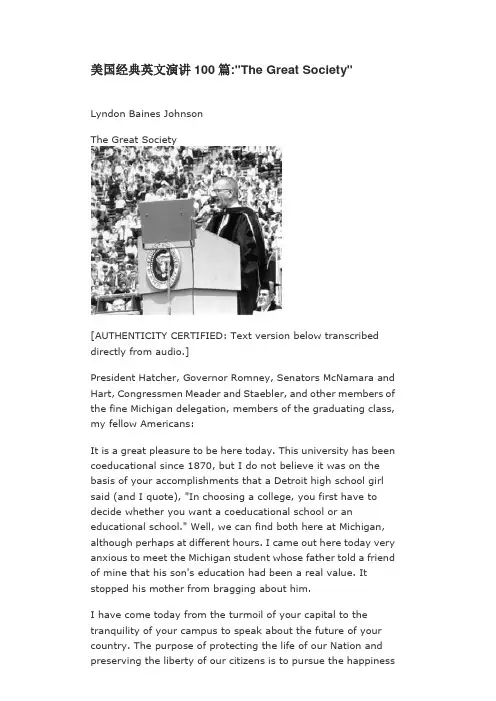
美国经典英文演讲100篇:"The Great Society"Lyndon Baines JohnsonThe Great Society[AUTHENTICITY CERTIFIED: Text version below transcribed directly from audio.]President Hatcher, Governor Romney, Senators McNamara and Hart, Congressmen Meader and Staebler, and other members of the fine Michigan delegation, members of the graduating class, my fellow Americans:It is a great pleasure to be here today. This university has been coeducational since 1870, but I do not believe it was on the basis of your accomplishments that a Detroit high school girl said (and I quote), "In choosing a college, you first have to decide whether you want a coeducational school or an educational school." Well, we can find both here at Michigan, although perhaps at different hours. I came out here today very anxious to meet the Michigan student whose father told a friend of mine that his son's education had been a real value. It stopped his mother from bragging about him.I have come today from the turmoil of your capital to the tranquility of your campus to speak about the future of your country. The purpose of protecting the life of our Nation and preserving the liberty of our citizens is to pursue the happinessof our people. Our success in that pursuit is the test of our success as a Nation.For a century we labored to settle and to subdue a continent. For half a century we called upon unbounded invention and untiring industry to create an order of plenty for all of our people. The challenge of the next half century is whether we have the wisdom to use that wealth to enrich and elevate our national life, and to advance the quality of our American civilization.Your imagination and your initiative and your indignation will determine whether we build a society where progress is the servant of our needs, or a society where old values and new visions are buried under unbridled growth. For in your time we have the opportunity to move not only toward the rich society and the powerful society, but upward to the Great Society.The Great Society rests on abundance and liberty for all. It demands an end to poverty and racial injustice, to which we are totally committed in our time. But that is just the beginning.The Great Society is a place where every child can find knowledge to enrich his mind and to enlarge his talents. It is a place where leisure is a welcome chance to build and reflect, not a feared cause of boredom and restlessness. It is a place where the city of man serves not only the needs of the body and the demands of commerce but the desire for beauty and the hunger for community. It is a place where man can renew contact with nature. It is a place which honors creation for its own sake and for what is adds to the understanding of the race. It is a place where men are more concerned with the quality of their goals than the quantity of their goods.But most of all, the Great Society is not a safe harbor, a resting place, a final objective, a finished work. It is a challenge constantly renewed, beckoning us toward a destiny where the meaning of our lives matches the marvelous products of our labor.So I want to talk to you today about three places where we begin to build the Great Society -- in our cities, in our countryside, and in our classrooms.Many of you will live to see the day, perhaps 50 years from now, when there will be 400 million Americans -- four-fifths of them in urban areas. In the remainder of this century urban population will double, city land will double, and we will have to build homes and highways and facilities equal to all those built since this country was first settled. So in the next 40 years we mustre-build the entire urban United States.Aristotle said: "Men come together in cities in order to live, but they remain together in order to live the good life." It is harder and harder to live the good life in American cities today. The catalog of ills is long: there is the decay of the centers and the despoiling of the suburbs. There is not enough housing for our people or transportation for our traffic. Open land is vanishing and old landmarks are violated. Worst of all expansion is eroding these precious and time honored values of community with neighbors and communion with nature. The loss of these values breeds loneliness and boredom and indifference.And our society will never be great until our cities are great. Today the frontier of imagination and innovation is inside those cities and not beyond their borders. New experiments are already going on. It will be the task of your generation to make the American city a place where future generations will come, not only to live, but to live the good life. And I understand that if I stayed here tonight I would see that Michigan students are really doing their best to live the good life.This is the place where the Peace Corps was started.It is inspiring to see how all of you, while you are in this country, are trying so hard to live at the level of the people.A second place where we begin to build the Great Society is in our countryside. We have always prided ourselves on being not only America the strong and America the free, but America the beautiful. Today that beauty is in danger. The water we drink,the food we eat, the very air that we breathe, are threatened with pollution. Our parks are overcrowded, our seashores overburdened. Green fields and dense forests are disappearing.A few years ago we were greatly concerned about the "Ugly American." Today we must act to prevent an ugly America.For once the battle is lost, once our natural splendor is destroyed, it can never be recaptured. And once man can no longer walk with beauty or wonder at nature his spirit will wither and his sustenance be wasted.A third place to build the Great Society is in the classrooms of America. There your children's lives will be shaped. Our society will not be great until every young mind is set free to scan the farthest reaches of thought and imagination. We are still far from that goal. Today, 8 million adult Americans, more than the entire population of Michigan, have not finished 5 years of school. Nearly 20 million have not finished 8 years of school. Nearly 54 million -- more than one quarter of all America -- have not even finished high school.Each year more than 100,000 high school graduates, with proved ability, do not enter college because they cannot afford it. And if we cannot educate today's youth, what will we do in 1970 when elementary school enrollment will be 5 million greater than 1960? And high school enrollment will rise by 5 million. And college enrollment will increase by more than 3 million.In many places, classrooms are overcrowded and curricula are outdated. Most of our qualified teachers are underpaid and many of our paid teachers are unqualified. So we must give every child a place to sit and a teacher to learn from. Poverty must not be a bar to learning, and learning must offer an escape from poverty.But more classrooms and more teachers are not enough. We must seek an educational system which grows in excellence as it grows in size. This means better training for our teachers. It means preparing youth to enjoy their hours of leisure as well as their hours of labor. It means exploring new techniques ofteaching, to find new ways to stimulate the love of learning and the capacity for creation.These are three of the central issues of the Great Society. While our Government has many programs directed at those issues, I do not pretend that we have the full answer to those problems. But I do promise this: We are going to assemble the best thought and the broadest knowledge from all over the world to find those answers for America.I intend to establish working groups to prepare a series of White House conferences and meetings -- on the cities, on natural beauty, on the quality of education, and on other emerging challenges. And from these meetings and from this inspiration and from these studies we will begin to set our course toward the Great Society.The solution to these problems does not rest on a massive program in Washington, nor can it rely solely on the strained resources of local authority. They require us to create new concepts of cooperation, a creative federalism, between the National Capital and the leaders of local communities.Woodrow Wilson once wrote: "Every man sent out from his university should be a man of his Nation as well as a man of his time."Within your lifetime powerful forces, already loosed, will take us toward a way of life beyond the realm of our experience, almost beyond the bounds of our imagination.For better or for worse, your generation has been appointed by history to deal with those problems and to lead America toward a new age. You have the chance never before afforded to any people in any age. You can help build a society where the demands of morality, and the needs of the spirit, can be realized in the life of the Nation.So, will you join in the battle to give every citizen the full equality which God enjoins and the law requires, whatever his belief, or race, or the color of his skin?Will you join in the battle to give every citizen an escape from the crushing weight of poverty?Will you join in the battle to make it possible for all nations to live in enduring peace -- as neighbors and not as mortal enemies?Will you join in the battle to build the Great Society, to prove that our material progress is only the foundation on which we will build a richer life of mind and spirit?There are those timid souls that say this battle cannot be won; that we are condemned to a soulless wealth. I do not agree. We have the power to shape the civilization that we want. But we need your will and your labor and your hearts, if we are to build that kind of society.Those who came to this land sought to build more than just a new country. They sought a new world. So I have come here today to your campus to say that you can make their vision our reality. So let us from this moment begin our work so that in the future men will look back and say: It was then, after a long and weary way, that man turned the exploits of his genius to the full enrichment of his life.Thank you. Good-bye.。
美国经典英文演讲100篇Truth_and_Tolerance_in_America
美国经典英文演讲100篇:"Truth and Tolerance in America"Edward M. KennedyFaith, Truth and Tolerance in America.Actually, a number of people in Washington were surprised that I was invited to speak here -- and even more surprised when I accepted the invitation. They seem to think that it’s easier for a camel to pass through the eye of the needle than for a Kennedy to come to the campus of Liberty Baptist College. In honor of our meeting, I have asked Dr. Falwell, as your Chancellor, to permit all the students an extra hour next Saturday night before curfew. And in return, I have promised to watch the Old Time Gospel Hour next Sunday morning.I realize that my visit may be a little controversial. But as many of you have heard, Dr. Falwell recently sent me a membership in the Moral Majority -- and I didn't even apply for it. And I wonder if that means that I'm a member in good standing.[Falwell: Somewhat]Somewhat, he says.This is, of course, a nonpolitical speech which is probably best under the circumstances. Since I am not a candidate for President, it would certainly be inappropriate to ask for your support in this election and probably inaccurate to thank you for it in the last one.I have come here to discuss my beliefs about faith and country, tolerance and truth in America. I know we begin with certain disagreements; I strongly suspect that at the end of the evening some of our disagreements will remain. But I also hope that tonight and in the months and years ahead, we will always respect the right of others to differ, that we will never lose sight of our own fallibility, that we will view ourselves with a sense ofperspective and a sense of humor. After all, in the New Testament, even the Disciples had to be taught to look first to the beam in their own eyes, and only then to the mote in their neighbor’s eyes.I am mindful of that counsel. I am an American and a Catholic;I love my country and treasure my faith. But I do not assume that my conception of patriotism or policy is invariably correct, or that my convictions about religion should command any greater respect than any other faith in this pluralistic society. I believe there surely is such a thing as truth, but who among us can claim a monopoly on it?There are those who do, and their own words testify to their intolerance. For example, because the Moral Majority has worked with members of different denominations, one fundamentalist group has denounced Dr. Falwell for hastening the ecumenical church and for "yoking together with Roman Catholics, Mormons, and others." I am relieved that Dr. Falwell does not regard that as a sin, and on this issue, he himself has become the target of narrow prejudice. When people agree on public policy, they ought to be able to work together, even while they worship in diverse ways. For truly we are all yoked together as Americans, and the yoke is the happy one of individual freedom and mutual respect.But in saying that, we cannot and should not turn aside from a deeper and more pressing question -- which is whether and how religion should influence government. A generation ago, a presidential candidate had to prove his independence of undue religious influence in public life, and he had to do so partly at the insistence of evangelical Protestants. John Kennedy said at that time: “I believe in an America where there is no religious bloc voting of any kind.” Only twenty years later, another candidate was appealing to a[n] evangelical meeting as a religious bloc. Ronald Reagan said to 15 thousand evangelicals at the Roundtable in Dallas: “ I know that you can’t endorse me. I want you to know I endorse you and what you are doing.”To many Americans, that pledge was a sign and a symbol of a dangerous breakdown in the separation of church and state. Yet this principle, as vital as it is, is not a simplistic and rigid command. Separation of church and state cannot mean an absolute separation between moral principles and political power. The challenge today is to recall the origin of the principle, to define its purpose, and refine its application to the politics of the present.The founders of our nation had long and bitter experience with the state, as both the agent and the adversary of particular religious views. In colonial Maryland, Catholics paid a double land tax, and in Pennsylvania they had to list their names on a public roll -- an ominous precursor of the first Nazi laws against the Jews. And Jews in turn faced discrimination in all of the thirteen original Colonies. Massachusetts exiled Roger Williams and his congregation for contending that civil government had no right to enforce the Ten Commandments. Virginia harassed Baptist teachers, and also established a religious test for public service, writing into the law that no “popish followers” could hold any office.But during the Revolution, Catholics, Jews, andNon-Conformists all rallied to the cause and fought valiantly for the American commonwealth -- for John Winthrop’s “city upon a hill.” Afterwards, when the Constitution was ratified and then amended, the framers gave freedom for all religion, and from any established religion, the very first place in the Bill of Rights.Indeed the framers themselves professed very different faiths: Washington was an Episcopalian, Jefferson a deist, and Adams a Calvinist. And although he had earlier opposed toleration, John Adams later contributed to the building of Catholic churches, and so did George Washington. Thomas Jefferson said his proudest achievement was not the presidency, or the writing the Declaration of Independence, but drafting the Virginia Statute of Religious Freedom. He stated the vision of the first Americans and the First Amendment very clearly: “The God who gave us life gave us liberty at the same time.”The separation of church and state can sometimes be frustrating for women and men of religious faith. They may be tempted to misuse government in order to impose a value which they cannot persuade others to accept. But once we succumb to that temptation, we step onto a slippery slope where everyone’s freedom is at risk. Those who favor censorship should recall that one of the first books ever burned was the first English translation of the Bible. As President Eisenhower warned in 1953, “Don’t join the book burners...the right to say ideas, the right to record them, and the right to have them accessible to others is unquestioned -- or this isn’t America.” And if that right is denied, at some future day the torch can be turned against any other book or any other belief. Let us never forget: Today’s Moral Majority could b ecome tomorrow’s persecuted minority.The danger is as great now as when the founders of the nation first saw it. In 1789, their fear was of factional strife among dozens of denominations. Today there are hundreds -- and perhaps even thousands of faiths -- and millions of Americans who are outside any fold. Pluralism obviously does not and cannot mean that all of them are right; but it does mean that there are areas where government cannot and should not decide what it is wrong to believe, to think, to read, and to do. As Professor Larry Tribe, one of the nation’s leading constitutional scholars has written, “Law in a non-theocratic state cannot measure religious truth, nor can the state impose it."The real transgression occurs when religion wants government to tell citizens how to live uniquely personal parts of their lives. The failure of Prohibition proves the futility of such an attempt when a majority or even a substantial minority happens to disagree. Some questions may be inherently individual ones, or people may be sharply divided about whether they are. In such cases, like Prohibition and abortion, the proper role of religion is to appeal to the conscience of the individual, not the coercive power of the state.But there are other questions which are inherently public in nature, which we must decide together as a nation, and wherereligion and religious values can and should speak to our common conscience. The issue of nuclear war is a compelling example. It is a moral issue; it will be decided by government, not by each individual; and to give any effect to the moral values of their creed, people of faith must speak directly about public policy. The Catholic bishops and the Reverend Billy Graham have every right to stand for the nuclear freeze, and Dr. Falwell has every right to stand against it.There must be standards for the exercise of such leadership, so that the obligations of belief will not be debased into an opportunity for mere political advantage. But to take a stand at all when a question is both properly public and truly moral is to stand in a long and honored tradition. Many of the great evangelists of the 1800s were in the forefront of the abolitionist movement. In our own time, the Reverend William Sloane Coffin challenged the morality of the war in Vietnam. Pope John XXIII renewed the Gospel’s call to social justice. And Dr. Martin Luther King, Jr. who was the greatest prophet of this century, awakened our nation and its conscience to the evil of racial segregation.Their words have blessed our world. And who now wishes they had been silent? Who would bid Pope John Paul [II] to quiet his voice against the oppression in Eastern Europe, the violence in Central America, or the crying needs of the landless, the hungry, and those who are tortured in so many of the dark political prisons of our time?President Kennedy, who said that “no religious body should seek to impose its will,” also urged religious leaders to state their views and give their commitment when the public debate involved ethical issues. In drawing the line between imposed will and essential witness, we keep church and state separate, and at the same time we recognize that the City of God should speak to the civic duties of men and women.There are four tests which draw that line and define the difference.First, we must respect the integrity of religion itself.People of conscience should be careful how they deal in the word of their Lord. In our own history, religion has been falsely invoked to sanction prejudice -- even slavery -- to condemn labor unions and public spending for the poor. I believe that the prophecy, ”The poor you have always with you” is an indictment, not a commandment. And I respectfully suggest that God has taken no position on the Department of Education -- and that a balanced budget constitutional amendment is a matter of economic analysis, and not heavenly appeals.Religious values cannot be excluded from every public issue; but not every public issue involves religious values. And how ironic it is when those very values are denied in the name of religion. For example, we are sometimes told that it is wrong to feed the hungry, but that mission is an explicit mandate given to us in the 25th chapter of Matthew.Second, we must respect the independent judgments of conscience.Those who proclaim moral and religious values can offer counsel, but they should not casually treat a position on a public issue as a test of fealty to faith. Just as I disagree with the Catholic bishops on tuition tax credits -- which I oppose -- so other Catholics can and do disagree with the hierarchy, on the basis of honest conviction, on the question of the nuclear freeze.Thus, the controversy about the Moral Majority arises not only from its views, but from its name -- which, in the minds of many, seems to imply that only one set of public policies is moral and only one majority can possibly be right. Similarly, people are and should be perplexed when the religious lobbying group Christian Voice publishes a morality index of congressional voting records, which judges the morality of senators by their attitude toward Zimbabwe and Taiwan.Let me offer another illustration. Dr. Falwell has written -- and I quote: “To stand against Israel is to stand against God.” Nowthere is no one in the Senate who has stood more firmly for Israel than I have. Yet, I do not doubt the faith of those on the other side. Their error is not one of religion, but of policy. And I hope to be able to persuade them that they are wrong in terms of both America’s interest and the justice of Israel’s cause.Respect for conscience is most in jeopardy, and the harmony of our diverse society is most at risk, when we re-establish, directly or indirectly, a religious test for public office. That relic of the colonial era, which is specifically prohibited in the Constitution, has reappeared in recent years. After the last election, the Reverend James Robison warned President Reagan no to surround himself, as president before him had, “with the counsel of the ungodly.” I utte rly reject any such standard for any position anywhere in public service. Two centuries ago, the victims were Catholics and Jews. In the 1980s the victims could be atheists; in some other day or decade, they could be the members of the Thomas Road Baptist Church. Indeed, in 1976 I regarded it as unworthy and un-American when some people said or hinted that Jimmy Carter should not be president because he was a born again Christian. We must never judge the fitness of individuals to govern on the bas[is] of where they worship, whether they follow Christ or Moses, whether they are called “born again” or “ungodly.” Where it is right to apply moral values to public life, let all of us avoid the temptation to beself-righteous and absolutely certain of ourselves. And if that temptation ever comes, let us recall Winston Churchill’s humbling description of an intolerant and inflexible colleague: “There but for the grace of God goes God.”Third, in applying religious values, we must respect the integrity of public debate.In that debate, faith is no substitute for facts. Critics may oppose the nuclear freeze for what they regard as moral reasons. They have every right to argue that any negotiation with the Soviets is wrong, or that any accommodation with them sanctions their crimes, or that no agreement can be good enough and therefore all agreements only increase the chance of war. I do not believe that, but it surely does not violate thestandard of fair public debate to say it. What does violate that standard, what the opponents of the nuclear freeze have no right to do, is to assume that they are infallible, and so any argument against the freeze will do, whether it is false or true.The nuclear freeze proposal is not unilateral, but bilateral -- with equal restraints on the United States and the Soviet Union. The nuclear freeze does not require that we trust the Russians, but demands full and effective verification. The nuclear freeze does not concede a Soviet lead in nuclear weapons, but recognizes that human beings in each great power already have in their fallible hands the overwhelming capacity to remake into a pile of radioactive rubble the earth which God has made.There is no morality in the mushroom cloud. The black rain of nuclear ashes will fall alike on the just and the unjust. And then it will be too late to wish that we had done the real work of this atomic age -- which is to seek a world that is neither red nor dead.I am perfectly prepared to debate the nuclear freeze on policy grounds, or moral ones. But we should not be forced to discuss phantom issues or false charges. They only deflect us form the urgent task of deciding how best to prevent a planet divided from becoming a planet destroyed.And it does not advance the debate to contend that the arms race is more divine punishment than human problem, or that in any event, the final days are near. As Pope John said two decades ago, at the opening of the Second Vatican Council: “We must beware of those who burn with zeal, but are not endowed with much sense... we must disagree with the prophets of doom, who are always forecasting disasters, as though the end of the earth was at hand.” The message which echoes across the years is very clear: The earth is still here; and if we wish to keep it, a prophecy of doom is no alternative to a policy of arms control.Fourth, and finally, we must respect the motives of those who exercise their right to disagree.We sorely test our ability to live together if we readily question each other’s integrity. It may be harder t o restrain our feelings when moral principles are at stake, for they go to the deepest wellsprings of our being. But the more our feelings diverge, the more deeply felt they are, the greater is our obligation to grant the sincerity and essential decency of our fellow citizens on the other side.Those who favor E.R.A [Equal Rights Amendment] are not “antifamily” or “blasphemers.” And their purpose is not “an attack on the Bible.” Rather, we believe this is the best way to fix in our national firmament the ideal that not only all men, but all people are created equal. Indeed, my mother, who strongly favors E.R.A., would be surprised to hear that she is anti-family. For my part, I think of the amendment’s opponents as wrong on the issue, but not as lacking in moral characterI could multiply the instances of name-calling, sometimes on both sides. Dr. Falwell is not a “warmonger.” And “liberal clergymen” are not, as the Moral Majority suggested in a recent letter, equivalent to “Soviet sympathizers.” The critics of official prayer in public schools are not “Pharisees”; many of them are both civil libertarians and believers, who think that families should pray more at home with their children, and attend church and synagogue more faithfully. And people are not sexist because they stand against abortion, and they are not murderers because they believe in free choice. Nor does it help anyone’s cause to shout such epithets, or to try and shout a speaker down -- which is what happened last April when Dr. Falwell was hissed and heckled at Harvard. So I am doubly grateful for your courtesy here this evening. That was not Harvard’s finest hour, but I am happy to say that the loudest applause from the Harvard audience came in defense of Dr. Falwell’s right to speak.In short, I hope for an America where neither "fundamentalist" nor "humanist" will be a dirty word, but a fair description of the different ways in which people of good will look at life and into their own souls.I hope for an America where no president, no public official, no individual will ever be deemed a greater or lesser American because of religious doubt -- or religious belief.I hope for an America where the power of faith will always burn brightly, but where no modern Inquisition of any kind will ever light the fires of fear, coercion, or angry division.I hope for an America where we can all contend freely and vigorously, but where we will treasure and guard those standards of civility which alone make this nation safe for both democracy and diversity.Twenty years ago this fall, in New York City, President Kennedy met for the last time with a Protestant assembly. The atmosphere had been transformed since his earlier address during the 1960 campaign to the Houston Ministerial Association. He had spoken there to allay suspicions about his Catholicism, and to answer those who claimed that on the day of his baptism, he was somehow disqualified from becoming President. His speech in Houston and then his election drove that prejudice from the center of our national life. Now, three years later, in November of 1963, he was appearing before the Protestant Council of New York City to reaffirm what he regarded as some fundamental truths. On that occasion, John Kennedy said: “The family of man is not limited to a single race or religion, to a single city, or country...the family of man is nearly 3 billion strong. Most of its members are not white and most of them are not Christian.” And as President Kennedy reflected on that reality, he restated an ideal for which he had lived his life -- that “the members of this family should be at peace with one another.”That ideal shines across all the generations of our history and all the ages of our faith, carrying with it the most ancient dream. For as the Apostle Paul wrote lo ng ago in Romans: “If it be possible, as much as it lieth in you, live peaceable with all men.”I believe it is possible; the choice lies within us; as fellow citizens, let us live peaceable with each other; as fellow human。
美国经典英文演讲100篇We shall overcome
Mr. Speaker, Mr. President, Members of the Congress:
I speak tonight for the dignity of man and the destiny of democracy. I urge every member of both parties, Americans of all religions and of all colors, from every section of this country, to join me in that cause.
In our time we have come to live with the moments of great crisis. Our lives have been marked with debate about great issues -- issues of war and peace, issues of prosperity and depression. But rarely in any time does an issue lay bare the secret heart of America itself. Rarely are we met with a ge, not to our growth or abundance, or our welfare or our security, but rather to the values, and the purposes, and the meaning of our beloved nation.
美国经典英文演讲100篇1990_Wellesley_College_Commencement_Address
美国经典英文演讲100篇:1990 Wellesley College Commencement Address Barbara Pierce BushThank you very, very much, President Keohane. Mrs. Gorbachev, Trustees, faculty, parents, and I should say, Julia Porter, class president, and certainly my new best friend, Christine Bicknell -- and, of course, the Class of 1990. I am really thrilled to be here today, and very excited, as I know all of you must be, that Mrs. Gorbachev could join us.These -- These are exciting times. They're exciting in Washington, and I have really looked forward to coming to Wellesley. I thought it was going to be fun. I never dreamt it would be this much fun. So, thank you for that.More than ten years ago, when I was invited here to talk about our experiences in the People's Republic of China, I was struck by both the natural beauty of your campus and the spirit of this place.Wellesley, you see, is not just a place but an idea -- an experiment in excellence in which diversity is not just tolerated, but is embraced. The essence of this spirit was captured in a moving speech about tolerance given last year by a student body president of one of your sister colleges. She related the story by Robert Fulghum about a young pastor, finding himself in charge of some very energetic children, hits upon the game called "Giants, Wizards, and Dwarfs." "You have to decide now," the pastor instructed the children, "which you are -- a giant, a wizard, or a dwarf?" At that, a small girl tugging at his pants leg, asked, "But where do the mermaids stand?" And the pastor tells her there are no mermaids. And she says, "Oh yes there are -- they are. I am a mermaid."Now this little girl knew what she was, and she was not about to give up on either her identity, or the game. She intended to take her place wherever mermaids fit into the scheme of things. "Where do the mermaids stand? All of those who are different, those who do not fit the boxes and the pigeonholes?" "Answer that question," wrote Fulghum, "And you can build a school, anation, or a whole world." As that very wise young woman said, "Diversity, like anything worth having, requires effort -- effort to learn about and respect difference, to be compassionate with one another, to cherish our own identity, and to accept unconditionally the same in others.You should all be very proud that this is the Wellesley spirit. Now I know your first choice today was Alice Walker -- guess how I know! -- known for The Color Purple. Instead you got me -- known for the color of my hair. Alice Walker's book has a special resonance here. At Wellesley, each class is known by a special color. For four years the Class of '90 has worn the color purple. Today you meet on Severance Green to say goodbye to all of that, to begin a new and a very personal journey, to search for your own true colors.In the world that awaits you, beyond the shores of Waban -- Lake Waban, no one can say what your true colors will be. But this I do know: You have a first class education from a first class school. And so you need not, probably cannot, live a"paint-by-numbers" life. Decisions are not irrevocable. Choices do come back. And as you set off from Wellesley, I hope that many of you will consider making three very special choices.The first is to believe in something larger than yourself, to get involved in some of the big ideas of our time. I chose literacy because I honestly believe that if more people could read, write, and comprehend, we would be that much closer to solving so many of the problems that plague our nation and our society.And early on I made another choice, which I hope you'll make as well. Whether you are talking about education, career, or service, you're talking about life -- and life really must have joy. It's supposed to be fun.One of the reasons I made the most important decision of my life, to marry George Bush, is because he made me laugh. It's true, sometimes we've laughed through our tears, but that shared laughter has been one of our strongest bonds. Find the joy in life, because as Ferris Bueller said on his day off, "Lifemoves pretty fast; and ya don't stop and look around once in a while, ya gonna miss it."(I'm not going to tell George ya clapped more for Ferris than ya clapped for George.)The third choice that must not be missed is to cherish your human connections: your relationships with family and friends. For several years, you've had impressed upon you the importance to your career of dedication and hard work. And, of course, that's true. But as important as your obligations as a doctor, a lawyer, a business leader will be, you are a human being first. And those human connections --- with spouses, with children, with friends -- are the most important investments you will ever make.At the end of your life, you will never regret not having passed one more test, winning one more verdict, or not closing one more deal. You will regret time not spent with a husband, a child, a friend, or a parent.We are in a transitional period right now -- We are in a transitional period right now, fascinating and exhilarating times, learning to adjust to changes and the choices we, men and women, are facing. As an example, I remember what a friend said, on hearing her husband complain to his buddies that he had to babysit. Quickly setting him straight, my friend told her husband that when it's your own kids, it's not called babysitting.Now maybe we should adjust faster; maybe we should adjust slower. But whatever the era twenty -- whatever the era, whatever the times, one thing will never change: fathers and mothers, if you have children, they must come first. You must read to your children, and you must hug your children, and you must love your children. Your success as a family, our success as a society, depends not on what happens in the White House, but on what happens inside your house.For over fifty years, it was said that the winner of Wellesley's annual hoop race would be the first to get married. Now they say,the winner will be the first to become a C.E.O. Both -- Both of those stereotypes show too little tolerance for those who want to know where the mermaids stand. So -- So I want to offer a new legend: the winner of the hoop race will be the first to realize her dream -- not society's dreams -- her own personal dream.And who -- Who knows? Somewhere out in this audience may even be someone who will one day follow in my footsteps, and preside over the White House as the President's spouse -- and I wish him well.Well, the controversy ends here. But our conversation is only beginning. And a worthwhile conversation it has been. So as you leave Wellesley today, take with you deep thanks for the courtesy and the honor you have shared with Mrs. Gorbachev and with me.Thank you. God bless you. And may your future be worthy of your dreams.。
美国英文演讲稿(共19篇)
美国英文演讲稿(共19篇)第1篇:介绍美国英文演讲稿篇1:美国文化之节日介绍演讲稿(英文版) the american heritage festival 1.united states is a cultural powers.short but rich history and unique it makes for an ethnic melting pot, and bring together the worlds culture.if the thought of this huge social and human treasures of get in, we may wish to take a short cut, that is, on his holiday to be a general understanding of the culture, because it is a microcosm of the festival.2.day(情人节情人节)(february valentines day(情人节)(february 14) 3.november 1, halloween is the traditional festival of the west.halloween, namely 31 october night, children enjoy a good time to play.as night fell, the children put on colorful costume, and wore a mask of all sorts, put on a pumpkin lampran out to play.packed with parity, the demons were dreed up as children of mobile pumpkin lamp, ran to a neighbors door, intimidation, like shouting: to trick or treat and give money or to eat.if the adults do not have to change for the hospitality they candy, and those naughty boy just talk the talk: well, youre not playing entertaining, i you.4.november 4th thursday is thanksgiving.on thanksgiving day, the united states the whole fun, people follow the customs of the prayer of thanksgiving to the church, and rural towns are nearby, theatrical performances or sporting events, etc.continues for another year of relatives will return from many, one family luck, taste the delicious thanksgiving turkey.christmas is the most typical christmas tree decorations, people in a small fir or pine filled with gifts and lantern, the top of the tree with a big star.篇2:美国文化演讲稿,英文版 presentation i’m glad to show you mine presentation today.and now let’s see some pictures.what are they? maybe you’ll say “ads”.but do you see the slogans on them? just as this one “obey yourthirst”.advertisements give latest information about products.but some people think that advertisements don’t give much information but only try to persuade customers to buy.may be what mentioned above is the citizens’ view about advertisement.so, what i want to say is that we can pay more attention on advertising slogans, and some of them give us some inspiration.we might as well take a look.first i want to share my favorite slogan with you.it’s the slogan of the henney.“to me, the past is black and white, but the future is always color.” just as the slogan said, i hold the view that a person can’t be always lost in the past, and no matter how happy or terrible the past is, the future is worthy to be expected.this slogan gives a clear picture of the life that every succeful person who want to realize the dream.besides, there’s another slogan, “start ahead”.i bel ieve that most of us are familiar with its chinese meaning “成功之路,从头开始”.iargue that wherever we go and whatever we meet, this sentence is full of power and wisdom.the other one is the slogan of canon.as it said, “impoible made poible.” when we are in case o f emergency or we meet difficulties at the critical stage of our life, it’s a good choice for us to use the slogan for encouragement.there’re also many slogans which deserve to be thought about.for example, “intelligence everywhere,” “the relentle pursuit of perfection,” and the most famous one “just do it”.maybe we’ll forget them after the first time we heard them or maybe we could seldom remember them unle in a special situation.in my opinion, since we have so many excellent advertising slogans, we have every reason to make full use of the social resources.in other words, after we enjoy the happine and know about the introduction of the products, we should take in the wisdom and the truth which behind them.thank you, it’s all my presentation.篇3:美国经典英文演讲100篇美国经典英文演讲100篇您的位置:首页 > 英语口语 > 美国经典英文演讲100篇美国经典英文演讲100篇,附mp3和英文演讲稿!美国经典英文演讲100篇:oklahoma bombing memorial addre2021-04-04 thank you very much, governor keating and mrs.keating, reverend graham, to the families of those who have been lost and wounded, to the people of oklahoma city, who have endured so much, and the people of this wonderful state, to all of you who are here as our fellow americans.美国经典英文演讲100篇:brandenburg gate addre2021-04-03 美国经典英文演讲100篇:meage to the gra roots2021-04-03 so we are all black people, so-called negroes, second-cla citizens, ex-slaves.you are nothing but a [sic] ex-slave.you dont like to be told that.but what else are you? you are ex-slaves.美国经典英文演讲100篇:addre on taking the oath of office2021-04-02 the oath that i have taken is the same oath that was taken by george washington and by every president under the constitution.but i aume the presidency under extraordinary circumstances never before experienced by americans.this is an hour of history that troubles our minds and hurts our hearts.美国经典英文演讲100篇:a crisis of confidence2021-04-02 this a special night for me.exactly three years ago, on july 15, 1976, i accepted the nomination of my party to run for president of the united states.i promised you a president who is not isolated from the people, who feels your pain, and who shares your dreams, and who draws his strength and his wisdom from you.美国经典英文演讲100篇:on vietnam and not seeking re-election2021-04-01 tonight i want to speak to you of peace in vietnam and southeast asia.no other question so preoccupies our people.no other dream so absorbs the 250 million human beings who live in that part of the world.no other goal motivates american policy in southeast asia.美国经典英文演讲100篇:statement to the senate judiciary...2021-04-01 my name is anita f.hill, and i am a profeor of law at the university of oklahoma.i was born on a farm in okmulgee county, oklahoma, in 1956.i am the youngest of 13 children.i had my earlyeducation in okmulgee county.my father, albert hill, is a farmer in that area.mymothers name is irma hill.she is also a farmer and a housewife.美国经典英文演讲100篇:television and the public interest2021-03-31 governor collins, distinguished guests, ladies and ernor collins youre much too kind, as all of you have been to me the last few days.its been a great pleasure and an honor for me to meet so many of you.and i want to thank you for this opportunity to meet with you today.美国经典英文演讲100篇:eulogy for robert francis kennedy2021-03-31 on behalf of mrs.kennedy, her children, the parents and sisters of robert kennedy, i want to expre what we feel to those who mourn with us today in this cathedral and around the world.美国经典英文演讲100篇:black power2021-03-30 thank you very much.it’s a privilege and an honor to be in the white intellectual ghetto of the west.we wanted to do a couple of things before we started.美国经典英文演讲100篇:chappaquiddick2021-03-30 on the weekend of july 18, i was on marthas vineyard island 美国经典英文演讲100篇:religious belief and public morality2021-03-29 the catholic churchs actions with respect to the interplay of religious values and public policy make clear that there is no inflexible moral principle which determines what our political conduct should be.美国经典英文演讲100篇:presidential nomination acceptance..2021-03-29 i have not sought the honor you have done me.i could not seek it, because i aspired to another office, which was the full measure of my ambition, and one does not treat the highest office within the gift of the people of illinois as an alternative or as a consolation prize.《美国经典英文演讲100篇》音频打包下载2021-03-28 美国经典英文演讲100篇:vice-presidential nomination...2021-03-28 my heart is filled with pride.my fellow citizens, i proudly accept your nomination for vice president of the united states.美国经典英文演讲100篇:the marshall plan2021-03-28 美国经典英文演讲100篇:the great society2021-03-27 how do i document that case? seven years later, the richest 1 percent of oursociety pays 20 percent le in taxes.the poorest 10 percent pay 20 percent more: reaganomics.美国经典英文演讲100篇:1988 dnc addre(上)2021-03-26 tonight, we pause and give praise and honor to god for being good enough to allow us to be at this place at this time.when i look out at this convention, i see the face of america: red, yellow, brown, black and white.we are all precious in gods sight -- the real rainbow coalition.美国经典英文演讲100篇:a whisper of aids2021-03-25 incidentally, that he spent weeks in the preparation of -- his words and policies were subjected to instant analysis and querulous criticism.美国经典英文演讲100篇:civil rights addre2021-03-24 upon receiving the first preliminary hard information of this nature last tuesday morning at 9 a.m., i directed that our thank you very, very much, president keohane.mrs.gorbachev, trustees, faculty, parents, and i should say, julia porter, cla president, and certainly my new best friend, christine bicknell -- and, of course, the cla of 1990.i am really thrilled to be here today, and very excited, as i know all of you must be, that mrs.gorbachev could join us.第2篇:100篇美国经典英文演讲稿美国经典英文演讲100篇:Brandenburg Gate AddreRonald ReaganRemarks at the Brandenburg Gate delivered 12 June 1987, West Berlin [AUTHENTICITY CERTIFIED: Text version below transcribed directly from audio.(2)]Thank you.Thank you, very much.Chancellor Kohl, Governing Mayor Diepgen, ladies and gentlemen: Twenty four years ago, President John F.Kennedy visited Berlin, and speaking to the people of this city and the world at the city hall.Well since then two other presidents have come, each in his turn to Berlin.And today, I, myself, make my second visit to your city.We come to Berlin, we AmericanPresidents, because it’s our duty to speak in this place of freedom.But I must confe, we’re drawn here by other things as well; by the feeling of history in this city -- more than 500 years older than our own nation; by the beauty of the Grunewald and the Tiergarten; most of all, by your courage and determination.Perhaps the composer, Paul Linke, understood something about American Presidents.You see, like so many Presidents before me, I come here today because wherever I go, whatever I do: “Ich hab noch einen Koffer in Berlin” [I still have a suitcase in Berlin.] Our gathering today is being broadcast throughout Western Europe and North America.I understand that it is being seen and heard as well in the East.To those listening throughout Eastern Europe, I extend my warmest greetings and the good will of the American people.To those listening in East Berlin, a special word: Although I cannot be with you, I addre my remarks to you just as surely as to those standing here before me.For I join you, as I join your fellow countrymen in the West, in this firm, this unalterable belief: Es gibt nur ein Berlin.[There is only one Berlin.] Behind me stands a wall that encircles the free sectors of this city, part of a vast system of barriers that divides the entire continent of Europe.From the Baltic South, those barriers cut acro Germany in a gash of barbed wire, concrete, dog runs, and guard towers.Farther south, there may be no visible, no obvious wall.But there remain armed guards and checkpoints all the same -- still a restriction on the right to travel, still an instrument to impose upon ordinary men and women the will of a totalitarian state.Yet, it is here in Berlin where the wall emerges most clearly; here, cutting acro your city, where the news photo and the television screen have imprinted this brutal division of a continent upon the mind of the world. Standing before the Brandenburg Gate, every man is a German separated from his fellow men.Every man is a Berliner, forced to look upon a scar.President Von Weizsäcker has said, “The German question is open aslong as the Brandenburg Gate is closed.” Well today -- today I say: As long as this gate is closed, as long as this scar of a wall is permitted to stand, it is not the German question alone that remains open, but the question of freedom for all mankind.Yet, I do not come here to lament.For I find in Berlin a meage of hope, even in the shadow of this wall, a meage of triumph.In this season of spring in 1945, the people of Berlin emerged from their air-raid shelters to find devastation.Thousands of miles away, the people of the United States reached out to help.And in 1947 Secretary of State -- as you’ve been told -- George Marshall announced the creation of what would become known as the Marshall Plan.Speaking precisely 40 years ago this month, he said: “Our policy is directed not against any country or doctrine, but against hunger, poverty, desperation, and chaos.” In the Reichstag a few moments ago, I saw a display commemorating this 40th anniversary of the Marshall Plan.I was struck by a sign -- the sign on a burnt-out, gutted structure that was being rebuilt.I understand that Berliners of my own generation can remember seeing signs like it dotted throughout the western sectors of the city.The sign read simply: “The Marshall Plan is helping here to strengthen the free world.” A strong, free world in the West -- that dream became real.Japan rose from ruin to become an economic giant.Italy, France, Belgium -- virtually every nation in Western Europe saw political and economic rebirth; the European community was founded.In West Germany and here in Berlin, there took place an economic miracle, the Wirtschaftswunder.Adenauer, Erhard, Reuter, and other leaders understood the practical importance of liberty -- that just as truth can flourish only when the journalist is given freedom of speech, so prosperity can come about only when the farmer and busineman enjoy economic freedom.The German leaders -- the German leaders reduced tariffs, expanded free trade, lowered taxes.From 1950 to 1960 alone, the standard of living in West Germany and Berlin doubled.Where four decades ago therewas rubble, today in West Berlin there is the greatest industrial output of any city in Germany: busy office blocks, fine homes and apartments, proud avenues, and the spreading lawns of parkland.Where a city’s culture seemed to have been destroyed, today there are two great universities, orchestras and an opera, countle theaters, and museums.Where there was want, today there’s abundance -- food, clothing, automobiles -- the wonderful goods of the Kudamm.¹ From devastation, from utter ruin, you Berliners have, in freedom, rebuilt a city that once again ranks as one of the greatest on earth.Now the Soviets may have had other plans.But my friends, there were a few things the Soviets didn’t count on: Berliner Herz, Berliner Humor, ja, und Berliner Schnauze.[Berliner heart, Berliner humor, yes, and a Berliner Schnauze.²] In the 1950s -- In the 1950s Khrushchev predicted: “We will bury you.” But in the West today, we see a free world that has achieved a level of prosperity and well-being unprecedented in all human history.In the communist world, we see failure, technological backwardne, declining standards of health, even want of the most basic kind -- too little food.Even today, the Soviet Union still cannot feed itself.After these four decades, then, there stands before the entire world one great and inescapable conclusion: Freedom leads to prosperity.Freedom replaces the ancient hatreds among the nations with comity and peace.Freedom is the victor.And now -- now the Soviets themselves may, in a limited way, be coming to understand the importance of freedom.We hear much from Moscow about a new policy of reform and openne.Some political prisoners have been released.Certain foreign news broadcasts are no longer being jammed.Some economic enterprises have been permitted to operate with greater freedom from state control.Are these the beginnings of profound changes in the Soviet state? Or are they token gestures intended to raise false hopes in the West, or to strengthen the Soviet system without changing it? We welcome change and openne; for webelieve that freedom and security go together, that the advance of human liberty -- the advance of human liberty can only strengthen the cause of world peace.There is one sign the Soviets can make that would be unmistakable, that would advance dramatically the cause of freedom and peace.General Secretary Gorbachev, if you seek peace, if you seek prosperity for the Soviet Union and Eastern Europe, if you seek liberalization: come here to this gate.Mr.Gorbachev, open this gate.Mr.Gorbachev -- Mr.Gorbachev, tear down this wall! I understand the fear of war and the pain of division that afflict this continent, and I pledge to you my country’s efforts to help overcome these burdens.To be sure, we in the West must resist Soviet expansion.So, we must maintain defenses of unaailable strength.Yet we seek peace; so we must strive to reduce arms on both sides.Beginning 10 years ago, the Soviets challenged the Western alliance with a grave new threat, hundreds of new and more deadly SS-20 nuclear miiles capable of striking every capital in Europe.The Western alliance responded by committing itself to a counter-deployment (unle the Soviets agreed to negotiate a better solution) -- namely, the elimination of such weapons on both sides.For many months, the Soviets refused to bargain in earnestne.As the alliance, in turn, prepared to go forward with its counter-deployment, there were difficult days, days of protests like those during my 1982 visit to this city; and the Soviets later walked away from the table.But through it all, the alliance held firm.And I invite those who protested then -- I invite those who protest today -- to mark this fact: Because we remained strong, the Soviets came back to the table.Because we remained strong, today we have within reach the poibility, not merely of limiting the growth of arms, but of eliminating, for thefirst time, an entire cla of nuclear weapons from the face of the earth.As I speak, NATO ministers are meeting in Iceland to review the progre of our proposals for eliminating these weapons.At the talks in Geneva, we have also proposed deep cuts in strategic offensive weapons.And the Western allies have likewise made far-reaching proposals to reduce the danger of conventional war and to place a total ban on chemical weapons. While we pursue these arms reductions, I pledge to you that we will maintain the capacity to deter Soviet aggreion at any level at which it might occur.And in cooperation with many of our allies, the United States is pursuing the Strategic Defense Initiative -- research to base deterrence not on the threat of offensive retaliation, but on defenses that truly defend; on systems, in short, that will not target populations, but shield them.By these means we seek to increase the safety of Europe and all the world.But we must remember a crucial fact: East and West do not mistrust each other because we are armed; we are armed because we mistrust each other.And our differences are not about weapons but about liberty.When President Kennedy spoke at the City Hall those 24 years ago, freedom was encircled; Berlin was under siege.And today, despite all the preures upon this city, Berlin stands secure in its liberty.And freedom itself is transforming the globe.In the Philippines, in South and Central America, democracy has been given a rebirth.Throughout the Pacific, free markets are working miracle after miracle of economic growth.In the industrialized nations, a technological revolution is taking place, a revolution marked by rapid, dramatic advances in computers and telecommunications.In Europe, only one nation and those it controls refuse to join the community of freedom.Yet in this age of redoubled economic growth, of information and innovation, the Soviet Union faces a choice: It must make fundamental changes, or it will become obsolete.Today, thus, representsa moment of hope.We in the West stand ready to cooperate with the East to promote true openne, to break down barriers that separate people, to create a safer, freer world.And surely there is no better place than Berlin, the meeting place of East and West, to make a start. Free people of Berlin: Today, as in the past, the United States stands for the strict observance and full implementation of all parts of the Four Power Agreement of 1971.Let us use this occasion, the 750th anniversary of this city, to usher in a new era, to seek a still fuller, richer life for the Berlin of the future.Together, let us maintain and develop the ties between the Federal Republic and the Western sectors of Berlin, which is permitted by the 1971 agreement. And I invite Mr.Gorbachev: Let us work to bring the Eastern and Western parts of the city closer together, so that all the inhabitants of all Berlin can enjoy the benefits that come with life in one of the great cities of the world.To open Berlin still further to all Europe, East and West, let us expand the vital air acce to this city, finding ways of making commercial air service to Berlin more convenient, more comfortable, and more economical.We look to the day when West Berlin can become one of the chief aviation hubs in all central Europe.With -- With our French -- With our French and British partners, the United States is prepared to help bring international meetings to Berlin.It would be only fitting for Berlin to serve as the site of United Nations meetings, or world conferences on human rights and arms control, or other iues that call for international cooperation.There is no better way to establish hope for the future than to enlighten young minds, and we would be honored to sponsor summer youth exchanges, cultural events, and other programs for young Berliners from the East.Our French and British friends, I’m certain, will do the same.And it’s my hope that an authority can be found in East Berlin to sponsor visits from young people of the Western sectors.One final proposal, one close to my heart: Sport represents a source of enjoyment and ennoblement, and you may have noted that the Republic of Korea -- South Korea -- has offered to permit certain events of the 1988 Olympics to take place in the North.International sports competitions of all kinds could take place in both parts of this city.And what better way to demonstrate to the world the openne of this city than to offer in some future year to hold the Olympic games here in Berlin, East and West.In these four decades, as I have said, you Berliners have built a great city.You’ve done so in spite of threats -- the Soviet attempts to impose the East-mark, the blockade.Today the city thrives in spite of the challenges implicit in the very presence of this wall.What keeps you here? Certainly there’s a great deal to be said for your fortitude, for your defiant courage.But I believe there’s something deeper, something that involves Ber lin’s whole look and feel and way of life -- not mere sentiment.No one could live long in Berlin without being completely disabused of illusions.Something, instead, that has seen the difficulties of life in Berlin but chose to accept them, that continues to build this good and proud city in contrast to a surrounding totalitarian presence, that refuses to release human energies or aspirations, something that speaks with a powerful voice of affirmation, that says “yes” to this city, yes to the future, yes to freedom.In a word, I would submit that what keeps you in Berlin -- is “love.” Love both profound and abiding.Perhaps this gets to the root of the matter, to the most fundamental distinction of all between East and West.The totalitarian world produces backwardne because it does such violence to the spirit, thwarting the human impulse to create, to enjoy, to worship.The totalitarian world finds even symbols of love and of worship an affront.Years ago, before the East Germans began rebuilding their churches,they erected a secular structure: the television tower at Alexander Platz.Virtually ever since, the authorities have been working to correct what they view as the tower’s one major flaw: treating the gla sphere at the top with paints and chemicals of every kind.Yet even today when the sun strikes that sphere, that sphere that towers over all Berlin, the light makes the sign of the cro.There in Berlin, like the city itself, symbols of love, symbols of worship, cannot be suppreed.As I looked out a moment ago from the Reichstag, that embodiment of German unity, I noticed words crudely spray-painted upon the wall, perhaps by a young Berliner (quote): “This wall will fall.Beliefs become reality.” Yes, acro Europe, this wall will fall, for it cannot withstand faith; it cannot withstand truth.The wall cannot withstand freedom.And I would like, before I close, to say one word.I have read, and I have been questioned since I’ve been here about certain demonstrations against my coming.And I would like to say just one thing, and to those who demonstrate so.I wonder if they have ever asked themselves that if they should have the kind of government they apparently seek, no one would ever be able to do what they’re doing again.Thank you and God ble you all.Thank you.第3篇:美国总统布什关于美国金融危机英文演讲稿布什关于美国经济前景的演讲 (世界名人英语演讲稿)US President’s speech on American economic future (August 6,2021) To grow the economy and help American families, we acted by paing the largest tax relief in a generation.And today, thanks to the tax relief and the efforts of America’s workers and entrepreneurs, our economy is strong and growing stronger.This past week, we learned that America added over 200,000 new jobs in July.Since May of 2021, we’ve added nearly 4 million new jo bs.Theunemployment rate is down to 5 percent, below the average of the 1970s, 1980s and 1990s.And more Americans are working today than ever before in our nation’s history.Recent economic reports show that our economy is growing faster than any other major industrialized nation.Small businees are flourishing.Workers are taking home more of what they earn.Real disposable personal income has grown by over 12 percent since the end of 2000.Inflation is low and mortgage rates are low.And over the past year, the home ownership rate in America has reached record levels.The tax relief stimulated economic vitality and growth and it has helpedincrease revenues to the Treasury.The increased revenues and our spending restraint have led to good progre in reducing the federal st month we learned that the deficit is now projected to be $94 billion le than previously expected.I set a goal of cutting the deficit in half by 2021, and we are ahead of pace to meet that goal.To continue creating jobs and to ensure that our prosperity reaches everycorner of America, we’re opening markets abroad for our goods and services.This past week, I was proud to sign the Central American-Dominican Republic Free Trade Agreement.This historic agreement will level the playing field for America’s workers and farmers, and open up a market of 44 million customers for products made in the United States. To keep our economy growing we also need affordable, reliable supplies of energy.Next week in New Mexico, I’ll sig n a bipartisan energy bill thatencourages conservation, expands domestic production in environmentally sensitive ways, diversifies our energy supply, modernizes our electricity grid and makes America le dependent on foreign sources of energy.And next Wednesday in Illinois, I’ll sign a highwaybill that will improve the safety of our roads, strengthen our transportation infrastructure and create good jobs.Our economy is strong, yet I will not be satisfied until every American who wants to work can find a job.So this coming Tuesday I will meet with myeconomic team in Texas to discu our agenda to keep the economy moving forward.As Congre considers appropriations bills this fall, we will work with the House and the Senate to ensure that taxpayer dollars are spent wisely, or not at all.We need to make the tax relief permanent, end the death tax forever, and make our tax code simpler, fairer and more pro-growth.We’ll continue working on Social Security reform.Social Security is sound for today’s seniors, but there’s a hole in the safety net for our younger workers, so I’ll work with the Congre to strengthen Social Security for our children and grandchildren.I’ll continue to pre for legal reform to protect small businees, doctors and hospitals from junk lawsuits.And we will work to make health care more affordable and acceible for all Americans.The American economy is the envy of the world and we will keep it that way.We will continue to unleash the entrepreneurial spirit of America, so more of our citizens can realize the American Dream.Thank you for listening.THE PRESIDENT: Good morning.As families acro the country enjoy the summer, Americans can be optimistic about our economic future.In the past four years, our economy has been through a lot: we faced a stock market decline, a receion, corporate scandals, an attack on our homeland, and the demands of an ongoing war on terror.第4篇:美国演讲稿。