
中医药文化英文版
中医药文化英文版
中医药文化(Traditional Chinese Medicine Culture)是中国传统医学的一个重要方面,涵盖了中医的理论体系、诊断方法、治疗技术以及与中医相关的文化传统。
以下是中医药文化的一些主要方面的英文介绍:
中医的基本理念和特点:
1.中医理论(Theories of Traditional Chinese Medicine):
•Traditional Chinese Medicine (TCM) is rooted in ancient Chinese philosophy and holistic thinking. It encompasses
theories such as Yin-Yang, Five Elements, and the concept
of vital energy (Qi) flowing through meridians in the body.
2.辩证施治(Diagnosis and Treatment Based on Syndrome
Differentiation):
•TCM diagnosis involves analyzing patterns of disharmony in the body, considering factors such as excess or
deficiency, cold or heat. Treatment aims at restoring
balance through acupuncture, herbal medicine, diet, and
lifestyle adjustments.
3.预防与调理(Prevention and Maintenance):
•TCM emphasizes preventive medicine and the maintenance of health. Practices such as acupuncture,
herbal tonics, and exercises like Tai Chi and Qigong are
used to strengthen the body's natural defenses.
中医的诊断与治疗方法:
1.脉诊与舌诊(Pulse and Tongue Diagnosis):
•TCM practitioners assess the pulse and examine the tongue to gather information about the patient's internal
condition, including the state of organs and energy flow.
2.针灸疗法(Acupuncture):
•Acupuncture involves inserting thin needles into specific points on the body to regulate the flow of Qi and restore
balance. It is widely used for pain management and
various health conditions.
3.中药治疗(Herbal Medicine):
•Herbal medicine uses a combination of plants, minerals, and animal products to create formulas tailored to
individual patient needs. These formulas aim to address
the root causes of illnesses.
中医文化的历史与发展:
1.源远流长(Ancient Roots):
•Traditional Chinese Medicine has a history of over 2,500 years. It has evolved through the contributions of
numerous physicians and scholars, and its theories and
practices continue to be refined.
2.现代中医(Modern Developments):
•In modern times, TCM has gained recognition worldwide.
It integrates with Western medicine in China's healthcare
system, and acupuncture and herbal medicine are
practiced globally as complementary therapies.
3.文化传承(Cultural Heritage):
•TCM is not only a system of medicine but also a cultural heritage. It includes practices like Tai Chi and Qigong, as
well as dietary principles based on balance and harmony. 中医文化的影响:
1.全球传播(Global Influence):
•Traditional Chinese Medicine has gained popularity worldwide, with acupuncture clinics, herbal medicine
shops, and TCM wellness practices found in many
countries.
2.中医与现代医学的互动(Integration with Modern Medicine):
•TCM and Western medicine often complement each other.
Many patients seek TCM for chronic conditions, pain
management, and overall well-being alongside
conventional medical treatments.
这些简要的介绍涵盖了中医药文化的一些关键方面。
值得注意的是,中医药文化非常庞大且深奥,对于更深入的理解,建议查阅专业
中医学术著作或咨询有经验的中医专业人士。
中医药文化的起源和发展英语作文

中医药文化的起源和发展英语作文The Origin and Development of Traditional Chinese Medicine CultureIntroduction:Traditional Chinese Medicine (TCM) has a long history of more than 2000 years and has become an important part of Chinese culture. It includes various practices such as acupuncture, herbal medicine, and massage therapy, and has been widely practiced in China and other parts of the world. The origin and development of TCM culture are closely related to the rich historical background and philosophical traditions of China.Origin of TCM Culture:The origin of TCM culture can be traced back to ancient China, where primitive tribes began using natural herbs and plants to treat diseases. Over time, these practices were further developed and refined by successive generations of scholars and practitioners. The earliest recorded works on Chinese medicine can be found in the Yellow Emperor's Inner Canon, a classic medical text dating back to the 2nd century BC. This text laid the foundation for the theory and practice of TCM, emphasizing thebalance between Yin and Yang, the five elements, and the flow of Qi in the body.Development of TCM Culture:Over the centuries, TCM culture continued to evolve, incorporating new ideas and practices from other cultures while retaining its core principles. During the Tang and Song dynasties, TCM underwent a period of great development, with the establishment of medical schools, hospitals, and the publication of numerous medical texts. Acupuncture, herbal medicine, and other TCM practices gained widespread popularity and acceptance among the Chinese population.In modern times, TCM culture has faced challenges from Western medicine and scientific skepticism. However, many people around the world are still turning to TCM for alternative therapies and holistic treatments. In recent years, the Chinese government has made efforts to promote TCM culture by establishing research institutes, standardizing practices, and integrating TCM into the national healthcare system.Cultural Significance of TCM:TCM culture is not just about treating illnesses; it is also a reflection of Chinese philosophy, cosmology, and culturaltraditions. TCM emphasizes a holistic approach to health, viewing the body as a microcosm of the natural world and the universe. This interconnectedness is reflected in the use of natural herbs, acupuncture, and other treatments to restore balance and harmony to the body.TCM culture also has a strong influence on Chinese art, literature, and philosophy. Traditional Chinese paintings often depict scenes of doctors and patients, herbal medicine gardens, and the five elements of nature. Poems, stories, and philosophical texts reference TCM concepts such as Yin and Yang, Qi, and the harmony of the mind, body, and spirit.Conclusion:Traditional Chinese Medicine culture has stood the test of time and continues to be an important part of Chinese heritage and identity. Its origins can be traced back to ancient times, and its development has been shaped by centuries of knowledge, wisdom, and practice. TCM culture embodies the rich cultural traditions and philosophical insights of China, offering a unique perspective on health, wellness, and the human experience. As TCM continues to gain popularity and recognition around the world, it serves as a bridge between East and West, ancient and modern, traditional and contemporary approaches to healthcare.。
中国中医英文介绍
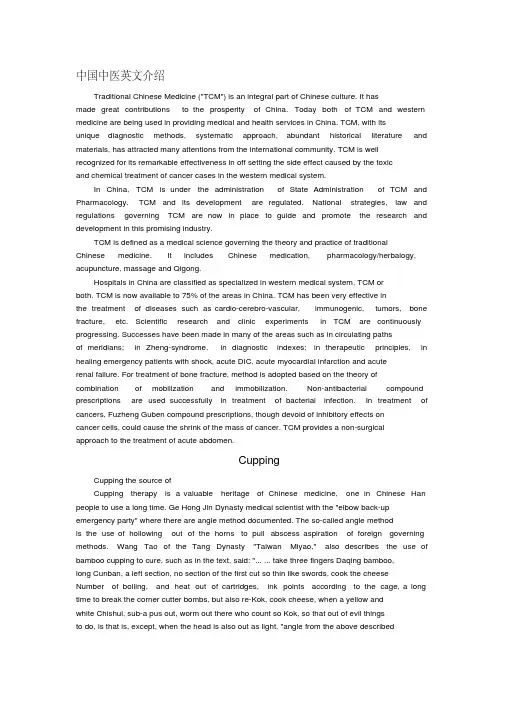
中国中医英文介绍Traditional Chinese Medicine ("TCM") is an integral part of Chinese culture. It hasmade great contributions to the prosperity of China. Today both of TCM and western medicine are being used in providing medical and health services in China. TCM, with itsunique diagnostic methods, systematic approach, abundant historical literature and materials, has attracted many attentions from the international community. TCM is wellrecognized for its remarkable effectiveness in off setting the side effect caused by the toxicand chemical treatment of cancer cases in the western medical system.In China, TCM is under the administration of State Administration of TCM and Pharmacology. TCM and its development are regulated. National strategies, law and regulations governing TCM are now in place to guide and promote the research and development in this promising industry.TCM is defined as a medical science governing the theory and practice of traditionalChinese medicine. It includes Chinese medication, pharmacology/herbalogy, acupuncture, massage and Qigong.Hospitals in China are classified as specialized in western medical system, TCM orboth. TCM is now available to 75% of the areas in China. TCM has been very effective inthe treatment of diseases such as cardio-cerebro-vascular, immunogenic, tumors, bone fracture, etc. Scientific research and clinic experiments in TCM are continuously progressing. Successes have been made in many of the areas such as in circulating pathsof meridians; in Zheng-syndrome, in diagnostic indexes; in therapeutic principles, in healing emergency patients with shock, acute DIC, acute myocardial infarction and acuterenal failure. For treatment of bone fracture, method is adopted based on the theory of combination of mobilization and immobilization. Non-antibacterial compound prescriptions are used successfully in treatment of bacterial infection. In treatment of cancers, Fuzheng Guben compound prescriptions, though devoid of inhibitory effects oncancer cells, could cause the shrink of the mass of cancer. TCM provides a non-surgicalapproach to the treatment of acute abdomen.CuppingCupping the source ofCupping therapy is a valuable heritage of Chinese medicine, one in Chinese Han people to use a long time. Ge Hong Jin Dynasty medical scientist with the "elbow back-up emergency party" where there are angle method documented. The so-called angle methodis the use of hollowing out of the horns to pull abscess aspiration of foreign governing methods. Wang Tao of the Tang Dynasty "Taiwan Miyao," also describes the use of bamboo cupping to cure, such as in the text, said: "... ... take three fingers Daqing bamboo,long Cunban, a left section, no section of the first cut so thin like swords, cook the cheeseNumber of boiling, and heat out of cartridges, ink points according to the cage, a long time to break the corner cutter bombs, but also re-Kok, cook cheese, when a yellow andwhite Chishui, sub-a pus out, worm out there who count so Kok, so that out of evil thingsto do, is that is, except, when the head is also out as light. "angle from the above describedmethod and system of green bamboo cupping of view, China's Jin, Tang Cupping of theera has long been popular.Cupping a comfortable pull Bingti"Cupping" is the private sector is commonly known as cupping therapy, also knownas "pulling pipes" or "suction tube." It is the air tank with heat to exclude the use of negative pressure so that sorption in the skin, causing bleeding as a treatment method ofthe phenomenon. This treatment can be by cold dampness, dredge the meridians, dispelstasis, qi and blood circulation, reduces swelling, pain, diarrhea fever Sida has to adjustthe body's yin and yang balance, lifting of fatigue, enhance physical function to achievethe rousing, cure The purpose of the disease. Therefore, many diseases can be treated with cupping therapy. For example: middle-aged, bones and muscles ache common, according to the interpretation of traditional Chinese medicine mostly rheumatoid Suchis Life. Cupping Guankou cover their time in the affected area, you can slowly suck themoisture out of lesions, while promoting local blood circulation, to relieve pain, restorefunction, and consequently treatment of rheumatism, "Bi Tong" bones bitterness and sodoes not apply.Cupping can do it because of gas-blood circulation, expelling wind and cold-dispelling, reduces swelling, pain, so the back muscle strain, lumbar disc herniationhave a certain therapeutic effect. Dr. Lulu's briefing, fire can also be used in the body acupuncture points, the treatment of headache, dizziness, faces badly bruised, coughing, wheezing, abdominal pain and other illnesses, and more than fire can be implemented atthe same timeCupping Traditional Chinese Medicine on the principle:Chinese medicine, cupping can be opened to vent Cou science, rousing. Disease is caused by pathogenic factors of yin and yang of the body Piansheng partial decline, thebody movements of qi disorders, internal organs caused by blood disorders. When the body is affected by wind, cold, summer heat, wet, dry, fire, poison, trauma or internal injuries invasion blog, you can lead to dysfunctional organs, resulting in pathological product, such as congestion, qi, phlegm, Sushi, water turbid, Xiehuo and so on, these pathological product is pathogenic factors, through the meridians and acupoints to go channeling the body, against the indiscriminate air-stranded organs; deposition resistance in turn, eventually lead to all kinds of illnesses. Cupping resulting vacuum hasa strong pull of the suction force, pulling the suction force acting on the meridian points,it can be to open pores and make skin absorption congestion, so that the body's pathological product from the skin pores to suck out of the body, so that able to dredgethe meridian qi and blood, so that organs function to be adjusted to achieve the purposeof combating the disease. Chinese medicine, cupping can dredge meridians, adjust blood. Meridians have "blood-line, business yin and yang, Confucianism bones, Lee joint," the physiological functions, such as the meridians are not impeded General through the air,blood stagnation line, there may be skin, flesh, tendons, veins and joints dystrophy andatrophy, adverse , or blood do not wing, Six Hollow Organs were not delivered and so on.By cupping the skin, pores, meridians, acupuncture points of the suction pull the role ofanger can lead battalion Wei lost before a cloth, agitation meridians qi, Ru Yang organstissues and organs, very inviting fur, while virtual decline of the organs function to beexcited, smooth meridian, adjust the body's yin and yang balance so that blood can be adjusted so as to achieve fitness illnesses Liaoji purposes.Western medicine on the principle of cuppingModern medicine, cupping treatment tank role in the formation of negative pressure,so that local capillary congestion and even rupture, rupture of red blood cells, skin congestion, there own hemolysis, then produce a histamine histamine and classes of substances, with the body fluids of weeks Stream body, to stimulate the various organs, to enhance its functional activity, can improve the body's resistance. Modern medicine, cupping negative pressure stimulus, enabling the expansion of local blood vessels, promote blood circulation, improve congestive state, strengthen the metabolism, changesin nutritional status of local organizations to enhance the permeability of blood vessel wall and leukocyte phagocytic activity, enhance the body's physical and human immunity.Modern medicine, cupping pressure on local parts of the suction pull, can speed up theblood and lymph circulation, promote gastrointestinal peristalsis, improving digestive function and promote. Speed up the muscle and internal organs on the Elimination of metabolite excretion.Cupping cans left spot, as well as the significance of colorCommon tank spots are flushing, purple or purplish black ecchymosis, small point-like purple rash, but also often accompanied by varying degrees of heat pain. Thesechanges in the skin are cupping therapy effect, and sustainable one to several days.Cupping, the tank spot, such as noticeable blisters, edema, and water vapor-like, indicating that patients with wet wet Sheng or because of the illness experience.Sometimes, after the blisters Secheng drawing blood red or black and red, indicatingthat the wet long illness folder pathological response to stasis.Cans dark red spot appears, Zihei or Dan dehydration phenomena, the micro-touchpain, and those who see the body heat, indicating that patients have a heat-toxin syndrome.Such as cans purple or purplish black spot appears, no Dan stasis and heat phenomena, indicating that there is congestion in patients with disease.Can spot-free skin color changes, do not touch the warm, multi-show patients Deficiency Syndrome.In case of micro-itching spot cans or there Piven, the wind's disease patients had more than that.Generally disease-free more than those who had no significant change in tank spot.About Our Massage ServicesMassage is the practice of soft tissue manipulation. It involves acting on the body and manipulating it with pressure. The masseur may use his hands, fingers, elbows, forearm,and even his feet to manipulate the tissue. Target tissues may include muscles, tendons, ligaments, skin, joints, connective tissue, lymphatic vessels, or organs of thegastrointestinal system. In China, massage is widely practiced and taught in hospitals andmedical schools and is an essential part of primary healthcare.At Sam’s Massage Center, clients lie fully clothed on a massage table. If cupping on scraping treatments are requested, the area to be treated is exposed. Full body oilmassage requires partial disrobing. Blankets are available to keep the client warm shouldthe client feel cold during the massage.Chinese Medical Massage (Tui Na)Chinese Medical Massage is good if you are experiencing pain in one or more parts ofyour body, such as neck pain, lower back pain, shoulder pain, slipped discs, sciatic nervepain, stomach problems (such as indigestion, heartburn, or digestive problems), orintestinal problems. The masseur can give you an all-over massage and focus on specificareas with pain or do a treatment on the affected area. The masseur uses shiatsu, or acupressure, to relieve pain. The masseur may use his thumbs, palms, elbow, and forearmwhile performing the massage.Sam’s Therapeutic MassageSam’s Therapeutic Massage is a deep tissue, all-over body massage. The masseur uses his thumbs to apply pressure to pressure points in the body, then releases his thumb fromthe point. You may experience some pain during the application of pressure, but the endresult is that you will feel relief when the pressure is released.Deep tissue massage is designed to relieve severe tension in the muscles and connective tissue. This type of massage focuses on the muscles located below the surface of the top muscles. Deep tissue massage is recommended for clients who experience constant pain,are involved in heavy physical activity, or have sustained a physical injury.Special Woman’s MassageOur special woman’s massage concentrates on areas of special concern for woman. The massage consists of a medical massage with attention paid to the pelvic area and themuscles above the breasts.Oil MassageWe use aromatic essential oils and massage techniques similar to Swedish massage. Oil massage consists of broad, circular strokes with no pressure point or deep tissue massage techniques. Oil massage is soothing and a great way to feel relaxed and refreshed. We especially recommend oil massage if you have been having difficulty sleeping.Foot MassageOur foot massage is different from traditional Chinese foot massage in that we performthe massage while the client is recumbent. We do not soak the feet in water but apply hot,wet towels to the feet before starting the massage. We use an emollient cream to softenand moisturize the feet during the massage. The masseur uses reflexology techniques to pinpoint problem areas in your body and improve your health.。
传统医药文化英语作文范文

传统医药文化英语作文范文Traditional Chinese medicine (TCM) has a long history and is an important part of Chinese culture. It has been practiced for thousands of years and has been proven to be effective in treating various illnesses and promotingoverall health. In recent years, TCM has gained popularity not only in China but also around the world, as more and more people are looking for alternative and holistic approaches to healthcare.One of the key principles of TCM is the idea of balance. According to TCM, the body is made up of a delicate balance of yin and yang, and when this balance is disrupted,illness occurs. TCM practitioners use a variety of techniques to restore this balance, including acupuncture, herbal medicine, massage, and dietary therapy. These techniques are based on the concept of qi, or vital energy, which flows through the body along meridians. Bystimulating certain points on the body or using specific herbs, TCM practitioners can help the body heal itself andrestore balance.Acupuncture is perhaps the most well-known TCM technique, and involves the insertion of thin needles into specific points on the body to stimulate the flow of qi. This can help relieve pain, reduce inflammation, andimprove overall well-being. Herbal medicine is another important aspect of TCM, with thousands of herbs used to treat a wide range of conditions. These herbs are often combined into formulas that are tailored to eachindividual's specific needs.In addition to acupuncture and herbal medicine, TCMalso includes other modalities such as cupping, moxibustion, and qigong. Cupping involves placing heated cups on theskin to create suction, which can help improve circulation and relieve muscle tension. Moxibustion involves burning dried mugwort on or near the skin to stimulate acupuncture points. Qigong, on the other hand, is a form of gentle exercise that combines movement, meditation, and breathing techniques to promote health and well-being.One of the key strengths of TCM is its focus on prevention. TCM practitioners believe that by maintaining a healthy lifestyle, including a balanced diet, regular exercise, and stress management, individuals can prevent illness and maintain optimal health. TCM also emphasizes the importance of treating the root cause of illness, rather than just the symptoms, which can lead to long-lasting and sustainable improvements in health.In recent years, TCM has gained recognition and acceptance in Western countries, with many people seeking out TCM practitioners for a wide range of health issues. In China, TCM is an integral part of the healthcare system, with TCM hospitals and clinics offering a wide range of services to patients. TCM is also increasingly being integrated into mainstream healthcare, with research studies supporting its effectiveness in treating conditions such as chronic pain, digestive disorders, and mental health issues.In conclusion, traditional Chinese medicine is a valuable and time-tested approach to healthcare that offersa holistic and personalized approach to healing. With its focus on balance, prevention, and treating the root cause of illness, TCM has much to offer in today's fast-paced and stressful world. As more people around the world discover the benefits of TCM, its popularity and acceptance are likely to continue to grow.。
英文介绍中医药PPT课件
2 Chinese massage was developed over 2,000 years ago and was popular in the Tang, Ming, and Qing dynasties.
The Chinese call this therapeutic bodywork tui na(推拿), 3 which literally means "push" and "pull".
第8页/共10页
Thank you!
1221100071
卓丽宁
2014.4.14
第9页/共10页
感谢您的观看!
第10页/共10页
第2页/共10页
ACUPUNCTURE
ACUPUNCTURE (针灸)
Acupuncture is the insertion of needles (针) into the skin at specific points in order to affect the flow of energy.
2 TCM is based on a belief in yin and yang, defined as opposing energies, such as earth and heaven, winter and summer, and happiness and sadness.
3 The ultimate goal of TCM treatment is to balance the yin and yang in our lives by promoting the natural flow of qi.
中国文化之中医-英文版PPT

大家学习辛苦了,还是要坚持
继续保持安静
Shen Nong’s Herbal Classic (《神农本草经》 ), prior to the Qin
Dynasty records 365 work that sums varieties of medicinal herbs and classifies them into three categories in accordance with their respective primary treatments, functions and toxic character. This is the earliest pharmacopoeia ever found in China. But when we talk about the pharmacopoeia, we can not neglect Lishizhen’s work
中国文化之中医-英文版PPT
壹 Chinese Culture
Classic Literature Traditional Chinese Arts Folk Culture
Folk Culture
Traditional Chinese Medicine Martial Arts Traditional Food Chinese Tea Traditional Holidays and Customs
肆 Herbal Medicine zhōngcǎoyào
The treatment originally required the patient to boil up medicinal plants and other medicinal substances,and drink the resultant liquid.
英文介绍中医药
英文介绍中医药IntroductionTraditional Chinese medicine (TCM), also known as Chinese medicine, has a history that dates back thousands of years. It is a unique and comprehensive medical system that combines various practices such as acupuncture, herbal medicine, and dietary therapy. TCM is rooted in ancient Chinese philosophy and has evolved over time to provide holistic healthcare solutions.Principles of Traditional Chinese MedicineTCM is based on the principles of balancing the yin and yang energies and the flow of Qi, or vital energy, within the body. It focuses on achieving harmony and balance to prevent and treat ailments. The key principles of TCM include:1.Yin-Yang Theory: This theory states that allphenomena can be classified as either yin or yang. Yinrepresents the feminine, passive, and cooling aspect, while yang represents the masculine, active, and warming aspect.Achieving a balance between these two energies is essential for health.2.Five Element Theory: TCM uses the concept of thefive elements (wood, fire, earth, metal, and water) tounderstand the relationships between organs, emotions,and bodily functions. Each element corresponds to specific organs and their associated functions.3.Meridian Theory: TCM believes that there are energy channels called meridians that run throughout the body. These meridians are responsible for the flow of Qi. Acupuncture and acupressure focus on stimulating specific points along these meridians to restore balance and promote healing.TCM Treatments1.Acupuncture: This is one of the most well-known practices of TCM. It involves the insertion of thin needles at specific points on the body to stimulate the flow of Qi and restore balance. Acupuncture is commonly used to alleviate pain, promote relaxation, and treat various conditions such as headaches, musculoskeletal disorders, and digestive issues.2.Herbal Medicine: TCM incorporates the use of various herbs, minerals, and animal products to create personalized herbal formulas. These formulas are designed to address the specific imbalances and symptoms of each individual. Herbal medicine is used to treat a wide range of conditions and is often combined with other TCM practices for better results.3.Cupping Therapy: Cupping involves placing glass or plastic cups on the skin to create suction. This technique helps to stimulate blood flow, relieve muscle tension, and promote overall wellness. Cupping is commonly used to treat pain, respiratory conditions, and to improve circulation.4.Moxibustion: Moxibustion involves burning dried plant materials known as。
中国的中药传统文化的英语作文
The Rich Heritage of Traditional ChineseMedicineDeep within the cultural veins of China, lies a remarkable legacy that has stood the test of time: Traditional Chinese Medicine (TCM). This ancient science, dating back over thousands of years, is a testament to the profound understanding of life, health, and the natural world that the Chinese people have cultivated over generations.TCM is not just a system of healing; it's a philosophy that views the body as a microcosm of the universe, interconnected and in constant flux. Illness is seen not just as a physical ailment but as a disruption of this delicate balance, requiring a multifaceted approach to restoration. This approach often involves the use of herbal remedies, acupuncture, cupping, moxibustion, and other therapies that aim to harmonize the body's energy flow, known as "Qi".Herbal medicine is a cornerstone of TCM, with over10,000 plants, minerals, and animals being used in formulations. These remedies are prescribed based on theprinciples of Yin and Yang, Five Elements, and the theory of meridians. Each herb is chosen for its specific properties and actions, often combined with others to create complex formulas that target specific conditions.Acupuncture, another essential component of TCM, involves the insertion of fine needles at specific points on the body to regulate Qi flow. This practice, which has been shown to have scientific basis in modern research, is believed to alleviate pain, improve circulation, and promote overall well-being.TCM also emphasizes prevention and the promotion of health through lifestyle modifications, diet, and exercise. It提倡a holistic approach to health, acknowledging therole of emotions, environment, and social factors in maintaining well-being.In recent years, there has been a renewed interest in TCM globally, as people seek alternative methods of healthcare that are less intrusive and more in tune with natural rhythms. The World Health Organization (WHO) has recognized TCM as a complete and distinct system ofmedicine, and many Western countries now offer courses and qualifications in TCM practices.Despite its widespread popularity and acceptance, TCM faces challenges in the modern era. The integration of Western medicine and its scientific methodologies has created a divide between the traditional and modern approaches to healthcare. However, there is also a growing recognition that the two systems can complement each other, offering a more comprehensive approach to healthcare.In conclusion, Traditional Chinese Medicine is a rich and profound cultural heritage that has shaped the health practices of the Chinese people for generations. Its emphasis on holistic health, prevention, and natural therapies offers a unique and valuable perspective in the global discourse on healthcare. As the world increasingly turns to alternative methods of healthcare, TCM stands as a testament to the enduring wisdom of ancient traditions.**中国传统医药的丰富遗产**在中国文化的深处,隐藏着一种历经时间考验的非凡遗产:中国传统医药(TCM)。
中药文化英文作文
中药文化英文作文英文:As a Chinese person, I am very proud of our traditional medicine culture. Chinese medicine has a long history andis deeply rooted in our culture. It is based on the belief that the body is a whole and that illness is caused by an imbalance in the body. Chinese medicine uses natural remedies, such as herbs, acupuncture, and massage, to restore balance and promote healing.One of the most important aspects of Chinese medicine is the use of herbs. There are thousands of different herbs used in Chinese medicine, each with its own unique properties and benefits. For example, ginseng is used to boost energy and improve mental clarity, while licorice root is used to soothe the digestive system and reduce inflammation.Another important aspect of Chinese medicine isacupuncture. Acupuncture involves the insertion of thin needles into specific points on the body to stimulate the flow of energy and promote healing. It is often used to treat pain, stress, and other conditions.Chinese medicine also emphasizes the importance of a healthy lifestyle, including a balanced diet, regular exercise, and stress management. By taking care of our bodies and minds, we can prevent illness and maintain good health.中文:作为一名中国人,我非常自豪我们的传统医学文化。
传承中医英语作文
传承中医英语作文(中英文版)The Legacy of Traditional Chinese Medicine传承中医的精髓In the tapestry of ancient wisdom, Traditional Chinese Medicine (TCM) stands as a vibrant thread, woven through centuries of healing practices.It is not merely a system of medicine, but a profound philosophy that embraces the harmony between humanity and nature.在古老智慧的织锦中,中医(TCM)犹如一条充满活力的线,穿梭于数个世纪的诊疗实践之中。
它不仅仅是一套医疗体系,更是一种深刻哲学,强调人与自然的和谐共生。
From the gentle art of acupuncture to the intricate science of herbal remedies, TCM offers a holistic approach to health, focusing on balancing the body"s energy, or "Qi." This alternative therapy has been passed down from generation to generation, and its relevance endures in our modern world.从温和的针灸艺术到复杂的草药科学,中医提供了一种整体健康观,强调平衡人体的能量——“气”。
这种替代疗法代代相传,其相关性在现代社会依然历久弥新。
The essence of TCM lies not only in its effectiveness but also in its ability to adapt and evolve.It is a living tradition that continues to inspire practitioners and patients alike, reminding us that sometimes, theanswers to our health challenges can be found in the wisdom of the past.中医的精髓不仅在于其有效性,还在于其适应和演变的能力。
介绍中医文化的英语作文
介绍中医文化的英语作文Traditional Chinese medicine (TCM) is a comprehensive medical system that has been developed and practiced in China for over 2,000 years. It encompasses various forms of treatments such as acupuncture, herbal medicine, massage (tui na), exercise (qigong), and dietary therapy.One of the key principles of TCM is the concept of balance. In TCM, the body is seen as a holistic entity, and the balance of yin and yang and the flow of qi (vital energy) are considered crucial for maintaining good health. TCM practitioners believe that illness is caused by an imbalance or blockage of qi, and the treatments aim to restore the balance and unblock the flow of qi.Acupuncture, a well-known TCM treatment, involves inserting thin needles into specific points on the body to stimulate the flow of qi and promote healing. This practice has gained popularity in the West and is often used to alleviate pain, reduce stress, and improve overall well-being.Herbal medicine is another important aspect of TCM. It involves using natural herbs and plants to treat various ailments. TCM practitioners believe that different herbs have different properties and can be used to restore balance in the body. Some commonly used herbs include ginseng, ginger, and goji berries.In addition to acupuncture and herbal medicine, TCM also emphasizes the importance of lifestyle and dietary choices in maintaining health. TCM dietary therapy focuses on the concept of food energetics, which categorizes food based on their energetic properties and their effects on the body. For example, warming foods like ginger and garlic are believed to promote circulation and digestion, while cooling foods like cucumber and watermelon are thought to reduce inflammation and heat in the body.Overall, traditional Chinese medicine offers a holistic approach to health and wellness, focusing on the interconnectedness of the body, mind, and spirit. Itsemphasis on balance, natural remedies, and preventive care has made it an important part of healthcare in China and has gained recognition and popularity in the West.。