
牛津译林英语七年级上册Unit4Welcome (共24张PPT)
2. Is it time for breakfast?
It’s time for sth意为“是……的时候了”, 可以和It’s time to do sth进行互换。
Practise 上课时间到了,我们进教室吧。 It’s time for class. Let’s go to the classroom. 午餐时间到了。 It’s time to have lunch. = It’s time for lunch.
need sth need to do sth
seldom: not often
Eddie’s day
Morning Have b_r_e_a_k_f_a_s_t, s_l_e_e_p____
Noon
Have l_u_n_c_h____
Afternoon Need a good r_e_s_t_____
Time Activity Time Activity
1. Wake up, Eddie!
wake up除了有“醒来”之意外,还可 表示“唤醒,使……醒来”。当被叫醒 的对象是人称代词时,要用宾格形式, 且必须放在短语中间;当被叫醒的对象 是名词时,可放在短语中间,也可放在 短语后面。
Practise
• To report one’s daily activities and ask for information about others’ daily activities.
wake up get up wake up the boy wake the boy up wake him up
Please _w_a_k_e__u_p_T_o_m__ at 7 o’clock in the morning. wake Tom up
Millie’s day
6:30 a.m. Get up
7:00 a.m. Have breakfast
_7_:2_0__a_.m__._ Go to school
8:00 a.m. Do morning exercises
_8_:1_5__a_.m__._ Have lessons
…
…
Millie is a hard-working student. She _g_e_ts_ up early in the morning. She goes to s_c_h_o_o_l at 7:20. She’s _n_e_v_er_ late for school. Before the first lesson starts, Millie and all her classmates do morning e_x_e_r_c_i_se_s_. She has lunch at ten to _tw__e_lv_e_. The school finishes at four o_’_c_l_o_ck_ in the afternoon. Then it’s time for after-school _a_ct_i_v_it_ie_s_. She always has fun. In the evening, Millie watches TV for _h_a_lf_ an hour. It’s her favourite time of the day. Then she needs to do her _h_o_m_e_w__o_r_k_. She always does it carefully. She usually goes to _b_e_d_ at 9:30.
6:3e0vae.mry. daGye?t up
1a:3.m0 p..mev. eHryavdealeys.sons
7:00 a.m. Have breakfast
4:00 p.m. Do after-school activities
7:20 a.m. Go to school 4:30 p.m. Go home
Unit 4 My day
Comic strip and Welcome to the unit
Learning aims:
• To ask and answer questions about Millie’s day.
• To use the new vocabulary to talk about the students’ own day.
8:00 a.m. Do morning 6:30 p.m. Have dinner exercises
8:15 a.m. Have lessons 7:00 p.m. Watch TV
11:50 a.m. Have lunch 7:30 p.m. Do homework
9:30 p.m. Go to bed
3. After breakfast…and then I have lunch.
表示三餐 (breakfast / lunch / dinner / supper) 的名词前一般不用冠词。当表 示三餐的名词被定语修饰时,前面通 常带不定冠词。
Practise 我每天和我的父母一起吃早餐。 I have breakfast with my parents every day. 我今天吃了一顿丰盛的晚餐。 I eat/have a nice dinner today.
拓展:It’s time for sb to do sth意为“对 某人来说该做某事了”。
Practise 我们该吃晚饭了。 It’s time for us to have dinner. 他们该上课了。 It’s time for them to have class. 你该擦黑板了。 It’s time for you to clean the blackboard.
Eddie’s day
Morning Have ________, ________
Noon
Have ________
Afternoon Need a good ________
…
…
Eddie’s day
Morning Have b_r_e_a_k_f_a_s_t, s_l_e_e_p____
4. Some dogs just don’t know how to have fun.
这里how to have fun是“疑问词+动 词不定式”结构,在句中作know的 宾语。与have fun意思相近的短语有 have a good time和enjoy oneself。
5. I’m never late for it. be late for 意为“迟到,迟做……”, for为介词,其后须跟名词作宾语。
汤姆,谢谢你每天早晨叫我的表弟起床。
Tom, thanks for waking my cousin up every morning. = Tom, thanks for waking up my cousin every morning. 你明早七点能把他叫醒吗?
Can you wake him up at 7:00 tomorrow morning?
Noon
Have l_u_n_c_h____
Afternoon Need a good r_e_s_t_____
…
…
Shall we do …?
Let’s do …
Why not do …?
go shopping
What/How about doing …? go swimming
Eddie just doesn’t know howgotofishhainvge fun.
Don’t _w_a_k_e__h_im___u_p_.
have breakfast have lunch
have supper have dinner
It’s my birthday today. My family are going to
_h_a_v_e_d_i_n_n_e_r_ outside in the evening.
do homework The girl is d__o_in_g__h_e_r_h_o_m__e_w_o_r_k__v_e_ry__c_a_r_e_fu_l_ly_.
go to bed go to sleep —Stop watching TV, Amy. It’s time _t_o_g_o__to__b_e_d. —Please, Mum, I just can’t _g_o_t_o_s_l_e_ep_.
6:40 six forty / twenty to seven
six forty-five / fifteen to seven / 6:45 a quarter to seven
WWhhaatt tdiomees dMoilelies ShSehegheatss up at
Mdioll…iaet?7g:e0t0uap.m?M. illie6’:sb3dr0eaaayk.mfas. t at 7:00
…
…
One day, Hobo _w_a_k_e_s up Eddie in the morning. He wants to go walking in the _h_il_l_s with Eddie. But Eddie says he _se_l_d_o_m_ goes out because he is always very busy at home. After _g_et_t_in_g_ up in the morning, he needs to have b_r_e_a_k_f_a_s_t and have another sleep. Then it’s time for _lu_n__ch_. In the afternoon, he needs a good _re_s_t_/s_l_ee_p_ again. What do you think Eddie does in the evening and at night? Yes, he has _s_u_p_p_e_r_/d_i_n_n_e_rand sleeps. Oh, Eddie is busy eating and _sl_e_e_p_in_g_ all day! Doesn’t he know how to have f_u_n_?
[2021精选]七年级英语上册 Unit 4《My day》(welcome)
![[2021精选]七年级英语上册 Unit 4《My day》(welcome)](https://360docs-1393072327.cos.ap-beijing.myqcloud.com/763fb48558fafab068dc0209.webp)
My day学生姓名__________________ 家长签名___________________学习目标:1.介绍日常学习和生活的根本安排和活动。
2.对自己或他人的一天进行简单的描述。
【课前热身】:1一大声朗读下面的词组,并在书上划下来★根本词汇1.表示提出或征求意见___________2.活动n____________(复数)________________3.家庭作业 n___________________(___________名词)1.醒醒2.开始上课 ________3.到时间做某事 __________ 6.去睡觉 7.玩得快乐 __ 8. 做课外活动 _____ ___ 9.上课 ____________ 10.看报纸 ____ __11.做早操/眼保操 __________ __12.需要某事 ___ _ 14.看太多的电视__________________15….迟到____ 17.上学/工作迟到(2) ______=_________________1.是吃早饭的时候了嘛?_____________________________________________________________2.我们去山上散步好吗?____________________________________________________________3.一些狗就是不知道怎样玩乐。
______________________________________________________4.我上学从不迟到。
________________________________________________________________5.米莉,你喜欢上学吗?________________________________________________________,Millie?6.——你们什么时候开始上课?——8:15.——_____________________________________________——____________________________7.午饭后,我总是需要好好休息。
牛津译林版七年级上册(2024)Unit 4 School day 语言点和语法点整理
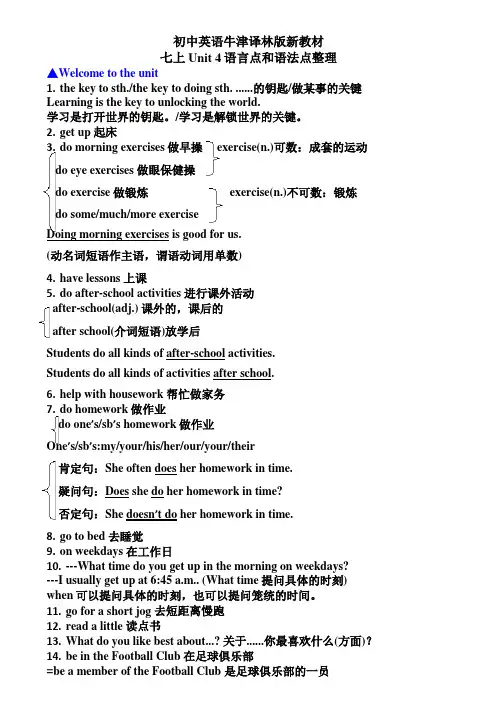
初中英语牛津译林版新教材七上Unit 4语言点和语法点整理▲Welcome to the unit1.the key to sth./the key to doing sth. ......的钥匙/做某事的关键Learning is the key to unlocking the world.学习是打开世界的钥匙。
/学习是解锁世界的关键。
2.get up 起床3.do morning exercises做早操 exercise(n.)可数:成套的运动 do eye exercises 做眼保健操do exercise 做锻炼 exercise(n.)不可数:锻炼do some/much/more exerciseDoing morning exercises is good for us.(动名词短语作主语,谓语动词用单数)4.have lessons 上课5.do after-school activities 进行课外活动after-school(adj.) 课外的,课后的after school(介词短语)放学后Students do all kinds of after-school activities.Students do all kinds of activities after school.6.help with housework 帮忙做家务7.do homework做作业do one’s/sb’s homework做作业One’s/sb’s:my/your/his/her/our/your/their肯定句:She often does her homework in time.疑问句:Does she do her homework in time?否定句:She doesn’t do her homework in time.8.go to bed 去睡觉9.on weekdays 在工作日10.---What time do you get up in the morning on weekdays?---I usually get up at 6:45 a.m.. (What time提问具体的时刻) when可以提问具体的时刻,也可以提问笼统的时间。
牛津译林英语 七年级上册Unit7Welcome to the unit(共28张PPT)

√C. Some sCtDam(ps=compact disc) 光盘,激光唱片
bCuyhrsitsht.mfaosr ibnugy. sDba.nsiethl .wants to _b_buu_yy_a_prSeismeonnt faor_pS_ri_me_so_en_nt__. But he
hate
vt. 讨厌;恨
maybe
adv 也许,可能
be interested in 对……感兴趣
stamp
n. 邮票
collect
vt. 收集,搜集
be interested in wallet hate
money collect stamps mall down the street
Miss Huang has many hobbies.
Daniel wants to buy a Christmas present. He is asking Mille for help. Listen to the dialogue and choose the best answers.
Talk about presents
1.Daniel wants to buy ________ a present. A. Millie
B: You’re welcome!
Do you think Eddie will buy gifts for Hobo? Why?
(1)Hobo doesn’t have
Read money to go
牛津译林版英语七上Unit4《Myday》(welcome)说课稿

牛津译林版英语七上Unit 4《My day》(welcome)说课稿一. 教材分析牛津译林版英语七上Unit 4《My day》(welcome)的话题是关于日常生活的,通过学习本单元,学生可以掌握关于日常活动的一些词汇和表达方式,如go to school, have lunch, do homework等。
同时,学生还可以学会如何用英语描述自己的日常生活。
本节课的主要内容是学习一般现在时,并通过谈论日常活动来运用一般现在时。
二. 学情分析七年级的学生已经掌握了一些基本的英语语法和词汇,但对一般现在时的理解和运用还不够熟练。
因此,在教学过程中,需要引导学生通过观察、实践和交流来理解和运用一般现在时。
此外,学生对日常活动的表达方式还不够熟悉,需要通过大量的练习和互动来提高他们的表达能力和合作能力。
三. 说教学目标1.知识目标:学生能够掌握关于日常活动的一般现在时的表达方式,如go to school, have lunch, do homework等。
2.能力目标:学生能够在适当的语境中运用一般现在时描述自己的日常生活,提高他们的语言运用能力。
3.情感目标:通过谈论日常生活,培养学生热爱生活、积极向上的态度。
四. 说教学重难点1.重点:学生能够掌握一般现在时的基本结构和用法。
2.难点:学生能够灵活运用一般现在时描述自己的日常生活,并在实际情景中进行交流。
五. 说教学方法与手段1.教学方法:采用任务型教学法,让学生在完成任务的过程中学习和运用语言。
2.教学手段:利用多媒体课件、图片、卡片等辅助教学,提高学生的学习兴趣和参与度。
六. 说教学过程1.导入:通过展示一张自己的日常照片,引导学生谈论自己的日常生活,激发学生的学习兴趣。
2.新课呈现:通过多媒体课件展示一般现在时的结构,引导学生观察和理解一般现在时的用法。
3.学习活动:学生分组进行角色扮演,用一般现在时描述自己的日常生活,如起床、上学、吃饭等。
牛津译林英语七年级上册Unit4Welcome (共35张PPT)

6:40 six forty / twenty to seven
six forty-five / fifteen to seven / 6:45 a quarter to seven
WWhhaatt tdiomees dMoilelies ShSehegheatss up at
Mdioll…aiet?7g:e0t0uap.m?M. illie6’:sb3dr0eaaayk.mfas. t at 7:00
My day
time
activities time
activities
B Listen to Millie and her aunt’s conversation. (P 43) Aunt: Millie, when do you go to school
every day? Millie: I _u_s_u_a_ll_y go to school at 7.20.
6:3e0vae.mry. daGye?t up
1a:3.m0 p..mev. eHryavdealeys.sons
7:00 a.m. Have breakfast
4:00 p.m. Do after-school activities
7:20 a.m. Go to school 4:30 p.m. Go home
What time do you wake up every morning? What time do you have breakfast / lunch / dinner every day?
I wake up at 6:00 / 6:05 / 6:15 / 6:30 / 6:40 / 6:45… every morning. I have breakfast/lunch/dinner at…
七年级上册 Welcome to our school Reading I课件(共18张PPT)

应用实践
Introduce Sunshine Middle School
1. What order(顺lib序ra)ry
would you like to use? (draw the route(路线) 2.What words can help you?
green spaces
classroom buildings sports field
SWchhoaotlciasnayogureleaatrnplfarocme faosrclheoaorl?ning.
Learn some
Learn to make
knowledge
Learn about the world
friends
......
迁移创新
Homework
For all Compare Sunshine Middle School and our school.
What can students do here?What may students do? chat with
AD.otaylokuwihthavseb any problems in life and study? WB.thaolkminwailflriyeonudlytainlkfotrom?aWl (非ill正yo式u的ta)lwkatyowteitahcshbers?
Beginning
学习理解
Read and finish part A
BeginningWhat
library
classroom buildings sports field
Main body
green spaces
noticeboards
牛津译林版(2024年)七年级上册 Unit 4 School day... 课时训练(含答案)
七年级英语上册牛津译林版(2024年)Unit 4Welcome to the unit一、单词拼写1.Hector always gets back from work very late on ________ (工作日).2.As a student, I should try to finish my homework by ________ (我自己). 3.Judy’s mother often does ________ (家务劳动) like cleaning and cooking. 4.This club has lots of ________(活动). You can swim, climb or play ball games.5.Bill ________ (通常)gets home at 6:00, but today he didn’t get home until 7:00.二、用所给单词适当形式填空6.Reading is a good way ________ (get) knowledge.7.I’m so happy that I can make nice cakes ________ (my).8.Mike likes to take part in some outdoor ________ (activity) after class. 9.Each of the students needs to do morning ________ (exercise) at school. 10.On the Mid-Autumn Festival, Chinese people ________ (usual) have a family dinner.三、单项选择11.My family have ________ breakfast together every day.A.不填B.aC.an D.the12.—When ________ your mother ________ up every morning?—At 6 o’clock.A.does; gets B.does; getC.do; gets D.do; get13.There is ________ water at home. We don’t need to buy any.A.little B.a littleDanny is usually at thetime. He is on the way to Cape Town. It just takeshim half an hour to get there. Danny likes reading andlistening to music there at weekends.Danny often goes to the Art Club at about ten in themorning. There he usually learns drawing, watchesAt 4:00 p.m., Danny takes the bus back home withhis friend Kim. After he is back, he helps his mumwith dinner. If it is early, he does some washing first.It is time for Danny to go to bed. But before sleeping,he always reads some books. Sometimes he listens tothe16.Danny is usually __________ at 8 o’clock on Sunday.A.at homeB.at schoolC.at the bus stopD.in the Art Club17.What does Danny sometimes do at the Art Club?A.Learns drawing.B.Plays games.C.Watches art shows.D.Reads books.18.Who goes back home with Danny?A.His friend.B.His mum.C.His teacher.D.His cousin.19.Danny usually ________ at 9 p.m.A.goes to bedB.watches TVC.does his homeworkD.takes a walk20.Which of the following is TRUE about Danny? A.Danny’s home is very far from Cape Town. B.Danny is really good at drawing.C.Danny washes clothes once a week.D.Danny sometimes listens to the radio at bedtime.【答案】一、1.weekdays 2.myself 3.housework 4.activities ually二、6.to get 7.myself 8.activities 9.exercises ually三、ABBDB四、CBAAD。
Unit4-ComicWele课件牛津译林版英语七年级上册
What time is it / What's the time It's seven o'clock. It's nine o'clock. It's two o'clock.
What time is it / What's the time
Unit 4 My day
Becky
Comic strip & Welcome to the unit
Guess
Activities Becky does in the morning
01
02
get up
03
get dressed
04
brush her teeth
wash her face
Guess Activities Becky does in the morning
Translation exercise
4.我下雨天几乎不出去。 I seldom go out on rainy days. 5.他不知道如何学好英语。 He doesn't know how to study English well.
Homework:
1.Read and recite comic strip. 2. finish the workbook. 3. Preview the new words in Reading
Show time
Millie's day
What does Millie do at 6:30 a.m. She gets up at 6:30 a.m.
What does Millie do at 4:00 p.m. She does after-school activities. What time does Millie start lessons At 8:15 a.m.
牛津译林版七年级英语上册unit4全单元教案
38 牛津译林版七年级英语上册牛津译林版七年级英语上册Periods :031Date : : Prepare – Oct.15th Title : Unit 4 My day Comic strip & Welcome to the unitTeaching aims: Students can master the following in this class.1.words :wake shall seldom activity quarter2.phrases :wake up, go out, do after-school activities, do homework, have fun,be late for , go to bed 3.sentences :I seldom go out .I’m never late for it .At a quarter past eight . Difficult points:Words about daily life .Students can use the words and sentences learned in this class to describe daily life .Procedures :Step1 Free talkLead-inT: What time does your school day begin ?S: It begins at 6:45.T: Oh, it starts at 6:45. You start our school day at 6:45. So you need to wake up very early. (teach wake up and start )Show some pictures of clock.T: It is six o ’clock in the morning. What does ….do? Can you guess ?(Teach have breakfast /have lunch /have dinner; need; rest ;go out ; have fun )Step2 PracticeT: Hobo wants to know something about you. He would like to ask the questions below. Please answer them.(1) What time do you wake up?(2) Do you often go out to play games /have dinner .have fun ?(3) Do you often have breakfast ?(4) Where do you have lunch ?(5) Do you always have a rest after lunch?According to the students ’ answers, present “seldom ”and “never ”at the right time.Step3 PresentationT: Do you remember our friend Eddie ? What does he do every day? Can you guess ?Now let’s listen to the conversation between Eddie and Hobo and check if you are right. (Teach hill )T: What does Hobo think of dogs like Eddie ?Step 4 PracticePractise the conversation and act it out.Step 5 ExtentionHere’s Hobo ’s diary. Please help him complete it.It is sunny today. I would like to go________. I like sports and I always go walking in the ____________. But my friend Eddie is lazy. He ___________does sports. He _________up very late.And then he wants to have __________. After it, he sleeps again. When he finishes his lunch, he says he ________a good _______ once more.Oh, my God ! His life is eating and sleeping. I think some dogs ________don’t know how to have____________.Step 6 PresentationT: Do you want to be lazy like Eddie? What time do you wake up every morning ? What time do you have breakfast / lunch / dinner /every day ? Why do you get up so early ?(Teach quarter, past, get up and be late for, have lessons/have classes. do after-school activities, do homework, go to bed …)Step 7 PractiseLook at the table of Millie’s day. Answer some questions.Look at the times on the blackboard. Please tell me your activities at these times.6:30 a.m 7:00 a.m 8:00 a.m 11:50 a.m4:30 p.m 6:00 p.m 8:00p.m 9:00 p.mMake sentences with “I _________________ at_____________.”Step 8 PresentationPart BT: Millie is busy every day. Now, she is telling her aunt about her school life. Let’s listen to their conversation and answer my question: Is Millie often late for school ?S: No. She is never late for school.T: Millie is a good student. She is never late for school. What about you? Are you often late for school? Are you never late for school?Step 9 PractiseRead Part B and practice it .T: Are your daily activities the same as Millie’s ? Now, you can complete the table on the right with your own information.…….T: Now time for you. I’d like you to work in groups of four to discuss your own day. You can use Millie and her aunt’s conversation as a model.Homework :1. Learn the new words by heart.2.Finish the exercisesAfterthoughts :Periods :032-033Date : : Prepare – Oct.15thTitle: Unit 4 My day ReadingTeaching aims:1. Students can master new words and expressions.2. Students can learn some new phrases: chat with best wishes have a good time3. Students can learn some new sentences:Our school starts at eight in the morning from Monday to Friday.Usually we do morning exercises first.Procedures :Step1 Free talk1.Do you have a full(充实的)充实的) and busy day?2.What do you usually do every day?Step2 PresentationListen to the passage and choose a title for this e-mail.Step3 ScaningRead the passage quickly and silently and do “T” or “F” questions in pairs.(partB2)Setp4 SkimmingRead the article again and do more exercises. (partB1)Step5 RetellingRetell Millie’s school life . Fill in the blanks.( partB3)Step6 Language pointsSome language points :a lot of = lots ofSometimes , some times , sometime , some timehave a good timeHomework :1. Learn the new words by heart.2.Finish off the exercises.Afterthoughts :Periods :034-035Date : : Prepare – Oct.18thTitle: Unit 4 My day GrammarTeaching aims:1. Students can use the prepositions correctly.2. Students can use the adverbs of frequency correctly.Difficult points: the usage of the prepositionsProcedures :Step1 Presentation1. Free talk .Use some questions to lead the usage of the prepositions .eg: What time do you go to school?When is your birthday?2. P47表格,教师归纳总结,领读例句。
Unit 4 School days) (课件)2024学年牛津译林版英语七上
A.few
B.little
C.a few
D.a little
[解析] 句意:冰箱里只有一点牛奶了,咱们去超市买一 些吧。根据“only”及“Let’s go to the supermarket to buy some”可知,此处指的是冰箱里只有一点牛奶,表示肯定 意义,且空后的milk为不可数名词,应用a little。故选D。
Language points
5 I always read a little .我总是会读一点书。(教材P43)
此处修饰动词read
a little 一点,少量;少量的;一些 (1)表示程度,可修饰形容词、副词或动词。 She’s a little afraid of the dog.她有点儿害怕狗。 (修饰形容词) Can you run a little..fast?你能跑得稍微快点吗?(修饰副词) Please turn down the radio a little.请把收音机音量调小一点儿。 (修饰动词)
a little little
表示肯定含义,
意为“一些;少 量的”。 表示否定含义,
意为“少得几乎 没有”。
修饰 不可
I know a little French.我懂一点 儿法语。
数名 词
I have little free time.我几乎没有 空闲时间。
Language points
表示肯定含义, a few 意为“几个;
Language points
3 Help with housework 帮忙做家务(教材P43) Do homework 做家庭作业(教材P43) housework/ˈhaʊswɜ:k/ n.家务劳动,家务事 homework/ˈhəʊmwɜ:k/ n.家庭作业 [不可数名词]是由“house/home+work”构成的合成词。