
高中英语 牛津译林版必修一Unit1 Lesson7 Project 教案
《英语》(必修·第一册)Unit 1 Back to schoolProject江苏省通州高级中学I. Learning objectivesBy the end of the lesson, students will be able to:1.know the steps to make a booklet about their school;2.know how to decide on a proper topic, where to get information, how to design interviewing questions and write a short passage about one aspect of their school;3.cooperate with group members, be clear about their assignments in the group work and complete the assignments.II. Key competence focusLearn how to cooperate with others.III. Predicted areas of difficulty1. Design interviewing questions.2. Learn to write a short passage about one aspect of the school.IV. Teaching proceduresStep 1 Lead-in1. Set the goal of this classSs read a letter from a student studying in the UK and should be clear about the goal of this class. 【设计意图:通过读信的形式,引起学生兴趣,明确本课目标。
】2. Free talkT asks Ss to talk about aspects about their school. Ss can use ideas in the textbook, such as lessons, teachers, school history, school events, clubs, t eaching buildings, labs, library, computer room …Ss think of other aspects, such as school canteens, dormitories, school stadium …【设计意图:让学生回顾前面所学内容,联系生活实际,激发学生兴趣。
同时,鼓励学生发散性思维,不拘泥书本,拓展思维。
】Step 2 Class discussionHow to nail down a topic1.Ss make comparisons of different topics, choose the better one and give reasons. e.g. Ss compare the topic “campus culture”with “annual sports meet”, and then compare the topic “English classes”with “English classes given by foreign teachers”.Ss summarize the features of a good topic: be specific and be interesting.2. Give students an example: the topic “school events”. T encourages Ss to think about the following questions:• Do you think it is a good topic?• If so, why?• If not, can you narrow it down?“School events” is a good topic, because it is interesting. But there are many school events in a school. So it still can be narrowed down to the Science and Technology Festival, the Arts Festival, the Sports Festival, etc. That way, the topic becomes more specific.3. Ss divide themselves into groups and decide on a topic in the group. Students should apply the rules—be specific and be interesting—when they’re discussing what topic they will decide on.【设计意图:通过比较的方式让学生直观理解好的话题应该是什么样的,罗列原因有助于锻炼学生的深度思维和逻辑思维能力。
通过总结选择好话题的原则提高学生归纳学习的能力。
给学生一个sample, 一起讨论并确定一个话题,有助于学生把所学的知识运用到实际,最终帮助学生自己确定一个好的话题。
】Step 3 Group discussionHow to get information1. Students discuss different aspects of their topic to be included in their booklet. First, T asks Ss what they want to know about their school events. And then Ss take down their questions. e.g. How many school events do we have? When are these school events held? Who can take part in these school events? What do students do in these school events?2. Students learn how to search for information.Teacher asks the question: Where can you find the answers you need?Ss think of ways of getting information and classify the ways into two categories: research and interview.3. Ss learn how to search for information online and summarize rules of selecting information: information should be accurate and reliable.T asks the following questions:• How can you find information you want online?• What are the key words if you want to find information about school events online?• What websites will you visit? School website or Baidu? Why?• What can you get from the websites?• Any other ways to get pictures?【设计意图:学生通过小组学习认识鉴别可靠的信息的原则,提高搜索信息和鉴别信息的能力。
点拨学生其他获取信息的方式,如记录个人校园生活的体验(拍照片)等,这些方式不拘泥于书本,有助于学生拓展思维,而且与生活紧密联系,会极大提高学生的兴趣和参与度。
】4. Ss learn how to design interviewing questions: start with general questions and then move on to specific ones. Ss design their interviewing questions on a topic and polish up their questions. (1) Ss answer the question:• Who will you interview?• What do you want to know?• What kind of questions should you ask in an interview?By studying the example in the textbook, students c an get the tip: it’s a good idea to start with general questions and then move on to specific ones.(2)Group work: Design your interview questions about school events. Students can refer to the questions they’ve taken down before, e.g.• Can you tell me some thing about the school events?• How many school events do we have?• When are these school events held?• Who can take part in these school events?• What do students do in these school events?(3) Group work: Design your interview questions about your topic and present to the class(4) Class work: Comment on others’ interview questions and help polish up those questions【设计意图:学生通过小组学习认识鉴别可靠信息的原则,提高搜索信息和鉴别信息的能力。
高一英语(译林牛津版)必修1《Unit 1 School life》project教案1
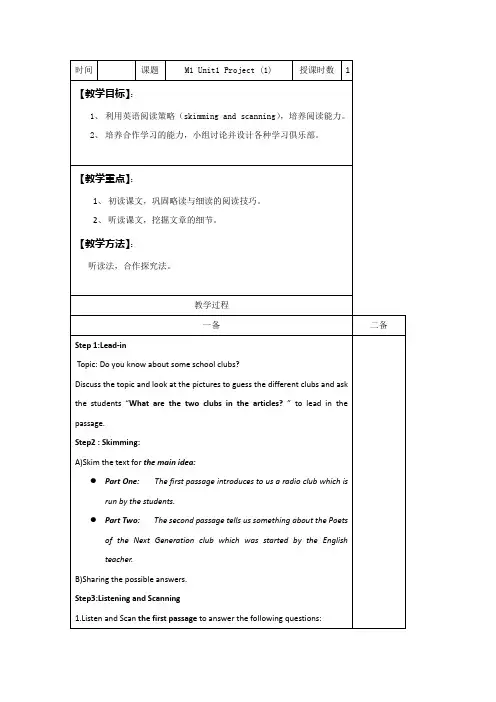
时间课题M1 Unit1 Project (1)授课时数 1【教学目标】:1、利用英语阅读策略(skimming and scanning),培养阅读能力。
2、培养合作学习的能力,小组讨论并设计各种学习俱乐部。
【教学重点】:1、初读课文,巩固略读与细读的阅读技巧。
2、听读课文,挖掘文章的细节。
【教学方法】:听读法,合作探究法。
教学过程一备二备Step 1:Lead-inTopic: Do you know about some school clubs?Discuss the topic and look at the pictures to guess the different clubs and askthe students “What are the two clubs in the articles? ”to lead in the passage.Step2 : Skimming:A)Skim the text for the main idea:●Part One:The first passage introduces to us a radio club which isrun by the students.●Part Two:The second passage tells us something about the Poetsof the Next Generation club which was started by the Englishteacher.B)Sharing the possible answers.Step3:Listening and Scanning1.Listen and Scan the first passage to answer the following questions:1) Who started the radio club?2) When did the radio club start?2.Please use the skill of scanning for the details:★The functions of the first club:Play music during the break timeBroadcast weather and recent newsPlus some special messages.Play songs sung by studentsInform parents of something important.★The functions of the second club:●Talk about poems and poets.●Read them out loud.●Be required to write a poem.3.True or False?1.The radio station is run by the principal. (F)2.The radio station started 2 years ago when CD players were allowedin school. (F)3.Members of Poets of the Next Generation meet up on the lastFriday of every month. (T)4.Everyone was nice and friendly in the group. They liked the firstpoem Bob read to them. (T)Step4:Discussion:How do these two clubs attract the students?How do they help the students?Step5:Homework:●Read the whole passage to find out some useful phrases andsentence drills.●Finish the related exercises.教学反思:。
译林版高中英语必修一U1L7 Project 教案

《英语》(必修·第一册)Unit 1 Back to schoolProjectI. Learning objectivesBy the end of the lesson, students will be able to:1.know the steps to make a booklet about their school;2.know how to decide on a proper topic, where to get information, how to design interviewing questions and write a short passage about one aspect of their school;3.cooperate with group members, be clear about their assignments in the group work and complete the assignments.II. Key competence focusLearn how to cooperate with others.III. Predicted areas of difficulty1. Design interviewing questions.2. Learn to write a short passage about one aspect of the school.IV. Teaching proceduresStep 1 Lead-in1. Set the goal of this classSs read a letter from a student studying in the UK and should be clear about the goal of this class. 【设计意图:通过读信的形式,引起学生兴趣,明确本课目标。
牛津高中英语牛津版译林版高一模块一Unit1教案
牛津英语译林版高一必修一Unit1 教案Unit 1 School lifeTeaching aims of the whole unit:1.Develop students abi’l ity of reading comprehension by reading an article about school life inthe UK and two other articles about school clubs.2.Develop students abi’lity of listening comprehension by listening to two talks about school activities.3.Develop students s’peaking ability by discussing daily school life and reporting school activities.4.Develop students writ’ing ability by writing a notice about school activities.5.Develop students inte’grated skills of using English by making a poster for a school club. 6.Enlarge students voca’bulary about school facilities.7 Help students understand what an attributive clause is and what relative words function as in attributive clauses; teach students how to use relative pronouns that, which, who, whom and whose.Period arrangement:The whole unit: 12 periodsWelcome to the unit: 1 periodReading: 2 periodsWord power: 1 periodGrammar and usage: 2 periodsTask: 2 periodsProject: 2 periodsSelf-assessment: 1 periodRevision and exercises: 1 periodPeriod 1 Welcome to the unitI. Teaching aims:1 Get students to know the different high school loves between the UK and China.2 Develop students ’English spe ak lil n s g. skiII. Teaching Procedures:Step 1. Warming upLet some students make a self-introduction.1. Introduce themselves.2. Say something about their junior high school life.3. Pair work: brain storm:When we are talking about our school life, what will we probably think of?What words or phrases will we use to describe our school life?Step 2 Presentation1. Say the following to students:It s’the beginni ng of the new term. You ’ve just finished your junior high and are about to enter a new period in your studies. I am happy to give your lessons and I hope we can be friends.I can see that some of your are eager to know what studying at senior high will be like. Will it be differ4ent from junior high? Well, there are certainly many differences between junior high and senior high, but there are also some things that are the same in every school in China.What about schools in other countries? Do you have different experiences? Are schools all overthe world the same? This is the subject of our first unit.2. Ask students to read the instruction and tell them:Here are three pictures that show some aspects of school life in the UK. Please read the instructions, look at the pictures: what's the difference between schools in China and the UK?Step 3 Discussion1 Ask students the following questions to talk about the words in the four pictures:Huge campus and low-rise buildingsWhat does h uge mean?What does low-rise mean?What about campus and school buildings in China?(Schools in China usually have a large enough campus to make sure students have enough space to study and play. But most school buildings have at least 3 storeys.)Lockers for every studentDo you know what a locker is?(There are rows of lockers by the classrooms for students to put their bookd, exercise-books and other belongings.)What do you think about locker for students?Do you think that we should have such locker in our school? Why or Why not?Fewer students in each classHow many students are there in our class?Do you know the number of students in a class in the UK?At ease with our teacherWhat can we know from this picture?What does the word ease mean? What do you think the phrase at ease mean?Were you getting on well with the teacher when you were in junior high?What relationship do you want to have with your teachers in senior high?2 Ask students to work in groups to talk about the four pictures and the differences betweenschools in the UK and China. Then ask several students to report their discussion to the whole class.aspects In the UK In ChinaHuge campus and We can see huge campus Schools in China usually have a large enoughlow-rise buildings and low-rise buildings. campus to make sure students have enough space to It is the biggest difference study and play in.from schools in China But most school buildings are taller, at least threestoreys.Lockers for every There are rows of lockers Students bring what they need for lessons to school student by the classrooms for and then take it all back home after school. Most students to put their schools in china do not have equipment in thestationary, books, classroom.exercise-books and otherbelongings.Fewer students in There are fewer studentsThere are usually more students in high school, each class in a class, no more than perhaps 40 to 50 per class. Recently some schools30 per class. are beginning to limit the number of students ineach class.At ease with our Students have a close It is similar in china. Nowadays, lots of teachers and teacher relationship with their students have established a good relationship with teachers. They feel at easeeach other. They respect each other and work toand comfortable with gain a better understanding of each other.them.4. Ask students to discuss the three questions in pairs, and them ask some of them to report their answers to the questions to the whole class.What is your dream school life like?What kind of school activities do you enjoy?What do you think of your life here in the new school?Step 4 Summary and HomeworkToday we ’ve mainly talked about the differences between the high school lives in the UK and in China. After class you should:1) Recall all the new words and expressions that we learn in this lesson.2) Find more about any other differences between the high school lives in the UK and in China, either by surf the Internet or by reading some articles in newspapers or magazines.3) Preview the following part: reading (page 2 to page 4).。
译林版高中英语必修一U2L7 Project 教案

《英语》(必修·第一册)Unit 2 Let’s talk teensProjectI. Learning objectivesBy the end of the lesson, students will be able to:1.know the elements of a play—setting, character, plot and theme;2.understand the parts of a play script;3.grasp how to choose a topic, decide on the elements of their play an write out the play;4.cooperate with group members, be clear about their assignments in the group work andcomplete the assignments.II. Key competence focus1. Write a play.2. Cooperate with others.III. Predicted area of difficulty1. Develop a plot.2. Write lines and stage directions in the script.IV. Teaching proceduresStep 1 Lead-in1. Sharing storiesIn front of the class, SS tell stories about their parents and themselves.【设计意图:通过自述与父母的故事,唤起学生与父母关系的回忆,引起学生对本堂课主题的兴趣。
】2. Free talkT: Do you often quarrel with your parents? Why do you quarrel? You often quarrel because of the generation gap, not because you don’t love each other.【设计意图:通过提出问题,引发学生对于父母之间的关系的思考,同时为下面选择自己要写的戏剧话题作铺垫。
新2024秋季英语高一必修第一册人教版Unit1teenagelife《7.Project》
教学设计:新2024秋季英语高一必修第一册人教版Unit 1 Teenage Life《7.Project》一、教学目标(核心素养)1.语言能力:学生能够运用所学词汇、句型和语法结构,围绕“青少年生活”这一主题进行口头和书面表达,提升语言综合运用能力。
2.文化意识:通过探讨青少年生活中的各种经历和挑战,增强对不同文化背景下青少年生活的理解和尊重。
3.思维品质:培养学生在项目研究中运用批判性思维和创造性思维,分析问题、提出解决方案,并能在团队中有效沟通与合作。
4.学习能力:引导学生掌握自主学习和合作学习的策略,学会搜集、整理和分析信息,提高解决问题的能力。
二、教学重点•围绕“青少年生活”主题,设计并完成一个综合性的语言项目。
•运用所学语言知识,准确、流畅地表达个人或团队对青少年生活的见解和感受。
三、教学难点•如何引导学生深入挖掘青少年生活话题,形成有深度的见解和创意。
•如何在团队合作中有效分工、协作,共同完成高质量的项目成果。
四、教学资源•人教版高中英语必修第一册Unit 1教材及配套教辅材料。
•多媒体教学设备(如电脑、投影仪),用于展示项目案例、分享学生作品等。
•网络资源,如青少年生活相关的网站、博客、社交媒体等,供学生搜集信息。
•小组合作工具,如在线协作平台、白板等,促进团队协作。
五、教学方法•项目式学习法:以完成具体项目为驱动,引导学生主动探索、学习和创造。
•合作学习法:组织学生分组进行项目研究,通过团队协作完成任务。
•讨论与分享法:鼓励学生参与课堂讨论,分享个人见解和团队成果,促进思维碰撞。
•反馈与评价法:通过同伴评价、自我评价和教师评价,帮助学生了解自己的学习状况,及时调整学习策略。
六、教学过程1. 导入新课(5分钟)•情境导入:播放一段关于青少年日常生活的视频或展示一系列图片,引导学生思考并讨论青少年生活的特点、挑战和乐趣。
•明确任务:介绍本单元Project的具体要求,如主题、形式、评价标准等,激发学生参与项目的兴趣和动力。
新牛津译林版必修一unit1《school life》优秀教案7(重点资料).doc

英语:Unit1《School life》教案(7)(译林牛津版必修1)一. 教学内容:Unit 1 School life二. 教学目标:掌握Unit 1词汇及词性变化三. 教学重难点:掌握课文中的重点句型的结构、用法Unit 1 School life(一)词汇attend vt. 参加,出席earn n. 获得respect v. 尊敬,敬重achieve v. 取得,完成grade n. 等级,成绩subject n. 科目literature n. 文学average adj. 普通的;平均的n. 平均数;普通on averagean average ofcooking n. 烹饪extra adj. 另外的,额外的Spanish n. 西班牙语adj. 西班牙的, 西班牙人的,西班牙语的etc. 等等miss v. 想念dessert n. 餐后甜点dessert , desert /e/dessert表示甜点,而desert 表示沙漠。
但是desert也可以发/ i /, 这时它是作为动词,意思是抛弃,离弃。
例:荒岛a deserted islandexperience vt. 经历,体验辨析experience和experimentexperience 表示经验,经历,而experiment表示实验。
注意两个单词拼法上的区别。
article vt. 文章immediately vi 立刻,马上(二)课文重难点1. meanv. 意味What do you mean?1)mean that +宾语从句我是说你不需要今天就完成。
I mean you needn’t finish it today.2)mean doingFalling into the river on such a cold day means losing your life.学好英语意味着花大量的时间。
Learning English means spending a lot time.3)mean to do 计划=plan to doI didn’t mean to hurt you.我们本打算给你一个惊喜的。
牛津译林版(2020)高中英语选择性必修第一册Unit1教案
《英语》(选择性必修·第一册)Unit 1 Food mattersIntegrated skills (II)I. Learning objectivesBy the end of the lesson, students will be able to:1. talk about their favorite food, including its appearance, smell, taste, ways of cooking and a particular experience associated with it;2. write an article about their favorite food.II. Key competence focusWrite an article about their favorite food.III. Predicted area of difficulty1. How to convey the ideas clearly.2. How to write an article vividly.IV. Teaching proceduresStep 1 Lead-in1.T presents some pictures of food such as mooncake, Tiramisu, dumpling, hot pot, etc. and asks the following questions:Picture 1 (Mooncake)T: What can you see in the picture?S: Mooncakes.T: Have you tried a mooncake?S: Yes.T: When did you try it for the first time?S: I gave it my first try at the age of 5.T: Do you like it?S: Yes, very much.T: How does it taste?S: It tastes sweet.Picture 2 (Tiramisu)T: Do you know the dessert in the picture?S: It is Tiramisu.T: How does it look?S: It looks adorable.Picture 3 (Dumpling)T: What’s the picture about?S: Dumplings.T: Do you know how to cook the dish?S: It can be steamed, boiled or fried.Picture 4 (Hot pot)T: What’s it?S: It’s a hot pot.T: How do you think it feels in your mouth?S: I think it is spicy.2. T asks more questions as follows:T: What’s your favorite food? Why do you like it?(Ss may give various answers.)3. T shows a picture of salted duck and mentions her experience of tasting it for the first time.T: Salted duck is one of my personal favorites. I gave it my first try twenty years ago, together with my family members. My father went on a business trip to Nanjing and brought one back. Itlooked mouth-watering. Before my mother sliced it, brother and I couldn’t wait to have a try. The meat was juicy and salty, which really impressed all of us. How can I forget such a tasty dish?【设计意图:通过互动,引入主题,并为对话环节做铺垫。
译林版高中英语必修一Unit1 Project 教案(雅礼)
Questions: How do you like your principal?
Possible answer:
respectable, devoted, knowledgeable, modest, responsible, easygoing,・・・
A booklet is a small thin book that contains information about a particular subject.
【设计意图:与校园开放日为导入,创设情境快速进入话题。】Step2:Making a booklet
Question: how to make a booklet?
教学目标:
By the end of this section, students will be able to:
1.Know more about our school;Understand the steps of how to make a booklet;
2.Make a booklet in groups after class.
School Open Day is coming near and your group is responsible for making a booklet to introduce Yali High School to the public. Work in groups and make one. Question: What is a booklet?
First, pick a specific topic.
Second, search for information.
牛津译林版(2020)高中英语选择性必修第一册Unit1教案
《英语》(选择性必修·第一册)Unit 1 Food mattersIntegrated skills (I)I. L earning objectivesBy the end of the lesson, students will be able to:1. understand how to introduce your favourite food;2. know some basic information and some events at the school Food Festival through listening;3. predict what type of word will be filled in the blanks before listening.II. Key competence focus1. Use listening strategies to get the right information.2. Get some useful information to prepare for writing by reading and listening.III. Predicted area of difficulty1. Complete the notes while listening.2. Know about the ways to introduce the favourite food.IV. Teaching proceduresStep 1 Free talkT asks Ss to have a free talk about their favourite food.T: Hello, boys and girls. What is your favourite food? Can you introduce something about it?T: Thanks for your sharing. I think you really love the food, so maybe you will be interested in the Food Festival. There is an announcement about the school Food Festival.【设计意图:本节课以情境导入——邀请学生谈谈自己最喜爱的食物,并引出学校即将举办美食节的活动,进而引出下文的听力部分。
2020_2021学年高中英语Unit1Project教案牛津译林版选修7
Unit 1 Living with technologyⅠ.单词拼写根据汉语或首字母提示,写出下列单词1.In Britain and the US,people get the vote (选票) at 18.2.To the doctor's relief,the patient's condition is stable (稳定的).3.That argument is not strictly valid (符合逻辑的) in this case.4 . The company reserves the right to cancel this agreement in certaincircumstances (条件).5.This is a typical (典型的) example of Italian cafe.6.I'm merely reporting what he said.7.I dialed my friend's number but the line was busy.8.I think that you have no reason to oppose the plan.9.The water gets quite shallow towards the shore.10.Success in your job is not worth the sacrifice of your health.Ⅱ.拓展词汇根据词性和汉语提示,写出下列单词1.religion n.宗教信仰→religious adj.宗教的,宗教信仰的;笃信宗教的,虔诚的2.vote vi.& vt.投票,选举,表决 n.选票;选举,表决→voter n.投票人;有选举权的人3.reject vt.拒绝,拒收;不予考虑,不予录用→rejection n.拒绝4.tight adj.亲密的,紧密的;紧的;紧身的;严密的→tightly adv.亲密地,紧密地;严密地5.typical adj.平常的;典型的,有代表性的;特有的→typically adv.典型地[寻规律 巧记忆]v.+ er→n.v.+ ion→n.carrier n.搬运者;媒介contribution n.贡献cleaner n.清洁工;清洁器 correction n.改正container n.容器decoration n.装饰,修饰Ⅲ.补全短语1根据提示补全下列短语1.face to face面对面2.be absorbed in专注于……3.focus on_集中精力于……4.in general大体上5.rather than而不是6.for good measure额外7.rid...of...使……摆脱……Ⅳ.选词填空选用上述短语的适当形式填空1.He was completely absorbed_in reading and forgot even to take his meal.2.I deal with customers on the phone and rarely meet them face_to_face.3.This book is intended for the general reader rather_than the student.4.In_general,employers do little to help the single working mother.5.After I'd weighed the apples,I put in another one for_good_measure.[寻规律 巧记忆]n.+ to+n.→副词短语in+n.→介词短语back to back 背靠背in addition 另外heart to heart 诚恳地,贴心地in advance 在前面;预先shoulder to shoulder 肩并肩地in brief 简言之背教材原句记句式结构仿写促落实No_matter_what_happens1.For example,no matter what the “no matter+tomorrow,hold on tocircumstances,when the phone rings, 疑问词”引导today and you won'teverything stops so that the call 让步状语从句,regret.can be answered.例如,无论在什么情 此时可与“疑无论明天发生什么,只要况下,当电话铃声响起时,为了能接电 问词+ever”紧紧抓住今天,你就不会话,一切都得停下来。