
牛津沪教版英语六年级上Unit10 复习教案
六年级上第U10Step1: Greetings & Free talkHow are you today? Is there something interesting or important this week?What have you learned in your school?Step2: Lead in—脑筋急转弯制造日期与有效日期是同一天的产品是什么?Step3: Words and expressions.Ⅰ. Words.1. healthyadj. 健康的;有益于健康的e. g. It is healthy to eat fruit. 吃水果对身体有好处You look very healthy. 你看起来很健康unhealthy adj. 不健康的,对健康有害的【友情提示】un-是一个用来构成反义词的前缀,表示“不”的意思。
其他的如:important重要的- unimportant不重要的等。
【辨析】healthy 和healthfulhealthy 主要指身体健康,可修饰人或动物.e.g. a healthy baby 健康的婴儿a healthy panda 一只健康的熊猫也指身体各部分乃至食欲等的正常e.g. have a healthy appetite 食欲正常healthful 意为“增进健康的”;一般仅指有益于健康的e.g. healthful food 有益于健康的食品healthful exercise 有益于健康的锻炼但现在也可以用healthy 代替healthful, 例如:healthy food 健康食品healthy outdoor work 有益于健康的户外活动2. eatingn. 吃;饮食e.g. Healthy eating is good for our body. 健康饮食有助于我们的身体【记忆链接】eating-house ealing-place 饭馆;饭店;食堂3. dietn. (1)食谱(2)日常食物e. g. His illness is because of poor diet. 他的疾病是因为差的饮食.v.节食e. g. You need to diet and take more exercise. 你应该节食并多做运动.4. pyramidn. 金字塔e. g. Pyramid is a great project for man. 金字塔对人类来说是一项巨大的工程.【友情提示】金字塔是埃及最为有名的建筑,被列为古代世界七大奇观之一。
埃及的金字塔建于4500年以前,是古埃及国王为自己修建的陵墓。
5. saltn. 盐e.g. I think you should eat little salt. 我认为你应该少吃盐.v. (1)用盐腌(食物)e.g. She is salting beef.她正在腌牛肉.(2)盐撒在…..上使冰或雪融化e. g. Peope salt on the road to melt ice and snow after a heavy snow.在一场大雪过后,人们将盐撒在路上融化冰雪.【记忆链接】salty adj.盐的;咸的【常见词组】 a grain of salt 一粒盐 a salt-water fish 咸水鱼table salt 调味盐sea salt 海盐bath salt 浴盐salt-mine 盐矿6. yogurtn. 酸奶;酸酪乳e. g. Do you like yogurt?你喜欢酸奶吗?I think yogurt is good for our health. 我觉得酸酪乳对我们的健康有益。
【友情提示】在英语中,yogurt常被拼写为yoghurt。
在口语中,yogurt有时也可数,例如:two strawberry yogurts 表示“两杯草莓酸奶”7. a little少量,少许e. g. Please give the cat a little water. 请给猫一些水。
I have a little money. 我有一些钱。
【友情提示】 a little后只能跟不可数名词,表示“一点点”。
例如:We need a little sugar every day. 我们每天只需要少量的糖。
如果要修饰可数名词的话,需用a few, 例如:Mum only bought a few apples. 妈妈只买了几个苹果。
8. plenty of大量的,许多e. g. There is plenty of water in the river because of rain. 因为下雨河里有大量的水。
There are plenty of flowers in the garden. 花园里有很多花。
【友情提示】plenty of与a lot of一样,后面可以跟可数名词的复数形式或不可数名词。
例如:I am very hungry. I need plenty of food. 我很饿。
我需要大量食物。
I have got plenty of stamps. 我有许多邮票。
9. freshadj. 新鲜的;淡的;无盐的e.g. People drink fresh water, not salty water. 人们喝淡水,不喝咸水.【常见词组】fresh flowers 鲜花fresh fish 鲜鱼,生鱼fresh colours 鲜艳的色彩feel fresh 觉得清新爽快a fresh hand 新手make a fresh start 重新开始10. exercisen.锻炼;练习e.g. Walking, running and jumping are all healthy forms of exercise. 走路、跑步和跳远都是健康的体育锻炼.We do morning exercises and eye exercises every day. 我们每天都做早操和眼保健操【注意】exercise作“锻炼”解释时,是不可数名词;但作“做操”、“练习”解释时,是可数名词.11. countrysiden. 乡村e.g. The English countryside looks at its best in spring. 英国的乡村在春天景色最美.【辨析】country 和countrysidecountry 和countryside 都可以意为“农村”.e. g. I live in the city, and he lives in the country. 我住在城市,他住在农村.(countryside只能是“乡村、农村”的意思. "我住在城市,他住在农村"此句中的“乡下”习惯上只能用country不用countryside).e. g. I sat in the front of the bus to get a good view of the countryside.我坐在公共汽车的前部,以便更好的看一看农村的风光.12. fitadj. (1)健康的e.g. He's been ill and isn't fit for work yet. 他一直生病,尚不能工作.(2)合适的;适宜的e. g. The food was not fit for human. 这种食物不适宜人吃.v.合适;合身e.g. These shoes don't fit me. 这双鞋我穿着不合适.13. stayv. 逗留stay 表示暂时的停留,而live 表示长期居住【常用短语】(1)stay away from 保持距离;不打扰e. g. Jim stayed away from school. 吉姆不上学了.Stay away from me.please. 请不要打扰我(2)stay for /to sth 呆在某人家(吃饭)e.g. Why don't you stay for dinner? 你为什么不吃了饭再走?14. porridge n. 粥e. g. I have a bowl of porridge for breakfast every day. 我每天早餐喝一碗粥。
Don’t put sugar in the porridge. 不要往粥里放糖。
【友情提示】do porridge是一个习语,意思是“坐牢;服刑”,例如:He will do porridge two years because of stealing. 他因为偷窃将坐牢两年。
15. than conj. 比e. g. He works harder than me. 他工作比我努力。
I like apples than bananas. 我喜欢苹果多于香蕉。
prep. (1)用在名词或代词前表示比较关系:e. g. I’m older than her. 我比她年纪大。
Nobody understands the situation better than you.谁也不如你更了解情况。
(2)用于more和less之后和表示时间、距离等词语前,表明做某事所用的时间。
e. g. It costs me more than l00 yuan. 这个花了我100多元。
It’s less than a mile to the school.离学校不到一英里。
16. as ...as 像……一样;如同用于副词和形容词之前,构成比较句型.(1)第二个as 用作介词e. g. He is as tall as his father. 他和他父亲一样高.(2)第二个as 用作连词e.g. Run as fast as you can. 你能跑多快就跑多快.17. habitn.习惯,癖好e. g. He has many bad habits. 他有许多坏习惯。
【常见短语】be in the / a habit of 惯于,有某种习惯18. quiz n. 问答竞赛;小型考试,测验e. g. John attended a quiz on television yesterday. 约翰昨天参加了一个电视问答竞赛。
Here's a quiz about eating habits. 这里有一份关于饮食习惯的小测试。
19. beforeconj. (1)在……之前e. g. Do it before you forget. 趁早动手,免得忘了.(2)不愿e.g. I'd shoot myself before I apologized to him. 我宁死也不向他道歉.【友情提示】before 作“宁愿”讲时相当于rather than.例如上面的句子也可以这样说: I'd shoot myself rather than I apologized to him.20. should modal v. 应该e. g. You should stop smoking. 你应该戒烟。
六年级英语上册Unit10《Air》(第1课时)教案牛津上海版(深圳用)
_________,_________and_________all need it.It________them high in the sky.
(T shows the text,and ask some questions about the text,then play the recording for the Ss to listen to the text.)
Step 3.单词讲解
①T: This is air,This is everywhere,we'll learn something about Air.
④小心地雷
老师播放相关单词的动画
Ⅲ.Grammer
Step 1
important
important重要的
It is important to do sth做....是重要的
It is important to sth对....来说是重要的
例如:
(1)空气对动物和植物来说是重要的。
Air is important to animals and plants.
重点单词:
important,need,keep
(3)I need five kilos of oranges.
(4)I need to buy some milk.
(5)Doing exercise can keep us healthy.
Step 3根据课文内容填空。
It has no_______or_______.It has no_______or_______.We can not______it,but we can______it.It is__________.
牛津版上海版六年级上册 Unit 10 Healthy eating 教学设计
牛津版上海版六年级上册 Unit 10 Healthy eating 教学设计一. 教材分析本课选自牛津版上海版六年级上册Unit 10 Healthy eating,本课主要讨论健康饮食的重要性。
通过本课的学习,学生能够掌握关于食物和健康的相关词汇,能够用英语描述健康饮食的重要性。
本课的内容与学生的生活紧密相连,能够激发学生的学习兴趣。
二. 学情分析六年级的学生已经具备了一定的英语基础,能够听懂并使用简单的英语进行交流。
但是,对于一些关于健康饮食的专业词汇,学生可能比较陌生。
因此,在教学过程中,教师需要帮助学生掌握这些词汇,并能够运用到实际情景中。
三. 教学目标1.知识目标:学生能够掌握关于食物和健康的相关词汇,如vegetables,fruits, meat, healthy等。
2.能力目标:学生能够用英语描述健康饮食的重要性,并能够用英语制定一份健康的食谱。
3.情感目标:学生能够意识到健康饮食的重要性,并在日常生活中养成良好的饮食习惯。
四. 教学重难点1.重点:学生能够掌握关于食物和健康的相关词汇,并能够用英语描述健康饮食的重要性。
2.难点:学生能够用英语制定一份健康的食谱,并能够将这些词汇运用到实际情景中。
五. 教学方法本课采用任务型教学法,通过各种任务活动,让学生在实践中学习英语,提高学生的语言运用能力。
同时,采用分组合作学习的方式,培养学生的团队协作能力。
六. 教学准备1.教师准备:教师需要准备相关的教学材料,如PPT,健康食谱等。
2.学生准备:学生需要提前预习课文,了解相关词汇。
七. 教学过程1.导入(5分钟)教师通过提问方式引导学生谈论他们最喜欢的食物,并询问他们是否了解健康饮食的重要性。
通过这个问题,激发学生的学习兴趣,并引出本课的主题。
2.呈现(10分钟)教师通过PPT展示一些关于健康饮食的图片,如蔬菜、水果、肉类等,并引导学生用英语描述这些食物。
同时,教师呈现一些关于健康饮食的句子,如“Eating vegetables is good for our health.”,让学生跟读并模仿。
牛津沪教版英语六年级上Unit10复习教案
牛津沪教版英语六年级上Unit10 复习教案六年级上第U10Step1: Greetings & Free talkHow are you today? Is there something interesting or important this week?What have you learned in your school?Step2: Lead in—脑筋急转弯制造日期与有效日期是同一天的产品是什么?Step3: Words and expressions.Ⅰ. Words.1. healthyadj. 健康的;有益于健康的e. g. It is healthy to eat fruit. 吃水果对身体有好处You look very healthy. 你看起来很健康unhealthy adj. 不健康的,对健康有害的【友情提示】un-是一个用来构成反义词的前缀,表示“不”的意思。
其他的如:important重要的- unimportant不重要的等。
【辨析】healthy 和healthfulhealthy 主要指身体健康,可修饰人或动物.e.g. a healthy baby 健康的婴儿a healthy panda 一只健康的熊猫也指身体各部分乃至食欲等的正常e.g. have a healthy appetite 食欲正常healthful 意为“增进健康的”;一般仅指有益于健康的e.g. healthful food 有益于健康的食品healthful exercise 有益于健康的锻炼但现在也可以用healthy 代替healthful, 例如:healthy food 健康食品healthy outdoor work 有益于健康的户外活动2. eatingn. 吃;饮食e.g. Healthy eating is good for our body. 健康饮食有助于我们的身体【记忆链接】eating-house ealing-place 饭馆;饭店;食堂3. dietn. (1)食谱(2)日常食物e. g. His illness is because of poor diet. 他的疾病是因为差的饮食.v.节食e. g. You need to diet and take more exercise. 你应该节食并多做运动.4. pyramidn. 金字塔1 / 9。
Unit 10教案 2022-2023学年牛津上海版英语六年级上册

Lesson PlanUnit 10 Period 1 (p 69, 73)Course: Oxford EnglishClass: B2Time: 40 minutesObjectives: 1. Review using a little, a few, many, a lot of, plenty of to describe the food people need every day.2. To learn the usage of need as a verb. How much/ many do we need? We need ...3. Know the differences between a healthy and unhealthy diet, and give goodsuggestions. Somebody should do / shouldn’t do something.Materials: computer, ppt, Oxford English book.1.Warm up(1)Do dictation.(2)(ppt 2) Look at the pictures of a food pyramid. Translate those Chinese categories intoEnglish.2.While-teaching(1)(ppt 3) Look at 4 pictures, and then tell what kind of food do we need every day?(2)(ppt 4) Look at the chart of the amount of food, then discuss what is a healthy diet. Horizontalline: amount; vertical line: different food.(3)(ppt 5) Use need to summarize the healthy diet: a lot of rice/noodles/bread, plenty offruit/vegetables/water, some fish/chicken/milk/eggs, a little cheese/meat/juice.(4)(ppt 6) Look at the food pyramid on book, and tell the food in each different category. yogurt,salt.(5)(ppt 7) Practice: How much do we need every day? Use proper amounts todescribe the food we need every day.(6)(ppt 8) Pair work: ask each other about the amount of food they have each day. Thendetermine whether his /her diet is healthy or not.(7)(ppt 9) Look at the picture of Danny’s diet; decide whether it is healthy or not.(8)(ppt 10-11) Still the same pictures, tell what’s wrong in his diet. Use too little, too much todescribe.(9)(ppt 12-15) According to his wrongs in diet, give him some proper suggestions by using heshould, he shouldn’t do something.(10)(ppt 16) Introduce a quiz about healthy diet. Quiz ---a small test. And how to ask others’about their choices in the quiz.(11)(ppt 17-18) Complete the quiz on page 74 themselves. Then read together of each sentence.(12)(ppt 19) Every student count their own scores, then see whether their diet is healthy or not.3.Post-teaching(1) (ppt 20) Pair work: Ask each other about their scores and some details about their eating habits,then give him/ her some suggestions.(2) (ppt 21) Look at more examples in a quiz, then try to add some of your own questions abouthealthy diets in the quiz.(3) (ppt 22) Writing examples, Virginia’s diet. First describe his/ her diet, then give duesuggestions. Today I have interviewed Virginia about her eating habits.She drinks at least 6 glasses of water every day. She also eats enough fruit. I think these are good eating habits. Fruit gives her vitamins. But sometimes she skips her breakfast. It’s importantfor us to have breakfast on time because it gives us energy to work and study. She doesn’t like drinking milk or eating many vegetables. To improve her eating habits, I suggest that she should remember to have breakfast on time. She should have some dairy products every day. She should also eat plenty of vegetables.(4) Homework:a.Recite all the new words and text. Copy new words.b.Write a short paragraph about someone’s eating diet and your suggestions for this diet.Lesson PlanUnit 10 Period 2 (p 71-72)Course: Oxford EnglishClass: B2Time: 40 minutesObjectives: 1. Tell others what you had, the food you eat.2. How to compare two similar things, comparative sentences. ... than ...3. Understand what is a healthy diet, and learn to eat in a healthy way.Materials: computer, ppt, Oxford English book.1.Warm up(1)Do dictation (new words and sentences learned in the previous lesson).(2)(ppt 2) Look at the pictures and name the food, review the food they learned.2.While-teaching(1) (ppt 3) Listen to the text, and ten fill in the tables, write down the food they eat for breakfast,lunch and dinner.(2)(ppt 4) Listen to the text once, and then read the text once aloud.(3) (ppt 5) Read the diets of Alice and Joe again, and then compare, which one is healthier. Alice’sdiet is healthier than Joe’s diet. Joe’s diet is less healthy than Alice’s diet. less + adj. + than (4) (ppt 6-7) Read another two diets, and compare which one is healthier. Eddie’s diet is as healthyas Peter’s diet. as + adj. + as. Ben’s diet is as unhealthy as Jill’s diet.(5) (ppt 8) Read a survey of 4 students’ diets. Then write at least 3 sentences of comparison.(6) (ppt 9-16) Show students some examples of the sentences.3.Post-teaching(1) (ppt 17) Pair work: first, write down what you had yesterday, then display the dialogues.S1: What did you have for breakfast/lunch/dinner yesterday?S2:I had for . What did you have for breakfast/lunch/dinner yesterday?S1:I had ...... for .(2) (ppt 18) Share your yesterday’s diet with your group members, and then give your commentsproperly.S3: Were ’s and ’s diets healthy or unhealthy?S4:Both diets were healthy/unhealthy. One was _________ and the other was _________.S3:Which one was healthier/less healthy?S4: ’s diet was ’s diet.(3) Homework:a. Recite all the new words and key sentences (including the ones in Notes).b. Recite the text on page 71.c. Exercise book page .Lesson PlanUnit 10 Period 3 (p 70)Course: Oxford EnglishClass: B2Time: 40 minutesObjectives: 1. Learn new words: exercise: 广播,练习可数;运动不可数。
六年级英语上册 Unit 10《Air》(第2课时)教案 牛津上海版(深圳用)-牛津上海版小学六年级
Air(1)我昨晚做了一个蛋糕。
I made a cake last night.(2)来自汽车的烟使空气脏。
The smoke from the car makes the air dirty.Step 2课堂练习英汉互译。
(1)你看起来很累,怎么啦?(2)You look sad,what's the matter?(3)She made the card by hand.(4)来自工厂的废气使空气变脏。
(5)他制作了一个漂亮的卡片。
Step 2 Ask and answer(1)What's the matter with Kitty?(2)Where is the smoke from?(3)What makes the air dirty?(4)How is the air in the park?(4)What should we do to make the air clean?Step 3 Complete the notes.Step 4 Ask and answerLook at the pictures.Talk about them with your classmates. 内容,完成此题学生根据课文内容完成本题根据课文,完成此题学生根据例句训练重点句型。
训练学生重点单词的掌握情况。
课文与语法相结合,达到课文与语法同步学习的目的。
检测学生对课文的掌握情况。
使学生多次、反复训练重点句型。
S1:What makes the air dirty?S2:The smoke from the car makes the air dirty. S1:What should we do to keep the air clean?S2:We should ride a bike.S1:What makes the air dirty?S2:The smoke from the bus makes the air dirty. S1:What should we do to keep the air clean?S2:We should walk.S1:What makes the air dirty?S2:The smoke from the factory makes the air dirty.S1:What should we do to keep the air clean?S2:We should plant trees.Step 51.还有哪些废气污染?2.我们应该怎么做才能保证空气的清洁?Step 6 Think and writeHelp Ben and Kitty complete the letter.Ⅳ.PronounceStep1(1)展示每个单词的读音,并附上录音。
沪教牛津版六年级上册英语全册教案(含单元知识点总结)
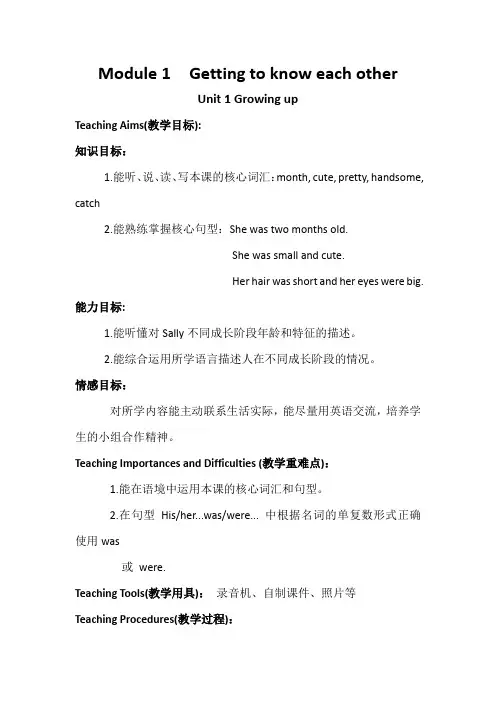
Module 1 Getting to know each otherUnit 1 Growing upTeaching Aims(教学目标):知识目标:1.能听、说、读、写本课的核心词汇:month, cute, pretty, handsome, catch2.能熟练掌握核心句型:She was two months old.She was small and cute.Her hair was short and her eyes were big.能力目标:1.能听懂对Sally不同成长阶段年龄和特征的描述。
2.能综合运用所学语言描述人在不同成长阶段的情况。
情感目标:对所学内容能主动联系生活实际,能尽量用英语交流,培养学生的小组合作精神。
Teaching Importances and Difficulties (教学重难点):1.能在语境中运用本课的核心词汇和句型。
2.在句型His/her...was/were... 中根据名词的单复数形式正确使用was或were.Teaching Tools(教学用具):录音机、自制课件、照片等Teaching Procedures(教学过程):StepⅠ.Warm up and revision(热身与复习)1. Greetings.2. Do some warming-up exercises.3. Review the numbers.Step Ⅱ.Presentation and practice(呈现新语言知识和练习)1. Lead in.T: How old are you?S1: I’m eleven years oldT: You’ll be twelve years old next year. You’re growing up.2. Show some photos and introduce the new words.3. Learn to say and use the words.4. Talk about the photos of Sally.5. Watch the screen and learn to say the sentences.6. Ask pupils to practise in groups.Sept Ⅲ. Learn the story (学习课文)1. Read the story and learn to say the useful sentences.2. Watch the cartoon.Module 1 Getting to know each otherUnit 2 My summer holidayTeaching Aims(教学目标):1.能听、说、读、写本课的核心词汇:famous, during, spend, everyone,countryside2.能熟练掌握核心句型:How was your summer holiday?It was wonderful. We went to the Great Wall.Everyone had a good time.3.读懂有关暑假生活的对话,学会询问别人和介绍自己的暑假生活。
牛津上海版英语六年级上册Unit10Period2教学设计
4.积极参与:鼓励学生积极参与课堂活动,提高学习兴趣,树立自信心。
5.环保意识:在讨论节日习俗时,引导学生关注环保问题,提高环保意识。
二、学情分析
在本章节的教学中,考虑到牛津上海版英语六年级上册Unit10 Period2的内容,我们需要充分关注学生的学习情况。六年级的学生已经具备一定的英语基础,他们掌握了基本的词汇和语法知识,但在实际运用中仍需加强。以下是具体的学情分析:
3.促进交流,培养跨文化意识:
-鼓励学生在小组内用英语讨论不同节日的习俗,促进口语交流。
-安排学生进行文化展示,介绍自己了解的节日,培养跨文化理解和尊重。
4.自主探究,提高学习效率:
-鼓励学生利用网络资源和图书,自主查找节日信息,增强学习的主观能动性。
-设计个性化学习任务,如制作节日视频、编写节日故事,让学生在探究中巩固知识。
-鼓励学生在完成作业过程中,与同学交流讨论,互相学习,共同提高。
2.语法:学生能够理解并运用一般现在时态描述节日习俗,掌握一般现在时态的肯定句、否定句和疑问句结构。
3.听力:学生能够听懂并理解关于节日的描述,获取关键信息,如节日名称、时间、地点、习俗等。
4.口语:学生能够在小组活动中,运用所学词汇和语法,就节日话题进行交流,分享各自的节日经历。
5.阅读与写作:学生能够阅读并理解关于节日的文章,提取关键信息,完成相关练习;同时,能够仿写一篇关于节日的短文,表达自己的观点。
为了巩固本章节的学习内容,确保学生对所学知识的理解和运用,特布置以下作业:
1.词汇巩固:请学生从本节课学习的新词汇中选择5-10个,用这些词汇编写一段关于节日的描述性文字,要求不少于50词。
新沪教牛津版六年级上Unit 10教案
Module 4 The natural worldUnit 10 AirTeaching Aims(教学目标):1.能听、说、读、写本课的核心词汇:air, everywhere , alive, smoke, factory, dirty, clean, fresh, plant2.能熟练掌握核心句型:It keeps them high in the sky.3.读懂描述空气污染的对话。
Teaching Importances and Difficulties (教学重难点):1.能在语境中正确使用本单元的核心词汇。
2.能用句型It keeps them high in the sky.描述空气的作用。
Teaching Tools(教学用具):录音机、自制课件、照片等Teaching Procedures(教学过程):StepⅠ.Warm up and revision(热身与复习)1. Greetings.2. Guessing game.Step Ⅱ.Presentation and practice (自主探究)1.生词关T: Please write the meanings on your paperair______ smoke ______ factory ________dirty________ clean ______ alive _________everywhere_______ important ______2. Learn the new words.T: Let’s listen and say the new words.Ss: Read these words after teacher.3. Work in groups to read the new words. Recite the new words, and then recite in groups。
牛津沪教版六年级上册6AUnit10复习教案无答案
牛津沪教版六年级上册6AUnit10 复习教学设计〔无答案〕Unit10healthyeating同步教学设计.Importantwordsandphrases:Words:healthyadj.健康的Tom’sdietishealthierthanJohn.汤姆的饮食比约翰的更健康。
unhealthy a.不健康的,对健康有害的Eatingtoomuchfastfoodisunhealthy. 吃太多快餐对健康有害。
health n.健康Healthcomesfirst. 健康是首位的。
1/14牛津沪教版六年级上册6AUnit10 复习教学设计〔无答案〕eatingn.吃,饮食AliceandJoearedoingaquizabouteatinghabits. Alice和Joe正在做对于饮食的测试。
eat v.吃Ieatanappleeveryday. 我每日吃一个苹果。
dietn.食谱,平时食品Lilymakesasalt-freedietforkeepingthin.莉莉为保持身材拟订了无盐食谱。
Hisillnessisbecauseofpoordiet.他的疾病是由于差的饮食。
4.salt n.盐Youputtoomuchsaltinthesteamedfish.你在清蒸鱼里放了太多盐。
Ithinkyoushouldeatlittlesalt.我以为你应当少吃盐。
salty adj.咸的Thefriedricetastedtoosalty.炒饭尝起来太咸。
Oh,thesteamedfishissalty,too.蒸鱼也特别咸。
5.fresh adj.新鲜的;淡的Thesevegetablesarefresh.Ipickedthemthismorning.这些蔬菜很新鲜,它们是我今日清晨摘的。
Peopledrinkfreshwater,notsaltywater.人们喝淡水,不喝咸水。
freshflowers鲜花afreshhand生手makeafreshstart从头开始6.exercise n.锻炼;运动;练习;体操Walking,runningandjumpingareallhealthyformsofexercise.走路,跑步和跳远都是健康的体育锻炼。
Unit10Period4教学设计2023-2024学年牛津上海版英语六年级上册
教学方法/手段/资源:
-自主学习法:引导学生自主思考,培养自主学习能力。
-信息技术手段:利用在线平台、微信群等,实现预习资源的共享和监控。
作用与目的:
-帮助学生提前了解“描述过去事件”课题,为课堂学习做好准备。
-培养学生的自主学习能力和独立思考能力。
4.过去式的练习:提供一些过去式的练习题,包括填空、选择、改写句子等,让学生在实践中巩固和应用过去式。
5.总结:对本节课的内容进行简要总结,强调过去式的关键知识点和应用技巧。
教学反思与总结
在教学过程中,我注意到了一些问题。首先,学生的学习兴趣和参与度较高,但仍有部分学生在理解过去式的构成和用法上存在困难。其次,在课堂讨论和活动中,部分学生过于依赖老师和同伴,缺乏独立思考的能力。最后,课堂时间管理方面,有时活动时间过长,影响了教学进度。
2.学生的学习兴趣、能力和学习风格:六年级的学生对英语保持着积极的学习兴趣,特别是在运用英语进行交流和表达方面。在学习能力方面,大部分学生能够跟上课程的进度,理解和掌握新知识。在学习风格上,学生们喜欢通过互动和参与式活动来学习,对于任务驱动和合作学习的方式较为适应。
3.学生可能遇到的困难和挑战:在学习过去式时,学生可能会对时态的运用和区分存在一定的困难,特别是在听力和阅读理解方面。另外,部分学生可能在口语表达时过于紧张,影响他们的表达流利度。此外,对于如何正确运用过去式进行写作,学生可能需要在实践中进一步练习和提高。
-设计预习问题:围绕“描述过去事件”课题,设计一系列具有启发性和探究性的问题,引导学生自主思考。
-监控预习进度:利用平台功能或学生反馈,监控学生的预习进度,确保预习效果。