
译林英语3B Unit7On the farm第一课时
ducks
pigs cows chickens apples oranges pears
四人一组, 有创意的 读一读, 看哪个小 组读得最 棒。
这些
那些
these, those those, these What are these? They’re…… 它们是 What are those? They’re……Leabharlann A: What’s this?
…… apple. B: It’s an
this 这个 these 这些
A: What are these?
…… B: They’re apples.
A: What’s that?
a duck. B: It’s ……
A: What are those?
…… B: They’re ducks.
不,它们不是。 它们是梨子。
aren’t = are not
They’re = they are 它们是
A: Are those pears too? 那些也是梨子吗? B: Yes, they are.
是的,它们是。
that 那个
those 那些
对于近处的某一个东西,我们问: What’s this ? 对于近处的某一些东西,我们问: What are these ? 对于远处的某一个东西,我们问: What’s that ? 对于远处的某一些东西,我们问: What are those ?
pears A: Are these oranges? 这些是橙子吗? B: No, they aren’t. They’re pears.
Unit7Onthefarm(讲义)译林版英语三年级下册
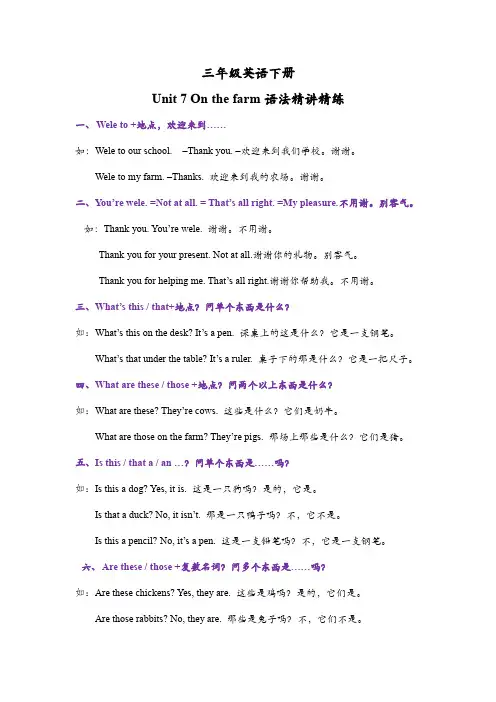
三年级英语下册Unit 7 On the farm语法精讲精练一、Wele to +地点,欢迎来到……如:Wele to our school. –Thank you. –欢迎来到我们学校。
谢谢。
Wele to my farm. –Thanks. 欢迎来到我的农场。
谢谢。
二、You’re wele. =Not at all. = That’s all right. =My pleasure.不用谢。
别客气。
如:Thank you. You’re wele. 谢谢。
不用谢。
Thank you for your present. Not at all.谢谢你的礼物。
别客气。
Thank you for helping me. That’s all right.谢谢你帮助我。
不用谢。
三、What’s this / that+地点?问单个东西是什么?如:What’s this on the desk? It’s a pen. 课桌上的这是什么?它是一支钢笔。
What’s that under the table? It’s a ruler. 桌子下的那是什么?它是一把尺子。
四、What are these / those +地点?问两个以上东西是什么?如:What are these? They’re cows. 这些是什么?它们是奶牛。
What are those on the farm? They’re pigs. 那场上那些是什么?它们是猪。
五、Is this / that a / an …?问单个东西是……吗?如:Is this a dog? Yes, it is. 这是一只狗吗?是的,它是。
Is that a duck? No, it isn’t. 那是一只鸭子吗?不,它不是。
Is this a pencil? No, it’s a pen. 这是一支铅笔吗?不,它是一支钢笔。
六、Are these / those +复数名词?问多个东西是……吗?如:Are these chickens? Yes, they are. 这些是鸡吗?是的,它们是。
《On the farm》-PPT标准课件(第一课时)

Words
orange /ˈɒrɪndʒ/
名词,意为“橙子”。复数:oranges。 小练习:根据图片选择正确的选项。__B____
A.apple B.orange orange还可以作为形容词,意为“橙色的” ,eg:an orange bag 一只橙色的包。
Expressions
Nice to meet you.
2.学富五车,形容读书多,知识丰富 。学贯 中西: 形容学 问贯通 了中国 和西方 的种种 知识。 语段中 所举的 钱钟书 、林语 堂和胡 适的事 例都是 说明“他 们的国 学功底 异常深 厚,他 们的英 语水准 堪称世 界一流 ”,而 非单纯 指他们 的学问 大,故 选“学贯 中西” 更合适 。
3.南辕北辙,比喻行动和目的相反, 指自身 的行动 与自己 的目的 相反。 背道而 驰:比 喻彼此 的方向 和目标 完全相 反,是 指某人 的做法 和应遵 循的大 众化的 目标相 反。语 境是“与 时代的 发展” 相反, 据此应 该选“背 道而驰 ”。
8.这是这堂课最精彩的部分,不论学 生的质 疑,还 是探究 ,都热 情高涨 ,高潮 迭起。 由于课 堂气氛 宽松、 和谐, 教学双 方对教 材有深 入的理 解,所 以能全 身心地 投入。
9.特别是学生思维异常活跃,常常迸 射智慧 的火花 ,出现 精彩的 对答。 在这一 环节中 ,教者 的点拨 、引导 ,学生 的质疑 与解疑 ,师生 之间思 想的碰 撞,语 言的交 流,课 文内容 与表达 形式的 交融无 不令人 赏心悦 目。
小练习:B( )Amy好奇地向叔叔询问询问她不认识 的动物们: Amy:____________ Uncle: They are donkeys. A.What are these? B.What are this?
牛津译林三年级英语下册《Unit7 On the farm》公开课精品课件
Let’s watch
On the farm
Read or act.
Tip: Choose one to read in three. 选择一 种三人练习。
Showtime.
1. 三人一组进行故事表演练习。 2. 注意自己的语音语调,表情和动作。 3.一小组表演时,其他小组观看并评分。 朗读基本流利,表情动作基本到位。 朗读较为流利,表情动作比较到位。 基本能够脱稿,表情动作十分到位。
B A. Am B. Are C. Is
Let’s practice.
三、按要求改写句子。 1. These are apples.(对画线部分提问) __________________________________
2. ThosWe ahreapteaarsreovtehr ethseree?.( 变为一般疑问句)
What’re these?
Story time
Grandpa, this is Mike.
Nice to meet you, Mike. Welcome to my farm.
Nice to meet you.
Nice to meet you! 初次见面时使用,说话的双方之前不认识
Story time
They’re pigs.
Summary
1. 词汇 apple orange pear pig duck cow chicken 2.句型
What are these/ those? They’re… Are these/those…? Yes, they are./ No, they aren’t.
Homework
1. 抄写四会单词apple, orange, pear, duck, cow, pig, chicken
译林版《英语》三(下)Unit_7_On_the_farm_第一课时

文|周敏教学过程Step1.Warming-upandLeading-in1.Sing a song “Where ’sthe bird ?”.2.Playagame:Train,Train,go away.(number /fruit /animal )Numbers:seven /two /eleven /three/twelve/...Fruit:orange /apple /banana/pear/...Animals:bird /pig /duck /cow /lamb /tiger /bear /...3.Ask and answer T:Where can you see the fruit and animals?S:We can see them on thefarm.(新授farm ,car-far-farm ,并揭题)设计意图:课堂伊始,让学生吟唱歌曲,营造轻松愉快的英语学习氛围,通过游戏的方式鼓励学生说说数字类、水果类和动物类词汇,激活学生已有的知识储备,激发学生的学习兴趣。
同时,教师有效借助核心词“fruit and animals ”自然引入新课的学习。
Step 2.Presentation 1.Watch and answerT:Here ’s a cartoon of afarm for you.Let ’s watch the cartoon together.I have some questions for you.(学生观看动画回答问题)Q1:Whose farm is it?S:It ’s Liu Tao ’s grandpa ’sfarm.(板贴刘涛爷爷的头饰)T:How is the farm?S:It ’s nice/great/ (2)Whoisvisiting thefarm?S:Liu Tao and Mike.(板贴刘涛和麦克的头饰)Q3:What can they see onthe farm?S:They can see pigs,cows,apples and pears.(新授词汇单复数:big-pig-pigs ,how-cow-cows ,apple-apples ,bear -pear-pears ,并同步板贴上述动物和水果的图片)设计意图:通过观动画、看插图等不同形式的语言输入引导学生初步感知故事。
三年级英语下册素材-Unit 7 On the farm课文翻译 译林版(三起)
Unit 7 On the farm第七单元在农场单元单词(15个)·farm英[fɑːm] / n.农场I'm going to the farm.(我要去农场。
)·Welcome英[ˈwelkəm] / v.欢迎来到……Welcome to las Vegas.(欢迎来到拉斯维加斯。
)·they英[ðeɪ] / pron.他们;她们;它们They are happy together.(他们在一起很开心。
)·they're=they are英/ abbr.他(她/它)们是They're too dear.(它们的价格太高了。
)·pig英[pɪg] / n.猪The pig stores a lot of fat in its body.(猪在体内储存了大量的脂肪。
)·those英[ðəʊz] / pron.那些Whose dirty socks are those?(那些是谁的脏袜子?)·cow英[kaʊ] / n.奶牛A mature cow has horns.(成年奶牛有犄角。
)·apple英['æp(ə)l] / n.苹果Do you like apples?(你喜欢苹果吗?)·pear英[peə] / n.梨Do you like pears?(你喜欢梨吗?)·chicken英['tʃɪkɪn] / n.鸡I want chicken.(我想吃鸡肉。
)·duck英[dʌk] / n.鸭子I have a duck.(我有一只鸭子。
)·orange英['ɒrɪn(d)ʒ] / n.橙子Do you like orange?(你喜欢橙子吗?)·picture英['pɪktʃə] / n.图画;照片The sunset glow is just like a picture.(晚霞恰如一幅图画。
小学英语三下U7 On the farm (story time)
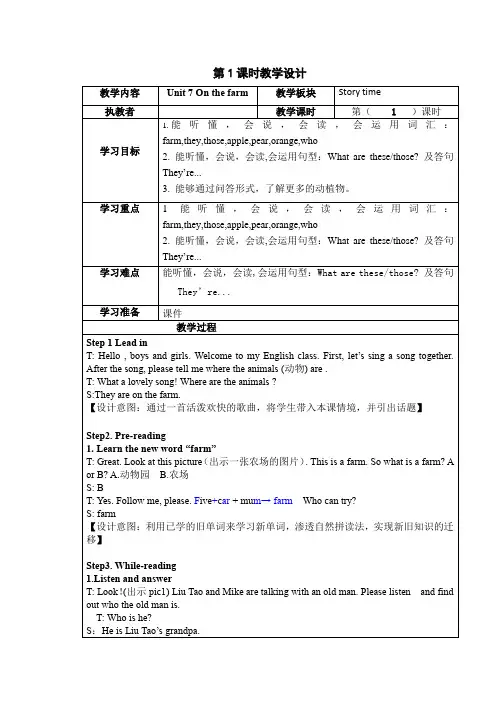
7.Read and complete
T: Let’s go to see some fruit trees with them. Please read Picture 4-5 and complete their dialogues.
S: What are these? /What are those?
T: Good job! Look at the questions and pictures. What’s the difference ?
S: ...
T: Good try! When the animals are nearby, we ask “What are these?” When the animals are far away, we ask “What are those?” Is that clear?
T: What a lovely song! Where are the animals ?
S:They are on the farm.
【设计意图:通过一首活泼欢快的歌曲,将学生带入本课情境,并引出话题】
Step2. Pre-reading
1.Learn the new word “farm”
T: Great. Look at this picture(出示一张农场的图片). This is a farm. So what is a farm? A or B? A.动物园的句型。】
9.Read and imitate
小学英语牛津译林版三年级下册Onthefarm说课稿
小学英语牛津译林版三年级下册Onthefarm说课稿On the farm说课稿一.说教学内容今天我说课的内容是On the farm的第一课时.这一课时主要学习单词plant, else, taste last, pick, picked和句型What(else) did you do…? I…围绕着一般过去时这一时态和动词的过去式展开.二.说教学目标<<英语课程标准>>指出:激发和培养学生学习英语的兴趣,使学生树立自信心,养成良好的学习习惯和有效的学习策略,发展学生自主学习的能力和合作精神是小学英语教育的基本任务.在认真分析教材的基础上,根据这一课时的内容和学生的整体认识水平,从知识教学,能力培养等方面考虑,我确立本课时的教学目标为:(一),知识目标1 能听懂、会说、会读、会拼写单词pull up , else, taste及其中动词的过去式。
2 能听懂、会说、会读单词, collect , pick, picked.3 能听懂、会说、会读、会写句型What(else) did you do…? I…,并能在情境中正确运用该句型.(二),能力目标能运用所学知识介绍农场上的情境,引导学生学会理解和运用一般过去时,让学生从语境中感知语言规律,从语境中学会技能,从语境中升华语言交际功能。
(三),情感目标1 培养学生注意观察,认真模仿的良好习惯和主动学习的能力.2 激发学生学习英语的兴趣,使学生树立学习英语的自信心.3 培养学生团结协作的精神,和合作交流的能力.三、说教学重点1四会单词pull up , else, taste。
2 理解并掌握句型What(else) did you do…? I…的读音及运用。
四、说教学难点1掌握句型What(else) did you do…? I…的读音及运用。
2 规则动词过去式的变化规律及其读音。
五、教学准备1 课件、若干橘子。
2 预先写好课题 Unit 5。
三年级下册英语教案-Unit 7 On the farm 译林版
三年级下册英语教案-Unit 7 On the farm 译林版第一部分教学目标语言知识目标1.能够听懂、会说、会读、会写并表演单词:pear, apple, banana, orange, watermelon, carrot, tomato, potato, cabbage, onion, corn, pumpkin, tree, garden, farm。
2.能够听懂、会说、会读、会写并表演句型:What’s this/that? It’sa/an/corn/pumpkin/tree/garden. What fruit do you like? I likeapples/bananas/watermelons.3.学会用英文表达自己的食物喜好。
情感态度价值观目标1.能够通过了解农场及果蔬的种植、栽培、采摘等过程,培养学生关心食品安全,珍惜食物资源,形成良好的素质和价值观;2.能够培养学生爱护大自然,珍惜资源的意识;3.通过小组合作学习,培养学生的合作精神和团队合作意识。
第二部分教学重难点教学重点1.学习12个蔬菜水果的名称;2.能够运用“What’s this/that?”并正确回答;3.学会用英文表达自己的喜好。
教学难点1.能够正确表达“corn”和“onion”两个单词;2.能够用英文表达自己对某些食物的喜好。
第三部分教学内容教学环节导入1.欣赏有关农场的图片,引导学生猜想本节课内容;2.引入新单词“pear, apple, banana, orange, watermelon, carrot, tomato, potato, cabbage, onion, corn, pumpkin”及运用“What’sthis/that?”,使学生对新单词有初步的了解。
热身操练三个单词:tree, garden, farm。
教师和学生相互回答“What’sthis/that?”呈现新课1.继续呈现新单词“pear, apple, banana, orange, watermelon, carrot, tomato, potato, cabbage, onion, corn, pumpkin”及发音、图画;2.教师设计例如:看图片识单词。
译林版(三起)三年级英语下册Unit 7 On the farm知识点归纳汇总
Unit 7 On the farm知识点归纳汇总单词farm 农场Welcome to 欢迎来到……they 他们;她们;它们they’re=they arepig 猪those 那些cow 奶牛apple 苹果pear 梨chicken 鸡duck 鸭子orange 橙子picture 图画;照片who 谁who’s=who is重点内容重点短语:my farm 我的农场a cow 一头奶牛a pig 一头猪a chicken 一只鸡a duck 一只鸭子a pear 一个梨知识点精析1.如何用“ Welcome(to)…”表达欢迎【课文应用】Welcome to my farm.欢迎来到我的农场。
welcome在这里的意思是“欢迎”,后面可以接副词back或home,也可以独立成句。
当要进一步说出欢迎来到的地点时,可以在welcome后面接to,再接表示地点的名词。
例如:Welcome to Beijing.欢迎来到北京。
Welcome back. 欢迎回来。
2. welcome简介welcome既可以作感叹词、形容词、名词,又可以作动词。
让我们一起来看一下它的用法吧!例如: He is a welcome teacher.他是一位受欢迎的老师。
①welcome作形容词时,表示“受欢迎的”通常位于be动词之后、名词之前。
②welcome作名词时,表示“欢迎;接待”,一般用于give后作直接宾语。
例如: Let's give them a warm welcome.让我们对他们表示热烈的欢迎。
③welcome作动词时,表示“欢迎”,后面一般接人作宾语。
例如:They welcomed us at the door.他们在门口欢迎了我们。
3.如何询问“这些/那些是什么?”【课文应用】What are these?这些是什么?They' re pigs.它们是猪。
What are those?那些是什么?They' re cows.它们是奶牛。
无锡市译林英语三下Unit7 On the farm赛课课件(有配套教案)
and underline.
(找出提到苹果的问题并划出来。)
Are these apples?
Are those apples too (也)?
要注意读出故事中人物的心情, 也可加上一些动作哦!
自豪
ห้องสมุดไป่ตู้
疑惑
要注意读出故事中人物的心情, 也可加上一些动作!
疑惑
自豪,开心
Try to read
Grandpa, this th is Mike. Nice to meet you,Mike. Welcome to my farm. Nice to meet you. What are th these? Tip2: 注意语音语调哦 ~ Th They're pigs. th What are those? Th They're cows. Are th these apples?
A: What are these? B: They're s. A: What are those? B: They're s.
Watch and answer
Question:Whose farm is this? (这是谁的农场?)
Welcome to my farm.
欢迎来我的农场。
Make a dialogue
Tips: 四人一组 ,互相介绍自己的 happy farm。 选择参观一人的开心农场,其 他三人发问,争取上台表演哦。
Homework
1.Copy the new words. (抄写新单词。) 2.Read Story time after the tape. (跟录音朗读课文。) 3.Go on drawing the happy farm and introduce the farm to your parents. (继续画开心农场并向父母介绍农场。)