
培根《论学习》 英文加翻译
OF STUDIES
Francis Bacon
Studies serve for delight, for ornament, and for ability.Their chief use
for delight, is in privateness and retiring; for ornament, is in discourse;
and for ability, is in the judgment and disposition of business.
For expert and execute, and perhaps judge of particulars, one by one; but
the general counsels, and the plots and marshalling of affairs, come best
form those that are learned.To spend too much time in studies is sloth; to use them too much for ornament, is affectation; to make judgement wholly by their rules, is the humour of a scholar.
They perfect nature, and are perfected by experience: for natural abilities
are like natural plants, that need proyning by study; and studies themselves
do give forth directions too much at large, except they be bounded in by experience.
Crafty men contemn studies, simple men admire them, and wise men use them; for they teach not their own use; but that is a wisdom without them, and above them, won by observation.
Read not to contradict and confute; nor to believe and take for granted; nor
to find talk and discourse; but to weigh and consider.
Some books are to be tasted, others to be swallowed, and some few to be chewed and digested; that is, some books are to be read only in parts;
others to be read, but not curiously; and some few to be read wholly, and
with diligence and attention.Some books also may be read by deputy, and
extracts made of them by others; but that would be only in the less
important arguments, and the meaner sort of books; else distilled books are, like common distilled waters, flashy things.
Reading maketh a full man; conference a ready man; and writing an exact man. And therefore, if a man write little, he had need have a great memory; if he confer little, he had need have a present wit; and if he read little, he had
need have much cunning, to seem to know that he doth not.
Histories make men wise; poets witty; the mathematics subtile; natural philosophy deep; moral grave; logic and rhetoric able to contend.Abeunt studia in morse.
Nay there is no stand or impediment in the wit, but may be wrought out by
fit studies: like as diseases of the body may have appropriate exercises. Bowling is good for the stone and reins; shooting for the lungs and breast; gentle walking for the stomach; riding for the head; and the like.So if a man's wit be wandering, let him study the mathematics; for in demonstrations, if his wit be called away never so little, he must begin again.If his wit be not apt to distinguish or find differences, let him
study the schoolmen; for they are cymini sectores.If he be not apt to beat over matters, and to call up one thing to prove and illustrate another, let
him study the lawyers' cases.So every defect of the mind may have a special receipt.
论学习
弗朗西斯·培根
王佐良译
读书足以怡情,足以傅彩,足以长才。
其怡情也,最见于独处幽居之时;其傅彩也,最
见于高谈阔论之中;其长才也,最见于处世判事之际。
练达之士虽能分别处理细事或一一判别枝节,然纵观统筹,全局策划,则舍好学深思者
莫属。
读书费时过多易惰,文采藻饰太盛则矫,全凭条文断事乃学究故态。
读书补天然之不足,经验又补读书之不足,盖天生才干犹如自然花草,读书然后知如何
修剪移接,而书中所示,如不以经验范之,则又大而无当。
有一技之长者鄙读书,无知者羡读书,唯明智之士用读书,然书并不以用处告人,用书
之智不在书中,而在书外,全凭观察得之。
读书时不可存心诘难读者,不可尽信书上所言,亦不可只为寻章摘句,而应推敲细思。
书有可浅尝者,有可吞食者,少数则须咀嚼消化。
换言之,有只需读其部分者,有只须
大体涉猎者,少数则须全读,读时须全神贯注,孜孜不倦。
书亦可请人代读,取其所作
摘要,但只限题材较次或价值不高者,否则书经提炼犹如水经蒸馏,淡而无味。
读书使人充实,讨论使人机智,笔记使人准确。
因此不常做笔记者须记忆力特强,不常
讨论者须天生聪颖,不常读书者须欺世有术,始能无知而显有知。
读史使人明智,读诗使人灵秀,数学使人周密,科学使人深刻,伦理学使人庄重,逻辑
修辞之学使人善辩;凡有所学,皆成性格。
人之才智但有滞碍,无不可读适当之书使之顺畅,一如身体百病,皆可借相宜之运动除
之。
滚球利睾肾,射箭利胸肺,慢步利肠胃,骑术利头脑,诸如此类。
如智力不
集中,
可令读数学,盖演题需全神贯注,稍有分散即须重演;如不能辩异,可令读经院哲学,
盖是辈皆吹毛求疵之人;如不善求同,不善以一物阐证另一物,可令读律师之案卷。
如
此头脑中凡有缺陷,皆有特效可医。
(完整版)培根的《论学习》中英文对照

Abeunt studia in mois wit be not apt to
If he be not apt to beat over
So every defect of the
读书使人充实,讨论使人机智,笔记使人准确。因此不常做笔记者须记忆力特强,不常讨论者须天生聪颖,不常读书者须欺世有术,始能无知而显有知。 读史使人明智,读诗使人灵秀,数学使人周密,科学使人深刻,伦理学使人庄重,逻辑修辞之学使人善辩;凡有所学,皆成性格。 人之才智但有滞碍,无不可读适当之书使之顺畅,一如身体百病,皆可借相宜之运动除之。滚球利睾肾,射箭利胸肺,慢步利肠胃,骑术利头脑,诸如此类。如智力不集中,可令读数学,盖演题需全神贯注,稍有分散即须重演;如不能辩异,可令读经院哲学,盖是辈皆吹毛求疵之人;如不善求同,不善以一物阐证另一物,可令读律师之案卷。如此头脑中凡有缺陷,皆有特效可医。
论学习
弗朗西斯·培根
王佐良 译
Their chief use for delight, is
To spend too much time in
Some
读书足以怡情,足以傅彩,足以长才。其怡情也,最见于独处幽居之时;其傅彩也,最见于高谈阔论之中;其长才也,最见于处世判事之际。 练达之士虽能分别处理细事或一一判别枝节,然纵观统筹,全局策划,则舍好学深思者莫属。读书费时过多易惰,文采藻饰太盛则矫,全凭条文断事乃学究故态。 读书补天然之不足,经验又补读书之不足,盖天生才干犹如自然花草,读书然后知如何修剪移接,而书中所示,如不以经验范之,则又大而无当。 有一技之长者鄙读书,无知者羡读书,唯明智之士用读书,然书并不以用处告人,用书之智不在书中,而在书外,全凭观察得之。 读书时不可存心诘难读者,不可尽信书上所言,亦不可只为寻章摘句,而应推敲细思。 书有可浅尝者,有可吞食者,少数则须咀嚼消化。换言之,有只需读其部分者,有只须大体涉猎者,少数则须全读,读时须全神贯注,孜孜不倦。书亦可请人代读,取其所作摘要,但只限题材较次或价值不高者,否则书经提炼犹如水经蒸馏,淡而无味。
(完整版)培根的《论学习》中英文对照
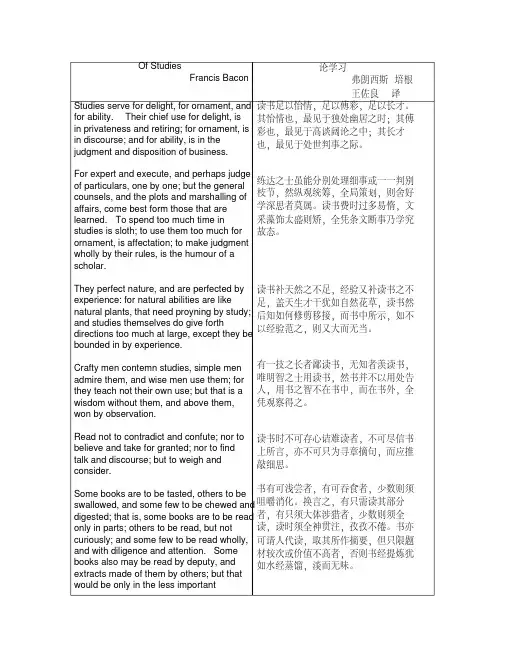
Of StudiesFrancis Bacon论学习弗朗西斯·培根王佐良译Studies serve for delight, for ornament, and for ability.Their chief use for delight, is in privateness and retiring; for ornament, is in discourse; and for ability, is in thejudgment and disposition of business. For expert and execute, and perhaps judge of particulars, one by one; but the general counsels, and the plots and marshalling of affairs, come best form those that are learned.To spend too much time in studies is sloth; to use them too much for ornament, is affectation; to make judgment wholly by their rules, is the humour of a scholar.They perfect nature, and are perfected by experience: for natural abilities are like natural plants, that need proyning by study; and studies themselves do give forthdirections too much at large, except they be bounded in by experience.Crafty men contemn studies, simple men admire them, and wise men use them; for they teach not their own use; but that is a wisdom without them, and above them, won by observation.Read not to contradict and confute; nor to believe and take for granted; nor to find talk and discourse; but to weigh and consider.Some books are to be tasted, others to beswallowed, and some few to be chewed and digested; that is, some books are to be read only in parts; others to be read, but notcuriously; and some few to be read wholly, and with diligence and attention.Some books also may be read by deputy, and extracts made of them by others; but that would be only in the less important读书足以怡情,足以傅彩,足以长才。
(完整版)培根的《论读书》OfStudies(原文和译文)

Of StudiesSTUDIES serve for delight, for ornament, and for ability. Their chief use for delight, is in privateness and retiring; for ornament, is in discourse; and for ability, is in the judgment, and disposition of business. For expert men canexecute, and perhaps judge of particulars, one by one; but the general counsels, and the plots and marshalling of affa irs,come best, from those that are learned. To spend too muc h timein studies is sloth; to use them too much for ornament, is affectation; to make judgment wholly by their rules, is the humor of a scholar. They perfect nature, and are perfected by experience: for natural abilities are like natural plants, that need pruning, by study; and studies themselves, do gi veforth directions too much at large, except they be bounded inby experience. Crafty men contemn studies, simple men ad mirethem, and wise men use them; for they teach not their ownbut that is a wisdom without them, and above them, won b yobservation. Read not to contradict and confute; nor to beli eveand take for granted; nor to find talk and discourse; but to weigh and consider. Some books are to be tasted, others t o beswallowed, and some few to be chewed and digested; that i s,some books are to be read only in parts; others to be read,but not curiously; and some few to be read wholly, and wit hdiligence and attention. Some books also may be read by d eputy,and extracts made of them bothers; but that would be only inthe less important arguments, and the meaner sort of book s,else distilled books are like common distilled waters, flashyReading make a full man; conference a ready man; and writ ingan exact man. And therefore, if a man write little, he had need have a great memory; if he confer little, he had need have a present wit: and if he read little, he had need have much cunning, to seem to know, that he doth not. Historie smake men wise; poets witty; the mathematics subtitle; nat uralphilosophy deep; moral grave; logic and rhetoric able to co ntend.Abeunt studia in mores. Nay, there is no stand or impedim ent inthe wit, but may be wrought out by fit studies; like as disea sesof the body, may have appropriate exercises. Bowling is go od forthe stone and reins; shooting for the lungs and ***; gentle walking for the stomach; riding for the head; and the like. Soif a man's wit be wandering, let him study the mathematics ; forin demonstrations, if his wit be called away never so little, he must begin again. If his wit be not apt to distinguish or find differences, let him study the Schoolmen; for they are Cymini sectors. If he be not apt to beat over matters, and t ocall up one thing to prove and illustrate another, let him st udythe lawyers' cases. So every defect of the mind, may have a special receipt.论读书王佐良译读书足以怡情,足以傅彩,足以长才。
中英对照培根《论学习》of_study王佐良先生翻译
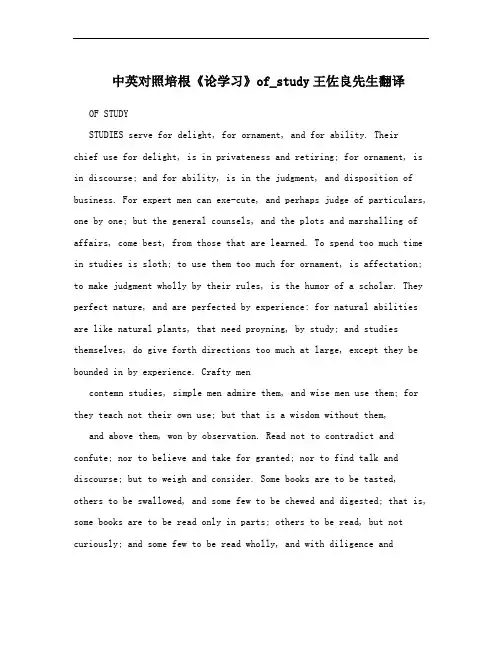
中英对照培根《论学习》of_study王佐良先生翻译OF STUDYSTUDIES serve for delight, for ornament, and for ability. Theirchief use for delight, is in privateness and retiring; for ornament, is in discourse; and for ability, is in the judgment, and disposition of business. For expert men can exe-cute, and perhaps judge of particulars, one by one; but the general counsels, and the plots and marshalling of affairs, come best, from those that are learned. To spend too much time in studies is sloth; to use them too much for ornament, is affectation; to make judgment wholly by their rules, is the humor of a scholar. They perfect nature, and are perfected by experience: for natural abilities are like natural plants, that need proyning, by study; and studies themselves, do give forth directions too much at large, except they be bounded in by experience. Crafty mencontemn studies, simple men admire them, and wise men use them; for they teach not their own use; but that is a wisdom without them, and above them, won by observation. Read not to contradict and confute; nor to believe and take for granted; nor to find talk and discourse; but to weigh and consider. Some books are to be tasted, others to be swallowed, and some few to be chewed and digested; that is, some books are to be read only in parts; others to be read, but not curiously; and some few to be read wholly, and with diligence andattention. Some books also may be read by deputy, and extracts madeof them bothers; but that would be only in the less important arguments, and the meaner sort of books, else distilled books are like common distilled waters, flashy things.Reading makes a full man; conference a ready man; and writing anexact man. And therefore, if a man write little, he had need have agreat memory; if he confer little, he had need have a present wit: andif he read little, he had need have much cunning, to seem to know, that he doth not. Histories make menwise; poets witty; the mathematics subtitle; natural philosophy deep; moral grave; logic and rhetoric able to contend. Abeunt studia in mores. Nay, there is no stand or impediment in the wit, but may be wrought out by fit studies; like as diseases of the body, may have appropriate exercises. Bowling is good for the stone and reins; shooting for the lungs and breast; gentle walking for the stomach; riding for the head; and the like. So if a man's wit be wandering, let him study the mathematics; for in demonstrations, if his wit be called away never so little, he must begin again. If his wit be not apt to distinguish orfind differences, let him study the Schoolmen; for they are cymini sectors. If he be not apt to beat over matters, and to call up one thing to prove and illustrate another, let him study the lawyers' cases. So every defect of the mind, may have a special receipt读书足以怡情,足以博彩,足以长才。
ofstudy培根论读书原文+翻译

O f S t u d y培根论读书原文+翻译-CAL-FENGHAI-(2020YEAR-YICAI)_JINGBIANOf StudyStudies serve for delight, for ornament, and for ability.Their chief use for delight, is in privateness and retiring; for ornament, is in discourse;and for ability, is in the judgment and disposition of business.读书足以怡情,足以傅彩,足以长才。
其怡情也,最见于独处幽居之时;其傅彩也,最见于高谈阔论之中;其长才也,最见于处世判事之际。
For expert and execute, and perhaps judge of particulars, one by one; but the general counsels, and the plots and marshalling of affairs, come best form those that are learned.To spend too much time in studies is sloth; to use them too much for ornament, is affectation; to make judgement wholly by their rules, is the humour of a scholar.练达之士虽能分别处理细事或一一判别枝节,然纵观统筹,全局策划,则舍好学深思者莫属。
读书费时过多易惰,文采藻饰太盛则矫,全凭条文断事乃学究故态。
They perfect nature, and are perfected by experience: for natural abilities are like natural plants, that need proyning by study; and studies themselves do give forth directions too much at large, except they be bounded in by experience.读书补天然之不足,经验又补读书之不足,盖天生才干犹如自然花草,读书然后知如何修剪移接,而书中所示,如不以经验范之,则又大而无当。
Of Study培根论读书原文+翻译
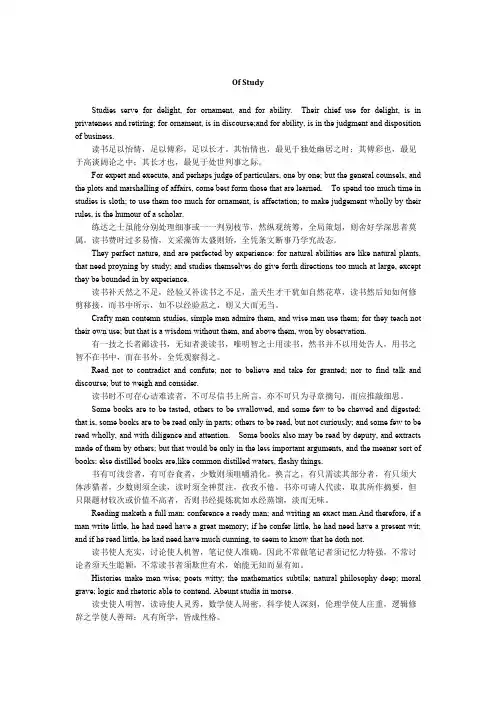
Of StudyStudies serve for delight, for ornament, and for ability. Their chief use for delight, is in privateness and retiring; for ornament, is in discourse;and for ability, is in the judgment and disposition of business.读书足以怡情,足以傅彩,足以长才。
其怡情也,最见于独处幽居之时;其傅彩也,最见于高谈阔论之中;其长才也,最见于处世判事之际。
For expert and execute, and perhaps judge of particulars, one by one; but the general counsels, and the plots and marshalling of affairs, come best form those that are learned. To spend too much time in studies is sloth; to use them too much for ornament, is affectation; to make judgement wholly by their rules, is the humour of a scholar.练达之士虽能分别处理细事或一一判别枝节,然纵观统筹,全局策划,则舍好学深思者莫属。
读书费时过多易惰,文采藻饰太盛则矫,全凭条文断事乃学究故态。
They perfect nature, and are perfected by experience: for natural abilities are like natural plants, that need proyning by study; and studies themselves do give forth directions too much at large, except they be bounded in by experience.读书补天然之不足,经验又补读书之不足,盖天生才干犹如自然花草,读书然后知如何修剪移接,而书中所示,如不以经验范之,则又大而无当。
(完整版)培根的《论学习》中英文对照
(完整版)培根的《论学习》中英文对照培根的《论学习》中英文对照Francis Bacon's "Of Studies" 中英文对照Introduction 引言In his essay "Of Studies," Francis Bacon discusses the importance and benefits of studying. Bacon emphasizes the various ways in which study can enhance one's life and character. This essay presents a comparison between the original English version and its Chinese translation. The aim is to explore how the author's ideas and arguments are effectively conveyed in both languages. While the content may differ slightly due to translation, the essence of Bacon's insights remain intact.第一部分:关于学习的价值 Part 1: The Value of StudiesOriginal (English) 原文(英文):Studies serve for delight, for ornament, and for ability. Their chief use for delight is in privateness and retiring; for ornament, is in discourse; and for ability, is in the judgment and disposition of business... Read not to contradict and confute; nor to believe and take for granted; nor to find talk and discourse, but to weigh and consider... Some books are to be tasted, others to be swallowed, and some few to be chewed and digested...Translation (Chinese) 翻译(中文):学习的价值在于获得欢乐、装饰人生和增长能力。
Of Study培根论读书原文+翻译
Of StudyStudies serve for delight, for ornament, and for ability. Their chief use for delight, is in privateness and retiring; for ornament, is in discourse;and for ability, is in the judgment and disposition of business.读书足以怡情,足以傅彩,足以长才。
其怡情也,最见于独处幽居之时;其傅彩也,最见于高谈阔论之中;其长才也,最见于处世判事之际。
For expert and execute, and perhaps judge of particulars, one by one; but the general counsels, and the plots and marshalling of affairs, come best form those that are learned. To spend too much time in studies is sloth; to use them too much for ornament, is affectation; to make judgement wholly by their rules, is the humour of a scholar.练达之士虽能分别处理细事或一一判别枝节,然纵观统筹,全局策划,则舍好学深思者莫属。
读书费时过多易惰,文采藻饰太盛则矫,全凭条文断事乃学究故态。
They perfect nature, and are perfected by experience: for natural abilities are like natural plants, that need proyning by study; and studies themselves do give forth directions too much at large, except they be bounded in by experience.读书补天然之不足,经验又补读书之不足,盖天生才干犹如自然花草,读书然后知如何修剪移接,而书中所示,如不以经验范之,则又大而无当。
(完整版)培根的《论学习》中英文对照
Read not to contradict and confute; nor to believe and take for granted; nor to find talk and discourse; but to weigh and consider.
Some books are to be tasted, others to be swallowed, and some few to be chewed and digested; that is, some books are to be read only in parts; others to be read, but not curiously; and some few to be read wholly, and with diligence and attention.Some books also may be read by deputy, and extracts made of them by others; but that would be only in the less importantarguments, and the meaner sort of books; else distilled books are, like common distilled waters, flashy things.
(完整word版)培根的《论读书》Of Studies (原文和译文)
Of StudiesSTUDIES serve for delight, for ornament, and for ability. Their chief use for delight, is in privateness and retiring; for ornament, is in discourse; and for ability, is in the judgment, and disposition of business. For expert men canexecute, and perhaps judge of particulars, one by one; but the general counsels, and the plots and marshalling of affa irs,come best, from those that are learned. To spend too muc h timein studies is sloth; to use them too much for ornament, is affectation; to make judgment wholly by their rules, is the humor of a scholar. They perfect nature, and are perfected by experience: for natural abilities are like natural plants, that need pruning, by study; and studies themselves, do gi veforth directions too much at large, except they be bounded inby experience. Crafty men contemn studies, simple men ad mirethem, and wise men use them; for they teach not their ownbut that is a wisdom without them, and above them, won b yobservation. Read not to contradict and confute; nor to beli eveand take for granted; nor to find talk and discourse; but to weigh and consider. Some books are to be tasted, others t o beswallowed, and some few to be chewed and digested; that i s,some books are to be read only in parts; others to be read,but not curiously; and some few to be read wholly, and wit hdiligence and attention. Some books also may be read by d eputy,and extracts made of them bothers; but that would be only inthe less important arguments, and the meaner sort of book s,else distilled books are like common distilled waters, flashyReading make a full man; conference a ready man; and writ ingan exact man. And therefore, if a man write little, he had need have a great memory; if he confer little, he had need have a present wit: and if he read little, he had need have much cunning, to seem to know, that he doth not. Historie smake men wise; poets witty; the mathematics subtitle; nat uralphilosophy deep; moral grave; logic and rhetoric able to co ntend.Abeunt studia in mores. Nay, there is no stand or impedim ent inthe wit, but may be wrought out by fit studies; like as disea sesof the body, may have appropriate exercises. Bowling is go od forthe stone and reins; shooting for the lungs and ***; gentle walking for the stomach; riding for the head; and the like. Soif a man's wit be wandering, let him study the mathematics ; forin demonstrations, if his wit be called away never so little, he must begin again. If his wit be not apt to distinguish or find differences, let him study the Schoolmen; for they are Cymini sectors. If he be not apt to beat over matters, and t ocall up one thing to prove and illustrate another, let him st udythe lawyers' cases. So every defect of the mind, may have a special receipt.论读书王佐良译读书足以怡情,足以傅彩,足以长才。