
高一英语人教版必修一unit4-reading
Fresh water was taken to the city.
Post-reading
☆ Retell the story.
____________ Strange things happened in Tang Shan. For a few days, water in the wells _____________. rose and fell A smelly gas __________come out of the ______. Mice, cracks chicken, pigs and even fish became ________. nervous At 3:00 am, everything began to ______.It shake seemed that the world was _________. at an end One-third felt _________ of the nation ____ it. ___________cut across the city. The city lay A huge crack _______. in ruins
Two-thirds of the people _____ or died ___________. Then later that afternoon, were injured another big quake ______ Tang Shan. shook People began to wonder ___________________________. But all how long the disaster would last hope ____________. _______ came to was not lost Soldiers help those ________. Slowly, the city survivors began to _____________. breathe again
I don’t know what time is it now. But I know it is a horrible time.
I don’t know whether they can have a good sleep here. But I know they have no choice now.
unbelievable
Unit 4 Earthqh Didn’t Sleep
☆ What do you think may happen
before an earthquake?
Pre-reading
Fast-reading
☆ Get the main idea of the whole passage and each part.
Careful-reading
☆ Read the passage carefully for the detailed information.
Para. 2-3
1/3
Data(数据)
of the nation felt the earthquake .
A huge crack that was 8 kilometres long and _____metres wide cut across houses. 30
☆Before… self-preservation
☆During… ☆After…
self-rescue help others&love life
Give your helping hand to warm the heart of the people who are in the big trouble. Support them to gain the courage of life, and rebuild the bright future……
Discussion
In order to avoid(避免) or at least reduce the damage, we must learn from the past.
☆ What can we learn from the earthquake?
What can we learn from the earthquake?
I don’t know how many towns were destroyed.
But I know many people lost their homes.
I don’t know how many schools fell down.
But I know at that time many classrooms were full of students.
Unit 4
Earthquake
农五师高级中学 张风华
Warming up
☆
Can you tell me your feelings when you watch the film?
nervous sad hopeless
scared
frightened
worried
feelings
shocked
ruins
brick
bridges
Railway track
Many people were killed or injured.
A great number of people lost their homes.
The army organized teams to dig out ☆ those who were trapped and to bury those who were trapped.
After the earthquake All hope was not lost. How did the army help the people in Tangshan?
☆ Miners were rescued from the coal mines. ☆ Shelters were built for survivors ☆
Read the passage quickly and silently.
A big earthquake happened What
atWhen on July 28,1976 3:42 am in Tangshan, Hebei, China. Where
Divide the passage into 3 parts and match the main ideas.
Part 1 (para. 1 ) Part 2 (para. 2-3 )
Part 3 (para. 4 )
the damage caused by the earthquake. the rescue work after the earthquake. signs before the earthquake.
Honour those who died in the earthquake Wenchuan and Yushu have just gone through a terrible earthquake. The earthquake shaked the whole area as well as our hearts. Let us remember the terrible days and remember the great love that people have shown during the unexpected disaster.
In
15
terrible seconds a large city lay in ruins.
2/3 of the people died or were injured during the earthquake.
The number of people who were killed or injured reached more than 400,000.
I don’t know why here is a school bag. But I know it must have belonged to one child.
I don’t know under the ruin whether the hands belonged to a girl or boy. But I know the hands hope to touch their parents again.
Homework:
1.Look for some earthquake information about Japan through the library, internet or other resources. Find out why Japan often has earthquakes and what measures are taken by the Japanese government to reduce the loss. 2. Find useful and difficult language points from the passage.
Value your life for those who lost their lives in the earthquake. Love your family for those who have lost their loving ones.
As students , let’s work harder for the students who died in the earthquake.
All of the city’s hospitals, 75% of its factories _ and buildings and 90% of its homes were gone.
人教版高一英语必修一-unit4-earthquake-reading1 (1)
可数名词,则谓语动词用复数 80% of the trees were cut down. 若指不可数名词,谓语动词用单数 50% of the water in the bottle has gone.
More than 61% of the surface of the earth __is__ covered by water. Seventy percent of the workers in this factory _a_r_e___young.
百分数表达法
• 数词+percent (%) 表示 “百分之…” eg. 75% - seventy five percent
人教版必修一 Unit4,earthquake
1.The water in the village wells
__ro__se__ ___a_n_d_ ____f_e_ll_.
rise与raise
rise Vi. (日、月、物价、温度、职位) 上升 (rose—risen)
raise Vt. 举起,提出,饲养, (raised—raised)
3. In the farmyards, the chickens and even the pigs were t_o_o__ nervous _to___eat.
too + adj. + to do sth.
“太…以而不能”
翻译:她太矮了够不着架子上的书。
She is _to__o_s_h_o_r_t_t_o_r_e_a_c_h_ the books on the shelf.
• 2) seem to do 我好象以前在哪儿见到过他。
高一英语必修一Unit 4 earthquake reading A night the earth didn't sleep 知识点
1) There is a clothes shop a_t__th_e__e_n_d_o_f_ the street 2) They gave up the plane_i_n_t_h_e__en__d_. 3) How many English words had you
learned _b_y__th_e__e_n_d_o_f_ last term?
as if 用虚拟语气的情况
与过去事实相反 与现在事实相反 与将来事实相反
从句谓语
had done 过去完成时 were/did 过去式
would/could/might + 动词原形
At an end 意为“结束终 止”在句中多用作表语。
1、战争结束了。 The war was at an end. 2、他继续大把的用钱直到用完 为止。 He went on spending freely until his money was at an end.
用burst或其短语的适当形式填空。 1. The plane crashed and _b_u_r_s_t _in__to_ flames.
(坠落)
2. The dam _b_u_r_s_t because of the heavy rain.
4. Everyone was quiet when John suddenly _b_u_r_s_t_o_u_t_ laughing.
It seemed as if the world was at an end! 这是一个复合句。主句是 _I_t_s_e_em__e_d_, as if 引导表语从句 【翻译】 世界似乎到了末日!
as if 在表语从句中相当于that = It seemed that the world was at an end!
人教版高一英语 Unit4 History and Traditions Reading
Think and share
• What rhetorical device (修辞手法)does the writer use?
The writer uses personification (拟人) as a rhetorical device.
Think and share
• How is the text organized?
Read and find out
• What makes the Irish countryside exciting and inspiring? Its beauty and how it offers something for all the senses.
Read and find out
✓ Introduction ✓ Body ✓ Ending
Read and find out
• Identify the introductory sentence(s) and the ending sentence(s).
Read and find out
• Identify the introductory sentence(s) and the ending sentence(s).
Read and find out
Write the senses and places in the order that they appear.
Senses touch smell
Places in the mountains in the mountains
Read and find out
hearing
Read and find out
• What senses are mentioned in the text?
人教版高一英语 Unit4 Reading The Rescue说课稿
人教版高一英语 Unit4 Reading The Rescue说课稿本教案是人教版高一英语上册第四单元Unforgettable experiences中Reading Part的说课稿包括四部分,并分为两步进行阅读教学。
部分内容:SEFC Book1A Unit4 Reading The RescueHello, everyone. Today I am very pleased to have an opportunity to talk about some of my teaching ideas. My topic is The Reading Part taken from Senior English for China Book 1A Unit 4, and my idea is made up of four parts: analysis of the teaching material, the teaching methods, the studying methods and the teaching procedure.Part 1. Analysis of the Teaching MaterialNowadays, natural disasters happen more frequently, and many of them are suddenly. Thus we should equip ourselves with some basic knowledge of self rescue. This part is the reading part, it describes two youngsters recued themselves in a flood. In this text, it has used many common verbs to describe the rescue process. By studying them, students will know more thoroughly how to use these words in our daily life correctly. In addition to this, it can also offer us of some useful rescuing methods.1. SEFC Book1A U nit4 Reading “The Rescue” P24 2.SEFC Book1A Unit12 Speaking P79 3.SEFC Book1B Unit20 Grammar P54 4.SEFC Book1B Unit16 Integrating skill“Animal Experiments” P27 5.SEFC Book2A Unit4 Reading: “English Poetry” P27 6.SEFC Book2B Unit20 Grammar。
高一英语必修一unit 4 reading
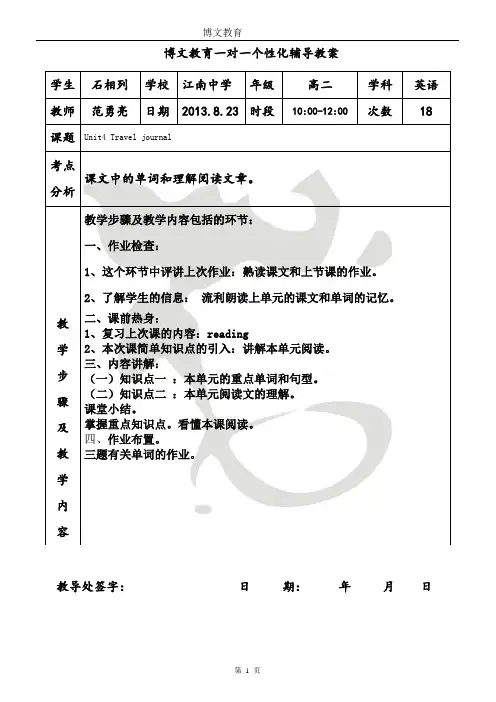
博文教育一对一个性化辅导教案教导处签字: 日 期: 年 月 日学生 石相列 学校 江南中学 年级高二 学科 英语 教师 范勇亮 日期 2013.8.23 时段10:00-12:00 次数 18课题 Unit4 Travel journal考点分析课文中的单词和理解阅读文章。
教 学步骤及教学内容教学步骤及教学内容包括的环节: 一、作业检查: 1、这个环节中评讲上次作业:熟读课文和上节课的作业。
2、了解学生的信息: 流利朗读上单元的课文和单词的记忆。
二、课前热身:1、复习上次课的内容:reading2、本次课简单知识点的引入:讲解本单元阅读。
三、内容讲解: (一)知识点一 :本单元的重点单词和句型。
(二)知识点二 :本单元阅读文的理解。
课堂小结。
掌握重点知识点。
看懂本课阅读。
四、作业布置。
三题有关单词的作业。
课后评价一、学生对于本次课的评价○特别满意○满意○一般○差二、教师评定1、学生上次作业评价:○好○较好○一般○差2、学生本次上课情况评价:○好○较好○一般○差学生自评学生签字:教师留言1.这堂课,学生知识点掌握情况:2.这堂课,学生状态及配合情况:3.一些鼓励的话语:教师签字:家长留言家长签字:日期:年月日讲义:学生:石相列学科英语教师:范勇亮日期:2013/8/23 考点分析:教学步骤及教学内容包括的环节:一、作业检查。
1、通过对作业的检查: 18题单项选择。
2、了解学生信息:对上单元知识点掌握的情况。
二、课前热身:1.抽查上节课的生词拼写2.本节课的知识引入:理解reading三、内容讲解Ⅰ.重点单词1.suffering n.苦难;痛苦→suffer vt.& vi.遭受2.extreme adj.极度的→extremely adv.极度地3.injure vt.损害;伤害→injury n.4.shock vt.& vi.(使)震惊;震动→shocking/shocked adj.5.electricity n.电;电流;电学→electric adj.电气科学的;与电有关的6.frighten vt.使惊吓;吓唬→frightened adj.受惊吓的→frightening adj.令人恐惧的7.congratulation n.祝贺;(复数)贺词→congratulate v.祝贺8.express vt.表示;表达;n.快车;速递→expression n.表达,表示;词语9.burst vi.爆裂;爆发;n.突然破裂;爆发10.event n.事件;大事11.ruin n.废墟;毁灭;vt.毁灭;使破产12.destroy vt.破坏;毁坏;消灭13.track n.轨道;足迹;痕迹14.rescue n.& vt.援救;营救15.trap vt.使陷入困境;n.陷阱;困境16.disaster n.灾难;灾祸17.bury vt.埋葬;掩埋;隐藏18.shelter n.掩蔽;掩蔽处;避身处19.harm n.& vt.损失;损害20.judge n.裁判员;法官;vt.断定;判断;判决Ⅱ.重点短语1.dig out掘出;发现2.be buried in埋头于;专心于3.judge from...从……判断4.be proud of为……而自豪;引以为荣5.break out爆发;发生6.get rid of离开,逃脱7.a (great) number of许多8.the number of……的数量/数字9.at once/right away立刻;马上10.burst into laughter/burst out laughing突然大笑11.as if仿佛;好像12.at an end结束;终结13.be/lie in ruins严重受损;破败不堪Ⅲ.重点句型1.In the farmyards,the chickens and even the pigs were too nervous to eat.2.It seemed as if the world was at an end!3.In fifteen terrible seconds a large city lay in ruins.4.All hope was not lost.5.To the north of the city,most of the 10,000 miners were rescued from the coal mines there.四.课堂练习:Ⅳ.速读课文,回答下列问题1.What happened?2.Where did it happen?3.How long did it last?4.Who helped to rescue the trapped people?Ⅴ.精读课文,回答下列问题1.概括每一部分的大意Part 1(Para.1):Before the earthquake,strange things began to happen but no onetook any notice of them.Part 2(Paras.2~3):The earthquake destroyed the city of Tangshan and shocked thepeople very much.Part 3(Para.4):The army came to help the survivors,bringing hope for a new life. 2.True or false?(1)People in Tangshan were warned of the earthquake and didn’t go to bed that night.( )(2)People in Beijing also felt the earthquake.( )(3)More than 400,000 people were killed in the earthquake.( )(4)Many rescue workers and doctors were trapped under the ruins during the aftershock.( )(5)People tried to get fresh water from under the ground in Tangshan.( )4.填入正确的数据(1) of the nation felt the earthquake.(2)A huge crack that was kilometres long and metres wide cut across houses,roads and canals.(3)In terrible seconds a large city lay in ruins.(4) of the people died or were injured during the earthquake.(5)The number of people who were killed or injured reached more than .(6)All of the city’s hospitals, of its factories and buildings and of its homes were gone.五、课堂小结增强英语朗读能力。
Unit4NaturalDisastersReadingandthinking教学设计-高中英语人教
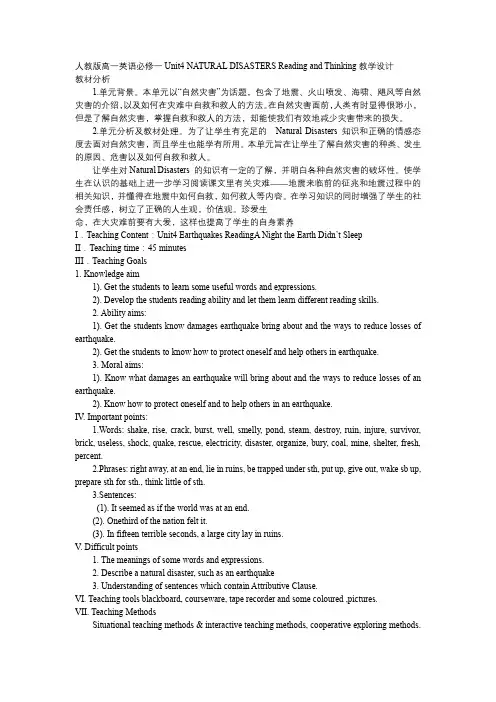
人教版高一英语必修一Unit4 NA TURAL DISASTERS Reading and Thinking教学设计教材分析1.单元背景。
本单元以“自然灾害”为话题,包含了地震、火山喷发、海啸、飓风等自然灾害的介绍,以及如何在灾难中自救和救人的方法。
在自然灾害面前,人类有时显得很渺小,但是了解自然灾害,掌握自救和救人的方法,却能使我们有效地减少灾害带来的损失。
2.单元分析及教材处理。
为了让学生有充足的Natural Disasters 知识和正确的情感态度去面对自然灾害,而且学生也能学有所用。
本单元旨在让学生了解自然灾害的种类、发生的原因、危害以及如何自救和救人。
让学生对Natural Disasters 的知识有一定的了解,并明白各种自然灾害的破坏性。
使学生在认识的基础上进一步学习阅读课文里有关灾难——地震来临前的征兆和地震过程中的相关知识,并懂得在地震中如何自救,如何救人等内容。
在学习知识的同时增强了学生的社会责任感,树立了正确的人生观,价值观。
珍爱生命,在大灾难前要有大爱,这样也提高了学生的自身素养I.Teaching Content:Unit4 Earthquakes ReadingA Night the Earth Didn’t Sleep II.Teaching time:45 minutesIII.Teaching Goals1. Knowledge aim1). Get the students to learn some useful words and expressions.2). Develop the students reading ability and let them learn different reading skills.2. Ability aims:1). Get the students know damages earthquake bring about and the ways to reduce losses of earthquake.2). Get the students to know how to protect oneself and help others in earthquake.3. Moral aims:1). Know what damages an earthquake will bring about and the ways to reduce losses of an earthquake.2). Know how to protect oneself and to help others in an earthquake.IV. Important points:1.Words: shake, rise, crack, burst, well, smelly, pond, steam, destroy, ruin, injure, survivor, brick, useless, shock, quake, rescue, electricity, disaster, organize, bury, coal, mine, shelter, fresh, percent.2.Phrases: right away, at an end, lie in ruins, be trapped under sth, put up, give out, wake sb up, prepare sth for sth., think little of sth.3.Sentences:(1). It seemed as if the world was at an end.(2). Onethird of the nation felt it.(3). In fifteen terrible seconds, a large city lay in ruins.V. Difficult points1. The meanings of some words and expressions.2. Describe a natural disaster, such as an earthquake3. Understanding of sentences which contain Attributive Clause.VI. Teaching tools blackboard, courseware, tape recorder and some coloured ,pictures.VII. Teaching MethodsSituational teaching methods & interactive teaching methods, cooperative exploring methods.VIII. Teaching Procedures1.Greetings2. LeadinTeacher shows some pictures about the earthquake. Students look at the pictures and think of some new words relating to the natural disasters.3.Reading1). Fast readingTeacher shows the title and the photo on page fifty. Let students guess what the text is about. Student will be given five minutes to get the main idea and pay attention to the beginning and any sentences in each paragraph and find out the topic sentence and then match the main idea with each paragraph.Para.1: A.The rescue work.Para.2: B.The revival of the city.Para.3: C.Warning signs before the earthquake.Para.4: D.The happening of the big earthquake.Para.5: E.The immediate effects of the earthquake2). CarefulreadingStudents will be given five minutes to read part one carefully and do the following exercises: What were some of the strange things happening before the earthquake and how did people in react to the signs.How did people in Tangshan react to the signs?A.Ignorant. B.Alert. C.Sensitive. D. Casual3. What rhetorical device(修辞手法) does the author use in the sentence “the water in the village wells rose and fell, rose and fell”?A.Metaphor(比喻).B.Repetition(重复).C.Parallelism(排比).D.Personification(拟人).参考答案A AFunction: To make the description more vivid and involve the readers in the atmosphere.Students read part 2 carefully and do the following exercise and read paragraph 3 to carefully to do the following exercise the teacher will choose some students to show your answers for others1. How can we protect ourselves in an earthquake at school?2.What can you do after an earthquake?(Creative thinking)PostreadingGroupwork(1) Don’t be nervous and keep calm.(2) Don’t try to run out of the classroom.(3) Sit down under your desk.(4) Protect your head by putting your bag on your head.(5) Don’t use lift.(6)If possible,run to the schoolyard.IX. Group workStudents will be given five minutes to have a group of work to have a discussion about how can we protect ourselves in an earthquake at school and what can you do after an earthquake? Whatdo you think helped in the revival of city?What lesson can we learn from these events? Some students will be invited to share their answers for the other students.The spirit of bating disaster relief抗震救灾精神Whether in Tangshan earthquake or in Wenchuan earthquake, the most important thing is the spirit of Chinese people. Every time a disaster happens, we fight against it together and we never lose hope. That is the spirit of bating disaster reliefRecently, in the battle against COVID19, China did the best in controlling the virus. That is the result of the spirit of bating COVID19X. SummarySome students will be invited to have a summary about what did we learn today.XI. Homework1.Write a passage about your feelings after today’s passage learning.2.Finish activity 5.XII. Blackboard writingXIII. Teaching reflection课后反思依据教学目标,对学生的学习过程进行评价,旨在反思教学效果,不断改进自己的教学方法与策略。
Unit 4 Reading for Writing 教学设计高一英语(人教版必修第一册)
必修第一册Unit 4 Natural Disasters教学设计Period 4 Reading for WritingTeaching material: Write a summaryTeaching objectives: In this lesson, the students will1. read a news report and learn about the basic elements and language feature of a news report2. write a summary for a special reports of a major news eventDifficult and focal point: Guide the students to learn about the language features of news reports and write a summary for a news reportTeaching aids: PowerPoint, blackboardTeaching approaches: PWP Teaching MethodTeaching procedures:Step 1 Lead in Watch a videoWatch the video and answer the following questions.1.What is a tsunami?2.What causes it?3.Will it cause great danger to human beings?Step 2 Pre-writingActivity 1 PredictionWhat can you see in the picture above the news report?Look at the headline “Tsunami Hits Asia: Over 6500 Dead” and the picture, guess what will be talked about in the text?Activity 2 Pre-readingWhat type of text is it?Where is the text taken from?Activity 3 Read for detailsRead the text, answer the following questions.1. What happened in the news report?2. When and where did it happen?3. What caused it?4. What were the effects/results?Activity 4 Read for language features1.What elements of a news report do the questions above refer to?Event, date, place, cause and result2.Is the picture necessary to the news report? Why or why not?Yes. Because the picture can catch readers’ attention and arouse their interest in the news report. Itcan also make the news report visually clearer and more convincing.3.How does the author develop the news report?A.By making comparisonB.By listing figuresC.By analyzing cause and effectD.By giving examples4.Why does the author list so many numbers in the report?To make the report more convincing.5.What other method does the author use to make the report more convincing? By means of citing a quote from a witness.Step 3 While-writingActivity1 Read the summary of the news report. Check the main points it includes.Activity 2 Drafting Task 1Task 2Task 3Step 4 Post-writingActivity 1 Evaluation1. Exchange your drafts and access each other’s work according to the checklistActivity 2 PolishingGet your draft back and revise it according to your partner’s comments. Activity 3 Present your page to the class.Step 5 Language pointsActivity 1 PhrasesActivity 2 Important wordsStep 6 HomeworkRead the text on page 92 and write a summary of it.。
人教版高中英语选择性必修第1册 Unit 4 第五课时 Reading and writing
Read for details (para3-4)
Body language Look up and make eye contact Smile Look confused when hear sth. diffcult Lean forward and look at…
Lower his head to look at…
3. The boy is telling a joke to the girl in secret, and she is hiding her face because she is laughing.
While-writing
Writing: Describe the Body Language
Ex 5. Write a passage to describe the body language
While-writing of the person in your drawing, and explain his/her
body language.
Describe the body language and its meaning from a person that you know
In this section, what you should describe are: - what is happening from the photo; - the person’s body language; - the feeling or emotion the person may have based on his/her body language.
Read for main idea
Ex 1. Read the first and last paragraphs in the text and answer the following questions.
高一英语人教版必修一unit 4 阅读
Enjoy a short poem :
If I Can Stop One Heart from Breaking by Emily Dickinson If I can stop one heart from breaking, I shall not live in vain; If I can ease one life the aching, Or cool one pain, Or help one fainting robin Unto his nest again, I shall not live in vain. 如果我能使一颗心免于破碎, 我将不会虚度此生。 如果我能减轻一个人的痛苦, 或平息一个人的悲伤, 或帮助一只昏迷的知更鸟 回到它的巢居 我将不会虚度此生。
Discussion:(讨论)
What should we do to protect wildlife?
Let’s protect animals from our mouths!
What can we do to help endangered animals?
Measures to protect the endangered animals:
Paragraph 1
Why are people hunting and killing the Tibetan antelopes? In order to get the wool which is used to make sweaters.
Paragraph 2&3
1.How did life improve for the elephants?
Unit 4
Wildlife Protection
人教高一英语必修一 UNIT-4-reading-and-writing教学设计
Name Subject 英语Time Class TeachingtopicModule 1 Unit 4 Earthquake Using Language Reading and writingTeaching Aims I. Language and ability goal1. To make Ss master the new expressions about gratitude2. To make Ss realize the structure of a thank-you letter.II. Skill goals1. To train Ss’reading skills of understanding the meaning of some specific sentences as well as finding the detailed information2. To practice Ss’ summarizing skills based on the reading exercises3. To develop Ss’ speak ing ability and learn to express their own opinions4. To improve Ss’ writing ability based on all the language inputIII. Emotion, attitude and value goals1. To encourage Ss to be active in class and learn to cooperate with each other in group study2. To improve Ss’ ability to solve problems and to express their own opinions3. To strengthen Ss’ awareness of being grateful to others in lifeTeaching key points 1. Improve Ss’ learning English abilities, including reading, speaking and writing2. Strengthen Ss’ abilities to use the language to express their gratitude3. Lead the Ss to write a thank-you letter by using the expressions learned in the classTeaching difficult points 1. How to help Ss to master reading, speaking and writing skills2. How to guide Ss to write a thank-you letterTeachingaidsBlackboard, PPT and computerTeaching procedures TeachingStepsActivities AimsLead-in I. Zhang Sha phones Li Hua and ask him to check theEmail.II. Have Ss to read the Email.III. Thinking:Why did Zhang Sha write to Li Hua?1. Stimulate Ss’ interestand catch theirattention;2. Encourage Ss to readEnglish aloud3. Practice Ss’ability offast reading. Reading I. Reading comprehensionTask 1: Listening while readingHave Ss listen to the speech given by Li Hua.Task 2: Fast readingWhen did the earthquake happen?Was it a serious one? How do you know?Task 3: Detailed readingWhy did Li Hua say “All hope was not lost”?What did the soldiers do to help the Tangshanpeople?Who do you think made the largest contributions to1.Lead Ss tounderstand howserious the Tangshanearthquake was.2.Have Ss understandwho helped Tangshanpeople a lot.3.Motivate Ss tothe city of Tangshan?Task 4: Detailed readingHow did Li Hua express his gratitude in the speech? ➢______________ are strong enough to express our ________________________________.➢I do wish to _________________________ the people who have made great efforts to this earthquake rescue and city rebuilding..➢____ your love and help ____ made us stronger to come out from the sadness and overcome all the difficulties.➢Thank you ___ your coming/ listening/ consideration.II. Study and presentationTask 1: Study the thank-you letters in groups in two aspects: structure and expressions.Task 2: Have Ss to do the presentation about the result.What can you learn from the letters?Structure:____________________________________________________________________________Expression__________________________________________________________________________________________________________________ III.PracticeFill in the blanksDear Mr. Li,I’m writing to ________________(表达我对你的感激之情). I am now a freshman of Wuhan University, which I have dreamed about. Mr. Li, _________________ (我可以清楚地记得)the days when you taught me English. _________ (由于) your love and help my English have been improved greatly. However, ___________________ (曾经一度)the pressure of examinations, too much homework and the high expectations made me depressed. _______________ _____________(没有你的鼓励和帮助), I wouldn’t have a chance to go to university. I wish more and more of your students could achieve their dreams.__________________(再次表示真挚感谢)!Yours,Li Huaexpress gratitude tothe soldiers and theworkers and learn theexpression from thetext4. Practice Ss’ ability offind and study thetarget expressionswith clear purpose5. Encourage Ss to learnfrom reading andstudy in group work.Practice Ss’ ability ofsummarizing..6. Assess the learningoutcomesSpeaking I.QuestionsWho do you want to thank most in your life? Why?II. Invite some students to share their opinions 1. Encourage Ss to beactive in class2. Improve Ss’ ability toexpress their ownopinions;Writing I. Before writingMake a choice of the taskII. While writingIII. After writingPresent some students’ writingsEmphasize the expressions and the structureIV. Share the possible versions 1.Arouse Ss’ interest infinishing the writingtask2.Improve Ss’writing byadmiring others’ work3. Help Ss to appreciate what a good writing is.Summary I. What have we learned today?➢Expressions about thanks➢Structure about a thank-you letter➢Reading helps us with writing.II. Share the affection goals today.➢Courage to express oneself, especially one’sgratitude. Guide Ss to reflect on the class today.。