
中国南海问题 英文
9
The 2002 ASEAN-China DOC (cont’d)
Pending a comprehensive and durable settlement of the disputes, the parties concerned may explore or undertake cooperative activities such as: (a) marine environmental protection; (b) marine scientific research; (c) safety of navigation and communication at sea; (d) search and rescue operation; and (e) combating transnational crime, including but not limited to trafficking in illicit drugs, piracy and armed robbery at sea, and illegal traffic in arms. 4. Parties shall continue their consultations and dialogues concerning relevant issues for the purpose of promoting good neighborliness and transparency, establishing harmony, mutual understanding and cooperation and facilitating peaceful resolution of disputes among them.
7
The 2002 ASEAN-China Declaration on the Conduct of Parties in the South China Sea (often referred to as 2002 DOC) 1. Parties reaffirmed their respect to the freedom of navigation in and overflight above the SCS, as provided for by universally recognized principles of international law and the UNCLOS. 2. Parties resolved to address their territorial and jurisdictional disputes by peaceful means, in accordance with universally recognized principles of international law, including the 1982 UNCLOS. 3. Parties undertake to exercise self-restraint in the conduct of activities that would complicate or escalate disputes including refraining from action of inhabiting on the uninhabited islands, reefs, etc and to handle their differences in a constructive manner.
3
Principles relevant to the SCS Issue
1. Renunciation of aggression or the threat or use of force or other acts in any manner inconsistent with international law. 2. Reliance on peaceful settlement of international disputes. 3. Enhanced consultations on matters seriously affecting the interests of the ASEAN. 4. Upholding the UN charter and international law.
2
“. . . A region of lasting peace, security and stability, sustained economic growth, shared prosperity and social progress.” Preamble, ASEAN Charter . . . A concert of Southeast Asian nations, outward looking, living in peace, stability and prosperity; and bonded together in partnership in dynamic development and in a community of caring societies. ASEAN Vision 2020
5
Why a flashቤተ መጻሕፍቲ ባይዱoint?
4. Four of the six claimant countries (Philippines, Malaysia, Brunei and Vietnam) are ASEAN member countries; one affected non-claimant country is also an ASEAN member - Indonesia. The Philippines has brought to the International Tribunal on the Law of the Sea (ITLOS) its complaints against the aggressive behavior of China 5. The dominating claimant country is China - - a potential global power and an acknowledged regional power with a modernizing military force; perceived to be resorting to all means to defend its publicly stated position that “its sovereignty in the Spratly is non-negotiable.”
4
Why a flashpoint?
◦ 1. Strategic value of the SCS: vital sealane and trade route; with abundant marine resources, oil and natural gas. ◦ 2. US pronouncement that “it will maintain its presence in the South China sea” and that the peaceful resolution of the SCS issue is in its national interests. US position on the SCS is regarded by China as an act of provocation. ◦ 3. Difficulty in resolving the conflicting positions of the claimant countries in resolving the SCS issue: bilateral negotiation as favored by China versus multilateral negotiation as favored by claimants belonging to the ASEAN. The US is supporting the position taken by the ASEAN.
6
The 1992 ASEAN Declaration on the SCS
1. Emphasized the necessity to resolve all sovereignty and jurisdictional issues by peaceful means, without resort to force. 2. Urged all parties to exercise restraint with the view to creating a positive climate for the eventual resolution of all disputes. 3. Asked all parties to explore the possibility of cooperation in the SCS relating to the safety of maritime navigation and communication, protection against pollution of maritime environment, coordination of search and rescue operations, efforts towards combating piracy and armed robbery as well as collaboration in the campaign against illicit trafficking in drugs. 4. Urged all parties to apply the principles contained in the ASEAN Treaty of Amity and Cooperation in Southeast Asia as the basis for establishing a code of international conduct over the SCS.
南海问题历史与现状
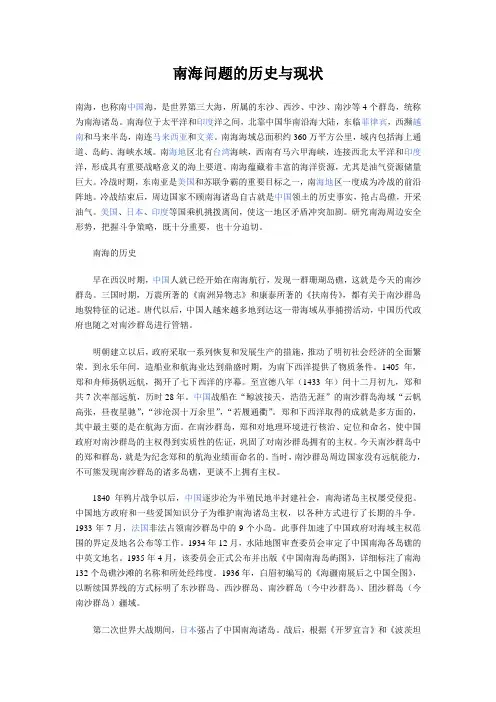
南海问题的历史与现状南海,也称南中国海,是世界第三大海,所属的东沙、西沙、中沙、南沙等4个群岛,统称为南海诸岛。
南海位于太平洋和印度洋之间,北靠中国华南沿海大陆,东临菲律宾,西濒越南和马来半岛,南连马来西亚和文莱。
南海海域总面积约360万平方公里,域内包括海上通道、岛屿、海峡水域。
南海地区北有台湾海峡,西南有马六甲海峡,连接西北太平洋和印度洋,形成具有重要战略意义的海上要道。
南海蕴藏着丰富的海洋资源,尤其是油气资源储量巨大。
冷战时期,东南亚是美国和苏联争霸的重要目标之一,南海地区一度成为冷战的前沿阵地。
冷战结束后,周边国家不顾南海诸岛自古就是中国领土的历史事实,抢占岛礁,开采油气。
美国、日本、印度等国乘机挑拨离间,使这一地区矛盾冲突加剧。
研究南海周边安全形势,把握斗争策略,既十分重要,也十分迫切。
南海的历史早在西汉时期,中国人就已经开始在南海航行,发现一群珊瑚岛礁,这就是今天的南沙群岛。
三国时期,万震所著的《南洲异物志》和康泰所著的《扶南传》,都有关于南沙群岛地貌特征的记述。
唐代以后,中国人越来越多地到达这一带海域从事捕捞活动,中国历代政府也随之对南沙群岛进行管辖。
明朝建立以后,政府采取一系列恢复和发展生产的措施,推动了明初社会经济的全面繁荣。
到永乐年间,造船业和航海业达到鼎盛时期,为南下西洋提供了物质条件。
1405年,郑和舟师扬帆远航,揭开了七下西洋的序幕。
至宣德八年(1433年)闰十二月初九,郑和共7次率部远航,历时28年。
中国战船在“鲸波接天,浩浩无涯”的南沙群岛海域“云帆高张,昼夜星驰”,“涉沧溟十万余里”,“若履通衢”。
郑和下西洋取得的成就是多方面的,其中最主要的是在航海方面。
在南沙群岛,郑和对地理环境进行核治、定位和命名,使中国政府对南沙群岛的主权得到实质性的佐证,巩固了对南沙群岛拥有的主权。
今天南沙群岛中的郑和群岛,就是为纪念郑和的航海业绩而命名的。
当时,南沙群岛周边国家没有远航能力,不可熊发现南沙群岛的诸多岛礁,更谈不上拥有主权。
中国南海问题 英文ppt课件

The 2002 ASEAN-China Declaration on the Conduct of Parties in the South China Sea (often referred to as 2002 DOC)
1. Parties reaffirmed their respect to the freedom of navigation in and overflight above the SCS, as provided for by universally recognized principles of international law and the UNCLOS.
issue 6. Other recent SCS-related developments 7. Conclusions and forecast
2
“. . . A region of lasting peace, security and stability, sustained economic growth, shared prosperity and social progress.” Preamble, ASEAN Charter
2. Reliance on peaceful settlement of international disputes. 3. Enhanced consultations on matters seriously affecting the
interests of the ASEAN. 4. Upholding the UN charter and international law.
2. Urged all parties to exercise restraint with the view to creating a positive climate for the eventual resolution of all disputes.
中国南沙实际占领岛礁及实际控制岛礁讲课稿

中国南沙实际占领岛礁及实际控制岛礁中国在南海控制岛礁比你想象的多!中国占领9个名称 ---- 英文(或拼音)名称 -------------- 掌控手段太平岛 ----- Itu Aba Island ------------- 台湾省海巡署驻防中洲礁 ----- Ban Than Reef ------------ 太平岛守备队监控渚碧礁 ----- Subi Reef ------------------ 南沙守备部队驻防南薰礁 ----- Gaven Northern Reef ----- 南沙守备部队驻防赤瓜礁 ----- Johnson Reef -------------- 南沙守备部队驻防东门礁 ----- Hughes Reef --------------- 南沙守备部队驻防永暑礁 ----- Fierry Cross Reef ---------- 南沙守备部队驻防华阳礁 ----- Cuarteron Reef ------------ 南沙守备部队驻防美济礁 ----- Mischief Reef -------------- 南海渔政部门驻防 (该礁有南北两个驻军点)(1995年,中国借口建设渔船避风设施为理由,占领美济礁,并修建多个永固型工事,并控制周围十二岛礁,以及其他未占领岛礁,但我海监船经常巡礁,被中国实际控制19个:仙娥礁 ----- Alicia Annie Reef ----------- 推测由南海舰队巡防监控信义礁 ----- First Thomas Shoal -------- 推测由美济礁守备队监控仁爱礁 ------ Second Thomas Shoal -----推测由南海渔政与南海舰队协同巡防监控三角礁 ----- Livock Reef ----------------- 推测由南海渔政与南海舰队协同巡防监控五方礁 ----- Jackson Atoll---------------- 推测由南海舰队巡防监控(菲军通过登陆舰搁浅的诡计侵占了好几年,近年应已撤兵)鲎藤礁 ------ Iroquois Reef -------------- 推测由南海舰队巡防监控(掌控程度应不次于菲律宾)仙宾礁 ------ Sabina Shoal --------------- 推测由南海舰队巡防监控(掌控程度应不次于菲律宾)牛轭礁 ----- Whitson Reef --------------- 推测由南海渔政与南海舰队协同巡防监控安乐礁 ----- Hallet Reef ----------------- 东门礁守备队监控西门礁 ----- Kennan Reef --------------- 东门礁守备队监控西南礁 ----- Gaven Southern Reef ----- 推测由南薰礁守备队监控 (该礁可能就是大家较熟知的小南熏礁)安达礁 ----- Eldad Reef ------------------ 推测由南海渔政与南海舰队协同监控 (越方暗示中国有驻军)铁线礁 ----- Tiexian Jiao ---------------- 推测由南海渔政与南海舰队协同巡防监控半月礁 ----- Half Moon Shoal ------------ 推测由南海舰队巡防监控曾母暗沙 -- James Shoal ----------------- 南海舰队定期巡视监控(设有主权碑。
南海问题英文作文

南海问题英文作文The South China Sea issue has been a hot topic in recent years. It involves territorial disputes, resource exploitation, and maritime security concerns. Many countries have conflicting claims over the area, leading to tensions and potential conflicts.Some countries, like China, claim historical rights over the South China Sea based on ancient maps and records. They argue that the area has been part of their territory for centuries and that they have the right to control and exploit its resources.On the other hand, other countries, such as Vietnam and the Philippines, reject China's claims and assert their own rights over the South China Sea. They argue that international law should govern the area and that all countries should have equal access to its resources.The United States has also been involved in the SouthChina Sea issue, conducting freedom of navigation operations to challenge China's claims and support its allies in the region. This has further escalated tensions and raised concerns about a potential military confrontation.Despite efforts to resolve the South China Sea issue through diplomacy and negotiations, progress has been slow and tensions remain high. The situation is complicated by the strategic interests of major powers and the competing claims of multiple countries.In conclusion, the South China Sea issue is a complex and volatile problem that has the potential to escalate into a major conflict. It requires careful diplomacy, respect for international law, and a willingness to compromise in order to reach a peaceful resolution.。
南海争端的原因分析
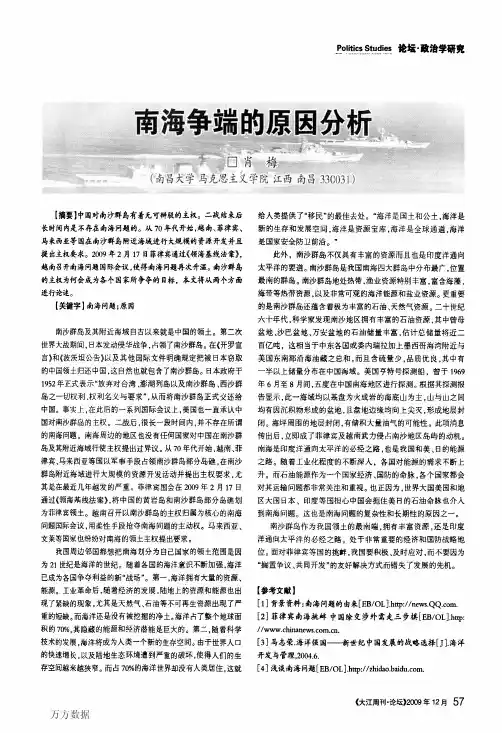
【摘要】中国对南沙群岛有着无可辩驳的主权。
二战结束后长时间内是不存在南海问题的。
从70年代开始,越南、菲律宾、马来西亚等国在南沙群岛附近海域进行大规模的资源开发并且提出主权要求。
2009年2月17日菲律宾通过《领海基线法案》,越南召开南海问题国际会议,使得南海问题再次升温。
南沙群岛的主权为何会成为各个国家所争夺的目标。
本文将从两个方面进行论述。
【关键字】南海问题;原因南沙群岛及其附近海域自古以来就是中国的领土。
第二次世界大战期间,日本发动侵华战争。
占领了南沙群岛。
在《开罗宣言》和《波茨坦公告》以及其他国际文件明确规定把被Et本窃取的中国领土归还中国.这自然也就包含了南沙群岛。
日本政府于1952年正式表示“放弃对台湾、澎湖列岛以及南沙群岛、西沙群岛之一切权利、权利名义与要求”,从而将南沙群岛正式交还给中国。
事实上,在此后的一系列国际会议上。
美国也一直承认中国对南沙群岛的主权。
二战后。
很长一段时间内,并不存在所谓的南海问题。
南海周边的地区也没有任何国家对中国在南沙群岛及其附近海域行使主权提出过异议。
从70年代开始,越南、菲律宾、马来西哑等国以军事手段占领南沙群岛部分岛礁,在南沙群岛附近海域进行大规模的资源开发活动并提出主权要求,尤其是在最近几年越发的严重。
菲律宾国会在2009年2月17日通过《领海基线法案》。
将中国的黄岩岛和南沙群岛部分岛礁划为菲律宾领土。
越南召开以南沙群岛的主权归属为核心的南海问题国际会议,用柔性手段抢夺南海问题的主动权。
马来西亚、文莱等国家也纷纷对南海的领土主权提出要求。
我国周边邻国都想把南海划分为自己国家的领土范围是因为21世纪是海洋的世纪。
随着各国的海洋意识不断加强,海洋已成为各国争夺利益的新“战场”。
第一,海洋拥有大量的资源、能源。
工业革命后,随着经济的发展,陆地上的资源和能源也出现了紧缺的现象,尤其是天然气、石油等不可再生资源出现了严重的短缺。
而海洋还是没有被挖掘的净土。
四六级中英段落翻译预测题

大学英语段落翻译【汉译英1】近代以来,亚洲经历了曲折和艰难的发展历程。
亚洲人们为改变自己的命运,始终以不屈的意志和艰辛的奋斗开辟前进道路。
今天,人们所看到的亚洲发展成就,是勤劳智慧的亚洲人民不屈不挠、锲而不舍奋斗的结果。
亚洲人民深知,世界上没有放之四海而皆准的发展模式,也没有一成不变的发展道路,亚洲人民勇于变革创新,不断开拓进取,探索和开辟适应时代潮流,符合自身实际的发展道路,为经济社会发展打开了广阔前景。
【参考译文】In modern times, Asia experienced twists and turns in its development history. In order to change their destiny, the people of Asia have been forging ahead in an indomitable spirit and with hard struggle. Asia's development achievements today are the result of the persistent efforts of the industrious and talented Asian people.The people of Asia are fully aware (or know very well) that there is no ready model or unchanging path of development that is universally applicable. They never shy away from reform and innovation. Instead, they are committed to exploring and finding development paths that are in line with the trend of the times and their own situations, and have opened up bright prospects for economic and social development.【汉译英2】朝气蓬勃,充满活力,丰富多彩的上海是现代中国的缩影。
中国在南海实际控制岛礁
中国在南海实际控制岛礁论坛出处:西陆东方军事作者:银海狂鲨时间:2012-03-14 16:20:43南沙共有230多个岛屿,沙洲和礁滩,其中有11个岛屿,5个沙洲,20个礁是露出水面的。
面积最大的太平岛约0.443平方公里,面积大于0.1平方公里的还有:中业岛,西月岛,南威岛,北子岛,南子岛和敦谦沙洲。
最南端的曾母暗沙距赤道200海里,距祖国大陆约1000海里。
美丽的南沙岛屿资料图片马来西亚8个:岛名北纬东经时间说明弹丸岛07度24‘00" 113度48‘00" 1977建有机场光星仔礁07度37‘00" 113度56‘00" 1977南海礁07度58‘30" 113度56‘00" 1979榆亚暗沙8度07 114度30 1999年6月簸箕礁8度06 114度08 1999年6月北康暗沙5度23 112度30 不详南康暗沙5度00 112度40 不详中康暗沙4度20 112度41 不详名义上马来西亚占领八个岛礁,其实马来西亚常阻止中国海监船穿越榆亚暗沙、簸箕礁南巡,榆亚暗沙、簸箕礁以南许多岛礁和暗沙,如二角礁、浪口礁、线头礁、息波礁、南通礁、皇路礁等虽未驻军,但实际控制它们,在该海域,马来西亚已经开始采油。
越南30个:岛名北纬东经时间说明鸿麻岛10度11‘114度21‘1973 越南驻军占领,面积0。
08平方公里,岛上有淡水,为南海第九大岛南威岛08度39‘00" 114度05‘40" 1973 越南驻军占领,面积0。
15平方公里,岛上有淡水,为南海第四大岛南子岛11度25‘30" 114度19‘02" 1973 越南驻军占领,面积0。
13平方公里,岛上无淡水,为南海第六大岛敦谦沙洲10度22‘55" 114度28‘00" 1973 越南驻军占领景宏岛09度54‘00" 114度20‘00" 1973 越南驻军占领,面积0。
翻译评分标准和技巧
译文
澳门,南海之滨一颗闪耀的明珠,以她的风采、沧 桑和辉煌,更以1999年12月20日这个不同寻常的日 子,吸引着全世界的目光。
South China Sea 表示中国南海,不是“南中国 海”。East China Sea表示东海。
A shining pearl on the coast of South China, Macao attracts the world’s attention for her charm, history of great events and glory, especially for the unusual date of December 20, 1999.
1. 分句法
汉译英时,需要分译的句子多数是长句,或
者是结构复杂的复句。这种句子如果译成一个长 句,就会使译文冗长、累赘、意思表达不清楚, 也不符合英文习惯。如果采用分译,则会使译文 简洁、易懂、层次分明。如以下五个例子:
例1. 少年是一去不复返的,等到精力衰竭时,要做学 问也来不及了。(按内容层次分译) Youth will soon be gone, never to return. And it will be too late for you to go into scholarship when in your declining years.
例4. 我们的政策是实行“一个国家,两种制度”, 具体说,就是在中华人民共和国内,有着十多亿 人口的大陆实行社会主义制度,香港、台湾地区 实行资本主义制度。(原文出现总说或分述时要分 译)
译文: We are pursuing a policy of “one country with two systems.” More specifically, this means that within the People’s Republic of China, the mainland with its more than one billion people will maintain the socialist system, while Hong Kong and Taiwan continue under the capitalist system.
中国南海问题论文题目选题参考
中国南海问题论文题目一、最新中国南海问题论文选题参考1、中国南海争端及其对亚洲的影响2、中国南海问题中的美国因素3、20世纪初中国南海问题述略4、影响中国南海争端的国家因素分析5、认知理论视角下的中国南海问题研究6、中国南海问题解决策略研究7、中国南海争端中的信任问题8、中国南海问题面临的挑战及解决途径9、浅谈中国南海问题10、“中国南海问题”专题11、马来西亚与中国南海问题12、Process Matters: Conflict Resolution Insights for the South China Sea Dispute 过程很重要:对化解南中国南海争端的见解13、美国在中国南海问题上扮演的角色14、中国国家安全中的南海问题初探15、南海主权争端的战略态势及中国的应对方略16、中国南海诸岛主权的形成及南海问题的由来17、中国南海海洋政治战略研究——论南海争端中的中国作为18、菲律宾提起南海争端强制仲裁程序与中国的应对19、从睦邻政策看中国在南海问题上的立场和主张20、南海问题与中国的对策二、中国南海问题论文题目大全1、两面下注与行为调整——中国-东盟在南海问题上的互动模式研究2、“中国—东盟命运共同体”构想下南海问题的前景展望3、从南海问题说到中国外交调整4、东盟如何在南海问题上“反领导”了中国?——一种弱者的实践策略分析5、南海问题与中国经济安全6、论南海问题“东盟化”的发展——东盟政策演变与中国应对7、南海问题对中国国家安全的影响8、南海问题与中国国家安全利益9、南海问题的复杂性与中国的应对原则和策略10、中国经济安全中的南海问题11、南海争端中的美国因素及其对中国维护南海权益的影响12、“南海问题”与中国因应之策13、南海问题上的利益冲突与中国的战略选择14、南海争端对中国和平发展影响探析15、南海问题对中国“三邻”周边外交政策的挑战及对策思考16、美国南海问题政策演变的海权分析及中国的应对之策17、关于美国在南海问题新变化及中国对策的探讨18、东盟英文报章在地缘政治报道中的中国形象建构——以《海峡时报》和《雅加达邮报》报道南海争端为例19、南海问题与中国能源安全20、南海地缘形势与中国政府对南海权益的维护——以20世纪六七十年代南海争端为考察中心三、热门中国南海问题专业论文题目推荐1、南海问题对中国国家安全影响探析2、“南海问题”的实质和中国的政策3、中国南海维权的国际舆论环境演变——基于1982年以来国际媒体对南海问题报道的分析4、南海问题中的中国倡议5、南海安全问题与中国海洋战略研究6、认知、预期、互动与南海争端的解决进程——基于中国自我克制视角下的分析7、南海问题及中国海洋战略研究8、中国在南海问题上需要新思维9、南海问题与中国的应对策略10、印度介入南海问题——中国视角下的地区安全思考11、论中国在南海问题上的国家利益12、矛盾与选择:中国崛起背景下的南海问题13、南海争端中各国权利主张的法理分析及中国的对策14、中国在南海争端中的有所为与有所不为之分析15、南海争端:搁置争议的关键在于共同开发——专访中国南海研究院院长吴士存16、“搁置争议,共同开发”——中国面对南海问题的最佳抉择17、“中国海洋资源环境与南海问题”学术研讨会暨“中国第四纪科学研究会海岸海洋专业委员会”、“中国地理学会海洋地理专业委员会”2006学术年会...18、南海问题与中国21世纪海上丝绸之路建设19、中国南海石油开发问题研究20、南海问题与中国南部地缘安全四、关于中国南海问题毕业论文题目1、中国南海问题2、日本在中国南海问题上扮演的角色3、中国南海问题:利益困境及维权路径探析4、美国对中国南海问题的介入及对策研究5、菲律宾诉中国南海争端案的主体适格性问题6、论菲律宾诉中国南海争端仲裁案中的管辖权问题7、菲律宾诉中国南海争端仲裁法庭的组成程序思考8、“区域文明”语境中西方殖义及其双重危害——以中国南海问题研究为中心9、中国南海U形线与菲律宾诉中国南海争端案管辖权的关系10、中国南海问题的地理缘由11、中国南海争端的政治学分析12、“中国南海问题”的话语分析13、越南与中国南海争端的政治根源14、重振中国南海问题话语系统15、中国南海问题的对外报道策略及建议16、中国南海问题中的印度参与17、中国南海问题的法律对策18、菲律宾诉中国南海争端案的不可受理性及案件对第三方的影响19、菲律宾在提起诉中国南海争端案之前应履行的法定义务20、菲律宾诉中国南海争端案管辖权问题的思考五、比较好写的中国南海问题论文题目1、南海争端与中国南海政策初探2、权力扩散视角下的中越南海争端与中国的战略选择3、南海争端对中国国家安全利益的影响4、中国在南海问题上有理有据5、论基于南海争端的中国能源战略走向及相关投资策略6、中国处理南海问题的新思路述评7、近年来越南激化与中国在南海争端的表现、原因与中国的对策8、南海争端影响下的中国能源战略走向及其相关投资策略探析9、东盟在南海问题上的政策演变及中国的应对策略10、东盟的南海问题政策与中国对策11、国际法视野下中国应对南海争端法律问题研究12、从中越南海问题看中国的周边政策13、中国崛起视角下的南海问题分析14、中国与菲律宾南海争端仲裁案程序问题研究15、南海问题对中国-东盟自贸区升级的影响16、求解南海争端——专访中国社科院学部委员张蕴岭研究员17、中国海洋发展研究会南海分会成立大会暨第三届《南海问题与区域发展》论坛在广州召开18、美高层叫嚣惩罚中国:用武力手段处理南海问题19、试析中国在南海问题上面临的挑战20、南海争端:美国介入和中国面对--论海权在当代的重要性。
关于中国崛起的英文演讲带翻译范文(精选多篇)
关于中国崛起的英文演讲带翻译范文(精选多篇)1. Speech on the Rise of ChinaAs the world's most populous nation, China has been on a remarkable journey of transformation and modernization over the past few decades. Through economic liberalization, technological innovation, and a concerted effort to improve infrastructure and build up its industries, China has become a major economic and political force on the global stage. While challenges remain, China's rise is undoubtedly a significant development in the 21st century that will shape the future of the world.Over the past few decades, China has experienced astonishing levels of economic growth, averaging an annual GDP growth rate of roughly 9% over the past several decades. Today, China's economy is the second largest in the world, and its middle class has grown to over 400 million people. This rapid growth has led to significant improvements in living standards across the country, but it has also created numerous challenges as China seeks to maintain its growth trajectory while balancing environmental sustainability and social equity.Moreover, China's rise has created geopolitical tensions with other major powers, particularly the United States. The two countries have been engaged in a tense bilateral relationship that has been marked by trade tensions, strategic competition, and geopolitical posturing. As China becomes increasingly assertive on the world stage, it is likely that these tensions will continue to shape the dynamics of global politics.China's rise also has implications for the international system more broadly. As a major power, China is becoming increasingly influential in shaping global governance, from climate change tothe regulation of emerging technologies. The rise of China, along with other emerging powers, is challenging the dominance of the traditional actors in the international system, and there is an urgent need to rethink how global governance can be reformed to accommodate the new realities of the 21st century.In conclusion, China's rise is one of the defining developments of the 21st century. While it brings with it numerous opportunities, it also poses significant challenges for China and the rest of the world. It is up to global leaders to manage these challenges effectively and to ensure that the rise of China is ultimately a force for good in the world.中文翻译:作为世界上人口最多的国家,中国在过去几十年中经历了一次引人注目的转型和现代化之旅。