
ccer国际贸易作业二答案
1. (H-O 模型)世界由米国和面国组成,他们相互贸易,只有小麦和布匹两个部门,没有
贸易成本,厂商都面临完全竞争的市场。
下式中的数字代表生产单位产品(小麦和布匹)所需要的各种投入品的数量,C 即单位成本:
C 小麦=60w +40r
C 布匹=75w +25r
(1) 如果小麦和布匹的市场价格为100,工资率w 和地租率r 各为多少?生产每一单位
的小麦和布匹的地租成本各是多少?
完全竞争市场,P=C ,故:
10060401007525w r w r =+⎧⎨=+⎩11w r =⎧⇒⎨=⎩
从而生产每一单位的小麦和布匹地租成本分别是40、25。
(2) 现在,布匹的价格上升至120,新的w 和r 值是多少(长期均衡水平)? 10060401207525w r w r =+⎧⎨=+⎩ 1.530.2w r =⎧⇒⎨=⎩
(3) 相对于各种商品的实际工资(劳动者收入对该商品购买力)会何种变化? 工资率的上升幅度(53%)比价格的上升幅度(最多20%)大,故实际工资上升了。
(4) 将你对(3)的答案与Stolper-Samuelson Theorem 相联系?
布匹的L/K 较高,为劳动密集型产品,其价格上涨导致劳工受益,这正是SS 定理的内容。
(5) 仍假设小麦和布匹的市场价格为100,面国现有3300单位劳动力,1700单位土地,
小麦和布匹的产量分别是多少?
设小麦产量为x ,布匹产量为y ,有:
3300607517004025x y x y =+⎧⎨=+⎩3020x y =⎧⇒⎨=⎩
(6) 由于鼓励生育,面国劳动力现在增加到了4050单位,土地规模不变,市场价格不变,
小麦和布匹的产量分别是多少?如果人口继续增加会怎么样?
4050607517004025x y x y =+⎧⎨=+⎩17.540x y =⎧⇒⎨=⎩
,根据Rybczynski Theorem ,人口继续增加会使劳动密集型产品产量增加,故y 继续变大,x 继续变小。
(7) 将你对(6)的答案与Rybczynski Theorem 相联系?请作图(如ppt lecture3 p.94)说
明人口增加带来的变化。
由(6),这正是Rybczynski Theorem的内容,如下图:
(8)米国只有1500单位劳动力,但有1600单位土地,某甲据此表示由于劳动/土地比偏低,米国工资会比面国高,你有何评论?
题目假设满足要素价格均等化的条件,故(1)、(2)解出的是两国共同的工资。
2.考虑一个特定要素模型,3种要素:劳动力、资本以及土地。
其中,生产商品1(食品)使用劳动力以及土地,而生产商品2(衣服)使用劳动力以及资本。
技术规模报酬不变,市场完全竞争。
劳动力可以跨部门流动,假设市场已经达到了均衡。
(1)考虑一个食品生产的技术冲击,使得土地投入不变的情况下,劳动力的边际产出提高了,这对均衡有何影响?请作图说明。
劳动力的边际产出提高了,工资曲线向外平移,因劳动可以跨部门流动,高的工资吸引了更多了劳动力到食品部门,这样市场的均衡工资提高了,食品部门的产量变大了。
如图:
(2)考虑一个食品生产的技术冲击,使得劳动的边际产出不变,土地的边际产出提高了,这对均衡有何影响?
劳动的边际产出不变,则工资曲线的位置不变,这样劳动力不会流动,劳动市场均衡不变。
但由于土地的边际产出上升了,从而使食品部门的总产量变大了。
(3)与修改版的Rybczynski Theorem相比,特定要素的变化(无论是存量还是边际产出)是否导致的市场均衡变化?共用要素的变化呢?你如何解释这种不同?
在以上技术变化的情况中,特定要素的边际产出变化不影响劳动市场均衡,但共用要素的边际产出变化会影响,特别的,共用要素边际产出上升,本部门使用的该要素比例上升,产量增加。
修改版的Rybczynski Theorem中,特定要素禀赋的增加使得使用此特定要素的部门产量增加,而另一部门产量减少。
共用要素禀赋的增加使得两个部门产出都增加,部门之间不存在此消彼长的关系。
比较而言,特定要素或共用要素增加在以上两种情况中正好相反。
这种不同在于冲击是不是影响了劳动的边际产出。
如果没有影响,则本部门产出受到影响的同时,不会影响两部门在劳动市场上的均衡。
反之,只要劳动的边际产出发生变化,两部门在劳动市场上的均衡必然变化。
3有人说,世界上最贫穷的国家不能出口任何商品,因为它们没有丰富的要素,
无论是资本、土地、还是人口在该国都很稀少,请对这种说法进行评论。
答:这种说法是不对的,因为一国的何种要素丰富,是由其要素的相对比例来决定,而不是由要素的绝对规模大小来决定。
比如说如果A国的资本、劳动力都小于B国,A国的资本/劳动小于B国的资本/劳动,则A国是劳动密集型,B国是资本密集型。
现实中,比如说韩国的资本和劳动力都小于美国,但是韩国和美国之间还是存在贸易。
因为要素的相对比例不同,所以贸易的基础就存在。
国际贸易实务第2章课后习题参考答案

国际贸易实务第二章课后习题答案一、单项选择题1.C2. B3. D4. A5. D二、多选题1.ABC2.ABCDE三、简答题1、答案要点:我国进出口商品的作价原则是:在贯彻平等互利的原则下根据国际市场价格水平,结合国别地区政策,并按照我们的购销意图确定适当的价格。
由于价格构成因素不同,影响价格变化的因素也多种多样。
因此在确定进出口商品价格时,必须充分考虑影响价格的种种因素,并注意同一商品在不同情况下应有合理的差价,防止出现不区分情况,采取全球同一价格的错误做法。
2、答案要点.1)考虑商品的质量和档次2)考虑运输距离3)要考虑交货地点和交货条件4)考虑季节性需求的变化5)考虑成交数量6)考虑支付条件和汇率变动的风险此外,交货期的远近,市场销售习惯和消费者的爱好与否等因素,对确定价格也有不同程度的影响。
3.答案要点:固定价格即固定作价法,是指买卖双方在签订合同时,将货物价格一次“订死“,不再变动。
这种作价办法比较适合交易量不大、市场价格变动不大、交货期较短的商品交易。
在大宗交易时,一般应加订保值条款,规定如果计价和支付货币币值发生变动,价格可根据保值货币相应调整,以防止汇率变动可能产生的风险损失。
4、答案要点:(1)凡价格中包含佣金的,称为“含佣价”。
含佣价可用文字表示。
如USD per metric ton CIF New York including 2% commission 。
(2)也可在贸易术语后面加注佣金的英文缩写字母“C”,并注明佣金的百分比来表示,如USD per metric ton CIFC2% New York 。
(3)明佣的表示方法一般是在价格之后加列一定百分比的佣金率,如USD27.50 per piece CIFC5 New York ,这里的C5指5%commission ,即佣金率。
(4)除用百分比表示外,也可以用绝对数来表示,如“每公吨付佣金25美元”。
如中间商为了从买卖双方获取“双头佣金”或为了逃税,有时要求在合同中不规定佣金,而另按双方暗中达成的协议支付。
国际贸易实务英文第二课后习题答案

III. Explain the following terms1. shipment contractShipment contract is a contract using an Incoterm which indicates that the delivery happens at the time or before the time of shipment.2. symbolic deliverySymbolic delivery is a delivery situation in which when the seller delivers the buyer does not physically receive the goods. This kind of delivery is proved by the submission of transport document by the seller to the buyer.3. arrival contractArrival contract means a contract using an Incoterm which indicates that the delivery happens when the goods arrive at the destination.4. actual deliveryActual delivery refers to a delivery situation in which when the seller delivers the buyer does physically receive the goods.IV. Short questions1. Who pays for loading for shipment under FOB ?The seller.2. Who pays for unloading under CIF?The buyer.3. Compare and contrast FOB, CFR and CIF?Similarities: a. The seller's risk will be transferred to the buyer when the goods are loaded on board, b. The seller is responsible for export customs formalities while the buyer is responsible for import customs formalities, c. The buyer is responsible for unloading the goods at the port of destination, d. All three terms can only be used for waterway transportation.Differences: a. FOB requires the buyer to arrange and pay for the ocean transportation; CFR requires the seller to arrange and pay for the ocean transportation; CIF requires the seller to arrange and pay for the ocean transportation and insurance against the buyer's risk.4. What are the two types of trade terms concerning the transfer of risks?Shipment contract terms vs. arrival contract terms. Under shipment contract terms the seller's risk will be transferred to the buyer before the goods depart from the place/port of shipment.Under arrival contract terms the seller will bear the risk of the goods until the goods arrive at the destination.5. What are the differences and similarities between CPT and CFR?Major similarities: a. The seller should contract and pay for the major carriage. b. The seller is not taking the risk of loss of or damage to the goods during the transportation.Difference: a. CPT is applicable to any kind of transportation mode while CFR is only used for waterway transport, b. Under CPT the seller's risk will be transferred to the buyer when the goods are handed over to the first carrier nominated by the seller. Under CFR the seller's risk will be transferred when the goods are loaded on board the vessel.6. What are the differences and similarities between CIP and CIF?Major similarities: a. The seller should contract and pay for the major carriage. b. The selleris not taking the risk of loss of or damage to the goods during the transportation, c. The seller must obtain insurance against the buyer's risk.Difference: a. CPT is applicable to any kind of transportation mode while CFR is only used for seaway or inland waterway transport, b. Under CPT the seller's risk will be transferred to the buyer when the goods are handed over to the first carrier nominated by the seller.Under CFR the seller's risk will be transferred when the goods are loaded on board the vessel.7. If you trade with an American, is the sales contract subject to Incoterms without any doubt?What should you do?No. The Revised American Foreign Trade Definitions 1941 is still in use, especially in the North American area. It has different interpretation about some trade terms. The traders should clarify the choice of rules before any further discussion.8. What are the most commonly used trade terms?FOB, CFR & CIF.9. Who is responsible for carrying out customs formalities for exports under an FOB contract?The seller. According to Incoterms 2010, except EXW and DDP these two terms, all the other eleven terms require the seller to handle the export customs formalities, while the buyer the import customs formalities.10. If a Chinese trader signs an FOB Hamburg contract, is he exporting or importing?Importing. FOB should be used with a "named port of shipment", if Hamburg is the port of shipment, from the Chinese trader's perspective, he is importing.V. Case studies1. An FOB contract stipulated "The shipment will be effected in March 2011." When the goodswere ready on 10 March 201 l, the seller contacted the buyer for shipment details. The buyer faxed "Please send the goods to the port for loading on 21 March. The vessel will depart on22 March." The seller sent the goods to the port accordingly. However the nominated vesseldid not turn up and the goods had to be stored in the warehouse at the port. On the night of 21 March a fire happened in the warehouse area and part of the goods was damaged. When the vessel arrived two days later the seller and the buyer had an argument about the settlement of the loss. The seller required the buyer to bear the loss caused by the fire, but the buyer believed that the vessel arrived within the shipment period and the loss occurred before the seller delivered the goods therefore the seller should bear the loss. Please provide your solution.析:1)首先案例中提到货物发生了损失是由于货物存放在码头仓库期间发生火灾造成的。
国际贸易实务双语教程第二版习题参考答案

Unit 1 A brief introduction to international tradeKeyI. Answer my questions1. International trade is business which involved the crossing of national borders2. Sales expansion, resource acquisition and diversification of sales and supplies.3. To gain profit.4. To seej out foreign markets and procurement.5. There are four major forms which are the following:Merchandise exports and Imports, Service Exports and Imports, Investment and Multinational Enterprise.6. It is the account which is a summary statement of the flow of all international economic and financial transactions between one nation (eg.the United States ) and the rest of the world over some period of time, usually one year.7. Merchandise Exporting and Importing.8. Yes. There are great differences between them.1) direct investment takes place when control follows the investment. It usually means high commitment of capital, personnel, and technology abroad. It aims at gaining of foreign resources and foreign markets. Direct investment may often get higher foreign sales than exporting. And sometimes it involves two or more parties.2) While portfolio investments are not under control. And they are used primarily for financial purposes. Treasures of companies, for example, routinely more funds from one country to another to get a higher yield on short term investments.9. MNE is the abbreviation of the multinational enterprise. Its synonyms are NNC (the multinational corporation) and TNC (transnational corporation).10. Examples are travel, transport, fee, royalties, dividends and interest.11. The choice of forms is influenced by the objective being pursued and the environments in which the company must operate.12. It is limited by the number of people intere sted in a firm‟s products and services and by customers‟ capacity to make purchase.13. This is because at an early stage of international involvement these operations usually take the least commitment and least risk of a firm‟s resources.14. Royalties means the payment for use of assets from abroad, such as for trademarks patens, copyrights, or other expertise under contract known as licencing agreements.Royalties are also paid franchising.15. It is a way of doing business in which one party (the franchiser) the use of a trademark that is an essential asset for the franchisers‟ business.II Match each one on the left with its correct meaning on the right1. J2.A3.E4.B5.C6.D7.I8.G9.F 10.HIII Translate the following terms and phrases into Chinese1 购买力11经济复苏;恢复2潜在销售量12 经济衰退3加价,涨价13间接投资4国内市场14有形货物5制成品15有形进出口6边际利润16收入及支出;岁入及岁出7市场占有率17超额能力8贸易歧视18贸易中间人(商);经纪人9时机选择19全部包建的工程承包方式10经销周期20许可证协定IV Case Study1 [Answer]:Batteries called "white elephant" exported from China were very popular in Southeast Asia, because "white elephant" was a lucky thing in Southeast Asia, but no one was interested in it in the market of Europe and the United States. The boss of the company was very strange that the quality of the battery or the price of reasons, so he asked his staff to investigate. Finally he found that is the brand "white elephant" to be blame. The brand's name translated into English was "white elephant" which meant something were no use but cumbersome in Western countries. It was really a bad translation from culture information perspective. The meaning derived from a legend. According to the legend, there was a king who hated a minister, so he gave a white elephant to the minister for punishment. The minister has to take care of the white elephant, he couldn't give it to others or kill it because it's the king gave it to him. However, the appetite of the white elephant was so great, and the minister became poorer. So it showed people in western countries would not buy the battery for the consumers have no willing to buy something useless but cumbersome.V. OpenVI.Translate the following into English1. Trade is often the …engine‟ of growth. However oversimplified this metaphor may be, it does serve to underline the importance of foreign trade in the process of growth. A healthy expansion of exports may not always be sufficient condition for rapid and sustained growth, but a strong positive association between the two is clearly undeniable. Trade expansion contributes to economic growth in many ways. Among them are the benefits of specialization; the favorable effects of international competition on domestic economic efficiency; the increased capacity to pay for the imports required in development and more generally the stimulus to investment.2. International trade is the exchange of goods and services produced in one country for goods and services produced in another country. In addition to visible trade, which involves the import and export of goods and merchandise, there is also invisible trade, which involves the exchange of services between nations. Nations such as Greece and Norway have large maritime fleets and provide transportation service. This is a kind of invisible trade. Invisible trade can be as important to some nations as the export of raw materials or commodities is to others. In both cases, the nations earn the money to buy necessities.3. There exist different ways of conducting international business. Exclusive sale means the seller gives the overseas client the exclusive right of selling a particular product in a designated area within a specified period of time. In this kind of business transaction, the product is bought by the exclusive seller and therefore he should sell the product by himself, assuming sole responsibilities for his profit and loss. Exclusive sale is different from agency where only commission is involved. And difference exists between general contract and exclusive sales because the exclusive seller enjoys exclusive right in a particular area.4. There is no country in the world that can produce all the products it needs. Thus countries joinin international division of labor for effective production and reproduction. Sometimes a country can buy goods and services from abroad on a barter basis. Barter means doing business by exchanging goods of one sort for goods of another sort without using money. Barter trade itself is not enough to meat a cou ntry‟s import needs. But as a form of international trade, it is still attractive in developing countries where foreign exchange is in short supply and inflow of foreign funds is far from sufficient to meet their obligations in external trade.Unit 2 General Procedures of Export and Import TransactionI. Answer the following questions(Omited)II. Filling the blanks with the suitable words in the text:1.meeting/satisfying;2.agent, foreign/overseas;mission;4.own;5.setting;6.patent;7.profits;8.outlets; 9.joint, venture; 10.subsidiaryIII. J udge the following statement, mark True (T) or False(F)1F 2. T 3. F 4. F 5.F 6.F 7.T 8.F 9.F 10. TIV. Explain the meaning of the words or phrases below as requested1. Offer: An offer is a proposal made by sellers to buyers in order to enter into the contract.2. Withdrawal: It means an offer by the offerer has been withdrawn before it is reached to the offeree in order to prevent its entry into force.3. Enquiry: An enquiry is a request for business information, such as price lists, catalogue, samples, and details of the goods or trade terms. It can be made either by the importer or the exporter.4. Acceptance: Acceptance is a statement made by other conduct of the offerees indicating unconditional consent to an offer.5. Shipping agent: Shipping agent(船代)is a ship owner's representative whose job is to find the ships to carry.V. Compose a letter of enquiry with the following particulars:KeysMessrs. Arthur Grey & Son,19 Cheapside,London, E.C.2Dear Sirs,We have obtained your name and address from China Council for Promotion of International Trade and learned that you are one of the leading exporters of Ice Box in your district.We are now interested in 100 sets of the said article and should be pleased if you would let us know whether you can supply us with the quantity and quality we desire. Please quote us your best price on CIF Guangzhou basis. When offering, please state clearly terms of payment, time of delivery, packing conditions together with illustrated catalogue for our consideration.We are looking forward to your early reply.Yours faithfully,VI. Please make your offer according to the following particulars:KeyDear Sirs,Thank you for your letter of 5th May. We are glad to learn of the inquiries you have had from your customers for our raincoats. Our "D.D." range is particularly suitable for warm climates, and during the past years we have supplied this range to dealers in several tropical countries, from many of whom we have already had repeated orders. This range is popular not only because it is light in weight, but also because the material used has been specially treated to prevent excessive condensation on the inside surface.For the quantities you mention we are pleased to quote as follows:"D.D." Raincoats100 men's medium @ US$14.50 US$ 1,450100 men's small 14.0 1,400100 women's medium 13.2 1,320100 women's small 12.7 1,270US$ 5,440Payment: by irrevocable L/C at sightShipment: Shipment will be effected within three or four weeks after receiving the L/C.This offer is subject to our final confirmation. We feel you may be interested in our other products and enclose some pamphlets for your reference.We are awaiting your early orders.Yours sincerely, VII. Write a counter-offer according to the following particulars:Keys:Dear Sirs,We thank you for your quotation May 10 for 1,000 sets of Hair IceBox. We find your price as well as delivery date satisfactory, however, we would give our suggestions of an alternation of your payment terms.Our past purchase of other household electrical appliances from you has been paid as a rule by confirmed, irrevocable letter of credit at sight. On the basis, it has indeed cost us a great deal. From the moment to open credit till the time our buyers pay us, the tie-up of our funds lasts about four months. Under the present circumstances, this question is particular taxing owing to the tight money condition and unprecedentedly high bank interests.In view of our long business relations and our amicable cooperation prospects, we suggest that you accept either “cash against documents on arrival of goods” or “drawing on us at 60 day‟s sight”.Your first priority to the consideration of the above request and an early favorable reply will be highly appreciated.Yours sincerely,VIII. Translate the followings into English1). Economic activity began with the cavemen, who was economically self-sufficient. He did his own hunting, found his own shelter, and provided for his own needs. As primitive populations grewand developed, the principle of division of labor evolved. One person was more able to perform some activity than another, and therefore each person concentrated on what he did best. While one hunted, another fished. The hunter then traded his surplus to the fisherman, and each benefited from the variety of diet.In today‟s complex economic world, neither individuals nor nations are self-sufficient nations are self-sufficient. Nations have utilized different economic resources; people have developed different skills. This is the foundation of international trade and economic activities.Foreign trade, the exchange of goods between nations, takes place for many reasons. The first, as mentioned above, is that no nation has all of the commodities than it needs. Raw materials are scattered around the world. Large deposits of copper are mined in Peru and Zaire, diamonds are mined in South Africa, and petroleum is recovered in Middle East. Countries that do not have these resources within their own boundaries must buy from countries that export them.Foreign trade also occurs because a country often does not have enough of a particular item to meet its needs. Although the United States is a major producer of sugar, it consumes more than it can produce internally and thus must import sugar.Third, one nation can sell some items at a lower cost than other countries. Japan has been able to export large quantities of radios and television sets because it can produce them more efficiently than other countries. It is cheaper for the United States to buy these from Japan than to produce them domestically.Finally, foreign trade takes place because of innovation or style. Even though the United States produces more automobiles than any other country, it still imports large quantities of autos from Germany, Japan and Sweden, primarily because there is a market for them in the United States.2). The different kinds of trade nations engaged in are varied and complex, a mixture of visible and invisible trade. Most nations are more dependent on exports than on any other activity. The earnings from exports pay for the imports that they need and want. A nation‟s balance of payment is a record of these complex transactions. By reflecting all of these transactions in monetary terms , a nation is able to combine the income it receives, for example, from exports, tourists expenditures, and immigrant remittances. This combined incomes is then spent on such items as manufactured goods from other countries, travel for its citizens to other countries, and the hiring of construction engineers.IX. Case Study[Answer]:A 公司与B公司的第一封信函可视为发盘,在该发盘中A公司对包装做出了要求。
国际贸易实务英文版第二版课后习题答案解析
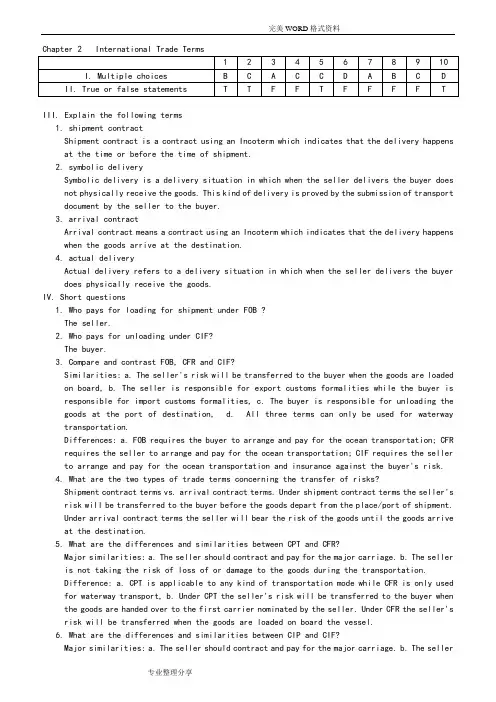
III. Explain the following terms1. shipment contractShipment contract is a contract using an Incoterm which indicates that the delivery happens at the time or before the time of shipment.2. symbolic deliverySymbolic delivery is a delivery situation in which when the seller delivers the buyer does not physically receive the goods. This kind of delivery is proved by the submission of transport document by the seller to the buyer.3. arrival contractArrival contract means a contract using an Incoterm which indicates that the delivery happens when the goods arrive at the destination.4. actual deliveryActual delivery refers to a delivery situation in which when the seller delivers the buyer does physically receive the goods.IV. Short questions1. Who pays for loading for shipment under FOB ?The seller.2. Who pays for unloading under CIF?The buyer.3. Compare and contrast FOB, CFR and CIF?Similarities: a. The seller's risk will be transferred to the buyer when the goods are loaded on board, b. The seller is responsible for export customs formalities while the buyer is responsible for import customs formalities, c. The buyer is responsible for unloading the goods at the port of destination, d. All three terms can only be used for waterway transportation.Differences: a. FOB requires the buyer to arrange and pay for the ocean transportation; CFR requires the seller to arrange and pay for the ocean transportation; CIF requires the seller to arrange and pay for the ocean transportation and insurance against the buyer's risk.4. What are the two types of trade terms concerning the transfer of risks?Shipment contract terms vs. arrival contract terms. Under shipment contract terms the seller's risk will be transferred to the buyer before the goods depart from the place/port of shipment.Under arrival contract terms the seller will bear the risk of the goods until the goods arrive at the destination.5. What are the differences and similarities between CPT and CFR?Major similarities: a. The seller should contract and pay for the major carriage. b. The seller is not taking the risk of loss of or damage to the goods during the transportation.Difference: a. CPT is applicable to any kind of transportation mode while CFR is only used for waterway transport, b. Under CPT the seller's risk will be transferred to the buyer when the goods are handed over to the first carrier nominated by the seller. Under CFR the seller's risk will be transferred when the goods are loaded on board the vessel.6. What are the differences and similarities between CIP and CIF?Major similarities: a. The seller should contract and pay for the major carriage. b. The selleris not taking the risk of loss of or damage to the goods during the transportation, c. The seller must obtain insurance against the buyer's risk.Difference: a. CPT is applicable to any kind of transportation mode while CFR is only used for seaway or inland waterway transport, b. Under CPT the seller's risk will be transferred to the buyer when the goods are handed over to the first carrier nominated by the seller.Under CFR the seller's risk will be transferred when the goods are loaded on board the vessel.7. If you trade with an American, is the sales contract subject to Incoterms without any doubt?What should you do?No. The Revised American Foreign Trade Definitions 1941 is still in use, especially in the North American area. It has different interpretation about some trade terms. The traders should clarify the choice of rules before any further discussion.8. What are the most commonly used trade terms?FOB, CFR & CIF.9. Who is responsible for carrying out customs formalities for exports under an FOB contract?The seller. According to Incoterms 2010, except EXW and DDP these two terms, all the other eleven terms require the seller to handle the export customs formalities, while the buyer the import customs formalities.10. If a Chinese trader signs an FOB Hamburg contract, is he exporting or importing?Importing. FOB should be used with a "named port of shipment", if Hamburg is the port of shipment, from the Chinese trader's perspective, he is importing.V. Case studies1. An FOB contract stipulated "The shipment will be effected in March 2011." When the goodswere ready on 10 March 201 l, the seller contacted the buyer for shipment details. The buyer faxed "Please send the goods to the port for loading on 21 March. The vessel will depart on22 March." The seller sent the goods to the port accordingly. However the nominated vesseldid not turn up and the goods had to be stored in the warehouse at the port. On the night of 21 March a fire happened in the warehouse area and part of the goods was damaged. When the vessel arrived two days later the seller and the buyer had an argument about the settlement of the loss. The seller required the buyer to bear the loss caused by the fire, but the buyer believed that the vessel arrived within the shipment period and the loss occurred before the seller delivered the goods therefore the seller should bear the loss. Please provide your solution.析:1)首先案例中提到货物发生了损失是由于货物存放在码头仓库期间发生火灾造成的。
2020年中国石油大学北京网络学院国际贸易-第二次在线作业参考答案

2020年中国石油大学北京网络学院国际贸易-第二次在线作业
参考答案
中国石油大学北京网络学院
国际贸易-第二次在线作业
参考答案
1.(
2.5分)某国对于手表的进口征收从价税15%,加征每只15美元的从量税,这是
A、从量税
B、从价税
C、混合税
D、选择税
我的答案:C 此题得分:2.5分
2.(2.5分)进口国在总配额内按国别和地区分配一定的配额,超过该配额便不准进口,它是
A、国别配额
B、全球配额
C、关税配额
D、总配额
我的答案:A 此题得分:2.5分
3.(2.5分)假定某国规定1995年从中国进口鞋不超过2000万双,它是
A、国别配额
B、全球配额。
国际贸易实务第二版---练习题答案--全部

练习题参考答案第一章一.判断题1√2×3×4√5√6√7√8×9×10√二.单选题:1A 2A 3B 4B 5A 6?7A 8 B 9A 10C三.多选题:1BCD 2ABC 3ACD 4ABCD 5BD 6ABCD 7BCD 8ABCD 9ABC 10ABCD第二章一.判断题:1×2×3√4√5×6×7×8√9×10√二.单选题:1B 2B 3A 4A 5C 6A 7C 8A 9A 10A 11B12A 13C14 A 15 A16 A 17B 18B 19 B 20A 21A 22 A 23B三.多选题:1ABC 2 ACD 3ABD 4ABC 5AC 6ABD 7ABCD 8BD 9ABC 10ABCD 11ABCD 12ABCD四.案例题1.答:最多:1磅=0.45359公斤,40磅=400.45359公斤=18.144公斤(10(1+5%)1000)18.144=578箱(尾数应去掉)最少:(10(15%)1000)18.144=524箱(尾数应进位)2.答:《统一惯例》规定:“凡“约”,“大约”用于有关信用证金额或数量或单价者,当解释为允许其金额或数量或单价有不超过10%的增减金额。
据此,我多装2 公吨亦可。
但来证的金额前并无类似“约”或“大约“的词语,故如持22公吨的发票和8800美元的汇票向银行办理议付,肯定不行。
因此,在签约时,如数量内约量,则来证之金额也应有相关规定。
否则,不能多装。
特别是对外汇紧缺和管制严格的国家尤应如此。
3.答:国外这一要求实质是定牌中性包装,一般可接受。
不过在接受法定牌名或指定商标时应注意其牌名或商标是否在国内外已有第三者进行注册。
在无法判明的情况下,为安全起见应在合同中列明“如发生工业产权争议应由买方负责“的条款,以防不测。
4.答:对方的要求是合理的,卖方交货的数量应严格按照信用证的规定执行,并按商品的净重交货。
国际贸易试卷2附答案.pdf
国际贸易模拟试卷-2学号:班级:姓名:成绩:一、单项选择题(101,共10分)1.某国出口商品价格与进口商品价格的比率,又称进出口商品交换比价,通常用一国在一定时期内的出口商品价格指数与进口商品价格指数对比进行计算。
这是该国的 ( A )A. 贸易条件B. 对外贸易依存度C. 贸易商品结构D. 贸易差额2. 第二次大战以后,各国关税税则多为复式税则,针对某一进口商品规定两种以上的进口关税税率,即普通税和最惠国税.当前,开展国际贸易的正常关税是( )A. 特惠税B. 最惠国税C. 普遍优惠税D. 普通税3. 国际贸易政策分为自由贸易政策和保护贸易政策,其中为保护贸易政策提供重要理论依据的经济学家有()A 配第B 亚当•斯密C 俄林D 李斯特4.李嘉图指出决定国际贸易的因素是:( B )A 生产这些商品所需要的绝对劳动成本B 两个国家商品的相对劳动成本C 两个国家工资的差异D 两国之间的运输距离5. 以下四个方面哪一个不是李嘉图比较优势模型中的假设条件?( D )A 生产要素只有劳动一种B 劳动在一国之内可自由流动,但在国际间不能流动C 商品和劳动市场都是完全竞争的D 考虑运输成本和其他交易费用6. 以下四个方面哪一个不是要素禀赋模型建立的基本假设条件?( A )A 两国相同部门的生产函数不同B 两国消费者偏好相同C 外部规模收益变化D 所有商品市场、要素市场都是完全竞争的7. H-O定理认为:( B )A 一国出口密集使用其稀缺要素的产品B 一国出口密集使用其丰富要素的产品C 一国进口密集使用其丰富要素的产品D 一国的进出口与其要素丰裕程度无关8. 依据特定要素模型分析,国际贸易会( C )A 提高贸易国进口部门特定要素的实际收入B 降低贸易国出口部门特定要素的实际收入C 提高贸易国出口部门特定要素的实际收入D 提高与进口相竞争部门特定要素的实际收入9.联想集团并购IBM电脑制造业务,联想电脑大量出口美国,以下贸易理论哪一个最能解释这种投资与贸易活动的内在原因.( D )A 重叠需求理论`````for developed coutries.B 贸易顺差理论C 绝对优势理论D 产品生命周期理论10. 以下关于规模经济的阐述,哪一个是不正确的?( C )A 与规模收益递增联系在一起B 当生产过程遵循规模报酬递增规律时,自然存在规模经济C 规模经济要求规模报酬递增一定存在D 在外部规模经济存在的情况下,企业的生产过程仍是规模收益不变的11.在贸易政策政治经济学分析中:( B )A 消费者群体对贸易政策的态度最为强烈B 进口替代部门对限制进口政策的要求最为强烈C 进口替代部门对鼓励出口政策的要求最为强烈D 出口部门对进口保护政策的反对十分强烈12.一般而言,选择出口导向战略的国家有以下特点:( D )A 内部市场相对比较广阔B 劳动力优势不足C 国内自然资源比较丰富D 国内自然资源比较稀缺13.世界贸易组织明确指出了五项基本原则,其中促进公平竞争的原则是指世界贸易要在公开、公正和不受干扰的情况下开展。
国际贸易实务二试题和答案
国际贸易实务二试题和答案2012年1月高等教育自学考试中英合作商务管理专业考试国际贸易实务(二)试题(课程代码00811)注意事项:1.考试时间165分钟。
2.试题包括必答题与选答题两部分,必答题满分60分,选答题满分40分。
一、一、三题为必答题,每题20分。
四、五、六、七题为选答题,每题20分,任选两题回答,不得多选,多选者只按选答的前两题计分。
3.选择题用铅笔(2B)将答案填涂在答题卡上,其他试题用黑色字迹的签字笔把答案按题号写在答题纸上,不必抄写题目。
在本试卷上作答无效。
4.可使用计算器、直尺等文具。
第一部分必答题(本部分包括一、二、三题,每题20分,共60分。
)一、本题包括第1-20小题,每小题1分,共20分。
在每个小题给出的四个选项中只有一项符合题目要求。
1.首先提出绝对优势理论的经济学家是A.亚当·斯密B.大卫·李嘉图C.卡尔·马克思D.凯恩斯2.首先提出比较优势理论的经济学家是A.亚当·斯密B.大卫·李嘉图C.卡尔·马克思D.凯恩斯3.在古代,远距离的国际贸易商品局限在A.基本食品B.基础的建筑材料C.武器装备D.奢侈品4.一国商品的进出口平衡称为A.贸易平衡B.无形贸易平衡C.经常项目平衡D.资本项目平衡5.在国际贸易中所占份额最大的商品是A.原材料 B.石油和能源C.制成品 D.服务6.属于外国直接投资( FDI)的是A.国外开设银行账户B.购买外国政府债券C.购买外国公司无表决权的股份D.获得某个外国公司绝大部分股份7.有助于平衡贸易逆差的政策措施是A.允许本币升值B.减少国内需求C.降低国内利率D.降低进口关税8.贸易自由化政策表现为A.加强外汇管制B.采取自动出口限制C.降低关税D.增加非关税壁垒9.战略性贸易政策主张政府应该A.推进贸易自由化B.用关税保护国内所有产业C.保护现有的重要产业D.扶持国内新兴产业10. 2010年经常项目顺差最大的国家是A.中国B.德国C.日本 D.美国11.在全球范围内推动贸易自由化的组织是A.国际货币基金组织B.联合国贸易发展委员会C.世界银行D.世界贸易组织12.差异性营销策略适用于A.标准化产品B.细分市场C.全球市场D.出口商的资源有限13.与企业物流管理相关的是A.计算机软件开发 B.供应链管理C.企业决策的所有方面D.复式记账14.人民币升值使中国A.进出口商品都更便宜B.进出口商品都更昂贵C.进口商品更便宜、出口商品更昂贵D.进口商品更昂贵、出口商品更便宜15.对出口商风险最小的支付方式是A.信用证B.汇票C.赊账 D.预付16.从价税是A.只适用于奢侈品进口 B.只适用于服务进口C.不随商品价格变化而变化 D.随商品价格变化而变化17. BOLERO的正确表述是A.管理银行的规则B.管理货物的铁路运输C.南美自由贸易区 D.给海运电子提单提供注册18.代理人的正确表述是A.代理人从委托人处获得商品的所有权B.代理协议必须是书面的C.代理人必须有代理资格 D.代理人必须对委托人的货物负责19.国际销售合同中的管辖权条款是A.冻结买方资产的条款 B.转移所有权给买方的条款C.规定某国法院对争议案有管辖权的条款D.规定适用于《联合国国际货物销售合同公约》的条款20.留置权(指在支付之前保留货物的所有权)适用的情况是A.买方开立信用证购买货物B.货物通过信用证出售单信用证失效C.买方的承运人具有货物所有权 D.货款已支付仔细阅读下面案例并回答二、三题。
ccer国际贸易作业二答案
1. (H-O 模型)世界由米国和面国组成,他们相互贸易,只有小麦和布匹两个部门,没有贸易成本,厂商都面临完全竞争的市场。
下式中的数字代表生产单位产品(小麦和布匹)所需要的各种投入品的数量,C 即单位成本:C 小麦=60w +40rC 布匹=75w +25r(1) 如果小麦和布匹的市场价格为100,工资率w 和地租率r 各为多少?生产每一单位的小麦和布匹的地租成本各是多少?完全竞争市场,P=C ,故:10060401007525w r w r =+⎧⎨=+⎩11w r =⎧⇒⎨=⎩从而生产每一单位的小麦和布匹地租成本分别是40、25。
(2) 现在,布匹的价格上升至120,新的w 和r 值是多少(长期均衡水平)? 10060401207525w r w r =+⎧⎨=+⎩ 1.530.2w r =⎧⇒⎨=⎩(3) 相对于各种商品的实际工资(劳动者收入对该商品购买力)会何种变化? 工资率的上升幅度(53%)比价格的上升幅度(最多20%)大,故实际工资上升了。
(4) 将你对(3)的答案与Stolper-Samuelson Theorem 相联系?布匹的L/K 较高,为劳动密集型产品,其价格上涨导致劳工受益,这正是SS 定理的内容。
(5) 仍假设小麦和布匹的市场价格为100,面国现有3300单位劳动力,1700单位土地,小麦和布匹的产量分别是多少?设小麦产量为x ,布匹产量为y ,有:3300607517004025x y x y =+⎧⎨=+⎩3020x y =⎧⇒⎨=⎩(6) 由于鼓励生育,面国劳动力现在增加到了4050单位,土地规模不变,市场价格不变,小麦和布匹的产量分别是多少?如果人口继续增加会怎么样?4050607517004025x y x y =+⎧⎨=+⎩17.540x y =⎧⇒⎨=⎩,根据Rybczynski Theorem ,人口继续增加会使劳动密集型产品产量增加,故y 继续变大,x 继续变小。
ccer国际贸易作业二答案
ccer国际贸易作业⼆答案1.(1)若汽车的世界价格为8000,成本为6000,⼀国对进⼝汽车征收25%的关税。
此时的有效保护率是多少?答案:(2)现假设每辆汽车的投⼊成本是8000元,投⼊品需要进⼝,世界价格为10000,如果⼀国对汽车征收50%的关税,对投⼊品征收20%的关税。
此时的有效保护率是多少?答案:如下图:2. 现有⼀个⽆法影响世界价格的⼩国“槐安国”,该国以每袋10美元的价格进⼝黄粱,其国内的需求曲线为:D=400-10P供给曲线为:S=50+5p确定⾃由贸易的均衡点,然后计算并绘出把进⼝配额限制在50袋时对以下各项的影响:(1)本国价格增幅10(2)配额租⾦(20-10)*(200-150)=500(3)消费扭曲损失(20-10)*(300-200)*0.5=500(4)⽣产扭曲损失(20-10)*(150-100)*0.5=250(5)画出该国的需求曲线和供给曲线,标出⾃然情况下的进⼝量和配额限制时的进⼝量。
见上图(6)实际上,保护本国⼯业不仅仅进⼝配额这⼀种⽅法,政府还可以对进⼝产品征收关税,本题中要达到和配额⼀样的保护效果,政府需要对每袋黄粱征收多少关税?由于本处为开放⼩国,故直接征收20-10=10的关税即可(7)当然,政府采购也是⼀个很好的保护本国⼯业的措施,要使本国⼯业得到同样的保护,政府要采购本国⼚商多少袋黄粱(假设此时本国的总需求曲线没有移动)?要是⽣产者的剩余同以前⼀样,显然此处让政府采购等于150袋即可,价格为20 (8)既然关税可以保护本国⼯业,为什么政府有时候还要采⽤进⼝配额这种⽅式?1.配额的效果更加直接。
2.在关税存在的情况下,外国⼚商可以通过本国补贴等⼿段来降低出⼝价格,增加出⼝,⽽配额就将进⼝量定了。
3.同时,WTO对关税政策是有明确限制的。
(9)同样,既然进⼝配额也可以达到和政府采购⼀样的效果,为什么政府有时候还要采⽤政府采购来保护本国⼯业?1.政府采购⽐配额更能直接的帮助本国企业,2.在配额下如果消费需求发⽣变动,或者其他⼀些不可控的原因,本国⼚商可能⽆法卖出⾜够的产品来得到想要的⽣产者剩余,⽽政府采购可以直接帮助企业获利。