
2019版高三英语外研版一轮课件:第2部分+专题5 动词时态、语态和语气
动词时态、语态和语气
栏目 导航
精剖析·语法突破 高效练·跟踪检测
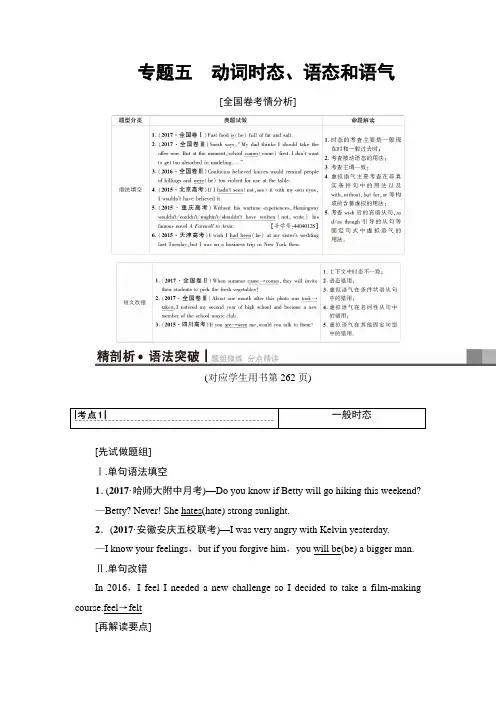
[全国卷考情分析]
(对应学生用书第 262 页)
一般时态
[先试做题组] Ⅰ.单句语法填空 1 . (2017· 哈师大附中月考 )—Do you know if Betty will go hiking this weekend? —Betty? Never! She hates(hate) strong sunlight.
(2)“be to+动词原形”表示按计划、约定或按职责、义务必须做的事或即 将发生的动作。 You are to hand in your papers by 10 o'clock. 到 10 点你得交上试卷。 (3)“be about to+动词原形”表示正要或即将要做某事,该结构不与表示具 体的将来时间状语连用。 (新课标全国卷)Tom was about to close the windows when his attention was caught by a bird. 汤姆正要关上窗户,就在这时一只鸟引起了他的注意。
(2)按时间表、时刻表、日程表等安排将要发生的动作。只限于 go,arrive, leave,start,stay,return,begin,come 等动词。 Look at the timetable.Hurry up! Flight 4026 takes off at 18:20. 看看时间表。快点儿吧!4026 航班 18:20 起飞。 (3)用在时间、条件或让步状语从句中表示将来。 If it is fine tomorrow,we will go there. 要是明天晴天,我们就去那里。
结尾为s,x,sh,ch 或o,discuss—discusses wash—washes 在词尾加es 结尾为“辅音字母+y” teach—teaches fix—fixes go—goes
变 y 为 i 再加 es studies carry— carries study —
2.一般现在时的用法 (1)表示经常发生的、习惯性的、反复出现的动作或状态。常与表示习惯的 副词(词组)always, every time, now and then, occasionally, often, seldom, never, sometimes,usually,every day/night 等连用。 He often goes to work by bus,and he takes a walk with his wife after dinner every day.他经常乘公共汽车去上班,而且每天饭后和妻子一块散步。
二、一般过去时 1.一般过去时的构成 一般过去时由动词的过去式构成。不规则动词的过去式的变化规则 变化规则 一般情况在动词后加ed 以e 结尾的动词后加d look—looked hope—hoped like—liked 例词
以“辅音字母+y”结尾的动词,变 y 为 i 再加ed 以重读闭音节或/r/音节结尾, 词尾只 有一个辅音字母时双写词尾的辅音 字母再加ed
[再解读要点] 一、一般现在时 1.一般现在时的构成 主要用动词原形构成。 动词 be 的第一人称单数形式用 am, 第三人称单数形 式用 is,其他人称形式均用 are。动词 have 的第三人称单数形式用 has。实义动 词的第三人称单数形式的变化规则是:
一般情况直接加s
hate→hates
—What time is it? ——几点了? —I have no idea.But just a minute,I will check it for you. ——我不知道。你稍等,我给你查查。
3.其他表示“将来”的结构及用法 (1)“be going to+动词原形”表示按计划、打算要做某事或根据某种迹象预 示着要发生某事。 Look,dark clouds are gathering.It is going to rain soon,I think. 瞧,乌云正在聚集,我想快要下雨了。 (2015· 天津高考)Whether in the home or the workplace,social robots are going to become a lot more common in the next few years. 无论是在家里还是在工作场所,在未来的几年里社交机器人将会变得越来 越普遍。
study—studied
try—tried
stop—stopped admit—admitted
prefer—preferred permit—permitted
2.一般过去时的用法 表示过去一段时间内经常性或习惯性的动作。 常与 often, usually, seldom 等 表示频度的副词连用。还可以表示在过去某一时间所发生的动作或存在的状态, 与现在没有关系, 常与 yesterday, the other day, last week, the day before yesterday 等过去的时间状语连用。 (2016· 全国卷Ⅰ)In 1931, Addams became the first American woman to win the Nobel Peace Prize. 1931 年亚当斯成为第一个赢得诺贝尔和平奖的美国女性。
2.(2017· 安徽安庆五校联考)—I was very angry with Kelvin yesterday. —I know your feelings,but if you forgive him,you will be(be) a bigger man.
Ⅱ.单句改错 In 2016,I feel I needed a new challenge so I decided to take a filmmaking course.feel→felt
三、一般将来时 1.一般将来时的构成 由“shall/will+动词原形”构成。 其中 shall 用于第一人称, will 用于一切人 称。 2.一般将来时的用法与表示将来的时间状语 tomorrow,next year,in+一段时间等连用。“will+动词原形”还可以表示说话 时临时做出的决定。
2019版高三英语外研版一轮教师用书:第2部分 专题5 动词时态、语态和语气 Word版含解析
专题五动词时态、语态和语气[全国卷考情分析](对应学生用书第262页)[先试做题组]Ⅰ.单句语法填空1.(2017·哈师大附中月考)—Do you know if Betty will go hiking this weekend?—Betty? Never! She hates(hate) strong sunlight.2.(2017·安徽安庆五校联考)—I was very angry with Kelvin yesterday.—I know your feelings,but if you forgive him,you will be(be) a bigger man.Ⅱ.单句改错In 2016,I feel I needed a new challenge so I decided to take a film-making course.feel→felt[再解读要点]一、一般现在时1.一般现在时的构成主要用动词原形构成。
动词be 的第一人称单数形式用am ,第三人称单数形式用is ,其他人称形式均用are 。
动词have 的第三人称单数形式用has 。
实义动词的第三人称单数形式的变化规则是:(1)表示经常发生的、习惯性的、反复出现的动作或状态。
常与表示习惯的副词(词组)always ,every time ,now and then ,occasionally ,often ,seldom ,never ,sometimes ,usually ,every day/night 等连用。
He often goes to work by bus ,and he takes a walk with his wife after dinner every day.他经常乘公共汽车去上班,而且每天饭后和妻子一块散步。
(2)按时间表、时刻表、日程表等安排将要发生的动作。
2019高三英语外研版一轮课件:Part5 精品

(2)On hearing the news that you are interested in Chinese history,I feel delighted and excited.
their teachers,they felt sort of at a loss.
(2)Some classmates didn’t know how to get on with their
teachers,feeling kind of confused.
情景1
情景2
情景3
情景4
情景5
-10-
-4-
情景1
情景2
情景3
情景4
情景5
积累: win first prize/finish in first place获得一等奖 on doing sth.一做某事就…… on arriving...一到达就…… on seeing...一看见就……
-5-
情景1
情景2
情景3
情景4
情景5
【魔句2】 能代表我校学生在这里发言,我感到非常荣幸。 It is a great honour to give a speech here,as a representative of all the students of our school. I feel honoured to deliver a speech here on behalf of all the students of our school. As a representative of all the students of our school,it is my honour to give a speech here.
高考英语一轮总复习 Module 2 A Job Worth Doing课件 外研版必修5

(2)requirement n. 要求;必要条件;需要
①The situation required that we (should) make an immediate decision.
当时的情况需要我们立刻作出决定。
②These young trees will require 树需要悉心照料。 ③Not all goods can satisfy the customers' requirements.并非 所有的商品都能满足顾客的需求。 carefully.这些小
need, require等。
【知识链接】 像require一样后跟宾语从句用虚拟语气的常用动词有:
一坚持: insist
二命令: order, command 三建议: advise, suggest, propose 四要求: request, require, demand, desire
demand n.要求;需求v.要求;请求;需求;查问
考点归纳拓展考点归纳拓展基础知识通关基础知识通关demandsthoffromsb向某人要求??demanddosth要求做某事demandsbsthshoulddosth要求某人某事??demand一经要求meetsatisfyone?sdemands满足某人的需求考点归纳拓展考点归纳拓展基础知识通关基础知识通关myfathercamedownknowwhatmanagerdemandedworkersshouldworkextrahourstaskaheadtime
(1)require sb to do sth
含义 require sth of sb require that...(should) do sth meet/satisfy one's requirement 满足/达到某人的要求
2019高考英语外研版总复习课件1 5 2
8._____adj.合格的;称职的→ ____vt.& vi.取得资格;达到标准
单 元
目
标
9.________ adj.暂时的;临时的→ ________ adj.永久的
领 航
10.________ n.分析家;分析师→ ________ v t.分析
考 点
双
11.________ vi.申请→________ n.申请;申请表
领
decide what you want to do.
航
考
5.I joined the company in 1995 on a________( 薪水)of $22,000 a
点 双
向
year.
联 动
自我诊断:
高 效
课
3.demand 4.temporary 5.salary
时 作
业
6.You will be informed when the book becomes________( 可获得
单
1._______ adj.令人满意的→ ______vt.使满意;使满足→ _______ n.
元 目
标
领
满意;满足
航
考
2._________ adj.充满压力的;紧张的→ _______n.压力
v t.强调
点 双
向
3.________ n.矿工→ ________ n.矿井 v 平均起来;一般说来
领 航
3. ________ 理论上;从理论上来说
考 点
双
向
4. ________ 实际上;在实践中
联 动
自我诊断:
高
效
外研版高考英语一轮总复习第二部分语法专题词法讲解情态动词和虚拟语气课件1
精品 PPT 可修改
16
(4)ought to 表义务,意为“应该”,口气比 should 稍重。 You are his father. You ought to take care of him. 你是他父亲。你应当照顾他。
精品 PPT 可修改
第二部分
语法专题
精品 PPT 可修改
1
词法讲解 情态动词和虚拟语气 (一)情态动词
精品 PPT 可修改
2
典题在线
语法精讲
精品 PPT 可修改
3
典题在线
精品 PPT 可修改
4
Ⅰ.单句语法填空 1.(2018·北京卷)In today's information age, the loss of data can cause serious problems for a company.
解析:情态动词 would 表示“意愿”时后面直接接动词原形。
精品 PPT 可修改
7
2.(2016·全国卷Ⅱ)We can chose between staying at home and taking a trip. chose→choose
解析:情态动词 can 后面接动词原形。chose 是 choose 的过 去式形式。
精品 PPT 可修改
11
2.表示请求、允许、允诺(can/could/may/might/shall/ will/would)
(1)can 表示请求和允许,与 may 同义,常用于口语中。could 表示的语气更委婉。
Can I have a look at your new pen? 我可以看一下你的新钢笔吗? (2)may 表示请求、允许,might 表示的语气更委婉。might 可以指过去的时间,也可指现在的时间。其疑问句的否定回答为 I'm afraid not 或 mustn't。 May (might) I ask for a photo of your baby? 我可以要一张你宝宝的照片吗?
【高三英语】高三英语一轮复习动词时态课件ppt模版课件推荐精选PPT
3)表示最近发生的动作。常常与just, already, yet, still, recently等连用。
如: He has recently moved in here from New York. My car has just been repaired. Have you typed the letters already? She still haven't past her driving test.
注意:由于进行时表示的是正在发生的动作,因此, 表示状态、结果、情感、思维等的动词不可用于进 行时。这类动词有:
思维类:agree, appreciate, believe, consider(认为), disagree, disbelieve, expect, feel, figure(美:捉摸), find, get it(弄懂), guess, hear, hear about, hear of, hope, imagine, know(知道), realize, recognize, regard, see, see through, suppose, tell(辨 认), think(认为), understand, wonder, etc.
高中新创新一轮复习英语外研版课件:专题五+动词的时态与语态
以辅音字母加y结尾
的动词
变y为-ies
carry→carries
fly→flies
(2)一般现在时的用法 一般现在时除了可以表示现在的经常性、习惯性动作或 存在的状态外,还可表示: ①客观真理、科学事实及自然现象。此用法即使出现在 过去语境中,也用一般现在时。 The sun rises in the east.太阳从东方升起。 ②用于 here, there 开头的倒装句中,一般现在时表示现 在正在发生的动作或存在的状态。 Here comes the bus.公共汽车来了。
3.一般将来时 (1)一般将来时的构成 ①shall+动词原形(第一人称) ②will+动词原形(各种人称)
(2)一般将来时的用法 一般将来时除了可以表示将来的动作或存在的状态外, 还有以下用法: ①will+动词原形 will 可用来表示事物的固有属性或必然趋势。will 表示将 来,有时含偶然性、临时性决定的意思。 Fish will die without water.离开水,鱼就会死。 —Do you know Mr. Smith has come to our town? —No. I will go and visit him right now. ——你知道史密斯先生来我们镇了吗? ——不知道。我现在就去看他。
③be about to+动词原形/be on the point of+动名词 “be about to+动词原形”及“be on the point of+动名 词”表示“立即的将来(immediate future)”,因此,这两种 结构不与表示将来的具体时间状语连用,但可以和并列连词 when(=and at that time)引出的分句连用。 The train is about to start/is on the point of starting. 火车就要开了。
高考英语(外研版)一轮复习素材:第二部分+专题复习+一、语法+7.+时态和语态
(3)This/It is the first/second time+that从句,that从句谓语 要用现在完成时。 This is the first time I have come here. 这是我第一次来这里。 (4)在条件、时间、让步状语从句中,表示将来某时以前已 完成的动作。 I will not believe you unless I have seen it with my own eyes. 只有我亲自看到,我才会相信你的话。(强调“看完”) I will go with you as soon as I have finished my work. 我干完了工作就和你一起去。(强调“干完”)
2.一般过去时 表示过去某一时间发生的动作或存在的状态。常常给出过 去的时间状语,如yesterday,last night,at that time等。
3.一般将来时 (1)be going to+动词原形,表示打算、计划、准备要做某事。 I’m going to learn Japanese next year. 明年我打算学习日语。 (2)be+to do,表示拟定或计划将发生的行为或按职责、义 务必须去做的事情。 The meeting is to be held at 9:00 a.m.. 会议预定上午九点开始举行。 You are to hand in your homework this afternoo going to和will均可表示“意图”:事先考虑过的意图用 be going to,不是事先考虑的意图即临时决定用will。 I’m going to Qingdao this weekend. 这个周末我要去青岛。 —Sorry,I forgot to buy the book you need. ——对不起,我忘了去买你要的书了。 —It doesn’t matter. I will go myself. ——没关系,我自己去买就行了。
高三英语外研版一轮复习课件 第2部分 专题5 动词的时态、语态和语气
They've gone to Paris so far. 他们目前已经到巴黎了(说明他们现在去巴黎了,不在这里)。 They went to Paris last year. 他们去年去过巴黎(只说明去过,不表明是否现在仍在那里)。
(二)过去完成时态的用法 1.表示在过去某一动作之前已经完成的动作,强调“过去的过去”之意。 常与 by,before 等介词短语或状语从句连用或用于有上下文暗示的句子。 ①By the end of last year,we had accomplished the project completely. 到去年年底,我们已经彻底完成了该工程。 ②(2016·天津高考)When walking down the street,I came across David,whom I hadn't seen for years. 当沿着街道散步的时候,我偶然遇见了多年未见的大卫。
We are to obey these rules when we go into the library. 进入图书馆时我们要遵守这些规定。 ③be about to do sth.表示即将要发生某事。该结构通常不与具体的时间状语 连用,但常与 when 引导的时间状语从句连用。 The train is about to leave. 火车即将开出。 [易错警示] will do sth.有时候强调“临时的、当即的决定”,意为“要去 做某事”。
考点二 动词的进行时态 (一)现在进行时的用法 1.表示此时此刻正在进行的动作,由“be+现在分词”构成。如: What are you doing?你在干什么? 2.按计划、安排近期发生的动作。如: I'm leaving for Beijing tomorrow. 明天我要到北京去。
2019高三英语外研版一轮课件:专题2 精品
-13-
ⅠⅡⅢ
7.Not having promoted the new digital camera successfully,the company should reflect its original marketing methods. 在reflect后加on 句意:由于没有成功推销这款新的数码相机,公司 应该反思最初的营销方式。reflect on意为“思考;反思”,为固定搭配。 8.Be careful!Don’t let the false information on your mobile phone take you out. out→in 句意:当心!别被你手机上的虚假信息给骗了。take in意为 “欺骗”,为固定搭配。 9.Nowadays when it comes at diet and exercise,people all know what to do. at→to 句意:当今,一谈到饮食和锻炼,人们都知道怎么去做。 when it comes to...是固定句式,意为“一谈到……”。
ⅠⅡⅢ
-14-
10.After studying in a medical college for five years,Jane took over her job as a doctor in the countryside. over→up 句意:在医学院学习了五年后,简在乡下做了一名医生。 表示“开始从事……”应用take up。故将over改为up。
forward,but his boots slipped on the warm asphalt (沥青).
behind 考查基本用法。根据空后的“push it forward”可知,此处表