
牛津沪教版英语六年级下册 Unit 9 复习学案
六年级下U9Ⅰ. Words.1. starfish n.海星【友情提示】复数为starfish或starfishes,也可以写做sea star。
2. competition n.竞争;竞赛,比赛【固定搭配】be in competition with sb. for sth.为……和(某人)竞争e. g. He was in competition with 10 others for the job. 为得到这份工作他与十个人展开竞争。
He takes part in a swimming competition.他参加游泳比赛。
3. intelligent adj.聪明的;有智慧的e. g. Can you say that dolphins are much more intelligent than other animals? 你能说海豚比其他动物聪明得多吗?【知识拓展】intelligence n.智力,智能4. important adj.重要的e. g. It's important to look both ways before you cross the street. 过马路前要左右两边看,这很重要。
5. cover n. 覆盖e. g. She covered the table with a cloth.她用一块布把桌子罩起来。
Dust covered the furniture.家具上满是灰尘。
6. internet n.因特网e. g. -The Internet has made the world smaller.因特网使世界变小了。
-That's because it has made communication faster.那是因为它使交流变快了。
7. shower v.淋浴n. 淋浴; 淋浴装置e. g. People use water for showering.人们用水来淋浴。
【提示】shower作动词时,相当于have showers。
8. farmer n.农场主,农民e. g. These days many farmers come to work in cities.现在许多农民进城工作。
9. crop n.庄稼e. g. The main crop in China is rice.中国的主要作物是水稻。
10.dripping adj.滴水的,湿淋淋的e. g. It's dripping day today.今天是个下雨天。
Is that roof still dripping? 那个屋顶还漏雨吗?He was dripping blood onto the floor.他的血正滴到地板上。
I'm dripping wet.我浑身湿透了。
11.waste v.浪费e. g. Eat up your rice. It’s bad to waste food.把米饭吃光,浪费粮食不好。
12. fix v.修理e. g. I asked the boy to fix the bicycle.我请这个小伙子修理自行车。
【知识拓展】repair v.修理Ⅱ. Daily expressions. 日常表达1. turn…o ff 把……关上(龙头,电器等)e. g. Please turn the water tap after you wash hands.洗完手后请关上水龙头。
【知识拓展】近义:switch…off把……关上反义:turn ...on把……打开(龙头,电器等)2. instead of代替【指点迷津】instead of,instead(1)instead of是介词短语,意为“代替;而不是”,在句中,它的后面要接其他的词或词组;(2)而instead是副词,意为“代替;顶替”,后面不能接其他的词,一般情况下可不译出,通常放在句首或句末,表示前面的事情没做,而做了后面的事。
e. g. They bought some oranges instead of apples.他们买了一些橘子,没有买苹果。
Last night I watched TV instead of playing games. 昨天晚上我看了电视,没有玩游戏。
There's no coffee. Would you like a cup of tea instead? 没有咖啡,可否来杯茶?She didn't answer. Instead, she asked me another question.她没有回答,反而问我另外一个问题。
3. the seafood we eat 我们吃的海鲜4. no water to brush our teeth 没有水刷牙5. no water to cook food 没有水烧饭6. be important to 对……很重要e. g. Environment is important to us.环境对我们很重要。
【随堂小练】I . Look .read and write.1.I like the ____________ v ery much.2.Dolphins are one of the most _____________ animals.3.We use water to have a _____________ .4.At home, we use water to wash ____________ .5.We can also see water in the ______________ .【Keys】1. starfish 2. intelligent 3. shower 4. dishes 5. streamⅡ.Fill in the blanks with the given words in their proper forms.1. Sea horses are and beautiful sea animals, (interest)2.Sharks are one of the most _____________ animals (danger)3. ____________ use nets to catch fish in the deep sea. (fish)4.Please help me to fix the _____________ tap. (drip)5.I can answer all the questions _____________ . (correct)【Keys】1. interesting 2. dangerous 3. Fishermen 4. dripping 5. correctlyStep 4: Important Sentences structures.1. Almost three quarters of the Earth is water.quarter n.四分之一;一刻钟e. g. a quarter四分之一three quarters四分之三It's a quarter past four. Let's go home together. 四点一刻了。
我们一起回家吧。
2. Many fish and sea animals live in the streams, rivers, lakes, seas and oceans on the Earth.这里streams, river, lakes, seas, oceans用于表达溪、河、湖、海等的种类不止一种,而是较多种溪、河、湖、海。
3. Whales are the largest animals on the Earth.the largest是large的最高级。
【知识拓展】形容词最高级的用法把一个人或事物与另一个人或事物进行比较时,用比较级;而在三个和三个以上的人或事物之间进行比较时,用最高级。
形容词最高级的词形变化为:(1)一般的单音节词及部分双音节词在词尾加est,如long→longest。
(2)以e结尾的词,加st,如nice→nicest。
(3)重读闭音节以一个辅音字母结尾的词,双写最后一个字母再加est,如big→biggest。
(4)词尾为辅音字母加y的词,先变y为i,再加est,如funny→funniest。
(5)一般多音节词变最高级要加most,如beautiful→most beautiful。
(6)有些变化是不规则的,如good→best,many/much→most。
形容词最高级在使用时一般要加the。
e. g. Tom is the tallest in his class. 汤姆是班上身材最高的。
4. Dolphins are one of the most intelligent animals.one of the most intelligent animals 意为“最聪明的动物之一”。
one of+形容词最高级+名词复数,意为‘‘最……的之一”。
e. g. Shanghai is one of the biggest cities in the world.上海是世界上最大的城市之一。
Tom is one of the most intelligent students in our school.汤姆是我们学校最聪明的学生之一。
5. Fishermen use nets to catch fish and prawns in the deep sea.to catch fish and prawns是动词不定式结构作状语。
动词不定式是由to十动词原形构成的(在某些情况下可以省略to),在句子中可以用作各种句子成分。
e. g. We use water to wash our clothes and dishes. 我们用水来洗衣服和盘子。
(作状语)We should remember to give him the present.我们应该记得给他这个礼物。
(作宾语)Mother asks us to get up early every day.妈妈要求我们每天很早起床。
(作宾语补足语)To read loudly is a good habit.大声朗读是一个好习惯。
(作主语)He is the first to get to the moon.是第一个到达月球的人。
(作后置定语)6. We must keep them clean.must的用法(1) must表示“必须;应该”,强调主观看法,只有现在时形式,否定式是must not (mustn't)。
上海牛津六年级下英语Unit9练习学案(含答案)
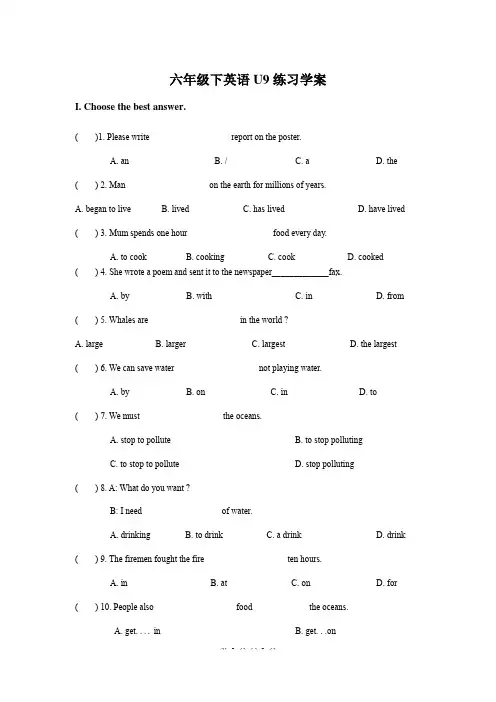
六年级下英语U9练习学案I. Choose the best answer.( )1. Please write__________________ report on the poster.A. anB. /C. aD. the( ) 2. Man __________________ on the earth for millions of years.A. began to liveB. livedC. has livedD. have lived( ) 3. Mum spends one hour ___________________ f ood every day.A. to cookB. cookingC. cookD. cooked ( ) 4. She wrote a poem and sent it to the newspaper_____________fax.A. byB. withC. inD. from( ) 5. Whales are ____________________ in the world ?A. largeB. largerC. largestD. the largest( ) 6. We can save water __________________ not playing water.A. byB. onC. inD. to( ) 7. We must__________________ the oceans.A. stop to polluteB. to stop pollutingC. to stop to polluteD. stop polluting( ) 8. A: What do you want ?B: I need _________________ of water.A. drinkingB. to drinkC. a drinkD. drink( ) 9. The firemen fought the fire __________________ ten hours.A. inB. atC. onD. for( ) 10. People also__________________ food ____________ the oceans.A. get. ... inB. get. . .onC. get. . . fromD. get. . . around( ) 11. Yesterday we visited the Space Museum and we learned_____________about space.A. a lotB. a lot ofC. lots ofD. lot ( ) 12. Miss Xu teaches_________________ Chinese.A. theirB. themC. theyD. theirs ( ) 13. A: ________________ do we use water?B: We use water to drink.A.WhatB. WhereC. WhyD. How ( )14. We need water to do many things. So we can't live_____________water.A. withB. withoutC. forD. on ( ) 15. The crops and vegetables___________________ i f there____________ no rain.A. will die. . . isB. will die. . . will beC. is. .. will beD. is. . . isⅡ. Choose the right word in the brackets to complete the sentence.1.Water is very important_____________ (to / for)us.2.The blue parts on the earth are____________ (land/ ocean).3.The star ___________ (like/is like ) a diamond, twinkling in the sky.4. A river is _____________ (wider/ narrower ) than a stream.5.We must stop___________ (polluting/to pollute) the water.Ⅲ. Rewrite the sentence as required.1.Farmers water the crops once a week. (改成一般疑问句)____________farmers_____________ the crops once aweek?2.The crops will die if there is no water. (改成否定句)The crops ____________ ____________ if there isno water.____________ ____________ Kitty and Tom usually do?1.I watched TV. I didn't do my homework. (合成一句)I watched TV_____________ ____________ doing my homework.5.Firemen use water to put out fires. (保持句意不变)Firemen use water __________________________ out fires.Ⅳ. Complete the following dialogue with proper sentences in the box.A: Where are you going, Tom?1. ________2. ________3. _______4. ________5. _______Ⅴ. Reading comprehension.(A)August 8, 2008 is a big day for China. The 29th Olympic Games will open on this day in Beijing.The Olympic Games are a big sports party every four years. It' s the first time for China to host them. We welcome everyone in the world to come and enjoy the Games.The Games run from August 8 to 24. It's a time for the world to see China. It's also a chance for us to see the world.We are ready. And we are looking forward for the big day.Choose the best answer.( ) 1. When will the 29th Olympic Games open in Beijing?A. August 5, 2008B. August 8, 2008C. August 5, 2010D. August 8, 2010() 2. Is it the first time for China to hold Olympic Games?A. Yes, it isB. Yes, it wil beC. No, it isn'tD. No, it won't() 3. How often do the Olympic Games take place?A. every yearB. every two yearsC. twice a yearD. every four years( ) 4. How long will the Games run?A. 16 daysB. 10 daysC. 20 daysD. 18days() 5. We are looking forward to the big day, aren't we?A. Yes, we willB. Yes, we areC No, we won t D. No, we aren’t(B)Yesterday afternoon, there was a big fire in King's Village. Some people saw two teenagers in a flat. They were about fifteen years old. They cooked food without any adults at home and atetheir lunch there. After that, they played with matches. They threw much paper into the fire.It was very dry and windy. Soon, there was a big fire in the kitchen. The teenagers were afraid and ran out. The fire got bigger and bigger. There were some old people in the block. They ran away quickly when they saw the fire. They lost everything in the fire.The firemen came after twenty minutes. They helped the people to leave. The firemen fought the fire for two hours. They were very brave.Answer the questions.1.Where was the big fire yesterday?It was_________________________________________________________ .2.How many teenagers played with matches?3.What did the teenagers throw into the fire?4.What did the teenagers do when they saw the big fire?5.How long did the firemen fight the fire?(C)(D)Choose the words or expressions and complete the passage.In England winter isn't very cold and summer isn't very hot.15does this happen? Because England is an island country. In winter the sea brings warm air to England. In summer the sea is16than the land. The winds17the sea bring cool air to England. The winds blow over England all the year. They18 rain to England all the year. England has19 rain. There's20rain in the west of England than21the east of England.( )1. A. Where B. Why C. How D. When( )2. A. cool B. more cool C. cooler D. muchcool( )3. A. from B. to C. of D. in ( )4. A. bring B. will bring C. brought D. brings ( )5. A. a lot B. a lot of C. many D. more ( )6. A. little B. much C. more D. a little ( )7. A. at B. in C. on D. with参考答案I.【Keys】1. C 2. C 3. B 4. A 5. D 6. A 7. D 8. C 9. D 10. C 11. A 12. B13. D 14. B 15. AII、【Keys】1. to 2. ocean 3. is like 4. wider 5. pollutingIII、【Keys】1. Do. ..water 2. won't die 3. What do 4. instead of 5. for puttingIV、【Keys】1. C 2. A 3. E 4. B 5. DV、【A】1. B 2. A 3. D 4. A 5. B【B】1. in King's Village.2. Two.3. They threw much paper into the fire.4. They ran out.5. For two hours.【C】1. busiest 2. plant 3. hard 4. round 5. Job【D】B C A A B C B。
牛津上海版英语六年级下册Unit9Seawaterandrainwater单元分析以及教学设计
作业布置要求:
1.作业量适中,以确保学生能够在规定时间内完成。
2.鼓励学生自主完成作业,培养独立思考和学习能力。
3.家长协助监督,关注学生的学习进度,鼓励学生遇到问题主动请教。
4.教师在批改作业时,要关注学生的完成情况,及时给予反馈,提高学生的学习兴趣和自信心。
2.语法:掌握一般现在时和现在进行时的用法,能够运用这两种时态描述海水与雨水的特点及变化过程。
3.句型:学会使用描述性语言表达海水与雨水的特征,如:“The salinity of seawater is higher than that of rainwater.”,以及运用一般现在时和现在进行时描述水循环过程。
7.教学拓展:鼓励学生在课后进行科学探究,如观察雨水、了解海水淡化技术等,将所学知识应用于生活实际。
四、教学内容与过程
(一)导入新课
1.教学活动设计:通过提问方式引导学生回顾已学的关于水的知识,如“Do you know where water comes from?”、“Can you tell me about the water cycle?”,激发学生的思维,为新课的学习做好铺垫。
4.阅读理解:通过阅读课文,理解海水与雨水的关系,了解水循环的基本原理。
5.口语表达:能够就海水与雨水这一主题进行简单的讨论,表达自己的观点。
(二)过程与方法
1.采用任务型教学法,引导学生通过观察、思考、讨论等方式,自主探究海水与雨水的特点及关系。
2.利用多媒体教学资源,如图片、视频等,帮助学生形象地理解海水与雨水的形成过程。
3.通过小组合作,培养学生的团队协作能力,提高学生的口语表达能力。
牛津上海版英语六年级下册《Unit 9 Sea water and rain water》教学设计8
牛津上海版英语六年级下册《Unit 9 Sea water and rn water》教学设计8一. 教材分析牛津上海版英语六年级下册《Unit 9 Sea water and rn water》主要让学生了解海水、雨水以及它们的特点。
通过本节课的学习,学生能够掌握相关的词汇和句型,提高他们的听说读写能力。
二. 学情分析六年级的学生已经具备了一定的英语基础,对于观察、描述和交流已经比较熟练。
但是,对于一些关于海水、雨水的专业词汇,可能需要加强指导。
此外,学生的学习兴趣和积极性也需要被激发和保持。
三. 教学目标1.知识目标:学生能够掌握与海水、雨水相关的词汇和句型;2.能力目标:学生能够运用所学的词汇和句型进行描述和交流;3.情感目标:学生能够激发对自然环境的关注和保护意识。
四. 教学重难点1.重点:学生能够掌握与海水、雨水相关的词汇和句型;2.难点:学生能够运用所学的词汇和句型进行描述和交流。
五. 教学方法采用任务型教学法,通过观察、讨论、交流等环节,激发学生的学习兴趣,提高他们的听说读写能力。
六. 教学准备1.准备相关海水、雨水的图片和视频;2.准备相关的词汇和句型卡片;3.准备听力材料和练习题。
七. 教学过程1.导入(5分钟)通过展示海水、雨水的图片和视频,引导学生观察和描述,激发学生的学习兴趣。
2.呈现(10分钟)教师展示相关的词汇和句型卡片,引导学生学习和朗读。
同时,通过简单的日常对话,让学生初步运用所学的词汇和句型。
3.操练(10分钟)学生分角色扮演,模拟海水、雨水的场景,运用所学的词汇和句型进行描述和交流。
教师巡回指导,纠正发音和语法错误。
4.巩固(10分钟)学生听听力材料,回答相关问题。
教师讲解答案,并进行讲解和辅导。
5.拓展(10分钟)学生分组讨论,探讨海水、雨水对人类和环境的影响。
每组选代表进行汇报,其他组进行评价。
6.小结(5分钟)教师总结本节课的学习内容,强调重点词汇和句型。
牛津上海版英语六年级第二学期:Unit 9 Sea water and rain water 学案
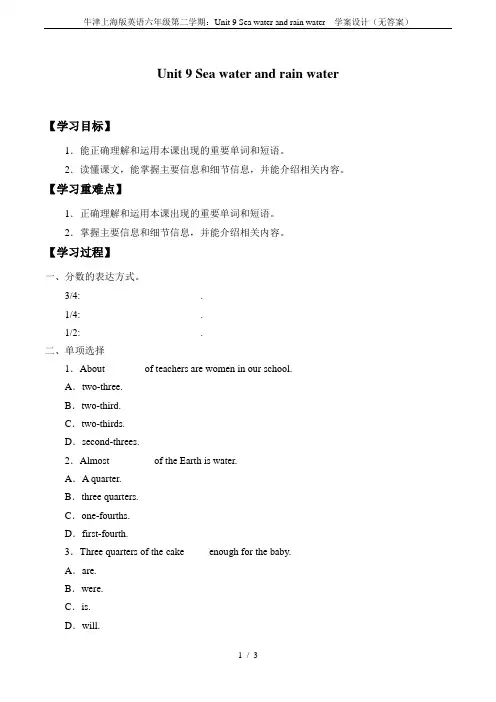
Unit 9 Sea water and rain water【学习目标】1.能正确理解和运用本课出现的重要单词和短语。
2.读懂课文,能掌握主要信息和细节信息,并能介绍相关内容。
【学习重难点】1.正确理解和运用本课出现的重要单词和短语。
2.掌握主要信息和细节信息,并能介绍相关内容。
【学习过程】一、分数的表达方式。
3/4: ______________________.1/4: ______________________.1/2: ______________________.二、单项选择1.About _______ of teachers are women in our school.A.two-three.B.two-third.C.two-thirds.D.second-threes.2.Almost ________ of the Earth is water.A.A quarter.B.three quarters.C.one-fourths.D.first-fourth.3.Three quarters of the cake ____ enough for the baby.A.are.B.were.C.is.D.will.4.A quarter of these apples ____ too much for me, but three quarters of the water ____ not too much.A.is, is.B.are, is.C.is, are.D.are, are.三、Whales are the largest animals on the Earth.large- larger (比较级) - the largest(最高级)形容词的最高级用于三者或以上人或物之间的比较,表示“最……”含义。
(一)形容词最高级的构成:(单音节或双音节形容词)a) 一般在词尾加-est:high--- the highest;tall --- _________.b) 以字母e结尾的形容词,在词尾加-st:fine--- the finest;nice --- _________.c) 以重读闭音节结尾,则双写结尾字母再加-est:big --- the biggest;fat---___________;thin--- __________.d) 以辅音字母+y结尾,把y变成i,再加-est:easy--- the easiest;early--- _________;heavy--- _________.(多音节形容词)多音节形容词的最高级在前面加most:beautiful --- the most beautiful;dangerous ---_______________;intelligent --- ______________;important ---_______________.不规则形容词:good --- the best;many/much--- the most;little --- the least.(二)句中出现由介词of, in, on组成的短语,暗示是三者以上的比较时,用最高级。
沪教牛津6下教案 Module 3 Unit 9 Reusing things

Module 3 Things we doUnit 9 Reusing things◆教材分析This lesson introduces how to use old things.◆教学目标【知识目标】Through the teaching activities of the Look and learn column, review the relevant core vocabulary.【能力目标】The Listen and say situational dialogue helps students learn phrases, review modal verbs can【情感目标】Guide the students to cherish the goods and learn to use them again.◆教学重难点【教学重点】sentence pattern: Finally, they made us into a piece of cloth.【教学难点】Phonetic learning: reading of a sentence.◆课前准备Tape recorder, Multimedia◆教学过程Step 1. Free talkDo you reuse anything at home/school?What do you reuse at home/ school?Why do people reuse things?Step 2. Look and learn1)read and learncan envelop pen holder vase2)Read and chooseenvelope can pen holder vase1. She grabbed a ____ of soda out of the fridge.2. Before you send a letter, you have to stick the stamp on the _________.3. Somebody broke the ____ and the flowers were all over the floor.4. I need a __________ to put my pencils and rulers in.Step 3. Listen and say1)Talk and shareWhat can we reuse? cans bottles2) Listen and judgeMrs Wang asks Alice to throw away the bottles and cans. ( ) .They will put rubbers and crayons in the small can. ( )They will put pencils and rulers in the bottle. ( )They will make the big can into a pen holder. ( )3) Complete the notes in page 55.4) read in roles and make a dialogue.Step 4. Look and read1)Listen and think➢Which one is a plastic bottle?➢What happened to the plastic bottle?A street cleaner found me. He put me into a truck. There were a lot of other bottles in the truck. The truck took us to a factory.Some people cleaned us and put us into a big machine. We became small pieces. Finally, they made us into a piece of cloth. Look at your T-shirt. Does it look like a plastic bottle?2) Complete the journey of the plastic bottle3) Retell the storyI’m a …A week ago, I was …Then a woman …The next morning, the woman …A street cleaner …The truck …Somepeople …We became …Finally, …Step 5. Think and discussHow can we ruse things around us?waste pollutionSave our planet!Don’t waste food.Flush the toilet with used water.Don’t buy things from shops when you can make them at home. Donate old clothes to people in remote places.Don’t throw old books away. book floating!Reject disposable tableware.Drink boiled water instead of bottled water.…Step 6. Listen and enjoyThese words rhymestring singaway playDo you know any other rhyming words?Think and sayWhen you find …, don’t throw it away.Use it to make …Save some ____________,And find ________________.Use them to _______________,And you can ______________!When you find ____________,Don’t ________________.Use it to _______________,Then __________________!Step 7. Think and writeHow can you reuse paper? Work in groups and write Step 8. HomeworkTalk about something you can reuse at home.。
六年级下册英语教案-Unit 9 Reusing things 第3课时 沪教牛津版(深圳用)
教师指出:Reusing things is a good habit.
接着出示一些系列活动的展示,让学生感受回收重新利用的好处。
4.完成幻灯片中相应的课堂练习。
三、Summary
根据板书复习今天学习的内容。
四、Homework
1.给同桌讲讲本课故事。
2.注意句子中单词的重读。
师生对话,生生对话。
说说怎样重新使用纸张。
学生完成句子。
展示句子
回答问题,跟着chant。
说规律
读句子
选择
看图片
做练习
读板书
记下作业
图片可以使教学内容更加容易理解与掌握。
说句型的能力培养。
学生从说到写能力的展示。
使学容易改错。好习惯由此形成。
评价使得学生积极性增强。
视频和chant巩固知识。
更加说的机会
2.能熟练找出重读的读音单词,使得句子更有节奏感。
情感目标:培养学生的旧物回收习惯。
重点
1.能够运用本单元学习的词汇和句子,描述某个重新利用的图片。
2.能熟练找出重读的读音单词,使得句子更有节奏感。
难点
1.能够运用本单元学习的词汇和句子,描述某个重新利用的图片。
2.能熟练找出重读的读音单词,使得句子更有节奏感。
(2)看视频,跟读chant。
5.Listen and say.
(1)听音,找出重读的单词;
(2)学生说说规律;
(3)教师出示重读规律
(4)Learn the sounds.
教师出示句子,并且给画出重读的单词,让学生读出重读的效果。
二、Practice
1.练习语音知识:选出重读标注正确的选项。
牛津上海版六下《Unit 9 Sea water and rain water》word教案
名师精编优秀教案教学设计牛津英语课标是以学生为本,培养学生在英语学习中运用英语和探究学习的能力。
因此我在本次英语课堂上,要达到出以学生为主体,教师为主导,以“任务型”教学理念贯穿于教学当中,充分调动学生探究学习的兴趣,让学生能掌握英语要点,运用英语句型和情景操练,并渗透情感教育的目的。
本课内容属于牛津英语6BM4的第四课时,课题是海水和雨水(Sea water and rain water),本节课教学内容是节约水(Save Water)。
在设计本课时,根据学生实际,以教材内容为主,适当作了一些课外知识的扩展。
本课教学目标就是:(1)认知目标:让学生学会进而操练句型:How can we …?We can …by…ing/not…ing…(2)能力目标:培养和提高学生的听说表达能力。
(3)情感目标:让学生明白如何去节约用水(To know how to save water),对学生进行思想教育,让他们知道节约水等资源的重要性。
水是人类生活不可缺的资源之一,学生很熟悉它,也有内容可说,同时也能在生活中意识到水的重要性。
在本节课中我采用启发式教学,“学——练——再学——再练”反复操练方式学习。
由故事导入上课,先让学生复习水的用处,再提问:如果没有水将会发生什么?(师生互动)。
总结:因此我们随时需要水,我们不能浪费水,因此我们该怎么做呢?(提问:引出主题:节约水Save water)在引出主题Save water时打出幻灯片后,提问学生:在学校或在家里能在哪里看到水?介绍单词:tap接着打出幻灯片引出新词组:a dripping tap/a running tap/a shower.然后先后出示人们浪费水的图片,引出课文新内容。
引导学生学会说祈使句:brush his teeth under a running tap. Don’t wash your teeth under a running tap. Don’t wash the dishes under a running tap/Don’t wash vegetables under a running tap.老师总结:他们都在浪费水,那样做对吗?(生答:不对)引导回答:我们应该节约水。
上海牛津沪教版六年级(下)同步讲义unit9
第九讲Unit9 Sea water and rain water教学过程一、课堂导入教师讲述一个与本节课题目有关的英文小故事,引出今日所要讲解的知识点,然后让学生简单梳理一下所涉及的问题,带着问题学习本节课的内容。
二、复习预习教师引导学生复习上节课学的重点内容,检测单词的用法,(以提问、回顾的形式进行),针对上节课的作业进行讲评、订正、答疑,并通过英文小故事导入本节课所要学习的新知识。
三、知识讲解1. 知识点一:重点单词1)competition [ˌkɒmpəˈtɪʃn]【词性】n.【词义】竞争;比赛【易混淆点】competition n. 竞争;比赛compete v. 竞争;比赛【经典例句】Miss Guo is reading a book to prepare a quiz for a class competition about the oceans.郭老师正在读一本书,为一场关于海洋的班级比赛准备一个小测试。
2)intelligent [ɪnˈtelɪdʒənt]【词性】adj.【词义】聪明的;有智慧的【易混淆点】intelligent adj. 聪明的;有智慧的intelligence n. 智力;潜能【经典例句】Dolphins are one of the most intelligent animals.海豚是最聪明的动物之一。
3)important [ɪmˈpɔ:tnt]【词性】adj.【词义】重要的【易混淆点】important adj. 重要的unimportant adj. 不重要的importance n. 重要(性)【经典例句】The oceans are important to all animals on the Earth.海洋对地球上的所有的动物都重要。
4)cover [ˈkʌvə(r)]【词性1】v.【词义1】覆盖;遮掩【词性2】n.【词义2】覆盖物;(书等的)封面【经典例句】What covers almost three quarters of the Earth?什么几乎覆盖了地球的四分之三?5)Internet [ˈɪntənet]【词性】n.【词义】因特网,互联网【易混淆点】Internet n. 因特网website n. 网址web n. 网页【经典例句】Kitty and Alice want to find some information about water on the Internet.Kitty 和Alice想在因特网上找些关于水的信息。
牛津上海版六年级下册英语Unit9 Sea water and rain water教案
牛津上海版六年级下册英语Unit 9 Sea water and rain water一、单元分析(Unit Analysis)(一)单元地位(Unit Position)16B 中已出现了use water to do sth.,本单元介绍了此句型的另为一种表达方式:use water for doing sth., 教师可以从use…to do.. 引出use … for doing用法。
教师让学生用身边的例子和生活经验,导入此句型。
,鼓励用此句型进行操练。
2本单元出现了if… will…的复合句,要加强操练。
学生对复合句的用法不很熟练,应设计各种情景,强化此句型的操练,以达到熟练运用。
3新的句型:we can save water by doing sth.学生在接受时会遇到困难,应该多加以机械操练。
4祈使句已经在前两册中出现过,本单元继续加强。
Fixing dripping taps. Turn dripping taps off.5Have you ever seen…? 的句型在6A中已出现,但作为知识难点,教师在学习过程中还要再复现与强调。
6作为情感态度发展的目标,教师要对学生进行节约能源的教育。
(二)单元目标(Unit Target)1熟练掌握use sth. for doing sth. / We use water for showering. / We use water for cooking. 2If… will…复合句的掌握,结合阅读的材料进行操练。
3掌握句型:How can we use water?We can use water by doing sth.4介词for 的用法(后跟一段时间); 介词by, under的用法5重点掌握情态动词can表达建议的用法。
(三)单元重点(Unit Points)1 关键词:⑴关于海洋生物的介绍:a coral reef, seaweed, dolphin, shark, intelligent.⑵关于如何节约用水:fix a dripping tap, turn a runni ng tap off, take a shower2 功能:用what/why/where/when/who/how…?询问对方,获取信息。
六年级英语下册Module3ThingswedoUnit9《Reusingthings》教案牛津上海版(三起)
Unit 9 Reusing thingsPeriod 1授课时间:总课时:教学目标知识与技能:词汇学习:throw away句型复习:We can reuse many old things.Then it’ll be a vase!过程与方法:通过Listen and enjoy的儿歌,让学生感受语言的韵律,导入旧物再利用的话题。
情感态度与价值观:培养环保意识,重复利用旧物。
教学重点:词汇学习:throw away教学难点:句型复习:We can reuse many old things.Then it’ll be a vase!教学过程Pre –task preparations1.播放课本第33页Listen and enjoy的儿歌,学生欣赏并跟读。
2.结合学生的生活常识及儿歌内容和学生问答,导入本单元话题,解释reuse的含义。
T:what did Ann use to make the pen bolder?S1: Ann used some paper and a can .T: Yes. Ann used a can and some paper to make a pen holder. We can reuse many old things .”Reuse” means to use something again.While-task procedures1.出示Look and learn 的图片及单词,学生看着图片大声朗读。
同时可出示前面所学单词的图片,如tape, scissors, glue, crayon, paints, brush等,让学生通过快速反应游戏巩固这些单词。
2.播放Listen and say的录音,让学生听录音后回答问题。
1)How many people are there in the dialogue?2)Who are they?3)What’s Alice going to do ?…T: Look! I can stick some cards together and put my pens and rulers in it. Then it’ll be a pen holder. Try to think of other ways to reuse things.S1: I can use some string to tie some small bottles together. Then it’ll be a wind-bell.Post-task activities教师播放课文录音,空出对话中的关键词让学生填空。