
新目标英语八年级上册Unit1 where did you go on vacation
1. 在英语中,anything, something, nothing和
everything是用于指代事物的复合不定代词,与之 相对应的复合不定代词anyone, someone, no one和 everyone (anybody, somebody, nobody和everybody) 用于指人。与形容词连用时,形容词必须置于复合 不定词之后,语法上称作“后置”。
Where did he go on vacation? He visited museums.
Where did they go on vacation? They went to summer camp.
They went to the mountains.
They went to the beach.
1b
Typescript
Conversation 3 Boy: Did you go anywhere on vacation, Tom? Tom: I went to summer camp. Boy: Did you go with anyone? Tom: Yes. I went with my friends. Everyone had a great time.
Explanation —Where did you go on vacation? —I went to the mountains. Where did you go ...? 是一般过去时的特殊 疑问句,did是助动词,动词go用原形。如: —Where did you go yesterday afternoon? 昨天下午你去哪里了? —I went to the library with my brother. 我和弟弟去图书馆了。
g visited summer camp museums
Listen. Number the people (1-5) 1b in the picture.
2 1
5
4
3
1b
Typescript (听力稿)
Conversation 1 Xiang Hua: Hey, Tina. Where did you go on vacation? Tina: I went to the mountains with my family . Xiang Hua: Did everyone have a good time? Tina: Oh, yes. Everything was excellent. Where did you go, Xiang Hua? Xiang Hua: I went to New York City.
√ √ √ √ √
Kevin the beach
Julie
play volleyball?
swim? go to the movies?
home
study for exams?
A: Grace, where did you go on vacation ? B: I went to New York City. A: Oh, really? Did you go with anyone? B: Yes, I went with my mother .
4. I just stayed at home most of the time to read and relax. most意为“大多数”,后跟可数名词
或不可数名词均可。
e.g. Most students go to school on foot.
大多数学生步行去上学。
【辨析】 most + 名词 泛指多数,无范围; most + of + the (this/that/those/these等) 名词 ,指某一范围内的多数。 e.g. Most of the students go to school by bike. 这些学生们中的多数骑自行车去上学。
根据汉语提示完成句子。 1. Did he go out with _______ anyone (任何人)? 2. They didn’t buy anything ________ ______ special (特殊
的东西) there yesterday.
3. Tell us __________ something __________ interesting (有趣的
How was the food? Did everyone have a good time?
Notes
合成不定代词和不定副词的构成及其用法
1.构成:由some, any, no, every分别加上-body, -thing, -one 构成的不定代词叫做合成不定代词;加上-where构成副词。 2.用法: (1)合成不定代词在句中可以作主语,宾语或表语等。 Nobody will listen to him. He wants something to eat. (2)不定代词作主语时,谓语动词要用单数。 There is nothing wrong with the TV. Everybody likes to be free.
Where did you go on vacation? Did you go out with anyone? Did you buy anything special?
I went to New York City. No ,no one was here. Every one was on vacation. Yes, I bought something for my father. No ,I bought nothing. Everything tasted really good. Oh, yes. Everything was excellent.
Unit 1
Where did you go on vacation? Section A-1
Where did he go on vacation?
He just stayed at home and watched TV.
Where did she go on vacation? She went to New York City.
•
记忆游戏
•
猜一猜
Did he/she/ they read a book?
f b went to stayed at the beach home d
went shopping
a
e c went to New went to the went to a York City mountains park h i went to went fishing
2a
Listen. Where did the people go on vacation? Complete the chart.
People
1. Grace
2. Kevin 3. Julie
Places
New York City beach home
2b
Listen again. Check (√ ) “Yes , I did .” or “No , I didn’t.” for each question.
Did you …
go with anyone ?
Yes, I did.
ห้องสมุดไป่ตู้No, I didn’t.
Nancy
go to Central Park ? buy anything special ? play volleyball ? swim ? meet anyone interesting ?
Kevin Julia
e.g. I can see someone new in your group. There’s nothing interesting in the news today.
2. Did you go anywhere interesting? anywhere意为“在任何地方”,常用于 一般疑问句或否定句中,代替somewhere。 e.g. I can’t find my keys anywhere. 我到处也找不到我的钥匙。
3. We took quite a few photos there. a few 意为“一些,若干(=some)”, 后跟可数名词复数形式。 quite a few 意为“相当多;不少(= many)”后跟可数名词复数形式。 e.g. A few girls are playing volleyball. 几个女孩正在打排球。 There are quite a few birds in the forest. 在那片森林里有很多鸟。
Notes
(3)some-不定代词,通常用于肯定句中;any-不定代 词则多用于否定句、疑问句和条件状语从句中。 但some-可用于表请求、邀请、预料对方会作肯定回答 时的疑问句中。 Someone called on her last week. There isn’t anyone else there. Is anybody over there? Could you give me something to eat? (4)形容词修饰不定代词时,通常要放在不定代词之后。 There is something wrong with your eyes.
事情) about your vacation, Jenny.
4. They caught ______ quite ___ a ____ few (相当多的) insects in the forest. 5. _____ Most __ of ___ the (大多数) students can get to school early.
B: I went to New York City. A: Oh, really? Did you go with anyone? B: I went with my mother.
人教新目标版英语八上Unit 1《Where did you go on vacation》(Sec

人教新目标版英语八上Unit 1《Where did you go on vacation》(Section A 1a-2c)教学设计一. 教材分析人教新目标版英语八上Unit 1《Where did you go on vacation》主要介绍了假期旅游的话题。
通过学习本单元,学生能够掌握一般过去时的疑问句和回答,学会描述自己和他人的假期活动。
本单元包括Section A 1a-2c,内容涵盖了假期旅游的照片、一般过去时的疑问句和回答、以及关于旅游活动的词汇和短语。
二. 学情分析学生在学习本单元前,已经掌握了一般过去时的基本知识,具备了一定的听说读写能力。
但部分学生对一些旅游相关词汇和短语可能较为陌生,需要教师在教学中进行引导和拓展。
此外,学生在与他人交流假期活动时,可能存在一定的语言困难,教师需要通过实例和练习,帮助学生提高语言表达能力。
三. 教学目标1.知识目标:学生能够掌握一般过去时的疑问句和回答,学会描述自己和他人的假期活动。
2.能力目标:学生能够运用本课所学知识,与他人交流假期旅游的经历。
3.情感目标:培养学生对旅游活动的兴趣,增进同学之间的友谊。
四. 教学重难点1.重点:一般过去时的疑问句和回答,描述假期活动的词汇和短语。
2.难点:如何运用所学知识,与他人流畅地交流假期旅游的经历。
五. 教学方法1.情境教学法:通过展示旅游照片,引导学生参与课堂活动,激发学习兴趣。
2.交际法:学生进行小组讨论,鼓励学生大胆开口,提高语言表达能力。
3.任务型教学法:设计具有实际意义的任务,让学生在完成任务的过程中,巩固所学知识。
六. 教学准备1.教师准备:备好相关旅游照片,制作PPT,准备教学用具。
2.学生准备:预习课文,了解一般过去时的疑问句和回答。
七. 教学过程1.导入(5分钟)教师展示旅游照片,引导学生谈论假期旅游的经历,激发学生对本课内容的兴趣。
2.呈现(10分钟)教师通过PPT展示课文1a-1c的内容,引导学生跟读,注意语音语调。
人教版新目标八年级英语上册 Unit 1 Where did you go on vacation单元知识归纳
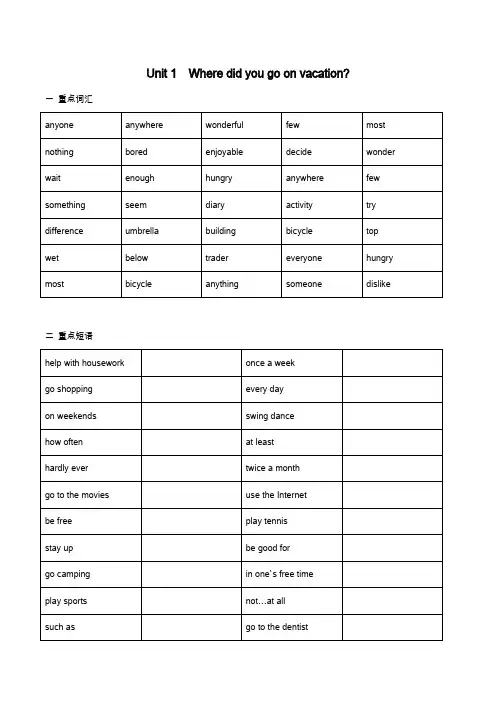
Unit 1 Where did you go on vacation? 一重点词汇二重点短语三用法精粹四经典句型1.Did you buy anything special?2.everything tasted really good!3.And because of the bad weather, we didn`t see anything below.4.My legs were so tired that I wanted to stop.5.Everything tasted really good.6.What a difference a day makes.五语言知识归纳1. Where did you go on vacation?vacation n. 假期,同义词:holidaygo on vacation 去度假be on vacation 在度假例题( ) I want to _________ in Hainan this winter.A. go vacationB. going on vacationC. go on vacation( ) Tom may ________ in Paris.A. went on vacationB. be on vacationC. was on vacation2. visited my uncle 看望我叔叔visited museums 参观博物馆visit vt. 其后接表示人的名词或代词时,译为“看望,拜访”;其后接表示地点的名词时,译为“参观,浏览”。
常用短语结构:visit sb./sp.visit n.访问,参观,游览visitor n. 参观者,游客例题( ) I _______ my grandmother last week.A. visitB. visitedC. visiting( ) Do you want _________ Shanghai?A. to visitB. visitedC. visitor( ) This is my first ________ to China.A. visitB. visitorC. visited( ) There are four ________ come from America.A. visitorsB. visitC. visitor3. … go with anyone? …anyone 复合不定代词,意为“任何人”,相当于anybody,常用于否定句或疑问句中,代替someone/somebody.辨析1.:例句Anyone in my class knows any one of the singers and any one of their songs.我们班上任何人都知道这些歌手中任何一个和他们歌曲中的任何一首。
最新人教版新目标八年级上册英语《Unit 1 Where did you go on vacation》教学设计

Unit1 Where did you go on vacationSection B(1a-1e)一.教学目标知识目标:1.key words: delicious,exciting,terrible,expensive,cheap,boring2.key sentences:(1)Where did Lisa go on vacation?(2)Did she do anything special there?Did she buy anything for her best friend?Did Lisa like her vacation?(3)How was/were...?3.运用be+形容词来评价事物能力目标:1.进行听力训练,提高综合听说能力。
2.能够利用自评和互评的评价标准,提高自己的听说能力。
情感目标:1.让学生学会分享过去发生的事件。
2.通过课堂活动,培养学生的合作精神。
3.向学生提供体验学习成功的多种机会,使其增强自信心。
学习策略:1.听力练习,训练学生学习和使用有选择的听的策略。
2.设计Pairwork, Groupwork等活动,培养和训练他们的合作策略。
3.通过自评和互评活动,使学生不断调整改进自己的学习策略。
文化意识:通过听力内容帮助学生了解香港。
二.教学重难点教学重点:The vocabulary:delicious,exciting,terrible,expensive,cheap,boringTarget language:Where did Lisa go on vacation?Did she do anything special there?Did she buy anything for her best friend?How was/were...?教学难点:1.熟练地谈论过去发生的事件2.运用be+形容词来评价事物三.教学过程Step 1Leading in1.Greetings.2.T:Where did you go on vacation?S:I went to summer camp.T:Did you do anything special there?S:Yes,I...T:Did you buy anything for your parents or friends?S:Yes,I bought...for.../No,I bought nothing.T:How was/were...?S:It was/They were...3.Present the adjectives:delicious,exciting,terrible,expensive,cheap,boring Step 2Pre-taskWork on 1a and 1b.1.Look at the six pictures.2.Match the words with the pictures.4.Check the answers.Step 3While-taskWork on 1c and 1d.1.Make students read the questions in 1c.2.Play the recording for the first time. And say:Listen to the tape. Lisa is talking about her vacation. Complete the four questions.①Where did Lisa go on vacation?She went to Hong Kong.②Did she do anything special there? What was it?__________________________________________________③Did she buy anything for her best friend?__________________________________________________④Did Lisa like her vacation?__________________________________________________3.Play the recording a second time. Students complete the task in 1d.What did Lisa say about ------?her vacation great the people ________the fun park ________ the food ________the stores __________4.Correct the answers.5.Ask the students to listen to the tape and repeat .Then let them read the tape scripts.Step 4Post-taskWork on 1e.1.Pairwork. Get the students to work in pairs about Lisa's vacation. You canbegin your questions with:Where did...?What did...?Did she...?How was...?How were...?2.Ask 3 or 4 students to ask and answer the questions .For example:A: Where did Lisa go on vacation?B: She went to Hong Kong.A: What did she do?B: She went to a fun park.A: Did she go shopping?B: Yes, she did.A: How were the stores?B: They were very expensive.A: How were the people?B: They were really friendly.A: How was the food?B: It was delicious.3.Groupwork. Let the students say about Lisa's vacation . First give the students time to practice it by themselves. Then let them work in groups .At last choose several students to show it individually.For example:Lisa went to Hong Kong with her family on vacation. She went to a fun park. It was really exciting. She bought something for her best friend. The stores were very expensive. The people there were really friendly. Lisa’s parents have some friends there.They had dinner at their friends ’ home. The fo od was delicious. Everything was excellent. And they had a good time.Step 5. Exercises一..根据括号所给单词,句意或首字母完成句子。
人教新目标八年级英语上册Unit1Wheredidyougoonvacation知识点讲解
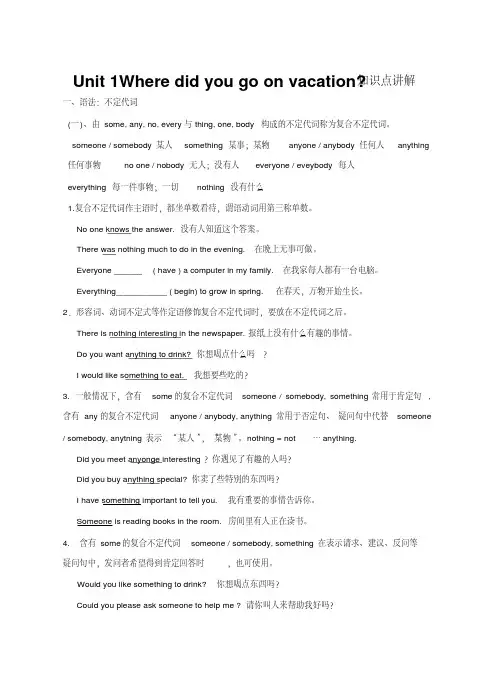
Unit 1Where did you go on vacation?知识点讲解一、语法:不定代词(一)、由some, any, no, every与thing, one, body 构成的不定代词称为复合不定代词。
someone / somebody 某人something 某事;某物anyone / anybody 任何人anything 任何事物no one / nobody 无人;没有人everyone / eveybody 每人everything 每一件事物;一切nothing 没有什么1.复合不定代词作主语时,都坐单数看待,谓语动词用第三称单数。
No one knows the answer. 没有人知道这个答案。
There was nothing much to do in the evening. 在晚上无事可做。
Everyone ______ ( have ) a computer in my family. 在我家每人都有一台电脑。
Everything___________ ( begin) to grow in spring. 在春天,万物开始生长。
2.形容词、动词不定式等作定语修饰复合不定代词时,要放在不定代词之后。
There is nothing interesting in the newspaper.报纸上没有什么有趣的事情。
Do you want anything to drink?你想喝点什么吗?I would like something to eat. 我想要些吃的?3. 一般情况下,含有some的复合不定代词someone / somebody, something常用于肯定句,含有any的复合不定代词anyone / anybody, anything常用于否定句、疑问句中代替someone / somebody, anytning表示“ 某人”,“某物”。
人教新目标版英语八上Unit1《Wheredidyougoonvacation》精美说课稿

人教新目标版英语八上Unit 1《Where did you go on vacation》精美说课稿一. 教材分析《Where did you go on vacation》是人教新目标版英语八上Unit 1的内容。
本节课主要讨论过去发生的事情,通过询问对方度假的地点来展开对话。
教材内容丰富,插图生动,激发学生的学习兴趣。
本节课的主要目的是让学生掌握一般过去时的疑问句和回答,并能够运用所学知识进行实际对话。
二. 学情分析八年级的学生已经掌握了基本的英语语法知识,对于一般过去时有一定的了解。
但在实际运用中,部分学生可能会出现语法错误。
此外,学生的词汇量有限,可能会影响他们对文本的理解。
因此,在教学过程中,需要关注学生的个体差异,因材施教,帮助学生更好地掌握知识。
三. 说教学目标1.知识目标:学生能够掌握一般过去时的疑问句和回答,正确运用动词过去式进行对话。
2.能力目标:学生能够听懂、说出一般过去时的疑问句和回答,提高英语口语表达能力。
3.情感目标:通过讨论度假经历,培养学生热爱生活、分享快乐的感情。
四. 说教学重难点1.重点:学生能够掌握一般过去时的疑问句和回答。
2.难点:学生能够正确运用动词过去式进行实际对话。
五. 说教学方法与手段1.情景教学法:通过设置度假场景,让学生在真实情境中学习一般过去时的疑问句和回答。
2.任务型教学法:学生分组进行角色扮演,完成对话任务,提高口语表达能力。
3.信息技术辅助教学:利用多媒体课件、网络资源等,丰富教学手段,提高学生的学习兴趣。
六. 说教学过程1.导入:教师通过提问“Where did you go on vacation?”引导学生思考并回答,激发学生的学习兴趣。
2.新课呈现:教师展示教材插图,介绍一般过去时的疑问句和回答。
3.课堂活动:学生分组进行角色扮演,完成对话任务,教师巡回指导。
4.巩固练习:学生进行小组竞赛,看哪个小组能够在最短时间内完成一般过去时的疑问句和回答。
人教新目标八年级上册英语《Unit 1 Where did you go on vacation?》
人教新目标八年级上册英语《Unit 1 Where did you go on vacation?》Section A_教学设计3一. 教材分析人教新目标八年级上册英语《Unit 1 Where did you go on vacation?》Section A,主要讲述了假期旅游的话题。
通过本节课的学习,学生能够掌握一般过去时的提问和回答方式,学会使用“Where did you go?”, “What did you do?”等句型来询问别人的假期经历。
教材内容丰富,插图生动,有助于激发学生的学习兴趣。
二. 学情分析八年级的学生已经掌握了基本的英语语法知识,对一般过去时有所了解。
但在实际运用中,可能还存在一定的困难。
学生的词汇量和对英语文化的了解有限,需要通过大量的操练来提高运用所学知识进行交际的能力。
三. 教学目标1.知识目标:学生能够掌握一般过去时的提问和回答方式,学会使用“Where did you go?”, “What did you do?”等句型来询问别人的假期经历。
2.能力目标:学生能够在日常生活中,运用所学知识进行简单的交流。
3.情感目标:通过本节课的学习,学生能够增进与同学之间的友谊,分享彼此的假期经历,培养对英语学习的兴趣。
四. 教学重难点1.重点:学生能够掌握一般过去时的提问和回答方式。
2.难点:学生能够在实际情景中,灵活运用所学知识进行交际。
五. 教学方法采用任务型教学法,通过创设情境,引导学生参与课堂活动,充分调动学生的积极性和主动性。
在教学过程中,注重师生互动,生生互动,让学生在实践中学习,提高语言运用能力。
六. 教学准备1.教师准备:准备好相关的教学材料,如PPT、图片、卡片等。
2.学生准备:学生提前预习教材内容,了解一般过去时的基本用法。
七. 教学过程1.导入(5分钟)通过展示一些假期旅游景点的图片,引导学生谈论自己的假期经历,引出本节课的主题。
2.呈现(5分钟)教师通过PPT展示本节课的主要句型:“Where did you go?”, “What did you do?”等,同时给出相应的回答,让学生感知和理解这些句型的用法。
人教新目标八年级上册英语《Unit 1 Where did you go on vacation?》
人教新目标八年级上册英语《Unit 1 Where did you go on vacation?》Section A_教学设计1一. 教材分析人教新目标八年级上册英语《Unit 1 Where did you go on vacation?》Section A,主要介绍了假期旅游的话题。
本节课通过引入旅游的话题,让学生学习一般过去时态的疑问句和回答。
教材内容丰富,插图生动有趣,有利于激发学生的学习兴趣。
本节课的主要语言点是一般过去时态的疑问句和回答,以及相关的旅游词汇。
二. 学情分析八年级的学生已经学习了英语一段时间,对英语有了一定的了解和掌握。
他们好奇心强,喜欢探索新事物,但同时也有可能对英语学习产生疲劳感。
因此,在教学过程中,需要充分调动学生的积极性,激发他们的学习兴趣。
学生的英语水平参差不齐,因此需要针对不同水平的学生进行分层教学。
三. 教学目标1.知识目标:学生能够掌握一般过去时态的疑问句和回答,以及相关的旅游词汇。
2.能力目标:学生能够用英语询问和描述假期旅游的经历。
3.情感目标:通过本节课的学习,学生能够培养对旅游的兴趣,增强对英语学习的热情。
四. 教学重难点1.重点:一般过去时态的疑问句和回答,以及相关的旅游词汇。
2.难点:一般过去时态的疑问句和回答的运用,以及旅游词汇的准确表达。
五. 教学方法1.任务型教学法:通过设定各种旅游相关的任务,让学生在完成任务的过程中学习和运用语言。
2.情境教学法:创设各种旅游情境,让学生在真实的情境中学习英语。
3.小组合作学习:通过小组讨论和合作,提高学生的参与度和积极性。
六. 教学准备1.教师准备:提前准备相关的旅游图片、视频和旅游经历的故事,以及旅游词汇的卡片。
2.学生准备:学生需要提前预习教材,了解本节课的学习内容。
七. 教学过程1.导入(5分钟)通过向学生展示各种旅游图片,引导学生谈论自己的旅游经历,激发学生的学习兴趣。
教师可以提问:“Where did you go on vacation?”,让学生用英语回答。
人教新目标八年级上册英语《Unit 1 Where did you go on vacation?》
人教新目标八年级上册英语《Unit 1 Where did you go on vacation?》Section B_教学设计1一. 教材分析人教新目标八年级上册英语《Unit 1 Where did you go on vacation?》Section B 主要讲述了假期旅行的主题。
通过本节课的学习,学生能够掌握一般过去时的疑问句和回答,以及如何描述过去发生的事情。
教材内容贴近学生的生活,激发学生对旅行的兴趣,提高学生的口头表达能力。
二. 学情分析八年级的学生已经掌握了基本的英语语法知识,具有一般现在时和一般过去时的基础。
在学习本节课之前,学生已经学习了如何用英语描述家庭成员和询问他们的去向。
因此,学生在学习本节课时,能够将已有的知识与新的知识相结合,提高学习效果。
三. 教学目标1.知识目标:–能够听懂、说出一般过去时的疑问句和回答。
–能够用英语描述过去发生的事情。
2.能力目标:–能够与他人用英语交流关于假期旅行的经历。
–能够提高口头表达能力。
3.情感目标:–激发学生对旅行的兴趣,拓宽视野。
–培养学生的团队协作精神。
四. 教学重难点•一般过去时的疑问句和回答。
•如何用英语描述过去发生的事情。
•一般过去时疑问句的构成和用法。
•如何在实际交流中运用一般过去时。
五. 教学方法1.情境教学法:通过设置旅行相关的情境,让学生在实际语境中学习英语。
2.交际法:鼓励学生参与课堂互动,提高学生的口头表达能力。
3.任务型教学法:通过小组合作完成任务,培养学生的团队协作精神。
六. 教学准备1.教学课件:制作与旅行相关的课件,包括图片、视频等。
2.教学道具:准备一些与旅行相关的实物道具,如地图、行李箱等。
3.小组活动准备:划分学习小组,提前分配任务。
七. 教学过程1.导入(5分钟)–教师展示一张旅行图片,引导学生谈论旅行的话题。
–学生分享自己最喜欢的旅行地点和经历。
2.呈现(10分钟)–教师通过课件呈现一般过去时的疑问句和回答。
新目标英语八年级上册Unit1-where-did-you-go-on-vacation
Where did he go on vacation? He visited museums.
Where did they go on vacation? They went to summer camp.
They went to the mountains. They went to the beach.
1. 在英语中,anything, something, nothing和
everything是用于指代事物的复合不定代词,与之 相对应的复合不定代词anyone, someone, no one和 everyone (anybody, somebody, nobody和everybody) 用于指人。与形容词连用时,形容词必须置于复合 不定词之后,语法上称作“后置”。
There is nothing wrong with the TV. Everybody likes to be free.
Notes
(3)some-不定代词,通常用于肯定句中;any-不定代 词则多用于否定句、疑问句和条件状语从句中。 但some-可用于表请求、邀请、预料对方会作肯定回答 时的疑问句中。 Someone called on her last week. There isn’t anyone else there. Is anybody over there? Could you give me something to eat? (4)形容词修饰不定代词时,通常要放在不定代词之后。 There is something wrong with your eyes.
事情) about your vacation, Jenny.
4. They caught _q__u_it_e_ _a__ _fe_w__ (相当多的) insects in the forest.
最新人教新目标版中学八年级英语上册 Unit 1 Where did you go on vacation?教案
Unit 1 Where did you go on vacation?The second period (Section A 3a---Section B 1e)Teaching Aims1.Knowledge Objects(1)Function‘ Talk about past event.② Pronouns﹢self/selves2.Ability Objects(1)Learn to develop the abilities to describe a past event(2)Master reflexive pronoun.3.Moral ObjectsTalk about a past event about one’s vacation.Teaching Key Points1.Vocabulary and expressions2.Indefinite pronouns and reflexive pronouns.Teaching Difficult PointsHow to use reflexive pronoun in a sentence correctly.(myself—ourselves…)Teaching MethodsEncourage a student to talk about his vacation, and let other students ask him questions about his vacation. For example’ “How do you think about your vacation? And why? Did anyone go with you? What did you buy? What did you buy for your mother? / yourself?...’Teaching Aids1.Some pictures2.Something that we bought from someplace that we visited on vacations.3. A tape recorder.Teaching ProceduresStep1 GreetingT’ Good morning class!S’ Good morning teacher!T’ I like traveling. This is a picture I took on last vacation. Can you tell me where I went?S1’ Beijing.T’ Great! Did you go anywhere on your vacation?S2’ I went to…S’ How did you like it? Now who can ask him questions just like me?S3’ What did you buy?S2’ I didn’t bu y anything there.S4’Why?S2’ I didn’t like anything there.S5’ How was the food?S2’ It was …Objects’ Review the past tense.Step2 PresentationRead the new words ‘nothing, everyone, myself, yourself, hen ,pig, seem, bored, someone, diary, of course’. T hen ask some students to read them, and correct the wrong pronunciations.Step3 3aStep4 PresentationLearn reflexive pronounsGet the students to learn some reflexive pron ouns and write them on t heir notebooks.Objects’ Learn reflexive pronounsAttenti on’ Give more phrases.Step5 3bFill in the blanks with the words in the box in 3b.The teacher should ask students to pay attention to indefinite pronouns, especially anything and everythingStep6 3cAsk students to finish 3c with their partners.( ‘keep a diary ‘ means write diary down)Step71a,1bThese are adjective words. The teacher should teach the meanings of each word. It is best for every student to make a sentence with each word. Then find the words of the opposite meanings.Ask stu dents to write commendatory words of 1a on the left column, and write the derogatory words on the right.Step8 1cFirst, let students read the questions. Then play the recording the first time, then play it the second time. This time ask students to write the answers on the books.Have four students share their answers.Step9 1dListen again and fill in the blanks.Pay attention to the key words ’vacation, park, people, food, stores.’Step10 1eFirst, find some s tudents to give us a report about his/her vacation. Then encourage other students to ask q uestions with these words’ wher e, what, how, did, when, why, and so on.Step11 SummaryIn this class, we learned indefinite pronouns and reflexive pronouns.Step12 HomeworkWrite an article about your vacation. What did you do during your vacation? Did you like your vacation? Why?Blackboard DesignU nit1 Where did you go on vacation?The Second Period (Section A 3a—SectionB 1e)精品教育资料delicious terriblegreat expensiveexciting boringcheapReflexive pronoun’your—yourself—yourselvesmy—myself—our—ourselveshim—himself—themselvesher—herself。