
2019-2020学年新教材高中英语unit2 exploring english 单元重点知识回顾教学案版本:外研版必修第一册
Unit 2 Exploring English
Ⅰ.重点词汇
1.confusing adj. 令人困惑的→confuse vt. 使迷惑,使糊涂→confused adj. 困惑的→confusion n. 混乱,困惑
confuse ... with/and ... 把……和……混淆
be confused about sth. 对某事迷惑不解
in confusion 困惑地,困窘地
2.reflect vt. 反映;反射(声、光、热等);显示;表达→reflection n. 反映;映像;反射;深思→reflective adj. 反射的,反映的;沉思的;深思的;(指物体表面)反光的reflect on/upon sth. 认真思考……
on/upon reflection 经再三思考
3.likely adj. 可能的,可能发生的
It is likely that ... 很可能……
sb./sth. be likely to do ... 某人/某事很可能……
4.remind vt. 提醒,使想起→reminder n. 引起回忆的事物,提醒人的事物;(告知该做某事的)通知单,提示信
remind sb. (not) to do sth. 提醒某人(不)做某事
remind sb. of/about (doing) sth. 使某人想起(做)某事
remind sb. that ... 使某人想起……,提醒某人……
5.comment n. 评论;议论vt.& vi. 作出评论;表达意见
make comments on/about ... 对……加以评论
No comment! 无可奉告!
offer comments 提意见
comment on/upon sth. 对……发表评论
6.base v. 以……为基础→basic adj. 基础的,基本的→basis n. 基础,根据
base ... on/upon ... 把……置于……基础之上
be based on/upon 以……为基础/根据
on the basis of 以……为基础;根据……
7.have trouble/difficulty/problems (in) doing sth. 做某事有困难/麻烦
have trouble/difficulty/problems with sth. 在某方面有麻烦或有困难
8.burn down 烧毁(多指建筑物被烧塌)
burn up 烧光,烧尽(多指东西被烧掉);(通过锻炼)消耗(热能)
burn out 烧坏;燃尽;耗尽体力
burn sth. to the ground 将……烧成平地
9.come across 偶然发现
come about 发生
come on 加油;得了吧,算了吧;进展,进步
come from 来自;出生于
come up with 赶上;提出,想出(注意、解决方法、计划等)
come through 安然度过
come true 实现
come out 出来,显露;开花;出版,发表;上市
10.aware adj. 意识到的,明白的→unaware adj. 不知道的→awareness n. 意识
be aware of 意识到,察觉到
raise one's awareness 增强某人的意识
Ⅱ.教材原句
1.Neither is there pine nor apple in pineapple.(P14)
菠萝中既没有松树也没有苹果。
2.That is why when the stars are out, they are visible, but when the lights are out, they are invisible.(P15)
这就是为什么星星out(出来)时是看得见的,但灯out(熄灭)时是看不见的。
3.Here are some of our favourites to remind us that some of the English we learn in the classroom is rather different from the English in the outside world!(P20) 这里有一些我们最喜欢的(帖子)提醒我们,我们在教室里学习的英语与外部世界的英语是相当不同的!
Ⅲ.单句语法填空
1.He does not work there, neither I.
答案:do
2.A survey showed people were (confusing) about what they should eat to stay healthy.
答案:confused
3.What are you (base) this theory on?
答案:basing
4.Jane reflected her boss's criticism and vowed to improve her work.
答案:on
5.Bryson decided to quit rather than (accept) the new rules.
答案:accept
6.The pictures remind her her happy childhood.
答案:of/about
7.You are welcome to make (comment) on it.
答案:comments
8.I want them to behave (them) while I'm away.
答案:themselves
9.It was (recognise) that this solution could only be temporary.
答案:recognised
10.I have no (intend) of going to the wedding.
答案:intention
Ⅳ.开放型任务
围绕本单元话题“Exploring English”,我们学习了confusing, wonder等重点词汇的用法;学习了英语构词法。
结合本单元学习内容写一篇关于英语语言文化的小论文吧!。
2019_2020学年新教材高中英语Unit2ExploringEnglishSectionⅠStartingout

熟词生义: behavior 还可以指(机器等的)运转状况 图形助记:
易错提示:unique 前面用不定冠词时,应用 a, 容易错用成 an, 类似单词还有 useful, European, university 等。
►重点单词和短语
1.behavior n.行为;举止 (1)mind one's behavior 注意某人的行为举止 (2)behave v. 表现;守规矩 behave oneself 守规矩;表现得体 behave well 表现好 behave badly 表现差
①I am sorry about what I did last night — I behaved lik
e a child. 对不起,我昨天晚上表现得太幼稚。 ②I think all of us should mind our behavior in public pl
aces. 我认为我们大家都应该注意在公共场所的行为举止。
rich imagination 你将无法相信他独特的思考方式和丰富的想像力。
3.reflect v.思考;反思;反映;反射
(1)reflect ... in... 在……中映出…… reflect on... 反思;思考 (2)reflection n. 映像;反射;反映 ①A man's actions reflect his thoughts. 人的行动反映出他的思想。 ②Her face was reflected in the mirror. 镜子中映出她的脸。
答案:C
4.We can learn from the passage that ________. A.English reflects the creativity of people. B.English was invited by computers. C.English is dull. D.English is spoken by many countries.
2019_2020学年新教材高中英语Unit2ExploringEnglishPeriodⅠStartingout
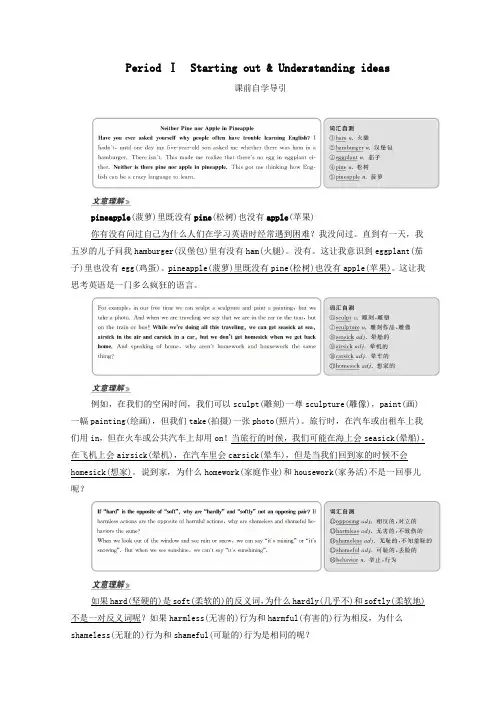
Period ⅠStarting out & Understanding ideas课前自学导引pineapple(菠萝)里既没有pine(松树)也没有apple(苹果)你有没有问过自己为什么人们在学习英语时经常遇到困难?我没问过。
直到有一天,我五岁的儿子问我hamburger(汉堡包)里有没有ham(火腿)。
没有。
这让我意识到eggplant(茄子)里也没有egg(鸡蛋)。
pineapple(菠萝)里既没有pine(松树)也没有apple(苹果)。
这让我思考英语是一门多么疯狂的语言。
例如,在我们的空闲时间,我们可以sculpt(雕刻)一尊sculpture(雕像),paint(画)一幅painting(绘画),但我们take(拍摄)一张photo(照片)。
旅行时,在汽车或出租车上我们用in,但在火车或公共汽车上却用on!当旅行的时候,我们可能在海上会seasick(晕船),在飞机上会airsick(晕机),在汽车里会carsick(晕车),但是当我们回到家的时候不会homesick(想家)。
说到家,为什么homework(家庭作业)和housework(家务活)不是一回事儿呢?如果hard(坚硬的)是soft(柔软的)的反义词,为什么hardly(几乎不)和softly(柔软地)不是一对反义词呢?如果harmless(无害的)行为和harmful(有害的)行为相反,为什么shameless(无耻的)行为和shameful(可耻的)行为是相同的呢?当我们看到窗外下雨或下雪时,我们可以说it's raining(正在下雨)或it's snowing(正在下雪)。
但是当我们看到阳光的时候,我们不能说it's sunshining。
即使是最小的单词也会令人困惑。
当你在医学报告中看到大写的WHO时,你会把它读成“Who's that?”中的who吗?那IT 和US呢?你也不得不对一种语言的独特疯狂感到惊奇。
2019_2020学年新教材高中英语Unit2ExploringEnglishSectionⅢUsi

Section Ⅲ Using language & WritingⅠ单句语法填空1.He had misread(read) a road sign and taken the wrong way.2.It is hoped that natural(nature) resources will be found on Mars.3.He was one of the greatest thinkers(think) and had a great effect on Chinese culture.4.We hope these lovely children grow happily and healthily(health) every day.5.On New Year’s Day, we visited every neighbor in the village and were greeted warmly(warm) at each house.6.Many accidents are caused by some driver s’ carelessness(careless).7.After a long discussion(discuss) with her father, she decided not to take the job.8.The boy didn’t pass the entrance examination, so his parents were unhappy(happy) about the result.9.The Great Wall in China left a deep impression(impress) on the people all over the world.10.Father looked at the result of his son’s examination with satisfaction(satisfy) and pride.Ⅱ阅读理解We do not usually think about how our languageworks.Talking is such a natural, everyday activity that we donot often stop to consider how it actually works.When we dostudy our language, though, we are often surprised that we are able to understand our conversations.Words can mean so many different things.However, it turns out that the speaking situation helps a lot in making language work.First, the speaking situation helps make words more particular.For example, the word “dog” can describe a dog that a speaker saw in a dream.It can also be used to discuss a neighbor’s dog.No language has a separate word for the idea “dog that I saw yesterday” and another word for the idea “dog that I saw in a dream”. This is because the speaking situation makes it clear what speakers mean when they use words.So, when you have a conversation with your friend, the knowledge that yourneigh bor has a dog tells your friend what the word “dog” probably means in that situation.The speaking situation also helps make language clearer.For example, the word “bank” has two possible meanings.It can mean “a place where people keep money”,but i t can also mean “the side of a river”. So the sentence “I went to the bank” is not clear.It could mean “I went to the side of a river” or it could mean “I went to the place where my money is kept”. However, if the speaker is talking about fishing or going to the mountains, others probably know that “bank” means “the side of a river”.The things that speakers say may not always be clear.Sometimes the words are not very particular, but the speaking situation can provide the meaning.Other times words may have many meanings.Then the speaking situation limits the right meaning.This extra knowledge from the situation is very important to understand language.【解题导语】本文讲述了语境对语言的理解起着很大作用。
2019-2020学年新教材高中英语 Unit 2 Exploring English Sect

Section ⅡLanguage Points(Starting out & Understandingideas)Ⅰ.单词拼写根据汉语或者首字母提示写出下列单词。
1.The chairman said our socialism system is unique(独一无二的)and different from others.2.He bought an alarm (闹钟)clock with a pig face.3.China's Ministry of Commerce condemns(谴责) Trump's stupid trade behavior(行为).4.Does such a change in attitude reflect real experiences in daily life?5.Creativity is more important than technical skill.Ⅱ.拓展词汇根据词性和汉语提示,写出下列单词1.confuse v.使困惑→confusing adj.令人困惑的→confused adj.感到困惑的→confusion n.困惑,疑惑2.behave v.表现,举止→behavior n.行为,举止3.reflect v.显示,反映,思考→reflection n.反映,思考,反射4.creat v.创造→creative adj.有创造性的,有创造力的→creation n.创造力,创造→creativity n.创造性,创造力Ⅲ.补全短语根据提示补全下列短语1.the number of ……的数量2.around the world 全世界3.for example 例如4.speak of 说起;说到5.burn up/down 烧光6.fill in/out 填充;填写7.wind up 上紧发条;使收尾;结束Ⅳ.选词填空选用上面的短语的适当形式填空1.This is an electronic watch,so you needn't wind it up.2.When they arrived at home,they found their garage had burned up.3.Can you fill in some details(细节) in your career form?4.There are many sources of air pollution;waste air from burning,for example.5.Those journalists present at the 2018 Boao Forum for Asia were from around the world.6.Speaking of The Belt and Road,Premier felt excited and raised his voice.7.The number of the students with a smart phone is small.[寻规律、巧记忆]v.+ive →adj. 众“说”纷纭attract→attractive 有吸引力的act→active 活跃的;积极的relate→relative 相关的speak 说话(注重动作) say 说(侧重内容)talk 讲话(注重交谈) tell告诉(侧重讲述)背教材原句记句式结构仿写促落实1.Have you ever asked yourselfwhy people often have trouble learning English?你是否曾问过自己为什么人们经常学英语时很费力?have trouble doingsth.做某事费力We had no trouble finding yourhome with your clearinstructions.有了你清晰的说明,我们毫不费力地找到了你的家。
2019-2020学年新教材高中英语 Unit 2 Exploring English Sect
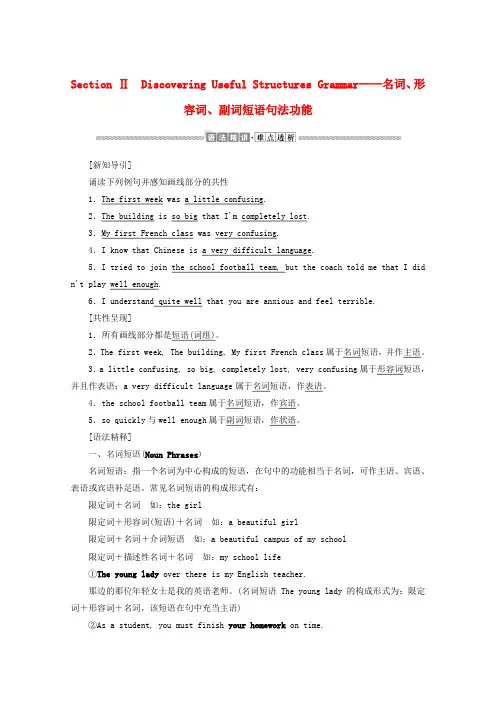
Section ⅡDiscovering Useful Structures Grammar——名词、形容词、副词短语句法功能[新知导引]诵读下列例句并感知画线部分的共性1.The first week was a little confusing.2.The building is so big that I'm completely lost.3.My first French class was very confusing.4.I know that Chinese is a very difficult language.5.I tried to join the school football team, but the coach told me that I did n't play well enough.6.I understand quite well that you are anxious and feel terrible.[共性呈现]1.所有画线部分都是短语(词组)。
2.The first week, The building, My first French class属于名词短语,并作主语。
3.a little confusing, so big, completely lost, very confusing属于形容词短语,并且作表语;a very difficult language属于名词短语,作表语。
4.the school football team属于名词短语,作宾语。
5.so quickly与well enough属于副词短语,作状语。
[语法精释]一、名词短语(Noun Phrases)名词短语:指一个名词为中心构成的短语,在句中的功能相当于名词,可作主语、宾语、表语或宾语补足语。
常见名词短语的构成形式有:限定词+名词如:the girl限定词+形容词(短语)+名词如:a beautiful girl限定词+名词+介词短语如:a beautiful campus of my school限定词+描述性名词+名词如:my school life①The young lady over there is my English teacher.那边的那位年轻女士是我的英语老师。
2019_2020学年新教材高中英语Unit2ExploringEnglish课件外研版必修第一册

In the field of science, you should pay much attention to English too. Much of ቤተ መጻሕፍቲ ባይዱhe technical terminology (术语) is based
Unit 2 Exploring English
英语何以会成为全球通用语言?下面的这篇文章将为你揭 晓答案。
How English Became So Popular
With more than 350 million people around the world speaking English as a first language and more than 430 million speaking it as a second language, there are so many English speakers in most countries around the world. Why is English so popular?
As well as studying and teaching, taking part in international conferences and publishing in foreign magazines are some of the key steps to success in academia. In order to speak at these conferences or publish in these magazines, excellent English is necessary.
2019_2020学年新教材高中英语Unit2ExploringEnglishSectionⅡInt
Section Ⅱ Integrating skills & Developing ideasⅠ品句填词1.You can take the subway(地铁) No.1 to get Tiananmen Square.2.Actually(事实上), it would be much more sensible to do it later.3.The weather of today is rather(相当) hot compared to this time last year.4.Please try to practise the ability to guess the meaning of an unknown word according to the context(上下文).5.Please remember to remind(提醒) me to give my parents a call.6.This famous star hates to see the bad comments(评论) about his life.7.With the weather getting cold, more and more people are wearing warm boots(靴子).8.The rent in this section(区域) is much higher than that in the suburbs.9.Don’t let others’ negative(消极的) attitude towards life disturb your own life.10.As an exchange(交换) student, he had great trouble getting used to the food here.Ⅱ完成句子1.他很期待和新经理一起工作。
2019_2020学年新教材高中英语Unit2ExploringEnglishPeriodⅢDevelopingideas教学案外研版
Period ⅢDeveloping ideas课前自学导引英语中的不幸事件上周,我们的论坛问你有没有关于使用英语的有趣或奇怪的故事。
我们没有想到会有这么多的帖子!这里有一些我们最喜欢的(帖子)提醒我们,我们在教室里学习的英语与外部世界的英语是相当不同的!人们说英国人总是谨慎对待他们的饮食。
不是真的!我去了曼彻斯特的一所暑期学校,我的英语老师叫玛吉。
一天,另一位老师带我们去上课。
他告诉我们那天玛吉不能去教书,因为她喉咙里有只青蛙(实指咽喉痛而说话困难)。
可怜的玛吉,但是她为什么要吃这么大的青蛙呢?135条评论当我第一次去纽约的时候,我去市区的一个购物中心去买一些冬天穿的靴子。
在入口的问询处,我问一位女士鞋子柜台在哪里。
她说在the first floor(一层)。
所以我去了the first floor(一层),但是没有找到任何鞋子。
我决定离开。
当我在找出口的时候,我看到鞋子实际上是在楼下的the ground floor(负一层)卖的,而不是在the first floor(一层)。
她为什么要给我错误的信息呢?128条评论我有一个英国笔友,今年夏天我终于在伦敦见到了他。
他告诉我他的祖父真的很wicked(缺德)。
但是当我见到他的祖父时,我很喜欢他。
我觉得很奇怪。
我的朋友为什么用贬义词来形容这么好的人?63条评论英国人一定有很高的标准。
我参加了英国一所大学和中国一所大学的学生交流活动。
我花了几天时间准备并且写我的第一篇英语论文。
我知道我做得很好,我期待着得到一个好的评语。
当我拿回试卷时,我发现我的老师写的评论“不错!”不错?可是我的论文里没有任何错误。
85条评论课堂合作探究①Let me remind you once again so that you won't forget.我再说一遍,省得你忘了。
②Please remind him to start early. 请提醒他早点动身。
2019_2020学年新教材高中英语Unit2ExploringEnglishSectionⅡ课件外研版
waiting room 候车室
fast-food 快餐
2.合成形容词
构成方式
举例
构成方式
举例
名词+ 动词-ing
Englishspeaking 讲英语的
形容词+ 名词
part-time 兼职的
名词+动 词-ed
副词+动 词-ed
state-owned 国有的
widespread 分布广的
And the Americans find the British spelling“-re”does not match its pronunciation, so they would rather spell -re as -er. 美国人觉得英国“-re”的拼写与发音不相匹配,所以他们宁愿 把-re 拼作-er。
[点津] (1)合成词的复数形式通常是把前面的主体名词变复数。
若没有主体名词,则在最后一个词后面加复数形式。例如:
father-in-law→fathers-in-law, grown-up→grown-ups。
(2)由 man 和 woman 构成的合成名词变复数时,两个名词都要变
成复数。例如:woman doctor→women doctors。
①He is a man with a powerful build.
n.体格
②Today, fresh fruit from these trees is shipped from one country
to another. ③The train slowed down.
v.运输 v.减缓
④They're running in the final.
2019_2020学年新教材高中英语Unit2ExploringEnglish单元仿真综合检测(含解析)外研版
Unit 2 Exploring English单元仿真综合检测(时间120分钟,满分150分)选择题部分(共95分)第一部分:听力(共两节,满分30分)第一节(共5小题;每小题1.5分,满分7.5分)听下面5段对话。
每段对话后有一个小题,从题中所给的A、B、C三个选项中选出最佳选项。
听完每段对话后,你都有10秒钟的时间来回答有关小题和阅读下一小题。
每段对话仅读一遍。
1.What might the weather be like this weekend?A.Sunny. B.Snowy. C.Rainy.2.How much will the woman pay?A.D|S5.2. B.D|S5. C.D|S1.3.What is the woman doing?A.Buying a ticket.B.Driving a car.C.Looking at a sign.4.Why does the woman want to call Harry?A.To invite Harry to go out.B.To borrow a bike from Harry.C.To know the best place to ride.5.What is the probable relationship between the two speakers?A.Doctor and patient.B.Teacher and student.C.Roommates.第二节(共15小题;每小题1.5分,满分22.5分)听下面5段对话或独白。
每段对话或独白后有几个小题,从题中所给的A、B、C三个选项中选出最佳选项。
听每段对话或独白前,你将有时间阅读各个小题,每小题5秒钟;听完后,各小题将给出5秒钟的作答时间。
每段对话或独白读两遍。
听第6段材料,回答第6、7题。
6.Where does the conversation probably take place?A.At home. B.In a factory. C.In an office.7.Why is the man so anxious?A.He missed an important phone call.B.He is waiting for an important phone call.C.He failed to answer the phone several times.听第7段材料,回答第8、9题。