
高中英语语法系列——形容词和副词
高中英语语法系列——形容词和副词作者:刘守君来源:《广东教育·高中》2009年第11期[知识梳理]一、形容词的概念与用法形容词(adjective)用以修饰名词,表示人或事物的特征。
它可在句中充当定语,修饰名词、代词;可以作表语或宾(主)语的补足语,表示主语或宾语的状态、特征;有时也可以作状语。
如:This is a beautiful school.这是一所美丽的学校。
(作定语,修饰名词school)I have something important to tell you.我有些重要的事要告诉你们。
(作定语,修饰不定代词something)Our school is beautiful.我们学校很美丽。
(作表语)We’ll make our school more beautiful.我们要使我们的学校更美丽。
(作宾补)Our school will be made more beautiful.我们的学校将会变得更美丽。
(作主补)He got home late that night, hungry and tired.那天晚上他很迟才回来,又累又饿。
(作状语)二、副词的概念与用法副词(adverb)用以修饰动词、形容词或其它副词。
它在句中主要作状语,个别副词也可作表语、定语、或宾(主)语补足语。
He studies hard.他学习很努力。
(作状语,修饰动词)I’m terribly sorry for being late. 非常抱歉,我迟到了。
(作状语,修饰形容词)This coat fits him very well.这件上衣他穿着很合适。
(作状语,修饰副词)The people here are kind to us.这里的人对我们很好。
(作定语,修饰The people)When will you be back? 你什么时候回来?(作表语)三、形容词与副词的转换有的形容词加上ly后可转换成副词,规则如下:注意:friendly, motherly, lovely等词虽然以ly结尾,但不是副词,而是形容词。
四、复合形容词五、形容词、副词的比较级和最高级构成1. 规则变化2. 特殊变化六、常用形容词、副词比较句型七、需要注意的几点1. 避免漏用系动词be。
[译]我今天很忙。
[误]I very busy today.[正]I am very busy today.2. 避免修饰错误。
[误] She studies more better than I.[正] She studies much better than I.3. 避免产生岐义。
[译]我比她更喜欢那个男孩。
[误]I like the boy better than her.(还可以理解为:我喜欢那个男孩胜过喜欢她) [正]I like the boy better than she.4. 避免比较对象不一致。
[误] Her spoken English is as good as I.[正] Her spoken English is as good as mine.[正] She speaks English as well as I.5. 避免自己与自己比较。
[误]He runs faster than any student in his class.[正]He runs faster than any other student in his class.[正]He runs faster than anybody else in his class.[正]He runs faster than (all) the other students in his class.[正]He runs faster than (all) the others in his class.[正]He runs faster than any of the other students.[正]He runs (the) fastest (of the boys) in his class.6. 从句中“替代”或“省略”时,应使结构清楚、正确。
I spend as much time watching TV as he does ______(write). (Key: writing)[灵活运用]一、单句填空按照下面句子结构的语法性,在空格处填入一个适当的词或使用括号中词语的适当形式填空。
1. If there were no examinations, we should have a much ______(happy) time at school.2. Professor White has written some short stories, but he is ______(well) known for his plays.3. —How did you find your visit to the museum?—I thoroughly enjoyed it. It was far _______(interesting) than I expected.4. I was expecting much ______ (big) rooms. I was ______ (terrible) disappointed.5. You are so good to me. I am the ______ (lucky) person in the world.6. As we all know, English is ______(wide) used in the world.7. A new playground for our children is ______(bad) needed.8. How beautifully she sings! I have never heard a ______(good) voice.9. We decided not to climb the mountains because it was raining _______(heavy).10. He is ______(true) happy who makes others happy.二、句子翻译将下列句子翻译成英语,注意下划线部分的用法。
1. 在场的那些人都是他的朋友。
2. 他这学期取得的进步比上学期大得多。
3. 他说的话听起来合情合理。
4. 伦敦没有纽约那么现代。
5. 你准备得越快,我们就离开的越早。
6. 一米是一英尺的三倍多长。
7. 汤姆身高1.8米。
8. 我哥哥比我大两岁。
9. 米价格比上个月上涨了15%。
10. 找工作比过去越来越困难了。
三、篇章运用阅读下面短文,按照句子结构的语法性和上下文连贯的要求,使用括号中词语的正确形式填空或者将汉语翻译成英语。
It’s ___1___ (legal) to drive under the age of eighteen in America. But a ___2 ___(十八岁的) boy managed to pass a driving test on the day of his eighteenth birthday. Most people would consider this ___3___(possible) because he needed a lot of lessons to pass the test. But he arranged to havea___4___ (六小时的) lesson beginning at dawn on his birthday. At first,he was ___5___(care) and hesitant, but he had a wonderful teacher and his driving improved ___6___(great) during the day. By four in the afternoon,still feeling___7___(energy), he was ready to take his test.He passed the first time! He was___8___(extreme) shocked and drove home very___9___(slow) in the reddish light because the sun was setting. When he got home,he showed his grandfather his certification and told him his whole story. His grandfather broke into smiles,congratulated him___ 10___(warm) and yelled, “My great kid Like me.”参考答案一、单句填空1. happier。
考试与无考试之间进行比较,用比较级。
2. better。
写短篇故事与写剧本比较“更”有名。
3. more interesting。
此处程度副词far用来修饰比较级。
4. bigger, terribly。
我原本盼望更大的房间,所以用比较级。
terribly修饰表语disappointed。
5. luckiest。
“世上最幸运的”,使用最高级。
6. widely。
副词widely、highly、deeply表示抽象意义,而副词wide、high、deep表示具体意义,如:His eyes were wide open.。
7. badly。
副词badly修饰被动语态。
8. better。
她唱的声音与所听的声音比较,故用比较级。
9. heavily。
“下大雨(雪)”的“大”用副词heavily。
10. truly。
谚语“真正幸福的是使人幸福的人”。
true变为副词时要去掉e。
二、句子翻译1. The people present were all his friends.2. He has made much more progress this term than he did last term.3. What he said sounded reasonable.4. London is not so modern as New York.5. The quicker you get ready, the sooner we’ll be able to leave.6. A metre is more than three times longer than a foot.7. Tom is 1.8 metres high.8. My elder brother is two years older than me.9. The price of rice is 15% higher than last month.10. It’s getting more and more difficult to find a job.三、篇章运用本文是讲述“他”在18岁生日的那天学习、考试、拿到驾照的经历。
高中英语语法:形容词和副词(共61张PPT)

二、形容词和副词的位置
(2)多个形容词修饰同一名词时的顺序。 要根据它们与名词的关系的密切程度来确定先后位置,一般来说,关 系越密切的越靠近名词。 his small new black foreign car他的那辆新的黑色的国外小汽车(限定 大小 新旧 颜色 出处 名词) a fine old stone bridge一座漂亮的石孔桥(限定 描述 新旧 材料 名词) several sour green eating grapes几枚酸绿的食用葡萄(数量 描述 颜 色 用途 名词) This is his big square old black Chinese writing desk.这就是他的又大又 旧的中国式黑色方形写字台。
一二、介 形词 容的 词分 和类副词的位置
2.副词的位置
(1)修饰动词时。 ①程度副词(almost, nearly, rather, fairly等)、频率副词(always, never, often, seldom等)一般放在实义动词之前,be动词、助动词和情态动词后。 In his blind haste he almost ran into the river.他匆匆忙忙地几乎跑到河里去了。 (程度副词almost位于run前。) On Saturday, he seldom stays in the house.星期天他很少待在家里。(频率副词 seldom位于stay前。) I reckon that he is rather too old to marry again.我认为他的年龄太大,不太适于 再婚。(程度副词rather位于系动词后。) You’ve always been my close friend.你一直是我亲密的朋友。(频率副词 always位于第一个助动词之后。)
高中英语语法系列――形容词和副词
高中英语语法系列――形容词和副词[知识梳理]一、形容词的概念与用法形容词(adjective)用以修饰名词,表示人或事物的特征。
它可在句中充当定语,修饰名词、代词;可以作表语或宾(主)语的补足语,表示主语或宾语的状态、特征;有时也可以作状语。
如:This is a beautiful school.这是一所美丽的学校。
(作定语,修饰名词school)I have something important to tell you.我有些重要的事要告诉你们。
(作定语,修饰不定代词something)Our school is beautiful.我们学校很美丽。
(作表语)We’ll make our school more beautiful.我们要使我们的学校更美丽。
(作宾补)Our school will be made more beautiful.我们的学校将会变得更美丽。
(作主补)He got home late that night, hungry and tired.那天晚上他很迟才回来,又累又饿。
(作状语)二、副词的概念与用法副词(adverb)用以修饰动词、形容词或其它副词。
它在句中主要作状语,个别副词也可作表语、定语、或宾(主)语补足语。
He studies hard.他学习很努力。
(作状语,修饰动词)I’m terribly sorry for being late. 非常抱歉,我迟到了。
(作状语,修饰形容词)This coat fits him very well.这件上衣他穿着很合适。
(作状语,修饰副词)The people here are kind to us.这里的人对我们很好。
(作定语,修饰The people)When will you be back? 你什么时候回来?(作表语)三、形容词与副词的转换有的形容词加上ly后可转换成副词,规则如下:注意:friendly, motherly, lovely等词虽然以ly结尾,但不是副词,而是形容词。
高中英语语法—形容词、副词

例题
1) Tony is going camping with ___ boys. A. little two other B. two little other C. two other little D. little other two
答案点拨:C 由"限定词--数词--描绘词--(大小,长短,形状,新 旧,颜色) --性质--名词"的公式可知数词,描绘词,性质依次顺序 只有C符合答案。
2、+ed
excite—excited worry—worried surprise—surprised close—closed interest—interested frighten—frightened
3、+ing
interest—interesting excite—exciting surprise—surprising follow—following
4、+y 所有表示天气状况的的形容词
sun—sunny snow—snowy wind—windy rain-rainy cloud—cloudy health—healthy
5、+ en
wool-woolen wood--wooden
6、+ern (东西南北)
east--eastern south-southern west--western north--northern
多个形容词做定语时的排列顺序:
在不确定的时候,可参照如下口诀: 美小圆旧黄,法国木书房 注释:美——描述性质;小——大小、长短、 高矮胖瘦 旧——新旧、年龄 圆——形状;黄——颜色;法国——产地、 国籍;木——材料;书房——用途 a new red silk cap一顶红色新丝帽 a short young Japanese businessman
2025届高考英语语法总复习形容词副词课件
however然而,otherwise否则,though尽管,yet虽然,instead相 反 besides而且,moreover而且,still还是,furthermore而且
表结果
therefore因此,thus因而
表让步
anyway不管怎样,无论如何
George didn’t study law.Instead,he decided to become an actor.
friend朋友→friendly友好的;time时间→timely 名词/动词
有……特征的 及时的;day一天→daily日常的;love爱→lovely
构成 意义
例词
end终止→endless无穷无尽的;aim目标→aimless无目 名词/动词 没有……
标的;home家→homeless无家可归的;use使用 +-less 的
形容词有时也作状语,通常说明主语的情况,主要表示原因、 结果、伴随、时间、条件或方式,可位于句首、句中或句末, 一般用逗号将其与其余部分隔开。
Hot and wet,you couldn’t imagine the climate here in summer.
又热又潮湿,你根本无法想象这儿的夏天(形容词作状语,表示原因)
……的 →comfortable舒适的;admire钦佩→admirable
able
可钦佩的
attract吸引→attractive有吸引力的;create创造 名词/动词
有……性质的 →creative创造性的;expense花费→expensive +-ive
昂贵的;effect效应→effective有效的
比较级、最高级的变化规则分为规则变化和不规则变化
高中英语语法-形容词和副词

C. obviously
D. formally
16.(NMET2004天津) Mr Smith used to B but he has given it up. smoke ___ A. seriously B. heavily
C. badly
D. hardly
17.(2004湖南) Everyone was on time for the meeting ____ C Chris, who’s usually ten minutes late for everything. A. but B. only C. even D. yet
3) 只用作表语的形容词:well, ill, content, fond, glad, likely, ready, sorry, sure He is likely to see me today. This is a possible solution. The boy is ill/sick. The sick boy is lying in bed. ill news, ill wind, ill luck
表语
宾补
状语
√ √
√
√
adv
副词是用来说 明动作或状态 的特征,说明时 间,地点,程 度等概念。它 用来修饰动词、 形容词、副词、 短语或句子。
√ √
√
√
形容词的用法及位置
adj 作定语
1. 前置定语 A difficult situation, efficient approach|way 2. 后置定语: 1)修饰不定代词:something, anything, nothing, everything Nothing serious, anything special 2) 某些a-开首的形容词:afraid, alike, alive, alone, asleep, ashamed, awake, aware He is the only man alive.
高中英语语法复习之形容词副词
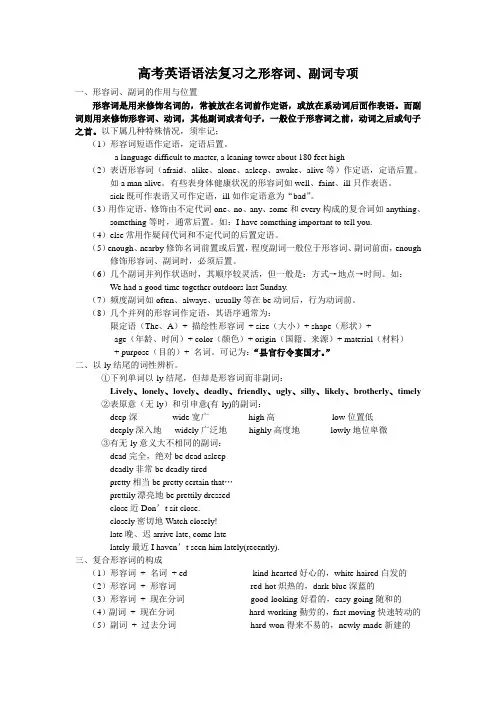
高考英语语法复习之形容词、副词专项一、形容词、副词的作用与位置形容词是用来修饰名词的,常被放在名词前作定语,或放在系动词后面作表语。
而副词则用来修饰形容词、动词,其他副词或者句子,一般位于形容词之前,动词之后或句子之首。
以下属几种特殊情况,须牢记;(1)形容词短语作定语,定语后置。
a language difficult to master, a leaning tower about 180 feet high(2)表语形容词(afraid、alike、alone、asleep、awake、alive等)作定语,定语后置。
如a man alive。
有些表身体健康状况的形容词如well、faint、ill只作表语。
sick既可作表语又可作定语,ill如作定语意为“bad”。
(3)用作定语,修饰由不定代词one、no、any、some和every构成的复合词如anything、something等时,通常后置。
如:I have something important to tell you.(4)else常用作疑问代词和不定代词的后置定语。
(5)enough、nearby修饰名词前置或后置,程度副词一般位于形容词、副词前面,enough 修饰形容词、副词时,必须后置。
(6)几个副词并列作状语时,其顺序较灵活,但一般是:方式→地点→时间。
如:We had a good time together outdoors last Sunday.(7)频度副词如often、always、usually等在be动词后,行为动词前。
(8)几个并列的形容词作定语,其语序通常为:限定语(The、A)+ 描绘性形容词+ size(大小)+ shape(形状)+age(年龄、时间)+ color(颜色)+ origin(国籍、来源)+ material(材料)+ purpose(目的)+ 名词。
可记为:“县官行令宴国才。
高考英语形容词与副词
无比较级,最高级的形容词和副词
1。表示比较,特殊意义的: comparative(ly),relative(ly),special(ly)
2。表绝对意义的unexpected(ly),entire(ly),excellent(ly),perfect(ly),total(ly),thorough(ly),whole(ly),complete(ly)
01
=be…rather than….=be rather…thaFra bibliotek….02
She was more frightened than hurt.
03
=She was less hurt than frightened.
04
=She was frightened rather than hurt.
05
4。形容词和副词的比较等级的用法:
比较等级的常见句型: 1)as+原级+as (as+adj.+a/an+单数名词+as) Tom can’t pay as high a price as I asked. It’s not so/as difficult as I expected.
2)比较级+than+比较对象(less+原级) He is taller than I/me. Mary is less clever than Tom.
5.比较状语中动词的使用: Bob looks younger than I do. Bob looks younger than he is. Bob looked younger than I did. I know you better than he does. I know you better than him.
高中英语语法形容词和副词
形容词和副词I 形容词及其基本用法形容词修饰名词,说明事物或人的性质或特征。
1.直接说明事物的性质或特征的形容词是性质形容词,它有级的变化,可以用程度副词修饰,在句中可作定语、表语和补语。
例如:hot,happy ,等。
2.叙述形容词只能作表语,所以又称为表语形容词。
这类形容词没有级的变化,也不可用程度副词修饰。
大多数以a-开头的形容词都属于这一类。
例如:afraid害怕的。
[误]She is afraid girl.[正]The girl is afraid.这类词还有: afraid,alike,alive,alone,asleep,awake 以及well,unwell,ill, faint,等。
3.形容词作定语修饰名词时,要放在名词的前边。
但是如果形容词修饰以-thing为词尾的不定代词时,要放在这些词之后。
例如:something nice.4.以1y结尾的形容词(1)大部分形容词加-1y后可构成副词。
注意:friendly,deadly,lovely,lonely,likely,lively,brotherly等是形容词。
【误】He spoke to me very friendly.[正]He spoke to me in a very friendly way.(2)有些以-1y结尾的词既为形容词,也可为副词,如daily,weekly,monthly,yearly,early等。
例如:China Daily is a daily newspaper.《中国日报》是一份日报。
China Daily is published daily.《中国日报》每天出版。
5.用形容词表示类别和整体(1)某些形容词加上定冠词可以指一类人,与复数谓语动词连用,如the dead,the living,the rich,the poor, the blind.the hungry等。
例如:The poor are losing hope.穷人将失去希望。
高中英语语法知识:形容词和副词
高中英语语法知识:形容词和副词形容词是用来修饰名词或代词的词,主要用作定语、表语和补足语等。
副词是用来修饰动词、形容词、副词、介词短语或全句的词,主要用状语、表语和定语等。
下面就形容词和副词的相关知识作如下讲解。
1. 形容词及其用法1) 直接说明事物的性质或特征的形容词是性质形容词,它有级的变化,可以用程度副词修饰,在句中可作定语、表语和补语。
例如:hot。
2) 叙述形容词只能作表语,所以又称为表语形容词。
这类形容词没有级的变化,也不可用程度副词修饰。
大多数以a开头的形容词都属于这一类。
例如:afraid 害怕的。
这类词还有well,unwell,ill,faint,afraid,alike,alive,alone,asleep,awake 等。
3) 形容词作定语修饰名词时,要放在名词的前边。
但是如果形容词修饰以-thing 为字尾的词语时,要放在这些词之后。
例如:something nice.2. 以-ly结尾的形容词1) 大部分形容词加-ly可构成副词。
但friendly,deadly,lovely,lonely,likely,lively,ugly,brotherly,仍为形容词。
改错:(错) She sang lovely.(错) He spoke to me very friendly.(对) Her singing was lovely.(对) He spoke to me in a very friendly way.2) 有些以-ly 结尾既为形容词,也为副词,如daily,weekly,monthly,yearly,early等。
例如:The Times is a weekly paper. 《时代周刊》为周刊。
The Times is published weekly. 《时代周刊》每周发行一期。
3. 用形容词表示类别和整体1) 某些形容词加上定冠词可以泛指一类人,与谓语动词的复数连接,如the dead,the living,the rich,the poor,the blind,the hungry等。
高考英语形容词和副词
高考英语形容词和副词形容词(Adjectives)和副词(Adverbs)是英语语法中非常重要的词类,在高考英语考试中占据着重要地位。
本文将从形容词和副词的定义、用法以及相关练习等方面进行论述。
一、形容词的定义和用法形容词是一种用来修饰名词或代词的词类。
它可以描述事物的性质、特征或状态,使句子更加详细和丰富。
形容词通常出现在名词前面,用来修饰它所在的名词,起补充说明的作用。
1.1 形容词的定义形容词是一类可以修饰名词或代词的词,以描述人、事、物的性质、特征和状态。
1.2 形容词的用法形容词可以通过以下几种方式使用:(1)作为定语修饰名词:a beautiful girl(一个漂亮的女孩)(2)作为表语:The weather is sunny.(天气晴朗)(3)作为宾补:I found the book interesting.(我觉得这本书有趣)二、副词的定义和用法副词是一种修饰动词、形容词、副词等的词类,用来说明行为或状态的方式、程度、频率、原因等。
副词可以增加句子的信息量,使句子更加准确和精确。
2.1 副词的定义副词是一类修饰动词、形容词或其他副词的词,用以表达行为或状态的方式、程度或其他相关信息。
2.2 副词的用法副词可以通过以下几种方式使用:(1)修饰动词:He runs quickly.(他跑得快)(2)修饰形容词:She is extremely beautiful.(她非常漂亮)(3)修饰副词:He reads very carefully.(他读书很认真)三、形容词和副词的比较级和最高级形容词和副词在表示比较程度时,可使用比较级和最高级。
比较级用于两者之间进行比较,最高级用于多者之中的极端比较。
3.1 形容词和副词的比较级和最高级形式(1)一般情况下,添加-er表示比较级,添加-est表示最高级。
如:fast → faster → fastest(2)以不发音的e结尾的词,直接加-r表示比较级,加-st表示最高级。