
牛津译林版高中英语必修四M4U3Grammar
M4U3Grammar一、被动语态的构成被动语态的构成形式为“be + V-ed”, 通过改变be的时态,可以构成不同时态的被动语态,以下是不同时态下被动语态的构成形式:1. 一般现在时:am / is / are + V-ed2. 一般过去时:was / were + V-ed3. 一般将来时:will (shall) + be + V-ed4. 过去将来时:would (should) +be + V-ed5. 现在进行时:am / is / are + being + V-ed6. 过去进行时:was / were + being + V-ed7. 现在完成时:has / have been + V-ed8. 过去完成时:had been + V-ed9. 将来完成时:will have been + V-ed三特殊结构或句型中的被动语态1. 双宾语动词的被动结构在give, lend, offer, send, tell, show等动词后可接双宾语,即指人的间接宾语和指物的直接宾语。
当把含有这些动词作谓语的句子变为被动语态时,在多数情况下都把间接宾语变为句子的主语;有时也把直接宾语变为主语,把间接宾语改为to引导的短语。
如:I sent my mum a letter yesterday. (主动语态)My mum was sent a letter yesterday. (被动语态,间接宾语作主语)A letter was sent to my mum yesterday. (被动语态,直接宾语作主语)2. 在主动语态中,某些感官动词如hear, watch, see, feel, notice等及使役动词make, let, have等后作宾补的不定式一般不加to,但改为被动语态时,不定式要加to。
如:We saw Lucy carry a big heavy box the other day. → Lucy was seen to carry a big heavy box the other day.3. “主语+情态动词+ be + V-ed”句型,如:The homework must be finished on time.4. “get / have sth. done” 结构,如:You’d better have your shirt ironed before attending the wedding ceremony.四、主动形式表被动意义1. 一些动词既是及物动词又是不及物动词,当它们和well,badly,easily 等副词连用时,表示主语内在的品质或性能,是不及物动词,用主动形式表示被动意义。
此类动词有:read, write, sell, wear, prove, pay等。
如:This novel reads well.2. 某些感官动词常用主动形式表示被动意义,此类动词有:taste, feel, sound, smell, look等。
如:This car looks handsome.3. “主语+ be +形容词+动词不定式”句型,主语是动词不定式的逻辑宾语,常用主动形式表示被动意义。
此类形容词有easy,hard,difficult,nice,comfortable等。
It’s difficult to explain.4. 在need, require, want, deserve等动词后常接V-ing形式表示被动意义,相当于“need / require / want / deserve to be done”。
须注意若用作V-ing的动词是不及物动词,后面应加与之相匹配的副词。
如:The window needs cleaning.He will need looking after.【注意】不可用被动语态的动词和短语动词不及物动词和某些短语动词无被动语态,类似的不及物动词或短语动词有:die, appear, disappear, fail, happen, belong to, lose heart, take place, come true等。
1.—How are the team playing?—They are playing well, but one of them ____ hurt.A. gotB. getsC. areD. were2.More than a dozen students in that school ____ abroad to study medicine last year.A sentB had been sentC had sentD were sent3. —Hey, where you are going!—Oh, I’m terribly sorry, ____.A. I’m not noticingB. I wasn’t noticingC. I haven’t noticedD. I don’t notice4. Now that she is out of a job, Lucy _____ going back to school, but she hasn’t decided yet.A. had consideredB. has been consideringC. consideredD. is going to consider5. The mayor of Beijing says that all construction work for the Beijing Olympics _____ by 2006.A. has been completedB. has completedC. will have been completedD. will have completed6.The hero’s story ____ differently in the newspapers.A. was reportedB. was reportingC. reportsD. reported7. When Jack arrived he learned Mary ____ for almost an hour.A. had goneB. had set offC. had leftD. had been away8.—You’ve made great progress in your studies of English, haven’t you?—Yes, but much _____.A. remains to doB. is remained to doC. remains to be doneD. is remained to be done9.It ____ six years since they last saw each other.A. wasB. had beenC. isD. would have been10.John as well as the other children who _____ no parents ____ good care of in the village.A. have; is being takenB. have; has takenC. has; is takenD. has; have been taken11.It ____ for three hours and the ground is too damp to play on, so the sports meeting ____.A. was raining; has been put offB. has been raining; has been put offC. has rained, is put offD. has been raining; has put off12.—The enemy spy was found at last—Really? Where _____ himself?A. had he hiddenB. did he hideC. has he hiddenD. was he hidden13.Those books which ____ often ____ well.A. are well received; are soldB. are well received; sellC. well receive; sellD. were received; sell14.—It is said that another new car factory _____.—Yeah. It _____ for nearly two months already.A. is building; has been builtB. is built; has builtC. is being built; has been builtD. is being built; has been being built15. —I will come to attend your lecture at 10:00 tomorrow.—I’m sorry, by then my lecture will have ended and I ______ my guests in my office.A. is being metB. will meetC. will be meetingD. will have met16. I know Mr. Brown; we ______ to each other at an international conference.A. are introduceB. are been introducedC. were introducedD. had been introduced17. I want to buy that kind of cloth because I ______ the cloth ______ well.A. have told; washesB. have been told; washesC. was told; washedD. have been told; is washed18. With the development of science, more new technology ______ to the field of IT.A. has introducedB. is being introducedC. is introducedD. was introduced19. —The window is dirty.—I know. It ______ for weeks.A Hasn’t cleaned B. didn’t cleanC. wasn’t cleanedD. hasn’t been cleaned20. The new suspension bridge ____ by the end of last month.A. has been designedB. had been designedC. was designedD. would be designedkeys:(1~5) AADBC (6~10) ADCCA (11~15) BABDC (16~20) CBBDB1. The letters for our teacher _____ on his desk but he didn’t read them until two days later.A. were putB. were puttingC. putD. have put2. Don’t worry. The hard work that you’re doing now _____ in your future life.A. will be repaidB. was being repaidC. has been repaidD. was repaid3. The Buffets are living with their parents for the time being because their own house _____.A. is rebuiltB. has been rebuiltC. is being rebuiltD. has rebuilt4. Tina had her luggage _____ an hour before her plane took off.A. checkB. checkedC. to checkD. checking5. Experiments of this kind _____ in the villages well before 1919.A. have carried outB. have been carried outC. had carried outD. had been carried out。
高中英语 M4U3 Grammar and usage学案 牛津译林版必修4
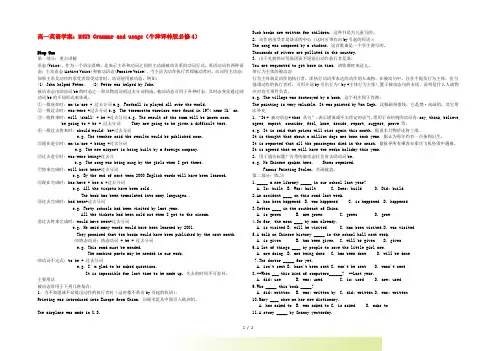
高一英语学案:M4U3 Grammar and usage (牛津译林版必修4)Step One 第一部分:重点讲解 语态(Voice),作为一个语法范畴,是表示主语和动词之间的主动或被动关系的动词行式。
英语动词有两种语态:主动语态(Active Voice)和被动语态(Passive Voice)。
当主语为动作执行者即施动者时,动词用主动态;如果主语是动作的承受者即受动者时,动词便用被动态。
例如: (1) John helped Peter. (2) Peter was helped by John. 被动语态由助动词be 的时态之一和及物动词的过去分词构成。
被动语态可用于各种时态,其时态变化通过助动词be 的不同形式来体现。
①一般现在时:am/is/are + 过去分词e.g. Football is played all over the world. ②一般过去时:was/were +过去分词e.g. The terracotta warriors were found in 1974 near Xi’an. ③一般将来时:will (shall) + be +过去分词e.g. The result of the exam will be known soon. be going to + be + 过去分词 They are going to be given a difficult test. ④一般过去将来时:should(would) be+过去分词 e.g. The teacher said the results would be published soon. ⑤现在进行时:am/is/are + being +过去分词 e.g. The new airport is being built by a foreign company. ⑥过去进行时:was/were being+过去分 e.g. The song was being sung by the girls when I got there. ⑦将来完成时:will have been+过去分词 e.g. By the end of next term 2000 English words will have been learned. ⑧现在完成时:has/have + bee n +过去分词 e.g. All the tickets have been sold . The book has been translated into many languages.。
牛津译林版高中英语必修四《Unit 3 tomorrows world》 Grammar 课件 3
Level B
即学即用 达标检测 2
1.They make us do all the work. 被动句: We are made to do all the work by them. 2. We often hear her sing songs. 被动句: She is often heard to sing songs by us. 3. I saw him walk to school. 被动句: He was seen to walk to school by me.
changed.
11/30
主动形式表示被动含义
• (1)持续系动词:表示主语继续或保持一种状 况或态度,主要有keep, remain, stay
• (2)变化系动词:表示主语变成什么样,主要 有become, grow, turn, get, go
• (3)表像系动词:表示“看起来好像”,主要 有seem, appear, look等
• 3.The palace caught fires three times in the last century, and little of the original
building __A____ now.
• A. remains B. is remained • C. Is remaining D. has been remaining
课堂回顾
• 1. the basic form: be+done
• 2. (1) . be bored with(……..)
• (2). see sb. do= sb. be seen to do
• (3) get + done
• (4) 主动形式表被动意思
牛津译林版高中英语必修四Grammar
2. Complete the passage on Page 49.
Answers:
1) are being
2) Electric Wear
3) been developed 4) teenagers
5) was invented 6) are uses
7) been completed 8) will be produced
2. English _is_f_o_u_n_d__ (find) very useful. 3. The picture w__il_l_b_e_f_i_n_is_h_e_d_ (finish)
tomorrow.
4. The bike i_s_b_e_i_n_g_r_e_p_a_i_r_e_d_(repair) by them now.
It+ passive verb+ that-clause Subject+ passive verb+ to-infinitive Another book is reported to be published next month.
Point 6.
We usually usebyto introduce the doer of the action, but wedo not mentionthe doer when it is not necessary or not important, or when it is difficult to say who the doer is. Point out the passive sentences without mentioning the doer in NOT just watching a film.
牛津译林版高中英语必修四Unit3tomorrow’sworldGrammarandusagewor
Unit 3 Tomorrow’s worldGrammar and usage一.【设计思想】以实际运用为主,让学生在语言交际中运用语法规则,在运用中慢慢把握语法规则。
二.【教学目标】1. 知识目标:(1)了解被动语态的动词大体形式和一些特殊的被动用法。
(2)学会如何在被动语态中利用情态动词。
(3)学习常经常使用于被动语态的动词2. 能力目标:能够准确地运用不同时态中的被动语态的动词形式。
三.【教学重难点】了解被动语态的一些特殊用法【课堂导入】Step 1用动词的被动语态填空。
(1)The man _________(call) “ Good husband”.(2)The pet dog __________(treat) by veterinary.(3) A frog __________ ( catch) by a big bird just now.总结:被动语态的大体形式是______________________【课堂教与学】Step 2 帮忙学生温习不同时态的被动语态(1)一样此刻时: am/is/are + done(2)此刻进行时: am/is /are being + done(3)此刻完成时: have/has + done(4)一样以后时: shall/will + done(5)一样过去时: was/were + done(6)过去进行时: was/were being + done(7)过去完成时: had been + done(8)过去以后时: would be + done1.Ask students how we can change a sentence into the passive voice.Remind students that we should pay attention to the following:Find out the object of the sentence and use it as the subject of the sentence with the passive voice.(1)Decide the tense of the sentence and use the related form of its passive.(2)If necessary, use “by” to join the former subject, which should be put into its object form. 2.Ask students when we use the passive voice. Ask them to read Point 3 on page 48 to find theanswer. And give them the following sentences as examples:(1)不明白或没必要指出动作的执行者。
牛津译林版高中英语必修四《Unit 3 tomorrows world》 Grammar 教案 2

牛津译林版高中英语必修四A d v a n c e W i t h E n g l i s h M o d u l e4Unit 1 AdvertisingPeriod 4 Grammar and usageAnalysis of the teaching material:This is the 5&6th period of Unit One. In this period we’ll deal with direct speech and reported speechObjectives:1.Help Ss understand how to use reported speech in statements,questions and imperative sentences.2.Help Ss learn the way to change direct speech into reported speech indifferent tenses and sentence structures.Teaching important point:How to help the students apply these rules into practiceTeaching approaches:Teaching approaches is the key step for class teaching. Visual-scene teaching method, tasked-based method as well as the approaches of discussion and so on will be adopted in the teaching process of this lesson . Emphasis will be put on Ss’ ability of speaking, expressing and brainstorming. Language is best learned through activities. I’ll introduce a rich variety of activities and approaches to meet different needs of theSs and make full use of the advantages of multimedia which is visual, operable to make my lesson vivid, interesting and effective.Interaction Patterns: Teachers -class, individuals, pairsSs’ ability to work both independently and together is very important to their success in the future. It is therefore important for Ss to have opportunities to develop their English skills and knowledge independently, in pairs, in groups and as a class.Teaching Aids: multimedia and a blackboardProcedures for teaching:Step 1 Revision and Lead-inMake a dialogue with some Ss to introduce the topic.Step 2 Direct speech and reported speech1. What should we pay attention to when changing direct speech into indirect speech?(1) personal pronouns and tense(2 )adverbials of time and place(3 )other cases3.Have Ss do the Ex:4.Change the following sentences into reported speech.5.Ask Ss to finish the Ex. on Page 9.Step 3 How to use reported speech to report1.Statements:After explanation, ask Ss to do some simple questions at once.2.Questions:Have Ss try some easy tasks after explaining.3.imperative sentences:Help Ss finish several exercises after imparting.Step 4 Ex. for consolidation1.Ask Ss to finish A on Page 11.2.Help Ss to finish B on Page 11.Step 5: 1 Finish Ex on Page 92.2 Make good preparation for Task part.。
牛津译林版高中英语必修四《Unit 3 tomorrows world》 Grammar 教案 1

牛津译林版高中英语必修四§Grammar and Usage§Teaching Aims:●To learn the direct and indirect speech and how to change from one to theother●To identify the differences between direct and in direct speech●To learn how to use reported speech in statements, questions, and imperativesentences●To complete the relevant written tasks to reinforce the grammar and usage●To apply what they learn to practice by fulfilling some written mistakes. Teaching Key Points & Teaching Difficulties:✧How to help them understand the changes when changing direct speech intoindirect speech✧The usages of persuade and discourage✧How to apply the grammar rules to compete the related exercises correctly Teaching Procedure:Step One: Leading-inT: (Greet the class as usual) Now boys and girls, please look at the screen. There is a short dialogue. Read it carefully and answer the two questions.‘What are you going to do this summer holiday,’ Tom asked Ann. ‘I am going to travel to Beijing with my parents.’ said Ann.➢What did Tom ask Ann?➢What did Ann say?Ss: …(This step is to attract their attention to direct speech and indirect speech. Latercollect their answers on screen.)Suggested Answers:✓Tom asked Ann what she was going to that summer holiday.✓Ann said that she was going to travel to Beijing with her parents.T: Wonderful! Yon can notice that when you answer my questions you have made some changes to the original sentences. In fact your answers are written in reported speech or indirect speech while the original sentences in direct speech.Step Two: Direct and Indirect SpeechT: Ok. This is what we will talk about today. Now please open your text books at page 8. Go through the group 1 and 2 to answer the next two questions:➢What are direct speech and indirect speech?➢How can we change direct speech into reported speech?(Have students analyze the sample sentences. Give them some time to discuss the sentences in pairs first and then check the answers.)Ss: …Suggested Answers:✓Direct speech is to report what exactly has been said while indirect speech is to report the meaning of what has been said without usingexact words.✓We can do it by changing what has been said to an object clause or an infinitive phrases.(Make sure they understand what direct and indirect speech is. Help the students to grasp the meanings of the sample sentences. Explain them to the students if necessary.)T: Very good! Then➢When you change direct speech into indirect speech, what else should you make changes to besides the major changes in sentence structure?Ss: …T: Now please go through the group 3 carefully, especially the tables. You can exchange your ideas with your classmates around you and think about the above question carefully.)Ss: Other changes in:✧Personal pronouns✧Tenses✧Adverbials of time and place✧Other casesT: Good! Next please consider how to change the following sentence in directspeech into reported speech.➢‘Light travels at a great speed,’ said the teacher.Ss: The teacher said that light travels at a great speed.(It doesn’t matter whether they are able to give correct answer. This is just tohelp them to realize something different when changing direct speech intoindirect speech.)T: So you can see we made no changes to the sentence in direct speech. Douyou know why? Please look at the tip on the left and recall what you havelearnt before and them tell me the reason.Ss: …Tips:We do not change the tense when we report a proverb or a fact that doesn’tchange over time.T: Terrific! And I can show you more examples as follows:✧My teacher told me that practice makes perfect.✧The teacher said that light travels faster than sound.(Ask them go through the content on page 8 again and deal with anyquestions raised by the students. Last let them finish the exercise on page 9.Make sure they know what to do.)Suggested Answers:1.was2.wouldn’t3.had read4.that5.would6. had bought7.that 8.would 9.those 10.her 11.was 12.was going to readStep Three: Reporting statements, questions, and imperative sentences T: Ok, let’s go on to learn how to report sentences in statements, questions andimperative sentences. Please turn your book to page 10. Go through them one by one and share your ideas with your partner. Later on tell me:➢How to report statements, questions, and imperative sentences?Ss: …(Give them enough time to go through them and help them summarize the following:✧Statements●Use noun clauses introduces by that to report statements●Say and tell are common reporting verbse.g. ‘There two main types of advertisements,’ the writer said to us.→The writer told us that there two main types of advertisements.✧Questions●Use noun clauses introduced by whether/if to report Yes/No questions●Use noun clauses introduced by WH-words to report WH-questionse.g. ‘Are all advertisements playing tricks on us?’ I asked her.→ I asked her whether/if all advertisements playing tricks on us.e.g. The teacher asked Tom ‘What’s the matter?’→ The teacher asked Tom what was the matter.✧Imperative sentences●Use the structure: reporting verb + object + (not) to-infinitive to reportimperative sentences●Ask and tell are common reporting wordse.g. ‘Don’t touch anything in the lab without permission.’ said the teacher.→ The teacher told us not to touch anything in the lab without permission.e.g. ‘Turn down the radio please, Tom.’ Jen said.→ Jen asked Tom turn down the radio.T: You’ve done a good job. Now you can overview what we have learnt on page10. If you have any difficulty, ask me for help.Ss: …(After this let them complete the Part A on page 11.)Suggested Answers:Part A:2.asked in what way it was different from other English learning software3.asked how it could help him to remember English words4.asked whether/if it taught listening and speaking5.asked what the designer would do if she was not satisfied with thesoftware.6.asked whether/if it was user-friendly( After this, give the students a few minutes to ask for help if they have any questions)Step Four: Language Points1.recommend vt. 推荐;建议、忠告recommend sth to sb = recommend sb sth 向某人推荐某物recommend doing sth 建议做某事recommend sb to do sht 建议某人做某事recommend that …接宾语从句用虚拟语气“should do”should可以省略e.g. They recommend Tom to do the job.e.g. The doctor recommend that she (should) stay another week in hospital.2. remind sb of …提醒某人某事…;使某人想起…remind sb to do sth提醒某人去做某事e.g. The film remind him of his happy childhood.e.g. My father often reminded me to behave myself at school.Step Six: Homework✧To do Part C2 and C2 on page 92✧To preview the task。
牛津译林版高中英语必修四Unit3Tomorrow’sworldGrammarandUsage
Exercises
1)Yourjacketneeds____w_a_s_h_in(wg ash). 2)Thehouserequires____r_e_p_a_i_r_in(rgepair). 3)Themeatisnotfit_____t_o_e(aetat). 4)WefindEnglishdifficult____t_o_l_e_a(rlnearn). 5)Ihavemuchhomework____t_o(ddoo). 6)Thearticleisdifficult___t_o_u_n_d_e_r_s_ta(unnddersand).
高中英语课件
madeofcanruohanxing
Tomorrow’sworld
Grammarand Usage
Unit3
Theman_i_sc_a_l_le_d___(call)“Goodhusband”.
Thepicture__is_b__e_in__g_ _p_a_in__te_d(paint)bythelit tlegirlnow.
六、动词不定式的主动形式表示被动意义:
不定式作定语与被修饰的名词或代词构成 动宾关系时,如:
1.我有许多事情要做。 Ihavealotofthingstodo.
2.他有几项任务要完成。 Hehasseveraltaskstocomplete.
七、在“系动词+形容词+不定式”结构中主 动形式表示被动意义:
Newflyovers__a_r_e_b_u_il_t (build)year.
1.Since1990,manyhighbuildings____Ainourcity.A.h avebeenbuiltB.werebuiltC.hasbeenbuiltD.hadbe
牛津高中英语 M4U3 Grammar
M4U3Grammar 导学案被动语态A动词的被动结构及用法B 情态动词的被动结构第 1 页共4 页D.系表结构与被动结构的区别一、单项选择1.What kind of advice ________ to you?A. has gaveB. was gaveC. has been givenD. has given2. Yesterday Peter ________ a ticket for speeding.A. gaveB. had been givenC. was givenD. was gave3. The construction of the gym ____________ by the end of January according to the contract.A. must be completingB. must completeC. must have completedD. must have been completed第 2 页共4 页4. He returned at midnight and found his house __________.A. had broken intoB. was broken intoC. to be broken intoD. had been broken into5. A cook will be fired if he is found ________ in the kitchen.A. smokeB. smokingC. to smokeD. smoked6. Coal can_________ to produce electricity for agriculture and industry.A. have usedB. be usedC. useD. used7. Some new oilfields _________ since 1976.A. were opened upB. has opened upC. have been opened upD. had been opened up8. These boys ________ our football team.A. are belong toB. are belonged toC. belong toD. belong of9. These bags which ______________ to Hong Kong were missing at last.A. should have been sentB. should be sentC. should have sentD. should send10. Can this good decision _________ from you?A. exceptB. expectedC. be expectedD. excepting11. She ______Robert for a year.A. marriedB. married withC. has been marriedD. has been married to12. Great changes ____________ in Beijing, and a lot of new facilities ____________.A. have been taken place; have been set upB. have taken place; have been set upC. have taken place; have set upD. were taken place; were set up13. He slipped into the room to avoid _________.A. noticedB. noticingC. being noticedD. being noticing14. TV and radio programmes __________ the other side of the world with the help of the satellites.A. can send toB. can send onC. can be sent toD. can be sent on15. The old man was quite weak after the operation, so he ________.A. must be taken careB. must take care ofC. must be looked afterD. must look after16. With the development of science, more new technology ________ to the field of IT.A. has introducedB. is being introducedC. being introducedD. was introduced17. The first World War _________ in 1914.A. was broken outB. broke outC. was brokenD. was happened18. Spring comes with many flowers __________.A. come outB. being come outC. coming outD. be come out19. Your cough ought _________ before it gets any worse.A. to seeB. to be seenC. to see toD. to be seen to20. ---Have you telephoned your father?---Yes, he ________ back next week.A. is expectedB. expectsC. will expectD. will be expected二、动词填空1. ---How ___________ it _______________ (feel) to be 60-year-old ?---Much weaker.2.The report needed ________________________ (hand) in last week according to the plan.3.They would like to see the plan ______________________ (practice) right now.4.---Where is my mp3? I couldn’t find it anywhere.---It must _______________________ (take) away by somebody.第 3 页共4 页5.You may get __________________ (separate) from your friends since the street is so crowded.6.It remains ____________________ (see) whether Jim will be fit for the job.7.The news reporter hurried to the airport, only to ____________________ (tell) the film star had left.8.________________(lose) in thought, he didn’t notice his boss coming.9.The medicine will be effective if _________________ twice a day. (take)10.The window must ____________________ (close) by him because he was the last one to leave.三、句子翻译1.在会上她被问了好些问题。
译林牛津版高中英语Module 4 Unit 3 Grammar and Usage The passive voice教学课件 (共17张PPT)
we_a_r_e__su__p_p_o_s_e_d_(suppose)to know the basic rules
for taking a train. First, tickets
must_b_e__c_h_e_c_k_e_d__(check) before entering.
一 用被动语态结构完成下列句子。
1 Sports __a_r_e_ __li_k_e_d__(like) by the children. 2 My work __is_ _b_e_i_n_g_ _d_o_n_e_ ( do) by me now. 3 The work _h_a_s_ _b_e_e_n_ _f_in_i_s_h_e_d___ (finish) by them already. 4 China _w_a__s_ __fo_u__n_d_e_d___( found) in 1949. 5 The gift_w__il_l _b_e_ __s_e_n_t__(send) to me tomorrow. 6 Homework _m__u_s_t __b_e__ _h_a_n_d_e__d_( must hand) in at once.
A. often sings B. often sang C. is often sang D. is often
sung 10 This kind of car _D__ in Japan.
A, makes B. made C. is making D. is made
【课内探究二】:主动语态变被动语态方法:
Unit 3 Tomorrow’s world
牛津译林版高中英语必修四M4U3Grammar
高中英语学习材料madeofjingetiejiM4U3Grammar一、被动语态的构成被动语态的构成形式为“be + V-ed”, 通过改变be的时态,可以构成不同时态的被动语态,以下是不同时态下被动语态的构成形式:1. 一般现在时:am / is / are + V-ed2. 一般过去时:was / were + V-ed3. 一般将来时:will (shall) + be + V-ed4. 过去将来时:would (should) +be + V-ed5. 现在进行时:am / is / are + being + V-ed6. 过去进行时:was / were + being + V-ed7. 现在完成时:has / have been + V-ed8. 过去完成时:had been + V-ed9. 将来完成时:will have been + V-ed三特殊结构或句型中的被动语态1. 双宾语动词的被动结构在give, lend, offer, send, tell, show等动词后可接双宾语,即指人的间接宾语和指物的直接宾语。
当把含有这些动词作谓语的句子变为被动语态时,在多数情况下都把间接宾语变为句子的主语;有时也把直接宾语变为主语,把间接宾语改为to引导的短语。
如:I sent my mum a letter yesterday. (主动语态)My mum was sent a letter yesterday. (被动语态,间接宾语作主语)A letter was sent to my mum yesterday. (被动语态,直接宾语作主语)2. 在主动语态中,某些感官动词如hear, watch, see, feel, notice等及使役动词make, let, have等后作宾补的不定式一般不加to,但改为被动语态时,不定式要加to。
如:We saw Lucy carry a big heavy box the other day. → Lucy was seen to carry a big heavy box the other day.3. “主语+情态动词+ be + V-ed”句型,如:The homework must be finished on time.4. “get / have sth. done” 结构,如:You’d better have your shirt ironed before attending the wedding ceremony.四、主动形式表被动意义1. 一些动词既是及物动词又是不及物动词,当它们和well,badly,easily 等副词连用时,表示主语内在的品质或性能,是不及物动词,用主动形式表示被动意义。