
区别将来进行时VS一般将来时
将来进行时VS 一般将来时
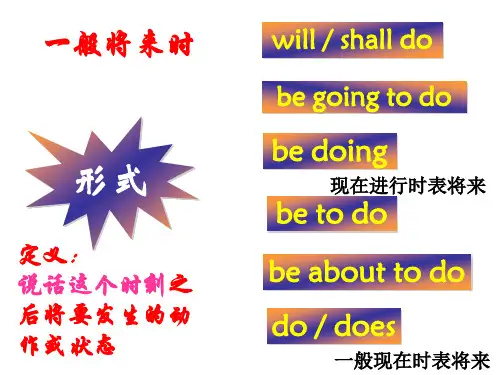
1. 概念:将来进行时主要表示将来某一时间正在进行的动作,或表示要在将来某一时间开始,并继续下去的动作。
常用来表示礼貌的询问、请求等。
(1)如:This time next day they will be sitting in the cinema.
What will you be doing at six tomorrow evening?
I’ll be meeting him tomorrow/ some time.我明天/某个时间将去见他。
2)常用的时间状语:
Soon, tomorrow, this evening,on Sunday, by this time,in two days, tomorrow evening By this time tomorrow, I'll be lying on the beach. 明天的这个时间,我将会海滩上。
2. 将来进行时的形式:
将来进行时由“动词be的将来时+现在分词”构成,具体形式见下表:
人称单数复数
第一人称I shall/will be leaving. We shall/will be leaving.
第二人称You will be leaving. You will be leaving.
第三人称He/She/It will be leaving. They will be leaving.
3. 将来进行时的基本用法:将来进行时表示在将来某一时间内正在进行的动作。
将来进行时有很强的推测性,因此人们往往在以下几种场合中使用它:
★(1)表示将来某一时间正在进行的动作,一般带状语。
如:
What will you be doing at this time next Monday? 星期一的这个时间你将干什么
When he comes to my house tomorrow, I will be writing the report.明天他来我家时,我将在写报告。
★ (2)表示现在正在进行的动作,但这个动作会延续到将来。
如:
I wonder if it will still be raining this afternoon.
I think that she will be working on this experiment until next morning.
★ (3)表示预定的将来动作或对将来的预测。
如:
Tomorrow I will be flying to Bombay.
After you take the medicine, you will be feeling much better.
★ (4)表示委婉的请求When shall we be meeting again
★ (5)表示原因Tomorrow morning, I'll be having a meeting.
★ (6)表示结果Stop the child or he will be falling over.
★ (7)表示对将来的打算(区别于对将来的预测)
My duties will end in July, and I'll be returning to Shanghai.
将来进行时用法:)~
概念:表示将来某时进行的状态或动作,或按预测将来会发生的事情.
如:I'll be meeting him sometime in the future.
形式:(肯定,否定形式以及一般疑问式)
常用的时间状语:
Soon, tomorrow, this evening,on Sunday, by this time,
tomorrow, in two days, tomorrow evening
By this time tomorrow, I'll be lying on the beach.
一将来进行时用来表示在将来的某一个时间正在进行的动作和按计划,安排,决定预料将要发生的事
①下个星期的这时候,我们将在那个工厂劳动.
This time next week we shall be working in that factory.
②明天下午三点,我们将正在开会.
We'll be having a meeting at three o'clock tomorrow afternoon.
③你将什么时候见怀特先生(语气较委婉客气,下属对上司)When will you be seeing Mr. White
④今天晚上七点,学生们将正在看电视.
The students will be watching TV at seven this evening.
二将来进行时主要表示将来某一时刻正在进行的动作,或表示要在将来某一时刻开始,并继续下去的动作.常用来表示礼貌的询问,请求等.例如:
1)This time next day they will be sitting in the cinema.
用法:强调在将来的某个具体时间正在发生的动作或事情.
例:Don't worry, you won't miss her. She will be wearing a red T-shirt and a white skirt at that time.
别担心,你不会认不出她的.她到时会穿一件红色的T恤衫和一条白色的短裙.
例:This time tomorrow you ________ there doing some more exercises.
A) will sit B) will be sitting C) sit D) shall sit
答案是B).因为this time tomorrow是个很具体的将来时间.
三将来进行时用来表示不含意图又未发生的动作
注意:将来进行时不用于表示"意志",不能说I'll be having a talk with her.
I will be helping Mary tomorrow.明天我帮玛丽干活.
这不表示说话人已安排好要帮助玛丽或者想帮助她.这个句子仅仅说明这一动作将要发生.将来进行时的这种用法有些像表示将来的现在进行时,但有以下几点不同之处.
◆将来进行时通常表示的是对将来事实的简单陈述.
而will+V. (一般将来时)除表示时间概念外,还带有感情色彩.
e.g. 汤姆明天将正在割草. Tom will be cutting grass tomorrow.
汤姆明天愿意割草. Tom will cut the grass tomorrow.
◆一般将来时是对将来的预测,一个表示将来要做的事,将来进行时,表示将来某个时点正在做
的事。
eg明天我要看书I'll read a book tomorrow.
明天十点我肯定正在看书I'll be reading a book 10:00 tomorrow.。
区别:将来进行时_VS_一般将来时

将来进行时VS 一般将来时1. 概念:将来进行时主要表示将来某一时间正在进行的动作,或表示要在将来某一时间开始,并继续下去的动作。
常用来表示礼貌的询问、请求等。
(1)如:This time next day they will be sitting in the cinema.What will you be doing at six tomorrow evening?I’ll be meeting him tomorrow/ some time.我明天/某个时间将去见他。
2)常用的时间状语:Soon, tomorrow, this evening,on Sunday, by this time,in two days, tomorrow eveningBy this time tomorrow, I'll be lying on the beach. 明天的这个时间,我将会海滩上。
2. 将来进行时的形式:将来进行时由“动词be的将来时+现在分词”构成,具体形式见下表:人称单数复数第一人称I shall/will be leaving. We shall/will be leaving.第二人称You will be leaving. You will be leaving.第三人称He/She/It will be leaving. They will be leaving.3. 将来进行时的基本用法:将来进行时表示在将来某一时间内正在进行的动作。
将来进行时有很强的推测性,因此人们往往在以下几种场合中使用它:★(1)表示将来某一时间正在进行的动作,一般带状语。
如:What will you be doing at this time next Monday? 星期一的这个时间你将干什么?When he comes to my house tomorrow, I will be writing the report.明天他来我家时,我将在写报告。
一般将来时和将来进行和过去将来
((CC)) to表i示nd过ic去at的e a安p排as或t 计arr划angement.
e.g. I was meeting him in town the next day.
((DD)) t表o 示m将ea来n 的tha事t 情th确e f实ut发ur生e a了ction actually happened.
2) —What are you going to do this afternoon?
—I am going to the cinema with some friends. The film _______ quite early, so we _______ to the bookstore after that. (NMET 2005年 重庆)
表示与安排,计划或时刻表有关的动作; 或用于if, when等状语从句中代替will do.
练习题
1. Don't cry.The sun __w_il_l_r_is_e___(rise) all the same tomorrow.
2. --Don't make such a mistake. --No.I ______. A.don't B.won't
A. finished; are going B. finished; go
C. finishes; are going D. finishes; go
3) Because the shop ________ , all the T-shirts are sold at half price. (NMET 2004年 浙江)
When will you come again?
将来进行时学案
将来进行时学案一、将来进行时的定义将来进行时表示将来某一时间正在进行的动作,或者预测将来会发生的动作,具有持续性和未完成性。
其构成形式为“will be +现在分词”。
例如:“I will be studying English at this time next week”(下周这个时候我将正在学习英语。
)二、将来进行时的用法(一)表示将来某一时刻正在进行的动作这种用法常常与特定的时间状语连用,比如“at this time tomorrow”(明天这个时候)、“at 9 o'clock tomorrow morning”(明天上午九点)等。
例如:“He will be playing football at 5 o'clock this afternoon”(今天下午五点他将正在踢足球。
)(二)表示按计划或安排即将发生的动作这种动作通常是可以预见的,并且已经被安排好。
例如:“The president will be meeting the foreign delegation next week”(总统下周将接见外国代表团。
)(三)表示委婉语气有时,将来进行时可以比一般将来时更委婉、更礼貌。
例如:“Will you be using the computer this evening? I need to do some work on it”(今晚你会用电脑吗?我需要用它做些工作。
)三、将来进行时与一般将来时的区别(一)侧重点不同一般将来时侧重于表示将来要发生的动作或存在的状态,是一个比较笼统的概念。
将来进行时则强调在将来某个具体的时间正在进行的动作,更具具体性和形象性。
(二)时间状语不同一般将来时常用的时间状语有“tomorrow”(明天)、“next week”(下周)等。
将来进行时常用的时间状语有“at this time tomorrow”(明天这个时候)、“from 8 to 10 tomorrow morning”(明天上午八点到十点)等。
英语时态的区别
现在时
现在完成进行时
现在完成进行时表示过去开始 的动作一直持续到现在,并且 可能会继续下去。它的基本形 式是have/has加上动词的现在 分词形式。例如:I have been studying for the past hour 。我学习了一个小时了
2
过去时
过去时表示过去发生的事情。它包括一般过 去时、过去进行时、过去完成时和过去完成 进行时
将来时
将来进行时
将来进行时表示将来某个时间正在进行的动作或存在的状态。它的基本形式是will加 上动词的现在分词形式或用be going to表示。例如:I will be studying at this time tomorrow night.我明天晚上这个时候将会在学习。(或)I'm going to be studying at this time tomorrow night.我打算明天晚上这个时候将会在学习
完成进行时
现在时
现在进行时
现在进行时表示正在进行的动 作或存在的状态。它的基本形 式是be动词加上动词的现在分 词形式。例如:I am studying 。我正在学习
现在时
现在完成时
现在完成时表示过去发生的动作对现在造 成的影响或结果。它的基本形式是 have/has加上动词的过去分词形式。例如 :I have finished my homework。我已 经完成了我的作业
(或)He said he was going to be studying for the exam at this time tomorrow night.他说他打 算明天晚上这个时候将会在备考考试
6
过去将来完成时
过去将来完成时表示在过去某个时间对未来的某个动作已经完成的预测或过 去的某个条件下的结果
英语语法将来进行时讲解

将来进行时一、定义来进行时(The Future Continuous)表示最近的将来正在进行的动作或说话人设想已经安排好的事情。
二、构成(shall用于第一人称,will用于第二、三人称)肯定句:主语 + shall/will + be + 现在分词。
We shall be landing in Paris in sixteen minutes。
我们将在16分钟后在巴黎机场降落。
Hurry up! The guests will be arriving at any minute! 快!客人就要来了。
否定句:主语 + shall/will + not + be + 现在分词.。
.Anyhow,you won't be playing for the next few Saturdays。
论如何,后几个星期六你不许再玩了.疑问句:Shall/Will + 主语 + be + 现在分词。
?Will you be remaining in the city?—Yes,I shall be(remaining in the city).你将来会留在这个城市吗?—-是。
Will they be coming this way? —No,they won't be(coming this way)。
他们会顺着这条路来吗?—-不,不会从这条路来。
疑问代词/疑问副词 + shall/will + 主语 + be + 现在分词。
.。
?What time will she be arriving? —She will be arriving at about 8:30 tomorrow morning。
她什么时候到达? ——她大概明天上午8点半到达.1。
6 将来进行时的用法1。
表示将来某一时刻或某一阶段内将要发生的动作一般只用于动态动词,不能用于静态动词:She’ll be leaving at about seven.她将在7点钟离开。
将来进行时
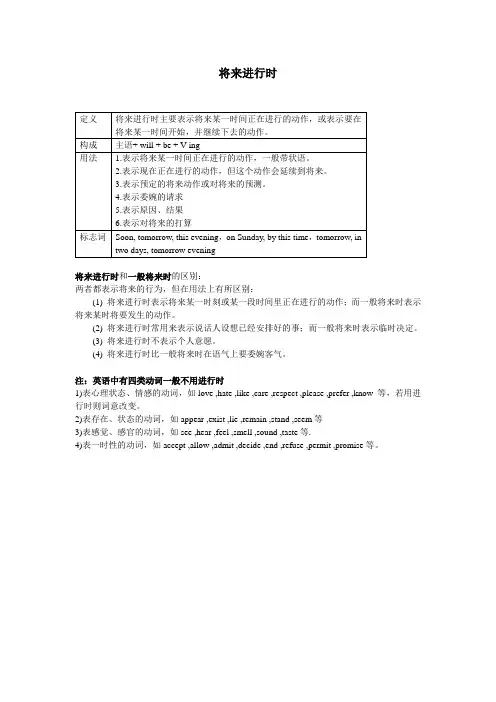
将来进行时定义将来进行时主要表示将来某一时间正在进行的动作,或表示要在将来某一时间开始,并继续下去的动作。
构成主语+ will + be + V-ing用法 1.表示将来某一时间正在进行的动作,一般带状语。
2.表示现在正在进行的动作,但这个动作会延续到将来。
3.表示预定的将来动作或对将来的预测。
4.表示委婉的请求5.表示原因、结果6.表示对将来的打算标志词Soon, tomorrow, this evening,on Sunday, by this time,tomorrow, intwo days, tomorrow evening将来进行时和一般将来时的区别:两者都表示将来的行为,但在用法上有所区别:(1) 将来进行时表示将来某一时刻或某一段时间里正在进行的动作;而一般将来时表示将来某时将要发生的动作。
(2) 将来进行时常用来表示说话人设想已经安排好的事;而一般将来时表示临时决定。
(3) 将来进行时不表示个人意愿。
(4) 将来进行时比一般将来时在语气上要委婉客气。
注:英语中有四类动词一般不用进行时1)表心理状态、情感的动词,如love ,hate ,like ,care ,respect ,please ,prefer ,know 等,若用进行时则词意改变。
2)表存在、状态的动词,如appear ,exist ,lie ,remain ,stand ,seem等3)表感觉、感官的动词,如see ,hear ,feel ,smell ,sound ,taste等.4)表一时性的动词,如accept ,allow ,admit ,decide ,end ,refuse ,permit ,promise等。
动词时态一般将来时的用法
动词时态一般将来时的用法动词时态包含了多种不同的形式,每种形式都传达了特定的时间信息。
在英语中,一般将来时是用来表达将来发生的动作、事件或状态的。
本文将详细介绍一般将来时的用法,并提供一些例句来帮助读者更好地理解。
一、一般将来时的定义一般将来时是用来表达明确的将来发生的动作或状态。
通常使用的助动词是will或shall,根据主语的不同而定。
二、一般将来时的构成1. 肯定句结构:主语 + will + 动词原形例如:- I will go shopping tomorrow.- He will travel to Europe next week.2. 否定句结构:主语 + will + not + 动词原形,或主语 + won't + 动词原形例如:- She will not visit her grandparents this weekend.- They won't attend the party.3. 疑问句结构:Will + 主语 + 动词原形?例如:- Will you join us for dinner?- Will they arrive on time?三、一般将来时的用法1. 表达自愿或意愿一般将来时常常用来表达主观上的决定、打算或愿望。
例如:- I will help you with your project.- He will volunteer at the local charity organization.2. 表示未来的计划或安排一般将来时可用于描述预定的时间表或安排。
例如:- We will have a meeting at 9am tomorrow.- They will arrive at the airport in the evening.3. 表示预测或推测有时,我们可以根据现有的证据或情况,使用一般将来时来推测未来可能发生的事情。
将来进行时用法小结
将来进行时用法小结【口诀】“将来某时(段)正进行,预计不久要发生。
通常用在口语中,语气委婉顿生情。
"【用法】将来进行时由“助动词will / shall + be + 现在分词”构成,具体用法如下:(1)表示将来某时刻或某段时间正在进行的动作。
常与soon, tomorrow, this evening, on Sunday,by this time, in two days, tomorrow evening等表示将来的时间状语连用。
如:I will be having an English class at 8 tomorrow. 我明天八点钟正在上英语课.Mary will be working in the factory in the next two months.下两个月玛丽将在这个厂里工作。
(2)在口语中常用来表示按计划或安排即要发生的动作。
如:This time tomorrow I shall be flying to New York. 明天这个时候我将飞往纽约。
At 7:00 this evening I will be watching the news programmes on TV。
今晚七时,我将正在收看电视上的新闻节目。
(3) 表示预料不久要发生或势必要发生的事情或将来的某种可能性,说话人往往有“我料想"或“我估计”的含义。
如:We believe that peasants’ life wil l be getting better and better.我们相信农民的生活会越来越好。
If we don’t do so,we shall be making a serious mistake。
如果我们不那样做,我们就会犯严重的错误。
(4) 表示亲切或委婉的语气。
如:When shall we be meeting again? 我们什么时候再见面?【注意】在时间、条件等状语从句中,用现在进行时代替将来进行时.如:Be careful when you are crossing the street。
将来时的动词变化规则
将来时的动词变化规则
在英语中,将来时的动词变化规则通常是使用“will”或“shall”来表达。
具体来说,一般现在时和现在进行时的动词形式分别变为一般将来时和将来进行时。
1. 一般现在时:动词变为原型,如“go”变为“goes”。
2. 现在进行时:动词变为“will be + -ing”形式,如“am/is/are + -ing”变为“will be + -ing”。
需要注意的是,具体使用“will”还是“shall”来表达将来时态,要根据具
体语境和习惯用法来决定。
一般来说,“will”用于表达不确定的将来事件
或个人意愿,而“shall”用于表达确定计划或约定好的将来事件。
此外,还有一些特殊情况下需要使用其他形式来表达将来时态,如“be going to”等。
将来进行时
• When I get home, my wife will probably be watching television.
当我到家时,我太太可能正在看电视。
2. 将来进行时表示表示按时划或安排要发 生的动作
• I will be seeing you next week.
我下个星期来看你。 • I’ll be taking my holidays soon. 不久我将度假了。
• We shall be going to London next week. 下周 我们要去伦敦。
3. 将来进行时表示委婉语气
• Will you be having some tea? 喝点茶吧。 • Will you be needing anything else? 你还需要什么 吗? • 试比较: • When will you finish these letters? 你什么时候会处理完这些信件? (如上司对下属) • When will you be seeing Mr White? 你什么时候会见到怀特先生? (如下属对上司)
• Will you bejoining us for dinner?
你会和我们一起吃饭吗? (将来)
三、将来进行时与一般将来时的区别
• 1. 两者基本用法不一样
• 将来进行时表示将来某时正在进行的动作,一
般将来时表示将来某时将要发生的动作:
• What will you be doing this time tomorrow?
有时这两种结构在意义上确实不同,例如: • Mary won’t pay this bill. 玛丽不付账。(她拒绝付账) • Mary won’t be paying this bill. 玛丽不会付账。(将来) • Will you join us for dinner? 你来和我们一起吃饭好吗? (邀请)