
初三英语中考专题复习(时态与语态)
初三英语中考专题复习第八节时态和语态( ) 1. Don’t make so much noise. We _______ to the music.A. listenedB. listenC. are listeningD. have listened ( ) 2. I must return the camera to Li Lei. I _______ it for two weeks.A. keepB. borrowedC. have keptD. have lent( ) 3. –When will you tell him the good news?--I will tell him about it as soon as he _______ back.A. comesB. cameC. will comeD. is coming ( ) 4. –Dad, please open the door, it _______. –OK, dear. I’m coming.A. locksB. lockedC. is lockedD. was locked ( ) 5. –Did you go to Jim’s birthday party? --No, I _______.A. am not invitedB. wasn’t invitedC. haven’t invitedD. didn’t invite ( ) 6. A talk on Chinese history _______ in the school hall next week.A. be givenB. has been givenC. will be givenD. will give( ) 7. You may go fishing if your work _______.A. is doneB. will be doneC. has doneD. have done ( ) 8. –What do you think of the football match yesterday?--Well. It’s surprising. The strongest team of our school _______.A. was beatenB. wonC. scoredD. was failed ( ) 9. –Would your younger brother go for a picnic this Sunday?--If I don’t go, _______.A. so does heB. so he willC. neither will heD. neither does he ( ) 10. The trees must _______ three times a week.A. waterB. is wateringC. be wateredD. waters( ) 11. –Did you see Tom at the party? -- No, he _______ by the time I got there.A. leftB. was leavingC. had leftD. has left( ) 12. –Why not go to see the dolphin show with me? --Because I ______ it.A. sawB. will seeC. seeD. have seen ( ) 13. –Do you like watching cooking programs on TV?--No, I don’t, but my twin brother _______. He’s very fond of cooking.A. doesB. doC. isD. are( ) 14. Catherin _______ the letter before her mother came into her bedroom.A. has writtenB. was writtenC. had writtenD. is writing ( ) 15. The old man is quite weak after the accident, so he _______.A. must take care ofB. must be take care ofC. must look afterD. must be looked after( ) 16. The ticket is on the floor. Would you please _______ for me?A. pick it upB. pick up itC. pick up themD. pick them up ( ) 17. He _______ living in the country to the city.A. likesB. prefersC. enjoysD. loves( ) 18. How long have you _______ the book?A. boughtB. lentC. hadD. borrowed ( ) 19. –Do you know him well ? --Sure. We _______ friend since ten years ago.A. wereB. have beenC. have becomeD. have made ( ) 20. _______ me carefully, boys and girls. Can you _______ me?A. Listen to; hearB. Hear; listen toC. Hear; hearD. Listen to; hear from ( ) 21. –These farmers have been to the United States. –Really? When ______ there?A. will they goB. did they goC. do they goD. have they gone ( ) 22. I’m sorry I haven’t got any money. I _______ my handbag at home.A. have missedB. have leftC. have putD. have forgotten ( ) 23. –Where is Miss Gao. Lily? --She _______ to the teacher s’.A. has beenB. has goneC. wentD. would go ( ) 24. When her father came back home, Joan _______ with her friend.A. talkedB. talksC. is talkingD. was talking ( ) 25. –What’s that thing with three legs?--It’s a cup. It ______ for drinking in the old days.A. usesB. usedC. is usedD. was used ( ) 26. His uncle _______ in three days.A. returnsB. has returnedC. returnedD. will return ( ) 27. –Hi, Lin Tao. I didn’t see you at the party.--Oh, I _______ ready for the maths exam.A. am gettingB. was gettingC. gotD. have got( ) 28. –Excuse me. What did you say you would like to do, Miss White?--I said I’d better go back to the office. I _______ something this afternoon.A. would meetB. meetC. am going to meetD. was meeting ( ) 29. What _______ the forest in our country in the last ten years.A. has happened doB. is happened toC. has happened atD. is happening ( ) 30. –What did Mr Jones do before he moved here?--He _______ a city bus for over twenty-five years.A. is drivingB. droveC. has drivenD. drives( ) 31. –When _______ you _______ your homework?--I had finished it before he _______ back.A. have; finished; cameB. have; finished; was comingC. did; finish; cameD. did; finish; was coming( ) 32. Look! The boys _______ happily in the river.A. swimB. swamC. will swimD. are swimming ( ) 33. Every spring, many trees _______ along the river.A. were plantedB. is plantedC. will be plantedD. are planted ( ) 34. The letter _______ in French. I can’t read it.A. is writingB. is writtenC. wroteD. writes( ) 35. If Mary _______ next Sunday, we will go boating together.A. will comeB. comesC. shall comeD. should come ( ) 36. We expected that the English teacher _______ some advice on how to write an English letter.A. will giveB. gaveC. is going to giveD. would give ( ) 37. Five years ago nobody knew him, although he _______ more than 100 songs.A. already wroteB. have already writtenC. had already writtenD. was already writing( ) 38. So far I _______ any success. However, I’ll keep trying.A. don’t haveB. didn’t haveC. haven’t hadD. won’t have ( ) 39. It was the third time that I _______ in at his office.A. have droppedB. had droppedC. droppedD. was dropping ( ) 40. I often see Tom _______ homework while I am watching TV every evening.A. doB. doingC. didD. to do( ) 41. The flowers want _______. Look, the soil is so dry.A. wateringB. being wateredC. to waterD. waters ( ) 42. –Be careful! You might fall into the water.--Thank you. I ______ I _______ so close to the pool.A. didn’t know; am standingB. don’t know; am standingC. didn’t know; was standingD. didn’t know; would stand( ) 43. –Excuse me. Where is the sick boy sent here a moment ago?--He ______ by the doctor.A. has been examinedB. will be examinedC. is examinedD. is being examined( ) 44.—Have you got the airplane tickets?--No. when I _______ to the office, all the tickets to Beijing ______ out.A. get; have been soldB. got; had been soldC. got; had soldD. got; were being sold( ) 45. –Your name again? I _______ quite catch it. –Bartholomew Liveli.A. didn’tB. don’tC. couldn’tD. can’t ( ) 46. – Whom are you waiting for?--Gary’s parents. But neither of them _______ yet.A. arrivedB. has arrivedC. are arrivingD. is arriving ( ) 47. He _______ in bed all day long because he had a headache.A. lieB. layC. laidD. lied( ) 48. Would you _______ your voice a little so that everyone can hear you?A. riseB. putC. liftD. raise ( ) 49. More and more people began to _______ that good health means good wealth.A. learnB. understandC. considerD. realize。
年中考英语专题复习动词时态及语态详解
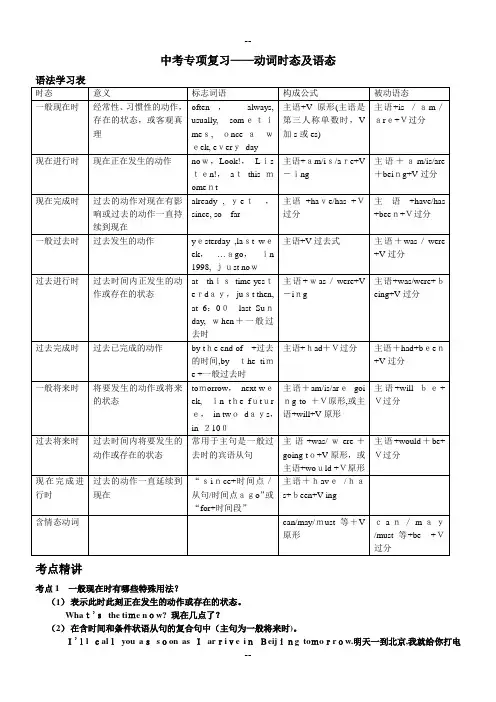
中考专项复习——动词时态及语态考点精讲考点1 一般现在时有哪些特殊用法?(1)表示此时此刻正在发生的动作或存在的状态。
What’sthe time now? 现在几点了?(2)在含时间和条件状语从句的复合句中(主句为一般将来时)。
I’ll callyou assoon as Iarrive inBeijing tomorrow.明天一到北京,我就给你打电话。
(3)在主句为过去时态的复合句中,如果宾语从句陈述的是客观真理,从句用一般现在时。
The teacher said Maria is a girl.老师说玛利亚是个女孩。
(4)表示书、信、报纸、通知、广播、告示牌等的内容用一般现在时。
Itsays,“Closed”.上面写着,“停止营业”。
专练用所给动词的适当形式填空1、T hree plus two_________(be)five.2、There____________(go)thebell!3、Light______________(travel)fasterthan sound.4、Ifyou____________(ask)her tomorrow, she will helpyou.5、The notice_______________(say)“NoSmoking!”.考点2 如何使用used to?used to后加动词原形表示“过去常常”,其疑问句和否定句可直接使用used,也可借助于did。
I used to be afraidofdark .我过去常怕黑。
He usedn’tto rideto school.他过去不常骑车去上学。
He used tosmoke,didn’the?他过去常抽烟,是吗?注意:be used to doing 意为“习惯做某事”,be used todo 意为“被用来……”,不要混淆。
专练按要求变化下面的句型1、She used to play nearthe river.(改为否定句)__________________________________________________________________________2、T he childrendidn’tuseto come here early,_____________________?(补全反意疑问句)考点3 一般将来时有哪些形式?(1)“begoing to+动词原形”表示计划或打算在最近要做的事。
初三(九年级)英语语法大全

初三(九年级)英语语法大全一、动词时态1. 一般现在时:表示经常发生的动作或存在的状态。
例如:He goes to school bus every day.(他每天乘公交车去上学。
)2. 现在进行时:表示正在进行的动作。
例如:She is reading a book.(她正在读书。
)3. 一般过去时:表示过去发生的动作或状态。
例如:Theyvisited the Great Wall last year.(他们去年参观了长城。
)4. 过去进行时:表示过去某一时刻正在进行的动作。
例如:He was watching TV when I called him.(我给他打电话时,他正在看电视。
)5. 一般将来时:表示将来发生的动作或状态。
例如:We will go to the park next week.(下周我们将去公园。
)6. 现在完成时:表示过去发生的动作对现在造成的影响。
例如:I have finished my homework.(我已经完成了作业。
)二、名词1. 可数名词:有单数和复数形式,可以用a/an和some修饰。
例如:apples(苹果),students(学生)。
2. 不可数名词:没有单数和复数形式,只能用some修饰。
例如:water(水),air(空气)。
3. 名词所有格:表示某物属于某人或某物。
例如:Tom's book(汤姆的书),the children's playground(孩子们的游乐场)。
三、代词1. 人称代词:I(我),you(你/你们),he(他),she(她),it(它),we(我们),they(他们)。
2. 物主代词:my(我的),your(你的/你们的),his(他的),her(她的),its(它的),our(我们的),their(他们的)。
3. 指示代词:this(这个),that(那个),these(这些),those(那些)。
初三复习 时态和语态
一般现在时的用法
经常性动作等。常与everyday, often, always, once a week, seldom, usually等连用。 She always goes to school by bus. 真理和事实。 Light travels faster than sound. 在由when, if, before, as soon as, unless等引导的时间状 语从句和条件状语从句中,用一般现在时代替一般将来时。 When I grow up, I will be a soldier.(主将从现) 表示主语的习惯特征,性格,能力等。 He studies very hard.
(2)一般过去时: Past Simple
概念: 结构:
表示过去发生的动作 did 标志语: yesterday、... ago、 in 1992、 last week/month…
一般过去时的用法
1.表示过去的某个时间发生的动作或存在的状态,常和明确的时间状语 连用。 (或有上下文语境暗示)
The moment she came in, she toldห้องสมุดไป่ตู้me what had happened to her. He bought a watch but lost it.
动词-ed形式的构成:
want 在动词后加-ed answer 以字母e 结尾的动 move 词,只+d die “ 辅音字母+y ” , carry 去y 改i, 再+ed cry stop 重读闭音节结尾 的,双写+ed plan
do cut say
标志语:Look! 、 Listen! 、now
现在进行时的概念
中考英语一轮复习:时态和语态+知识点考点总结与练习(基础篇)
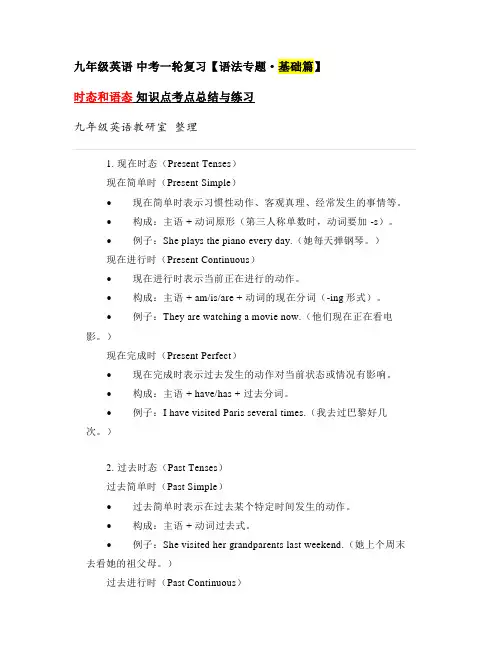
九年级英语中考一轮复习【语法专题·基础篇】时态和语态知识点考点总结与练习九年级英语教研室整理1. 现在时态(Present Tenses)现在简单时(Present Simple)•现在简单时表示习惯性动作、客观真理、经常发生的事情等。
•构成:主语 + 动词原形(第三人称单数时,动词要加 -s)。
•例子:She plays the piano every day.(她每天弹钢琴。
)现在进行时(Present Continuous)•现在进行时表示当前正在进行的动作。
•构成:主语 + am/is/are + 动词的现在分词(-ing形式)。
•例子:They are watching a movie now.(他们现在正在看电影。
)现在完成时(Present Perfect)•现在完成时表示过去发生的动作对当前状态或情况有影响。
•构成:主语 + have/has + 过去分词。
•例子:I have visited Paris several times.(我去过巴黎好几次。
)2. 过去时态(Past Tenses)过去简单时(Past Simple)•过去简单时表示在过去某个特定时间发生的动作。
•构成:主语 + 动词过去式。
•例子:She visited her grandparents last weekend.(她上个周末去看她的祖父母。
)过去进行时(Past Continuous)•过去进行时表示过去某一时刻正在进行的动作。
•构成:主语 + was/were + 动词的现在分词(-ing形式)。
•例子:They were playing soccer when it started raining.(当雨开始下时,他们正在踢足球。
)过去完成时(Past Perfect)•过去完成时表示在过去某个时间点之前已经完成的动作。
•构成:主语 + had + 过去分词。
•例子:By the time I arrived, they had already eaten dinner.(我到达时,他们已经吃完晚饭了。
2023年中考英语复习动词时态、语态 课件

He joined the League three years ago. ( 三年前入团,joined为短暂行为。)
I have finished my homework now. ---Will somebody go and get Dr. White? ---He's already been sent for.
I'd rather you came tomorrow.
4) wish, wonder, think, hope 等用过去时,作试探性 的询问、请求、建议等。如:
I thought you might have some. 我以为你想要一些。
比较:
一般过去时表示的动作或状态都已成为过去,现已 不复存在。
He is used to a vegetarian diet. Scarf is used to taking a walk.(现在习惯于散步)
典型例题
---- Your phone number again? I _A__ quite catch it. ---- It's 69568442. A. didn't B. couldn't C. don't D. can't
3) be +不定式表将来,按计划或正式安排将发 生的事。如:
We are to discuss the report next Saturday. 4) be about to +不定式,意为马上做某事。如:
He is about to leave for Beijing. 注意:be about to 不能与tomorrow, next week 等表示明确将来时的时间状语连用。
中考英语备考 专题03 动词时态及语态(含解析)

专题03 动词时态及语态【考点综述】:动词是谓语动词所表示的动作或情形发生时刻的各类形式。
英语动词有16种时态,可是经常使用的只有9种:一样此刻时、一样过去时、一样以后时、此刻进行时、过去进行时、此刻完成时、过去完成时、过去以后时、此刻完成进行时。
当句子的主语是动作的执行者时,谓语的形式叫主动语态。
句子的主语是动作经受者时,谓语的形式叫被动语态。
被动语态由助动词be + 过去分词组成,时态通过be 表现出来。
动词是中考考查的重点,动词的时态和语态更是考查的重中之重。
动词不仅有人称和数的转变,而且有时态、语态、语气和非谓语形式等语法现象。
这些都是中考考查的内容。
【中考真题再现】:1. 【2021江苏南京】---Millie, where is Miss Li?---She _________ a speech on Chinese art to the first-year students in the hall.A. givesB. gaveC. is givingD. has given2. 【2021江西】— Have you had your b reakfast yet?—Yes. Mom _____ it for me.A. was cookingB. is cookingC. will cookD. cooked3. 【2021山东菏泽】—Linda, I called you this morning, but nobody answered the phone.—I'm sorry. I football with my friends then.A. playB. playedC. am playingD. was playing4. 【2021陕西】The mobile phone has influenced people’s life a lot since it .A. inventsB. inventedC. is inventedD. was invented【答案】D【解析】考查动词时态及语态。
2023中考英语语法复习之考点专题——动词时态(原卷版)
2023中考英语语法复习之考点专题——动词时态(原卷版)2023中考英语语法复习之考点一网打尽专题十二动词时态目录考点1 一般现在时(一般用法)考点2(易错)一般现在时(表客观事实和真理)考点3(重点)主将从现考点4(易错)主将从现(if宾语从句与状语从句区分)考点5 一般过去时考点6 一般过去时(used to do)考点7(重点) used to do sth/be used to doing sth辨析考点8 一般将来时(be going to)考点9 一般将来时(will/shall)考点10 现在进行时考点11(易错)现在进行时表将来考点12 过去进行时(表示过去某一刻正发生的动作)考点12 过去进行时(表示过去某阶段一直发生的动作)考点13(重点)过去进行时(含when/while 引导的状语从句)考点14 现在完成时(表过去的事对现在的影响:已经做了...)考点15 现在完成时(表过去的事一直持续到现在:一直做....)考点16(重点)现在完成时(have been to/have gone to/have been in辨析)考点17(难点)现在完成时(延续性与非延续性动词)考点18 过去将来时考点19 过去完成时考点1 一般现在时(一般用法)考点讲解1.(2021·上海松江·二模)Tim likes watching films. He _________ to the cinema with his girlfriend once a week.A.goes B.is going C.has gone D.will go2.(2020·湖北恩施)I hear that it often ________ in Sichuan and there are usually floods, especially in summer.A.rains B.rained C.will rain3.(2021·北京房山·二模)Mary ________ her grandparents every weekend.A.visits B.was visiting C.is visiting D.has visited4.(2021·广西桂林)The zebra eats grass, but it ________ eat meat.A.doesn’t B.didn’t C.don’t5.(2021·黑龙江·齐齐哈尔市碾子山区教师进修学校一模)—Do you like the flower? —Yes. It ________ sweet.A.is smelling B.smells C.smelt考点2(易错)一般现在时(表客观事实和真理)考点讲解精选练习6.(2020·天津红桥·二模)In the past, people didn't know the earth ________round the sun. A.going B.goes C.will go D.go7.(2021·吉林长春·模拟预测)The teacher told us that the sun ________ in the east. A.rises B.rise C.rose D.rising考点3(重点)主将从现考点讲解精选练习8.(2021·四川乐山)—What’s your plan for the summer holiday?—I’ll go to Chendu as soon as the school term ___________.A.end B.ends C.will end9.(2021·广西河池)Mrs. Green will take her son to the amusement park if she ________ the tickets.A.got B.gets C.is getting D.will get10.(2021·辽宁丹东)We can’t avoid traffic accidents unless everyone ________ the rules. A.follows B.breaks C.will follow D.will break考点4(易错)主将从现(if宾语从句与状语从句区分)考点讲解精选练习11.(2021·辽宁鞍山)—Tina wants to know if you ________ to the park with us tomorrow. —I’d love to. But if it ________, I may go to the library instead.A.go; will rain B.go; rains C.will go; rains D.will go; will rain12.(2020·黑龙江牡丹江)—I wonder if we ________a farewell party next week. —If we________it, I will call you.A.will have ; have B.have;will have C.will have; will have13.(2021·黑龙江哈尔滨)—I wonder if you ________ us for the English party tomorrow. —If I ________ free, I will go with you.A.will join, am B.will join, will be C.join, am考点5 一般过去时考点讲解精选练习14.(2021·广西贵港)—Where does Bill live? —He ________ me his address, but I can’t remember it now.A.tells B.told C.is telling D.will tell15.(2021·四川达州)— Alice has gone out. — Oh, has she? What time ________ she________?A.has; gone B.will; go C.did; go D.is; going16.(2021·江苏徐州)In my school days, I ________ a lot of reading in English every day. That was how I learned English at that time.A.do B.did C.have done D.will do17.(2021·重庆)Last Sunday my brother and I ________ our grandparents.A.will visit B.visits C.visit D.visited18.(2021·内蒙古兴安盟)— Have you ever been to Shanghai? — Of course. Actually, I________ there for six years, but now I live in Beijing.A.worked B.was working C.would work D.have worked考点6 一般过去时(used to do)考点讲解精选练习19.Mr Jiang isn’t as busy as before because there ___________no home robot to help him.A.used to be B.may be C.used to have D.may have20.I ________ in this small mountain village when I was a child.A.use to live B.used to living C.used to live D.used to life21.(2019·江苏镇江)Yao Ming, a basketball giant , ___________ water polo when he was young.A.is playing B.used to play C.is used to playing D.was playing考点7(重点) used to do sth/be used to doing sth辨析考点讲解精选练习22.(2020·湖南益阳)Diana used to _________ to work, but now she is used to ________ because the road is crowded and she wants to keep fit.A.drive; walk B.drive; walking C.driving; walk23.Dick __________ in America, but he has been ___________ Chinese food since he moved to China.A.used to live; used to eating B.is used to live; used to eat C.is used to live; used to eating D.used to living; used to eat24.—How does your brother go to school? —He ___________ ride a bike, but now he__________ there to keep fit.A.used to; is used to walk B.used to; is used for walking C.was used to; is used to walking D.used to; is used to walking考点8 一般将来时(be going to)考点讲解一般将来时表示将来某个时间要发生的动作,事情或存在的状态,也表示将来经常或反复发生的动作或事情。
九年级中考时态复习
注意一:
1. 曾经去过某地(人已回来)__h_a__v_e_/_h_a__s_b__e_e_n__(_t_o_)__.._________
可以和ever,never, twice, before等连用。
mother ___a special dinner for my grandpa 〓n〓o〓w.
A.prepare
B.prepared
C.is preparing
D.will prepare
( C )2. 【2010湖南】---W〓〓h〓e〓re〓〓is〓P〓e〓t〓e〓r?〓
---He______ volleyball with his friends in the
Summary
时态
现在进行时
过去进行时
现在完成时
动词的构成
is/am/ are +Ving was/were + Ving have / has done
贵港市中考真题
2012年
1.---It’s time for lunch. Where is your
grandmother, Gina?
----She ____ the flowers in the garden.
A. won’t receive B. haven’t received C. hadn’t received D. didn’t receive
难点突破--- 现在完成时与一般过去时
1.我已经读过这本书了。 _____I_h_a_v_e__a_lr_e_a_d_y__re_a_d__t_h_is__b_o_o_k_.______ 2. 我上周读了这本书。 _____I_r_e_a_d__th_i_s_b_o__o_k_l_a_s_t _w_e_e_k_._________
人教版英语九年级全册动词时态和语态知识点及相应习题
【动词时态和语态】一、时态3.主将从现(1)条件状语从句由if(如果)、as long as(只要)、unless(除非)引导,主句为一般将来时或表述将来含义,从句用一般现在时。
例如:She had better travel with a local tour guide if she wants to know more about the culture.(2)时间状语从句由when(当……时候)、as soon as(一……就……)、until(直到)等引导,主句为一般将来时或表述将来含义,从句用一般现在时。
例如:I’ll discuss this matter with you when we meet next time. / We won’t leave until Mary arrives.考点5 现在完成时have/has+(not+)过去分词(1)表示过去的动作对现在产生的结果和影响现在完成时表示过去某个时间曾经做过的、发生过的事情,对目前的某种影响,这时一般不用时间状语;也可以表示到目前为止没有发生或经历的事情。
The tickets have sold out.(票已售空。
)I have tried Italian food. It’s delicious!(我已经尝过意大利美食了。
美味啊!)Simon has seen the concert. He doesn’t want to see it again.(西蒙已经看过这场演唱会,不想再看了。
)I have never visited San Francisco in the U.S.A.(我从没去过美国的旧金山。
)(说明过去没有去过,现在仍没去过)I have just heard the news that our school will set up a press club.(我刚听到消息说我们学校要成立一个记者俱乐部。
人教版初三英语动词的时态和语态复习
【中考链接】
( ) 1. —I heard your father had gone to Beijing on business.
—Yes. And he ____A___ in three weeks. A. will return B. has returned C. returned D. returns ( ) 2. Just go down this road and you __D_____
等,也常和
等引导的状语从句连用.
★必背句式 It is/has been+一段时间+since+一般过去时
It is/has been five years since he lived in China.
【中考链接】
( ) 1. —Are you going anywhere?
—I __D____ about visiting my sister, but I have changed my mind.
the library next to the bank. A. see B. saw C. have seen D. will see
( ) 3. We ____B___ have a picnic together with our teachers next Thursday.
A. are going B. are going to C. will going D. may going to
B. watches
C.was watching D.watching
3.-----Hey ,what did I say? -----I _________. A. I’m not listening B. I was not listening