
仁爱英语七年级英语下册知识点总结-Unit7 Topic2
Unit7 Topic2
重点词组:
1.at the birthday party在生日聚会上
2.perform ballet跳芭蕾舞
3.dance to disco 跳迪斯科
4.take these flowers to 把这些花带去…
5.work out math problems 解出数学题
6.read books 读书
7.fly a kite放风筝
8.be good at / do well in doing擅长做…
9.have a good time /enjoy oneself
玩得开心
10.with one’s help / with the help of
在某人的帮助下
重点句型
11.Can/Could you dance? —Yes, I can/could. No, I can’t/couldn’t.
12.What can you do? —I can speak English. He can’t sing English songs.
13.Do you want to sing Chinese songs or English songs? --Chinese songs.
14.One year ago, she couldn’t do it at all. 一年前她根本不会做这件事。
15.They could do it before, but not very well. 他们一年前会做这件事,但是做得不是很好。
16.Zhang Jun can ride a bike this year, but he couldn’t do it a year ago.
张军今年会骑自行车,但是他一年前并不会。
17.Michael can’t come to school tod ay because he hurt his right leg.
18.Michael今天不能来上学了,因为他伤到了他的右腿。
19.I couldn’t play the piano when I was four and I still can’t now.
我四岁时不会弹钢琴而且我现在仍然不会。
20.Kangkang is good at playing soccer, while Michael does well in basketball.
康康擅长踢足球,而Micheal篮球打得好。
(表示对比)
21.Six years ago, there was something wrong with her eyes.(there be 过去时)
六年前,她的眼睛出了毛病。
22.She could n’t see anything. = She could see nothing.她什么都看不见了。
23.Life was very hard for her when she was young.当她年轻的时候,生活对她来讲是艰难的。
24.In English, “hard” means“difficult” here. 英语中,“hard”的意思是困难的。
25.No way! 没门!绝对不行!
重点讲解
1.Do you want to sing Chinese songs or English songs? —Chinese songs.
选择疑问句中,回答时只能选择一者作答,不能用“Yes”或“No”回答。
2.take sb./sth. to +地点.带某人/某物去某地I’d like to take these flowers to the party.
巧辩异同Take ,bring ,fetch 和carry
Bring“带来,拿来”表示“拿到靠近说话着的地方” (由别处带到说话人处);
take “拿走,带走”表示“拿到远离说话着的地方” (从说话人处带到别处)
carry“拉,搬”表示“用力移动,没有方向”;
fetch“去取,去拿”,表示“往返拿物”。
Please take the books to the classroom。
Remember to your homework to school tomorrow
The bag is too heavy,please it to my office。
Don’t worry ,I can the key.
3.一段时间+ago是表示过去的时间状语。
two years ago
4.at the age of 在……岁的时候
5.with one’s help = with the help of…在……的帮助下
6.Can you count the photos for me? 你能为我数数这些照片吗?
--Yes, I can. / No, I can’t. 好的,可以。
/ 不,不可以。
7.What else can you do? 你还能做其他什么吗?--I can dance and play the guitar.
(else为形容词,做后置定语。
一般放在不定代词和疑问词之后)
8.I can only/also sing English songs. 我只/ 也会唱英文歌。
(only/also一般放在be动词、情态动词之后,实义动词之前)
9.I can swim a little / very well.(修饰动词不能用very good)我会一点游泳/ 我游泳游得很好
I can’t swim at all. 我根本不会游泳。
10.I’m sure we’ll have a good time at the party. 我确信我们在晚会上一定会过得很愉快。
be sure of… / be sure to do. be sure (that)+句子
11.Happy birthday to you! 生日快乐!Best wishes to you! 衷心祝福你!
--Thank you(very much) / Thanks (a lot). (非常)谢谢!
12.When she was five, she could only dance a little. 当她五岁时,她会跳一点儿舞。
(when在这里是连词,后跟句子。
也可做疑问词,引导提问日期的特殊疑问句)
重要语法
情态动词can / could 的用法
1. 情态动词本身有各种意义,但不能单独做谓语,只能和动词一起构成谓语,表示说话人的语气和
情感。
没有人称和数的变化。
2. 情态动词can的用法
1>(表示有能力做或能够发生)能\会I couldn’t ride a bike at the age of 6
I’ll do what I can to finis h it on time
2>(表示知道如何做)懂得,会She can speak English
3>(表示允许)可以We can’t wear jeans at work
4>(请求帮助)能Can you feed my cat while I am away?
5>(请求允许)可以Can I read your newspaper?
6>表示可能性,用于否定句表示事实肯定不真实That can’t be Mary. She’s in New York.
7>(表示常有的行为)有时会It can be quite cold in winter
8>can’t help doing情不自禁做某事,can’t wait to do迫不急待做某事
9>can 和a little ,very well not……at all 连用表示能会的程度
Can you dance? Yes, a little /very well . No ,not at all
10>Can/Could/Will/would you p lease……?你能……?表示有礼貌的请求。
Excuse me,could I borrow some money from you?--Of course,you can.
3. can和could的使用------ can/could 表示一般的能力
(1) can(could)“可以,同意,准许”表示请求,允许。
(2) can“会,能”,表现在或将来的能力.could表示过去的能力.could语气较can委婉。
4. 当表示允许别人某事时,用can而不用could.
5. 表示提议和请求。
在语气上could较客气,但can较肯定。
e.g. A monkey can’t swim. She couldn’t draw before.
Could I open the door now? --Yes, of course you can.
Could you tell me the way to the hospital?。
Unit 7 topic 2 总复习课件 2020-2021学年仁爱版英语七年级下册
3.我和我妹妹都喜欢玩球类游戏。 My sister and I both like playing ball games.
句式
结构
肯定句 主语+can+1. 动词原形 (其他).
否定句
主语+can+2. not +动词原形(+其 他).
一般疑问句 3. Can +主语+动词原形(+其他)?
肯定回答: Yes,主语+can. 简略回答
否定回答: No,主语+4. can’t .
[运用]将下列句子进行句型转换
1. Jane can write stories(改为否定句) Jane can’t write stories.
What can you do? 4. Shelly could sing and dancc in 2020.(改为否定句)
Shelly couldn’t sing or dance in 2020.
选择疑问句
选择疑问句是指说话人提出两种或两种以上的情况,要求对 方选择一种情况回答。其表现形式可以是一般疑问句形式, 也可以是特殊疑问句形式。请仔细观察下面的例子,然后补 全结论部分所缺的内容。 [例子] 一般疑问句形式的选择疑问句 1.----Is your new school big or small?
4.放学后,咱们做些户外活动吧。 Let's do some outdoor activities after school.
5.两年前她就会唱英语歌曲。 She could sing English songs two years ago .
仁爱英语七年级下册各单元知识点总结归纳Unit7Topic2
Unit7 Topic2 Section A学习目标1.学习can/can't的用法,学会谈论某人能够和不能够做的事情,并进行才艺展示。
2.学习并掌握选择疑问句的用法。
重点短语1.play the piano/guitar 弹钢琴/吉它2.perform ballet 表演芭蕾舞3.dance to disco 跳迪斯科4.at the party 在晚会上5.have a good time=enjoy oneself=have fun 玩得高兴,过得愉快名师课堂1.Do you want to sing Chinese songs or English songs?你想唱中文歌还是英文歌?由or构成的选择疑问句,其结构是一般疑问句或特殊疑问句加选择部分,选择部分用or连接,回答时不用Yes或No,而是直接选择。
e.g.-Do you want to play basketball or soccer?你是想打篮球还是踢足球?-I want to play soccer.我想踢足球。
2.But I can't sing Chinese songs.I can only sing English songs.但是我不会唱中文歌,我只会唱英文歌。
can 是情态动词,不能单独作谓语,只能和动词一起构成谓语,没有人称和数的变化,表示“能,会”之意。
含有can的陈述句变为否定句时,直接在其后加not,缩写为can't.含有ean的陈述句变为疑问句时,只需要把can 提前大写目子母,答语通常为Yes,主语+can./No,主语+can't.,有时也用一些程度的词来回答。
e.g - Can you play the piano?你会弹钢琴吗?-Yes,I can,/No,I can't,是的,我会。
/不,我不会。
(Yes,a little./No,not at all.是的,会一点。
七年级英语下册 Unit 7 Topic 2 I can dance and play the guitar讲义 (新版)仁爱版
Unit 7 Topic2一. 重点单词(所有程度学生都要掌握)good (adj.) ——well(adv.) write(v.)——writer(n.)activity (n.)——activities (pl.)二·词组(△的程度较差可以不掌握,中、上学生需全部掌握)Section A1.at Kangkang’s birthday party 在康康的生日聚会上2.play the piano/guitar 弹钢琴/吉他3.sing some songs 唱些歌4.dance to disco 跳迪斯科5.perform ballet 表演芭蕾舞6.have a good time 过得很痛快7.take photos 拍照8.draw pictures 画画9.read English books 看英文书10. make model planes 制作模型飞机Section B11.Happy birthday to you. 祝你生日快乐12. take sth. to…把某物带到。
13.so many flowers/ so much food 这么多的花/这么多的食物14. so smart 如此聪明15.count them for me 为我把它们数一下16.do … very well …做得非常好17.just a little 就一些,只有一些Section C18.one year ago 一年前196.fly a kite/ fly kites 放风筝20.in the past 在过去st year/next year 去年/明年Section D22.live in London 住在伦敦23. at the age of five 在五岁时24. a few words 一些单词25. not… any more 不再,再也不26. with sb’s help =with the help of sb. 在某人的帮助下27 her first book 她的第一本书28. want to be…想要成为…三.重点句子(所有程度学生都要掌握)Section A1. Oh, do you want to sing Chinese songs or English songs?哦,你想唱中文歌曲还是英文歌曲?此句是选择疑问句,即提供两种或两种以上情况以供对方选择。
最新仁爱版英语七年级下册Unit7Topic2语法专项课件(情态动词can和could的用法)
③表示请求或允许。
③表示请求,语气更委婉。
易错点1 can 和 could的区别
It can't be true. (表推测,can用于否定句) We could go there this summer. (表推测,不限句式)
易错点1 can 和 could的区别
Can I use your pen? Could I use your pen?
A. can't
B. mustn't
C. may not
D. couldn't
考查情态动词。句意: —那个人一定是萨拉的丈 夫。 —不,那不可能是她丈夫。她是单身。根据句 意,表示确切的否定的推测选用 can't ,答案选 A。
can的用法
1. 表示能力时,意为“能、会”。 例:He can speak a little Japanese. 他会说一点日语。 2. 表示请求或许可时,意为“可以”。 例:Can I help you? 要我帮忙吗?
3. 表示猜测时,意为“可能”。 例:Where can she go now? 她现在可能到哪里去了呢?
一般疑问句:could提前 Could you speak English when yld的区别
can ①表示与生俱来的能力。
could ①表示过去拥有的一般的能力。
②表推测时,只用于否定句或疑 ②表推测时,可用于肯定句、否
问句中。
定句以及疑问句。
can的句式结构
肯定句:can + 动词原形 He can speak English. 否定句:can后加not(缩写为can't) He can not (can't) speak English
仁爱版英语七年级下册Unit7Topic2知识点总结

仁爱版英语七年级下册Unit7Topic2知识点总结Unit 7 Topic 2: Knowledge Points Summary in Ren'ai English Textbook for 7th GradeIn the seventh grade English textbook of Ren'ai, Unit 7 Topic 2 focuses on various knowledge points related to the English language. This article will provide a comprehensive summary of the key concepts covered in this topic.1. Verb tenses:- Present Simple: Used to talk about habitual actions, general truths, and permanent situations.- Present Continuous: Used to talk about actions happening now or around the present time.- Past Simple: Used to talk about completed actions in the past.- Past Continuous: Used to talk about actions that were in progress at a specific time in the past.- Future (be going to): Used to talk about future plans and intentions.2. Adverbs of frequency:- Adverbs such as always, usually, often, sometimes, and never are used to express how often an action occurs.- They are usually placed before the main verb, except when the main verb is "to be." In that case, the adverb is placed after "be."3. Comparatives and superlatives:- Comparatives are used to compare two things, while superlatives are used to compare more than two things.- Comparatives are formed by adding "-er" to short adjectives or using "more" before long adjectives.- Superlatives are formed by adding "-est" to short adjectives or using "most" before long adjectives.4. Quantifiers:- Quantifiers are words or phrases used to specify the quantity or amount of something.- Some common quantifiers include much, many, a lot of, a few, a little, and some.- They can be used with countable and uncountable nouns, but the choice of quantifier depends on the noun.5. Modal verbs:- Modal verbs are auxiliary verbs that express ability, possibility, necessity, or permission.- Common modal verbs include can, could, may, might, must, should, and would.6. Question forms:- There are two types of questions: yes/no questions and information questions.- Yes/no questions are formed by inverting the subject and the helping verb.- Information questions are formed by placing the question word at the beginning of the sentence.7. Direct and indirect speech:- Direct speech is when we report someone's words exactly as they were spoken.- Indirect speech is when we report someone's words indirectly, without using their exact words.- When changing from direct to indirect speech, tenses, pronouns, and time references often need to be adjusted.8. Prepositions of time and place:- Prepositions such as on, at, and in are used to express time and place relationships.- "On" is used with specific days, "at" is used with specific times, and "in" is used with months, years, and longer periods.- Prepositions of place, such as "in," "on," and "at," indicate where something is located.This summary provides a brief overview of the key knowledge points covered in Unit 7 Topic 2 of the Ren'ai English textbook for seventh graders.By understanding and practicing these concepts, students can enhance their English language skills and improve their proficiency in communication.。
仁爱版英语七年级下册unit7重难点知识归纳总结
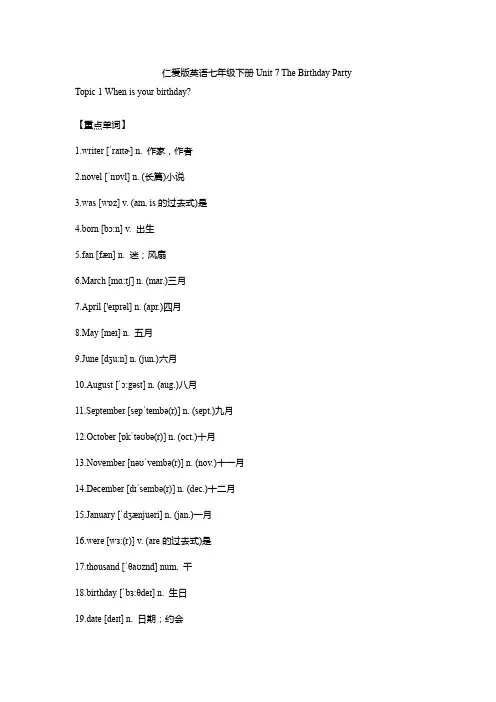
仁爱版英语七年级下册Unit 7 The Birthday Party Topic 1 When is your birthday?【重点单词】1.writer [ˈraɪtɚ] n. 作家,作者2.novel [ˈnɒvl] n. (长篇)小说3.was [wɒz] v. (am, is的过去式)是4.born [bɔ:n] v. 出生5.fan [fæn] n. 迷;风扇6.March [mɑ:tʃ] n. (mar.)三月7.April ['eɪprəl] n. (apr.)四月8.May [meɪ] n. 五月9.June [dʒu:n] n. (jun.)六月10.August [ˈɔ:gəst] n. (aug.)八月11.September [sepˈtembə(r)] n. (sept.)九月12.October [ɒkˈtəʊbə(r)] n. (oct.)十月13.November [nəʊˈvembə(r)] n. (nov.)十一月14.December [dɪˈsembə(r)] n. (dec.)十二月15.January [ˈdʒænjuəri] n. (jan.)一月16.were [wɜ:(r)] v. (are的过去式)是17.thousand [ˈθaʊznd] num. 千18.birthday [ˈbɜ:θdeɪ] n. 生日19.date [deɪt] n. 日期;约会20.calendar [ˈkælɪndə(r)] n. 日历21.plan [plæn] v. &n. 计划,打算22.celebrate ['selɪbreɪt] v. 庆祝23.party ['pɑ:tɪ] n. 聚会,宴会;党派24.fourth [fɔ:θ] num. 第四25.fifth [fɪfθ] num. 第五26.sixth [sɪksθ] num. 第六27.seventh ['sevnθ] num. 第七28.eighth [eɪtθ] num. 第八29.ninth [naɪnθ] num. 第九30.tenth [tenθ] num. 第十31.eleventh [ɪ'levnθ] num. 第十一32.twelfth [twelfθ] num. 第十二33.twentieth ['twentɪəθ] num. 第二十34.present ['preznt] n. 礼物35.shape [ʃeɪp] n. 形状v. 使成为……形状36.ball [bɔ:l] n. 球;舞会37.afraid [əˈfreɪd] adj. 担心;害怕38.star [stɑ:(r)] n. 星;明星39.mouse [maʊs] n. 老鼠40.square [skweə(r)] n. 正方形;广场;平方adj. 正方形的41.circle ['sɜ:kl] n. 圈,圆圈v. 圈出42.triangle ['traɪæŋɡl] n. 三角形43.rectangle [ˈrektæŋgl] n. 长方形;矩形44.oval ['əʊvl] n. 椭圆adj. 椭圆形的45.centimeter ['sentɪˌmi:tə] n. (cm)厘米46.Mrs. [ˈmɪsɪz] n. 太太,夫人47.cake [keɪk] n. 蛋糕【重点短语】1.be born 出生2.look at 看3.plan to do sth. 计划做某事4.have a birthday party 举办生日聚会5.the shape of ……的形状6.be like 像……7.how long 多长8.how wide 多宽e ... for ... 用……做……【重点句型】1.—When were you / was he/she born?你/他/她是什么时候出生的?—I/He/She was born on/in …我/他/她出生于……2.—Where were you / was he/she born?你/他/她在哪里出生的?—I/He/She was born in …我/他/她出生在……3.—When is your birthday?你的生日是什么时候?—May 13th.5月13号。
仁爱英语七年级下册Unit7 Topic 2 Section A教案新部编本
教师学科教案[ 20 – 20 学年度第__学期]任教学科:_____________任教年级:_____________任教老师:_____________xx市实验学校仁爱英语七年级下册Unit7 Topic 2Section A教案The main activities are 1a and 3.本课重点活动是1a和3。
Ⅰ. Teaching aims and demands 教学目标1. Learn some useful words and expressions:take photos,row, skate2. Learn "can" and "can’t" for ability and inability:(1)—Can you sing Chinese songs at Kangkang’s birthday party?—Yes, I can.(2)—Can you play the guitar?—No, I can’t.(3)—Can you dance?—Yes, I can.(4)—Can you take photos?—Yes, I can.(5)I can’t sing any Chinese songs.Ⅱ. Teaching aids 教具实物/卡片/挂图/录音机Ⅲ. Five-finger Teaching plan 五指教学方案Step 1 Review 第一步复习(时间: 10分钟)1.(让学生以小组为单位,复习以前学过的动词短语。
)(学生四人为一小组,列出已学过的动词短语,看哪一小组写得最多。
) T: Work in groups. Write as many verb phrases as you can. Let’ s see which group can write the most phrases. One phrase one point.Now, let’s begin.(每组写完后,派一个代表向全班同学汇报,然后老师把这些词组板书在黑板上。
七年级下册英语-Unit7-It's-raining单元知识点总结2
最新人教版第七单元It’s raining单元知识点总结一、询问天气的句型及其答语.1.例句:--How’s the weather 天气怎么样-- It’s cloudy./It’s sunny./It’s raining.多云./晴天./在下雨.2.询问天气的句型:常见的询问天气的句型有:How’s the weather What’s the weather like ?两个句型后面都可以加“in+ 地点”,用以询问“某地天气如何”3.回答天气状况回答询问天气的问句时,通常用:“It’s +表示天气的形容词”。
常见的该类形容词有:fine(晴朗的)dry(干燥的) warm(温暖的) cold( 寒冷的) cool(凉爽的) hot(炎热的)rainy(下雨的)snowy(下雪的) sunny(晴朗的) cloudy(多云的)等。
同时也可以用现在进行时进行回答:It’s raining/snowing 正在下雨/ 下雪。
例句: --How’s the weather in your city—It’s war m.--What’s the weather like in Shanghai—It’s raining now.例1:How’s the weather in Shanghai( 同义句转换)例2.--- ___________________---It’s sunny today.A.How was the weather yesterdayB.How are you doingC.What fine weather!D.What’s the weather like today例3.—How’s the weather there---Great. It’s ______.I can make a snowman tomorrow.A.rainyB.sunnyC.cloudyD.snowy例4.连词成句:is What Beijing like the weather in______________________________________例5.单句改错:1.Howis the weatherlike ( )_________A B C D2.The weatheriswindy and rain. ( ) _________A B C D二、现在进行时1.例句:---What are you doing---I am cooking.---What are they doing---They’re playing basketball in the park.---What’s he doing---He’s studying at his friend’s home.2.用法:(1)表示说话时动作正在发生或进行。
仁爱版七年级英语下册教学设计:Unit7Topic2SectionC
3.教师总结学生的回答,引出本节课的主题:Volunteers are people who freely give their time to help others. They often participate in different activities to make a difference.
三、教学重难点和教学设想
(一)教学重难点
1.重点:本节课的重点在于让学生掌握一般现在时态的用法,包括肯定句、否定句和疑问句,并能运用该时态描述日常活动和爱好。
难点:学生在实际语境中灵活运用一般现在时态,尤其是在写作和口语表达中正确使用疑问句和否定句。
2.重点:本节课的另一重点是拓展学生的词汇量,特别是与日常活动和志愿者工作相关的词汇。
3.教学方法设想:
a.情境教学法:通过设置真实的日常活动场景,让学生在情境中感知、体验和运用英语。
b.任务型教学法:设计各种听说读写任务,引导学生积极参与,培养其英语综合运用能力。
c.混合式教学法:结合线上和线下教学资源,提高学生的学习兴趣和参与度。
4.评价方式设想:
a.过程性评价:关注学生在课堂上的表现,及时给予反馈,鼓励学生持续进步。
5.引导学生通过观察、模仿、实践等方式,发现并掌握一般现在时态的用法。
(三)情感态度与价值观
在本章节的学习过程中,学生将形成以下情感态度与价值观:
1.培养学生对英语学习的兴趣和自信心,使其乐于参与英语学习活动。
2.培养学生关爱他人、乐于助人的品质,使其认识到参与志愿者活动的重要性。
3.培养学生积极向上的生活态度,鼓励他们参与各种社会实践活动,拓展视野。
仁爱英语七年级下册Unit 7 英语重点短语句子语法梳理
七年级下册Unit 7 英语重点短语句子语法梳理Unit 7 Topic 1重点词组1. plan to do sth 打算/准备做某事2. want to do sth 想做某事3. have a birthday party 开个生日聚会4. make a cake 做蛋糕5.cook a big dinner 做一顿丰盛的晚餐6.buy sb sth =buy sth for sb 为某人买某物7. be born 出生8. how wide 多宽9. how long 多长10. how often 多久一次(表频率)11. how soon 多久,多块12. how far “多远”,问距离13. use...for... 用...做...重点句型:1.--When was he born?--He was born in June, 1997.2.--Where were you born ?--I was born in England.3.--When is your birthday?--May 2nd.4.-What day is it today?-It’s Sunday.5.-What's the date today?-It’s 13th, August.6.-What's the shape of your present?--It’s a circle./ rectangle / triangle/square.7.--How long/wide is it?--It’s...long/wide.8. --What do we use it for?--We use it to study English.9.--What’s it like ?--It’s like a star.重点语法1 英语中日期可以有两种表达法:(1)月日,年。
May 1st, 2008(2)日月,年。