
新冀教版五年级英语下册《Unit 3 Writing Home Lesson 14 Jenny Writes a Postcard》教案_4
Lesson14 Jenny writes a postcard教学设计一、课前系统部分(一)课标分析《英语课程标准》中明确指出,基础教育阶段英语课程的任务之一是:激发和培养学生学习英语的兴趣,使学生树立自信心,养成良好的学习习惯和形成有效的学习策略,发展自主学习的能力和合作精神;使学生掌握一定的英语基础知识和听、说、读、写技能,形成一定的综合语言运用能力。
并强调从学生的学习兴趣、生活经验和认知水平出发,倡导体验、实践、参与、合作与交流的学习方式和任务型的教学途径,发展学生的综合语言运用能力,使语言学习的过程为学生形成积极的情感态度、主动思维和大胆实践、提高跨文化意识和形成自主学习能力的过程。
我在进行本课的教学设计时,深入研究教材,结合《英语新课程标准》,通过多样的教学形式,努力倡导学生的积极参与,让学生在学习过程中促进语言实际运用的能力。
在教学过程中,通过设置问题让学生思考并解决,培养学生学习的积极性和主动性,同时注重让学生进行小组合作。
并创设情境为学生创造运用语言的机会。
(二)教材分析本课是小学冀教2011课标版(三年级起点)五年级下册第十四课Jenny writes a postcard. 本课为第三单元的第二课,本单元孩子们将学习关于信,明信片和电子邮件的词汇和表达。
学生有机会了解国外的学生怎样和朋友及家人保持联系。
他们能够对比中国人和外国人保持联系的方式。
本课围绕Jenny给父母写明信片,以此为主线,讲述了如何写明信片,如何书写姓名和地址,如何给明信片上贴邮票。
容易引起学生的兴趣,在教学中也容易产生共鸣和互动。
本课需要学生重点掌握的是如何写一封明信片,因此在学生自主合作以及展示模块写明信片占比重较大。
通过本课的学习,不仅能增进学生对中西方文化的认识,还能使学生了解,明信片不仅仅是一张张漂亮的风景,也承载着对亲人和朋友的思念。
(三)学生分析1. 五年级的学生已经具备了一定的听、说、读、写能力,掌握了一定的英语词汇,具有一定的英语学习的积极性与主动性,具备了一定的英语语言的运用能力,大部分学生能够用简单的英语进行话题的讨论。
通过本单元第13课的学习,学生已经对信、明信片及电子邮件有了一定的了解,能围绕此话题进行简单的讨论。
并且五年级学生的好奇心有所增加,对新知识有所思考,探索,学习的兴趣更加广泛。
2. 学生存在的学习问题主要包括以下几方面:第一,一小部分学生不爱参与到课堂之中,不愿与他人合作。
第二,个别学生学习习惯不好,课上注意力不集中。
这个问题在分组上进行了调整,由组员带动,教师提示,使学生融入小组,从而减少两个问题的出现。
3. 学习需要:五年级学生的求知欲强烈,对于英语,学生们最渴求的是会说,会运用,所以在进行教学设计时,首先将词汇的听、说、读项目在课前进行渗透,课上尽量多的设计了组内交流,小组展示任务让学生更好地应用英语语言。
4. 学习行为:学生的学习行为在进行新课改之后明显转好。
能在课前准备好课上常用物品,课上认真听讲,积极参与讨论交流。
组内做的不好的同学会有组长、组员、教师进行监督、提示。
(四)教学目标1. 三维目标语言知识目标1)学生能听、说、读、写单词:write, mum, dad, dear, fine, left, right.2)学生能认读、理解并运用下列基本句型结构:Where do you write on a postcard? On the left.Where do you put the address? On the right.语言技能目标学生能熟练运用句型:Where do you write on a postcard? On the left. Where do you put the address? On the right.就如何写明信片这一话题进行交流。
学习策略目标1)通过小组合作、讨论,培养学生英语思维及团结互助学习的习惯。
2)贯穿了课堂教学始终的形成性评价包含了自我评价和他人评价,有利于学生发展调控策略,形成自主学习能力。
3)学生自主探究的学习模式,能开发学生自主学习能力,小组合作以及展示等可以开发学生的合作能力以及表现力。
情感态度目标1)通过学习,增进学生对中西方文化的认识,使学生了解,明信片不仅仅是一张张漂亮的风景,也承载着对亲人和朋友的思念。
2)开展丰富的合作学习,引导学生积极与他人合作,让学生在小组合作中积极参与,大胆交流,在活动中培养学生的协作能力。
3)学生通过学习学会唱一首关于明信片的歌。
使学生乐于学习英语,激发学生的学习兴趣,调动学习积极性。
4)运用多媒体参与英语教学,用生动的视、听方式刺激学生的感知,激发学生的求知欲。
文化意识目标学生能够对通信文化有所了解。
2.教学重点与难点本课的重点在于:使学生学会如何书写明信片,如何写姓名和地址,如何给明信片贴上邮票。
本课的难点在于:学生实际动手写一封明信片。
(五)教学策略1)视听法:主要通过多媒体课件展示、图片展示、老师提问、学生回答、小组合作等方式,提供给学生看、听、说的机会来练习所学的内容。
2)实施情境教学法3)采用任务型语言教学(六)教学用具1. 教学环境的设计与准备:准备配有电子白板的教室。
2. 教学用具的设计与准备:设计PPT,准备明信片和邮票。
二、课堂系统部分——教学过程(一)课前预习:提前下发导学案,以导学案上的模块引导学生进行预习。
(二)课前导入:在课前几分钟播放本课歌曲,以歌曲激发孩子们的上课热情,使学生能快速融入英语课堂。
(三)开始上课1.Greetings!2.Let’s play a guessing game!教师引导学生玩一个小游戏,教师对物品进行描述,学生来猜测。
复习13课学习的通信方式letter, postcard, email.(游戏方式复习上一课学过的内容,学生较感兴趣,学生参与度高)3.向学生展示老师的明信片,并向学生介绍明信片:My postcard has a picture of________. I want to send it to ________. 请学生仿照老师来介绍自己的明信片。
(允许学生自由发挥)(利用一个展示小活动引导学生练习句型,并对展示的学生发“奖品”—邮票,来予以鼓励,同时鼓舞更多学生来展示。
)4.在介绍明信片之后向学生提问“Do you want to write a postcard? How to writea postcard?”导入本课。
(利用PPT展示本课内容结构,让学生了解需要学习的内容,更加有条理性。
)5.导入本课词汇,利用多媒体展示词汇图片,将词汇放入句子或词组中,让学生重复单词、词组、句子。
(学习单词,将单词放入词组、句子中,潜移默化的引导词汇的使用)6.利用PPT展示明信片,介绍明信片的每一部分。
并对address, date进行复习与练习。
(为写明信片做准备)7.看课文动画视频,思考“How to write a postcard?”8.跟读课文,自读课文并小组讨论“How to write a postcard?”9.教师提问“Where do you write on a postcard?”“Where do you put the address?”并请学生来回答。
(导入本课句型)10.Pair work:学生互相问答“Where do you write on a postcard? On the left.”“Where do you put the address? On the right.”(练习本课句型,加强每一个学生的口语练习)11.Let’s look at Jenny’s postcard! 齐读明信片并提问,请学生进行回答。
12.Let’s write a postcard to our father or mother. (给出情境,让学生写明信片,让每一个学生都参与到实践活动中,可小组合作,学生之间相互交流,互帮互助)13.小组展示:展示明信片,并投进“邮筒”。
(对每组的展示进行评价,鼓励学生大胆尝试,让学生体会到学习英语的乐趣。
)14.Let’s sing a song!(引导学生学唱歌曲,在歌曲中结束本课。
)板书:(四)课堂总结部分引导学生回忆本课内容,并点拨明信片不仅仅是一张张漂亮的风景,也承载着对亲人和朋友的思念。
(五)课后作业部分课后作业:1、句型问答匹配。
(复习本课学习的句型以及单词)2、完成基本功训练拓展运用。
(本作业为根据凯特的明信片写一封回信,考察学生知识的运用。
)三、课后系统部分——教学后记本堂课的设计大部分都进行的很顺利,但是也有一些不足之处。
例如,1)学生发音问题,对于一些词汇,学生在记忆发音时出现困难,但课堂时间有限,没能引导学生进行多次重复记忆。
应该利用一部分时间来引导学生重复记忆,或者使用一些小办法,来帮助学生记忆加强记忆。
2)时间的掌控。
因为本课设计的教学内容稍多且需要展示偏多,但是时间有限,较难掌握。
但是本堂课的设计完成的较好,每一个教学目标都达成。
展示环节学生比较有兴趣,知识运用较强,无论是复习旧知识还是新知识的学习及运用都很好地锻炼了学生的表达及表现能力,让学生参与到课堂中来。
让学生积极、自主地学习,提高学生学英语的兴趣。
通过本堂课,我认为我应进行以下改进。
1、加强语音学习。
在平时的学习及日常生活中,多为学生引入一些语音知识,多分析,多朗读,体会发音,感受发音规则,在遇到不认识的词汇时,鼓励学生自己拼读,在摸索中不断进步。
2、教学设计应更严密、更科学,尤其要预留出学生活动的时间,加强教学设计能力,更科学地进行预设。
经过这次课堂教学的反思,我总结出了自己在本课教学中出现的问题,我会把问题进行总结,并将今后的教学反思中出现的问题,进行分类,并逐一攻克,这对我今后更科学的进行教学设计,以及选取教学手段有很大助益。
冀教版五年级英语下册第13课
This is a letter.
We write a letter on paper.
These are letters.
This is an email.
We write an email
on
a computer.
These are emails.
This is a postcard.
3、some us buy let postcards(!)
Let us buy some postcards!
4、 has it picture a the Great Wall of (.)
It has a picture of the Great Wall.
5、that I see may postcard please (?)
May I see that postcard , please?
Focus on
Thank you
How much is this postcard?
It’s two yuan.
I’ll take nine , please.
1.How much is the postcard? It’s three yuan. 2. How much is the cap? It’s ten yuan. 3. How much is the T-shirt? It’s fifteen yuan. 4. How much is the book? It’s twenty--three yuan. 5. How much is the panda? It’s thirty yuan.
3、再听录音,边听边响亮地跟读。
4、自告奋勇,领读课文,其他学生跟读。
5、指名同桌互读,男女对读,分角色朗读。其他同学耐心倾听 ,查找本课重点句型。
九年义务教育2020年编五年级英语下册Unit3WritingHomeLesson18LittleZekeSendsanEmail作业冀教版三起
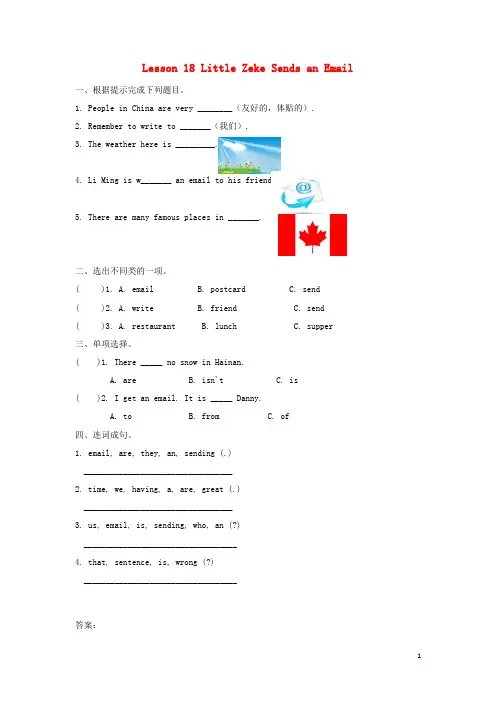
Lesson 18 Little Zeke Sends an Email一、根据提示完成下列题目。
1. People in China are very ________(友好的,体贴的).2. Remember to write to _______(我们).3. The weather here is _________.4. Li Ming is w_______ an email to his friends.5. There are many famous places in _______.二、选出不同类的一项。
( )1. A. email B. postcard C. send( )2. A. write B. friend C. send( )3. A. restaurant B. lunch C. supper三、单项选择。
( )1. There _____ no snow in Hainan.A. areB. isn'tC. is( )2. I get an email. It is _____ Danny.A. toB. fromC. of四、连词成句。
1. email, are, they, an, sending (.)__________________________________2. time, we, having, a, are, great (.)__________________________________3. us, email, is, sending, who, an (?)___________________________________4. that, sentence, is, wrong (?)___________________________________答案:一、1. friendly 2. us 3. sunny 4. riting 5. Canada二、1. C 2. B 3. A三、1. C 2. B四、1. They are sending an email.2. We are having a great time.3. Who is sending us an email?4. Is that sentence wrong?赠送试卷五年级Module2T,不同F。
2022年五年级英语下册Unit3WritingHomeLesson15SendingthePost

6. How to get to the Garden Hotel?(在文中找出同义句)
___H_o_w__c_a_n__I_g_e_t_t_o_t_h_e_G__a_r_d_e_n_H__o_t_el_,_p_l_e_a_se_?____
4. The bookshop is ___f_a_r___ from the zoo.
五、请为下列句子选择相应的答语。 ( D )1. Where is the park? ( E )2. How much are the pictures?
A. Thank you! B. Yes, but not now. C. He's sleeping. D. Turn right at the traffic lights. E. They are ten yuan.
六、仿照例子,对画线部分提问。 例:It's fifteen yuan. How much is it? 1. The post office is near the zoo. ___W__h_e_r_e_i_s_t_h_e_p_o_s_t_o_f_f_ic_e_?____________
2. I'll take three pens. ____H_o_w__m__a_n_y__p_e_n_s_w_i_ll__y_o_u_t_a_k_e_?______
B. write; to
C. writing; to
方法点拨:本题用固定搭配法解答。take one's picture给某人拍照,是固定搭配。
( A )5. You can see the computer room________
the left.
A. on
新冀教版五年级英语下册《Unit 3 Writing Home Lesson 17 Danny.s Email》教案_14
通过小组活动,让学生主动参与,自主学习的教学模式,让学生主动去学习并掌握邮件的书写格式。
根据第2部分内容,也编写一段对话。
Step 4. Role play
Act it out to practice saying goodbye at the airport.
完成本课的英语练习册
学生独立完成
板书
设计
Lesson 17.Danny's Email
kind, us,forget , famous , remember , place
How’s the weather in Canada?
Is it snowy?It’s sunny.
There is no snow.
2.学生能认读、理解并运用下列基本句型结构:How’s the weather in Canada?Is it snowy?It’s sunny.There is no snow.What a great trip!
重点难点
1.能听、说、读、写单词:forget、famous、remember、placekind、us2.能够熟读课文
出示Danny的电子邮件,提出以上问题,学生讨论交流,并回答问题。
学生学会心的单词kind.
根据课本录音,迅速的阅读教材内容。
程序
教师行为
期望的学生行为
评注
Step 3. Presentation
1.Pair work : Each pair makes a dialogue about Danny’s email.
What a great trip!
教学
反思
冀教版五年级英语下册第3单元单元《Lesson 14》
( 2)I send it __t_o___ you. 点拨:send sth. to sb. 把某物寄给某人。
from to of in on ( 3)It is not far _f_r_o_m__ Tian’an men Square.
1 熟记本节课所学的句型、短语和单词,必须会 听、说、读、写。
2 将Let’s write a postcard的内容朗读流利。 3 完成课后作业。
知识点 4 write /raɪt/ v. 写 发音:字母i 的发音是/aɪ/。 例句:I want to write a letter to my brother. 我想要给我的哥哥写一封信。 句型:write an email 写一封电子邮件 write down 写下来
同音异形词记忆法:right 右边
本节课我们学习了以下知识,请同学们一定加 强巩固,以便能和同学们进行灵活交流哦! 重点词汇:mum, dad, dear, fine, write, left, right 重点短语:write down, on the left/right 重点句式:I am fine.
What a fine day !
词形变化:write(原形)→ writing(现在分词) → wrote(过去式) → writer(名词)作家
知识点 5 left /left/ n. 左边
短语:on the left 在左边 例句:You can write on the left of the postcard.
你可以在明信片的左边写内容。 歌谣记忆法:left 左,right 右。中间中间是middle。
五年级英语下册Unit3WritingHomeLesson13《Let’sBuyP
2.Who does she send the postcard to?
She wants to send this postcard to her mum and dad.
3. How much is 源自he postcard ?This postcard is two yuan.
One yuan.
明信片
电子邮件 信
e-mail on a computer. 1、You write an ______ send this postcard ___ to my mum and dad. 2、I want to _____ 3、How much ____ for this postcard? Five yuan.
Lesson 13 Let's buy postcards!
Dear Mum, I am in Canada, How’s the weather in Beijing ? Is it snowy?
April 17 Dear Steven, How are you? I’m very well in beijing. Beijing is great . See you soon. Danny
多少钱?
How much for this postcard?
I’ll take nine, please.
How much ......
¥8 ¥ 12 ¥1 0
A: What does this postcard have? B: It has a picture of __________________ the Palace Museum on it. A: How much is it? one yuan B: It’s _________.
新冀教版五年级英语下册《Unit 3 Writing Home Lesson 18 Little Zeke Sends an Email》教案_2
教学设计Writing (6分钟) Teacher evaluates the studentsI want to send an email to LittleZeke. Can you help me?Pay attentionTeacher evaluates the studentsWriteShow利用写邮件考察学生能正确的书写邮件的能力。
Summary (3分钟)1.How many ways do you contact with yourfriends?2.Keep in touch with your friends常和朋友保持联系3.Evaluation of students at different levelsHomework (1分钟)1. Retell the story to your friends.2. Send an email to me.板书设计L esson18 Little Zeke Sends an Email反思:在开展阅读教学时,让学生通过故事阅读掌握大量的阅读技巧,会极大地降低阅读教学难度,提高学生的阅读理解和推理能力。
英语教师要不断革新自己的教学思路,创新教学方法,采用灵活多样的教学策略,提高小学英语故事阅读教学的有效性。
本节课我从听读说写四个方面进行设计,指导学生在读前读中读后运用不同的阅读策略进行学习,比如我让学生通过寻读、略读、猜测词义、设疑引导下文等阅读策略,培养学生的阅读意识,促进学生理解故事能力的发展,提高阅读能力。
本节课目标基本达成。
本节课亮点有:1.在阅读的准备环节,我向学生简单地介绍故事发生的背景,从而引导学生进入到相应的故事情境当中,另外通过阅读准备工作能够让学生为阅读当中的词汇和重点句型语法的学习做好知识准备,从而提高阅读效率。
2.我设计了较为科学合理的阅读问题。
在提出的阅读问题尽量是需要学生通过观察思考才能解决的,并且要从整体上保证难易适当和层次清楚让学生理解文字的实际含义,让学生通过想象和深入挖掘理解来获得答案,拓展思维。
冀教版五年级英语下册 Unit3 Lesson 17 Danny's Email授课课件+作业
习题源于《典中点》
六、阅读下面的电子邮件,完成任务。 To: rose@ From: brian@compmail.ca Subject: A trip to Shanghai. Dear Brian, I'm in Harbin now. How's the weather in Canada? It's cold and snowy here. I'm having fun.
A: __A_r_e__th_e_r_e__ any _c_o_m__p_u_te_r_s_ in the room? B: Yes, there are.
习题源于《典中点》
4. A: __D_o_n_'_t__ forget to__w_r_i_te___ your name. B: OK!
5.
A. in
B. to
C. from
( B )2. —________ the weather in Beijing?
—It's rainy.
A. What's
B. How's C. How
习题源于《典中点》
( A )3. I get an email. It's________ Anna.
A. from
an︶egg look out
︶ look︶at
in front︶of an orange
︶ ︶put on
get︶up a map of China
︶
一、选词填空。
习题来自《点拨》
in to from on ( 1) It’s sunny ___i_n___ Beijing. ( 2) Say hi ___t_o___ your friends. ( 3) She will come to Beijing ___o_n___ February 12. ( 4) This is an email __f_ro_m___ Steven.
冀教版英语五年级下册Unit 3 Lesson 15 Sending the Postcards课件
Go straight. Turn left at the traffic lights. You will see the hotel on the right.
Excuse me, where is the hotel?
Thank you.
Practice with your partner.
3.—__H_o_w__m__u_c_h_a_r_e__th_e_s_e__sh_o_e_s_? —__T_h_e_y_’_r_e_8_0_y_u_a_n__________.
¥10 ¥80
Homework
1. Read and perform the dialogue in the text. 2. Prepare a simple map to show how you get
B. what; at
C. where; at
4.Don’t worry. There’s nothing ______.
A. right
B. wrong
C. OK
5.You will _____ the hotel on the right.
A. seeing
B. sees
C. see
二、看图,仿照例句写对话。
⑤Could you tell me the way to...? 你能告诉我……的路吗?
⑥Can you tell me how to get to...? 你能告诉我怎样到达……吗?
⑦Can you tell me which is the way to...? 你能告诉我哪条路是去……的吗?
¥30
How much is…? this/that ¥15
How much are…? these/those ¥8
冀教版五年级英语下册第3单元单元《Lesson 13》
1.Look, write and draw. a Li Ming:I want to send a letter to my uncle. b Steven:_I_w__a_n_t_t_o_s_e_n_d__a_p_o_s_t_c_a_r_d_t_o_D__a_n_n_y_._ c Danny:_I_w__a_n_t_t_o_s_e_n_d__a_n_e_m__a_il_t_o__m_y__m_u_m__._ d I: ________________________________
John:___D___ Shop assistant: They are twelve yuan.
John: OK. ___B___
A. May I see these postcards,please ? B. I’ll take them. C. It has a picture of the Great Wall. D. How much are these postcards ?
三、选择合适的选项补全对话。
John: Look at this postcard.___C___ Jason: Oh,it’s great ! I want to send this postcard to Mum.
John: It’s good. __A____ Shop assistant: Sure !
拓展 how much 还可以用来提问不可数名词的数量。 其结构为“How much + 不可数名词+ 其他?”。
例句:How much water is there in the bottle ? 瓶子里有多少水?