
最新人教版新目标八年级英语初二上册Unit2单元教案(5课时)
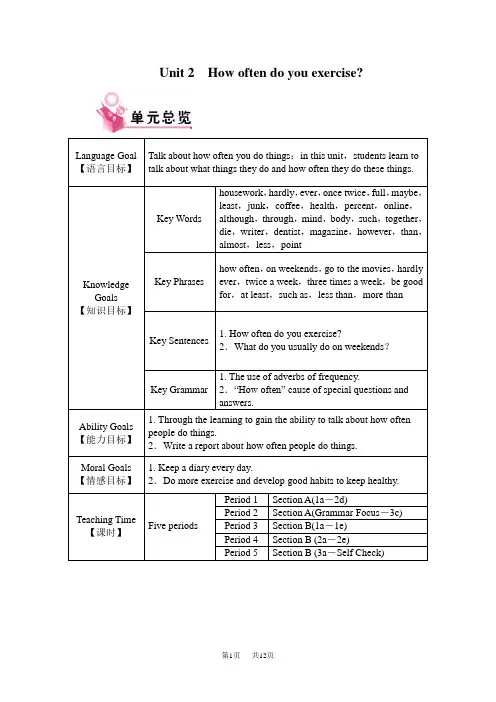
Unit 2 How often do you exercise?第一课时Section A (1a~2d)【学习目标】1.学生能掌握六个频率副词的用法。
2.学生能听懂谈论各项活动的对话;学会用英语谈论做各项活动的频率。
3.通过完成各项活动,学生能够养成团结协作的意识,并能合理利用时间。
【学习重点】学生能够学会用六个频率副词谈论做各项活动的频率。
【学习难点】通过交流表达和听力训练,掌握六个频率副词Learning action tips:Play the video about students' activities on weekends in class. Let students watch it.Task 1Learning action tips:Preview the words on Page2 in the word list. Students read the words by phonetic symbols, then underline new words in the text and mark the Chinese meaning. At last finish the task in 1a.【知识链接】▲once,twice,three times等次数的表达法(1)这三个词都表示次数,once是一次,twice是两次,除了一次、两次,其他的次数都用“数字+times”表达。
如:三次是three times,五次是five times。
(2)这些表达数的词后与一段时间连用,表示动作多长时间发生几次,即动作的频率。
【导练】(1)我一周看一次电视。
I watch TV once a week.(2)我每天读三次英语。
I read English three times__ a day.情景导入生成问题T:What do you usually do on weekends?S1:I usually play basketball.S2:I often go shopping.S3:I sometimes help my parents with housework.自学互研生成能力Task 1Let's read new words and the phrases.1.I can read.(我会读)housework,once,twice,Internet,program,always,usually,often,sometimes,hardly ever,never2.I can write.(我会写)翻译下列短语和句子。
(1)帮忙做家务help__with__housework(2)在周末on__weekends(3)去看电影go__to__the__movies(4)一周两次twice__a__week(5)上网use__the__Internet(6)动物世界animal__world(7)hardly ever几乎不(8)How often do you watch TV?你多久看一次电视?(9)我从不逛街。
I__never__go__shopping.(10)I exercise three times a week.我一周锻炼三次。
3.I can summarize.(我会总结)频率副词hardly ever的用法:hardly ever意为“几乎不”,表示否定概念。
一般位于实义动词之前,be动词、助动词或情态动词之后。
如:Lucy hardly ever calls me.露西几乎不给我打电话。
Peter is hardly ever late.彼得几乎不迟到。
【拓展】频率副词的比较:always(100%)usually(80%)often(30%-50%)sometimes(20%) hardly ever(5%) never(0%)(1)汤姆几乎不做运动。
Tom hardly ever takes (take)exercise.(2)平时,他几乎不在家。
He is hardly ever at home on weekdays.(3)—I saw you come to school by bus this morning.—Oh,I __B__ come to school by bus,but it is raining today.A.usually B.hardly ever C.sometimesTask 2Let's listen to the tape and finish 1b,2a,2b.Task 3Make conversations and interview.How often多久一次用来提问动作发生的频率。
如:—How often do you go to the library?你多久去一次图书馆?—Once a week.一周一次。
【备注】我们学过的有关how的疑问词组:how old多少岁how much问不可数名词的数量多少how many问可数名词的数量多少how far多远how long多久;多长Task 2Learning action tips:1.Students turn to Page9 and listen to the tape, finish the listening task in 1b. Students listen to the tape again andrepeat.2.Students turn to Page10 and listen to the tape, finish the listening tasks in 2a and 2b. Then students listen again and repeat.【Method coach】听录音时,要求学生注意用笔标记:(1)断句:“|”(2)语调:升调 降调(3)重读单词:△(4)不会认读的单词:____模仿纯正的语音语调,朗读听力材料,培养学生的语言交际能力。
Task 3Learning action tips:Students read aloud the dialogue to imitate and make the dialogue and have practice with“How often do you…?I …twice a week.”And interview classmates and have a report.【备注】1.I can practice.(我会练)阅读2d,完成下列对话。
A:Grace.Are you free next week?B:Next week (1)is__quite__full__for(相当忙)me.A:Oh,really?(2)How__come(怎么会呢)?B:I have dance and piano lessons.A:(3)What__kind(哪一种)of dance are you learning?B:Swing dance.A:(4)How__often(多久)do you have the piano lessons?B:(5)Twice a week(一周两次).2.I can make conversations.(我会编对话)结合课文内容运用how often编写对话,介绍自己课余生活做某事的频率。
A:How__often__do__you__watch__TV?B:I__watch__TV__every__day.A:What’s__your__favorite__program?B:Animal__World.A:How__often__do__you__watch__it?B:Twice__a__week.交流展示生成新知Preshow:Show in groups. (Time: six minutes)Task 1:First read the words and phrases in groups,then read together and sum up the usage of the words in groups,mark the difficult words in pronunciation and understanding(students can ask teacher for help).At last,write them on the blackboard.Task 3:First discuss and check the answers of Task 3 in groups, then discuss and set scenes to perform the dialogues, interview students about their holiday activities.At last,write them on the blackboard.Promotion show: Class show. (Time:sixteen minutes)Task 1: 1.I can read.(1)Read together,pay attention to the pronunciation of “Internet”“program”;(2)Consolidate the words by word games.2.I can write.(1)Translate the phrases into English or Chinese by answering quickly;(2)Read together;(3)Spot test:consolidate the usage of the phrases by making sentences,master the key sentences by imitating.3.I can summarize.(1)Sum up the usage of frequency adverbs with the phrases in “I can write”; (2) Spot test:finish the exercises to consolidate the usage of frequency adverbs,check the answers by answering quickly and explain.Task 3: 1.I can practice.(1)Choose some students to translate the key sentences in Task 3;(2)Read together.2.I can make conversations.(1)Make dialogues according to the task;(2)Set scenes to perform the dialogues;(3)Question students randomly according to the dialogues.当堂演练达成目标根据句意和汉语提示填写单词。
新目标八年级英语上册unit2教案

新目标八年级英语上册Unit 2 教案What’s the matter?Part 1: T eaching design (第一部分:教学设计)SECTION A Goals●To learn to use have for talking about health problems ●To learn uses of Modal should/shouldn ’t ProceduresWarming up by learning grammarTo begin with, go to page 8, and let ’s learn to use have for talking about health problems and modal verbs should/shouldn ’t. Warming up by discussing Hello, everyone!Can you name the parts of your body? How many parts of the body can you name? Let’s look at the doll and name the parts of the body.Now let’s read the words together.Keeping healthy is very important. So today we will talk about it. Let’s look at Unit 2 What’s the matter? 1A Writing the lettersNow open your books and turn to page 7. Please look at the picture and read the name of the body parts. OK. Now look at the picture of the students numbered 1 through 5. Several body parts are marked with the letters a ~ m. Write the correct letter after the name of each body part on the list. Y ou must completethe activity individually.Let’s check the answer, please.1b Listening and numberingCan you tell what part of the body doesn’t feel good? Now let’s learn the new words in the picture. Please read after me.Good. Let’s listen to the recording. There are conversations about each of these five students. Look at the picture and find the people that are being talked about. Listen to the tape and write the number next to them in the picture next to their names. The first one has been done for you.Let’s check the answers, please.And finally let’s read the tapescript to blacken all examples of have for talking about health problems andexamples of modal should/shouldn’t.1c Doing pairworkCan you express what part of the body doesn’t feel good now? Work in pairs. Makeyour own conversations out of the picture on page 7. Then present your conversations tothe whole class, using have for talking about health problems.2a Listening and matchingTaking care of your friends or family member is very important. Now please lookat page 8, 2a. Read the eight items in this activity. When you read you must callattention to the meaning of the new words.Then listen to the recording. On this recording there are four different conversations. People are talking about health problems they have and are getting advice for them. Draw lines to match the problems with the advice.The first time, you only listen. The first one has been done for you. The boy has a toothache and the advice is to see a dentist.The second time, you draw lines to match the problems and the advice.Answers:2b Listening and fillingV ery good. These conversations are illustrated by the pictures. Now listen again and fill in the blanks. Firstlook at the four pictures. Each of these pictures illustrates one of the conversations. This time, listen for the missing words. Write the missing words on the blank lines.Now read the tapescript and blacken all examples of have for talking about health problems and examples of modal should/shouldn’t.2c Doing pairworkNow let’s look at a conversation. Who wants to read it to the class? Y ou two, please.Good. Y ou are going to make a conversation in pairs using the information from activities 2a and 2b.Take turns having problems and giving advice.3a Filling the blanksHere is a picture. Look at it. A boy is sick. A teacher is talking to him. Now read the conversation on the left, please.Think of how you can complete the conversation. Write the answers in the blanks.Answers:3b Doing pairworkBefore doing the pairwork, practice the dialogue in activity 3a with your partner. (Ss act it out)Good. Now look at the picture on page 9 and ask and answer what’s the matter with the people in the picture. At last, present the conversation to the class.4 Doing group workAre you tired? Now we are going to do a game “mime an illness”.For example, hold tooth as if you have a toothache. One students stand in front of theclassroom and mime an illness. The other students guess the illness and advice. Y ou can ask and answerlike this:Then fill in the chart.Closing down by asking and answering—What’s the matter?What’s the matter?I have a toothache.I have a sore back.I have a sore throat.I have a stomachache.…SECTION BGoals●To talk about your health●To learn the habits of different countriesProceduresWarming up by asking and answeringToday we are going to learn Section B. First let’s ask and answer questions aboutillness, using have for talking about health problems and modal verbsshould/shouldn’t.1A: Matching the words you studyNow open your books at page 10. Let’s look at the words together. Pleaseread after me.V ery good. Please look at the picture and match the words with the picture.Let’s check the answers.1b MatchingLook at the pictures. The person in each picture is giving advice. What advice are the people giving? Let’s discuss the pictures.Now match each picture with one piece of advice. Write the letter of the picture in front of the sentences that give advice.2a Listening and writingGina,Tony,Julie and Alan are talking about thehealthy problems. Look at this chart. Read thenames on the left. Pay attention to the sample answer after Gina’s name.Now listen to the recording. There are four conversations. Write the problems in the blanks after eachperson’s name.Answers:Read the tapescript to underline all examples of modal should/shouldn’t.2b Listening and matchingNow I will play the recording again. This time, write what each person should and shouldn’t do for their problem.I’ll give a pause after each conversation.Please listen and write.Let’s check the answers.2c Doing pairworkAfter listening to the conversation, can you make up a conversation? Look at the conversation on the right. Y ou two, please. Read it to the class.Now use the information in activity 2a to make conversation with your partner.3a Reading and underliningWe are going to read the article on page 11. First we shall read to the tapetogether and try to blacken all the useful expressions.Next we are going to read aloud the article slowly and clearly. We will try to understand the meaning of the article.. For example, are you often weak and tired?foods, like beef. Eating Dangshenare too stressed out and angry may have tooFinally read the article again. Underline each thing you should do.3b Filling in the blanks in the articleHere is an article. It doesn’t finish. Please read it carefully, circlethe expressions and finish the activity.Let’ check the answers. Li Li, please read your answers to the class.3c.Writing an article“Do you have a cold?” Please write some advice to a person who has a cold. What shouldhe or she do? What shouldn’t he or she do?4 Doing groupworkWe can choose a problem from the list below:Write it on a piece of paper. Then go around the room and ask other students for advice about your problem. Write down the best advice. Write the name of the student, too.Closing down by asking and answeringAfter a long time learning, we are tired. Now let’s have a relaxation by asking and answering about somehealth problems.SELF CHECKGoals●To revise the vocabulary.●To revise the target language in this unit.ProceduresWarming up by having a dictationToday we are going to learn Self Check to revise the target language. Before learning, let’s have a dictation first.1 Filling in the blanksThere are five sentences in the box. First use the words given to you to fill in the blanks. Then check the answers.Next make your own sentences.2 WritingImagine that you and Sally are on a student exchange program.Read her letter, underline the useful expressions, shadow the connectives and write back to give advice.Model:Just for fun!Let’s sing a song in English.Wee Willie WinkieWee Willie Winkie runs through the town,Upstairs and downstairs in his night-gown,Tapping at the window, crying through the lock,"Are the babes in their beds,For it's now ten o'clock?"Part 2: T eaching Resources (第二部分:教学资源)I. Believe it or not, by imagination you can also lose weight.If we can gorge on fatty bacon and still lose weight, how else can we beautifyourselves and still remain lazy slobs? Here are some fitness plans for exercisehaters:"Soda Stretches," an arm-strengthening workout, in which you use soda cans as barbells. This is designed to loosen joints, increase circulation and, ultimately, inspire more vigorous activity.Toilet Training: Use bathroom fixtures as gym equipment. Hang your legs over the side of the tub and you're ready for stomach crunches. For upper body strength, do push-upswith your hands on the toilet seat and your feet put on the tub.Shop Till You Drop: Walking is the easiest way to stay in shape, and a mall is a large area that's safe and temperature-controlled.Imaginary Exercising: Psychologists in England have issued a study that could fulfill every couch potato's deepest wish: They say just thinking about exercise stimulates your muscles. The simple act of visualizing exercise makes a difference.II. American DietThese days Americans are more and more concerned with watching theirweight. Perhaps as many as 70 million Americans are on weight-reducingdiets, and weight control has become a multibillion-dollar business. Americansupermarkets sell a variety of diet foods such as diet soft drinks, diet candy,and diet salad dressings. Dieters also spend money on diet pills, exercise machines, and jogging suits. Each year dozens of new diets are popularized. They have such names as the Miracle Diet, the Nine-Day Wonder Diet, and the Easy 24-Hour Diet. There is even one called the Ice Cream Diet, which advises thedieter to eat only ice cream for lunch and dinner! For dieters who cannot lose weight on their own, there are many well-organized diet groups, which offer help and encouragement.III.Word studies (词语学习)1.mattern.1. [U]物质what everything is made of: Most matter has three states. 大多数物质具有三种状态:固态、液态和气态。
【人教】新目标八年级英语上册Unit2单元教案
Unit 2How often do you exercise?本单元的教学内容围绕“多久做一次运动”这一话题展开。
Section A是基本语言内容的收集和学习,这一部分引导学生通过本课的语言素材进行看图说话、句型演练、实际描述,通过对话表演等使学生能够正确地使用表示做什么活动的词组,多久做一次的句型,从而熟练地谈论多久做一次活动。
Section B是知识的扩展和语言的综合运用,是在Section A的基础上,锻炼学生能够自如地谈论自己的生活习惯。
这些内容都是与学生日常生活紧密相关的,学生很熟悉,也乐于去说,因此在这一课题的教学过程中,应紧密联系学生生活实际,采用多种方式,以说为主,配合听的练习,最终以对话为途径,解决本课题的中心语句。
这易于引发学生学会运用简单的英语进行交际和交流,也对提高学生的综合能力,特别是说的能力很有帮助。
学生通过对本单元的学习,可以引导他们养成良好的生活习惯和饮食习惯,从而合理安排自己的各项工作,享受丰富多彩的校园生活。
第一课时Section A(1a-2d)Teaching Goals【教学目标】Key words:housework,hardly,ever,once,twice,Internet,program,full,swingKey phrases:how often,on weekends,go to the movies,help with housework,hardly ever,go shopping,once/twice a week/a month,swing danceKey sentences:1.What do you usually do on weekends?I often go to the movies.2.How often do you watch TV?I watch TV every day.Teaching Key Points【教学重点】The vocabulary:housework,hardly,ever,once,twice,how often,on weekends,go to the movies,go shopping,help with housework,once/twice/three times a week/a month Target language:What do you usually do on weekends?I often go to the movies. Does he go shopping?No,he never goes shopping. How often do you have piano lessons?Twice a week,on Wednesday and Friday.Teaching Difficult Points【教学难点】1.The adverbs of frequency:always,usually,often,sometimes,hardly ever,never2.Target language above.Teaching Aids【教学工具】An English textbook,a tape recorder,CAI or courseware.Teaching Steps【教学过程】★Step 1Leading in1.Greetings:Talk about something the students did on summer vacation.2.Check the homework.★Step 2Pre-taskPage 9,1a.1.Look at the picture.2.Name each activity.T:What are they doing?S:They are shopping/reading/exercising/watching TV/helping with housework.(Help the students to answer.)3.Write the activities on the line.4.Check the answers on the board.5.Practice reading.Page 9,1c.1.Focus on the conversation in the box.2.Practice reading.3.Pair-work:What do you do on weekends?I...4.Group-work:Divide the class into groups of four or five. Make conversations. First S1 to S2:S1:What do you do on weekends?S2:I...S1:What does she/he do on weekends?S2:She/He...5.Act out their own dialogues.★Step 3While-taskPage 9,1b.1.Look at each picture above 1a.Tell what the person does on weekends. Check the Ss orally.2.Make sure what they will hear and do.3.Read these adverbs and explain.4.Play the tape twice. Write the letters on the line.Page 10,2a & 2b.1.Read the activities and the answers of “how often” first.2.Practice reading.3.In 2a we should know the activities you hear. In 2b we should know the answers of how often he does the activities.4.Play the tape for the first time. Ss only listen.5.Play the tape a second time. Ss do 2a.6.Play the tape a third time. Check the answers.7.Play the tape. Ss do 2b.8.Check the answers.In this part,we should pay attention to “how often” cause of special questions and answers.★Step 4Post-taskPage 10,2c & 2d.1.Focus on the conversation in 2c first.2.Practice reading.3.Read the activities in the left box.4.Fill in the chart.5.Pair-work:Make conversations.6.Make students scan the conversation in 2d.7.Teach and then make Ss role-play the conversation in pairs. In this part,student A will be Jack. Student B will be Claire. As they talk,move around to monitortheir work. Offer language or pronunciation support as needed.8.Have a group of students present their conversation to the class.★Step 5Homework1.Practice the conversation in 2d.2.Do the exercises on Page 8 in students' book.Board Design板书设计Unit 2How often do you exercise?The first period Section A(1a-2d)1.Key vocabulary:housework,once,twice,full,how often,on weekends,go to the movies,help with housework,hardly ever,once a week,three times a month 2.表示动作的频率由高到低依次是always(100%),usually(80%),often(30%~50%),sometimes(20%),hardly ever(5%),never(0%)。
新版八年级英语上册unit2教案
新版八年级英语上册unit2教案新版八班级英语上册unit2教案1一、教学目标情感目标:通过对音乐类型的介绍,让同学学会正确表达自个儿的情感,激发同学对音乐、对生活的宠爱,培育同学健康的情感品质。
2、学问与技能目标:把握词汇sweet、everyday、simple,理解词汇jazz、classical、folk;了解音乐的分类;学会用“It’s great! I love it! It’s not my favorite, but I don’t mind it.I hate this kind ofmusic.”等句子表达自个儿的情感,提高听、讲、读、写等综合运用语言的力气。
二、教学重、难点1、教学重点:了解音乐的分类;学会用“It’s great! I love it!/It’s not my favorite, but I don’tmind it./I hate this kind of music.”等句子表达自个儿的真实情感。
2、教学难点:能用所学学问表达自个儿对音乐的喜好。
三、教学预备1、依照课文内容预备一个话筒,CAI(课件),录音机。
2、设计一张对不同音乐喜好的表格,设计两张表达情感的句式卡片。
四、教学过程Step l Leading—in activities用多媒体播放一首同学平常学过的英语歌,让同学共同跟随音乐演唱,营造轻松的学习氛围。
询问同学一些询问题:Do you like music?Why?/What do you think of the music? Step 2 Role-task(1)Task1:呈现生词jazz、classical、folk,接着用多媒体播放相对应的音乐,让同学推想jazz、classical、folk的意思,如有错误加以订正。
听过音乐之后,询询问同学听音乐的感受,引导同学认知sweet。
(2)Task 2:阅读2a短文内容,布置略读任务,提出简洁的询问题:How many kinds of music do you learn fromthe passage? What are they?同学回答询问题后,让同学再读一遍课文,布置细读任务,提出更深层次的询问题:Where do people usually enjoy classical music? What is pop music? Who is famous for folkmusic?请同学回答,接着订正答案,跟着录音机读短文一遍。
新目标英语八年级上unit 2 教案
课题Unit 2 What’s the matter? Section A 授课教师付莲萍课型New lesson 授课班级八年一班教材分析:本课学习一些有关身体部位、疾病的词汇和短语,学生通过小组合作与交流能够应用所学知识进行病情的具体询问并提出是适当的建议学情分析:学生对一些有关身体部位的单词有一定的了解,能够在已有的知识上进一步升华,积极配合课堂的各个环节。
教学目标:1)Knowledge Objects:Important words: stomach , nose , tooth , sore , toothache , have a coldSentence Pattern: What’s the matter? What’s wrong with sb?I have a headache/stomachache/toothache/sore back/sore throat.2) Ability Objects: a、To train students’ listening ability.b、To train stude nts’ writing ability.3) Moral Objects:Know how to take care of yourself and others.T教学重点:1) Master the new words:stomach , nose , tooth , sore , toothache2) Know the usage of the sentence pattern such as “What’s the matter?I have a cold3) Give advice according to different illness教学难点:Use the sentence pattern freely and give advice according to different illness教学用具:A computer for multimedia use.教学方法:任务型教学法、小组合作法教学过程教师活动学生活动设计意图教学环节Step one : Lead inHow many parts of the body canyou name? You have done a goodjob, there are some new wordsabout the body, let’s learn themtogether.Step two : PresentationDivide the whole class into fivegroups and have a competitionamong them.1、Show a picture of the body,Point and say the names of thebody parts students don’t knowand write the words on theblackboard .Then teach them toread the words.2、PracticeShow the picture and let studentsname the parts of the body, thenfinish 1a.3、Gane timeTouch and say the parts of the bodyas quickly as possible.4、Show language pointsWhat’s the matter?I have a toothache\cold\sorethroat.Step three: Listening PracticeFirst, students go over the wordsand phrases, try to match theproblems with the advice.Then listen to the tape and checkthe answers,At last, listen to the tape again andfill in the blanks of 2b.Students say the body partsthey learned.Students try to learn andremember the new wordsTry their best to finish theexercise.Touch and say the namesof the body as quickly aspossible.Look at the pictures andmake a small conversation.Go over the words andphrases, then listen to thetape carefully and finishthe exercise.Inspire theinterest ofthe students.Step four: Pair workLook at the sample conversation, then imagine you are a magic doctor, role play your own conversations with your partners. Step five: SummarySum up today’s important points. Step six: Homework1. Read each new words & dialogues of P7 & 8 three times (☆).2. Interview your family members and write 2 dialogues on their health(☆☆). Role play the conversations Sum up today’s important points.板书设计Unit 2 What’s the matter?I fever drink lots of water You cold take some medicine He have\has stomachache should\shouldn’t lie down and rest She toothache see a dentistThey sore throat drink hot tea with honey。
【人教版新目标】英语八年级上册Unit2单元教案
Unit 2How often do you exercise?Section A (1a-1c)1.重点单词:housework,hardly,ever2.重点短语:hardly ever,go shopping3.重点句式:—What do you do on weekends?—I usually watch TV.—Do you go shopping?—No,I never go shopping.能描述课余时间的活动安排能描述课余时间的活动安排一、预习课本P9新单词并背诵,完成下面的汉译英。
1.家务____________ 2.几乎不____________3.从来____________二、认真预习1a-1c,找出下列短语和句型。
1.去购物____________ 2.几乎从不____________3.—你周末干什么?—我通常看电视。
________________________________________________________________________ 4.—你去购物吗?—不,我从来不去购物。
________________________________________________________________________Step 1情景导入Teacher:I like Saturday and Sunday.Because I can do many things what I like.I always watch TV.I sometimes help with the housework.I often go shopping.I usually play with my friends.What do you usually do on weekends?Can you tell us what you do on weekends?Please say something to your partner about your weekends.环节说明:由自己的周末活动为导线让学生说出自己周末的活动,引出本课时的学习,同时也锻炼了学生的口语。
人教版八年级英语上册教材Unit2 教案
人教版八年级英语上册教材Unit2 教案
教学目标
- 通过本课的研究,学生能够掌握有关物品地点的表达方式,
如商店、电影院等。
- 学会使用“where”的疑问句和回答句来询问和描述物品的地点。
- 能够熟练运用所学知识与同伴进行交流,并进行情景对话。
教学重点
- 学会使用“where”的疑问句和回答句来询问和描述物品的地点。
- 熟练掌握单词和短语的拼写和发音。
教学准备
- 教材:人教版八年级英语上册教材Unit2
- 幻灯片或黑板
- 学生小组卡片
教学步骤
1. 导入:用幻灯片或黑板上展示一些物品图片,引导学生用英
语描述物品的地点。
2. 研究新知:通过教材Unit2的相关内容,教授目标词汇和短语,让学生理解并记忆。
3. 练活动:进行对话练,学生分组,每个小组选择一个物品进行情景对话,询问和回答物品的地点。
4. 拓展活动:让学生运用所学知识,创造自己的对话,交流物品的地点。
5. 归纳总结:让学生回顾所学知识,进行总结归纳。
6. 作业布置:布置课后作业,要求学生练复述本课内容,并使用疑问句和回答句描述物品地点。
教学评价
- 通过学生的课堂表现、练活动和讨论活动来进行评价,检查学生是否能够正确运用所学语言进行物品地点的描述。
- 提供及时的反馈,鼓励学生用英语进行交流。
注意事项
- 确保课堂秩序,引导学生积极参与。
- 注重学生的口语能力培养,鼓励他们进行对话练。
- 提供足够的练机会,让学生熟练掌握所学知识。
以上为人教版八年级英语上册教材Unit2的教案,根据课堂实际情况适当调整教学步骤。
Unit2教案人教新目标版(8上)
Unit 1
I always get up early.
I am never late for class.
I sleep nine hours every night.
always usually often hardly ever never
of course , pretty healthy/good ,unhealthy ,a healthy lifestyle, try to do sth..,
三、教学准备 图片、多媒体课件
四、教学课时
第 1 课时
1
五、教学过程
Step 1 :Greeting. 1.Welcome back: Talk about their holidays. 2.Encourage Ss to share their holidays with the whole class. Step 2 :Leading – in 1. Do you like watching TV? Yes ,I do.
How often does Cheng watch TV? He watches TV..
三、教学准备 图片、多媒体课件
四、教学课时
第 2 课时
4
五、教学过程
Step One :Greeting. Step Two :Leading – in Drills: T: What do you usually do on weekends ? S1: I usually play soccer . T: How often do you play soccer ? S1: I play soccer twice a week . T: How often does he play soccer ? The other Ss: He plays soccer twice a week . Repeat for three times . Step Three :Pre-task Review the grammar box . Step Four :While-task
【人教版】新目标八年级英语上册:Unit2单元教学设计
【人教版】新目标八年级英语上册:Unit2单元教学设计一. 教材分析人教版新目标八年级英语上册Unit 2主要围绕“How do you get to school?”这一主题展开,通过引入不同的交通工具和描述去学校的方式,让学生能够运用一般疑问句询问他人如何去某地,并能用现在时态描述自己的日常上学路线。
同时,本单元还涉及到一些日常对话的交际用语,如问候、介绍、道别等。
二. 学情分析八年级的学生已经掌握了基本的英语语法和词汇,具备一定的听、说、读、写的能力。
但是,对于一些复杂的交通方式和表达方式可能还存在困难,因此,在教学过程中需要注重对学生细节的理解和语言表达能力的培养。
三. 教学目标1.知识目标:学生能够掌握与交通方式相关的词汇和表达方式,如bus,subway, car, walk等,以及一般疑问句的构成和用法。
2.技能目标:学生能够用英语询问他人如何去某地,并能用现在时态描述自己的日常上学路线。
3.情感目标:通过小组合作,培养学生的团队协作能力和交际能力。
四. 教学重难点1.重点:学生能够正确使用一般疑问句询问他人如何去某地,并能用现在时态描述自己的日常上学路线。
2.难点:对于一些复杂的交通方式和表达方式的准确运用,以及对于不同场景下的语言交际能力的培养。
五. 教学方法采用任务型教学法,通过设定各种实际情境,让学生在完成任务的过程中运用英语,提高学生的实际运用能力。
同时,运用分组合作、讨论等教学手段,激发学生的学习兴趣,培养学生的团队协作能力和交际能力。
六. 教学准备1.准备相关的交通方式的图片、地图等教学素材。
2.设计各种任务和活动,如角色扮演、小组讨论等。
3.制作课件,包括单词卡片、对话示例等。
七. 教学过程1.导入(5分钟)利用图片和地图,引导学生谈论自己平时如何去学校,激发学生的学习兴趣。
2.呈现(10分钟)展示与本课主题相关的词汇和句型,如“How do you get to school?”和各种交通方式的词汇。
人教版(新目标)英语八年级上Unit2教案第五课时 Section B (3a - Selfcheck)
第五课时Section B (3a~Self Check)【学习目标】1.学生能询问或谈论别人饮食、锻炼的频率、休息的时间及选择不同频率的理由。
2.学生能够综合总结回顾所有的频率词,并学会运用所学的频率词书面描述某人的生活习惯。
3.学生能够养成良好的生活习惯,合理安排时间。
【学习重点】学生能综合运用所学的重难点词汇来完成相关任务。
【学习难点】总结回顾所有的频率词,并学会运用所学的频率词书面描述某人的生活习惯Learning action tips:The main content of this lesson is about talking about their own or others' living habits. Ask students to talk about their own living habits according to the knowledge learned.Learning action tips:Preview the words on Page 15-16 in the word list. Students read the words by phoneticsymbols, then underline new words in 3a and mark the Chinese meaning.【Method coach】▲however和but区别(1)however作副词,意为“然而,可是”,表示转折关系,可放在句首、句中或句末,其前或其后通常要加逗号。
(2)but作连词,一般位于它所引出的分句之首,其后直接跟句子,but后一般不用逗号。
【导练】(1)She is very smart,however,she is quite lazy.(2)She is very smart,but she is quite lazy.Task 2Learning action tips:1.Students talk about the frequency of doing something according to the sentences learned in the unit and make the dialogue according to them.2.Students read 3a and finish the exercises in 3a, answer the questions according to the main idea of the passage.3.Students sum up their own good habits and bad habits and their frequency.4.Students imitate 3a and string together the sentences they write to introduce their own living habits.情景导入生成问题1.T:What are your good habits?S:________________________________________________________________________2.T:What are your bad habits?S:________________________________________________________________________自学互研生成能力Task 1Let's read the new words and the phrases.1.I can read.(我会读)dentist,magazine,however,than,almost,less,none,point2.I can write.(我会写)翻译下列短语。
人教新目标英语八年级上册Unit2全单元教学设计
人教新目标英语八年级上册Unit 2 How often do you exercise?I. Teaching article: Unit TwoII. Teaching aims and demands:What do you usually do on weekends?I sometimes go to the beach.How often do you eat vegetables?Every day.Most of the students do homework every day.III. Teaching important and difficult points:Talk about how often you do things.IV. Teaching ways:Revision, Learning, Practice and Reading.V. Teaching tools:Tape-recorderV. Teaching time:Six periodsVI. Teaching procedure:The 1st periodStep 1 Greet the classT: I’ll introduce myself first. I’ll be your English teacher this term. Doyou like English? I hope we’ll get along very well. I’m not only your teac her, but can be your friends. We’ll be happy together. Now let’s begin. This class we’ll learn Unit2. How often do you exercise? Please open your books at page9.Step 2 Section A 1aFirst look at the picture. Ask a few students to say what they see in the thought bubbles. Each thought bubble shows something a person does on weekends.Then name each activity. Ask students to repeat each one.One girl is shopping.Another girl is reading.This boy is watching TV.The girl is helping with housework.Point out the sample answer. Then ask students to list all the activities in the thought bubbles. If they don’t know how to write the activities, use bilingual dictionaries.Then ask the students who finishes first to write the answers on the board.Check the answers on the board and ask students to correct their own activities.Step 3Display a large calendar that shows the days of the week. Tell studentsSaturday and Sunday are the weekend. Ask students to repeat Weekend. Then show these new words.How often always usually often sometimes hardly ever never Step 4 1c PairworkFirst ask two students to read the sample in speech bubbles.What do you usually do on weekends?I often go to the movies.Now work with a partner. Make your own conversations about the people in the picture. For example.Step 5 SummaryThis class we’ve learnt some names of activities: watching TV, reading, skateboarding, exercising, shopping. And we’ve also leant some adverbs of frequency: always, usually, often, sometimes, hardly, ever, never. Step 6 Homework:Keep a weekend dairy showing what you do on weekend. You can write down you do from the time you get up until you go to sleep.The 2nd periodStep 1 Greet the class.Step 2 Learn some new wordsStep 3 2aNow please look at the list of activities and read after me.Watch TV Exercise ---ReadStep 4 2bNow please look at the heading. How often? In the chart in Activity 2a. Ever day Once a week Twice a week Three times a weekOnce a month Twice a monthStep 5 2c PairworkFirst ask a student to read the list of activities to the class.Watch TV Surf the Internet Read English books Go to the movies ExerciseNow tell me how often do these activities. You can write your answers under the list of How often.Step 6 2dRole play the conversation and underline any difficult point.Lead Ss to read the conversation and explain some difficult ter,make their own conversations in pairs like the sample one.Step 7 Grammar FocusStep 8 Summary and HomeworkThis class we’ve leant some adverbs of frequency: every day, once a week, once a month, twice a month. And we’ve leant to talk about how often p eople do things. And also we’ve had a game.The 3rd periodStep 1 Greet the class and check the homework.Step 2 Show the new words on the screen and teach students how to read. And ask them to repeat.Step 3Now please open your books at page11. Look at 3a first. I’ll read each line to plete the questions with ‘do and does’.Then match the questions and st write questions with the words given, and ask and answer them with a partner.Finish 3b.Correct any mistakes.Step 4 3c Group workWhat can you do improve your English?Collect the answers on the blackboard. For exampleRead English books Sing English songs See English moviesHow often do you do the things?Step 5 An activityAsk students to talk about how often their family members do things. For example,My mother cooks dinner every day. We eat in a restaurant once a week. My father goes to the United States once a year.Step 6 SummaryThis class we’ve read a magazine article and done an exercise. I hope you can study hard and be good students. Your parents and teachers are proud of you.Step 7 HomeworkWrite a passage on how to improve your English.The 4th periodStep 1 Greet the class and check the homework.Step 2 Show the new words on the screen and teach the new words. Ask students to repeat them. And make sure everyone knows the meanings. Step 3 Section B 1aNow open your books at page12. Look at Activity 1a. First I’ll read each word. Junk food Milk Fruit Vegetables Sleep CoffeeThere are vegetables on the plate.Step 4 1b PairworkAsk some pairs to present some questions and answers to the class.Step 5 1cNow you’ll hear a r eporter interview two people. Tina and Bill.Play the recording the first time. Students only listen. Then play it again. This time ask students to circle Yes, No or I don’t know.Step 6 1dFirst read the questions in the chart to the class.How often do you exercise? How often do you eat vegetables?How often do you eat fruit? How many hours do you sleep every night? How often do you drink milk? How often do you eat junkfood?Listen and fill in the blanks.Check the answers.Step 7 1e PairworkRead the sample in speech bubbles to the class first.Interviewer: How often do you exercise?Tina: I exercise every day.Interviewer: And How often do you …?Step 8 Summary and HomeworkThis class we’ve leant some words and leant to interview somebody with the sentence, how often…?After class please give more practice.The 5th periodStep 1 Greet the class and check the homework.Step 2 Show the new words on the screen and teach them. Read the new words to students and ask them to repeat.Step 3 2aOpen your books at page 13. Look at Activity 2a.Read the instruction to the class.Explain the phrases and rank these activities.Check the answers.Step 4 2b This activity provides reading practiceusing the target language.Read the article and complete the pie charts.Ask students to work individually.Explain some language points and correct mistakes if any.Step 5 2cAsk students to have a quick look at the questions in 2c,then read the passage again and answer the questions.Correct mistakes if any. Then ask some students to read their answers to the class.Step 6 2dAsk Ss to read through the instruction,then do it individually.Check the answers and lead Ss to read the sentences,call attention to the pronunciation and tone.Step 7 2eFree talk Work in groups of five to ask each other how often they do free time activities.Fill the results in the chart and make a pie chart.Check the answers together.Step 8 Summary and HomeworkThis class we’ve learnt a lot. We know what healthy things are and unhealthy things are.Recite activity 2b.The 6th periodStep 1 Greet the class and check the homework.Step 2 Show the new words on the screen and teach them. Read the new words to students and ask them to repeat.Step 3 3aOpen your books at page 15. Look at Activities 3a. Look at the information in the chart and talk about whether they have these good /bad habits or plete the report and check the answers.Read the report and explain some language points.Step 4 3bComplete the chart with your own information.Ask students to work individually and talk about his or her ter, present their work,lead Ss to have a good habit.Step 5 3cAsk students to finish the writing individually. Then ask some students to read their paragraphs to the class.Lead Ss to tell good habits from bad habits.Step 6 4 SurveyTake the health quiz.Who is the healthiest?Questions.1. How often do you exercise?2. What sports do you play?3. How often do you eat vegetables?---Collect the results,choose the healthiest one.Step 7 Self Check 1and 2Complete the chart and make five sentences. Check the answers.Step 8 Self Check 3(for homework)Complete the conversation,check the answers.Then role play the conversation.Often every day usually three times a week sometimesonce a week always once a month hardly ever neverStep 9 SummaryThis class we’ve reviewed vocabulary a nd abverbs of requency in unit 2. And we’ve reviewed the target language in this unit and done some exercises.Step 6 HomeworkIf time doesn’t permit, leave some exercises of workbook as homework.。