
Beijing Opera
Beijing Opera, also called "Eastern Opera," is a principle tradition in Chinese culture. It is called Beijing Opera because it is formed in Beijing. Beijing Opera has a history of 200 years in which its fountainhead can be dated back to old local operas, especially Anhui Opera, which was very popular in northern China in the 18th century. In 1790, the first Anhui Opera performance was held in Beijing to celebrate the Emperor's birthday. Later, some other Anhui Opera troupes went on to perform in Beijing. Anhui Opera was easy to move and good at absorbing the acting styles of other types of operas. Beijing accumulated many local operas, which made Anhui Opera improve quickly.At the end of the 19th century and the beginning of the 20th century, after merging for 10 years, Beijing Opera finally formed, and became the biggest of all operas in China.Beijing Opera has a rich list of plays, artists, troupes, audiences, and wide influences, making it the foremost opera in China.Beijing Opera is a comprehensive acting art. It blends singing, reading, acting, fighting, and dancing together by using acting methods to narrate stories and depict characters. The roles in Beijing Opera include the male, female, painted-face, and comedic roles. Besides, there are other supporting roles as well. In addition, the types of facial make-up,especially concerning the color, are the most particular art in Beijing Opera, because they can symbolize the personalities, characteristics, and fates of the roles.It is widely acknowledged that the end of the 18th century was the most flourishing period in the development of Beijing Opera. During this time, there were lots of performances not only in folk places, but also in the palace. The noble class loved Beijing Opera; the superior elements in the palace played a positive role in the performances, make-up, and stage setting. The mutual influence between palace and non-government places promoted Beijing Opera's development.From the 1920's to the 1940's of last century was the second flourishing period of Beijing Opera. The symbol of this period was the emergence of lots of sects of the opera. The four most famous were "Mei" (Mei Lanfang 1884-1961), "Shang" (Shang Xiaoyun 1900-1976), "Cheng" (Cheng Yanqiu 1904-1958), and "Xun" (Xun Huisheng 1900-1968). Every sect had its groups of actors and actresses. Furthermore, they were extremely active on the stage in Beijing, Shanghai, and so on. The art of Beijing Opera was very popular at that time.Mei Lanfang was one of the most prominent Beijing Opera artists in the international world. He studied opera when he was 8, and began to perform on the stage when he was 11. In his more than 50 years ofperforming, Mei created and developed many acting phases, such as dancing, singing, make-up, and costumes, all of which helped him form his own style. In 1919, Mei led the opera troupe to Japan, which was the first time that China began to spread the art of Beijing opera overseas. In 1930, Mei Lanfang led a troupe to the United States and gained great success and significant recognition. In 1934, he was invited to visit Europe, and was given much attention by the European opera world. Later, other places in the world considered Beijing Opera as the performing sect of China.After the reform and opening-up policy, Beijing Opera had new development. Especially as the traditional quintessence of China, Beijing Opera got great support from the government. Today, the BeijingChang'an Opera House holds international competitions every year that attract many people from various countries. Beijing Opera is also the reserved program for the communication between Chinese and many foreign cultures.P eking opera of China is a national treasure with a history of 200 years. In the 55th year of the reign of Emperor Qianlong of the Qing Dynasty(1790) ,the four big Huiban opera Troupes entered the capital and combined with Kunqu opera, Yiyang opera, Hanju opera and Luantan in Beijing's thearetical circle of the time. Through a period of more than halfa century of combination and integration of various kinds of opera there evolved the present Peking opera, the biggest kind of opera in China, whose richness of repertoire, great number of artists of performance and of audiences, and profound influence are incomparable in China.Peking opera is a synthesis of stylized action, singing, dialogue and mime, acrobatic fighting and dancing to represent a story or depict different characters and their feelings of gladness, anger, sorrow, happiness, surprise, fear and sadness. In Peking opera there are four main types of roles: sheng (male) dan (young female), jing( painted face,male), and chou (clown, male or female). The characters may be loyal or treacherous, beautiful or ugly, good or bad, their images being vividly manifested. The repertoire of Peking opera is mainly engaged in fairy tales of preceding dynasties, important historical events, emperors, ministers and generals, geniuses and great beauties, from the ancient times to Yao, Shun, Yu, the Spring and Autumn Period, the Warring States Period and the dynasties of Qin, Han, Sui, Tang, Song, Yuan, Ming, Qing.The music of Peking opera is that of the "plate and cavity style".Its melody with harmonious rhythms is graceful and pleasing to the ears. The melody may be classified into two groups: "Xipi" and "erhong", guiding pattern, original pattern, slow pattern, quick pattern, desultary pattern being their chief patterns. The performance is accompanied by a tune played on wind instruments, percussion instruments and stringedinstruments, the chief musical instruments being jinghu (a two-stringed bowed instrument with a high register), yueqin( a four-stringed plucked instrument with a full-moon-shaped sound box), Sanxian( a three-stringed plucked instrument), suona horn, flute drum, big-gong, cymbals, small-gong, etc.The costumes in Peking opera are graceful, magnificent, elegant and brilliant, most of which are made in handicraft embroidery. As the traditional Chinese pattern are adopted, the costumes are of a high aesthetic value.The types of facial make-ups in Peking opera are rich and various, depicting different characters and remarkable images, therefore they are highly appreciated. Moreover there are numerous fixed editions of facial make-up.Since Mei Lanfang, the grand master of Peking opera, visited Japan in 1919, Peking opera has become more and more popular with people all over the world, and it has made an excellent contribution to cultural exchange between China and the West, to friendly association and to improvement of solidarity.Peking Opera house of Beijing has been invited to perform in U.S.A., England, France, Germany, Italy (three times), Australia, Japan( four times), Brazil, Turkey, Singapore, South korea and Hongkong (five times). The performances have made an outstanding contribution to Sino-foreigncultural exchange and to the promotion of friendly association of peoples in the world, and were highly appreciated by foreign audiences.In 1993 Peking Opera House of Beijing as a big Peking opera troupe made a performance visit to Taiwan, pushing the cultural exchange to a new height.Peking Opera house of Beijing is willing to participate in activities of international cultural exchange and of commercial performances and sincerely hopes that friends in various countries will make contacts with us about cultural exchange and performances.Peking opera or Beijing opera(simplified Chinese: 京剧; traditional Chinese: 京劇; pinyin: Jīngjù) is a form of traditional Chinese theatre which combines music, vocal performance, mime, dance, and acrobatics. It arose in the late 18th century and became fully developed and recognized by the mid-19th century.[1] The form was extremely popular in the Qing Dynasty court and has come to be regarded as one of the cultural treasures of China.[2] Major performance troupes are based in Beijing and Tianjin in the north, and Shanghai in the south.[3]The art form is also preserved in Taiwan, where it is known as Guoju (國劇; pinyin: Guójù). It has also spread to other countries such as the United States and Japan.[4] Peking opera features four main types of performers. Performing troupes often have several of each variety, as well as numerous secondary andtertiary performers. With their elaborate and colorful costumes, performers are the only focal points on Peking opera's characteristically sparse stage. They utilize the skills of speech, song, dance, and combat in movements that are symbolic and suggestive, rather than realistic. Above all else, the skill of performers is evaluated according to the beauty of their movements. Performers also adhere to a variety of stylistic conventions that help audiences navigate the plot of the production.[5] The layers of meaning within each movement must be expressed in time with music. The music of Peking opera can be divided into the Xipi (西皮) and Erhuang (二黄) styles. Melodies include arias, fixed-tune melodies, and percussion patterns.[6] The repertoire of Peking opera includes over 1,400 works, which are based on Chinese history, folklore, and, increasingly, contemporary life.[7]Peking opera was denounced as 'feudalistic' and 'bourgeois' during the Cultural Revolution, and replaced with the eight revolutionary model operas as a means of propaganda and indoctrination.[8] After the Cultural Revolution, these transformations were largely undone. In recent years, Peking opera has attempted numerous reforms in response to sagging audience numbers. These reforms, which include improving performance quality, adapting new performance elements, and performing new and original plays, have met with mixed success.。
beijing opera高中阅读理解
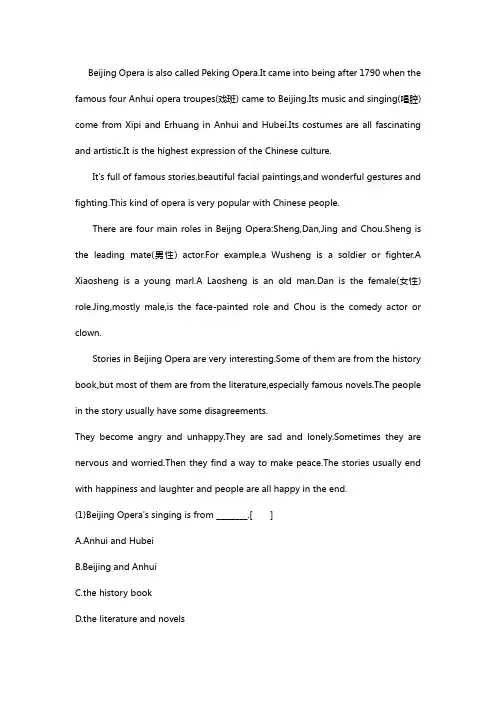
Beijing Opera is also called Peking Opera.It came into being after 1790 when the famous four Anhui opera troupes(戏班) came to Beijing.Its music and singing(唱腔) come from Xipi and Erhuang in Anhui and Hubei.Its costumes are all fascinating and artistic.It is the highest expression of the Chinese culture.It's full of famous stories,beautiful facial paintings,and wonderful gestures and fighting.This kind of opera is very popular with Chinese people.There are four main roles in Beijng Opera:Sheng,Dan,Jing and Chou.Sheng is the leading mate(男性) actor.For example,a Wusheng is a soldier or fighter.A Xiaosheng is a young marl.A Laosheng is an old man.Dan is the female(女性) role.Jing,mostly male,is the face-painted role and Chou is the comedy actor or clown.Stories in Beijing Opera are very interesting.Some of them are from the history book,but most of them are from the literature,especially famous novels.The people in the story usually have some disagreements.They become angry and unhappy.They are sad and lonely.Sometimes they are nervous and worried.Then they find a way to make peace.The stories usually end with happiness and laughter and people are all happy in the end.(1)Beijing Opera's singing is from ________.[ ]A.Anhui and HubeiB.Beijing and AnhuiC.the history bookD.the literature and novels(2)The second paragraph(段落) of the reading is about the ________ of Beijing Opera.[ ]A.storiesB.rolesC.gesturesD.paintings(3)From the reading,we know the role Chou most probably has a(n) ________ feature.[ ]A.honestB.funnyC.dullD.serious(4)Which of the following statements is TRUE?[ ]A.Peking Opera is full of different gestures.B.There are only four roles in Beijing Opera.C.Beijing Opera is the most popular in the world.D.The people in the story usually are in agreement.答案:1.A 2.B 3.B 4.A。
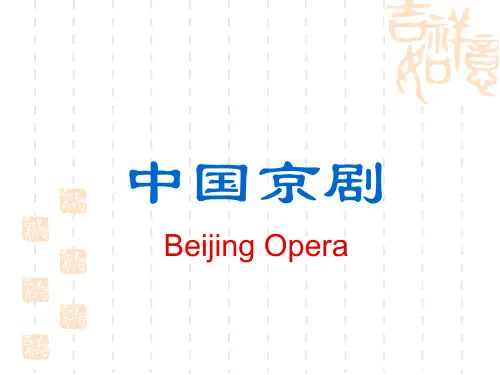
初中音乐八年级《中国京剧Beijing Opera》PPT
二、京剧的特点
the characteristics of Beijing Opera
(1)综合性:唱、做、念、打、舞 (2)程式化、规范化 (3)虚拟化
ห้องสมุดไป่ตู้
三、角色类型
Role types of Beijing Opera
生、旦、净、末、丑
老 生
小 生
青 衣
花 旦
刀 马 旦
老 旦
净 关 羽
中国京剧
Beijing Opera
一、京剧的起源
The origin of Beijing Opera
京剧也叫“皮黄”,是东方的歌剧,中国 的歌剧,是中国的国剧,是中国文化的代 表。 1840年前后,有两百年历史 (1)徽(安徽省)秦(陕西省)合流 (2)徽(安徽省)汉(武汉)合流 (3)京腔、昆曲
程 砚 秋
荀 慧 生
荀 慧 生
谢谢各位老师莅临指导!!
——
净 曹 操
——
四、念白
Monologue and Dialogue
中州韵、湖广音
五、唱 腔 Singing
西皮 二黄
六、四大名旦——梅、尚、程、荀
Four Famous Dan Actors –Mei,Shang,Cheng,Xun
梅 兰 芳
梅 兰 芳
尚 小 云
尚 小 云
程 砚 秋
中国京剧英文介绍

1. Beijing Opera, also known as Peking Opera, is a traditional Chinese art form that combines singing, dancing, martial arts, and acrobatics. It originated in Beijing during the late 18th century and has since become one of the most popular forms of Chinese opera.京剧,也被称为北京剧,是一种融合了唱、舞、武术和杂技的中国传统艺术形式。
它起源于18世纪末的北京,成为中国最受欢迎的戏曲之一。
2. The distinctive features of Beijing Opera include elaborate costumes, stylized makeup, and complex vocal techniques. Performers wear brightly colored costumes and use exaggerated movements to portray their characters. The makeup, known as "jing," is highly symbolic and helps the audience distinguish between different roles.京剧的独特特点包括精致的服装、风格化的化妆和复杂的声乐技巧。
演员穿着鲜艳的服装,并通过夸张的动作来表现角色。
化妆,被称为“京”,具有很高的象征性,并帮助观众区分不同的角色。
3. Beijing Opera combines various storytelling techniques, such as singing, spoken dialogue, and mime. The singing style, known as "xiangsheng," involves a unique combination of singing and recitation. The performers use specific gestures and movements to convey emotions and actions.京剧融合了各种叙事技巧,如唱、说和默剧。
北京京剧英语作文

Beijing Opera,also known as Peking Opera,is a traditional Chinese performing art that combines music,vocal performance,mime,dance,and acrobatics.It originated in the late18th century and has since become one of the most influential and representative forms of Chinese opera.1.History of Beijing Opera:The art form emerged during the Qing Dynasty,evolving from the fusion of various regional operas,particularly the Hui opera troupes.It was during the reign of Emperor Qianlong that these troupes were invited to perform in Beijing,leading to the development of what we now know as Beijing Opera.2.Characteristics of Beijing Opera:Musical Accompaniment:The music is characterized by a combination of string and percussion instruments,with the pipa and erhu being particularly prominent.Vocal Styles:There are two main vocal styles in Beijing Opera:the highpitched and melodious Xipi and the more somber Erhuang.Roles:Performers are categorized into four main roles:Sheng male roles,Dan female roles,Jing painted face roles,usually depicting warriors or villains,and Chou clown roles.3.Costumes and Makeup:The costumes are elaborate and colorful,often embroidered with intricate patterns.Makeup is used to accentuate facial features and to symbolize the characters personality or social status.For instance,the Jing characters often have bold, stylized facial patterns.4.Performance Elements:Singing:The singing in Beijing Opera is highly stylized and requires a great deal of vocal control and technique.Recitation:Characters often recite lines in a rhythmic manner,which is an integral part of the performance.Acting:The acting style is highly symbolic and uses a range of gestures and movements to convey emotions and tell the story.Fighting:Martial arts and acrobatics are often incorporated into the performances, adding to the drama and spectacle.5.Storytelling:Beijing Opera narratives often draw from Chinese history,folklore,and legends.The stories are typically moralistic,emphasizing virtues such as loyalty,filial piety,and righteousness.6.Cultural Significance:Beijing Opera is not just a form of entertainment but also a reflection of Chinese culture and values.It has been passed down through generations and continues to be a vital part of Chinese cultural heritage.7.Modern Adaptations:In recent years,there have been efforts to modernize Beijing Opera by incorporating contemporary themes and technologies,ensuring its continued relevance and appeal to new audiences.8.Learning Beijing Opera:It is a highly disciplined art form that requires years of rigorous training.Young performers often begin their training at a young age,learning the various aspects of the art,including singing,acting,and martial arts.9.International Recognition:Beijing Opera has gained international recognition and has been performed in various countries,showcasing the richness of Chinese culture to the world.10.Preservation Efforts:There are ongoing efforts to preserve and promote Beijing Opera,including the establishment of schools and institutions dedicated to its study and performance.In conclusion,Beijing Opera is a multifaceted art form that offers a unique window into Chinese history,culture,and society.It is a testament to the creativity and artistry of the Chinese people and continues to captivate audiences both in China and around the world.。
Unit 6 Beijing Opera
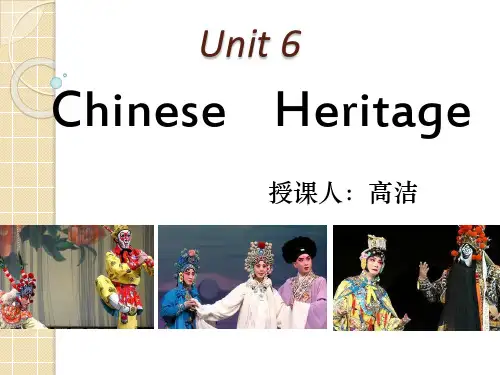
The role of
Jing
主要扮演性格、品质或相貌不同于一般、有突出特征的男性人物,俗称花脸
张飞
关羽
包拯
正净
Jing are the painted-faced roles, and they represent warriors, heroes, statements and bad men. The painted faces are symbolic and exaggerated, and are used to represent a character’s personality.
《贵妃醉酒》剧照
《霸王别姬》剧照
《五花洞》
剧情:宋代,五大郎与潘金莲夫妻俩因年 月不好,离家去寻兄弟武松。蜈蚣、蝎子、 壁虎、蛤蟆、毒蛇等在五花洞修炼成精, 因恨仙道张天师与它们作对,前往京都作 乱。路遇武大郎携妻潘金莲寻访其弟武松, 见二人一矮丑、一娇媚,相映成趣,遂幻 化成二人模样相戏。真假武大郎、潘金莲 相貌言语一般无二,难辨真伪,乃互相扭 至阳谷县衙申告。知县吴大炮难以判识, 五毒精又变出一假知县与之哄闹。恰逢包 拯(另有版本为张天师)巡视至此,以照 妖镜辨出真伪,又请来天兵天将降服了众 妖。
What does each mark of painted faces represent?
This painted face is used to represent a clown, or a kind-hearted and humorous man, but sometimes, it is negative, bad or silly. This painted face is used to represent a loyal and courageous character.
BeijingOpera教学设计北师大版

1. 教学方法:
(1)讲授法:在介绍北京Opera的基本概念、历史背景和表演形式时,教师可以通过讲授法向学生传授知识。结合生动的例子和图片,教师可以激发学生的兴趣,并帮助学生建立对北京Op组讨论,让学生分享对北京Opera的了解和看法。在讨论过程中,教师引导学生思考和分析问题,提高学生的思维品质和表达能力。
3. 学生可能遇到的困难和挑战:在学习和理解北京Opera的相关知识时,学生可能会遇到一些困难。首先,Opera这一艺术形式对于学生来说可能较为陌生,难以理解和接受。其次,北京Opera中涉及的一些专业术语和表演手法可能对学生来说较为复杂,需要教师进行详细的解释和示范。此外,学生可能对中文的听说能力有所欠缺,需要教师提供更多的语言支持和练习机会。因此,在教学过程中,教师需要关注学生的学习情况,及时解答疑问,并提供必要的帮助和指导。
三、学习者分析
1. 学生已经掌握了哪些相关知识:在开始本节课之前,学生应该已经掌握了基本的汉语拼音知识,能够熟练地读写一些常用的汉字。此外,学生可能已经接触过一些关于中国传统文化和艺术的形式,如书法、绘画等,但对北京Opera的了解可能较为有限。
2. 学生的学习兴趣、能力和学习风格:五年级的学生通常对有趣且富有创意的课堂活动感兴趣。他们具有较强的好奇心和探索欲望,喜欢通过图片、视频和实物等直观的方式进行学习。在学习能力方面,学生能够较好地理解和记忆知识点,但需要教师的引导和激励来提高学习的积极性和主动性。在学习风格上,学生们可能偏爱互动式和参与式的学习方式,希望能够通过小组讨论、角色扮演等活动来提高学习效果。
(5)课后作业:布置相关的课后作业,如让学生观看一场北京Opera的表演,并撰写观后感。这样既能巩固所学知识,又能拓展学生的文化视野。
Beijing opera
尚小云
尚小云(1899—1976),原名德泉,字绮霞。出生于 河北省南宫县。汉军旗籍人,为清平南王后裔。 1914年12月,孙菊仙与尚小云配戏,自此尚小云声 名大彰。主演《苏三起解》《玉堂春》《祭江》 《孝义节》《宇宙锋》《彩楼酣》《探寒窑》《昭 君出塞》《醉酒》等,还与杨小楼合演《长坂坡》 《八蜡庙》《红鬃烈马》《楚汉争》。与谭小培合 演《汾河湾》《打渔杀家》《南天门》等。其中以 《武家坡》与《玉堂春》最受欢迎。1924年1月25日, 在北京广德楼首次演出了《张敞画眉》。1924年5月 15日,在北京广德楼首次演出了《秦良玉》,这出 戏文武带打,唱做兼重,受到欢迎。
脸谱展示
京剧脸谱的分类有:整脸、英雄脸、六分脸、歪脸、神仙脸、丑角脸等
旦
名
大
四
The four men
梅兰芳 程砚秋
荀慧生 尚小云
梅兰芳
梅兰芳(1894—1961),字畹华。原籍江苏泰州,长期 寓居北京。他在50余年的舞台生活中,精心钻研,勇 于革新,创造了众多优美的艺术形象,积累了大量优 秀剧目,发展和提高了京剧旦角的演唱和表演艺术, 形成一个具有独特风格的艺术流派,世称“梅派”, 深受国内广大群众的喜爱,并在国际上享有盛誉。梅 兰芳的艺术成就,对现代中国戏曲艺术的发展起了承 前启后的作用。
京剧至今已有将近二百年的历史。它是在徽调和汉戏 的基础上,吸收了昆曲、秦腔等一些戏曲剧种的优点和特长逐渐演变而形成的。 京剧音乐属于板腔体,主要唱腔有二黄、西皮两个系统, 京剧角色的行当划分比较严格,早期分为生、旦、净、末、丑、武行、流行(龙套) 七行,以后归为生、旦、净、丑四大行
Development : 一、Incubation period :1640s—1820s清初至道光年间; 二、formation :1840—1860(道光二十年至咸丰十年); 三、The mature stage :1883—1918 四、 peak :1917—
京剧英文介绍1000字
京剧英文介绍1000字English.Beijing Opera (京剧, Jīngjù) is one of the most celebrated and iconic forms of Chinese traditional opera.It is renowned for its elaborate costumes, stunning makeup, and highly stylized singing and acting techniques. Beijing Opera originated in Beijing during the mid-19th century and quickly became popular throughout China. It is now considered one of the most important and influential forms of Chinese performing art.Characteristics of Beijing Opera.Beijing Opera is characterized by its unique combination of music, singing, dialogue, martial arts, acrobatics, and mime. The performance is divided into three main sections: the overture, the play, and the epilogue. The overture typically consists of a series of instrumental pieces that set the mood for the play. The play is the mainpart of the performance and tells a story through a combination of singing, dialogue, and action. The epilogueis a short section that concludes the play and provides a moral or philosophical message.Beijing Opera is also known for its elaborate costumes and makeup. The costumes are often very colorful and adorned with intricate embroidery. The makeup is highly stylized and helps to create the characters' personalities and emotions.Performance Techniques.Beijing Opera actors undergo rigorous training tomaster the specialized performance techniques that are required for this art form. The singing is characterized by a high-pitched, nasal style that is unique to Beijing Opera. The actors also use a variety of hand gestures, body movements, and facial expressions to convey emotions and actions.Roles.Beijing Opera characters are classified into four main types: sheng (male), dan (female), jing (painted face), and chou (clown). Each type of role has its own unique set of conventions and techniques.Themes.Beijing Opera plays often explore themes of history, legend, love, and betrayal. They often draw on stories from Chinese mythology and folklore, as well as historical events.Influence.Beijing Opera has had a profound influence on Chinese culture and society. It has been featured in numerous films, television shows, and stage productions. The art form has also been exported to other countries around the world, where it has been adapted and incorporated into local performing arts traditions.Significance.Beijing Opera is considered a national treasure ofChina and is protected by the government. It is a livingart form that continues to evolve and adapt to modern audiences. Beijing Opera is a testament to the richcultural heritage of China and its enduring artistic traditions.中文回答:京剧,又称京戏,是中国传统戏曲中最著名、最具代表性的形式之一。
20.Peking Opera
京剧是中国的一种传统艺术。
Peking opera is a traditional art in China.它是中国戏曲的一种,起源于1790 年四大徽班(Four Great Anhui Troupes)入京表演的时候,发展于19 世纪中期,到清朝达到全盛阶段。
It is a kind of Chinese opera which was born when the Four Great Anhui Troupes came to Beijing in 1790, arose in the mid-19th century and was extremely popular in the Qing Dynasty.京剧被看成是中国文化艺术的瑰宝。
Peking opera is widely regarded as one of the cultural treasures of China.虽然它被称为京剧,但是它的起源地却是中国的安徽省和湖北省。
Although it is called Beijing opera, its origins arein the Chinese provinces of Anhui and Hubei.京剧先是一种宫廷表演艺术,而后才慢慢普及到民间。
Beijing opera was originally staged for the court and came into the public later.在数百年前,京剧作为一种新的戏曲形式,无论在哪里进行表演,都饱受欢迎。
Hundreds of years ago, as a new style of drama, wherever they have been performed, they would be warmly welcomed.而在现代社会中,京剧等传统戏曲却不大能被年轻人接受,面临着巨大的生存危机。
京剧相关英语介绍Beijing Opera
京剧相关英语介绍Beijing OperaFour Famous Dan Actors 四大名旦;Stage Props in Peking Opera 京剧道具Types of Facial Make-up in Beijing Opera 京剧脸谱Roles in Beijing Opera 京剧的角色;Xipi and Erhuang 西皮和二簧Wenchang and Wuchang 文场和武场;Piao You and Xia Hai 票友和下海Longtao and Figurant "龙套”和“跑龙套”;Qiba “起霸” ;Liangxiang “亮相”In 1927, an open selection of the top Dan actors, sponsored by the Shuntian Times newspaper, was launched. As a result, Mei Lanfang (1894-1961), Shang Xiaoyun (1900-1976), Cheng Yanqiu and Xun Huisheng (1900-1968) were the most outstanding in the selection, and were named the four most famous Dan actors of Peking Opera at this time, each having his own unique characteristics in regard to action, expression and music. In addition, each had his own special repertoire, and these have been handed down from generation to generation. Eventually, they formed the four main schools of Peking Opera.Later, groups of excellent young actors were active on the opera stages, among whom the most famous were: Li Shifang, Zhang Junqiu, Mao Shilai and Song Dezhu, selected by the Liyan Newspaper. Each of the four had his own special repertoire, and their wonderful performances were well received by the mass. Eventually, they were recognized as the four sub-leading Dan actors of Peking Opera.China entered the modern era amidst turbulence and change in the 20th century. The Revolution of 1911 put an end to the 2,000-year rule of the feudal dynasties. Thus there was a spate of famous actors and actresses and schools of Peking Opera in the early decades of this century.二十世纪20年代年京剧旦行先后成名的四位有代表性的演员:梅兰芳、尚小云、程砚秋、荀慧生。