
牛津沪教版六年级英语6BUnit1-3复习教案
M1 Unit1-3巩固复习一、课前回顾单词默写:二、新课导入【句型万花筒】Unit 1 Great cities in Asia亚洲的著名城市Ask and answer问一问,答一答S1: Which city is the capital of …? 哪个城市是……的首都?S2: … is the capital of …? ……是……的首都。
S1: Where is it? 它在哪里?S2: It’s … of Shanghai.它在上海的……。
Ask and answer问一问,答一答How far is it from Shanghai to …?从上海到……有多远?City Beijing Tokyo BangkokHow far?1,400kilometres2,300kilometres3,050kilometresHow long?/ by plane 1 hour and50 minutes2 hour and30 minutes4 hoursHow long?/by ship/ 11.5 days 15.5 days How long?/by train10 hours / /S1:How far is it from Shanghai to …? 从上海到……有多远?S2: It’s about… 它大约……S1: How can we travel to …? 我们怎样去……?S2: We can travel by … 我们可以坐……去。
S1: How long does it take to travel from … to … by …?乘……从……到……要花费多少时间?S2: It takes about… 大约花费……Unit 2 At the airport在飞机场Ask and answer问一问,答一答You are going to another country for a holiday. In pairs, look at the timetable and talk about it. 你们打算去另外一个国家度假。
DepartureTo Flight No.time2.50 p.m. Los Angeles MU 5839.10 a.m. Tokyo MU 5231.50 p.m. Bangkok MU 541S1: What time does your plane leave for … tomorrow?你去……的飞机明天几点钟起飞?S2: At … in the morning/afternoon/evening.在中午/下午/晚上……。
What time should I arrive at the airport? 我应该在几点钟到达机场?S1: You should arrive at the airport before … in the morning/afternoon/evening. 你应该在中午/下午/晚上……到达飞机场。
Ask and answer问一问,答一答Suppose you and your classmate are Mr and Mrs Wang. Ask and answer questions, like this:假设你和你的同学分别是王先生和王夫人。
问和回答问题,像这样:S1: Have you … yet? 你已经……吗?S2: Yes, I’ve already … /No, I haven’t … yet.是的,我已经……/不,我还没有…….brought a camera √ 带一个相机got some US dollars√ 有一些美元written down Aunt Judy’s address ×记下朱迪姑姑的地址called Aunt Judy ×给朱迪姑姑打电话Unit 3 Dragon Boat Festival端午节Ask and answer问一问,答一答Find out the kinds of rice dumplings you and your classmates like/don’t like.找出你和你的同学喜欢和不喜欢的粽子的种类。
Rice dumplings粽子sweet…with beans 带豆类的甜……sweet…without beans 没带豆类的甜……salty…with meat 带肉的咸……salty…without meat 没带肉的咸……S1: Do you like rice dumplings? 你喜欢粽子吗?S2: I like…, but I don’t like… 我喜欢……,但是我不喜欢……Ask and answer问一问,答一答In pairs, talk about what you would like to eat, like this:两人一组,谈论你们想吃什么,像这样:S1: Would you like some rice dumplings?你想要一些粽子吗?moon cakes? 月饼吗?biscuits? 饼干吗?dumplings? 饺子吗?pudding? 布丁吗?S2: Yes, please. I like …/No, thanks. I don’t like…是的。
我喜欢…… /不,谢谢你。
我不喜欢……I’d rather have a piece of bread.我宁愿要一块面包。
a biscuit/sandwich.一块饼干/三明治。
some biscuits/noodles.一些饼干/面条。
三、新课讲解Unit 1 Great cities in Asia亚洲的著名城市◆Where is it? 它在哪里?It’s north/south/east/west of… 它在……的北/南/东/西。
It’s north-east/north-west/south-east/south-west of…它在……的东北/西北/东南/西南。
◆How far is it from Shanghai to Beijing? 从上海到北京有多远?It’s about 1,400 kilometres. 大约1400公里。
◆How can we travel to Beijing? 我们怎么样去北京?We can travel by train. 我们可以坐火车去。
◆Many tourists like visiting those places.许多旅游者喜欢参观那些地方。
They love eating spicy food. 他们喜欢吃辛辣食物。
enjoy喜欢拓展:东西南北方位词1. 作名词,意为北(南、东、西),使用时前面要加定冠词the。
如:Beijing is in the north of China.北京在中国的北部。
2. 作形容词,意为北(南、东、西)的。
如:They live on the east beach.他们住在东海岸。
3. 作副词,意为向/朝北南、东、西)。
如:The building faces east 这栋楼朝东。
Unit 2 At the airport在飞机场◆Aunt Judy and Uncle Mike have lived in Los Angeles for six years.朱迪姑姑和迈克叔叔已经在洛杉矶住了六年了。
◆They have bought their plane tickets.他们已经买了飞机票。
She has some silk scarves. 她买了一些丝绸围巾。
◆What time does your plane leave for Los Angeles?你们飞机几点起飞去洛杉矶?It leaves at three o’clock in the afternoon.在下午三点钟。
◆What time are we going to leave home? 我们打算几点钟离开家?We’re going to leave home at eleven thirty in the morning.我们打算在上午十一点半离开家。
◆Have you brought your passports(boarding cards)yet?你们已经带了护照(登机牌)吗?Yes, we’ve already brought our passports.是的,我们已经带了我们的护照。
No, we haven’t brought our passports yet.不,我们还没有带我们的护照。
拓展:be going to的用法be going to do用来描述计划或打算要做某事,常与表示将来的时间状语连用。
如:next week, tonight, tomorrow等。
如:I’m going to read a magazine tonight. 今晚我打算读本杂志。
We are going to see a film next weekend.下周末我们打算看场电影。
What are you going to do tomorrow? 明天你打算干什么?Unit 3 Dragon Boat Festival端午节◆Would you like some rice dumplings?您想要一些粽子吗?pudding? 布丁吗?Yes, please. I like rice dumplings.是的。
我喜欢粽子。
pudding. 布丁。
No, thanks. I don’t like rice dumplings.不,谢谢你。
我不喜欢粽子。
pudding. 布丁。
I’d rather have a piece of pizza.我想要一块比萨。
◆ I like salty rice dumplings with meat.我喜欢带肉的咸粽子。
Without 没带◆I like sweet rice dumplings without beans,我喜欢没带豆类的甜粽子,but I don’t like salty ones with meat.但是我不喜欢带肉的咸粽子。
四、课堂练习I.Fill in the blanks according to the phonetic transcriptions(按所给的音标填空)26. The king didn’t take Qu Yuan’s [ədˈvaɪs] .27. Why do people ['selɪbreɪt] the Lantern Festival?28. Y u Garden is ['feɪməs] for its tasty food.II. Choose the best answer(选择最恰当的答案)( ) 29. On Sunday afternoon,Michael usually plays basketball and Stella plays piano.A.the, /B. /, theC. the, theD. /,/( )30. The Jones ____their home in America last Friday. They ____ Canada by air for a holiday.A. left; leftB. left; left forC. left; left inD. left for; left for( )31. ---- is it from your office to the Exhibition Center?---- About ten minutes’ walk.A. How farB. How longC. How soonD. How often( )32. There are about eight people in the city.lionB. millionsC. million ofD. millions off( )33. We like to watch the moon the night of the Mid-Autumn Festival.A. onB. atC. inD. into( )34. I don't like the sweet rice dumplings, give me those meat .A. oneB. someC. othersD. ones( )35. I will take us about to reach Sichuan Province.A. two and a half hourB. two hours and a halfC. two hours and halfD. two and a half hour( )36. We should do to keep us healthy.A.many exerciseB. much exerciseC . many exercises D. much exercises( )37. James always gets “A” in English. ,he is never proud (骄傲).A.ButB. SoC. BecauseD. However( )38.Mrs Ma has a stomach ache because she eats many rice dumplings.She should eat rice dumplings.A.lessB. moreC. fewerD. little( )39. He’d like ____ football with his friends, but I’d rather ____ some books in my room.A. to play; to readB. play; to readC. play; readD. to play; read( )40 ---- The party is a great success. We had a good time!----____.A. It doesn’t matterB. No, thanksC. It’s not very goodD. I’m glad to hear thatIII.Choose the word or expression which is closest in meaning to the underlined part in each sentence (选择与划线部分意义最近的单词或词组)A. a lot ofB. play withC. meD. underE. wellF. whyG. toysI’m Shelly. I went to a park with my little brother last Sunday. There were (41)____ people in the park. I met Linda and Tammy in the park. They were singing and dancing (42)____ a big tree. At the moment my little brother was playing in the sandbox (沙箱). He saw a little boy in a wheelchair (轮椅).The boy was about five years old. My brother went to him and asked if he could (43)____ him. My brother was only five years old. He didn’t know (44)____ the boy couldn’t get into the sandbox to play with him.Then he brought much sand in his bucket (桶) to the boy. He also brought some (45)____ and put them in the boy’s wheelchair. I asked, “Tom, why do you do that?”He looked at me and answered, “He can’t play in the sandbox with (46)____, so I bring the sand to him. N ow we can play with the sand together!”IV. Fill in the blanks with the proper forms of the given words:(用括号中所给单词的适当形式完成下列句子)47. The Mid-autumn Festival is in the lunar month. (eight)48. There are some ______ over there. (trolley)49.If the king ______ Qu Y uan’s advice, he would win the battle. (take)50. We love outdoor very much. (active)51. We should eat more food. (health)52. You must know the time If you want to meet people at the airport. (arrive)53. A lot of visit Shanghai every year. (tour)54.I want a pizza ______ tomatoes, because I don’t like them. (with)ⅣRewrite each sentence as required (按要求改写句子)(共10分)55. He's already bought some pairs of glasses.(改为一般疑问句)he bought any pairs of glasses .56. Kitty will go with us if she gets the ticket. (改为否定句)Kitty ______ ______ with us if she gets the ticket.57. Peter had toothache yesterday because he ate too many sweets. (对画线部分提问)______ Peter have toothache yesterday?58. My father arrives at his office at 9 0'clock every morning. (保持句意不变)My father his office at 9 0'clock every morning.59. Danny has exercise aft.er school twice a week.(对画线部分提问)does Danny have exercise after school五、课堂小结六、课后作业Ⅰ. Reading comprehension(阅读理解)(共6分)A. Choose the best answer(选择最恰当的答案)Yesterday was Thursday. It was Lisa’s birthday. She expected her friends Jet and Selina to come to her birthday party. Jet has a car. He said he would take Selina to the party by car.Selina waited for Jet in front of her house. At that time Jet gave her a call. Jet said he had something important, so he couldn’t go to the party. Then Selina had to go to Lisa’s house by taxi. But there was no taxi in the street.Later she walked to the bus station. It started to rain and she felt a little cold. She had to wait at the bus station. She felt cold and tired. She fell asleep after she got on the bus and she didn’t get off at the right stop.Selina got off at the next stop and walked to Lisa’s house. But she couldn’t find the way to Lisa’s house. She called Lisa and Lisa told her how to go there. At last, she arrived at Lisa’s house. She was too late for the party. The party was over. Her friends all went back home. What a bad day!( )60. It was ____ birthday yesterday.A. Selina’sB. Jet’sC. Mona’sD. Lisa’s( )61. What does the word “expected” mean in Chinese?A. 拒绝B. 期待C. 帮助D. 忘记( )62. How did Selina and Jet plan to go to Lisa’s house at first?A. By bus.B. By taxi.C. On foot.D. By car.( )63. Jet couldn’t go to the party because ____.A. he had a toothacheB. he had a feverC. he had something importantD. he had a piano lesson( )64. What was the weather like yesterday?A. Rainy.B. Windy.C. Sunny.D. Cloudy.( )65. What did Selina do when she couldn’t find the way to Lisa’s house?A. She gave Lisa a call and asked her the way.B. She asked the police for help.C. She went back home.D. She took a taxi.B. Choose the words or expressions and complete the passage. (选择最恰当的单词或词组完成短文)Mr Smith is quiet. He doesn’t like (66)____with people. He likes reading and surfing the Internet. He hardly (几乎不) ever exercises. Sometimes he watches sports news on TV. He likes coffee very much, and he drinks it (67)____ a day, just like the meals every day.Mr Smith works in a bank. His job is busy, (68)____ it’s a little boring. He works with people and money every day, so he (69)____ feels tired after work. He likes to (70)____ early after dinner. Mr Smith is very happy with that. But Mrs Smith isn’t, because Mr Smith always talks in his sleep. One morning, Mr Smith sits at table and has (71)____. Mrs Smith asks him, “Why do you always talk in your sleep?” Mr Smith says, “Because I don’t have time to talk in the daytime (白天).”The next (72)____ after their children all go to school, Mrs Smith says angrily, “Why did you scold (骂) me in your sleep last night?” “Because I don’t have the courage (勇气) to do it when I’m awake.”( )66. A. playing B. talking C. sitting D. working( )67. A. once B. twice C. three times D. five times( )68. A. and B. but C. because D. if( )69. A. never B. again C. always D. sometimes( )70. A. go to bed B. watch TV C. do homework D. go home( )71. A. supper B. lunch C. dinner D. breakfast( )72. A. week B. morning C. month D. yearC. Read the passage and fill in the blanks with proper words(在短文的空格内填入适当的词,使其内容通顺,每空格限填一词,首字母已给)In China, there're many different kinds of food. Some of them are very popular. The real Chinese food is dumplings. Now let's talk about them, OK? Everyone in China likes dumplings very much, and there are many (73)d kinds of dumplings. Some have meat and vegetables in them, (74)o have sugar, eggs and so on. I like dumplings with vegetables and pork (75)b than any other kinds.Usually people make dumplings at home. If you have no time to(76)m - them, you can buy them from any supermarket. Then you take them home and eat them with vinegar(醋),The Spring Festival is very important in China. When it comes, we make dumplings; usually we put a coin(硬币)in a dumpling. If one(77)e the dumpling with the coin in it, he will be lucky in the new year.' In the old days, people seldom(极少)ate dumplings,(78)b they were very poor. Now our country is (79)b stronger and stronger, and our people are richer and richer. We can eat them very often.73 74 75 76 77 78 79D. Read the passage and answer the questions. (根据短文内容回答问题)China is developing rapidly. Learning Chinese is more and more popular in the world. Many foreigners are interested in learning Chinese. They learn Chinese very carefully. They hope they can come to visit China or work in China one day.How do the foreign people learn Chinese? The kids in the pictures are learning Chinese with the teachers’help in different ways. The kids are from the USA. They are so young. But they have already learnt much about Chinese. They can talk with each other in Chinese freely. The classroom is so beautiful. There are many colorful pictures in the classroom. There are also many learning rules in the classroom. What are they? First, the students must speak Chinese in the classroom. Second, they must use Chinese often. Third, they must oftenuse the pictures to learn Chinese. The teachers often help the students put on the pictures on the wall. The students are so proud.What do you think of the ways of learning Chinese? We can learn much from the American kids and we can learn English or other languages in these ways.1.Why are many foreigners interested in learning Chinese?2.Where are the kids in the pictures from?3.Now they cannot talk with each other in Chinese freely, can they?4.What are there in the classroom?5.How many learning rules are there in the classroom?6.What do you think of the ways of learning Chinese?。
(沪教版)牛津英语教案6BModule1Unit3(2)
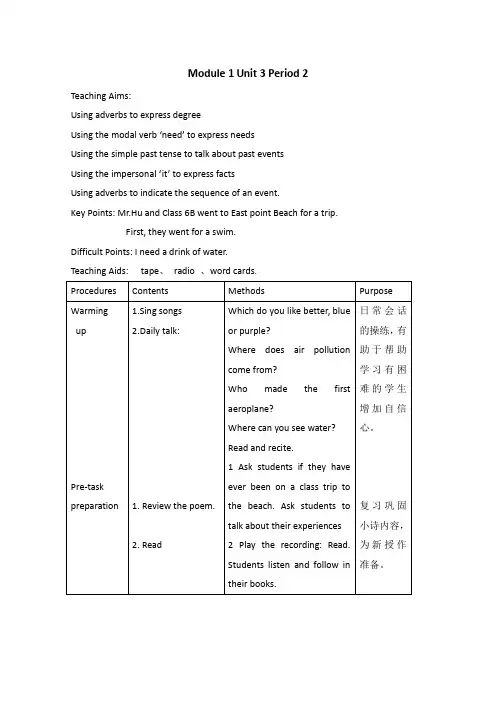
日常会话的操练,有助于帮助学习有困难的学生增加自信心。
复习巩固小诗内容,为新授作准备。
While-task procedure
Post-task activity
Using the ‘it’ to express facts
Using adverbs to indicate the sequence of an event.
Key Points: Mr.Hu and Class 6B went to East point Beach for a trip.
1. Give students time in class todo the matching/sequencing activity. Give assistance to the less able students.
2. Invite students to read out individual sections in the proper order.
Module 1 Unit 3 Period 2
Teaching Aims:
Using adverbs to express degree
Using the modal verb ‘need’ to express needs
Using the simple past tense to talk about past events
1.Sing songs
2.Daily talk:
1. Review the poem.
2. Read
Which do you like better, blue or purple?
(沪教版)牛津英语教案 6B Module1 Unit1(3)
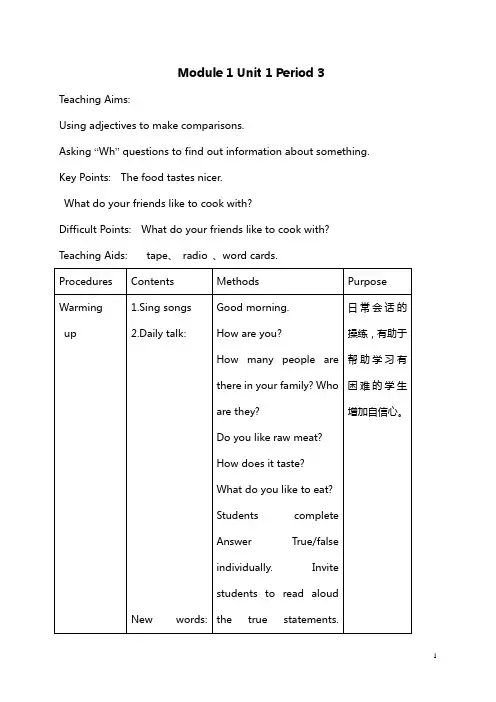
Module 1 Unit 1 Period 3Teaching Aims:Using adjectives to make comparisons.Asking “Wh” questions to find out information about something.Key Points: The food tastes nicer.What do your friends like to cook with?Difficult Points: What do your friends like to cook with?Teaching Aids: tape、 radio 、word cards. Procedures Contents Methods PurposeWarmingupPre-task preparation 1.Sing songs2.Daily talk:New words: cave,heat, light,berries, fireGood morning.How are you?How many people are therein your family? Who arethey?Do you like raw meat?How does it taste?What do you like to eat?Students complete AnswerTrue/false individually.Invite students to readaloud the truestatements. Encouragethe more able students tocorrect the falsestatements and read themaloud.Introduce/review: wood,charcoal, gas,electricity by showing日常会话的操练,有助于帮助学习有困难的学生增加自信心。
牛津小学英语6B全册教案1-3
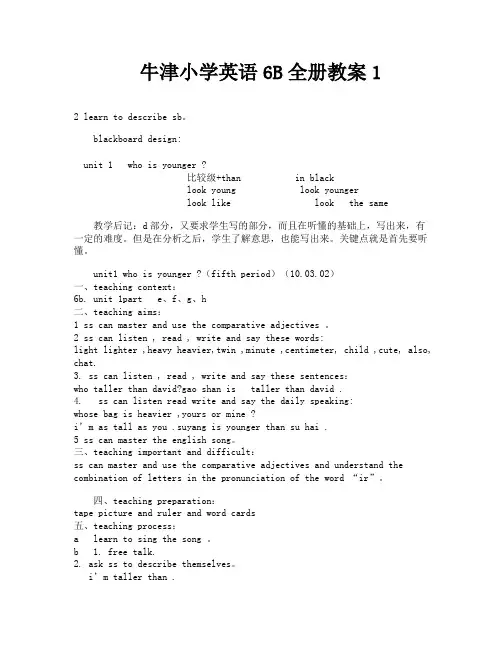
牛津小学英语6B全册教案12 learn to describe sb。
blackboard design:unit 1 who is younger ?比较级+than in blacklook young look youngerlook like look the same教学后记:d部分,又要求学生写的部分,而且在听懂的基础上,写出来,有一定的难度。
但是在分析之后,学生了解意思,也能写出来。
关键点就是首先要听懂。
unit1 who is younger ?(fifth period)(10.03.02)一、teaching context:6b. unit 1part e、f、g、h二、teaching aims:1 ss can master and use the comparative adjectives 。
2 ss can listen , read , write and say these words:light lighter ,heavy heavier,twin ,minute ,centimeter, child ,cute, also, chat.3. ss can listen , read , write and say these sentences:who taller than david?gao shan is taller than david .4. ss can listen read write and say the daily speaking:whose bag is heavier ,yours or mine ?i’m as tall as you .suyang is younger than su hai .5 ss can master the english song。
三、teaching important and difficult:ss can master and use the comparative adjectives and understand the combination of letters in the pronu nciation of the word “ir”。
六年级:牛津英语6b全册教案
小学英语新课程标准教材英语教案( 2019 — 2020学年度第二学期 )学校:年级:任课教师:英语教案 / 小学英语 / 小学六年级英语教案编订:XX文讯教育机构牛津英语6b全册教案教材简介:本教材主要用途为通过学习英语的内容,提高学生的语言技能,增加一项语言能力,有利于国际化的日常交流、生活、工作等,本教学设计资料适用于小学六年级英语科目, 学习后学生能得到全面的发展和提高。
本内容是按照教材的内容进行的编写,可以放心修改调整或直接进行教学使用。
unit 6 planning for the weekend (第一教时)一教学内容:1能听懂、会说和会读和会拼写单词:picnic , plan ,take part in ,play2能听懂、会说和会读单词contest ,beijing opera show ,singing contest ,sports meeting 3能听懂、会说、会读和会写句型:what are we going to do …?we are going to …二教学目标:1能听懂、会说和会读和会拼写单词:picnic , plan ,take part in ,play2能听懂、会说和会读单词contest ,beijing opera show ,singing contest ,sports meeting 3能听懂、会说、会读和会写句型:what are we going to do …?we are going to …三教学重点和难点:what are we going to do …?we are going to …句型进行对话.四课前准备:录音机,挂图五教学过程教学环节教师活动学生活动a free talk一、师生自由交流. 1、which season do you like best ?i like … why ? because it’s … i can …2、do you like basketball ?yes , i do .i like basketball ,too . i’m going to play basketball this afternoon.b presentation1呈现b小图片,have a picnic 师生通过对话区别现在进行时和一般将来时.look ,what are they doing ?they are having a picnic .do you like having a picnic ?yes ,i do .we’re going to have a picnic this sunday .教师讲解在进行时和一般将来时两者的区别或者就让学生说说两者有什么明显的区别.2用以上方法教学前四副图.3看图,师引导学生对话,学习give a puppet show .look at this picture . what is he going to do this evening ?he is going to give a puppet show . 4.依照以上方法教学后四副图,同时要注意人称的变化引起be动词的变化.c consolidation1.看图完成c部分的对话练习。
沪教版牛津小学英语六年级上册教案(全册)
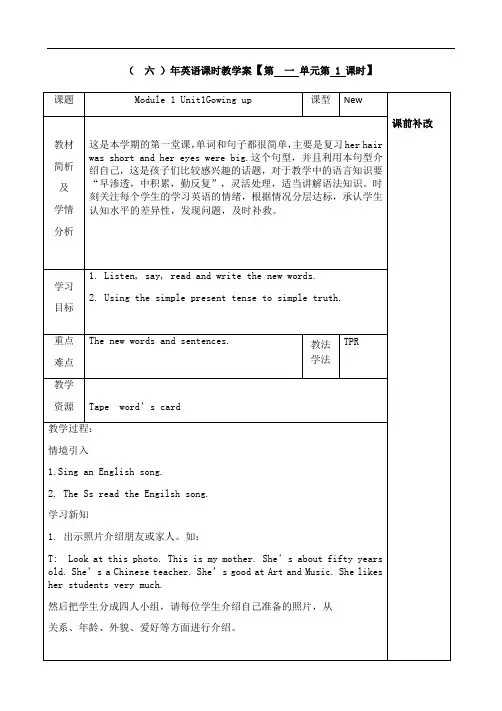
(六)年英语课时教学案【第一单元第 1 课时】
(六)年英语课时教学案【第一单元第 2 课时】
( 6 )年英语课时教学案【第 1 单元第 3 课时】
(六)年英语课时教学案【第二单元第 1 课时】
(六)年英语课时教学案【第二单元第 2 课时】
(六)年英语课时教学案【第 2 单元第 3 课时】
(六)年英语课时教学案【第3单元第 1 课时】
(六)年英语课时教学案【第 3 单元第 2 课时】
(六)年英语课时教学案【第 3单元第 3 课时】
(六)年英语课时教学案【第 4 单元第 1 课时】
(六)年英语课时教学案【第4单元第 2 课时】
(六)年英语课时教学案【第 4 单元第 3 课时】
(六)年英语课时教学案【第5单元第1课时】
(六)年英语课时教学案【第5单元第2课时】
(六)年英语课时教学案【第5单元第3课时】。
牛津沪教版六年级英语6BModule1Unit3语法及拓展优秀教学案例

3.小组合作促进互动:在学生小组讨论环节,我合理分组,并设计了具有挑战性的任务。学生在小组内进行有效的沟通和协作,共同解决问题。这种小组合作的学习方式不仅培养了学生的团队精神,还提高了他们的沟通能力和协作能力。
二、教学目标
(一)知识与技能
1.能够理解并运用一般过去时描述过去发生的动作和经历。
2.掌握一般过去时的构成,即在过去时间状语的帮助下,正确运用动词的过去式。
3.能够听懂、会说、会读、会写一般过去时的句子。
4.了解一般过去时的应用场景,能够在适当的语境中进行运用。
(二)过程与方法
1.通过情境创设、小组合作、任务型教学等方法,引导学生主动探究、实践和应用一般过去时。
牛津沪教版六年级英语6BModule1Unit3语法及拓展优秀教学案例
一、案例背景
在牛津沪教版六年级英语6B Module1 Unit3的教学中,本节课旨在帮助学生掌握一般过去时的表达方式,并能够运用该时态描述过去发生的动作和经历。通过对文本的学习,让学生理解一般过去时的构成及其在实际语境中的应用。此外,本节课还将结合拓展内容,提高学生的语言运用能力和思维品质。
在教学过程中,我将以学生为中心,注重启发式教学,激发学生的学习兴趣和积极性。通过创设情境、小组合作、任务型教学等方法,引导学生主动探究、实践和应用一般过去时。同时,我还关注学生的个体差异,给予每个学生充分的关注和指导,确保他们能够在课堂上充分展示自己,提高自主学习能力。
五、案例亮点
牛津沪教版六年级英语6BModule1Unit3优秀教学案例
针对学生的学习需求,我采用了多元化的评价方式,既注重过程评价,也关注结果评价。通过自评、互评和他评相结合,让学生在评价中认识到自己的优点和不足,激发他们不断进步的动力。在教学实践中,我发现这种教学方法取得了良好的效果,学生在一般过去时的掌握程度有了明显提高。
(三)学生小组讨论
1.任务分配:教师将学生分成小组,每组选择一个话题,如:“Your favorite pastime last week”,要求学生用一般过去时进行讨论。
2.小组活动:学生小组内进行讨论,分享自己的经历,互相提问和回答,练习使用一般过去时。
3.互动交流:各小组派代表向全班汇报讨论成果,其他学生进行评价和提问,促进学生之间的互动交流。
2.设计探究性问题,如:“一般过去时和现在时有什么区别?”引导学生通过讨论、分析来解决问题。
3.鼓励学生提出自己的疑问,充分尊重学生的主动性,让学生在解决问题中提高自己的思维能力。
(三)小组合作
1.小组讨论:学生分组讨论一般过去时的用法,分享自己的心得体会,互相学习,共同进步。
2.合作任务:设计一些小组合作任务,如编写一个小剧本,描述过去发生的故事,培养学生的团队协作能力。
3.引入主题:教师引导学生思考一般过去时的构成和用法,提问:“How do we form past tense sentences?”,引发学生对一般过去时的思考。
(二)讲授新知
1.规则讲解:教师讲解一般过去时的构成规则,如:动词过去式是在动词原形后面加上-ed,特殊情况如结尾为e+辅音+y的动词变y为i+e。
牛津沪教版六年级英语6BUnit1-3复习教案.docx
Ml Unitl-3巩固复习一、课前回顾单词默写:二、新课导入【句型万花筒】Unit 1 Great cities in Asia亚洲的著名城市Ask and answer 问一问,答一答S1: Which city is the capital of...?哪个城市是 ...... 的首都?S2: ... is the capital of...? ............. 是... 的首都。
SI: Where is it?它在哪里?S2: It's ... of Shanghai.它在上海的 ..... 。
Ask and answer 问一问,答一答How far is it from Shanghai to ...?从上海到.・・・・.有多远?City Beijing Tokyo Bangkok How far?1,4002,3003,050kilometres kilometres kilometres How long?/ 1 hour and 2 hour and4 hoursby plane50 minutes30 minutesHow long?/by ship/11.5 days15.5 days How long?/by train10 hours//SI : How far is it from Shanghai to ...?从上海到 ..... 有多远?S2: It's about...它大约 .....SI: How can wc travel to ...?我们怎样去...... ?S2: We can travel by ...我们可以坐..... 去。
S1: How long does it take to travel from ... to ... by ...?乘……从......到......要花费多少时间?S2: It takes about...大约花费.....Unit 2 At the airport在飞机场Ask and answer 问一问,答一答You are going to another country for a holiday. In pairs, look at the timetable and talk about it. 你们打算去另外一个国家度假。
(沪教版)牛津英语教案6BModule1Unit2(3)
What do you like to cook with?
What do you know about fire-safety?
How does a balloon rise in the air?
T: Where does air pollution come from?
Fill in the blanks and make the poster.Cut out more pictures of things for use on thir pollution poster.
Ask representatives of each group to come forward to show their poster and read what they have written.
Procedures
Contents
Methods
Purpose
Warming
up
Pre-task preparation
1.Sing songs
2.Daily talk:
Review
New words
3. Look and think.
How are you?
What do you like to eat?
Quick talking match.
Introduce : factories, dust, construction sites,
Play the recording: Look and think.
日常会话的操练,有助于帮助学习有困难的学生增加自信心。
复习空气污染来源,
牛津沪教版六年级英语6BModule1Unit3教学设计
3.增强学生的跨文化意识,了解不同国家的天气特点和人们的生活习惯,尊重文化差异。
4.培养学生的集体荣誉感,鼓励学生在课堂上积极参与、互相帮助,共同进步。
5.引导学生树立正确的价值观,学会珍惜时间、热爱生活,用所学英语知识为他人和社会做出贡献。
(五)总结归纳,500字
在总结归纳环节,我将执行以下步骤:
1.让学生回顾本节课所学的词汇和句型,并邀请几名学生到前台进行展示。
2.教师和学生一起总结一般现在时在描述天气时的用法,并强调其在日常交流中的重要性。
3.鼓励学生课后观察和记录天气变化,尝试用英语与家人或朋友分享。
4.对学生的课堂表现给予极的评价,强调每个学生的进步和努力,鼓励他们在今后的学习中继续保持积极的态度。
二、学情分析
针对牛津沪教版六年级英语6B Module1 Unit3的教学内容,进行以下学情分析:
六年级学生已具备一定的英语基础,掌握了基本的词汇和语法知识,具备初步的听说读写能力。在此基础上,他们对天气话题较为熟悉,生活中已有关于天气的简单表达经验。然而,学生在准确运用一般现在时描述天气状况、使用目标句型进行交流等方面仍需加强。
2.每组准备一段对话或小故事,展示他们对新学词汇和句型的掌握。
3.小组间进行分享,其他小组成员可以提问或评论,促进互动交流。
4.教师巡回指导,为学生提供必要的帮助和反馈,确保每个学生都能参与到讨论中来。
(四)课堂练习,500字
在课堂练习环节,我将设计以下活动:
1.填空练习:提供一些关于天气的短文,让学生填入适当的词汇,练习词汇的运用。
6.阅读拓展:推荐学生阅读与天气相关的英语文章或故事,了解不同国家的天气特点,拓展知识面。