
Unit2 Let's make a fruit salad 教案
Unit2 Let’s make a fruit salad(第一课时)教学目标:1.能初步听懂、会读、会拼写单词a banana、a grape、a mango、a pineapple;复习水果类单词an orange, a peach,a pear,an apple。
2.能听懂、会说、会读、会运用句型Do you have…?并且会用Yes, I do.和No,I don’t来回答。
3.初步理解some和any的使用方法。
4.了解西方国家的饮食文化。
5.充分利用学生已有的知识和生活经验,创设生活化的真实情境,引导学生在运用语言中学习语言,在学习新的语言知识后创造性地运用语言。
教学重点:1.能初步听懂、会读、会拼写单词a banana、a grape、a mango、a pineapple;复习水果类单词an orange, a peach,a pear,an apple。
2.能听懂、会说、会读、会运用句型Do you have…?并且会用Yes, I do.和No,I don’t 来回答。
3.充分利用学生已有的知识和生活经验,创设生活化的真实情境,引导学生在运用语言中学习语言,在学习新的语言知识后创造性地运用语言。
教学难点:1. 初步理解some和any的使用方法。
教学疑点学生能否理解some和any的使用方法,渗透的语法知识能否完全掌握?教学准备:挂图,卡片,多媒体(PPT),学生自带水果,老师做的水果沙拉教学过程:Step 1 Greeting and warm up1.GreetingT: Hello, boys and girls. How are you ?S: I’m fine, thank you. And you?T: I’m well.2.Warm upPlay a game----Fast response游戏规则:快速闪现问题,抢答例如:What can you see?I like monkeys, What do you like ?Do you like monkeys ?What colour is the …?Step 2 Presentation1.Play a game----Magic bag游戏规则:收口的口袋里装些玩具和水果。
一个学生摸,其他学生问Is that an animal/a frit?Is that a/an …?最后展示摸到的物品,并且说This is a/an…?例如:Ss:Is that an animal/a frit?S1: Yes/No.Ss: Is that a/an …?S1: Yes/No.This is a/an…T:Look, this is a magic bag. There are many animal toys and fruit in it.出示单词:animal, fruit,并且教读fruit当最后展示的时候教师还可以复习第一单元所学的句型。
例如:T:Do you like…?S:Yes, I do. /No, I don’t.T: What do you like ?S: I like…2.Lead in and teach the name of the fruits把袋子里的水果都拿出来:a banana、 a grape、a mango、 a pineapple,an orange, a peach,a pear,an apple,并且板书pineapple [ˈpainˌæpl]T:I have some fruits.Let’s name them.Look , this is a /an…3.出示课题T: Here are so many fruits. We can make a fruit salad. OK?S: OK.出示课题:Unit 2 Let’s make a fruit salad.教读课题saladcat bananasa la d salad4.Story time(1)出示课文图片T: Miss Li and her students are making fruit salad.(2)Watch the cartoon ,and answer the questionWhat fruit can you see ?I can see a /an/ some…(3)教授Story time 句子(注意语音语调的纠正)Picture 1:T:Who can read ? 板书:Do you have a /an…?教授单词have Yes, I do./ No, I don’t.T: Let’s try to read the sentences.have [hæv] 有T: Mike has a mango and an orange. Look at Miss Zhang. I have two mangoes and two oranges. 出示mango orange复数mangoes orangesPicture 2: Listen to the tapeSu Yang: Do you have any bananas?Yang Ling: No, I don’t. I have some grapes.教读:any [ˈeni] many 板书:anysome any都表示一些,后面可以跟可数名词的复数形式,也可以跟不可数名词的原形。
但是,some一般用在肯定句中,而any多用在疑问句或否定句中。
教读:some grapesT:I can say‘I have some grapes’.What can you say?让学生造句。
Picture 3&4T: Who can read Picture 3&4?thanks= thank youPicture 5:教读great ea/ei/ 板书:Great.Picture 6:教读:our PS:we的物主代词(4)Read Story timea.注意语音语调,播放录音,学生跟读T:Let’s read after the tape.b.学生齐读T:Let’s read it together.c.学生自读d.角色扮演模仿语音语调,比比谁读的好,角色扮演。
Step 3 Consolidation1.Puzzles(fill in the blanks)根据单词提示,或是图片提示拼写单词例如:a yellow banana some purple grapes 2.Work in pairs用身边带来的水果进行对话练习:对话提示:S1:Do you have a/an/any…?S2: Yes, I do./ No, I don’t.S1: Here you are.S2: Thanks./Thank you.S1:Let’s make a fruit salad.S2: Great/Good/OK/All right.让学生懂得分享自己的水果,培养学生的团结合作意识。
充分利用学生已有的知识和生活经验,创设生活化的真实情境。
3.Summary让学生说说这节课学了什么,让学生自己来总结。
A.复习单词(1)水果类的单词出示的时候单数、复数以及音标共同出示。
(2)some any great ourB.复习句型(1)句型:I have a/an/some…(2)对话句型S1:Do you have a/an/any…?S2: Yes, I do./ No, I don’t.S1: Here you are.S2: Thanks./Thank you.S1:Let’s make a fruit salad.S2: Great/Good/OK/All right.C.复习课文Step 4 Homework1.Copy the new words four times.2.Recite Story Time after class.作业:1.Copy the new words four times.2.Recite Story Time after class.板书设计Unit 2 Let’s make a fruit saladI have a/ an/ some…A:Do you have a/an/any…?B:Yes, I do./ No, I don’t. a banana a mangoA:Here you are. a grape a pineappleB:Thanks./Thank you. ( a peach a pearA:Let’s make a fruit salad.可不写an apple an orange)可不写B:Great/Good/OK/All right. 可不写Unit 2 Let’s make a fruit salad(第二课时)教学目标:1.能熟练地听懂、会读、会拼写单词a banana、a grape、a mango、a pineapple;复习水果类单词an orange, a peach,a pear,an apple。
2.能熟练地听懂、会说、会读、会运用句型Do you have…?并且会用Yes, I do.和No,I don’t来回答。
3.能初步会用How many…?询问可数名词的数量。
4.能明白Cartoon time 的幽默之处5.复习数字1-12教学重点:1.能熟练地听懂、会读、会拼写单词a banana、a grape、a mango、a pineapple;复习水果类单词an orange, a peach,a pear,an apple。
2.能熟练地听懂、会说、会读、会运用句型Do you have…?并且会用Yes, I do.和No,Idon’t 来回答。
3.能初步会用How many…?询问可数名词的数量。
4.能明白Cartoon time 的幽默之处5.复习数字1-12教学难点:能初步会用How many…?询问可数名词的数量。
教学准备:挂图,卡片,多媒体(PPT)教学过程:Step 1 Greeing and warm up1.Dictation2.GreetingT: Good morning, boys and girls. How are you?S: I’m fine/well/good/Not so good…3.Warm up(1)Question box教师出示一个盒子----Question box,盒子里装了过去所学的问题,让学生在盒子一抽出一张纸回答问题。
(译林版)四年级英语上册 Unit2 Let's make a fruit salad教案(全单元教案)

苏教译林四年级英语上册教案Unit2 Let’s make a fruit salad 教学目标:1.能初步听懂、会读、会拼写单词a banana、 a grape、a mango、a pineapple;复习水果类单词an orange, a peach,a pear,an apple。
2.能听懂、会说、会读、会运用句型Do you have…?并且会用Yes, I do.和No,I don’t 来回答。
3.初步理解some和any的使用方法。
4.了解西方国家的饮食文化。
5.充分利用学生已有的知识和生活经验,创设生活化的真实情境,引导学生在运用语言中学习语言,在学习新的语言知识后创造性地运用语言。
教学重点:能初步听懂、会读、会拼写单词a banana、 a grape、a mango、a pineapple;复习水果类单词an orange, a peach,a pear,an apple。
2.能听懂、会说、会读、会运用句型Do you have…?并且会用Yes, I do.和No,I don’t 来回答。
3.充分利用学生已有的知识和生活经验,创设生活化的真实情境,引导学生在运用语言中学习语言,在学习新的语言知识后创造性地运用语言。
教学难点:1. 初步理解some和any的使用方法。
教学疑点学生能否理解some和any的使用方法,渗透的语法知识能否完全掌握?教学准备:挂图,卡片,多媒体(PPT),学生自带水果,老师做的水果沙拉教学过程:Step 1 Greeting and warm up1.GreetingT: Hello, boys and girls. How are you ?S: I’m fine, thank you. And you?T: I’m well.2.Warm upPlay a game----Fast response游戏规则:快速闪现问题,抢答例如:What can you see?I like monkeys, What do you like ?Do you like monkeys ?What colour is the …?Step 2 Presentation1.Play a game----Magic bag游戏规则:收口的口袋里装些玩具和水果。
Unit2Let’smakeafruitsalad说课稿
Unit2 Let’s make a fruit salad说课稿Unit2 Let’s make a fruit salad说课稿作为一名默默奉献的教育工作者,时常要开展说课稿准备工作,借助说课稿可以让教学工作更科学化。
那么应当如何写说课稿呢?下面是小编整理的Unit2 Let’s make a fruit salad说课稿,欢迎大家分享。
一、说教材Unit2 Let’s make a fruit salad是一篇有关学生做沙拉过程中的对话。
首先Liu Tao和Mike各自叙述了自己拥有的水果,然后Su Hai 问Yang Ling和Wang Bing是否有某种水果。
最后Miss Li召集学生一起做水果沙拉。
文章亲切自然,比较容易理解,同时贴近生活,与食物相关,极大的提高了学生的学习兴趣。
二、说教学目标教学目标:1、能听懂、会读、会说、会写句型:I have… Do you have…? Yes, I do. /No, I don’t.2、能熟练朗诵story time板块的对话,尝试角色扮演。
3、培养学生用英语谈论自己所拥有的物品的能力。
教学重点:正确理解文章内容,用正确的语音语调朗读短文,并尝试角色扮演。
教学难点:能用句型:I have… Do you have…? Yes, I do. /No, I don’t. 来描述自己的物品以及询问他人的物品。
三、说教学方法我主要采用了以下几种教法:1.多媒体教学法:本课利用实物、图像、视频、声音等多种媒体向学生传递信息,帮助学生理解、想象。
2、情境教学法:通过情景设计,使学生如临其境,产生兴趣,形成最佳注意力,有助于句型的理解与运用。
3、朗读法。
通过不同形式、不同要求的读,引导学生感受课文的语言美和文章美。
四、说教学过程我是紧扣“make a fruit salad”进行设计的:(一)歌曲与游戏导入,激发兴趣。
这一课的导入,选用了歌曲与游戏来激发学生的兴趣。
苏教版牛津译林版小学英语四年级上册 Unit2 Let's make a fruit salad教案
Unit2 Let’s make a fruit salad教学目标:1.能初步听懂、会读、会拼写单词a banana、 a grape、a mango、 a pineapple;复习水果类单词an orange, a peach,a pear,an apple。
2.能听懂、会说、会读、会运用句型Do you have…?并且会用Yes, I do.和No,I don’t 来回答。
3.初步理解some和any的使用方法。
4.了解西方国家的饮食文化。
5.充分利用学生已有的知识和生活经验,创设生活化的真实情境,引导学生在运用语言中学习语言,在学习新的语言知识后创造性地运用语言。
教学重点:能初步听懂、会读、会拼写单词a banana、 a grape、a mango、 a pineapple;复习水果类单词an orange, a peach,a pear,an apple。
2.能听懂、会说、会读、会运用句型Do you have…?并且会用Yes, I do.和No,I don’t 来回答。
3.充分利用学生已有的知识和生活经验,创设生活化的真实情境,引导学生在运用语言中学习语言,在学习新的语言知识后创造性地运用语言。
教学难点:1. 初步理解some和any的使用方法。
教学疑点学生能否理解some和any的使用方法,渗透的语法知识能否完全掌握?教学准备:挂图,卡片,多媒体(PPT),学生自带水果,老师做的水果沙拉教学过程:Step 1 Greeting and warm up1.GreetingT: Hello, boys and girls. How are you ?S: I’m fine, thank you. And you?T: I’m well.2.Warm upPlay a game----Fast response游戏规则:快速闪现问题,抢答例如:What can you see?I like monkeys, What do you like ?Do you like monkeys ?What colour is the …?Step 2 Presentation1.Play a game----Magic bag游戏规则:收口的口袋里装些玩具和水果。
Unit2--Let's-make-a-fruit-salad教案
Unit2 Let’s make a fruit salad(第一课时)教学目标:1.能初步听懂、会读、会拼写单词a banana、a grape、a mango、a pineapple;复习水果类单词an orange, a peach,a pear,an apple。
2.能听懂、会说、会读、会运用句型Do you have…?并且会用Yes, I do.和No,I don’t来回答。
3.初步理解some和any的使用方法。
4.了解西方国家的饮食文化。
5.充分利用学生已有的知识和生活经验,创设生活化的真实情境,引导学生在运用语言中学习语言,在学习新的语言知识后创造性地运用语言。
教学重点:1.能初步听懂、会读、会拼写单词a banana、a grape、a mango、a pineapple;复习水果类单词an orange, a peach,a pear,an apple。
2.能听懂、会说、会读、会运用句型Do you have…?并且会用Yes, I do.和No,I don’t 来回答。
3.充分利用学生已有的知识和生活经验,创设生活化的真实情境,引导学生在运用语言中学习语言,在学习新的语言知识后创造性地运用语言。
教学难点:1. 初步理解some和any的使用方法。
教学疑点学生能否理解some和any的使用方法,渗透的语法知识能否完全掌握?教学准备:挂图,卡片,多媒体(PPT),学生自带水果,老师做的水果沙拉教学过程:Step 1 Greeting and warm up1.GreetingT: Hello, boys and girls. How are you ?S: I’m fine, thank you. And you?T: I’m well.2.Warm upPlay a game----Fast response游戏规则:快速闪现问题,抢答例如:What can you see?I like monkeys, What do you like ?Do you like monkeys ?What colour is the …?Step 2 Presentation1.Play a game----Magic bag游戏规则:收口的口袋里装些玩具和水果。
Unit2 Let’s make a fruit salad 第1课时教案20
四上Unit2 Let’s make a fruit salad (第1课时)【教材分析】本单元通过水果类单词的引入,继续学习一般疑问句,句型Do you have…?及回答Yes, I do.和No,I don’t 任然是本单元的重点句型,并且还加入了some和any的用法。
【学情分析】1.(共性)学生通过第一单元的学习,对于可数名词的单复数以及句型Do you…?有了一定的理解。
【教学目标】1.知识目标①能初步听懂、会读、会拼写单词a banana、 a grape、a mango、a pineapple;复习水果类单词an orange, a peach,a pear,an apple。
②能听懂、会说、会读、会运用句型Do you have…?并且会用Yes, I do.和No,I don’t 来回答。
③初步理解some和any的使用方法。
2.能力目标充分利用学生已有的知识和生活经验,创设生活化的真实情境,引导学生在运用语言中学习语言,在学习新的语言知识后创造性地运用语言。
3.情感目标①让学生爱上水果,并且知道水果对人的健康有益处。
②了解西方国家的饮食文化。
【教学重点】①能初步听懂、会读、会拼写单词a banana、 a grape、a mango、a pineapple;复习水果类单词an orange, a peach,a pear,an apple。
②能听懂、会说、会读、会运用句型Do you have…?并且会用Yes, I do.和No,I don’t 来回答。
③充分利用学生已有的知识和生活经验,创设生活化的真实情境,引导学生在运用语言中学习语言,在学习新的语言知识后创造性地运用语言。
【教学难点】初步理解some和any的使用方法。
【课前准备】1.常规预习听磁带,预习第二单元的Story部分,会说一个新的句子。
2.预习导学(有关重点内容、语法等讲解)【课堂活动】Step1 GreetingsGreetingT: Hello, boys and girls. How are you ?S: I’m fine, thank you. And you?T: I’m well. good 此处well学生还没有掌握,可以用good来代替Step2 Revision1.T:Unit 1 we have learned a lot of words about animals. Look,what’s this ?S:It’s a dog.T:It’s a happy animal family.Yang Ling like dogs. Do you like dogs?Do you like …?Yes,I do. No, I don’t.Today,Yang Ling will go to another family.(教授fruit)*2. T:Now,let’s sing a song: Apple treeT: What fruit can you see ?S: Apples.T:Do you like apples ?S:Yes,I do.T:What about you ?S:Me too.(设计意图:切合主题,由主线人物Yang Ling创设free talk 由上一单元animal 话题自然过渡到本单元话题fruit.为下面的学习做铺垫。
四年级英语新教材Unit2 Let’s make a fruit salad教案
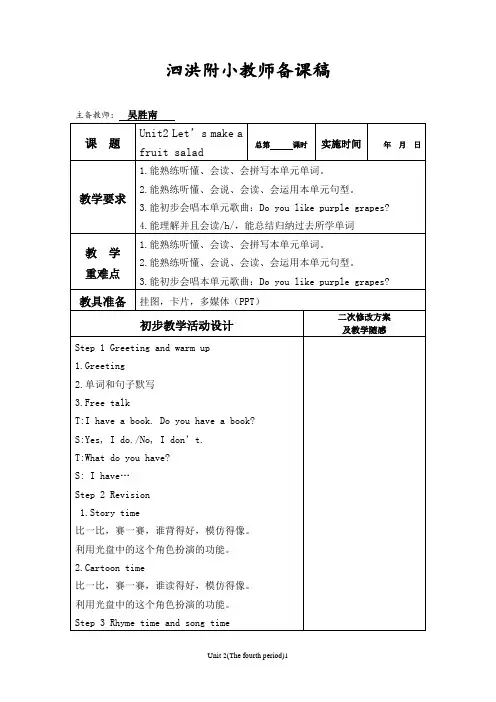
泗洪附小教师备课稿主备教师:吴胜南课题Unit2 Let’s make afruit salad总第课时实施时间年月日教学要求1.能熟练听懂、会读、会拼写本单元单词。
2.能熟练听懂、会说、会读、会运用本单元句型。
3.能初步会唱本单元歌曲:Do you like purple grapes?4.能理解并且会读/h/,能总结归纳过去所学单词教学重难点1.能熟练听懂、会读、会拼写本单元单词。
2.能熟练听懂、会说、会读、会运用本单元句型。
3.能初步会唱本单元歌曲:Do you like purple grapes?教具准备挂图,卡片,多媒体(PPT)初步教学活动设计二次修改方案及教学随感Step 1 Greeting and warm up1.Greeting2.单词和句子默写3.Free talkT:I have a book. Do you have a book? S:Yes, I do./No, I don’t.T:What do you have?S: I have…Step 2 Revision1.Story time比一比,赛一赛,谁背得好,模仿得像。
利用光盘中的这个角色扮演的功能。
2.Cartoon time比一比,赛一赛,谁读得好,模仿得像。
利用光盘中的这个角色扮演的功能。
Step 3 Rhyme time and song time及教学随感1.复习过去所学的小诗Mango, mango ,I love you. One for Tommy, one forJoe. …2.复习过去所学的歌曲Seasons song, I like rice. …3.Do you like purple grapes?(1)复习水果以及颜色教师出示部分被遮挡的水果图片:T:What’s this/that?S: It’s a/an …T:What are these/ those?S: They’re…T:What colour is it/are they?S: They’re…出示葡萄的图片T:What do I have?S: You have some grapes.T:What colour are the grapes?S: They are purple.T: Do you like purple grapes?S: Yes, I do./ No, I don’t.(2)出示歌曲Do you like purple grapes?A.欣赏歌曲B.猜一猜They’re nice and sweet.意思是:糖果()甜的()C.唱一唱让学生说说会唱哪一句歌词。
Unit 2 Let’s make a fruit salad (教案)英语四年级上册-牛津译林版
回顾本课重点知识句型。
在回顾总结中反思本节课重点句型结构
Homework:
1听录音跟读Story time.
2.抄写四会单词。
板书设计:
Unit 2 Let’s make a fruit salad
grape mango pineapple salad
Ihave….Do you have a/an/any…?
Step3
Task 1
回忆相关知识,初步运用结构
1.Say the chant
2.Pair work
I have….
Do you have a …?
Yes, I do.
Do you have …?
师生问答
引出单词banana的教学
同桌讨论交流,初步学习句型
达成目标1、2
Step4
Task 2呈现刺激材料,活用结构
2.能听懂、会说、会读、会写make, banana, some, our.,能用这些单词组成词组、句型等;
3.能听懂、会说、会读let’s, fruit, salad , pineapple, mango, grape, thanks.
Teaching Procedures
Steps
Teacher’s activities
Read and find
Read the story
Act the story.
Read the words and sentences.(Class work)
分角色朗读(Group work)
整班跟读
小组合作表演
小老师领读
教师巡视,小组呈现,展示成果。
达成目标3
Step6
Unit 2 Let’s make a fruit salad (教案)英语四年级上册-牛津译林版
(1)Watch tt they are talking about.
(2)Read the story,find out the fruit they have.
(3)Read after the tape./Read together.
3、根据Fun time ,制作卡片,为下一节课做准备.
板书设计Unit2 Let’s make a fruit salad
A:Do you have a/an/any ...? banana
grape
B: Yes, I do. mango
No, I don’t. pineapple
2、游戏引入,操练句型
T:I have some/a/an....
Do you have any/a/an...?
S:Yes,I do./No,I don’t.I have some...
(设计思路:教师通过同桌对话,练习学习I have…Do you have…?
以上环节加强巩固单词pineapple, grape, banana, mango.)
(2)T: Today I have some fruit in my bag. Let’s make a fruit salad.
板书课题Let’s make a fruit salad
学习单词fruit, salad
Step 2 Presentation
1、单词卡片,引入句型
T: First Let’s touch and guess what they are.
课时
第一课时
教学过程:
Step1 Warm up
1、游戏引入,新授单词
(1)Today I have a big box.There are many fruit in the box.What’s in the box? Let’s touch and guess. What is this?
译林版英语四年级上册Unit2Letsmakeafruitsalad教案
译林版英语四年级上册Unit2Letsmakeafruitsalad教案第一篇:译林版英语四年级上册Unit 2 Lets make a fruit salad教案译林版英语四年级上册Unit 2 Let’s make a fruit salad教案一、教材简析:本单元由Story time, Fun time, Cartoon time, Sound time, Rhyme time, Checkout time, Ticking time七个部分组成。
安排了“说明自己有某物”、“询问他人是否有某物”这两个语言情景,话题贴近生活,学生乐意学习。
在教学内容方面,本单元要求能听懂、会说、会读和会拼写单词a banana, a grape, a mango, a pineapple.能听懂、会说、会读和会写句型Do you have…? Yes, I do./ No, I don’t.I have….因此,对单词的字体、书写方法、规格等方面要进行示范、指导,使学生逐步形成良好的书写习惯。
二、教学目的:1.能听得懂、会说、会读和会拼写单词a banana, a grape, a mango, a pineapple.2.能听懂、会说和会读日常交际用语 3.能听懂、会说、会读、会写句型Do you have…? Yes, I do./ No, I don’t.I have… 4.了辅音字母h 在单词中的读音。
6.能诵读歌谣Purple grapes.三、教学重点:1、能听得懂、会说、会读和会拼写单词a banana, a grape, a mango, a pineapple.2、能听懂、会说、会读、会写句型Do you have…? Yes, I do./ No, I don’t.I have….3、了辅音字母h 在单词中的读音。
四、教学难点:1、能听得懂、会说、会读和会拼写单词a banana, a grape, a mango, a pineapple.2、能听懂、会说、会读、会写句型Do you have…? Yes, I do./ No, I don’t.I have….五、课时安排:本单元共安排5课时 Story time1课时Fun time, Rhyme time及新单词1课时 Cartoon time, Sound time及课课练1课时Checkout time, Ticking time及补充习题.1课时复习本单元中单词、句型、做听读训练。
Unit2 Let’s make a fruit salad(教案英语四年级上册牛津译林版 (7)
B: No, I don’t.
T: Today Yang Ling and Liu Tao are in Mike’s home. Mike and Helen are A: What do you have? showing their toys. What do Mike and Helen have? Let’s read and choose.
教学重点 Teaching Key Points 教学难点 Teaching Difficult Points 1.对文本的理解和朗读; 2.句型 How many ... do you have? 以及 Can I...? 的教学。
学情分析 Students Analysis
教学准备 Teaching Preparation
Step1. Greeting and warming up
Warming up
1. Greeting. 2. Warming up (1)Game: 判断老师说的句子是否属实。True : Yeah! False: No!
1. Count the numbers from 1 to 12, then from 12 to 1.
一、数字接龙,引入新课 数字 1~12 是同学们已经熟练掌握的内容,我通过数字接龙游戏,活跃了课堂气氛,消除了紧 张,使学生的注意力很集中,激发了学习兴趣,使学生很自然地进入了良好的学习状态,并且为下 面的教学环节作好铺垫。 二、不同方式,教学单词 新单词通过不同的方式呈现、操练,学生学得兴趣盎然。首先,让学生用数数形式学习,学生 兴致高昂;sticker 的学习则是通过听课文录音,圈找单词,再结合课文插图来学习,以此保持了他 们学习单词的兴趣。 三、联系实际,灵活运用