
外研版(三起)-英语-六年级上册- Module 7 模块重点归纳
小学-英语-上册-打印版
Module 7
模块重点归纳
本模块重点学习运用一般现在时描述动物及其习性。
现将本模块主要句型及相关知识归纳如下:
一、习惯搭配/短语
look at看come out of从……中出来 a fantastic present一件非常棒的礼物be dangerous危险get frightened变得害怕
二、惯用表达式
I don’t believe it!我简直不敢相信! I don’t know.我不知道。
Thank you again.再次谢谢您。
You’re welcom e.不用谢。
Wow!哇! Oh no!哦,不!
三、公式化句型
描述人或动物的习惯性动作的句型
主语+动词原形/动词第三人称单数+其他.
描述人或动物的喜好的句型
主语+love/loves+其他……喜欢……
(备注:标注★的词汇为教材单词表中的词汇。
)。
六年级英语上册-Module-7-Unit-1-I-don’t-believe-it教案-外研版(三
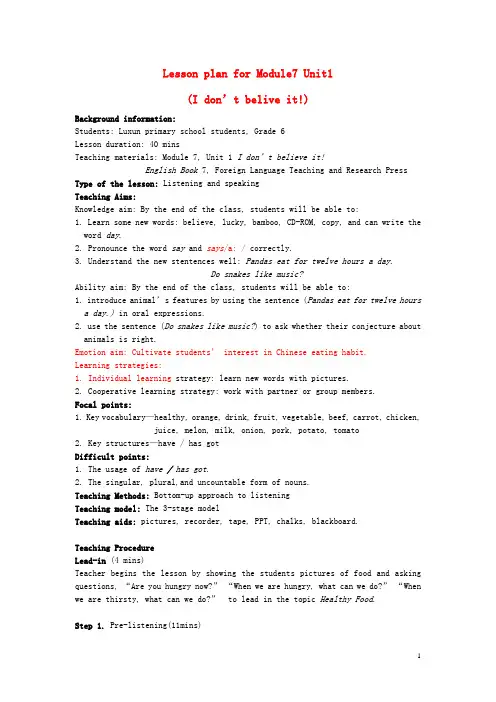
Lesson plan for Module7 Unit1(I don’t belive it!)Background information:Students: Luxun primary school students, Grade 6Lesson duration: 40 minsTeaching materials: Module 7, Unit1 I don’t believe it!English Book 7, Foreign Language Teaching and Research Press Type of the lesson: Listening and speakingTeaching Aims:Knowledge aim: By the end of the class, students will be able to:1. Learn some new words: believe, lucky, bamboo, CD-ROM, copy, and can write the word day.2. Pronounce the word say and says/a: / correctly.3. Understand the new stentences well: Pandas eat for twelve hours a day.Do snakes like music?Ability aim: By the end of the class, students will be able to:1. introduce animal’s features by using the sentence (Pandas eat for twelve hoursa day.) in oral expressions.2. use the sentence (Do snakes like music?) to ask whether their conjecture about animals is right.Emotion aim: Cultivate students’ interest in Chinese eating habit.Learning strategies:1. Individual learning strategy: learn new words with pictures.2. Cooperative learning strategy: work with partner or group members.Focal points:1. Key vocabulary—healthy, orange, drink, fruit, vegetable, beef, carrot, chicken,juice, melon, milk, onion, pork, potato, tomato2. Key structures—have / has gotDifficult points:1. The usage of have / has got.2. The singular, plural,and uncountable form of nouns.Teaching Methods: Bottom-up approach to listeningTeaching model: The 3-stage modelTeaching aids: pictures, recorder, tape, PPT, chalks, blackboard.Teaching ProcedureLead-in(4 mins)Teacher begins the lesson by showing the students pictures of food and asking questions, “Are you hungry now?” “When we are hungry, what can we do?” “When w e are thirsty, what can we do?” to lead in the topic Healthy Food.Step 1. Pre-listening(11mins)1. Write the words food and drink on the blackboard.2. Ask a student “What did you eat yesterday?” in order to classify the food into3 kinds, fruit, vegetable and meat. Blackboard layout as follow,3.Ask students “What’ the food?” students may repeat“Fruit, vegetables andmeat are food.”4. Ask students “What fruit/ vegetables/ meat/ drink do you know?”, and writetheir answers on the blackboard. When talk about juice, explain the expressions of different kinds of juice.(e.g. apple juice)5. Ask students to open their book and finish the three activities(Activity 1,2, 3) individually. Then call back the answers from the whole class as complete sentences.(e.g. Picture 1 is fruit, and in picture 1 there is an apple, a melon and an orange.)Activity 1 Work in pairs. Match the words with the pictures.Answersfood: 1;2;3 drink:4Activity 2 Label the food in the pictures with these words.Answersfruit:1 meat:3 vegetables:2Activity 3 Label the food and drink with these words.Answersa. melonb. applec. oranged. chickene. porkf. beefg. tomato h. potato i. carrot j. onion k. water l. milk m. Juice6. Explain and show the singular, plural, and uncountable form of nouns. Then askstudents to write the plural form near the words on P26, Ativity 1, and then askstudents to read the words on PPT.Step II. While-listening(15mins)1. Do Activity 4①. Teacher ask “Do you know Betty? What Betty and her mother have got?” then play the recording and ask students to focus on the shopping list.②. Play the recording again for them to check. Call back the answers from the wholeclass.③. Ask students work in pairs and make dialogue.(e.g. A: Have they got any apples?B: Yes, they have.)Answersoranges√ beef × onions × apples√ pork carrotsmelons× tomatoes√ milk chicken√ potatoes√ juice2. Do Activity 6①. Ask students to read the four sentences in Activity 6 silently, then one studentto read loudly.②. Play the recording for the students.③. Call back the answers from the whole class.Answers1. juice2. meat3. Yes, they have.4. No, they haven’t.④.Play the conversation again and pause after each phrase, point out the grammarpoint.⑤. Ask students to read these dialogues after the tape individually, and thenputthem into groups of four to practice the dialogue.Step III. Post-listening1.Do Activity 7(10mins)①Play the recording once without stopping.②Play the recording again and stop at the end of each line. Ask the whole classto repeat.③Ask students to practice in pairs.2.Do Activity 8. Choose six words in Activity 4. Work in pairs and makedialogues.①Ask students to choose six words secretly and not tell anyone.②Read the example with the class. Then pair them to make dialogues..③Ask some pairs of them to present the dialogues.Homework: Practice the conversation in Activity 5 and sounds in Activity 7.Blackboard Layout: key words and sentences。
Module7Unit1Idon’tbelieveit!(教学设计)外研版(三起)英语六年级上册

目标:通过具体案例,让学生深入了解“I don't believe it!”这个表达方式的特性。
过程:
选择几个典型的“I don't believe it!”案例进行分析。
详细介绍每个案例的背景、特点和意义,让学生全面了解“I don't believe it!”的多样性或复杂性。
2.拓展建议:
-口语练习:鼓励学生在家中与家人或朋友进行口语练习,用“I don't believe it!”描述一些令人惊讶的事情,提高口语表达能力和听力理解能力。
-写作练习:鼓励学生撰写一篇关于“I don't believe it!”的短文或日记,描述自己经历过的令人惊讶的事情,提高写作能力和表达能力。
学生对英语学习有较高的兴趣,特别是通过故事情节和角色扮演等互动活动。在能力方面,学生具有较强的自主学习和合作学习能力,能够积极参与课堂活动。在学习风格方面,学生偏好通过视觉和听觉方式学习,喜欢通过参与实践活动来学习。
3.学生可能遇到的困难和挑战:
在本章节的学习中,学生可能遇到以下困难和挑战:
-词汇和句型的记忆和运用,需要通过大量的练习和实际语境来巩固。
2.互动式教学:鼓励学生积极参与课堂讨论和小组活动,通过提问、回答和互动,提高学生的参与度和学习兴趣。
3.多元化评价:采用多元化的评价方式,如口头报告、小组讨论、作业完成情况等,全面评估学生的学习成果,激发学生的学习动力。
(二)存在主要问题
1.教学管理:课堂纪律管理有待加强,部分学生在课堂上注意力不集中,需要采取更有效的管理措施。
在文化意识方面,本章节的故事情节涉及不同的文化背景,学生将学习如何尊重和理解不同的文化,并培养他们的跨文化交际能力。
外研版(三起)-英语-六年级上册-Module 7 Unit 2 Pandas love bamboo 教学设计
Module 7 Unit 2 Pandas love bamboo 教学设计一、教学目标1.掌握本课中描述动物习性的6个句子:Pandas love bamboo. Elephants like water.Snakes love the sun.Sheep like grass.Bears like to sleep in winter.Dogs like playing with children.2.能用一般现在时描述动物及其习性。
3.激发学生保护动物的情感。
二、教学重点1. 掌握本课中描述动物习性的6个句子。
2.能用一般时描述动物及其习性。
三、教学难点能熟练运用一般现在时态来描述动物及习性四、教学准备教学光盘,课件,动物及单词卡片五、教学过程Step1:Warm-up.1.Greeting.T: Class begins! Stand up please!T: Good morning, boys and girls!S:Good moring,Miss Wu!2.复习动物单词T: Today, I bring you some animals. Now, look at the scream,do you known them? What is it?S:Monkey,tiger,lion, elephant,cat,snake,panda,dog )T:In these animals,I love dogs. Which animal do you love?S:I love________.师指着回答完的学生问:Which animals does he\she love?S: He\She loves________.3.复习句型。
I love_________.He\She loves________.把自己所喜爱的动物告诉同桌4.指名回答:I love_________.He\She loves________.(设计意图:通过多媒体直观出示动物图片,不但能很快吸引学生的注意力,还能有效地帮助学生复习所学的知识,为新知的学习打下铺垫。
外研版(三起点)小学六年级英语上册Module7_知识清单

Module 7一、核心词汇1. 名词:snake蛇DVD数字化视频光盘,DVD 光盘bamboo 竹子body 身体flute 笛子2. 动词:believe相信get变得,变成3. 副词:together一起,共同4. 形容词:lucky幸运的frightened 恐惧的,害怕的5. 物主代词:its 它的6. 短语:come out of 从……中出来二、拓展词汇1. 名词:fish鱼hour小时elephant大象sheep绵羊grass草owl 猫头鹰chameleon变色龙2. 动词:use用3. 形容词:fantastic极好的;出色的interesting有意思的,有趣的dangerous危险的4. 短语:in a tree在树上三、核心句型1. —Do snakes love music? 蛇喜欢音乐吗?—Well, I don’t know. 噢,我不知道。
解读:此句是助动词do引导的一般疑问句,用来询问某种动物的生活习性,其时态为一般现在时。
does是do的第三人称单数形式,当主语是第三人称单数时,用助动词does,助动词后跟动词原形。
对此句常见的回答是“Yes, 主语+ do/does.”或者“No, 主语+ don’t/doesn’t.”。
当对方提出的问题我解答不了时也可以用“I don’t know.”回答。
举一反三:—Do your parents like milk? 你的父母喜欢牛奶吗?—Yes, they do./No, they don’t. 是的,他们喜欢。
/不,他们不喜欢。
—Does Jim like sports? 吉姆喜欢运动吗?—Yes, he does./No, he doesn’t. 是的,他喜欢。
/不,他不喜欢。
2. They love bamboo. 它们喜爱竹子。
解读:此句是描述喜好的句型。
当主语是第三人称单数时love改为loves。
love在此表示“喜爱”,故此处love也可以替换为like。
最全外研版(三起)小学英语六年级上册知识点归纳总结

最全外研版(三起)小学英语六年级上册知识点归纳总结Module 1一、词汇1.postcard 明信片2.more 更多3. thousand 一千4. kilometre 千米,公里5. map 地图6. something 某事物,某种东西7. million 百万8. right 正确的9. country 国家10. Mexico 墨西哥11. Canada 加拿大12. 方位名词: 东east 南south 西west 北north二、习惯搭配1. more than超过2. in the east在东部3. a picture of一张......的图片4. in the west在西部5. look at看6. in the south在南部三、常用表达1. That’s really big!那真大!2. It’s here.它在这里。
3. That’s right.没错。
四、重点短语1.look at 看2.a picture of the Great Wall 一副长城的图片3.day and night 日夜4.tell me more about……告诉我更多关于……的事5.in the east of America 在美国的东部6.something about Beijing关于北京的一些事8.from…to…从……到……9.a map of America 一副美国地图10.in New York 在纽约11.eight million people 八百万人口12.six thousand seven hundred kilometers 六千七百米五、重点句型1. 询问某物长度的句型:-- How long is + 其他?-- It’s + 数字+ 其他.eg: 1. -- How long is the Great Wall?-- It’s more than twenty thousand kilometres.2. -- How long is the river?-- It’s about thirty metres.2. 描述某地在哪的句型:地名+ is in the + 方位词+ of + 其他.eg: 1. Beijing is in the north of China.2. New York is in the east of the US.Module 2一、词汇1. dancing 跳舞,舞蹈2. Chinatown 唐人街,中国)3. sometimes 有时4. shop 商店5. then 既然是这样,那么6. ah 啊7. strong 坚固的二、专有名词:1.the Changjiang River(长江)2.the Huangshan Mountain(黄山)3.the West Lake(西湖)4.the Great Wall(长城)三、习惯搭配1. send an email to...给......发送电子邮件2. lots of许多3. go to Chinatown去唐人街4. Chinese dancing中国舞蹈四、知识点1. tell sb. about sth. (告诉某人关于某事)五、重点短语1.ride bicycles to work 骑自行车去上班2.send an email to my family 发送一封电子邮件给我的家人3.miss china 想念中国4.go to Chinatown 去唐人街5.want to do 想要干6.Chinese restaurants 中餐馆7.Chinese dancing 中国舞蹈8.go to Chinatown 去唐人街9.the Changjiang River 长江10.the Tian’anmen Square 天安门广场11.the Huangshan Mountain 黄山the West Lake 西湖六、重点句型1. there be 句型(be动词选择采用就近一致原则)eg: There is a cat and lots of big apples on the tree.There are many birds and a kite in the sky.Module 3一、词汇1. collect 收集2. stamp 邮票3. hobby 业余爱好4. doll 玩具娃娃5. bicycle 自行车二、习惯搭配1.collect stamps收集邮票2. have got有3.fly kites放风筝4.collect dolls收集玩具娃娃5.ride my bicycle骑自行车6.lots of很多三、惯用表达1. That’s right! 没错!2. Great! 太好了!3. What about you? 你呢?四、重点短语1.collecting stamps 收集邮票2.collect dolls 收集洋娃娃4.be from 来自5.a letter for me 我的一封信6.another Chinese stamp 另一枚中国邮票7.fly kites 放风筝8.ride bikes 骑自行车9.famous men and women 著名人士五、重点句型1. 主语+ is my hobby.eg: Collecting stamps is my hobby.2. 主语(不是第三人称单数)+ have got + 其他.eg: They have got famous people on them.3. –What’s your hobby? –主语+ is my hobby.eg: –What’s your hobby? –Flying kites is my hobby.Module 4一、词汇1. Thanksgiving (Thanksgiving Day)感恩节2. flag 旗;国旗3. fly(使)(旗帜)飘扬4. special 特殊的,特别的5. meal 餐6. sound 听起来7. football (美式)橄榄球8. race 比赛,竞赛9. lantern 灯笼10. hang 悬挂,吊二、习惯搭配1. Flag Day (美国)国旗制定纪念日2. moon cake 月饼3. the Mid–Autumn Festival 中秋节4. the Dragon Boat Festival 端午节5. the Lantern Festival 元宵节6. sing songs 唱歌7. a special meal 一顿特别的饭8. do dragon dances 舞龙9. hang lanterns 挂灯笼10. on TV在电视上11. fly the flag 升(国)旗12. my favourite festival 我最喜欢的节目13. go to see the dragon boat race 去看龙舟比赛14. a big family dinner 一顿丰盛的家庭晚餐1. That’s lovely. 那太好了。
外研版英语六年级上册期末复习 Module7 训练课件ppt(共13张ppt)
Ⅱ.单项填空
( B )4.He studies for three
a day.
A.hour
B.hours
C.houres
( C )5.You’re really
.
A.luck
B.luckily
C.lucky
Ⅲ.连词成句
1.in,bears,sleep,do,to,winter,like,why(?) Why do bears like to sleep in winter?
Ⅲ.根据实际情况回答问题
1.What do pandas love? They love bamboo.
2.Do pandas eat for eight hours a day? No, they don’t.
3.Can snakes hear? No,they can’t.
Ⅲ.根据实际情况回答问题
Module 7
Unit 1 I don’t believe it!
Ⅰ.根据句意及首字母提示补全单词
1.Grandma gives Daming a p resent . 2.Wow!I don’t b elieve it! 3.What an i nteresting book! 4.It’s a f antastic present,Grandma. 5.The snake thinks the f lute is dangerous.
Ⅱ.单项填空
( A )1.Does she
up at 6:00?
A.get
B.gets
C.get to
( B )2.Here are some
for present
( A )3.I don’t
知识点总结(知识清单)-2024-2025学年外研版(三起)英语六年级上册
外研版(三起)六年级英语上册单元知识点Module 1一、短语:1、the Great Wall长城2、visit the US拜访(参观、游玩)美国3、in New York在纽约4、look at 看...5、a picture of... 一张....图画(相片)6、tell me more about...多给我讲点关于...7、how long多长8、It`s about ...它是大约(关于)9、twenty thousand kilometres long 两万千米长10、tell me something about…告诉我关于...的事11、how big 多大12、eight million people 八百万人13、twenty million people 两千万人14、be great 太棒了15、an animal 一只动物16、in the east of… 在...的东部17、in the west/south/north of … 在...的西/南/北部18、San Francisco 旧金山19、a (big) map of... 一(大)张...地图20、lots of=a lot of=many/much 许多21、from...to.. 从....到......22、a big country一个大国23、every day and night 每日每夜二、句子1、These postcards are great ! 这些明信片真棒!Yes, they are. 是的,它们是。
2、Tell me more about the Great Wall.多给我讲点关于长城的3、How long is it? 它有多长?It’s more than twenty thousand kilometres long. 它有两万多千米长。
4、How big is it? 它有多大?It has got more than eight million people.它有八百多万人口。
Module7 Unit1 I don't believe it(课件)六年级英语上册(外研版三起)
gives
a present
What is the present? It's a DVD.
Look and say What are they doing?
They are watching the DVD together.
Listen and answer What do pandas love? How many hours do pandas eat a day?
Grandma: Why does the snake come out of the box? Do snakes like music?
Daming: Well, it says snakes can’t hear. They think the flute is dangerous.
Grandma: So the snake gets frightened!
Read and answer Do snakes like music? No, they don't.
Why?
Because snakes can't hear.
snake ,snake, the snake gets frightened.
Listen and repeat
Daming: And look at this picture. The snake can use its body to dance.
They think the flute is dangerous.
Grandma: So the snake gets frightened!
要求:
1. 分工明确,人人参与。 2. 语音正确、流利。 3. 注意语音、语调。
Module7-8外研版(三起)六年级英语上册单元知识点
外研版(三起)六年级英语上册单元知识点Module 7一、单词believe 相信snake蛇*DVD数字化视频光盘,DVD光盘together一起,共同lucky 幸运的bamboo竹子its它的body身体come out of从……中出来*flute笛子get变得,变成frightened恐惧的,害怕的二、短语:1 in the winter 在冬天2、sleep in the winter 冬眠3、eat bamboo吃竹子4、come out of the box 从盒子里出来5、a fantastic present 一件非常棒的礼物6、another snake 另一条蛇the other snake 另一条蛇(两条中)7、an interesting CD-ROM 一件有趣的CD8、believe it or not 信不信9、I don`t believe it!我不相信!10、twelve hours a day一天十二小时11、learn….from….向…学习…三、句子1、Why is the snake coming out of the box? 为什么这条蛇正从盒子里出来?Because the snake thinks the flute is another snake .(宾语从句)此句是why 引导的疑问句,构成方式:Why +be动词+主语+其它部分此句中已经有一个动词is ,所以come 这个动词只能转换成动名词形式coming表示出来的那个状态。
Come out of 从….出来。
Why 提问由because来回答。
举例:Why are you so late ?为什么你迟到了?Because I am sick. 因为我生病了。
2、what an interesting CD-ROM?多么有趣的光盘啊!此句为what 引导的感叹句。
构成方式:what +a/an+形容词+名词【以How开头的感叹句,其构成为:How+形容词+名词+be动词!】举例:What a beautiful day!多美好的一天啊!3、Do snakes like music?此句为Do 引导的疑问句后面可跟另外一个动词,句子的构成方式为:DO+主语+动词原形+其它部分。
外研版(三起)六年级上册英语Module 7 知识总结
Module7知识总结重点单词1.名词: snake蛇DVD 光盘bamboo 竹子body 身体flute 笛子2. 动词: believe 相信get 变得,变成3. 副词: together 一起,共同4. 形容词: lucky 幸运的frightened 恐惧的,害怕的5. 物主代词: its 它的拓展词汇1.名词: fish鱼hour小时elephant 大象sheep 绵羊grass 草owl 猫头鹰chameleon 变色龙2. 动词: use 用3. 形容词: fantastic 极好的;出色的interesting 有意思的,有趣的dangerous 危险的重点短语e out of 从……中出来2.in a tree 在树上3.get frightened变得害怕4.learn a lesson from从……中得到启示5.live in住在……6.twelve hours a day一天十二个小时7.a fantastic present 一件很棒的礼物8.sleep in winter 冬眠9.play with 和......一起玩10.a photo of 一张......的照片11.l ook at 看12.I don't believe it!我简直不敢相信!13.T hank you again.再次感谢您。
14.Y ou're welcome.不用谢。
重点语法1. —Do snakes love music? 蛇喜欢音乐吗?—Well, I don't know. 噢,我不知道。
解读:此句是助动词do引导的一般疑问句,用来询问某种动物的生活习性,其时态为一般现在时。
does是do的第三人称单数形式,当主语是第三人称单数时,用助动词does,助动词后跟动词原形。
对此句常见的回答是“Yes, 主语+ do/does.”或者“No, 主语+ don't/doesn't.”。