
七年级英语上册Unit1 Topic1 SectionA精品学案 最新仁爱版
Unit1Topic1SectionA精品学案
自学——质疑——解疑
学习目标:
1、学习字母Aa-Gg;
2、学习问候、欢迎、自我介绍等日常用语。
自学指导:
1、试着读写英文字母Aa-Gg;
2、小组内同学之间练习问候、欢迎、自我介绍的日常用语。
自测——互查——互教
1、按照字母表的顺序从Aa写到Gg。
2、从Ⅱ栏中选出与Ⅰ栏中相对应的答语。
()1.Good morning! A.Hello!
()2.Hello! B.Nice to meet you,too.
()3.Nice to meet you. C.No,I am not.
()4.I am Fang Ming.Are You YangLi? D.Good morning!
()5.Welcome to China! E.Thanks.
展示——反馈——导学
知识点击:
1、Good morning!早上好!
此句为早上、上午见面时互相打招呼的问候语,它的答语仍然用Good morning.其他时间段的问候语还有:
Good afternoon!下午好!Good evening!晚上好!
Good night!晚安!
2、——Welcome to China!欢迎来到中国!
——Thank you.谢谢你!
Welcome to+地点名词意思为“欢迎到……来”。
当所到的地点是副词时,不用to。
Welcome to Beijing!欢迎到北京来。
Welcome here!欢迎到这儿来!
3、Hello!/Hi!你好!
Hello和Hi是英语中使用频率最高的日常用语之一,多用于同学、同事、熟人或者朋友之间互相打招呼,Hi比Hello更加口语化。
4、——I am Kang Kang.Are You Michael?我是康康,你是迈克尔么?
——Yes,I am.是的,我是。
⑴、英语中常用I am……句型来进行自我介绍;
⑵、Are you……?你是……吗?
肯定回答:Yes,I am.否定回答:No,I am not.
5、——Nice to meet you.
——Nice to meet you.很高兴见到你。
本句是双双初次见面经介绍后常说的一句话,也可用于好久没见,偶然相逢时的场合。
自测——反馈——点拨
1、对话表演,1a,3a。
2、字母大小写比赛。
自测——反馈——点拨
1、你能迅速写出下列单词相应的大写或小写形式么?
bee EGG deaf DAD FACE age 2、单项选择。
()⑴、——you Li Ping?
——Yes,.
A.Are;I am
B.I;I’m
C.Are;I am not
D.Am;I am
()⑵、——
——Nice to meet you,too.
A.Thanks; B.Thank you. C.Yes,I am. D.Nice to meet you.
()⑶、——Good morning!I am Wang Li.
——!I am.
A.Good morning!;Li Xia
B.Morning;Not
C.Yes;Li Xia
D.No;Li xia ()⑷、——Hi,Li Mei.
——
A.Gao Hui,hi. B.Good. C.Yes. D.Hi,Zhang Hua.
()⑸、——
——Thanks.
A.Nice to meet you.
B.Good morning!
C.Hello!
D.Welcome to China!
回顾——总结——反思。
仁爱版七年级英语上册Unit1教学指导案

精心整理Unit1Topic1SectionA学习目标:1、从Aa-Gg的书写2、交际英语合作交流:1、Goodmorming.早上好。
此句为正式问候语,用于早晨至中午12点以前。
它的答语仍然用Goodmorming.2、Hi!喂!你好!Hello!也是“喂!你好!”的意思。
hi和hello英语中使用频率最高的日常用语之一,多用于同学、同时、熟人以及朋友之间相互打招呼,语气比较随便,意为“你好”。
3、—AreyouMichael?你是迈克尔吗?—Yes,Iam.是的,我是。
Areyou··年龄等问题,回答肯定的用Yes,4、—WelcometoChina!欢迎到中国来!—Thankyou!谢谢。
welcometo+地点名词欢迎到······来。
习题巩固:Ⅰ、按照四线格要求写出Aa-Gg。
Ⅱ、单项选择。
()1、—youLiPing?—Yes,I.A.Are;amB.I;()2、——A.Fine,thankyou.B.Thankyou()3、——A.Yes,I’m.()4、——A.Maria,hi.B.Kangkang,hi.C.Goodmorning.D.Hi,Michael.()5、——Thanks.A.Nicetomeetyou.B.Goodmorning.C.Yes,Iam.D.WelcometoBeijingRen’aiInternational(国际的)School!Ⅲ、从Ⅱ栏选出对应的答语。
ⅠⅡ()1.Goodmorning.A.Fine,thanks.()2.Hello!B.Nicetomeetyou,too.()3.Nicetomeetyou.C.No,Iamnot.()4.IamKangkang.AreyouMaria?D.Goodmorning.()5.Howareyou?E.Hi,Mr.Zhang.Unit1Topic1,SectionB 学习目标:1.字母的书写。
仁爱版七年级英语上册Unit1 Topic1 SectionA教学设计
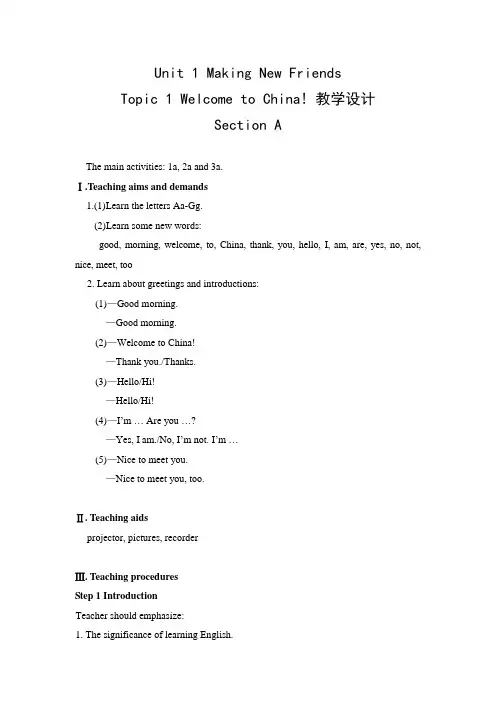
Unit 1 Making New FriendsTopic 1 Welcome to China! 教学设计Section AThe main activities: 1a, 2a and 3a.Ⅰ.Teaching aims and demands1.(1)Learn the letters Aa-Gg.(2)Learn some new words:good, morning, welcome, to, China, thank, you, hello, I, am, are, yes, no, not, nice, meet, too2. Learn about greetings and introductions:(1)—Good morning.—Good morning.(2)—Welcome to China!—Thank you./Thanks.(3)—Hello/Hi!—Hello/Hi!(4)—I’m … Are you …?—Yes, I am./No, I’m not. I’m …(5)—Nice to meet you.—Nice to meet you, too.Ⅱ. Teaching aidsprojector, pictures, recorderⅢ. Teaching proceduresStep 1 IntroductionTeacher should emphasize:1. The significance of learning English.2. Some methods of English learningAim: Stir up Ss’interest and improve the efficiency and effectiveness of English Leaning.Step 2 Simple greetingsPresent some simple greetings1. Get Ss to feel the greetings by applying real situations(Get Ss to guess the meaning of “Good morning!”T remind: people can use it instead of “Hello” to greet each other in the morning. Drill “Good morning!”)(Drill Hi! / Hello! /Good morning! in pairs)(Give them five and encourage them)2. Utilize projector and present 1a(1)Get Ss to watch the video of 1a for the first time.(2) Focus their attention on the video for the second time(Drill in pairs.)3. Play the video of 1a for the third time and get Ss to imitate, making Ss pay attention to the pronunciation and intonation.4. Show the photos of the four figures, let Ss know them and teach Ss to read, then play the sound of 1b and check the answer.Step 3 More greetingsHelp Ss practice and perform the target language and underway effective communication1. (1) Teach “I’m …“, “Are you …? Yes, I am. /No, I’m not.”Ask two boys and two girls to role-play Kangkang, Michael, Jane, Maria. Respectively teaching them to say “I’m Kangkang. I’m Michael. I’m Jane. I’m Maria.” so introduce “I’m=I am. Then Are you …? Yes, I am. / No, I am not.T introduce himself/ herself to the class, then ask some students to introduce themselves.(2)Ask S, teach “Nice to meet you. Nice to meet you, too.”(Drill in pairs)2. Play the video of 2a.(1) The first time: Get Ss to enjoy the situation.(2) The second time: Get Ss to imitate the dialogue, so that the Ss can pay attentionto the pronunciation and intonation.(3) Get the Ss to retell the dialogue according the hints the teacher gives3. Ask the class practice 1a and 2a in pairs and then ask several pairs to act it out in front of class.Step 4 Letters1. Learning Aa-Gg.(1)Listening and speaking.Show seven letters gradually, demonstrate the pronunciation of each letters and get Ss to listen carefully, then demand them to imitate according to the shapes of month and sound. Meantime read each letters with rising and falling intonation. (2)WritingTell the class: each letter has the difference of print form and written form and the distinction of capital form and ordinary form. The class should use ruled paper to write on. Besides, the class must strictly write all letters according to the order strokes,then get them to feel the correct writing by imitating all letters.2. Consolidation(1) Letters relay1. The first student in the first line say "A", the second student say"B"quickly. Then others take turns to say C, D, E, F, G, A, B…(2) The first student in the second line say "AB", the second student say"BC" quickly. Then others take turns to say CD, DE, EF, FG,…(3) Pair work. Form the capital letters with bodies and read them aloud.3. T explain the way of doing 3b and make an example, then get Ss to listen to the recorder and finish 3b.4. Help Ss complete 3c: match the big letters with the small letters, then write them on the lines.Step 5 Homework1. Practice the writing of Aa-Gg, and each letter for five times2. Practice the pronunciation of Aa-Gg and all greetings in Section A。
仁爱七年级上册英语Unit1Topic1Welcometochina!SectionA优秀教学案例
(三)情感态度与价值观
本节课的情感态度与价值观目标主要包括以下三个方面:
1.学生能够积极参与课堂活动,表现出对英语学习的热情和兴趣,建立自信,克服羞涩,勇于开口说英语。
2.学生能够尊重和理解文化差异,培养开放的心态,提高他们的跨文化交际能力。
反思与评价是教学过程中的重要环节,通过反思和评价,学生可以了解自己的学习情况,发现不足并进行改进。在教学过程中,教师可以定期组织学生进行自我评价和小组评价,让学生反思自己的学习过程和成果。同时,教师还可以对学生的学习情况进行总结和反馈,给予他们鼓励和指导,帮助他们不断提高。
四、教学内容与过程
(一)导入新课
在课堂评价方面,教师注重过程性评价和终结性评价相结合,关注学生的全面发展。通过观察学生的课堂表现、作业完成情况和小组活动参与度,教师可以及时了解学生的学习情况,并给予相应的指导和鼓励。同时,教师还可以定期组织英语角、角色扮演等活动,让学生在实践中提高英语水平,增强自信心。
二、教学目标
(一)知识与技能
5.教学内容与过程设计合理
教师在教学过程中,从导入新课到讲授新知,再到学生小组讨论、总结归纳和作业小结,每一个环节都设计得合理且紧凑。这种教学内容与过程的设计有助于学生系统地学习和掌握英语知识,提高他们的英语实际应用能力。
导入新课是教学过程中的重要环节,教师需要通过有趣的导入活动激发学生的兴趣和好奇心。在本节课中,教师可以利用多媒体展示一些中国的传统文化和风景图片,如京剧、书法、长城等,让学生初步感受中华文化的魅力。然后,教师可以提问:“你们知道这些图片中的是什么吗?它们与中国有什么关系?”通过这样的导入,激发学生的兴趣,自然引出本节课的主题——欢迎来到中国。
仁爱英语初中七年级的Unit1Topic1学案.docx

仁爱英语七年级Unit1Topic1学案仁版英七年学案Unit1Topic1一、知目【重要短】eleto ⋯迎到⋯Haveaniceday! 祝您一天愉快Excusee! 不起,打了!Seeyoulater!=Seeyousoon!等会儿!Seeyoutoorro明天!Good-bye!==Bye-bye!=Bye!再!Standup. 起立Sitdon.坐下【重点句型】Nicetoeet/seeyou.=Gladtoeet/seeyou.很高到你。
hat ’ syournae? 你叫什么名字?ynaeisaria.=Iaaria.我叫 aria 。
Hodoyoudo?Hodoyoudo?你好!你好!Hoareyou? 你身体好?I ’fine/o/ell.Thans.我很好,!Notbad,thans.不,!Thisisary.ThisisTo.是 ary. 是 To.【重点法】一般在 be 用法:主是第三人称数, be 用“ is ”;主不是第三人称数, be 用“ are ” .二、要点Excusee! 不起,打了! 1. —eletoBeijing!—____A.eletoBeijing,too.B.Thanyou.c.Fine,thanyou.分析: B eleto...的回答常用Than...构。
o,thisisyteacher,issLin.issLin,____A.thanyou.B.hoareyou?c.thisisyo.分析: c 本根据上下文境考“介⋯⋯”的常用,一般Thisis...。
—____—Fine,thanyou.A.Hodoyoudo?B.Hoareyou?c.Areyour.ang?分析: BHoareyou?是英美等西方国家人面的常用候 , 它只是一句客套, 意“你好?”, 并非真的要人的身体健康如何。
常用于熟人之,答Fine,thanyou.Andyou?—____youinging?—yes,I____.A.Are;areB.A;ac.Are;a分析: c 本题通过语境考查 be 动词的用法。
最新仁爱版七年级英语上册unit1topic1sectionA教案整理

Unit 1 Making New FriendsTopic 1 Welcome to China !Section A一、教学目标1.引导学生熟练掌握见面礼貌用语。
2.复习小学英语重要知识点。
3.引导学生练习26个英文字母大小写使其书写更规范更美观。
二、教学重难点1、Good morming.早上好。
此句为正式问候语,用于早晨至中午12点以前。
它的答语仍然用Good morming. Good afternoon下午好Good evening晚上好Good night晚安2、Hi!“喂!你好!”Hello!也是“喂!你好!”的意思。
hi和hello英语中使用频率最高的日常用语之一,多用于同学、同事、熟人以及朋友之间相互打招呼,语气比较随便,意为“你好”。
3、—Are you Michael?你是迈克尔吗?—Yes,I am.是的,我是。
Are you···?是一般疑问句,意思是“你是······吗”,可以用来询问姓名、职业、身份、年龄等问题,回答肯定的用Yes,否定的用No。
肯定答语不能用I’m(缩略形式),否定答语可以用缩略形式。
4、—Welcome to China!欢迎到中国来!—Thank you!谢谢。
welcome to+地点名词欢迎到······来。
三、习题巩固1、单项选择()1、— you Li Ping? —Yes,IA.Are;amB.I;amC. Are;areD.Is;am( ) 2、—— Nice to meet you,too.A.Fine,thank you.B. Thank youC. Yes,I am.D. Nice to meet you.( )3、—Are you Li Weikang? —A. Yes,I’m.B. No,I’m.C. Yes,I am.D. No,I am.( )4、—Hi,Jane —A. Maria,hi.B. Kangkang,hi.C. Good morning .D. Hi,Michael.( )5、——Thanks.A. Nice to meet you.B. Good morning.C. Yes,I am.D. Welcome to Beijing Ren’ai International(国际的)School!2、从Ⅱ栏选出对应的答语。
仁爱版英语七年级 Unit 1 Topic1Section ABCD 集体备课教案

仁爱版英语七年级 Unit 1 Topic1(Section A、B、C、D)集体备课教案The first period 第—课时I教学内容ContentSection A 中的1a, 1b, 1c, 2a, 2, 3b及26个字母中Aa—Nn的学习。
II 教学目标1.知识目标: 1〕正确认读字母Aa-Nn并掌握字母Aa-Nn大小写的书写。
2〕掌握Aa-Nn字母中含有的元音音素及辅音音素。
3〕情景交际用语Good morning! Welcome to China! Thank you. I’m Kangkang. Are you Michael Nice to meet you! Nice to meet you too.2.能力目标能听懂问候、自我介绍、识别他人、欢迎及感激的表达,并做出恰当的回应;能听懂课堂用语并做出恰当的反响;III 教学重点及难点教学重点:让学生掌握字母Aa-Nn的书写及正确认读。
情景交际用语Good morning! Welcome to China! Thank you. I’m Kangkang. Are you Michael Nice to meet you! Nice to meet you too.教学难点:掌握Aa-Nn字母中含有的元音音素及辅音音素。
及运用本课的情景交际用语进行对话。
IV.教学方法情景交际法V.教学手段多媒体VI.教学过程Step1 教师创设情境及多媒体图片呈现对话1a, 2a,Step2 对话理解练习1)Listen and number the picture (1b),2)分组按角色听音朗读1a及1b〔Jane,Maria,Kangkang,Michael 〕Step 3 用多媒体图片呈现国家China, the USA, the UK, Hongkong, Beijing让学生认读。
Step 4 学生自选国家名,依据1a, 2a四人一组编对话Step 5 学习字母Aa-Nn1)认读Aa-Nn〔学生活动-认读比赛〕2)迅速写出以下单词相应的大写或小写形式bee __________ EGG _________ ad ________FACE ___________3)认读音标〔Aa-Nn字母中含有的音标〕4)让学生依据音标读出字母的读音5)让学生找出每个字母中含有的元音因素,或共同的元音因素。
七年级英语上册Unit1Topic1SectionA教学设计最新仁爱版
七年级英语上册Unit1Topic1SectionA 教学设计最新仁爱版。
教学目标:1. 能够听懂、会读、会说并正确运用单词:school, student, teacher, classroom, desk, chair, book, pen, pencil, ruler。
2. 能够听懂、会读、会说并正确运用句型:This is a/an. These are。
3. 能够运用目标语言进行简单的对话,介绍自己和他人。
教学重点:1. 目标单词的听、说、读的能力。
2. 目标句型的听、说、读、写的能力。
教学难点:能够运用目标语言进行简单的对话,介绍自己和他人。
教学准备:教师:黑板、彩色粉笔、图片、教学PPT。
学生:教材、课本、练习册。
教学过程:Step 1: Warming-up1. Greetings。
2. Sing the song "Hello, How Are You?" to review the greetings。
3. Show some pictures of different school supplies and ask students to name them。
Step 2: Presentation1. Show pictures of a school, a student, a teacher, a classroom, a desk, a chair, a book, a pen, a pencil, and a ruler, and teach the newwords: school, student, teacher, classroom, desk, chair, book, pen, pencil, ruler。
2. Drill the new words with the whole class and individual students。
仁爱英语新版七年级上册Unit 1Topic1 SectionA导学案
Unit 1 Making New FriendsTopic 1 Welcome to China!(总第1课时)Section A 1a—3c【学习目标】:1、学习字母Aa-Gg.2、学习新单词:good, morning, welcome, to, China, thank, you, hello, I, am, are, yes, no, not, nice, meet, too3、学习怎么和别人打招呼和介绍自己。
【学习重点】:使学生学会打招呼和介绍自己:(1)—Good morning. (2)—Welcome to China! (3)—Hello/Hi!—Good morning. —Thank you./Thanks. —Hello/Hi!(4)—I’m … Are you …? (5)—Nice to meet you.—Yes, I am./No, I’m not. I’m …—Nice to meet you, too.【学习过程】:一、走入新课:1. 借助肢体语言和大家一起学习领会招呼语“Good morning!”,“Hi!”和“H ello!”。
2. 拿出点名册走到一位新同学前面说:“Are you Wang Lin?”引导该同学感悟出:“Yes , I am./ No ,I’m not.”。
3.设想一个外国人到我们学校来参观,如何问候他们呢?老师先走上前和对方握手说:Nice to meet you!和Welcome to China!引导对方说:Nice to meet you!too.和Thanks./Thank you二、阅读提示1:1.听1a和3a.,学会并听懂“G ood morning!”,“Hi!”,“H ello!”,“Are you…?”,“Yes ,Iam./ No ,I’m not.”。
2.读1a和3a.并且理解1a 和3a.的意思。
3.找出不懂的其它词汇:______________________________________________________________________4.听1a和3a后,学会自我介绍用:I am……【多元互动合作探究】1. 成组练习。
仁爱版英语七上Unit 1 Topic 1 Section A同步教案
Unit 1 Making New FriendsTopic 1 Welcome to China!Section AⅠ. Material analysis本课是初中阶段的第一节课。
主要活动是1a, 2a和3a。
通过中国的康康(Kangkang)在机场迎接从国外来的Michael, Jane和Maria, 学习有关问候、介绍、辨认他人、欢迎及感谢等表达方式;同时还将学习有关国家和城市的名称,如:China, the USA, the UK, Hong Kong, Beijing等;另外,还将学习英文字母Aa~Gg。
教师可采用师生互动、生生互动、游戏等教学方式;同时要关注学生的个性差异,发挥学生的积极性和主动性,为以后的英语学习创造一个好的开端。
Ⅱ. Teaching aims1. Knowledge aims能够正确朗读并运用下列词汇:good, morning, I, am, welcome, China, thank, hello, are, yes, no 等;能够熟练读写字母 Aa~Gg,并认识到字母有印刷体和书写体、大写和小写之分;能够用英语熟练表达问候和介绍:Hello! / Hi! Welcome to China! Thank you. / Thanks. I am …/ I’m…Are you…?2. Skill aims能听懂有关问候、介绍、辨认他人、欢迎及感谢等的表达方式;能运用表示问候、介绍、辨认他人、欢迎及感谢等的表达方式进行简单的交流;能正确地朗读对话,并能注意语音语调;能正确书写和使用大小写字母。
3. Emotional aims能够与同学积极合作,参与课堂活动,大胆实践;能够认真、规范书写英文字母和单词;能够体会到英语学习的兴趣,养成良好的英语学习习惯。
Ⅲ. The key points and difficult points1. Key points正确使用表示问候、介绍、辨认他人、欢迎及感谢等的表达方法;正确书写Aa~Gg大小写字母。
Unit1Topic1教案2023-2024学年仁爱版英语七年级上册
- 网络资源:可以为学生提供一些适合年龄的英文网站,如BBC Learning English、VOA Learning English等,让学生通过网络资源进行自主学习。
2. 拓展建议
- 让学生观看电影片段,并模仿其中的自我介绍和询问他人姓名的场景,进行角色扮演活动。
1. 课前自主探索
教师活动:
- 发布预习任务:教师通过在线平台或班级微信群,发布预习资料,如PPT、视频、文档等,明确预习目标和要求。
- 设计预习问题:围绕自我介绍和询问他人姓名等课题,设计一系列具有启发性和探究性的问题,引导学生自主思考。
- 监控预习进度:利用平台功能或学生反馈,监控学生的预习进度,确保预习效果。
- 参与课堂活动:学生积极参与小组讨论、角色扮演等活动,体验自我介绍和询问他人姓名等知识的应用。
- 提问与讨论:学生针对不懂的问题或新的想法,勇敢提问并参与讨论。
教学方法/手段/资源:
- 讲授法:教师通过详细讲解,帮助学生理解自我介绍和询问他人姓名等知识点。
- 实践活动法:教师设计实践活动,让学生在实践中掌握自我介绍和询问他人姓名等技能。
14. 例题14:询问他人的生日。
答案:When is your birthday? My birthday is on December 8th.
15. 例题15:询问他人的兴趣爱好。
答案:What are your hobbies? My hobbies are playing basketball and swimming.
4. 例题4:询问他人的年龄。
答案:How old are you? I am 12 years old.