
【人教版】中考英语第一轮复习 七年级上册Unit6-Unit9知识梳理
考点剖析
写作素材
随堂演练
考点一 watch, look, see与read)
The old man sat under the tree and watched his dog playing with a ball. Suddenly he saw a wallet lying on the ground. He looked around but there was only a little boy reading a picture book on the chair nearby. He went and picked it up. Then he called the police.
核心知识
考点剖析
写作素材
随堂演练
重点短语 1. 思考;思索t_h_in_k__a_b_o_u_t_ 2. (提出建议)……怎么样? w__h_a_t_/h_o_w__a_b_o_u__t ...? 3. 下周 __n_e_x_t_w_e_e_k 4. 饮食习惯 __e_a_ti_n_g__h_a_b_it 5. 健康的食物 _h_e_a_lt_h_y__fo_o_d_ 6. 多少钱 __h_o_w__m_u_c_h
核心知识
考点剖析
写作素材
随堂演练
If you have any _B_ on this point, please raise your hand and ask me. A. problems B. questions C. a question D. a problem
核心知识
考点剖析
写作素材
强调“看”的 _结__果__ ,意为“看见”;常用于表示“ 看 电影;看病”等;也可表示“理解;明白”。
read 意为“ _阅__读__ ”,常用于表示“看书/报纸/杂志”等。
核心知识
考点剖析
写作素材
随堂演练
—I can't find the key to my bike, Mom. —I _C_ you put it on the table just now. A. watched B. looked C. saw D. read
核心知识
考点剖析
写作素材
随堂演练
10. 五 num. _f_i_v_e→ f_i_ft_h_(序数词)第五 11. 二十 num. _t_w_e_n_t_y→ _t_w_e_n_t_i_e_th_(序数词)第二十 12. happy adj. → h_a_p_p__ie_r_(比较级)→ _h_a_p_p_i_es_t_(最高级)→ _h_a_p_p_i_ly_adv. 高兴地→ h_a_p_p__in_e_s_s_n. 高兴→ _u_n_h_a_p__p_y不高兴 的(反义词) 13. 音乐n. _m_u_s_i_c_→ m__u_s_i_ca_l_adj. 音乐的 → _m_u_s_i_c_ia_n_n. 音乐家
核心知识
考点剖析
写作素材
随堂演练
7. 吃得好 __e_a_t _w_e_ll 8. 以非常优惠的价格 _a_t__a_v_e_r_y_g_o_o_d__p_r_i_ce 9. 出售;减价销售 __o_n_s_a_le 10. 这个学期t_h_is__te_r_m__ 11. 一双 __a_p__a_ir__of 12. 多大年龄 __h_o_w__o_ld 13. 无疑;肯定 __fo_r__su__re
核心知识
考点剖析
写作素材
随堂演练
重点句型 1. 约翰的生日派对在下周。 _J_o_h_n_'s_birthday party is _n_e_x_t _w_e_e_k_ . 2. —什么时候?—今天下午三点。 — _W__h_e_n_ is it? —_I_t_'s_ three o'clock _t_h_is_ afternoon. 3. 晚饭我喜欢吃汉堡。I like _h_a_m__b_u_r_g_e_r_s _fo_r_ __d_i_n_n_e_r. 4. 让我们来想想吃什么。Let's _t_h_in_k__ _a_b_o_u_t what to eat.
核心知识
考点剖析
写作素材
随堂演练
14. 从……到…… __f_r_o_m__._.._t_o_._.. 15. 举行艺术节 __h_a_v_e_a_n__a_r_t_f_e_st_i_v_al 16. 和……一起玩游戏 __p_la_y__g_a_m_e_s__w_i_th 17. 那之后 __a_f_te_r__th_a_t
核心知识
考点剖析
写作素材
随堂演练
辨析
含义和用法
think of
意为“认__为__,__想__起___”,后常接名词、代词或动 名词;一般用于疑问句,常与what连用。
think about
意为“考__虑___ ”,后可接名词、代词、动名词或 “疑问词+动词不定式”或 _宾__语__ 从句。
think over
核心知识
考点剖析
写作素材
随堂演练
14. 使用v. /n. _u_s_e→ _u_s_e_fu__l adj. 有用的→u_s_e_le_s_s_adj. 无用 的 15. 科学n. s_c_ie_n_c_e_→ _sc_i_e_n_ti_f_ic_adj. 科学的→ s_c_ie_n_t_i_st_n. 科学家 16. 胖的 adj. f_a_t_→ _fa_t_t_e_r(比较级)较胖的 → _fa_t_t_es_t_(最高级)最胖的 17. 买v. b__u_y_→ _b_o_u_g_h_t_(过去式) 18. 爱v. _lo_v_e_→ _lo_v_e_l_yadj. 可爱的
核心知识
考点剖析
写作素材
随堂演练
重点语法 1. 一般现在时 2. 基数词和序数词 3. 可数名词与不可数名词 4. how much 句型 5. 名词所有格 6. 特殊疑问句
核心知识
考点剖析
写作素材
随堂演练
话题 Unit 6食物 Unit 7 购物 Unit 8 日期 Unit 9 学校科目
核心知识
核心知识
考点剖析
写作素材
随堂演练
考点三 question 与problem
A: You look worried. What's wrong with you? B: My problem is that when I have questions, I don't know who I can ask. I'm new here, and I have few friends. A: I think you can ask your parents and your teachers for help. And you can try to make more friends. B: That's a good idea. Thank you!
第2课时 七年级上册 Unit 6~9
核心知识考点剖析来自写作素材随堂演练
重点单词 1. 西红柿n. _to_m__a_t_o_→ _t_o_m_a_t_o_e_s(复数) 2. good adj. → w__e_ll_adv. 好地→ _b_e_t_te_r_(比较级)→ _b_e_s_t (最高级) 3. 健康的adj. _h_e_a_l_t_h_y→ _u_n_h__ea_l_t_h_y(反义词)不健康的→ _h_e_a_lt_h_n. 健康→ h_e_a_l_t_h_il_y_adv. 健康地
核心知识
考点剖析
写作素材
随堂演练
辨析 question
用法
指人们由于主观上感到疑惑不解而提出的 需要解决或回答的问题。
常与动词__a_sk_ 或 _a_n_s_w_e_r_搭配。
problem
常指客观上需要解决的问题,尤指需要动脑筋 解决的疑难、困难或麻烦。常作think about, solve, work on,意w为ork“o_没u_t_问等__题的__宾”。语。no problem
核心知识
考点剖析
写作素材
随堂演练
考点二 think of, think about 与think over
A: What do you think of the news? B: I think it's bad. A: I agree with you. Please think about how to tell her the bad news. B: Let me think it over. I will give you an answer later.
核心知识
考点剖析
写作素材
随堂演练
5. 这件外套多少钱? _H__o_w_ m__u_c_h_ is this coat? 6. 我们卖的所有衣服价格都很优惠。 We sell all our clothes __a_t _a_ _v_e_r_y _g_o_o_d_ _p_r_i_ce_ . 7. 我需要一双上学穿的黑色的鞋子。 I need _a_ pair _o_f black shoes _fo_r_ school. 8. 午餐时间从12点到1点。 Lunch is _f_ro_m__ 12:00 _t_o_ 1:00.
核心知识
考点剖析
写作素材
随堂演练
9. —你为什么喜欢科学?—因为它很有趣。 — _W__h_y_ do you like _sc_i_e_n_c_e ? — _B_e_c_a_u_s_e it's _i_n_te_r_e_s_ti_n_g_ . 10. —你什么时候上地理课?—星期一和星期五。 — _W__h_e_n_ is your _g_e_o_g_r_a_p_h_y_ class? — It's _o_n_ _M__o_n_d_a_y_ and _F_r_id_a_y_ .
人教版初中英语中考考点知识过关 第二讲 七年级上 Unit 6—Unit 9
考点3 take的用法
语境拓展 I'll take it.我要买了它。
take作动词,用法如下: (1)意为"拿走"。常用搭配:take sb./sth. to some place将某人/某物带往某地。 (2)意为"吃;喝;服(药)"。如:take the medicine服药。 (3)意为"乘坐;搭乘"。如:take a bus乘公共汽车。 (4)意为"花费(时间或精力等)"。常用搭配:It takes sb. some time to do sth.做
5.We should thank those who help us and we should also help those __i_n_ need and do something for our society.
6.Caregiving robots can provide care for the customers and the need _f_o_r_ them will increase in the future.
考点2 need的用法
语境拓展 I need a sweater for school.我需要一件上学穿的毛衣。
(1)作实义动词,意为"需要"。常见用法: ①need sth.需要某物 ②need (sb.) to do sth.需要(某人)做某事 ③sth. need(s) doing/to be done某事/某物需要被……
take a rest休息一下。 (8)拓展:took过去式 taken过去分词
考点3 take的用法
提分速记
•take after(外貌或行为)像 •take away拿走;带走 •take part in参加 •take up(尤指为消遣)学着做;
人教版中考英语一轮复习第二讲七年级(上)Units6-9说课稿
人教版中考英语一轮复习第二讲七年级(上)Units 6-9说课稿一. 教材分析人教版中考英语一轮复习第二讲七年级(上)Units 6-9主要包括了四个单元,分别是Unit 6 Thanksgiving in the United States,Unit 7 On the farm,Unit 8 My birthday,Unit 9 The weather is changing。
这四个单元的主题涵盖了西方传统节日、农场生活、生日庆祝以及气候变化等。
这些内容旨在通过真实情境的呈现,让学生在掌握语言知识的同时,增强跨文化交际意识,提高英语运用能力。
二. 学情分析面对七年级的学生,他们在经过一个学期的英语学习后,已经具备了一定的英语基础。
学生们对英语学习充满热情,但同时也存在一些问题。
比如,部分学生在口语表达方面较为薄弱,有些学生对语法知识掌握不扎实。
因此,在教学过程中需要关注学生的个体差异,因材施教,充分调动学生的积极性。
三. 说教学目标根据新课程标准,本节课的教学目标为:1. 学生能掌握 Units 6-9 的主要知识点,包括词汇、语法、功能句型等;2. 学生能在真实情境中运用所学知识进行交际;3. 学生能提高跨文化交际意识,增强英语运用能力;4. 学生能培养良好的学习习惯,提高自主学习能力。
四. 说教学重难点本节课的重难点主要包括:1. 词汇的学习和运用,特别是与节日、农场、生日、天气等相关词汇;2. 语法知识的掌握,如一般现在时、一般过去时等时态的运用;3. 功能句型的运用,如询问节日、描述生日庆祝、谈论天气变化等场景的交际用语。
五. 说教学方法与手段为了提高教学效果,本节课将采用任务型教学法、情境教学法和合作学习法等多种教学方法。
通过设定真实情境,引导学生参与各种交际活动,提高他们的英语运用能力。
同时,利用多媒体教学手段,如图片、视频等,丰富教学内容,激发学生的学习兴趣。
六. 说教学过程1.导入:以一首关于季节变化的英语歌曲引入话题,激发学生的学习兴趣。
七年级上册 Units 6~9 核心知识梳理
七年级上册Units 6~9 核心知识梳理(学习版)编制人:__________________审核人:__________________审批人:__________________编制学校:__________________编制时间:____年____月____日序言下载提示:该文档是本店铺精心编制而成的,希望大家下载后,能够帮助大家解决实际问题。
文档下载后可定制修改,请根据实际需要进行调整和使用,谢谢!并且,本店铺为大家提供各种类型的经典范文,如英语单词、英语语法、英语听力、英语知识点、语文知识点、文言文、数学公式、数学知识点、作文大全、其他资料等等,想了解不同范文格式和写法,敬请关注!Download tips: This document is carefully compiled by this editor.I hope that after you download it, it can help you solve practical problems. The document can be customized and modified after downloading, please adjust and use it according to actual needs, thank you!In addition, this shop provides various types of classic sample essays, such as English words, English grammar, English listening, English knowledge points, Chinese knowledge points, classical Chinese, mathematical formulas, mathematics knowledge points, composition books, other materials, etc. Learn about the different formats and writing styles of sample essays, so stay tuned!七年级上册Units 6~9 核心知识梳理核心知识梳理【重点单词】1.香蕉(n.)________2.汉堡包(n.)________3.冰激凌(n.)________4.沙拉(n.)________5.梨(n.)________6.牛奶(n.)________7.面包(n.)__________8.生日(n.)________9.(中午或晚上吃的)正餐(n.)________10.食物(n.)________11.当然;肯定;一定(adv.)________12.蔬菜(n.)________13.水果(n.)________14.那么(adv.)________15.鸡肉(n.)________16.(引出评论或问题)那么(conj.)________ 17.早餐;早饭(n.)________18.午餐(n.)________19.明星;星星(n.)________20.习惯(n.)________21.问题(n.)________22.需要;想要(v.)________23.短袜(n.)________24.毛衣(n.)________25.短裤(n.)(pl.)________26.裤子(n.)(pl.)________27.鞋(n.)________28.裙子(n.)________29.美元(美国、加拿大等国的货币单位,符号为$)(n.)________ 30.需要(v.)________31.看;看上去(v.)________32.一双;一对(n.)________33.衣服;服装(n.)(pl.)________34.商店(n.)________35.价格(n.)________36.(疑问副词)什么时候(adv.)________37.月;月份(n.)________38.一月(n.)________39.二月(n.)________40.八月(n.)________41.聚会(n.)________42.测验;检查(n.)________43.旅游;旅行(n.)________44.(音乐、喜剧等的)会演节;节日(n.)________ 45.学生(n.)________46.东西;事情(n.)________47.时间(n.)________48.(在)那里(adv.)________49.特别喜爱的(人或事物)(adj.&n.)________50.学科;科目(n.)________51.数学(n.)________52.语文;汉语(n.) 汉语的;中国的(adj.)________ 53.地理(学)(n.)________54.历史(n.)________55.为什么(adv.)________56.因为(conj.)________57.星期六(n.)________58.妙极的;酷的(adj.)________59.(表示开始的时间)从……开始(prep.)________ 60.完成;做好(v.)________61.课;一节课(n.)________62.小时(n.)________【词形百变】1.tomato(n.)西红柿→________(复数)2.strawberry(n.)草莓→________(复数)3.week(n.)周;星期→________(adj.)每周的4.right(adj.)正确的;适当的→________(反义词)(adj.)错误的;不适当的5.eat(v.)吃→________(过去式)→________(过去分词)→________(现在分词)6.health(n.)健康→________(adj.)健康的→________(adv.)健康地→________(反义词)(adj.)不健康的→________(adv.)不健康地7.really(adv.)真正地→________(adj.)真正的→________(n.)现实8.fat(adj.)肥的;肥胖的→________(比较级)→________(最高级)→________(反义词)(adj.)瘦的→________(比较级)→________(最高级)9.woman(n.)女子→________(复数)→________(对应词)(n.)男子→________(复数)10.take(v.)买下;拿;取→________(过去式)→________(过去分词)→________(现在分词)11.much(pron.&adj.)许多;大量;多少→________(比较级)→________(最高级)12.big(adj.)大的;大号的→________(比较级)→________(最高级)→________(反义词)(adj.)小的;小号的→________(比较级)→________(最高级)13.long(adj.)长的→________(比较级)→________(最高级)→________(反义词)(adj.)短的;矮的→________(比较级)→________(最高级)14.old(adj.)年老的→________(比较级)→________(最高级)→________(反义词)(adj.)幼小的;年轻的15.sell(v.)出售;卖→________(过去式/过去分词)→________(名词)特价销售;出售→________(反义词)(v.)购买;买→________(过去式/过去分词)16.happy(adj.)愉快的;高兴的→________(比较级)→________(最高级)→________(n.)高兴;幸福→________(adv.)高兴地→________(adj.)不高兴的→________(adv.)不开心地17.five(num.)→________(序数词)第五18.twelve(num.)→________(序数词)第十二19.twenty(num.)二十→________(序数词)第二十20.free(adj.)空闲的→________(n.)自由→ ________(反义词)(adj.)繁忙的21.use(v.)使用;运用→________(adj.)有用的→________(反义词)(adj.)无用的→________(v.)重新使用;再用22.science(n.)科学→________(n.)科学家→________(adj.)科学的23.music(n.)音乐;乐曲→________(n.)音乐家→________(adj.)音乐的【核心短语】1.思考;思索____________2.吃得好____________3.多少钱____________4.一双;一对____________5.特价销售 ____________6.待售____________7.多大年纪;几岁了____________8.过得愉快____________9.无疑;肯定____________10.从……到……____________11.吃早餐____________12.紫色短裙____________13.艺术节____________14.以非常合理的价格____________15.在八月____________16.第二天____________17.玩游戏____________18.饮食习惯____________【连词成句】1.like,you,do,bananas______________________________? 2.like,for,you,what,do,breakfast ______________________________? 3.this,how,is,T­shirt,much______________________________? 4.is,dollars,it,seven______________________________. 5.your,is,when,birthday______________________________? 6.on,birthday,my,is,June 3rd______________________________. 7.is,favorite,what,subject,your ______________________________? 8.like,you,P.E.,do,why______________________________?9.fun,it,because,is______________________________. 10.am,very,on,busy,I,Friday______________________________. 11.the teacher,it,is,says,useful ______________________________.【核心语法】1.行为动词(have, like)一般现在时的用法2.可数名词和不可数名词3.when引导的特殊疑问句及how much句型,学会如何询问价格、时间、日期4.能正确使用wh­疑问句及回答5.名词所有格('s)6.基数词与序数词的运用【话题写作】1.Food食物2.Shopping购物3.Dates日期4.School subjects学校科目1.The skirt is very beautiful, and Lucy ________(real) likes it.2.Christmas comes in the ________(twelve) month of the year.3.Smoking is bad for our ________(健康). We'd better give it up.4.Our math teacher says math is very ________(use).5.My daughter is much ________(tall) now. The jeans she wore last year are already too short.6.Last year, the light­colored car was ________(sell)better than the dark­colored one.7.Nick's mother worries about his ________(healthy) lifestyle, though he is a college student.8.The children enjoy the life in the country and live ________(happy) with their families.9.Suzy got the ________(five) place in the competition. She has tried her best.10.Grandma went to the market and bought some meat, eggs and ________(tomato) for lunch.参考答案【核心知识梳理】重点单词1.banana2.hamburger3.ice­cream4.salad5.pear6.milk7.bread8.birthday9.dinner10.food11.sure12.vegetable13.fruit14.then15.chicken16.so17.breakfast18.lunch19.star20.habit21.question22.want23.sock24.sweater25.shorts26.trousers27.shoe28.skirt29.dollar30.need31.look32.pair33.clothes34.store35.price36.when37.month38.January39.February40.August41.party42.test43.trip44.festival45.student46.thing47.time48.there49.favorite50.subject51.math 52.Chinese53.geography54.history55.why 56.because57.Saturday58.cool59.from 60.finish61.lesson62.hour词形百变1.tomatoes2.strawberries3.weekly4.wrong 5.ateeateneating 6.healthyhealthilyunhealthyunhealthily 7.realreality 8.fatterfattestthinthinnerthinnest 9.womenmanmen10.tooktakentaking 11.moremost 12.biggerbiggestsmallsmallersmallest 13.longerlongestshortshortershortest 14.olderoldestyoung15.soldsalebuybought 16.happierhappiesthappinesshappilyunhappy unhappily17.fifth18.twelfth19.twentieth20.freedombusy 21.usefuluselessreuse22.scientistscientific 23.musicianmusical核心短语1.think about2.eat well3.how much4.a pair of5.on sale6.for sale7.how old8.have a good time 9.for sure10.from... to...11.eat breakfast 12.purple skirt13.art festival14.at very good prices 15.in August16.the next day17.play games18.eating habits连词成句1.Do you like bananas2.What do you like for breakfast3.How much is this T­shirt4.It is seven dollars5.When is your birthday6.My birthday is on June 3rd7.What is your favorite subject8.Why do you like P.E.9.Because it is fun10.I am very busy on Friday11.The teacher says it is useful词形百变练习1.eful5.taller6.sold7.unhealthy8.happily9.fifth10.tomatoes。
Unit6+单元重点知识总结+2024-2025学年人教版英语七年级上册+

新人教版七上Unit6一、短语默写充分利用时间在你的空闲时间一点四十五分穿好衣服刷牙读点书值日/值班课前一名学校记者大约五点上床睡觉在九点半上课她上学日的日常在上学日帮他妈妈做家务看电影一会儿二、句型1. I live with my parents in … 我和父母一起住在……2. After breakfast, I walk to school. 早饭后,我步行去学校。
3. Each lesson is 45 minutes long, and there is a break between lessons. 每节课时长45分钟,课与课之间有一段休息时间。
4. At 9:30, it’s time for me to go to bed. 在9:30,我该去睡觉了。
5. Then I prepare my schoolbag for the next day. 然后我为第二天准备我的书包。
三、单元重点知识总结1. dress动词,意为“穿衣服”。
dress表示“穿,戴”时,宾语是人(通常是人称代词或反身代词),而不是衣服wear表示“穿着,戴着”的状态put on表示“穿,戴”的动作2.sometimes、sometime、some time和some timessometimes有时=at times用于一般现在时和一般过去时中sometime某时(时间点)用于一般将来时或一般过去时中some time一段时间可用于多种时态(指时间段)some times几次,几倍表示次数或倍数3.ask sb. about sth. 表示"询问某人某事",ask sb. for sth. 表示"向某人要某物"。
4.prepare 意思为“准备;把......预备好”prepare for... 为......做准备prepare to do sth. 准备去做某事5.work/jobwork作名词,意为“工作”,泛指从事的体力或脑力劳动,指代各种工作,是不可数名词。
人教版七年级英语上册Unit6-Unit9_核心考点
核心知识
考点剖析
写作素材
随堂演练
4. 真的adj. _r_ea_l_→ r_e_a_l_ly_adv. 真正地;事实上 5. small adj. → _s_m_a_l_le_r_(比较级)→ s_m__a_ll_e_s_t(最高级) 6. 卖v. _se_l_l→ _so_l_d_(过去式)→ _s_a_le_n. 出售,廉价销售 7. 颜色 n. _co_l_o_r_→ c_o_l_o_r_fu__l adj. 五颜六色的 → _c_o_lo_r_v. 把……染成 8. 十二 num. _tw__e_lv_e_→ __tw__e_lf_th_(序数词)第十二 9. 九 num. _n_in_e_→ _n_in_t_h_(序数词)第九
no problem意为“ _没__问_题___”。
核心知识
考点剖析
写作素材
随堂演练
If you have any _B_ on this point, please raise your hand and ask me. A. problems B. questions C. a question D. a problem
核心知识
考点剖析
写作素材
随堂演练
14. 从……到…… _fr_o_m__._.._t_o__.._. _ 15. 举行艺术节 _h_a_v_e__a_n_a_r_t_f_e_s_ti_v_a_l 16. 和……一起玩游戏 _p_la_y__g_a_m_e_s__w_i_th_ 17. 那之后 _a_f_te_r_t_h_a_t_
核心知识
考点剖析
写作素材
随堂演练
重点语法 1. 一般现在时 2. 基数词和序数词 3. 可数名词与不可数名词 4. how much 句型 5. 名词所有格 6. 特殊疑问句
人教版七年级英语第六单元至第九单元知识点复习
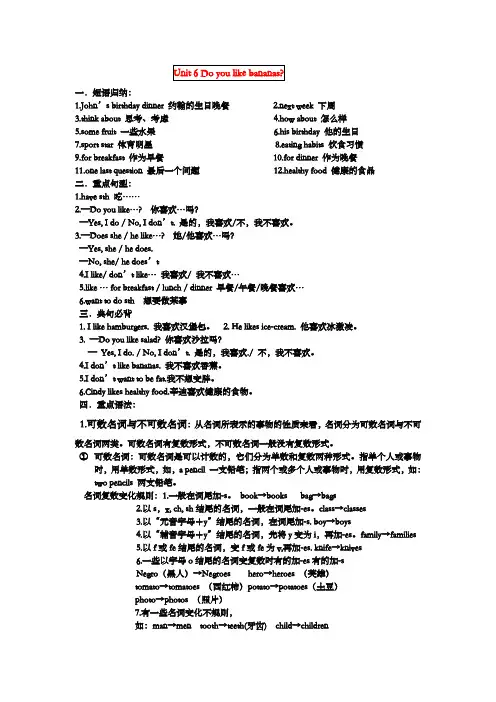
一.短语归纳:1.John’s birthday dinner 约翰的生日晚餐2.next week 下周3.think about 思考、考虑4.how about 怎么样5.some fruit 一些水果6.his birthday 他的生日7.sport star 体育明星8.eating habits 饮食习惯9.for breakfast 作为早餐10.for dinner 作为晚餐11.one last question 最后一个问题12.healthy food 健康的食品二.重点句型:1.have sth 吃……2.—Do you like…? 你喜欢…吗?—Yes, I do / No, I don’t. 是的,我喜欢/不,我不喜欢。
3.—Does she / he like…? 她/他喜欢…吗?—Yes, she / he does.—No, she/ he does’t4.I like/ don’t like…我喜欢/ 我不喜欢…5.like … for breakfast / lunch / dinner 早餐/午餐/晚餐喜欢…6.want to do sth 想要做某事三.典句必背1. I like hamburgers. 我喜欢汉堡包。
2. He likes ice-cream. 他喜欢冰激凌。
3. —Do you like salad? 你喜欢沙拉吗?—Yes, I do. / No, I don’t. 是的,我喜欢./ 不,我不喜欢。
4.I don’t like bananas. 我不喜欢香蕉。
5.I don’t want to be fat.我不想变胖。
6.Cindy likes healthy food.辛迪喜欢健康的食物。
四.重点语法:1.可数名词与不可数名词:从名词所表示的事物的性质来看,名词分为可数名词与不可数名词两类。
可数名词有复数形式,不可数名词一般没有复数形式。
人教版丨七年级上册英语Unit6~Unit9单元必考知识点梳理
人教版丨七年级上册英语Unit6~Unit9单元必考知识点梳理人教版丨七年级上册英语Unit6~Unit9单元必考知识点梳理Unit6 Do you like bananas?1. like 喜欢1)like sb. / sth. 喜欢某人/某物2) like to do sth. 喜欢/想要做某事(表一次性或特指的某一具体的动作)3) like doing sth 喜欢做某事(表习惯性的动作或爱好)①我喜欢每天打篮球。
I like playing basketball every day.②今天很冷,我喜欢呆在家里。
Today is cold, I like to stay at home.2. Do you like bananas? 你喜欢香蕉吗?可数名词可用复数表示一类人或事物。
3. 名词的分类1)名词分为“专有名词”和“普通名词”两大类。
专有名词是个别的人、事物、地点等专有的名称,如:Gina, China。
专有名词的第一个字母要大写。
2)普通名词又可分为下面四类:①个体名词:表示某类人或东西中的个体。
如:pen, student, apple。
②集体名词:表示若干个体组成的集合体。
如:family, class。
③物质名词:表示无法分为个体的物质。
如:water, broccoli等。
④抽象名词:表示动作、状态、品质、情感等。
如:work, happiness等。
个体名词和集体名词都是可数名词,物质名词和抽象名词都是不可数名词。
3)有些名词既可作可数名词又可作不可数名词,但意义不同,要注意区分。
①glass C. 杯子U. 玻璃orange C. 橘子U. 橘汁②还有表示动物类的名词,表示动物时是可数名词,作为菜肴时是不可数名词。
chicken C. 小鸡U. 鸡肉;fish C. 鱼U. 鱼肉③salad, ice cream, food, fruit作总称讲是不可数名词,作种类讲是可数名词。
七年级上册Unit 9 人教版英语中考一轮复习(词汇+语法讲解)
一轮复习:七上U9 词汇+语法讲解【单词默写】【单词变形】【单词变性】useful形容词变名词_________【一词多义】1. free __________ ____________ _____________ _____________I am free these days.I want to be free.There is no free lunch in the world.Feel free to ask me any questions.【词汇用法】1. finish: finish doing sth./finish sth.同义词辨析: complete vs. finishcomplete: vt./完成工程finish: vt. /finish doing sth./finish sth.2. useful: adj./sth. is useful同义词辨析: helpful vs. usefulhelpful: sb./sth. is helpfuluseful: sth. is useful复习冠词,名词,数词,人称代词&指示代词,特殊疑问词(一),动词(一&二),时间介词,地点介词及固定搭配【词汇练习】1.I like reading books, b ________ I can learn a lot from them.2. C ________ is spoken by more and more foreigners outside China.3.His f ________ subject is music. I like it very much.st night she didn’t go to bed until she f ________ her homework.5.I'm very busy. You can ask your father to help you with your homework. He is f________.6.Thousands of visitors f ________ all over the world come to the West Lake every day.7.In the g _______ class, our teacher tells us different places around the world.8.Of all the subjects, I like h ________ a lot. I find it interesting.9.Doctors advise that everyone needs at least eight h ________ sleep every day.10.There will be a talk on healthy diet for all the teachers and students on M ________ afternoon.11.My favorite day is Friday because the next day is S ________.12.Chinese and math are my favorite s _______.13.The last day of the week is S ________.14.I take exercises every other day, Tuesday, T _______ and Saturday.15.The teacher says math is a u ________ subject.16.Let’s meet at Café Benes on W ________, before the party on Thursday.17.Could you tell the reason w ________ you are late again?18.Our s ________ teacher is Mr. Wang. In his class we can learn a lot about nature(大自然).19.China is an ancient country with a long h ________.20.He is going to work as an actor after f________ the college.Travel can teach kids more than a textbook. Traveling with kids is good 1 ________ them. They can find new interests. Travel 2 ________(make) information alive for kids, and makes it much more exciting than studying textbooks or 3 ________(do) experiments in the lab. While traveling, they learn 4 ________ to deal with new situations, and communicate with other people. They learn patience, because sometimes it takes a long time 5 ________(get) to some exciting or interesting places.I’ve been traveling since I was seven years old. For me, to stop traveling would be like taking something away from my soul(灵魂). I can’t live 6 ________ traveling and I wouldn’t be who I am if I don’t travel. Some people think it’s hard to travel after having 7 ________(kid). But in my opinion, when people become parents, it doesn’t mean they couldn’t travel any more. My children have been traveling since they were three weeks old.Bringing a new life into the world comes with many duties(责任) and I’d love to be a good mother. One of my 8 ________(duty) is to educate my children. I’m so thankful that my parents took me on family trips when I 9 ________(be) young. I’ve learned that the outside world is more colorful than the little one I was living 10 ________. Of course, I want to pass these travels on to my children.I value the memories I have traveling with my children. I’m sure they will always remember them in their lives.Special surfing camp a place to make great memoriesJacob Newland, 14, had never surfed before. But after a few tries, he did it! He raised his arms 1 ________(excited). “It felt like I did something great.” he said. His father looked 2 ________ him from the shore. He could see Jacob 3 ________(keep) his eyes forward, as the water washed over his bright yellow surfboard.Jacob and about 25 other kids with disability(残疾) learned to surf at a camp in Virginia Beach, Virginia, US. The surf camp has lasted 4 ________ nine years. Each kid 5 ________(get) a 30-minite lesson with the help of a swim coach and a few volunteers.It was nothing new for 9-year-old Jack Wenrich to be in the water. He had been through swim lessons. It was his 6 ________(four) time at the camp. His mom, Jennifer, said he is not afraid. “Once he knew how 7 ________(swim), he just jumped right into the deep end,” she said.Jack has autism(自闭症). But surfing gives 8 ________(he) a sense of freedom, Jennifer said. “It’s something they can do, something they can be happy about,” she said. Not everyone wanted to try surfing. Some just liked being in the water and lying on the board. So people greeted them with cheers when they returned to shore. And all the students came back 9 ________ smiles.Karen Morgan-Hill, 10 ________ organizer(组织者), helped the surfs. Morgan-Hill said the water makes people open up more and builds trust.Speaker 1: No one knows what life will be like in the future. But we can have some 1 ________(predict). There will be computers in each home. We can talk on the Internet and even see the doctors on it. And we won’t use paper to write on. We can study on computers. And there won’t be many cars or much 2 ________(pollute). Everyone will try their best 3 ________(keep) the environment nice and beautiful. The sea will be 4 ________(clean) and the sky will be bluer. So the world will be better and better.Speaker 2: In the future, people will have more time 5 ________ fun. People will be able to travel to other planets for holidays. Maybe people will live on other planets one day. 6 ________, some people don’t agree on this. They think it is not safe for people to live on other planets. They hope that scientists will build cities under the sea to make them live there.Speaker 3: What kind of life will we live in the future? I think in the future every family will have a robot in their homes. It can help with the housework, 7 ________ as cleaning the rooms, sweeping the floor, 8 ________(wash) the clothes, and so on. So, we can save much time from unnecessary things. Of course, there will be many robots working in 9 ________(factory). They do easy jobs over and over 10 ________. And they will never get bored. Because of this, many people will lose their work---they might have nothing to do.Life is full of regrets(遗憾). Anyone around you will have no 1________ (difficult) telling his regrets. But what can we do to avoid future regrets?Make better plansIf you start to do something,you need to make a plan before doing it. The earlier, the 2________ (good). You will know what comes first and what comes last. You’ll also know what you should do and what you shouldn’t do. 3________ changes happen, you can have more time to deal with them.Live a more active lifeYou can go around more often. More outdoor activities can keep you relaxed and active. You also need to be kind. “Thank” you can bring a smile to 4________ (someone) face. Learn 5________ (say) “Sorry” and don’t be angry with others.Find the right friendA friend may make your life better and he or she can break your life as well. So you need to think 6________ (two) when you choose a friend. Good friends will always better your ideas. When you get into trouble, ask them 7________help. That little help may get you good 8________ (result).Never fear failureEverybody 9________ (fail). Even the greatest person failed. We should not fear failure, because failure is not the end of the road, we must take failure as a chance to learn and improve 10________ (we).Life is good. We don’t have to live in our past,but we do hope that we can plan better, live better, and work better when we have the chance to do so.【参考答案】useful形容词变名词use1. free 空闲的自由的免费的无拘束的I am free these days.I want to be free.There is no free lunch in the world.Feel free to ask me any questions.【词汇练习】because Chinese favorite finished free from geography history hours’ Monday Saturday subjects Saturday Thursday useful Wednesday why science history finishing【语法练习】for makes doing how to get without kids duties was inexcitedly at keeping for gets fourth to swim him with thepredictions pollution to keep cleaner for However such washing factories againdifficulty better If/when someone’s to say twice for results fails ourselves。
七年级上册六至九单元英语重难点总结
七年级上册六至九单元英语重点、难点知识总结:1. Do you like bananas / hamburgers / salad…? 你喜欢香蕉/ 汉堡包/ 沙拉……吗?Yes, I do. / No, I don’t. 是的,我喜欢。
/ 不,我不喜欢。
2. like doing sth. = like to do sth. 喜欢做某事. 如:She likes helping / to help students. 她喜欢帮学生。
3. 短语:for breakfast / lunch / dinner / dessert 对早餐/ 午餐/ 晚餐/ 甜食来说running star 跑步明星lots of = a lot of ( 后既可接可数名词复数,又可接不可数名词) healthy food 健康食品1. How much are these pants? =What’s the price of these pants? 这条裤子多少钱?They’re twenty dollars. 这条裤子20美元。
How much is this sweater? =What’s the price of this sweater? 这件毛衣多少钱?It’s 60 yuan. 它60元。
2. How much加不可数名词,how many 加可数名词复数。
如:how much food, how many students3. Can I help you? 我能帮你吗?What can I do for you? 我能为你做什么?4. Yes, please. 是的,请吧。
No, thanks. 不了,谢谢。
5. I want a sweater. 我想要件毛衣。
6. What color do you want? 你想要什么颜色?7. Here you are. =Here it is给你(这件毛衣/ 钱等)。
人教版初中英语新教材七年级上Unit6知识点归纳总结(复习必背)
Unit 6 A Day in the Life !学习目标单元主题人与自我→做人与做事→自我认识,自我管理,自我提升必备单词Section A1.quarter / kwɔ:tə(r)/ n.一刻钟;四等份之一2.shower/’ʃaʊə(r)/ n.淋浴;淋浴器v.洗淋浴3.brush/brʌʃ/v.(用刷子)刷n.刷子;画笔4.tooth /tu:θ/ n.牙齿5.duty/'dju:ti/n.值班;职责6.usually/'ju:ʒuəli/adv.通常地;一般地7. reporter/rɪ'pɔ:tə(r)/n..记者8. around /ə'raʊnd/ prep.& adv·大约;环绕;到处9.homework/'haʊmwɜ:k/n.家庭作业10.saying/'seɪɪŋ/n.谚语;格言11.rise/raɪz/v.起床;升起;增长n.增加;增强12.stay/steɪ/v.停留;待13.routine/ru:'ti:n/n.常规14.restaurant/'restrɒnt/n.餐馆;餐厅15.housework/'haʊswɜ:k/n.家务劳动16.while/waɪl/n.一段时间;一会儿conj.在······期间;当······的时候17.weekend/,wi:k'end/n.周末Section B1.daily/'deɪli/adj.每日的;日常的2.only/'əʊnli/adv.只;仅3.break/breɪk/n.休息;间断v.(使)破碎;损坏4. Finnish/ 'fɪnɪʃ/ / n ..芬兰语adj.芬兰的;芬兰人的;芬兰语的5.finish/'fɪnɪʃ/v.结束;完成6.hockey/'hɒki/n.曲棍球7.already/ɔ:l'redi/adv.已经;早已8.dark/da:k/adj.昏暗的;深色的9.outside/,aʊt'saɪd/adv.在外面adj.外面的prep.在······外面10.part/pa:t/n.部分11.everyday/'evrideɪ/adj.每天的;日常的12.prepare/prɪ'peə(r)/v.把······预备好;准备13.Finland/'fɪnlənd/芬兰高频短语1.make use of 使用···;利用···· 10.have class 上课2.take a shower 淋浴11.for a while 一会儿3.get dressed 穿衣服12.at weekends 在周末4.brush teeth 刷牙13.daily routine 日常生活5.on duty 值班14.home economics 家事经济6.get up 起床;站起15.ice hockey 冰球运动;冰上曲棍球7.do one's homework 做···的家庭作业16.prepare sth for为······把某物准备好8.go to bed 上床睡觉17.get off work 下班9.play sport 做运动18.another four hours 另外四小时常考句型1.what time 提问具体时间(钟点):-What time do you usually get up?你通常几点起床?-I usually get up at 6:30 a.m.我通常早上六点半起床。