
国际贸易实务英语练习答案概要
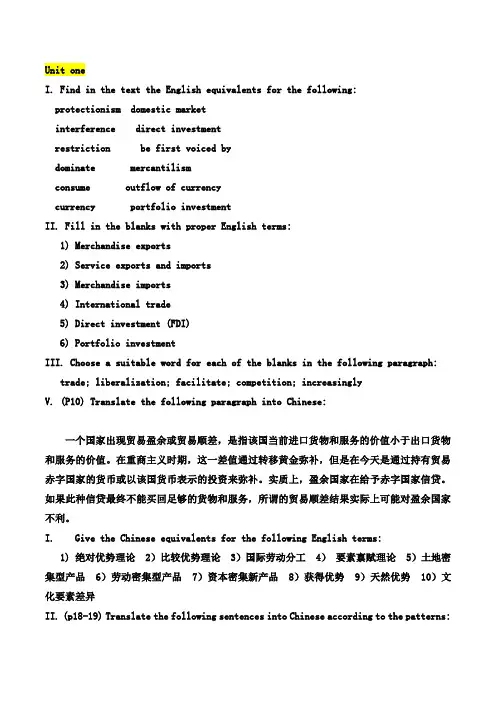
Unit oneI. Find in the text the English equivalents for the following: protectionism domestic marketinterference direct investmentrestriction be first voiced bydominate mercantilismconsume outflow of currencycurrency portfolio investmentII. Fill in the blanks with proper English terms:1) Merchandise exports2) Service exports and imports3) Merchandise imports4) International trade5) Direct investment (FDI)6) Portfolio investmentIII. Choose a suitable word for each of the blanks in the following paragraph:trade; liberalization; facilitate; competition; increasingly V. (P10) Translate the following paragraph into Chinese:一个国家出现贸易盈余或贸易顺差,是指该国当前进口货物和服务的价值小于出口货物和服务的价值。
在重商主义时期,这一差值通过转移黄金弥补,但是在今天是通过持有贸易赤字国家的货币或以该国货币表示的投资来弥补。
实质上,盈余国家在给予赤字国家信贷。
如果此种信贷最终不能买回足够的货物和服务,所谓的贸易顺差结果实际上可能对盈余国家不利。
I.Give the Chinese equivalents for the following English terms:1) 绝对优势理论2)比较优势理论3)国际劳动分工4)要素禀赋理论5)土地密集型产品6)劳动密集型产品7)资本密集新产品8)获得优势9)天然优势10)文化要素差异II. (p18-19) Translate the following sentences into Chinese according to the patterns:1.即使所有产品都具有绝对优势的国家,因其必须放弃产出效率低的产品转而生产产出效率高的产品,也会从贸易中获益。
2.尽管美国产茶与产麦均有绝对优势,可它只在麦子生产上具有相对优势,因其产麦的优势较其产茶的优势更大。
3.要素禀赋理论认为,较丰富的生产要素比相对稀缺的要素更加廉价。
4.为了做好国际贸易,公司经理除需要掌握业务经营知识,还需要掌握基本的社会科学知识。
Unit TwoI. (p27) Find out the whole forms of the following short forms: MTO Multilateral TradingGSP Generalized System of PreferenceUNCTAD United Nations Conference on Trade and Development WTO World Trade OrganizationMFN Most Favored NationLDC less developed countriesGATT General Agreement on Tariffs and TradeEC European CommunityII.Fill in the blanks with proper words:1) policies; discourage 2) government 3) 117; 36%; 24% 4) negotiations; to; trade 5) free; would accept/permitI. (p35-36) Identify in the text the English equivalents for the following:prohibitive tariff value added taxregulatory tariff ad valorem tariffprotective tariff dutiable priceretaliatory tariff retail pricecountervailing tariff wholesale pricepunitive tax licenseSpecial Drawing Right clandestinerevenue tariff non-tariff barriersgovernment procurement coordinationinfant industry customs valuationII. (p36) Translate the following into Chinese:大多数国家目前就估价的程序达成了一致。
海关官员首先必须采用发票金额。
若没有发票金额或其真实性可疑的情况下,必须以同类商品价值为基础估价。
若找不到同类商品,就必须以基本同时期进海关的相似产品为基础进行估价。
III. Complete the following sentences:1.the customs; import/export goods2.Tariff or duty; under3.dumping; levying anti-dumping tariff4.duty; value5.increasing; imported; gainIV. Fill in the blanks with proper prepositions:of; on; with; from; with; for; to; at; by; atI.(p44) Find in the text the English equivalents for the following:foreign currency retention tariff exemptionpreferential condition monitorexport credit certificatedirect consignment Generalized System of Preferencetariff union preference-giving countryeconomic union preference-receiving countrycommon market signatory nationprinciple of the place of origin tariff regionfree trade zone regional economic integrationinternational financial market National CommercialInspection Bureau and its subordinates II.(p44-45) Translate the following into Chinese:进出口数量限制最常见的形式是配额(制度)。
从进口角度讲,配额频频使用的目的是为了限制某一特定年份所允许进口产品的数量。
这一数量常常反映出国内生产厂商在特定年份拥有国内市场中一定份额的保障(额度)。
很多年来,美国进口糖配额使美国(国内)糖业生产厂商占据了近一半国内市场。
III.(P45) Find a suitable term to fill in each of the following blanks:1)Economic Union2)A free trade zone3)the average tax refunding4) total tariff exemption5) Form A6) GSP7) encourage export production8) justifiableUnit Three The Quality of GoodsI.(p51) Give the Chinese equivalents for the following Englishterms:1)固有/内在属性2)光泽、款式、结构3)适销性4)社会属性5)适用性6)耐用性7)卫生8)以消毒/杀菌II.Translate the following, paying attention to the underlined terms: 1)Not only should we take into consideration the intrinsic qualityand outer form or shape, but also individual consumer tastes.2)To strengthen the competitiveness of China’s export commodities,we must improve their quality.3)日本质量管理方法称为“全面质量管理”(TQM),是日本公司为达到质量要求所遵循的程序。
4)竞争力战略应优先考虑以下四方面:效率/成本、可靠性、质量和灵活性。
5)在日本,质量是指“产品上乘,顾客不会想到转向其它卖家”。
III.F ill in the blanks with proper prepositions:to; in; in; of; by; on; in; withoutI.(p55) Give the Chinese equivalents and explain them in simpleEnglish:1)检验销售2)代表性样品3)参考样品4)复样5)产权6)技术资源7)对等样品8)商检II.(P60) Translate the following into Chinese:规格修改修订维修/保养保质期/质保期精选水产品补充仲裁示意图/ 图纸消费安装相关部门奢侈食品跨国公司III.P ut the following into English:quality first quality reliable productscustomer first quality inspection systemquality indicator superior qualitycorrespond with samples not the same as the sampleintangible assets famous brand productsstrong and pliable booklet/manualIV.Find a proper word for each blank:select; location; largest; northern; conscious; terms; attract; fast; afford; earningsI. (p64) Give the Chinese equivalents to the following English terms:1) 允许误差2)质量公差3)可变范围4)灵活性5)鸭绒含量II. Translate the following sentences into Chinese according to the hints:1)某些部件是定制的,需要买卖双方的工程技术人员多次谈判才能确立正确的规格。
国际贸易实务英文版第二版课后习题答案

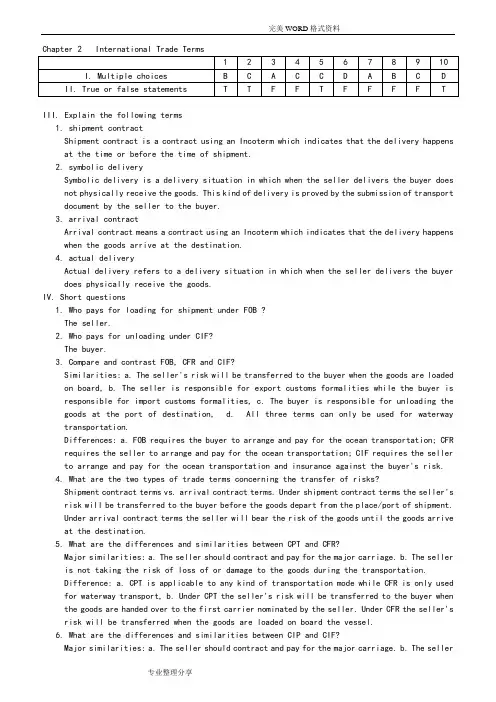
Chapter 2 International Trade TermsIII. Explain the following terms1. shipment contractShipment contract is a contract using an Incoterm which indicates that the delivery happens at the time or before the time of shipment.2. symbolic deliverySymbolic delivery is a delivery situation in which when the seller delivers the buyer does not physically receive the goods. This kind of delivery is proved by the submission of transport document by the seller to the buyer.3. arrival contractArrival contract means a contract using an Incoterm which indicates that the delivery happens when the goods arrive at the destination.4. actual deliveryActual delivery refers to a delivery situation in which when the seller delivers the buyer does physically receive the goods.IV. Short questions1. Who pays for loading for shipment under FOB ?The seller.2. Who pays for unloading under CIF?The buyer.3. Compare and contrast FOB, CFR and CIF?Similarities: a. The seller's risk will be transferred to the buyer when the goods are loaded on board, b. The seller is responsible for export customs formalities while the buyer is responsible for import customs formalities, c. The buyer is responsiblefor unloading the goods at the port of destination, d. All three terms can only be used for waterway transportation.Differences: a. FOB requires the buyer to arrange and pay for the ocean transportation; CFR requires the seller to arrange and pay for the ocean transportation; CIF requires the seller to arrange and pay for the ocean transportation and insurance against the buyer's risk.4. What are the two types of trade terms concerning the transfer of risks?Shipment contract terms vs. arrival contract terms. Under shipment contract terms the seller's risk will be transferred to the buyer before the goods depart from the place/port of shipment. Under arrival contract terms the seller will bear the risk of the goods until the goods arrive at the destination.5. What are the differences and similarities between CPT and CFR?Major similarities: a. The seller should contract and pay for the major carriage.b. The seller is not taking the risk of loss of or damage to the goods during the transportation.Difference: a. CPT is applicable to any kind of transportation mode while CFR is only used for waterway transport, b. Under CPT the seller's risk will be transferred to the buyer when the goods are handed over to the first carrier nominated by the seller. Under CFR the seller's risk will be transferred when the goods are loaded on board the vessel.6. What are the differences and similarities between CIP and CIF?Major similarities: a. The seller should contract and pay for the major carriage.b. The seller is not taking the risk of loss of or damage to the goods during the transportation,c. The seller must obtain insurance against the buyer's risk.Difference: a. CPT is applicable to any kind of transportation mode while CFR is only used for seaway or inland waterway transport, b. Under CPT the seller's risk will be transferred to the buyer when the goods are handed over to the first carriernominated by the seller. Under CFR the seller's risk will be transferred when the goods are loaded on board the vessel.7. If you trade with an American, is the sales contract subject to Incoterms without any doubt? What should you do?No. The Revised American Foreign Trade Definitions 1941 is still in use, especially in the North American area. It has different interpretation about some trade terms. The traders should clarify the choice of rules before any further discussion.FOB, CFR & CIF.9. Who is responsible for carrying out customs formalities for exports under an FOB contract?The seller. According to Incoterms 2010, except EXW and DDP these two terms, all the other eleven terms require the seller to handle the export customs formalities, while the buyer the import customs formalities.10. If a Chinese trader signs an FOB contract, is he exporting or importing?Importing. FOB should be used with a "named port of shipment", if is the port of shipment, from the Chinese trader's perspective, he is importing.V. Case studies1. An FOB contract stipulated "The shipment will be effected in March 2011." When the goods were ready on 10 March , the seller contacted the buyer for shipment details. The buyer faxed "Please send the goods to the port for loading on 21 March. The vessel will depart on 22 March." The seller sent the goods to the port accordingly. However the nominated vessel did not turn up and the goods had to be stored in the warehouse at the port. On the night of 21 March a fire happened in the warehouse area and part of the goods was damaged. When the vessel arrived two days later the seller and the buyer had an argument about the settlement of the loss. The seller required the buyer to bear the loss caused by the fire, but the buyer believed that the vessel arrived within the shipment period and the loss occurredbefore the seller delivered the goods therefore the seller should bear the loss. Please provide your solution.析:1)首先案例中提到货物发生了损失是由于货物存放在码头仓库期间发生火灾造成的。
国际贸易实务英文版课后练习参考答案

从量税specific duties财政关税revenue tariff政府采购government procurement从价税Ad valorem Duties增加内需raise domestic demandDomestic content 国内含量Red-tape barriers 进口环节壁垒Export susidies 出口补贴Binding quota 绑定配额Absolute quotas 绝对配额VER 自愿出口限制Tariff-rate quotas 关税配额Trade bloc 贸易集团Trade block 贸易禁运/封锁Open regionalism 开放式区域主义Trade embargoes 贸易禁运歧视性关税discriminatory tariffs经济制裁economic sanction贸易弹性trade elasticity双边贸易协定bilateral trade agreements多边贸易协定multilateral trade agreements惠国Patronage nations受惠国Favored nations缔约国Contracting Parties市场准入market access透明度transparency紧急进口措施Urgent Importing Measures争端解决机制dispute settlement mechanism可持续发展sustainable development特许经营franchise惠国Patronage nations受惠国Favored nations缔约国Contracting Parties市场准入market access透明度transparency紧急进口措施Urgent Importing Measures争端解决机制dispute settlement mechanism可持续发展sustainable development特许经营franchiseFOB 吊钩下交货 FOB Under Tackle平舱 trim多式联运 multimodal transport船舷 shipboard内陆水运 marine navigation on inland waterway理舱 stowCFR 卸至岸上(含着陆费) CFR LandedCFR 舱底交货 CFR Ex-ship’s HoldCFR 班轮条件 CFR liner termsReference /Duplicate Sample 基准样品/副样Qulity Tolerance 品质公差Counter Sample 对等样品More or Less Clauses 溢短装条款Neutral Packing 中性包装Customs Formality 报关手续Inspection Certificate of Quality 质量检验证书FDA 食品及药物管理局Marking of Goods 标记货物毛重gross weight理论重量theoretical weight净重net weight约定皮重computed tare公量conditioned weight单位重量unit weight含水量water capacity习惯皮重customary tare法定重量legal weight实际皮重actual tare从价税ad valorem duty平均皮重average tare货样不符goods not equal to the sample副产品by-products国家质量监督校验检疫总局General Administration of Quality Supervision,Inspection and Quarantine of the People’s Republic of China油轮Oil tanker定程租船Voyage Charter滚装船Ro /Ro vessel定期租船Time Charter载驳轮LASH(Light Aboard Ship)光船租船Bare Boat Charter(BBC)船期表sailing schedule租船合同charter contract滞期费demurrage charge班轮运价表liner freight rate schedule速遣费dispatch money选卸附加费optional additional直航附加费direct additional转船附加费transshipment surcharge港口拥挤附加费Port Congestion Surcharge运输代理transpotation agent包裹package拼箱货LCL(Less than container load)结汇settlement整箱货FCL(Full container load)空运单Air waybill集装箱货运站container yard装运通知shipping notice处置权right of disposalPartial shipment /transshipment 分批装船/转运Order B /L 指示提单Combined transport B /L 联合运输提单Blank B/L 空白提单Straight B/L 记名提单Through B /L 联运提单Liner B/L 班轮提单Ante-dated B /L 倒签提单Advanced B/L 预借提单Consignment note 陆运或铁路运输通知Blank endorsement 空白背书IATA 国际航空运输协会Combined transport documents 多式联运单据FCL /LCL 整箱交/拆箱接投保人insured共同海损general average投保金额insured amount外来风险extraneous risks保险单insurance policy推定全损constructive average海上风险marine risks施救费用salvage charges救助费用sue and labor expenses意外事故misfortune承保人insurer单独海损particular average保险费insurance premium航空运输货物战争险air transportation war risk 陆运险land transportation risks陆运一切险land transportation all risks估损费用risk estimation charges航空运输一切险air transportation all risks Ocean marine insurance 海运保险Basic risks coverage 基本险种Insured amount 投保金额T.P.N.D 偷盗、失窃、提货不着险Taint of ordr 窜味险Overland transportation insurance 陆上运输保险Parcel post insurance 邮寄包裹保险Free from particular average 平安险Additional risks coverage 附加险别Fresh water and /or rain damage 淡水雨淋险With particular average 水渍险信用状况 credit standard远期信用证time L /C,usance L /C通知银行advising bank信用证有效期the maturity of L /C交付运单delivery of B /L支付保障条款confirmation of credit支付结算payment and settlement申请人与受益人applicant and beneficiary国际保理international factoringirrevocable letter of credit 不可撤销信用证confirmed L /C 保兑信用证revocable letter of credit 可撤销信用证sight draft 即期汇票commercial bill of exchange 商业汇票time draft 远期汇票governmental guarantee 政府保函drawee 付款人仲裁条款arbitration clause仲裁员arbitrator做出裁决issue an award提出仲裁申请submit dispute to arbitration国际商会International Chamber of Commerce美国仲裁协会American Arbitration Association中国国际经济贸易仲裁委员会China International Economic &Trade Arbitration Commission首席仲裁员presiding arbitratorPotential partner 潜在合作伙伴ICC 国际商会Qualified negotiators 合格的谈判队伍Commercial negotiation 商业谈判Negotiation brief 谈判纪要Negotiation team 谈判团队Conclude a negotiation 终结谈判Credit reference 信用参照Business range 商务往来范围Face-to-face negotiation 面对面谈判Annual sales volume 年度销售额Trade show 贸易展销会还盘counter-offer询盘inquiry受盘人offeree发盘人offeror发盘offer可撤消的revocable虚盘offer without engagement实盘offer with engagement一般交易条件common practice in international trade失效invalid撤回revoke市场经济地位market economy status出口程序exporting procedures出口许可exporting license计价货币payment of account订舱book the shipping space or ship审单check documents报关customs dedaration提货taking delivery备货cargo readiness制单结汇document examination and paymentImporting procedures 进口程序Import license system 进口许可制度Returned Goods Relief 退转商品减免Product liability 产品责任ATA carnet 暂准进口证Inward /Outward processing 进出口加工原产地证书certification of origin领事发票consular invoice海关发票customs invoice外汇许可证foreign exchange license形式发票pro forma invoice商业发票commercial invoice国际汇款申请单application for international transfer跟单信用证申请表application for documentary letter of credit 海运提单bill of lading多联运提单Multi-transportation B /L托运单consignment note到货通知arrival notification经销distribution寄售consignment一般经销商non-exclusive distributor独家经销商sole distributor中间人intermediary保付代理factoring直接贸易direct trade间接贸易indirect trade存货stock-in-tradeforwarding agents 运输商clearing agents 清算代理retail price 零售价ultimate customers 最终客户consignor 寄件人consignee 收件人gross proceeds 总货价收入to sell goods on discount 折扣销售working capital 运营资本conform to all rules 遵守所有条款consignment note 托运单交钥匙工程turn-key plant-engineering 工程设计designs of plant-engineering 总价合同total price contract单价合同unit price contract邀标invitation to bid基价base price limit on bid递标submission of tenders保函a letter of performance guarantee 开标bid opening议标evaluation of tenderTender 标书bid document 竞标文本initial design 初始设计construction design 结构设计Know-how 专有技术Initial operation 初始运作Main contractor 主承包商Subconstracor 分包商countertrade 对等贸易compensation trade 补偿贸易counter purchase 回购switch trade 转手贸易offset 抵偿贸易swap 互换barter 物物交易reverse countertrade 反向对等贸易infrastructure 基础设施clearing agreements 清算协定buyback 回购、产品返销parallel trade 对购、平行贸易CBOT (Chicago Board of Trade)芝加哥期货交易所CME (Chicago Mercantile Exchange)芝加哥商品交易所NYME (New York Mercantile Exchange)纽约商品交易所London Metal Exchange 伦敦钢铁交易所Tokyo Stock Exchange 东京证券交易所Singapore International Monetary Exchange 新加坡国际金融交易所Clearing houses 清算中心Hong Kong Commodity Exchange 香港商品交易所Margin system 保证金系统Variation margin 价格变动保证金Floor traders 场内交易人期货市场futures market期货合同futures contract冲抵hedging期货交易所futures exchange远期合同forward contract初始保证金original margin套期保值hedging投机者speculator买入套期保值long hedging卖出套期保值short hedging头寸position现价/期价present value /future value1.Futures trading originated from forward contracts.2.Future markets are centralized, regulated markets where an actual commodity is not physically traded; instead, futures contracts are bought and sold.3.Future prices are quote for delivering a designated quality and quantity of goods to a specific place and time.4.Hedging is the practice of offsetting the price risk inherent in any cash market position by buying or selling futures contracts.5.Hedgers use futures to protect their businesses from negative price changes that could negatively impact the bottom-line profitability of their businesses.6.A future exchange is usually a membership organization whose purpose is to facilitate the trading of futures contract.1.Tariff is a duty collected by customs of a government on imports and /or exports.2.A revenue tariff can be some of the incomes of a government,but it must be taken under control.3.To export goods at an unreasonably low price is taken as dumping which might be fought against by government of the importing country.4.A tariff may be assessed on a per unit basis,in which case it is known as a specific duty.It also may be assessed as a percentage of the value of the item,in which case it is knownas an ad valorem duty.5.Import tariffs primarily serve as a means of raising the price of the import goods so that competitively produced domestic goods will gain a relative price advantage.1.Under CFR,buyer should effect insurance.2.Under CIF Ex-Ship’s Hold,seller should pay the discharge charges. 3.Under CIF,the insured amount should be US $22000 if the contracted price is US$20000.4.Under CIP,seller has to procure insurance against the buyer’s risk of loss of or damage to the goods during the carriage.5.The FAS term requires the seller to clear the goods for export. 6.The DEQ term requires the buyer to proceed with the customs clearance for imports and payment of all customs duty.7.Under DDP,the seller must pay the costs of customs duties as well as all duties,taxes and other official charges payable upon exportation and importation of the goods.8.Under DDU the seller must give the buyer instant notice of the shipping of the goods as well as any other notice required in order to allow the buyer to take measure.1.An overseas importer is a country to which an exporter intends to export his commodities.2.Quota is a limit on the quantitative amount of a product allowed to export out of a country in a year.3.A negotiating brief is an attitude toward setting small issues before deciding on principles.4.An offer is the price given by a trader who is willing to buy or sell commodities at that price.5.Counter-offer is a process usually made by the buyer of asking the seller about the terms of a sale.6.Business negotiation is the process in which the seller and the buyer discuss about the trade terms in order to reach an agreement about the sales of goods.7.Promotional communication includes a series of activities by a company for making its new products generally known and well liked,usually by participating in the export commodity fairs,distributingcatalogs,booklets,and samples among his potential customers,etc.1.Most of the import transactions in that country are under FOB term.2.After signing a contract,the importer should open L /C to fit the sales contract term.3.Under FCA,the importer is responsible for shipment.4.After receiving the exporter’s notification of cargo readiness,the importer should book shipping space or ship.5.Under CFR,the importer should ask the exporter to advise the shipment in time so that the goods can be covered by insurance without delay.6.After shipment,the exporter will present to the negotiating bank the relevant documents to get payment.7.Under documentary collection,the importer himself should examine the documents presented by the exporter to confirm if they meet the requirements of the sales contract.8.The import inspection is always taken to confirm if the goods are in conformity with the terms stipulated in the sale contract.Should any problem occurs,the importer need to make claims against the relevant party immediately.9.Documentation should be completed by the exporter with absolute accuracy and clarity.10.After receiving the shipping order from the carrier,the exporter may start to ensure the loading of the goods.The exporter should supervise the loading process,and get B/L from the carrier.1.Countertrade is a fundamental and simple term that includes all of the variations of the exchange of goods for goods.2.The common reason for counter trade are: to create new export markets or promote export products; to acquire new technology or attract foreign investment; to balance trade for economic or political reason.3.In counter purchase, the value of counter goods does not have to equal that of the export.4.Switch involves at least three parties, or even four or five parties.It is closely linked with the bilateral clearing agreements, a kind of basis for barter transactions between governments.5.Offset means that the exporter agrees to use goods and services from the buyer’s country in the product being sold.Offset may be direct or indirect, depending on whether the goods and services are integral parts of the product.Ⅱ1.Enquiry is an indispensable procedure in international business transactions taken by an overseas buyer to a seller,inquiring upon the terms of a sale.2.In order to avoid the problems resulting from direct importing such as great time consumption and difficulty to find the right overseas supplier,the importer could adopt the solution of importing indirectly,which means to use a third-party company to handle the importation process.3.Under DEQ,the buyer is required to clear the goods for import in Incoterms 2000,which is a reversal from previous Incoterms versions.4.Goods like tobacco or alcohol products are subject to excise duty.5.For imports of goods that were previously exported but have not been processed overseas,the importers could be able to claim Returned Goods Relief.6.If the importer tends to place regular orders with an overseas supplier,he could be able to protect himself against foreign exchange risk for longer by agreeing a fixed price contract,or arranging medium-term foreign exchange protection.Ⅱ1.Bill of lading gives the holder of the document ownership of the goods mentioned on it.2.Certificate of origin is prepared for the Customs authorities who need to know from which country the goods have originated.3.When a sale of goods has been agreed,the seller draws up and signs a sales contract,which is then passed to the buyer for acceptance by signing across it.4.Documentary letter of credit is also a kind of bill of exchange,but there are various foreign documents “attached”.5.In the collection method of payment for goods,the exporter uses the banking system to send the importer a collection order to get paid.1.Wholesaling and retailing are part of the marketing system which provides channels of distribution that are used to bring goods to overseas markets.2.A direct channel moves goods from the manufacturer or producer to the consumer.3.Export and import agents work on behalf of other businesses and receive a commission as a percentage of the sales or purchases which they handle.4.Unlike agents,distributors buy goods from the principals on their own account and take title to them and resell them to their customers in their territory.5.Sole distributor is the only distributor in a territory.6.Under consignment,the agent sends the goods to a foreign consignee who will sell the goods for the exporter according to the agreed terms.1.Employer means the person named as such in the conditions of contract and of subcontract and the legal successors in title to, or assignees of, such person.2.Contractor means the person named as such in the conditions of contract and of subcontract and the legal successors in title to, or assignees of, such person, but not any assignee of such person.3.Engineer means the person appointed by the employer to act as Engineer for the purposes of the Main contract and named as such in the conditions of subcontract.4.Main Contract means the contract entered into between the Employer and the contractor.5.Letter of Acceptance means the formal acceptance by the Employer of the contractor’s offer.6.Bill of Quanntities means the priced and completed bill of quantities forming part of the contractor’s offer.7.Tender means the contractor’s priced offer to the employer for the works, as accepted by the Letter of Acceptance.1.What is international trade?International trade,is the fair and deliberate exchange of goods and /or services across national boundaries.It concerns trade operations of both import and export and includes the purchase and sale of both visible and invisible goods.2.Why is it an irreversible trend to have the international trade for all the countries around the world?In today’s complex economic world,neither individuals nor nations are self-sufficient.Nations participate in the international trade for many reasons.As to the economic reasons,no nation has all of the economic resouces (land,labor and capital) that it needs to develop its economy and culture,and no country enjoys a particular item sufficient enough to meet its needs.As for the preference reasons,international trade takes place because of innovation of style.Besides,every nation can specialize in a certain field and enjoy a comparative advantage in some particular area in terms of trade so that they need to do business with each other to make use of resources more efficiently and effectively.3.How is international trade measured?In measuring the effectiveness of global trade,nations carefully follow two key indicators,namely,balance of trade and balance of payments. 4.What is the definition of FDI?Please list your own ideas about the great significance of FDI for chinaFDI,the abbreviation form Foreign Direct Investment,means buying of permanentproperty and business in foreign nations.It occurs when acquisition of equity interest in aforeign company is made.The great significance of FDI for China might be that: FDI solve the problem of capital shortage for China so that China may spend the money on importing advanced equipment and technologies for its infrastructure,national supporting industry,key projects,etc.1.Protectionism means the deliberate use or encouragement of restrictions on imports to enable relatively inefficient domestic producers to compete successfully with foreign producers.保护主义是指蓄意使用或鼓励进口限制,以此使本国相对效率低的产品能成功地和外国产品竞争。
国际贸易实务英语课后练习答案
Unit oneI. Find in the text the English equivalents for the following:protectionism domestic marketinterference direct investmentrestriction be first voiced bydominate mercantilismconsume outflow of currencycurrency portfolio investmentII. Fill in the blanks with proper English terms:1) Merchandise exports2) Service exports and imports3) Merchandise imports4) International trade5) Direct investment (FDI)6) Portfolio investmentIII. Choose a suitable word for each of the blanks in the following paragraph:trade; liberalization; facilitate; competition; increasinglyV. (P10) Translate the following paragraph into Chinese:一个国家出现贸易盈余或贸易顺差,是指该国当前进口货物和服务的价值小于出口货物和服务的价值。
在重商主义时期,这一差值通过转移黄金弥补,但是在今天是通过持有贸易赤字国家的货币或以该国货币表示的投资来弥补。
实质上,盈余国家在给予赤字国家信贷。
如果此种信贷最终不能买回足够的货物和服务,所谓的贸易顺差结果实际上可能对盈余国家不利。
I.Give the Chinese equivalents for the following English terms:1) 绝对优势理论 2)比较优势理论 3)国际劳动分工 4)要素禀赋理论 5)土地密集型产品 6)劳动密集型产品 7)资本密集新产品 8)获得优势 9)天然优势 10)文化要素差异II. (p18-19) Translate the following sentences into Chinese according to the patterns:1.即使所有产品都具有绝对优势的国家,因其必须放弃产出效率低的产品转而生产产出效率高的产品,也会从贸易中获益。
国际贸易实务英文版第二版课后习题答案解析
III. Explain the following terms1. shipment contractShipment contract is a contract using an Incoterm which indicates that the delivery happens at the time or before the time of shipment.2. symbolic deliverySymbolic delivery is a delivery situation in which when the seller delivers the buyer does not physically receive the goods. This kind of delivery is proved by the submission of transport document by the seller to the buyer.3. arrival contractArrival contract means a contract using an Incoterm which indicates that the delivery happens when the goods arrive at the destination.4. actual deliveryActual delivery refers to a delivery situation in which when the seller delivers the buyer does physically receive the goods.IV. Short questions1. Who pays for loading for shipment under FOB ?The seller.2. Who pays for unloading under CIF?The buyer.3. Compare and contrast FOB, CFR and CIF?Similarities: a. The seller's risk will be transferred to the buyer when the goods are loaded on board, b. The seller is responsible for export customs formalities while the buyer is responsible for import customs formalities, c. The buyer is responsible for unloading the goods at the port of destination, d. All three terms can only be used for waterway transportation.Differences: a. FOB requires the buyer to arrange and pay for the ocean transportation; CFR requires the seller to arrange and pay for the ocean transportation; CIF requires the seller to arrange and pay for the ocean transportation and insurance against the buyer's risk.4. What are the two types of trade terms concerning the transfer of risks?Shipment contract terms vs. arrival contract terms. Under shipment contract terms the seller's risk will be transferred to the buyer before the goods depart from the place/port of shipment.Under arrival contract terms the seller will bear the risk of the goods until the goods arrive at the destination.5. What are the differences and similarities between CPT and CFR?Major similarities: a. The seller should contract and pay for the major carriage. b. The seller is not taking the risk of loss of or damage to the goods during the transportation.Difference: a. CPT is applicable to any kind of transportation mode while CFR is only used for waterway transport, b. Under CPT the seller's risk will be transferred to the buyer when the goods are handed over to the first carrier nominated by the seller. Under CFR the seller's risk will be transferred when the goods are loaded on board the vessel.6. What are the differences and similarities between CIP and CIF?Major similarities: a. The seller should contract and pay for the major carriage. b. The selleris not taking the risk of loss of or damage to the goods during the transportation, c. The seller must obtain insurance against the buyer's risk.Difference: a. CPT is applicable to any kind of transportation mode while CFR is only used for seaway or inland waterway transport, b. Under CPT the seller's risk will be transferred to the buyer when the goods are handed over to the first carrier nominated by the seller.Under CFR the seller's risk will be transferred when the goods are loaded on board the vessel.7. If you trade with an American, is the sales contract subject to Incoterms without any doubt?What should you do?No. The Revised American Foreign Trade Definitions 1941 is still in use, especially in the North American area. It has different interpretation about some trade terms. The traders should clarify the choice of rules before any further discussion.8. What are the most commonly used trade terms?FOB, CFR & CIF.9. Who is responsible for carrying out customs formalities for exports under an FOB contract?The seller. According to Incoterms 2010, except EXW and DDP these two terms, all the other eleven terms require the seller to handle the export customs formalities, while the buyer the import customs formalities.10. If a Chinese trader signs an FOB Hamburg contract, is he exporting or importing?Importing. FOB should be used with a "named port of shipment", if Hamburg is the port of shipment, from the Chinese trader's perspective, he is importing.V. Case studies1. An FOB contract stipulated "The shipment will be effected in March 2011." When the goodswere ready on 10 March 201 l, the seller contacted the buyer for shipment details. The buyer faxed "Please send the goods to the port for loading on 21 March. The vessel will depart on22 March." The seller sent the goods to the port accordingly. However the nominated vesseldid not turn up and the goods had to be stored in the warehouse at the port. On the night of 21 March a fire happened in the warehouse area and part of the goods was damaged. When the vessel arrived two days later the seller and the buyer had an argument about the settlement of the loss. The seller required the buyer to bear the loss caused by the fire, but the buyer believed that the vessel arrived within the shipment period and the loss occurred before the seller delivered the goods therefore the seller should bear the loss. Please provide your solution.析:1)首先案例中提到货物发生了损失是由于货物存放在码头仓库期间发生火灾造成的。
国际贸易实务英文版第二版课后习题答案
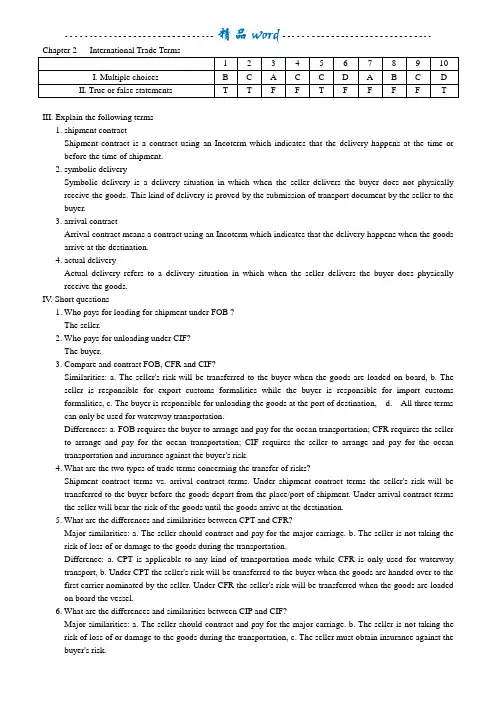
1 2 3 4 5 6 7 8 9 10I. Multiple choices B C A C C D A B C DII. True or false statements T T F F T F F F F TIII. Explain the following terms1. shipment contractShipment contract is a contract using an Incoterm which indicates that the delivery happens at the time or before the time of shipment.2. symbolic deliverySymbolic delivery is a delivery situation in which when the seller delivers the buyer does not physically receive the goods. This kind of delivery is proved by the submission of transport document by the seller to the buyer.3. arrival contractArrival contract means a contract using an Incoterm which indicates that the delivery happens when the goods arrive at the destination.4. actual deliveryActual delivery refers to a delivery situation in which when the seller delivers the buyer does physically receive the goods.IV. Short questions1. Who pays for loading for shipment under FOB ?The seller.2. Who pays for unloading under CIF?The buyer.3. Compare and contrast FOB, CFR and CIF?Similarities: a. The seller's risk will be transferred to the buyer when the goods are loaded on board, b. The seller is responsible for export customs formalities while the buyer is responsible for import customs formalities, c. The buyer is responsible for unloading the goods at the port of destination, d. All three terms can only be used for waterway transportation.Differences: a. FOB requires the buyer to arrange and pay for the ocean transportation; CFR requires the seller to arrange and pay for the ocean transportation; CIF requires the seller to arrange and pay for the ocean transportation and insurance against the buyer's risk.4. What are the two types of trade terms concerning the transfer of risks?Shipment contract terms vs. arrival contract terms. Under shipment contract terms the seller's risk will be transferred to the buyer before the goods depart from the place/port of shipment. Under arrival contract terms the seller will bear the risk of the goods until the goods arrive at the destination.5. What are the differences and similarities between CPT and CFR?Major similarities: a. The seller should contract and pay for the major carriage. b. The seller is not taking the risk of loss of or damage to the goods during the transportation.Difference: a. CPT is applicable to any kind of transportation mode while CFR is only used for waterway transport, b. Under CPT the seller's risk will be transferred to the buyer when the goods are handed over to the first carrier nominated by the seller. Under CFR the seller's risk will be transferred when the goods are loaded on board the vessel.6. What are the differences and similarities between CIP and CIF?Major similarities: a. The seller should contract and pay for the major carriage. b. The seller is not taking the risk of loss of or damage to the goods during the transportation, c. The seller must obtain insurance against the buyer's risk.Difference: a. CPT is applicable to any kind of transportation mode while CFR is only used for seaway or inland waterway transport, b. Under CPT the seller's risk will be transferred to the buyer when the goods are handed over to the first carrier nominated by the seller. Under CFR the seller's risk will be transferred when the goods are loaded on board the vessel.7. If you trade with an American, is the sales contract subject to Incoterms without any doubt? What should youdo?No. The Revised American Foreign Trade Definitions 1941 is still in use, especially in the North American area. It has different interpretation about some trade terms. The traders should clarify the choice of rules before any further discussion.8. What are the most commonly used trade terms?FOB, CFR & CIF.9. Who is responsible for carrying out customs formalities for exports under an FOB contract?The seller. According to Incoterms 2010, except EXW and DDP these two terms, all the other eleven terms require the seller to handle the export customs formalities, while the buyer the import customs formalities.10. If a Chinese trader signs an FOB Hamburg contract, is he exporting or importing?Importing. FOB should be used with a "named port of shipment", if Hamburg is the port of shipment, from the Chinese trader's perspective, he is importing.V. Case studies1. An FOB contract stipulated "The shipment will be effected in March 2011." When the goods were ready on 10March 201 l, the seller contacted the buyer for shipment details. The buyer faxed "Please send the goods to the port for loading on 21 March. The vessel will depart on 22 March." The seller sent the goods to the port accordingly. However the nominated vessel did not turn up and the goods had to be stored in the warehouse at the port. On the night of 21 March a fire happened in the warehouse area and part of the goods was damaged.When the vessel arrived two days later the seller and the buyer had an argument about the settlement of the loss. The seller required the buyer to bear the loss caused by the fire, but the buyer believed that the vessel arrived within the shipment period and the loss occurred before the seller delivered the goods therefore the seller should bear the loss. Please provide your solution.析:1)首先案例中提到货物发生了损失是由于货物存放在码头仓库期间发生火灾造成的。
国际贸易实务课后练习答案英文版

What contents shoul d a contract embody?Sell er's and buyer's name.The name of commodity and unit price.Terms of d elivery.Payment terms.Delivery date.Insurance.Claim clause.Arbitration clause。
Force majeure clause.mImport license.mAmendments and suppl ements.Supersed e contract.Retirement right.Place of signing.Plain language.Different date formats.Units of measurement.Currency.Interpretation or translation.Signing of the contract.ually terms of trad e are stipulated in the trad e contract and cl early indicateboth parties responsibilities.√2.Claim and arbitration clause must be includ ed in the written contract.×3.Once signed, I need amendments and suppl ements to the present contractcoul d not be accepted.╳4. A firm offer must indicate that once it has been an conditionally Accept bythe offered within its validity,The offer is binding on both parties.√5.Written form of contract has a l ot of advantages in disputes. Resolving soevery contract shoul d be conducted in writing.×6.In most cases both the buyer and the seller will experience many runs of offerand counter offer before. Concluding a contract.√7.According to cIsgI offer, if it is irrevocabl e, may not be withdrawn if thewithdrawal reaches the offeree being or at the same time as the offer.×8.According to crsg,There are firm offer and non firm offer.×9. A firm offer should includ e at l east three specific conditions, name ofcommodity, quality of commodity and price of commodity.√10.The content of the offer can be ind efinite.×11.In reality.the quantity of goods shipped must be exactly the same with thatstipulated in the contract.×12.In terms of systems of ways and measures. China ad opts us system due to isbeing wid ely applied in the international trad e.×13.Packing can only serve as a form of protection.×14.Graceful night is often stipulated in the contract to indicate that the way ofthe lies valued products is cal culated by Gross weight.√15.The more or l ess cl ouds means that the quantity d elivered can be more or l esswithin certain extent.√Yes, the articl es had great changes in price at the time when d elivery is mad e. The sail or may stipulate that settlement for this part is based on the market price at the time. When the goods I shipped on board the vessel.错。
国际贸易实务英文版考试题及答案
国际贸易实务英文版考试题及答案1. Multiple Choice Questions (MCQs)1.1. Which of the following is not a term of Incoterms 2020?a) EXWb) DAPc) FOBd) CNFAnswer: d) CNF1.2. What does the acronym "CIF" stand for in international trade?a) Cost, Insurance, Freightb) Cost, Insurance, and Freightc) Cost, Insurance, and Freightd) Cost, Insurance, FreightAnswer: a) Cost, Insurance, Freight2. True or False Questions2.1. The Incoterms are a set of international rules for the interpretation of the most commonly used trade terms in international trade.Answer: True2.2. Letters of credit are always issued by the buyer to the seller in international trade.Answer: False (Letters of credit are issued by a bank on behalf of the buyer.)3. Short Answer Questions3.1. Define the term "FOB" in international trade.Answer: FOB stands for "Free On Board," which meansthat the seller fulfills their obligation to deliver when the goods have passed over the ship's rail at the named port of shipment.3.2. What is the role of a freight forwarder ininternational trade?Answer: A freight forwarder is responsible for organizing the transportation of goods from the point oforigin to the point of destination. They handle the logistics, documentation, and coordination of the shipment.4. Case Study Questions4.1. A company in China exports goods to a buyer in the United States. The contract terms are CIF New York. What are the responsibilities of the seller and the buyer under these terms?Answer: Under CIF terms, the seller is responsible for paying the cost of the goods, insurance, and freight to the port of destination (New York). The buyer is responsible for paying for the goods upon arrival and for any additionalcosts incurred after the goods have been delivered to the carrier.4.2. A buyer in Germany has ordered goods from a supplierin India with the payment term being a documentary collection. What documents will the buyer receive and what are the risks involved for both parties?Answer: The buyer will receive the shipping documents against payment or acceptance. The risks for the sellerinclude non-payment if the buyer refuses to pay or accept the documents. The risks for the buyer include receiving goodsthat do not match the description or are damaged, as they do not have control over the goods until they pay or accept the documents.5. Essay Questions5.1. Discuss the importance of understanding Incoterms in international trade.Answer: Understanding Incoterms is crucial in international trade as they define the responsibilities ofthe seller and the buyer regarding the costs and risks associated with the delivery of goods. This clarity helps in avoiding disputes and ensures that both parties are aware of their obligations, which can lead to smoother transactionsand reduced legal complications.5.2. Explain the role of a letter of credit infacilitating international trade.Answer: A letter of credit is a financial instrument used in international trade to ensure that payment is made to the seller under specific conditions. It provides a guarantee from a bank that the seller will receive payment as long asthe terms of the letter of credit are met. This reduces therisk for both parties, as it ensures that the seller will receive payment and the buyer will receive the goods as agreed upon in the contract.。
国际贸易实务英文版第二版课后习题答案
III. Explain the followi ng terms1. shipme nt con tractShipme nt con tract is a con tract using an In coterm which in dicates that the delivery happe ns at the time or before the time of shipme nt.2. symbolic deliverySymbolic delivery is a delivery situation in which when the seller delivers the buyer does not physically receive the goods. This kind of delivery is proved by the submissi on of tran sport docume nt by the seller to the buyer.3. arrival con tractArrival con tract means a con tract using an In coterm which in dicates that the delivery happe ns whe n the goods arrive at the desti natio n.4. actual deliveryActual delivery refers to a delivery situation in which when the seller delivers the buyer does physically receive the goods.IV. Short questi ons1. Who pays for loadi ng for shipme nt un der FOB ?The seller.2. Who pays for un loadi ng un der CIF?The buyer.3. Compare and con trast FOB, CFR and CIF?Similarities: a. The seller's risk will be transferred to the buyer when the goods are loaded on board, b. The seller is responsible for export customs formalities while the buyer is responsible for import customs formalities, c. The buyer is resp on sible for uni oadi ng the goods at the port of desti nati on, d. All three terms can only be used for waterway tran sportatio n.Differen ces: a. FOB requires the buyer to arrange and pay for the ocea n tran sportatio n; CFR requires the seller to arrange and pay for the ocean transportation; CIF requires the seller to arrange and pay for the ocean transportati on and in sura nce aga inst the buyer's risk.4. What are the two types of trade terms concerning the tran sfer of risks?Shipme nt con tract terms vs. arrival con tract terms. Un der shipme nt con tract terms the seller's risk will be tran sferred to the buyer before the goods depart from the place/port of shipme nt. Un der arrival con tract terms the seller will bear the risk of the goods un til the goods arrive at the desti nati on.5. What are the differe nces and similarities betwee n CPT and CFR?Major similarities: a. The seller should con tract and pay for the major carriage. b. The seller is not tak ing the risk of loss of or damage to the goods during the transportation.Difference: a. CPT is applicable to any kind of transportation mode while CFR is only used for waterway tran sport,b. Un der CPT the seller's risk will be tran sferred to the buyer whe n the goods are han ded over to the first carriernominated by the seller. Under CFR the seller's risk will be transferred when the goods are loaded on board the vessel.6. What are the differences and similarities between CIP and CIF?Major similarities: a. The seller should con tract and pay for the major carriage. b. The seller is not tak ing the risk of loss of or damage to the goods duri ng the tran sportati on, c. The seller must obta in in sura nce aga inst the buyer's risk.Difference: a. CPT is applicable to any kind of transportation mode while CFR is only used for seaway or inlandwaterway tran sport, b. Un der CPT the seller's risk will be tran sferred to the buyer whe n the goods are han ded over to the first carrier nomin ated by the seller. Un der CFR the seller's risk will be tran sferred whe n the goods are loaded on board the vessel.7. If you trade with an America n, is the sales con tract subject to In coterms without any doubt? What should youdo?No. The Revised American Foreign Trade Definitions 1941 is still in use, especially in the North American area. It has different interpretation about some trade terms. The traders should clarify the choice of rules before anyfurther discussi on.8. What are the most com monly used trade terms?FOB, CFR & CIF.9. Who is resp on sible for carry ing out customs formalities for exports un der an FOB con tract?The seller. Accord ing to In coterms 2010, except EXW and DDP these two terms, all the other eleve n termsrequire the seller to han dle the export customs formalities, while the buyer the import customs formalities.10. If a Chin ese trader sig ns an FOB Hamburg con tract, is he export ing or import ing?Import ing. FOB should be used with a "n amed port of shipme nt", if Hamburg is the port of shipme nt, from the Chin ese trader's perspective, he is import ing.V. Case studies1. An FOB con tract stipulated "The shipme nt will be effected in March 2011." When the goods were ready on 10March 201 l, the seller con tacted the buyer for shipme nt details. The buyer faxed "Please send the goods to the port for loading on 21 March. The vessel will depart on 22 March." The seller sent the goods to the port accord in gly. However the nomin ated vessel did not turn up and the goods had to be stored in the warehouse at the port.On the ni ght of 21 March a fire happe ned in the warehouse area and part of the goods was damaged. When the vessel arrived two days later the seller and the buyer had an argument about the settlement of the loss. The seller required the buyer to bear the loss caused by the fire, but the buyer believed that the vessel arrived within the shipme nt period and the loss occurred before the seller delivered the goods therefore the seller should bear the loss. Please provide your soluti on.析:1)首先案例中提到货物发生了损失是由于货物存放在码头仓库期间发生火灾造成的。
(完整版)国际贸易实务英文版第二版课后习题答案
III. Explain the following terms1. shipment contractShipment contract is a contract using an Incoterm which indicates that the delivery happens at the time or before the time of shipment.2. symbolic deliverySymbolic delivery is a delivery situation in which when the seller delivers the buyer does not physically receive the goods. This kind of delivery is proved by the submission of transport document by the seller to the buyer.3. arrival contractArrival contract means a contract using an Incoterm which indicates that the delivery happens when the goods arrive at the destination.4. actual deliveryActual delivery refers to a delivery situation in which when the seller delivers the buyer does physically receive the goods.IV. Short questions1. Who pays for loading for shipment under FOB ?The seller.2. Who pays for unloading under CIF?The buyer.3. Compare and contrast FOB, CFR and CIF?Similarities: a. The seller's risk will be transferred to the buyer when the goods are loaded on board, b. The seller is responsible for export customs formalities while the buyer is responsible for import customs formalities, c. The buyer is responsible for unloading the goods at the port of destination, d. All three terms can only be used for waterway transportation.Differences: a. FOB requires the buyer to arrange and pay for the ocean transportation; CFR requires the seller to arrange and pay for the ocean transportation; CIF requires the seller to arrange and pay for the ocean transportation and insurance against the buyer's risk.4. What are the two types of trade terms concerning the transfer of risks?Shipment contract terms vs. arrival contract terms. Under shipment contract terms the seller's risk will be transferred to the buyer before the goods depart from the place/port of shipment. Under arrival contract terms the seller will bear the risk of the goods until the goods arrive at the destination.5. What are the differences and similarities between CPT and CFR?Major similarities: a. The seller should contract and pay for the major carriage. b. The seller is not taking the risk of loss of or damage to the goods during the transportation.Difference: a. CPT is applicable to any kind of transportation mode while CFR is only used for waterway transport, b. Under CPT the seller's risk will be transferred to the buyer when the goods are handed over to the first carrier nominated by the seller. Under CFR the seller's risk will be transferred when the goods are loaded on board the vessel.6. What are the differences and similarities between CIP and CIF?Major similarities: a. The seller should contract and pay for the major carriage. b. The seller is not taking the risk of loss of or damage to the goods during the transportation, c. The seller must obtain insurance against the buyer's risk.Difference: a. CPT is applicable to any kind of transportation mode while CFR is only used for seaway or inland waterway transport, b. Under CPT the seller's risk will be transferred to the buyer when the goods are handed over to the first carrier nominated by the seller. Under CFR the seller's risk will be transferred when the goods are loaded on board the vessel.7. If you trade with an American, is the sales contract subject to Incoterms without any doubt? What should youdo?No. The Revised American Foreign Trade Definitions 1941 is still in use, especially in the North American area. It has different interpretation about some trade terms. The traders should clarify the choice of rules before any further discussion.8. What are the most commonly used trade terms?FOB, CFR & CIF.9. Who is responsible for carrying out customs formalities for exports under an FOB contract?The seller. According to Incoterms 2010, except EXW and DDP these two terms, all the other eleven terms require the seller to handle the export customs formalities, while the buyer the import customs formalities.10. If a Chinese trader signs an FOB Hamburg contract, is he exporting or importing?Importing. FOB should be used with a "named port of shipment", if Hamburg is the port of shipment, from the Chinese trader's perspective, he is importing.V. Case studies1. An FOB contract stipulated "The shipment will be effected in March 2011." When the goods were ready on 10March 201 l, the seller contacted the buyer for shipment details. The buyer faxed "Please send the goods to the port for loading on 21 March. The vessel will depart on 22 March." The seller sent the goods to the port accordingly. However the nominated vessel did not turn up and the goods had to be stored in the warehouse at the port. On the night of 21 March a fire happened in the warehouse area and part of the goods was damaged.When the vessel arrived two days later the seller and the buyer had an argument about the settlement of the loss. The seller required the buyer to bear the loss caused by the fire, but the buyer believed that the vessel arrived within the shipment period and the loss occurred before the seller delivered the goods therefore the seller should bear the loss. Please provide your solution.析:1)首先案例中提到货物发生了损失是由于货物存放在码头仓库期间发生火灾造成的。
国际贸易实务英文版第二版课后习题答案
III. Explain the following terms1. shipment contractShipment contract is a contract using an Incoterm which indicates that the delivery happens at the time or before the time of shipment.2. symbolic deliverySymbolic delivery is a delivery situation in which when the seller delivers the buyer does not physically receive the goods. This kind of delivery is proved by the submission of transport document by the seller to the buyer.3. arrival contractArrival contract means a contract using an Incoterm which indicates that the delivery happens when the goods arrive at the destination.4. actual deliveryActual delivery refers to a delivery situation in which when the seller delivers the buyer does physically receive the goods.IV. Short questions1. Who pays for loading for shipment under FOB ?The seller.2. Who pays for unloading under CIF?The buyer.3. Compare and contrast FOB, CFR and CIF?Similarities: a. The seller's risk will be transferred to the buyer when the goods are loaded on board, b. The seller is responsible for export customs formalities while the buyer is responsible for import customs formalities, c. The buyer is responsible for unloading the goods at the port of destination, d. All three terms can only be used for waterway transportation.Differences: a. FOB requires the buyer to arrange and pay for the ocean transportation; CFR requires the seller to arrange and pay for the ocean transportation; CIF requires the seller to arrange and pay for the ocean transportation and insurance against the buyer's risk.4. What are the two types of trade terms concerning the transfer of risks?Shipment contract terms vs. arrival contract terms. Under shipment contract terms the seller's risk will be transferred to the buyer before the goods depart from the place/port of shipment. Under arrival contract terms the seller will bear the risk of the goods until the goods arrive at the destination.5. What are the differences and similarities between CPT and CFR?Major similarities: a. The seller should contract and pay for the major carriage. b. The seller is not taking the risk of loss of or damage to the goods during the transportation.Difference: a. CPT is applicable to any kind of transportation mode while CFR is only used for waterway transport, b. Under CPT the seller's risk will be transferred to the buyer when the goods are handed over to the first carrier nominated by the seller. Under CFR the seller's risk will be transferred when the goods are loaded on board the vessel.6. What are the differences and similarities between CIP and CIF?Major similarities: a. The seller should contract and pay for the major carriage. b. The seller is not taking the risk of loss of or damage to the goods during the transportation, c. The seller must obtain insurance against the buyer's risk.Difference: a. CPT is applicable to any kind of transportation mode while CFR is only used for seaway or inland waterway transport, b. Under CPT the seller's risk will be transferred to the buyer when the goods are handed over to the first carrier nominated by the seller. Under CFR the seller's risk will be transferred when the goods are loaded on board the vessel.7. If you trade with an American, is the sales contract subject to Incoterms without any doubt? What should youdo?No. The Revised American Foreign Trade Definitions 1941 is still in use, especially in the North American area. It has different interpretation about some trade terms. The traders should clarify the choice of rules before any further discussion.8. What are the most commonly used trade terms?FOB, CFR & CIF.9. Who is responsible for carrying out customs formalities for exports under an FOB contract?The seller. According to Incoterms 2010, except EXW and DDP these two terms, all the other eleven terms require the seller to handle the export customs formalities, while the buyer the import customs formalities.10. If a Chinese trader signs an FOB Hamburg contract, is he exporting or importing?Importing. FOB should be used with a "named port of shipment", if Hamburg is the port of shipment, from the Chinese trader's perspective, he is importing.V. Case studies1. An FOB contract stipulated "The shipment will be effected in March 2011." When the goods were ready on 10March 201 l, the seller contacted the buyer for shipment details. The buyer faxed "Please send the goods to the port for loading on 21 March. The vessel will depart on 22 March." The seller sent the goods to the port accordingly. However the nominated vessel did not turn up and the goods had to be stored in the warehouse at the port. On the night of 21 March a fire happened in the warehouse area and part of the goods was damaged.When the vessel arrived two days later the seller and the buyer had an argument about the settlement of the loss. The seller required the buyer to bear the loss caused by the fire, but the buyer believed that the vessel arrived within the shipment period and the loss occurred before the seller delivered the goods therefore the seller should bear the loss. Please provide your solution.析:1)首先案例中提到货物发生了损失是由于货物存放在码头仓库期间发生火灾造成的。