
unit3How do you get to school教案
Unit 3 How do you get to school?
Period 1 Section A (1a-1c)
一、Teaching Goals:
1. Language goals:
1) words and expressions:
train, bus, subway, ride, bike, taxi, walk, motorbike, get to
2) Language structures::
①—How do you get to school?
—I ride my bike./ I go to school by bike.
②—How does Mary get to school?
—She takes the subway./ She goes to school by subway.
2. Ability goal:
Talk about how to get to places.
3.Emotion goals:
Understand the difference of transportations between eastern and western countries. Learn the development of traffic and the traffic rules.
二、Difficult and important points
1.Difficult point s:
1) wh-questions with how
2) Expressions of transportations
2. Important points:
●—How do you get to school?
—I take th e …/ride …/ walk…/ I go to school by …
●—How does Mary get to school?
—She takes the subway./ She goes to school by subway.
三 .T eaching Methods:
(1) Communicative teaching method.
(2) Audio-visual teaching method.
四.Teaching Procedures
Ⅰ. Warming-up and Lead in
Ss: Good morning, teacher.
T: Good morning, class
T: How are you today?
Ss: I’m fine, thank you, and you?
T: I am fine, too.
T: Ok, today we are going to learn “Unit 3 How do you get to school?”.
Ⅱ. Presentation
1. T: At first, let’s watch a short video and try to remember the words in it.
(play the video) Do you remember the words in the video?
Ss: Yes.
T: Ok, tell me together.
Ss: Train, plane, car, boat, bike.
T: Yes, you are very good. They are some kinds of transportation. Can you remember other kinds of transportation?
Ss: …
2. Teacher shows pictures and words about transportation on the big screen.
Read the words together.
3. Free talk: How do you get to school?
Students look at the pictures and learn the expression “take a/ the+…”. Then students complete the conversations with the expressions. Read the conversations together.
4. Ask some students to answer the questions: How do you get to school?
T: How do you get to school?
Student A: …
Student B: …
……
5. Pair work:
Students work in pairs to make their own conversations with the structures.
Ask some pairs of students to read their conversations.
6. Learn the expression “by+…”
Tell students the difference of “take the/a +…” and “by+…”
7.—How does he or she get to school?
—He or she takes…to school.
Students look at the pictures and answer the questions. Read the sentences together. Ⅲ. 1a
T: Look at the picture on your book. Match the words with the picture.
Then check the answers.
Ⅳ. 1b Listening
1. Make sure the Ss know what to do. Give them an example orally if possible.
2. Read the names in the box.
3. Play the tape and check the answers.
Ⅴ. 1c Pair work
Ask two students to read the dialogue in the speech bubbles to the class. Then ask students to work in pairs. Ask and answer how students get to school in the picture.
Finally ask some pairs of students to present their conversations to the class.
Ⅵ.Exercise
Complete the sentences with the words in the box.
ride take get to by
1) How do you ________ school in the morning?
2) When it rains, I _______ a taxi.
3) I like to ______ my bike on the weekend.
4) Mary’s mother gets to work ______ car.
5)My math teacher __________ the bus to work.
Students finish the exercise alone.
Then check the answers.
Homework
1.Remember the new words and expressions in this period.
2.Make a survey about how your classmates get to school and write a report.
板书设计:
教学反思:本课时的重点在于掌握交通工具的名称、表达“使用某种交通工具”的搭配,如:take the bus/by bus, ride a bike/by bike等,还导入了谈论出行方式的句式。
在呈现新词汇是可以利用简笔画、图片让学生直观的接触,这样音、形、义相结合的方式便于学生记忆。
而在掌握表达“使用某种交通工具”的动词搭配时不能让学生死记硬背,而应该结合主题图,让学生感悟动词take, ride, walk的含义,在语境中去学习掌握。
Unit 3 How do you get to school?口语课教学设计
Unit 3 How do you get to school?口语课教学设计丁薇;韩炜【期刊名称】《英语教师》【年(卷),期】2018(018)012【总页数】4页(P77-80)【作者】丁薇;韩炜【作者单位】130022,吉林长春,吉林省教育学院初中教研培训部外语教研室;133200,吉林延边,吉林省汪清县汪清第一中学【正文语种】中文一、课例背景本堂课荣获吉林省初中英语优质课大赛第一名,以及2017年12月2日至4日在江苏省镇江市举办的第十二届初中英语课堂教学观摩培训会的优质课展评一等奖。
本堂课授课时间为35分钟。
华侨大学外国语学院院长毛浩然和安徽省教育科学研究院英语教研员赵杰对本堂课的设计提出了建设性意见。
二、教学内容本堂课的教学内容是Go for it!七年级(下)Unit 3 How do you get to school?本单元是对上一单元(Unit 2 What time do you go to school?)教学内容的延伸,主题是学生上学的交通方式,并紧紧围绕这一主题展开了关于距离、时长的讨论。
本堂课是这一单元的第一课时,也是本单元所有内容的重要铺垫,内容涵盖本单元的基本语言知识,是顺利完成第二课时的基础和关键。
完成好本课时的教学,对本单元乃至后面几个单元的英语教学具有重要的意义和价值。
本单元以交通方式为话题,其中A部分主要涉及出行方式(how)、距离(how far)和时长(how long)。
1a-1c呈现了各种交通工具的名称、表达“使用某种交通工具”的动词搭配,以及谈论出行方式的句式;2a-2e部分进一步深化“出行”话题,旨在让学生学习并掌握英语中十位数和百位数的表达方式,培养其捕捉听力对话中数字信息的能力,并训练其询问和回答两地距离和出行花费时长的英文表达。
在设计本堂课教学内容时,备课团队对教材内容进行适当扩展,增加了和学生实际生活相关的交通方式,如motorbike,minibus等,以吸引学生的注意力,同时通过多种教学手段调动学生的学习兴趣。
七年级下册英语Unit3Howdoyougettoschool教案
Unit 3 How do you get to school?Section A 1 (1a-2d)一、教学目标:1. 语言知识目标:1) 能掌握以下单词:train, bus, subway, ride, bike, sixty, seve nty, eighty, nin ety, hun dred, far, minute,kilometer, n ew, every, every day2) 能掌握以下句型:①一How do you get to school? —I ride my bike.②—How does Mary get to school? —She takes the subway.2. Talk about how to get to places 谈论出行方式)take the bus /subway /train /taxi , ride a bike /walk .3. how引导的特殊疑问句,表示乘坐何种交通工具的方式。
how far, how long弓I导的特殊疑问句。
4. 复习基数词及时间的表示方法。
2•情感态度价值观目标:让学生感受到他们学习英语是为了在现实生活中进行交流,而不单纯是为了英语课和应付考试而学习,了解东西方国家出行方式的不同,以及不同的交通规则教育学生注意交通安全,加深对交通知识的了解。
倡导自觉遵守交通法规及礼貌,构建和谐的人际关系。
了解交通的发展,培养创新精神。
二、教学重难点1. 教学重点:1) how /how far /how long引导的特殊疑问句.2) 乘坐交通工具的表示方法.3) It takes / sb. some time to do sth..2. 教学难点:—How do you get to school? —I take the …/ride …/ walk …—How does Mary get to school? —She takes the subway.——How long does it take? ——It takes forty minu tes.—It's …kilometers.—How far is it from …to…三、教学过程I . Warming-up and Lead in学生和老师进行简单的问候Ss: Good morning, teacher.T: Good morning, classT: Look at the picture. What can you see? Do you like your school? I usually get to school by bike, but sometimes on foot. How do you get to school?Ss按实际情况作答S1: I ride my bike.S2: I go by bus.S3: ............T: Very good. You ' re clever. Let ' s learn Unit 4之后板书:A.“ Unit 4 How do you get to school?”n. Presentation1. T: If you are here, but your school is in Shan ghai. How do you get to school?Ss: I take the bus /pla ne/ boat / ship / car / taxiI ride a bike / motorbikeT: Do you know any other way?2. Teacher shows pictures on the big scree归纳出行方式和常用短语.Ask some questi ons about how you get to •?(让学生积极主动的思考想象总结,多媒体增加趣味性,加强直观性,效果事半功倍)3. Show a picture about Part 1, on the scree n.Point at girls or boys in the picture.Ask stude nts to an swer and write in the bla nks.S1: How does he / she go to school?S2: He / She .............川.1aT: Look at the picture on your book. Match the words with the picture.(学生们完成1a的学习任务,然后校对答案)IV. Listening1. Make sure the Ss know what to do. Give them an example orally if possible.2. Read the n ames in the box.3. Play the tape and check the an swers.V.Pair workAsk two stude nts to read the dialogue in the speech bubbles to the class. Then ask stude nts to work in pairs. Ask and an swer how stude nts get to school in the picture. Fin ally ask some pairs of stude nts to prese nt their conv ersatio ns to the class.W. Listening1. Revise the numbers, first, zero~nine, next, ten~nineteen, then, twenty, thirty, forty …fin ally,twen ty-one, twen ty-two …Teach the new word "hun dred".2. Play the tape for the stude nts to finish 2a. Then play aga in and check the an swers VD. PresentationShow a picture on the TV and expla in these are your home and school.Teach: home----school How long 10 minutes How far two kilometersThen make up a dialogue to practice.A: How do you get to school?B: I usually take the bus.A: How far is it from your home to school?B: It's about two kilometers.A: How long does it take?B: It takes 30 minu tes by busVffl. Listening1. Tell Ss the follow ing recordi ng is about how Tom and Jane go to school.2. First, liste n to the recordi ng fill in the first colu mn.3. Then, play the recording for the Ss again. Ss listen and complete the rest of the chart.4. Check the an swers.IX. Role-play1. Read the dialogue and find the an swer to these questi ons:①How does Jane get to school?②How far is it from home to school?③How long does it take to get to school from her home?2. Ss read the con versati ons and the n find the an swers to the questi ons.3. Check the an swers with the class.4. Play the record ing for the Ss to liste n and complete.Lisa: Hey, Jan e. Is this your new bike?Jane: Yes. I ____ it to school every day. How do you ____________ ?Lisa: I usually ___________ .Jane: _______ is it from your home to school?Lisa: I ' m not sure … about ______ minutes. ________ does it take you to get to school? Jane: About 15 minutes _______ . It ' s good exercise.Lisa: Yeah. Well, _____________ at school.Jane: You, too.5. Ss read the con versati on the n role-play the conv ersati on.6. Let some pairs act out the conv ersati on.nguage points1. take the subway 乘坐地铁乘坐某种交通工具去某地take + the/a +交通工具+ to +地点=get/go to + 某地+ by + 交通工具e.g. He ofte n takes the subway to work.=He goes to work by subway.注意:当home, here, there作地点时,不加to。
初一七年级英语下册人教版Unit 3 How do you get to school? 单元教案、教学设计

Unit 3 How do you get to school?Learning Objectives一、Topics(话题):Transportation二、Functions (功能)Talk about how to get to places三、Structures (结构)1. How questions2. How long questions3. How far questions四、Target Language (目标语言)How do you get to school?I ride my bike.How long does it take to get to school?It takes about 20 minutes.How far is it from your home to school?It’s about two kilometers.五、V ocabulary (词汇)train, bus, subway, bike, car, boat, river, year, minute, kilometer, sixty, seventy, eighty, ninety, hundred, ride, drive, live, leave, cross take the train/bus, go by bike/subway, ride a bike, drive a car, think of, between … and …, leave home/school, come true六、Skills (技能)Listening for key informationScanning in reading七、Recycling (复习巩固)Numbers 1–30I usually …It is easy to …Thanks for …八、教材分析本单元以How do you get to school?为中心话题,主要运用How long/How far 询问“去某地的交通方式、时间、距离”,简单描述路线。
Unit3How-do-you-get-to-school教案 (1)
PEP Go for it SB 7BUnit 3 How do you get to school?Teaching objectives: Through learning this unit, students should be able to master the focal sentence structure “How do you get to…? I ride my bike”. “How long does it take to get to …? It takes about … minutes” and can use these words and sentence structure to ask the way of going out.Period1 Section A (1a-1c)Background information:Students: 40 Junior high school students, Grade 1Lesson duration: 45 minutesTeaching objectives:1. Knowledge objectives:1)All students will be able to say different transportations in English.2)75% students will be able to ask and answer questions about one’stransportations to go to school.2. Ability objectives:1)Most students will be able to work with others in a group to find the best way.2)After listening and practicing the materials on the book, about 90% studentswill be able to listen to the dialogue materials about the way of going out, and fill in the blanks according to the listening materials.3)After leaning this period, 90% students will be able to describe the way ofgoing out.3. Moral objectives:1)Most students will be able to learn to work actively with other members and learn to be a good listener.2)After leaning this period, most students will be aware of the different ways of going out between western countries and China.3)Through learning this period, Ss will know some traffic rules.Teaching contents:New words: the vocabulary of transportationSentence structures: How do you get to…? I ride my bike.How long does it take to get to …? It takes about … minutes.Focal points:V ocabularies: train, bus, subway, bike, walkSentence structures: How do you get to…? I ride my bike.How long does it take to get to …? It takes about … minutes.Lesson type: vocabulary, listening and speakingTeaching methods: activity, group work, game, making dialoguesTeaching aids: PPT, pictures, Bb, etcTeaching steps:Step1: Warming up (8minutes)Activity: Enjoy a short video (about the development of transportation)T: Good morning, everyone. First, let us enjoy a short video. After watching the video, you should tell me what transports did you see and later we will learn them, ok?(After watching the video)T: What transports did you see?S1: …T: Very well!S2: …T: Very good. Any more?S3: …T: Well down!Step2: Presentation and drill (17minutes)Activity 1: Listen and guess (Listen to the sound and guess what transport it is)T: You’ve mentioned a lot of transports. Now, let’s listen to the sound and guess what transport it is.Ss: …T: It’s a train/bus/car/bike (write the words on Bb).T: But, you know, my home is near. So I walk (performing the movement of walk and write the word on Bb) to school.Ss: (All students read words together)Activity 2: Listen to the tape and do 1aT: Now, let us listen to the tape and do1a.Listen carefully and match the words with the pictures.Ss: (All students read words together)Activity 3: Missing gameT: Let’s play a game and find what is missing (using PPT).S1: Walk!S2: Train!S3: Bus!S4: Bike!S5: Car!T: Wow, you are so smart!Ss: (All students read words together)Step3: Presentation and Practice (25minutes)Activity 1: Talk about how they get to school and other places.(15minutes)T: We go to school to have class every day. My home is near, so I walk to school. It takes about 10minutes. Can you tell me how do you get to school and how long does it take (write these four sentences on Bb)?S1: I ride my bike to school. It takes about …minutes.T: Your home is near too, right?S1: Yes!T: Thank you (write “I ride my bike to school” on Bb). What about you? How do you get to school?S2: …T: Wonderful. You take the bus to school (write “I take the bus to school” on Bb).How long does it take to get to school?S2: …T: Oh. It’s so long. You must get up early. Do you know how does S3 get to school? S2: I don’t know.T: Would you please ask him/her?S2: How do you get to school?S3: …S2: How long does it take to get to school?S3: …T: You take the car to school (write the sentence on the Bb) and it takes about …minutes. Do you still remember how does S1 get to school?S3: Yes. He rides his bike to school.T: Wonderful. You have a good memory (write “He rides his bike to school” on Bb).How can you get to Beijing?S4: I take the train.T: …Activity2: Group work and complete a chart (10minutes)T: As you see, I have given one group one chart. Work with others and complete the chart. Then show the results for us in front of class.Activity3: Help Tom to find the quickest way to his home! (A map will be shown on PPT and students should work in groups to find the quickest way to the destination)T: Tom wants to go home as quick as he can. You need to work in groups to help him to choose the best transportations and count the time. At last, you need to make a report before us to tell us which way you choose.Homework:Level 1: read and remember the new wordsLevel 2: read the dialogue 2e on page14 fluentlyLevel 3: make a map and write a short essay about how to get to …Blackboard design:。
人教版七年级英语下册《Unit 3 How do you get to school单元教案
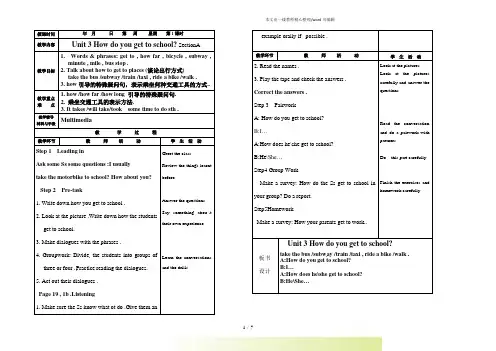
授课时间年月日第周星期第1课时教学内容Unit 3 How do you get to school? SectionA教学目标1. Words & phrases: get to , how far , bicycle , subway ,minute , mile , bus stop .2. Talk about how to get to places (谈论出行方式)take the bus /subway /train /taxi , ride a bike /walk .3. how引导的特殊疑问句,表示乘坐何种交通工具的方式..教学重点难点1. how /how far /how long 引导的特殊疑问句.2. 乘坐交通工具的表示方法.3. It takes /will take/took some time to do sth .教学辅导材料与手段Multimedia教学过程教学环节教师活动学生活动Step 1 Leading inAsk some Ss some questions :I usuallytake the motorbike to school? How about you? Step 2 Pre-task1. Write down how you get to school .2. Look at the picture .Write down how the studentsget to school.3. Make dialogues with the phrases .4. Groupwork: Divide the students into groups ofthree or four .Practice reading the dialogues. 5. Act out their dialogues .Page 19 , 1b .Listening1. Make sure the Ss know what ot do .Give them an Greet the classReview the things learntbefore.Answer the questions.Say something abou ttheir own experience.Learn the conversationsand the drills.example orally if possible .教学环节教师活动学生活动2. Read the names .3. Play the tape and check the answers .Correct the answers .Step 3 PairworkA: How do you get to school?B:I…A:How does he\she get to school?B:He\She…Step4 Group WorkMake a survey: How do the Ss get to school inyour group? Do a report.Step5HomeworkMake a survey: How your parents get to work..Look at the pictures.Look at the picturescarefully and answer thequestions.Read the conversationand do a pairwork withpartners.Do this part carefullyFinish the exercises andhomework carefully.板书设计Unit 3 How do you get to school?take the bus /subway /train /taxi , ride a bike /walk .A:How do you get to school?B:I…A:How does he\she get to school?B:He\She…教学反思授课时间年月日第周星期第2课时教学内容Unit 3 How do you get to school? SectionA 教学目标1.复习基数词及时间的表示方法.2.了解中外文化的差异.教学重点难点1.It takes /will take/took some time to do sth .2. Target language. The use of the drill.教学辅导材料与手段Multimedia教学过程教学环节教师活动学生活动Step 1 Leading in1. Greetings .2. Check the homework .Step 2 Pre –taskPage 20 , 2a.2b&2c .1. Revise the numbers .2. Teach the new word :minute .3. Play the tape for the students to finish Greet the classReview the things learntbefore.Revise the numbers .Listen to the recordingcarefully.2a&2c .Then play again and check theanswers ..4. Go over the dialogue in Page20 ,2d.Step 3 Pre-taskCheck the answer.教学环节教师活动学生活动Page 20 ,Grammar focus .1. Review the grammar box .Ask students to saythe statements and responses .2. Practice reading .Explain the usage of “take” in “take the train”and “take some time to do sth” .activityStep 4 PairworkMake a conversation about how you get toschool. Then practice in pairs.Step5 HomeworkRemember the Grammar Focus .Read the conversationand do a pairwork withpartners.Do this part carefullyFinish the exercises andhomework carefully.板书设计Unit 3 How do you get to school? Numbers: 32 40 41 50 60 70 80 90 100 Phrases:It takes /will take/took some time to do sth .教学反思授课时间年月日第周星期第3课时教学内容Unit 3 How do you get to school? SectionA教学目标1. 复习how far ,how long 引导的特殊疑问句.2. Reading practice.3. Writing practice.4.New words and phrases: town ill worry so much教学重点难点1. Key vocabulary, key phrases2. Target language. The use of the drill.教学辅导材料与手段Multimedia教学过程教学环节教师活动学生活动Step 1 Leading in1.Have Ss make sentences with “take to” .Explain the usage of “take” in “take the train”and “take some time to do sth” .Step 2 While-taskPage 21,3a .1. Pay attention to the speech bubbles .Read thequestions .2. Read the passage by the Ss. Find the answersto the questions and write the answers on thelines .Correct the answers .Step 3 Page 21, 3b .Greet the classReview the things learntbefore.Answer the questions.Say something abouttheir own experience.Learn the conversationsand the drills.教学环节教师活动学生活动1. Show Ss the example in the box .Two studentsread it to the class .2. Pairwork: Make your own conversations usingthe information in the left box.3. Ask some pairs to present the conversations tothe classStep 4 Post-taskPage 21 ,Part 4 .Groupwork.Divide the Ss into groups of three .In each group ,one is A,who look at Page 21.One is B,who look at Page 85,the other is C,who look at Page 86 .Fill in the blanks .The group who fill in the blanks first wins .Step 5 HomeworkWrite the sentences in Part 4 on the exercise books .Look at the pictures. Look at the pictures carefully and answer the questions.Read the conversation and do a pairwork with partners.Read this part carefullyFinish the exercises and homework carefully.板书设计Unit 3 How do you get to school?A:How far is it from your home to school?B:It’s…It takes/took sometime to do something.教学反思时间年月日第周星期第4课时教学内容Unit 3 How do you get to school?. SectionB教学目标1. vocabulary :bus stop bus station train station subwaystation .2. 能力目标:谈论上学的全过程。
七年级下册英语Unit-3-How-do-you-get-to-school-教案
实用文档七年级下册英语Unit 3 How do you getto school 教案和介绍后,老师可以通过展示一些图片或视频,引导学生谈论不同的出行方式,如乘坐公交车、地铁、骑自行车、步行等。
XXX1.首先,老师可以通过展示图片或视频,教授新单词和短语,如train、bus、subway、ride、bike、sixty、XXX、eighty、y、hundred、far、minute、kilometer、new、every、every day 等。
2.然后,老师可以模拟对话,让学生研究如何用英语谈论出行方式。
例如,老师可以问学生“How do you get to school?”,学生可以回答“I ride my bike”,或者老师可以问“How does Mary get to school?”,学生可以回答“She takes the subway”。
3.接下来,老师可以教授特殊疑问句,如“How far is it from…to…”和“How long does it take?”,并且教授如何回答这些问题。
例如,当学生被问到“How far is it from your home to school?”时,学生可以回答“It's 5 kilometers”,或者当学生被问实用文档到“How long does it take to get to school?”时,学生可以回答“It takes 40 minutes”。
Ⅲ。
Practice1.老师可以让学生进行小组讨论,讨论在不同情况下应该选择哪种出行方式,并且给出理由。
2.老师可以让学生进行角色扮演,模拟在不同场景下的出行方式和对话。
3.老师可以让学生完成一些练,如填空、选择题等,以检验他们对所学知识的掌握程度。
XXX1.老师可以引导学生了解不同国家的出行方式和交通规则,让学生了解和尊重不同文化和惯。
2.老师可以教授一些有关交通安全和礼仪的知识,让学生养成良好的交通惯和安全意识。
Unit3_How_do_you_get_to_school第一课时说课稿[1]
Unit3 How do you get to school?SectionB(2a-2c)(说课稿)一、说教学重点与难点:根据教学大纲的要求,及本课在教材中所处的地位和作用,确定本课的重难点为:1、教学重点:学会不同的交通工具(subway , train, bus , bike , taxi , car ,)与交通工具相关的动词(take, ride , walk),相关介词:(on foot , by , in a car )使用--How do you get to school?-- I take the bus .谈论相关话题。
2、教学难点:使用上面所学词汇和句子,使用不同人称围绕对话主题实行操练,并能熟练使用。
二、学情分析1、初中学生的抽象思维水平较低,形象思维水平强,但注意力容易分散。
本课采用多种形式展示,并配以丰富的色彩,从而增强学生的兴趣和注意力。
2、初中生的学习心理特点是:对英语普遍感兴趣,但有很大的不稳定性,好奇心强,求知欲旺盛,已不满足教师对课文的简单重复。
在本课教学过程中,注重启发引导,培养学生分析、概括水平的同时,更要注重教学方法的灵活性,通过任务型教学法,情景交际法,全身反应教学法等,激发学生学习的兴趣,让学生乐于接受,易于接受。
三、学法指导《英语课程标准》把"培养学生学习英语的兴趣,树立自信心,培养良好学习习惯和形成有效策略,发展自主学习和合作精神"放在了首位。
依据这个前提,我从以下几个方面对学生实行学法指导。
1、学习方法的指导:培养学生观察力,想象力,记忆力以及思维水平。
用生动的课件调动学生的感官实行听说读写的训练。
2、学习积极性的调动:我在教学过程中创造一种开放的,和谐的,积极互动的语言气氛,把课堂变成有声有色的舞台,让学生在乐中学。
3、学习水平的培养:通过连接的听说读写,游戏,竞赛等,培养学生的交际水平,发展他们的思维水平。
四:教学步骤Teaching aims:a.培养学生的阅读水平和写作水平。
初中英语《Unit3Howdoyougettoschool》单元教学设计以及思维导图1
Unit 3 How do you get to school适用年级七年级所需时间5课时主题单元学习概述本单元话题取材于七年级英语下学期第三单元:交通运输方式。
该话题与学生生活息息相关,他们有深刻的生活体验,易于接受,有话可说,乐于表达。
本单元以交通为话题、以谈论出行方式为功能,在具体语境中呈现了How、How far、How long 引导的特殊疑问句及回答,谈论如何到达目的地、行程多久及距离多远。
本单元包括33个生词和9个常用短语和固定搭配。
通过模仿对话、自编对话、阅读,学生将掌握不同交通方式的英语表达,了解不同地区的学生是采用何种交通方式去学校的,并能根据自己实际情况,合理安排行程,合理选用交通工具。
主题单元规划思维导图主题单元学习目标知识与技能:1.能听说读写围绕交通工具等的核心词汇。
2. 能正确使用各种人称来询问他人的出行方式,并作出正确地回答。
3.能在任务型活动中熟练运用how, how long, how far等引导的特殊疑问句询问出行方式、所花费时间和两地之间的距离。
过程与方法:1.通过谈论不同的上学出行方式,提高同学们的口语表达能力和交际能力。
2.在多媒体资源和网络资源的帮助下,锻炼听说读写能力。
3.使用阅读技巧阅读文章,提高阅读理解能力,培养寻找信息,概括主旨大意的能力。
4.能够写一篇电子邮件来介绍自己的出行方式。
情感态度与价值观:1.让学生了解东西方国家出行方式的区别,以及不同的交通规则,教育学生注意交通安全。
2.通过英美国家交通文化的学习,倡导自觉遵守交通法规及礼貌,构建和谐的人际关系。
对应课标1.能听懂有关出行话题的对话,提取重要信息和观点。
2.能熟练使用语言目标有效地询问信息和获得帮助。
3.能在活动中正确地使用语音、语调。
4.能在课文中找出有关信息,理解课文大意。
5.在交际中遇到困难时,能主动地向老师和同学寻求帮助。
6.能主动参与小组学习,并在小组活动中扮演一定的角色。
新目标Unit3Howdoyougettoschool教案
Unit 3 How do you get to school?Period 1 Section A 1a — 1c【学习目标】【学习重点】:1、谈论如何到达某地;学会用how 来问路;2、熟记本课单词和短语。
【体验学习】:I、预习交流1.根据单元标题和图片等,预测新课内容;2.根据音标拼读单词并牢记;3.自学课文,勾画出重点和疑惑。
II、翻译1.到校________________2.坐火车___________________3.坐公汽_______________4.乘地铁___________________5.骑单车________________6. 步行_____________________【课堂导学】:学习任务一::完成活动1a1.要求学生尽可能的说出表示交通工具的词汇2.学习并记住1a中的新单词和短语3.将单词与图画匹配起来4.对话练习------How do you get to school?------I ride my bike to school5. 自编对话,并展示学习任务二:完成1b部分。
1.听录音, 完成活动1b2.听录音, 核对答案3.听录音,跟读并复述对话内容学习任务三:完成1c.1、熟读1a中的对话, 理解并复述.2、两人一组做对话, 谈论1b中人物及自己和同伴的上学方式.------How does Mary get to school?------She takes the subway,学习任务四:总结归纳, 小结乘坐某种交通工具的方式take the +交通工具用来表示“乘……”相当于by +交通工具如:I usually take a bus to work. = I usually go to work _____ _____.take the train to school = go to school by traintake the taxi to the airport =________________w alk to = go to…on foot ride the bike = by bike知识点总结1. 询问交通方式的句型How do/does -------get to ---?回答时可用动词短语(做谓语):take the bus /train /subway /plane /ship to+地点ride my bike /the horse to+地点walk to +地点还可以用介词短语(做状语):by bus /train /subway /plane /bikeon foot /on the bus /on the train /on her bikein his car2. 各种交通工具:(take ,ride , drive ,walk) (by)car, truck, motorbike, bike/ bicycle, subway, taxi, train, bus, plane, school-bus, ship, boat.【练习检测】:I、选择题1. ------_________----- By bus.A. Why does he go to work?B. How does he go to work?C. When does she go to work?2. ----- How do you go to school?----- I ______.A. take busB. take the busC. by the bus3. She usually gets to school on her bike. But she sometimes ______.A. walkingB. walkC. walks4.I usually go to school ___ bike, but sometimes I go to school ___foot.A. with, onB. on, byC. by, onII、句型转换1、He takes a bus to school .(同义句)He gets to school ________ _________ .2、I get to work by boat . (划线提问)________ _________ you get to work ?Ⅲ、用所给词的适当形式填空1. How ________he _______to school? (get)2. Liu Pei ___________the train to school. (not take)3. He ____________ (ride) his bike to work every day.IV、完成单词1. I usually go to school by bus but s ________on foot.2. Liu Mei always rides her bike to school and she never t_______ a bus.3. I hardly ever walk to work. What a________ you?4. It t______ them one and a half hours to do their homework every day.Unit 3 How do you get to school?Period 2 Section A 2a— 2e【学习目标】【学习重点】:1、学习单词和短语sixty ,seventy, eighty, ninety, hundred, minute , kilometer,new, every day, by bike.2、句型:How long does it take from...to...? How far is it from...to...?3、学习how对交通方式提问的特殊疑问句。
初中英语_ Unit 3 How do you get to school教学设计学情分析教材分析课后反思
Unit3 How do you get to school?SectionB (2a—2c)Learning objectives1. Students can remember some new words and structures in this passage and understand the passage.2. Students can use the target language to communicate in our daily life and have a clear mind-map about this passage.3. Through learning, lead students to love school, cherish their life and study hard. Key points and difficult points1) Key points: New vocabularies and some sentence patterns: village、bridge、boat 、ropeway、afraid、cross、leave、come true、between… and… It’s easy to… He is like a father to me. There is no bridge…2) Difficult points: Understand the passage and be able to form a clear mind-map of the whole passage.Teaching procedures:Step1 Warm up and lead-in1. Let’s chant2. Have a free talk: How do you go to school? How do they go to school?Step2. Pre-reading:Look at the picture and the title. Predict what the passage is about.Step3 While-reading1.Fast reading:Task 1:Read the passage quickly and answer the question:How do the students in the village go to school?_____________________________________________________________________ 2. Careful reading仔细阅读Read Para.1, finish the following tasks:Task 2:Translate the sentenceFor many students, it’s easy to get to school._____________________________________________________________________ Task 3:Answer the questionWhy do they go to school like this?_____________________________________________________________________ Read Para.2 and 3, finish the following tasksTask 4:True or false.1. Liangliang is 11 years old.2. Many of the students and villagers leave the village.Task 5:Answer the questions1. Does the boy like his school? Why?_____________________________________________________________________ 2. What’s the villagers’ dream? Do you think their dream can come true?_____________________________________________________________________3.Discussion(讨论)How can their dream come true?What can we do?What can they do?Their dream can come true if(如果) people around the world(世界各地的人们)help them.By discussing the answers of the questions, it can improve their ability of cooperation.4. Read the passage again. Complete the sentences with the words from the passage.1) For the students in the village, it is ________ to get to the school.2) They have to cross a very _____ river between their school and the village.3) They cannot go by boat because the river runs too _________.4) It is not easy to cross the river on a ropeway, but the boy is not _______.5) The students and villagers want to have a bridge. Can their dream come _____? 5. ListeningListen and repeat, try to imitate the pronunciation and intonation.Step4.Post-reading:Retell the whole passage according to the mind-map.For many students-----It’s easy to get to schoola big river between…difficult no bridge so……For the students inone small village the river runs quicklyone 11-year-old boyLiangliangis is not afraidloves schoolDream------have a bridge-----come trueRewritingComplete the passage without looking at your own books.Life is precious(宝贵的). We should cherish our good life now.(珍惜现有的生活)Step7.Homework1. For all: Finish the exercise and preview 3a and 3b.2. Optional: Write a letter to the village students and tell them the way you get to school and what you want to do for them.Unit 3 How do you get to school?学情分析Section B (2a-2c)七年级下册教材内容,较七年级上册内容比,英语知识点深入,而且我们这里的学生地处比较偏远的农村地区,各种条件相对比较落后。