
人教版高中英语必修5:Unit 1《Great scientists》Reading (II)
7. cure v. /n. 治愈, 治疗 Neither its cause nor its cure was understood. 既不知道它产生的原因也不知道它的治疗方法。 This kind of medicine can’t cure him of his headache. 这种药不能治好他的头痛。 【即学即练】 翻译句子: 科学家们在寻找一种治疗禽流感的方法。 Scientists are searching for a method to cure bird flu.
9. control v. 统治,控制
He knew that cholera would never be controlled until its cause was found. 他知道如果引起霍乱的原因找不到,它就得不到控制。 He tried to control his anger. 他努力控制自己的怒气。 【拓展】与control 有关的短语 in control of 指导;支配 under the control of 被……控制着 ( go ) out of control 失控
【拓展】(1)absorb…in/by... 吸引……注意…… I was absorbed in a book and didn’t hear your call. 我在专心看书,所以没有听到你的电话。 (2)absorb…into… 把……吸收进……
The big company has gradually absorbed these small companies into its own organization. 这家大公司已经逐渐地把这些小公司合并到自己的组织中了。
【点津】the way引导的定语从句的引导词有三种, 可以用 that;可以用in which; 还可以省略。
I don’t like the way (that/ in which) you speak to your father. 我不喜欢你跟你父亲讲话的方式。
【拓展】与way相关的短语 by the way 顺便说 by way of … 通过……的方法 lose one’s way 迷路 no way (俚语) 没门, 别想 feel one’s way 摸黑走, 谨慎从事 on one’s way to… 在去……的路上 in this way=by this means=with this method 用这种方法
13. blame v. 责备,指责,归咎于 It seemed that the water was to blame. 原因似乎应归咎于水源。 【拓展】blame sth. on sb.
blame sb. (for sth. ) The police blamed the accident on the driver. 警察把这个事故的责任归咎于那个司机。 He blamed himself for the loss of the match. 他把比赛的失败归咎于自己。
6. deadly adj. ①危险的;致命的 ②强有力的;致命的 adv. ①极度;非常;十分 ②死一般地
This was the deadly disease of its day. 这是那个时期致命的疾病。 a deadly disease/weapon 致命的疾病;致命武器 a deadly remark 击中要害的评论 deadly serious 十分认真 deadly pale 死一般地苍白
4. attend v. 专心处理;照顾 ;治疗,护理, 照料;出席, 参加 …that he attended Queen Victoria as her personal physician. ……因而他成了维多利亚女王的私人大夫。 He attended to his business. 他专心处理他的事业。 If you go out, who will attend to the baby? 如果你出去,谁来照顾宝宝?
10. absorb vt. 吸收;吸引;使专心 The second suggested that people absorbed this disease into their bodies with their meals. 第二个建议就是人们通过食物将疾病摄入到他们的体内。 Use the cloth to absorb the spilled ink. 用布将洒的墨水吸干。 We will not absorb these charges. 我们将不能承担这些费用。
【即学即练】 (2012·泰安高二检测)You can take anything from the shelf and read, but please ___C___ the books when you’ve finished with them. A. put on B. put down C. put back D. put off
2. the way of doing sth.= the way to do sth. “做……的方法” Who invented the way of giving electricity to everybody in large cities? 谁发明了把电带给大城市中的每个人的办法? She showed us the way of cleaning it. = She showed us the way to clean it. 她给我们示范清洗它的办法。
【即学即练】 翻译句子 1.她5岁就上学了。 She attended school at the age of five. 2.一位好医生在医院里给我看病。
A good doctor attended (on) me in the hospital. 3.你能马上处理这件事吗? Can you attend to this matter right away?
12. valuable adj. 贵重的,重要的,有用的 This gave him a valuable clue about the cause of the disease. 这给他提供了关于疾病原因的重要线索。 He provided us with valuable information. 他给我们提供了宝贵的信息。 This book is very valuable to me in my studies. 这本书对我的学习很有价值。 【拓展】be valuable to sb. 对某人有价值 be valuable for sth. 对……有用 value n. 价值 very valuable = of great value
8. So many thousands of terrified people died every time there was an outbreak. 每次爆发霍乱时就有大批惊慌的老百姓病死。
every time是连词,引导时间状语从句, 意为“每次,每当”, immediately, the moment, directly, instantly 等都可以作连 词,引导时间状语从句,意为“一……就……”。例如: Keep that in mind every time you try something new. 每次在你尝试新东西的时候都要牢记这一点。
9.调查 10.水源 11.使慢下来 12.把……和……联系
起来 13.死于…… 14.毫无疑问地 15.阻止……做……
look into the source of water slow down link…to…
die of… with certainty prevent…from…
Language Points
5.But he became inspired when he thought about helping ordinary people exposed to cholera. exposed to cholera 在句中是过去分词短语作后置定语, 表 示被动。意为 “患霍乱的”。例如: The book written by Lu Xun is very popular. 这本鲁迅写的书非常受欢迎。 【拓展】expose v. 暴露 expose …to … 把……暴露在…… expose to 使易受, 使受 expose a fraud 揭穿骗局 expose sth. to the light of day 把某事暴露于光天化日之下
11. severe adj.严厉的,严格的; 剧烈的 …the cholera outbreak was so severe that more than 500 people died in ten days. ……霍乱如此严重以至于10天内有500多人死亡。 His severe looks frightened me. 他的严厉表情使我恐慌。 He has a severe pain in his leg. 他的腿痛得厉害。 【拓展】be severe with = be strict with 对……要求严格 He is very severe with himself. 他对自己要求很严格。
【拓展】与put 有关的短语 put away 将……收起来放好;把……放回原处 put down 写下; 记下 put on 穿上; 戴上; 增加 put off 耽误;延期 put out 熄灭(灯); 扑灭 (火) put up 建立; 搭建 put up with… 忍受…… put back 放回原处;推迟
1.Who invented the first steam engine? 谁发明了第一台蒸汽机? 【辨析】 discover & invent discover v. “ 发现”, 被探索或被揭示物很早就客观存在着。 invent v. “发明”, 指的是发明原先不存在的东西。 Columbus discovered America in 1492. 哥伦布于1492年发现了美洲。 Do you know who invented the telephone? 你知道谁发明了电话吗?
新人教高中英语必修5Unit1 Great scientists(ppt)
He also began to experiment using the same drugs to help women when they had babies. That is why he became the doctor for Queen Victoria at the births of her many children.
John Snow (1813-1858) was born and worked as a doctor in Great Britain. He was originally an anesthetist, which means that he put people to sleep during operations.
Scientific Report by John Snow
The problem
The cause
Idea 1:
Idea 2 :
The method
The results
Idea 1 or 2? Why?
The conclusion
Nobody knew the caused of the serious disease of cholera.
Task 2. Ss discuss and answer the following questions. 1. What do you know about infectious diseases? What do you know about cholera? 2. Do you know how to prove a new idea in scientific research? Discuss in small groups the stages in examining a new scientific idea. What order would you put them in? Draw a conclusion Find a problem Think of a method Analyse the results Collect results Repeat if necessary Make up a question
高中英语 Unit 1 Great Scientists课件 新人教版必修5
characteristic radium painter scientific conclude conclusion analyse defeat expert attend physician expose cure challenge victim absorb suspect enquiry neighbourhood severe pump foresee blame pollute handle link 词汇 announce instruct construct construction contribute firework chart positive movement backward spin enthusiastic cautious reject universe
10
Hooke’s early education began at home,under the guidance of his father.He entered Westminster School at the age of thirteen,and from there he went to Oxford,where he came in contact with some of the best scientists in England.Hooke impressed them with his skill at designing experiments and devising instruments.In 1662,at the age of twentyeight,he was named Curator of Experiments of the newly formed Royal Society of London.Hooke accepted the job,even though he knew that it had no money to pay him!
高中英语Great Scientists 人教版必修五
Unit 1 Great ScientistsTeaching Goals:1. Enable the Ss to familiar with some famous scientists and their contributions.2. Enable the Ss to learn how to organize a scientific research.3. Let the Ss learn the reading skill of getting the main idea of each para./ part & each passage .Difficult points1. How to grasp the main idea of each paragraph / part & each passage.2. How to help the Ss use what they’ve learnt to do first aid treatment for burns correctly. Teaching methods1. Skimming & scanning methods to make the Ss get a good understanding of the text.2.Discussion methods to make the Ss understand what they’ve learned in class.3.Pair work of group to get every student to take part in the teaching-and-learning activities.petition and role-play method to arouse the Ss’ interestTeaching process:Period 1 Word study, Warming up, pre-readingPre-class task:1. Preview new vocabulary of Unit 1, and especially pay attention to the pronunciation of the new word2. Finish the quiz in Warming up( p1) in groups of four by referring to books or surfing the net.Step 1 Learning GoalsGet Ss to go through the summing up form on p 8 in order to have a general idea of the learning goals of Unit 1Step 2 Word Study1. (Pair work) Get Ss to learn the new words and phrases on p92 within 3 mins, by reading them aloud to each other to make sure that they can pronounce the words correctly---- Get Ss to read aloud the words in pairs by turns, e.g. 1 pairs read 4 words then go to next pair2. Practice Use the correct form of the words to fill in the blanks.Step 3. Warming up (Group competition and introduce the great scientists)1.Check the answers to the quiz to find out which group know the most .2.Introduce the great scientists.1) Archimedes (287—212 BC) Ancient Greek. He was a mathematician. He found that if you put an object into water the water pushes the object up. It rises and partly floats.“Give me a place to stand on, and I can move the earth.” ----Archimedes2) Charlie Darwin(1808-1882) British naturalist. The Origin of Species was published in 1859. It explained how plants and animals had changed over time to fit in with a changing environment. His book showed that people had developed from apes.3) Gregor Mendel(1822—1884) Czech. The father of genetic. He grew pea plants and developed ideas on heredity (遗传) and inherited characteristics. Between 1856—1863 he grew 28,000 pea plants. He examined seven kinds of seed and plant characteristics and developed some laws of inheritance.4) Marie Curie ( Polish ) (1867-1934) was born in Poland, moved to Paris and studied chemistry and physics there. She married Pierre Curie and together they studied radioactive materials and discovered radium. In 1911 she received the Nobel Prize in Chemistry. Her death in 1934 was almost certainly due to radiation in her work.5) Thomas Edison(1847----1931) He was already an inventor of other electrical devices (phonograph, electric light bulb) when in 1882 he designed a system for providing New York with electricity from a central power station. This was a tremendous achievement, which had previously been thought impossible.6) Leonardo da Vinci (Italian) (1452-1519)He was a famous Italian artist whose skill for showing human skin tones made his paintings seem to come alive. He used to study dead people in order to make his paintings as accurate as possible. Some of his famous paintings include “The Adoration of the Magi” and the “The Last Supper”. Later in his life he lived in France where he designed a submarine (潜水艇) and a flying machine.7) British. He did research into different gases and discovered the medical value of nitrous oxide (laughing gas) as an anaesthetic.(麻醉药) In 1815 he developed a safety lamp for miners.8) Zhang Heng ,Chinese( 78-----139) He invented the first seismograph to indicate in the direction of an earthquake. It was in the shape of a cylinder with eight dragonheads round the top, each with a ball in its mouth. Around the bottom were eight frogs directly under a dragon’s head. When an earthquake occurred, a ball fell out of the dragon’s mouth, making a noise.9) Stephen Hawking,British(1942--- ) He has worked in astronomy and studied black holes in space. He has shown that black holes do not only absorb everything around them but, from time to time, throw out matter as well. This may mark the beginning of new galaxies. This is an advance on the old theory which said that black holes “eat” everything they come across.Step 4 Pre-reading1. (Pair work) What five most important qualities do you think a scientist should have? Give reasons.clever/talented strict patient creative determined/strong-willed positive honest energetic intelligent/hard-working ambitious careful co-operative confident brave2. (Group work) Ex2, p1Do you know how to prove a new idea in scientific research? Discuss in groups the stages in examining a new scientific idea. What order would you put them in?8)Draw a conclusion 3)Think of a method 4)Collect results 5)Make up a question 1)Find a problem 5)Analyse the results 6)find supporting evidence 7)Repeat if necessary Step 5. SummarySeeing much, suffering much, and studying much are three pillars (支柱,要素) of learning. learning without thought is a labour lost; thought without learning is perilous(危险的)3. To know the disease is half the cure. 找出病根等于医治了一半。
高中英语Unit1GreatScientists课件1新人教版必修5
• Who discovered radium? Maries Curie
• Who invented the way of giving electricity to everybody in large cities? Thomas Edison
• Who was the painter that studied dead bodies to improve his painting of people? Leonardo da Vinci
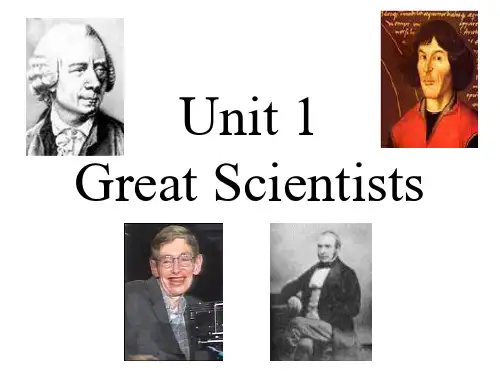
Who are they?
Who is he?
He has made a famous kite experiment. He learned a lot from it and invented lightning rod(避雷针).
He is … Benjamin Franklin
Never leave that until tomorrow, which you can do today.
Homework:
• Write a short article about a great scientist .
பைடு நூலகம்
3.Firefighters have been called to _p_u_t__o_u_tthe fire in the city centre.
4.Don’t _p_u_t__o_f_f__ until tomorrow
what can be done today.
---Benjamin Franklin
Brainstorming
enthusiastic Co-operative
positive
bright
高中英语必修五《unit1 Great Scientists》示范说课稿
《unit1 Great Scientists》说课稿各位评委老师,上午好!我是号考生,我今天说课的题目是《unit1 Great Scientists》。
我主要从教材分析、教学方法与策略、教学过程、板书设计等几个步骤向大家详细地讲解我对这节课的安排。
一.说教材1. 教材内容本节课是人教课标版必修5第一单元的第一课时的Reading部分,是该单元的主要内容,它介绍了英国著名医生John Snow是如何通过考察、分析、探究的科学方法,发现并控制“霍乱”这种传染病的。
通过阅读课文,使学生感悟科学家的周密观察、勇于探索、认真分析的科学精神,使学生了解科学方发现的全过程具有其科学的严密性。
2. 教学目标结合单元教学要求和本课特点,充分考虑学生的年龄特点、认知水平,遂将本课的教学目标确定为:知识目标1) Get students to learn the useful new words and expressions in this part.2) Let students learn about some great scientists and their contribution.3) Have students read the passage and know about John Snow and how he defeated “King Cholera”.能力目标1) Develop students’ reading ability and let them learn different reading skills.2) Enable students to talk about great scientists and tell their stories.情感目标1) Let students learn from great scientists, stimulate their love and respect for them and develop their moral qualities.2) Develop student’s sense of cooperative learning.3. 教学重点因为本组教材的重点了解项目是“John Snow 破解King Cholera难题”,所以确定本课的教学重点是:1) Let students learn about some great scientists and their contributions.2) Get students to read the passage and know about John Snow and how he defeated “ King Cholera”.3) Have students learn different reading skills.4.教学难点考虑到学生拓展阅读能力,语言输出能力等方面还需进一步努力,所以将本课的教学难点确定为:1) Develop students’ reading ability.2) Enable students to talk about great scientists and tell their stories.3) Let students learn how to organize scientific research.二.说教法和学法1. 教学方法引导学生独立思考,合作学习,进行师生、生生互动的“任务型”教学,设计了许多易于操作的任务型活动。
高中英语人教版课本同步课件:Unit1 Great scientists 必修5
爆发;发作(尤指疾病或战争) 受害者 询问 附近;邻近 泵;抽水机 (用泵)抽(水) 烟火(燃放) 图表 热情的;热心的
距离高考还有一段时间,不少有经验的老师都会提醒考生,愈是临近高考 ,能否咬紧牙关、学会自我调节,态度是否主动积极,安排是否科学合理,能 不能保持良好的心态、以饱满的情绪迎接挑战,其效果往往大不一样。以下是 本人从事10多年教学经验总结出的超实用新高考英语专题复习讲义希望可以帮 助大家提高答题的正确率,希望对你有所帮助,有志者事竟成!
背 put aside
节省;储蓄;储存;留出
相 put away
放好;积蓄
关 put off
延期;推迟
短 put up
举起;张贴;建立;提供食宿
语 put through
以……结束……
用 to conclude
最后
法 (2)come to/reach/draw a conclusion 得出结论
in conclusion
总而言之
背 ①I've come to the conclusion that he's the right person for the job.
法说明;指示 5.conclude vt.& vi.结束;推断出→conclusion n.结论;结束 6.contribute vt.& vi.捐献;贡献;捐助→ contribution n.贡献;捐款 7.reject vt.拒绝;不接受;抛弃→ rejection n.拒绝;抛弃 8.science n.科学→ scientific adj.科学的→ scientist n.科学家
高中英语Unit1 Great scientists文章 哥白尼与日心说人教版必修五
哥白尼与日心说尼古拉.哥白尼(Copernicus Nicholas),波兰一位伟大的天文学家。
他以惊人的天才和勇气揭开了宇宙的秘密,奠定了近代天文学的基础。
哥白尼以毕生的精力去进行天文研究,创立了《天体运行论》这一“自然科学的独立宣言”。
他的这些成就使他成为了人类科学发展历史上最伟大的革命家之一。
一. 哥白尼生平哥白尼于1473年2月19日出生在波兰西部维斯杜拉河畔托伦城的一个商人家庭。
家里兄妹四个,哥白尼是最小的。
在他10岁时,父亲去世了,舅父卢卡斯承担起了抚育他的重任。
1491年至1495年,哥白尼进入克拉科夫大学学习。
克拉科夫是当时波兰的首都,也是东欧最大的贸易和文化中心,有许多国家的留学生在这里学习。
由于它地处东西欧交通要冲,所以比较早地受到意大利文艺复兴的影响。
因此在这座古老的大学里,新兴的资产阶级人文主义思想和腐朽的封建教会的经院哲学之间展开了激烈的斗争。
哥白尼在先进的人文主义思想的熏陶下,在心灵里埋下了向经院哲学挑战的种子。
在这里,他遇到了对他的一生产生深远影响的数学家和天文学家布鲁楚斯基(Brudzewski)教授。
是这位教授的启蒙教育促使哥白尼决定将自己的一生奉献给天文科学。
1496年哥白尼前往意大利求学,先后进入博洛尼亚大学、帕多瓦大学和费拉拉大学学习和研究法律、天文学、数学、神学和医学,他同时还学会了希腊文。
1503年,哥白尼获得了教会法规博士学位。
1497年,哥白尼就任瓦尔半米亚牧师的僧正。
1510年后,他先后从事过管理、外交等工作。
他是一个杰出的经济学家,写过《货币的一般理论》一书。
他是近代第一个提出劣币淘汰良币理论的经济学家。
哥白尼医术高明,他利用业余时间行医,免费为穷苦人治病,是一位颇有名望的医生,被人们誉为“神医”。
哥白尼还是一位出色的数学家,他的巨著《天体运行论》附录里,发表过他的球面三角论文。
哥白尼也是一位伟大的爱国主义者,当条顿骑士团疯狂侵略波兰时,他挺身而出,起来保卫自己的祖国。
人教版英语第一部分 必修5 Unit 1 Great scientists
人教版英语第一部分必修5 Unit 1GreatscientistsUnit 1Great scientists(对应学生用书第113页)[单词拼写应用]Ⅰ.考纲单词——会拼写、要识记1.defeat vt.打败;战胜;使受挫n. 失败2.expert adj. 熟练的;经验或知识丰富的n. 专家;行家3.attend vt. 照顾;护理;出席;参加4.expose vt. 暴露;揭露;使曝光5.cure n. 治愈;痊愈vt. 治愈;治疗6.absorb vt. 吸收;吸引;使专心7.suspect vt. 认为;怀疑n. 被怀疑者;嫌疑犯8.foresee vt. 预见;预知9.blame vt. 责备;谴责n. 过失;责备10.handle n. 柄;把手vt. 处理;操纵11.link vt.&n. 连接;联系12.positive adj. 积极的;肯定的;确实的13.reject vt. 拒绝;抛弃14.characteristic n. 特征;特性15.analyse vt. 分析16.physician n. 医生;内科医师17.victim n. 受害者18.enquiry n. 询问19.severe adj. 严重的;严厉的20.universe n. 宇宙;世界Ⅱ.派生单词——能辨别1.science n.科学;技术→scientist n.科学家→scientific adj.科学的2.conclude vt.& vi.结束;推断出→conclusion n.结论;结束3.challenge n.挑战vt.向……挑战→challenging adj.挑战性的4.pollute vt.污染;弄脏→pollution n.污染5.announce vt.宣布;通告→announcement n.通知;宣告6.instruct vt.命令;指示;教导→instruction n.命令;传授→instructions n.用法说明书;操作指南7.construct vt.建设;修建→construction n.建设;建筑物8.contribute vt.&vi.捐献;贡献;捐助→contribution n.贡献9.enthusiasm n.热心;热情;热忱→enthusiastic adj.热情的;热心的→enthusiastically adv.热情地10.caution n.小心;谨慎→cautious adj.小心的;谨慎的Ⅲ.语境应用(用所给词的适当形式填空)1.I was bored with my job and felt I needed a new challenge.Last week I got a new job in a big firm,and I found it very challenging.(challenge) 2.The workers are constructing the bridge damaged by the flood,and the bridge under construction connects the road with the town.(construct) 3.I want to be a scientist to discover a scientific breakthrough to save people's lives.(science)4.The headmaster contributed to a newspaper to praise the lady's generous contributions to the school.(contribute)[拓展联想]Ⅰ.短语回顾——会默写1.put_forward提出2.expose...to 使显露;暴露3.apart_from 除……之外;此外4.make_sense 讲得通;有意义5.draw_a_conclusion 得出结论6.link...to... 将……和……联系或连接起来7.(be)strict_with... 对……严格的8.be_to_blame 应受谴责;应负责任9.point_of_view 态度;观点;看法10.slow_down 减速11.lead_to 通向;导致12.look_into 调查Ⅱ.语境应用(选用上述短语的适当形式填空)1.Everyone is supposed to put_forward some suggestions on how to improve our environment at the meeting.2.We must be_strict_with our students while we should give them love and care as well.3.I wrote a letter of complaint,and the manager has promised to look_into the matter.4.Eating too much fat can lead_to heart disease and cause high blood pressure.5.Don't waste time thinking about a sentence which doesn't make_sense.6.Apart_from the English class, I took an active part in English Corner and other after-class English activities.[拓展联想][句式结构仿写](对应学生用书第114页)精讲6个考纲单词conclude vt .& vi .推断出;结束;达成;缔结[经典例句] He concluded from their remarks that they were not in favour of the plan.(牛津词典)他从他们的话语中推断出他们不赞同这项计划。
人教版高中英语必修5:Great scientists_课件69
Байду номын сангаас
Michael Faraday: One Of The World's Greatest Scientists Michael Faraday 迈克尔·法拉第 was born in
1791 in Newington, England. His family was poor and self-educated. Faraday left school when he was 13. When he was 14, he became an apprentice(学徒) to a bookbinder and bookseller. He read extensively and began keeping a notebook with entries about art, history and the nature.
【答案】He became an apprentice to a bookseller and then worked as a bottle washer and Davy's assistant.
2.What was a primitive electric motor? 【答案】A primitive electric motor was the first device that used an electric current to make an object move.
When he was twenty, Faraday began lecturing at the Royal Institution. His lectures were dramatic and impressive.
人教版高中英语必修五第一单元重点句子Unit1Greatscientists
人教版高中英语必修五第一单元重点句子Unit1Greatscientists人教版高中英语必修五第一单元重点句子Unit 1 Great scientistsI. Phrases1. put forward 提出2. draw a conclusion 得出结论3. be/get under control 在……控制下be/get out of control失去控制,不能操纵4. be absorbed in 专心5. be to blame 应该受责备(用主动形式表示被动)blame sb. for sth. 因某事责备某人6. in addition 也,另外,此外7. link.。
to.。
将…和…连接或联系起来8. die of 因…而死亡(内因)die from 因…而死亡(外因)9. lead to 导致,通向10. make sense 有意义,说得通11. apart from 除…之外,此外12. contribute to 为…作贡献或捐款,导致,有助于13. be enthusiastic about 对…热情14. be curious about 对…好奇15. cure sb. of illness 治好某人…病16. point of view 态度,观点,看法17.(be)strict with sb. 对某人要求严格II. Sentences1. John Snow was a well-known doctor in London –so famous,indeed,that he attended Queen Victoria to ease the birth of her babies.约翰?斯诺曾经是伦敦一位著名的医生――他的确太负盛名了,所以维多利亚女皇生孩子时都是他去照料,帮助她顺利分娩。
2. But he became inspired when he thought about helping ordinary people exposed to cholera.但当他一想到要帮助患病的普通老百姓,特别是那些得了霍乱的患者时,他就感到很振奋。