
JOIN IN 剑桥英语四年级教案
window, board,
floor, curtains
Step Two: New Leson.
• 1.Introduce the new words: • T: Look.There is a girl on the box. • Show the word: in, Follow the same step to introduce the other four preposition. • 2.Revisw the new words. • 3.The students follow the teacher to say and act.
Step Two: NewLeson.
• 4.The teacher gives the order and the students act. • 5.The teacher act. The students say. • 6.Wo在……上
There’s a girl.
Unit 1 In the classroom
• • • •
Teaching aims: 1.Learn the new words: in, on, under, behind, in front of 2.Learn to use the preposition and sentence pattern “There be ……” to describe the things in a room.
• Teaching Difficuties: Master the preposition.
• Teaching Period: • One period • Teaching Aids: • PPT 、schoolbag、 book
Teaching Procedures:
• Step One: Review the words
Put the book
the schoolbag
Step Three: Exercise.
• 1.Use the sentence pattern “There be ……” to describe the picture. • 2.Finish the exercise according to the picture. Then check the answers one by one.
behind The bird is ________ the box.
in front of
在……前面
The ball is
in ----------- of front
the
box .
Blackboard writing Design:
• Unit 1 In the classroom
in on under behind in front of
on The girl is _____ the box.
in
在……里
Look at the boy.
in The boy is _____ the box.
under
在……下
A white cat!
under The cat is ______ the box.
behind
在……后面
Hi. I’m a bird.
in front of the board
behind
the curtains
on a chair
on a desk
in a schoolbag under a desk
under a chair
Goodbay!.
JOIN IN 剑桥英语四年级教案教学文案

• 6.Work in pairs.
on 在……上
There’s a girl.
The girl is __o_n__ the box.
in 在……里
Look at the boy.
The boy is __i_n__ the box.
to introduce the other four preposition. • 2.Revisw the new words. • 3.The students follow the teacher to say
and act.
Step Two: NewLeson.
• 4.The teacher gives the order and the students act.
under 在……下
A white cat!
The cat is _u_n_d_e_r_ the box.
behind 在……后面
Hi. I’m a bird.
The bird is __b_e_h_in_d__ the box.
in front of
在……前面
ball is in ---f-r-o--n--t-- of the box .
• 2.Finish the exercise according to the picture. Then check the answers one by one.
behind the curtains
in front of the board
under a desk
on a desk under a chair
JOIN IN 剑桥英语四年级教案
JOININ剑桥英语四年级教(学)案
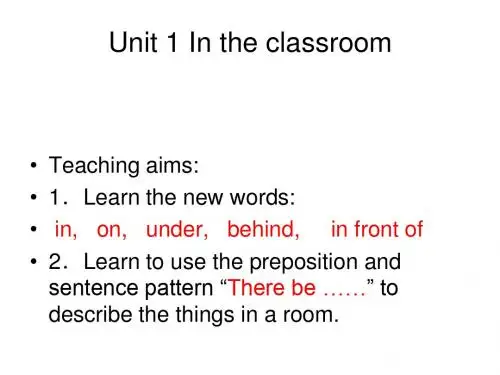
• Teaching aims: • 1.Learn the new words: • in, on, under, behind, in front of • 2.Learn to use the preposition and
sentence pattern “There be ……” to describe the things in a room.
• 5.The teacher act. The students say.
• 6.Work in pairs.
on 在……上
There’s a girl.
The girl is __o_n__ the box.
in 在……里
Look at the boy.
The boy is __i_n__ the box.
• 2.Finish the exercise according to the picture. Then check the answers one by one.
behind the curtains
in front of the board
under a desk
on a desk under a chair
on a chair
in a schoolbag
Goodbay!.
知识回顾 Knowledge Review
放映结束 感谢各位的批评指导!
谢 谢!
让我们共同进步
•
desk, chair, door,
•
window, floor,
•
board, curtains
Step Two: New Leson.
剑桥(join in)版小学英语四年级下册教案(全册) 1
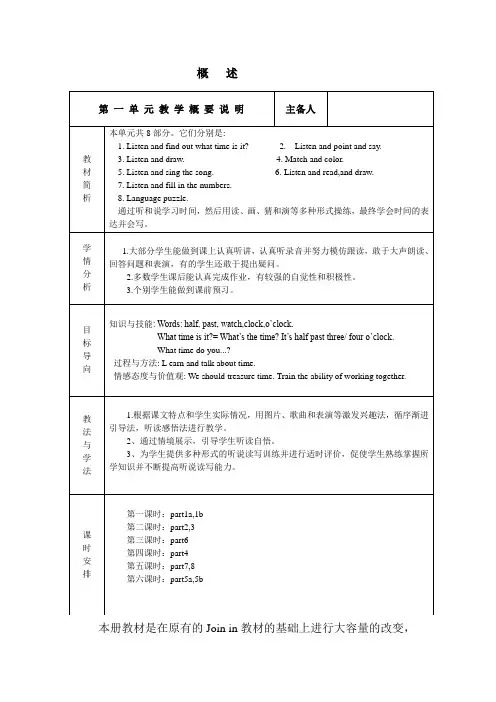
概述本册教材是在原有的Join in教材的基础上进行大容量的改变,由一个预备单元、六个主题单元以及两个复习单元,及活动练习组成,内容之多,课时较少确实成为本学期的一个教学难点。
我们将本学期的教学周定为17周,预计课时34节,其中预备单元3课时,另外六个单元,除开始单元3课时,第二单元6课时,其他单元平均5课时,两个复习单元中的每一部分穿插在各个单元里解决,书后的活动练习可以结合各校学情选做。
有些题目和书本上的题目雷同,可以不做。
在这里我们仅提供给老师们这个基标,老师们可以根据各自学校学生的学情以及一些机动课时来酌情安排教学内容。
本册书共7个单元,2个Revision:Starter Unit: Let’s join in! 3课时Unit 1: Time 5课时Unit 2: Friends 6课时Unit 3: Animals 5课时Unit 4: My room 5课时Unit 5: School life 5课时Unit 6: Holidays 5课时(本学期预计课时共32-34课时,每周2课时)Starter Unit Let’s join in教学目标:1. 能听懂、理解句子“I'm new to the class.” “Let's be fri ends.”,并表演对话。
2. 能根据图片认读写出正确的单词,。
3. 能认读与话题months,seasons,countries,days of the week ,numbers,clothes,things in a classroom, feelings about weather,places in a school 相关的单词。
能正确理解并按类别划分。
4. 能正确理解句子并根据听到的录音结合图片标号。
5. 能会认读有关月份的单词,并圈出来,正确地写一写。
6. 能听懂、读懂对话内容,根据对话内容填空并能在提示下进行复述。
外研社剑桥小学英语Join_in四年级上册整体课时教案

外研社剑桥小学英语Join_in四年级上册整体课时教案Starter Unit Let's begin第一学时:The pupils learn to understand:How are you today? I’m fine/OK.Goodbye.The pupils learn to use:What’s your name? I’m (Alice).How are you? I’m fine. I’m OK.Activities and skills:Decoding meaning from teacher input.Using phrases for interaction in class.Greeting each other.I Introduce oneself.Asking someone’s mane.Teaching process:Step 1: Warm—up.Sing a song. Hello, what’s your name?Step 2: Presentation.1. What’s your name? I’m….(1) The teacher introduces herself, saying:Hello, /Good morning, I’m Miss Sun.(2) Asks a volunteer’s name:What’s your name?The teacher prompt the pupil by whispering, I’m (Alice).(3) Asks all the pupils the same question and help those who need it by whisperingI’m….2. How are you today? I’m fine. I’m OK.(1) The teacher explains the meaning of How are you today? (2) Tell the class to ask the question all together and introduce two answers,I’m (notvery) fine/I’m Ok.(3) Asks all the pupils the same question and make sure that all the students can reply.Step3: Speak English in class.1. Tells the pupils to open their books at page3, look at the four photographs, andlisten to the tape.2. Asks the pupils to dramatise the situations depicted in the four photographs. Avolunteer will play the part of the parts of the other pupils, answering as a group.第二学时:The pupils learn to use these new words:Sandwich, hamburger, hot dog, puller, cowboy, jeans, cinema, walkman, snack bar, Taxi, clown, superstar.Activities and skills:Singing the song and colouring picture frames.Teaching process:Step 1:Warm—up:Greetings:(1) Good morning!(2) I’m Miss Sun. What’s your name?I’m (Alice, John…).(3) How are you today?I’m fine/OK.Step 2: New words.1. Learn to say these words one by one using flash cards.2. Guessing game.Is it a cowboy/snack bar…?No, it isn’t. Yes, it is.3. Read them following teacher.4. Colour the frames.(1)Open book at page4, take your colour pens. Listen and colour.(2)Colour your (hamburger, orange…).(3)Let’s check.The hamburger is orange.Step 3: Sing the song.1. Listen to the tape.2. Teacher sings the words.3. Learn to say the words.4. Let’s sing it one sentence by one sent ence.5. Sing the song and do the actions together.Step 4: Say good—bye.Goodbye, children.Goodbye, Miss Sun. See you next time.第三学时:The pupils learn to understand:Watch me. Stretch. Clap your hands. Stand back to back.Stand nose to nose. Stand arm in arm. The pupils learn to use: Good morning./Morning. Good afternoon. Good evening.Good night.Activities and skills:Carrying out action story.Listening to the tape and filling numbers.Teaching process:Step 1: Warm—up(1) Greetings.(2) Play guessing game with flash cards. (3) Sing the song: English is easy.Step 2: Mime the action story.1. The teacher and the pupils listen to the instructions on the cassette. The teacherperforms each action and the pupils watch and then imitate the teacher. Repeat thisstage several times.2. The teacher gives the instructions in the same order which the pupils heard them onthe cassette during Phase 1. The pupils listen and do the actions one at a time,following the teacher’s instructions.3. The teacher gives the instructions in jumbled order. The pupils listen and performsthe actions one at a time.Step 3: Listen and fill in the numbers.(1) Listen and mime.(2) Fill in the numbers.(3) Check it. Make sure that everyone is correct.Step 4: Learn to say.The teacher draws a clock on blackboard. When it is 7:30, says “Good morning” or“Morning” to the pupils. The pupils answer “Good morning” or “Morning”.“Good afternoon”, “Good evening” and “Good night” are the same above.第四学时:The pupils learn to use:How are you? I’m fine/very well/OK.Thank you. And you?Nice to meet you. Nice to meet you, too.Activities and skills:Speaking and comprehension:Teaching process:Step1: Warm—up.1. Greetings.Good morning. /Morning.Good afternoon.2. Sing a song: Join in.Step 2: Let’s read and act.1. T: Hello, I’m Miss Sun. What’s your name?S: Hi, I’m Alice.T: Nice to meet you.Tell the student that he or she should say “Nice to meet you, too.”Have this conversation with others, and make sure that all the pupils can say itcorrectly.2. Other sentences just to be taught and learnt like those above.3. Actions:(1). Pair work: Two pupils to act the conversations. (2). Boys and girls competition.Step 3: The end.Goodbye, children.Goodbye, Miss Sun.Unit 1 Numbers第一学时:The pupils learn to understand:The tiger jump.Do the numbers rock.The pupils learn to say:Numbers 1—12.Twelve o’clock; do the numbers rock.Yippee!Let’s do the tiger jump.Your turn.Activities and skills:Singing the song: The numbers rock.Saying the chant : The tiger jump.Colouring the numbers.Listening to conversations and matching the names of children with numbers ondice.Playing two number games.Teaching process:Step 1: Warm—up.1. Count numbers from 1 to 10.2. Sing the song. Hop.Step 2: Listen and sing the song. The numbers rock. 1. Learn to say:11 eleven, 12 twelve. Twelve o’clock.2. Listen and say the chant.Step 3: Listen and say the chant.1. The teacher says the chant and performances in the same order,the pupils follow.2. Teacher says, pupils do in the same order.3. The teacher saysand pupils do in the jumbled order. 4. Listen to the tape and say the chant, do the actions.Step 4: Colour the numbers.1. Show numbers’ cards 1—12 to the pupils. Count them.2. Open book at page9, match numbers with the words.3. Colour them and check them.Step 5: Listen and match.1. Teacher writes numbers on the blackboard. The pupils read them.For example: 3, 6, 1 5, 4 5, etc.2. Listen and match then check.3. learn to say “Your turn.”4. Play the game in class.第二学时:The pupils learn to understand:What’s in the box?Guess the number.Super prize!Come on, (Fred).Here is your prize, Emma.Thank you, Emma.Great!The pupils learn to use:What’s in the box?Snails! Yuk!How many?Activities and skills,Listening to and understanding a story. Playing game: “Guess the number.”Teaching process:Step 1: Warm—up.1. Say the chant : The tiger jump.2. Sing the song: The numbers rock.Step 2: A game. Guess the number. 1. Count numbers 1—12.2. Shows the pupils numbers’ cards, guess the number.3. Take a box, put some glass balls in it. Shows them a glass ball, asks:What’s this? What’s in t he box? How many?If the pupils are right, says “Great! Here is your prize.” And give them a glass ball.Step 3: A story. The snails.1. Teacher says, You will hear a story. The snails. Please listen carefully.2. Listen to the tape several times.3. Make sure that the pupils fully understand the meaning of this story.4. Play this game in class.第三学时:The pupils learn to understand:Guess the number.The pupils learn to use:Twelve is two plus ten, now let’s start again.How many?Yes. / No.Activities and skills:Saying the rhyme.Playing two number games.Teaching process:Step 1: Warm—up.Sing the song. The numbers rock.Step 2: Listen and say the rhyme. 1. Count numbers 1—12.2. Read the words line by line several times.3. listen to the tape, say the rhyme.4. Asks a group of 6-7 pupils stand in a circle, and say the rhyme, see who is left out.Step 3: Play a game.1. Teacher asks a pupil to come to the front of the class and demonstrate the game asshown in the first two pictures.2. Play in pairs and proceed in the same way for the second game.3. Play this game one by one.第四学时:The pupils learn to understand and use:What’s your phone number?Activities and skills:Listening and taking notes of phone numbers and saying what they are.Asking other pupils for their phone numbers and taking notes.Teaching process:Step1: Warm—up.1. Count numbers 1—12.2. Say the rhyme.Step 2: Listen and write the phone numbers.1. Draw a big telephone on the board. Introduce the word Phone or telephone immediately followed by the sentence My phone number is ….2. Listen and write.Tell the pupils that they are going to hear some recorded interviews, and that theyhave to listen and discover the telephone numbers of a few children. Read the names of the children out loud and ask the pupils to repeat them. Listen to the tape several times and write.3. Let’s check.Step 3: Write your phone numbers.1. The pupils write their phone number. Tell them how to read the number.2. Read your number yourself.Step 4: Asks children’s phone number.1. Teacher asks, what’s your phone number? A volunteer answers, other pupils write down.2. Work in pairs.3. The pupils ask and answer each other, and write.4. Let’s check.第五学时:Teaching aims:1. Learn to say:How many girls/boys/flags…can you see?Let me count. I can see….2. Learn to say:What is (seven) plus (twelve)?What is (eleven) minas (nine)?3. Write the numbers 1—12.Teaching process:Step 1: A game.Prepare a box which is full of glass balls. Shows them the box, and asks, what’s in it?Let pupil guess, and then someone touches it. (Glass balls.)How many? How many glass balls? How many glass balls can you see? Count, please. The pupil counts. One, two, three, four…Step 2: Learn to say.1. Teacher chooses a group of pupils, and asks, how many girls can you see? Tellsthem to reply, let me count. And then, count. One, two,…. Tells them to say, I can see…2. Repeat this exercise several times.3. Ask and answer with other words which they learned, such as boys, flags, dogs…Step 3: Learn to say.1. Write those below on the blackboard:7+5 8+2 11-96+4 12-9 2+2Point a pupil to read them.2. The teacher asks What is 7 plus 5,Make sure that each pupil can reply “It’s…” correctly.3. Pupils open book at page 15, work in pairs.Some pairs of pupils wok in class.Step 4: Complete the word puzzle.1. Show the pupils flashcards of numbers 1—12. Read them, and spell the words. 2. Open book at page 15, complete the 14th exercise.3. Check it.Unit 2 Colours第一学时:The pupils learn to understand:What colour is this/The pupils learn to use:Colours: red, orange, yellow, green, blue, purple, pink, black, white.I like (green) and (red); I like orange, too.Oh, what a rainbow!Activities and skills:Listening to words and pointing at the appropriate pictures in the box.Sing a song.Teaching process:Step 1: warm—up.1. Greetings.Good morning. / Good afternoon.2. Sing a song. Butterfly.Step 2: Listen and point—presentation.1. Introduce the following colours: red, orange, yellow, green, blue, purple, pink, white and black.Show the pupils colours with the help of coloured flash cards and objects in the classroom,2. Say the words.(1) Show a colour and say the word several times, then ask thepupils to repeat it. (2) Name a colour and ask the pupils to touch something of that colour. 3. A game.(1) Teacher names a colour, four pupils touch an object of the correct colour. The last pupil is “out”. The winner is the person who touches the correct one first.(2) Asks of the pupils to take over the role of the teacher.(3) Proceed in the same way for the other remaining colours.Step 3: Listen and point.Open their book at page 16, listen to the tape carefully, point the corresponding colour.Step 4: Listen and sing s song. Rainbow.1. Draw a picture of a rainbow on the board and introduce the word Rainbow.2. Listen to the word and repeat it.3. Sing the song following the tape.第二学时:The pupils learn to understand:1. What colour is (the wizard’s house)?2. I’m from Italy; (Great Britain; Argentina; Brazil).The pupils learn to use:I’m (Lucia). I’m from China. This is my flag.Activities and skills:Finding out from a listening text wha t colour the wizard’s house is (listening for detail).第三学时:The pupils learn to understand:Help.Open the door.The pupils learn to use:(Green), please. Here you are.Good night! Good morning!What’s this? Wow!Activities and skills:Listening to and understanding a story.Teaching process:Step 1: Warm—up.1. Sing a song. The rainbow.2. (1) Teacher walks around the classroom asking the pupils:Blue, please. Green, please, etc.The pupils should give me a colored pencil requested. (2) Do the same exercise by the pupils in pairs.Step 2: The story.1. Introduce and practise new vocabulary. Here you are. Help. Open the door. What’s this?2. Pupils listen to the text two or three times with their books closed and try toimagine what is happening from the tone of the voices and blackboard noises. 3. Pupils listen two or three times with their books open.4. Pupils listen one more time with their eyes closed and try to imagine what they saw in the text.Step 3: Act out the story.Two pupils for wizards, somebody to make the noises of boiling water, and explosion, colored bottles.第四学时:The pupils learn to understand:What’s my favourite colour? Is it (blue)?What’s your favourite colour?Yes, that’s right.The pupils learn to use:Guess.What’s my favourite colour? Is it (blue)?What’s your favourite colour?Yes, that’s right.Activities and skills:Playing a game based on the principle of information gap.Completing dialogues in writing.Listening to a chant and circling patches of colour.Saying a chant.Doing a crossword puzzle.Teaching process:Step 1: Play a guessing game.1. Ask a pupil to touch a part of the coloured fish.The teacher can’t see what colour the pupil is touching and, naming several different colours, should try to guess.2. Once the pupils have understand the way game works, they can play in pairs and exchange roles.Step 2: Complete the dialogues.1. Learn to write the words and sentence:Green, blue, white, please.Here you are.2. Ask the pupils to look carefully at the four scenes and to complete the dialogues according to what they see in the pictures.Step 3: A chant.1. The pupils should listen to the chant once all the way through.2. Then they listen a second time, but this time the tape should be stopped after each question to give the pupils time to circle the colour.3. Finally they listen a third time to check the answers.The teacher should check that the pupils have understood and ask which colours theyhave circled. The pupils say the colours in the correct order.4. The teacher writes them on the blackboard. The pupils copy the words.5. Repeat the chant in two separate groups.第五学时:The pupils learnt to understand:What about you?What about this?What’s that over t here?The pupils learn to use:I’m from (America).I like (red) best.What’s your favourite colour?What colour do you like?Activities and skills:Speaking those sentences in groups. Talking about the birthplace and the favourite colours of themselves.Teaching process:Step1: Warm—up1. Say the chant: what’s your favourite colour?2. Revise the words: Great Britain, Italy, Brazil, Argentina.I’m from China.Step 2: Let’s learn and work in groups.1. Introduce new words.America, England, Canada, best, about. 2. Learn to say.I’m….I’m from….I like (red) best.3. Introduce how to use “what about you?”. Make sure that everyone has understoodit.4. Read the sentences.Step 3: Work in the groups.1. Pair work.2. Teacher and student act in class.3. Work in tablemates as the model.Step 4: Let’s talk.1. Introduce new words: jeep, over there.2. Using some flashcards, ask and answer. T: What’s this? (A car.)S: It’s a car.T: What colour is it?S: It’s (red).And tell the volunte er to say: It’s a Chinese car. All the class repeat it.The teacher shows them another flashcard, and asks: What about this? Make sure that the student can answer it correctly.3. Talk about the flashcards in pairs.4. Let’s talk in class.Unit 3 School things第一学时:The pupils learn to understand:What colour is the wizard’s schoolbag,The pupils learn to use:Pen, pencil, pencil case, schoolbag, ruler, eraser, book..Activities and skills:Listening to the words on the tape and filling in the numbers in the book. Listening to the tape and finding out what colour the wizard’s schoolbag is.Teaching process:Step1: Warm--up.1. Show pupils some school things, such as:pencil, book, pen, schoolbag, pencil case. Ask pupils: What’s this? It’s a (p en).2. A game Toby says:Touch your (pen). Take your (book).Step2: Listen and fill in the numbers.1. Introduce the new vocabulary using regalia, rule, eraser,2. The pupils open their books at Page 24.The teacher reads the words, first in the order in which they are presented and then injumbled order, ask the pupils to point to the corresponding picture.3. Listen and fill in the numbers.(1) The first time, the pupils listen to the tape without interruptions for general dothe exercise by themselves.(2) The second time, the pupils listen to the tape without interruptions so that everybody can do the exercise.Check the answer. Name the objects and ask the pupils to answer with the corresponding numbers.Step3. Listen. What colour is the wizards schoolbag.1. Tell the pupils in Chinese that they have to discover the colour of the wizards schoolbag.2. Give them an example.The pupils point to the word start, the teacher says blue and the pupils point to the blue square. Then say ruder and the pupils touch the ruder.Proceed in this way from ruder to yellow, and then to pencil to blue to eraser.At this point ask what colour is the wizards schoolbag? (Blue). 3. Listen to the tape and follow the sequence of squares using a pencil. 4. Listen two or three times to check the answer.第二学时:The pupils learn to understand:Open your (schoolbag).Take out (a ruler).Take out (two books).What’s this? A skipping rope.Hooray!The pupils learn to use:Three pens, four pencils, two books.Activities and skills:Understanding instructions and miming actions.Listening to the tape and filling in numbers.Teaching process:Step 1: Warm—up.Ask and answer.Show the pupils a ruler, a pen , a schoolbag, two erasers, four books, three pencils. Ask: What’s this? What colour is it? How many books can you see? Etc.Step 2: New word.Show them a skipping rope and teach the new word.Step 3: Mime the action story.1. The teacher and the pupils listen to the instructions on the cassette. The teacher performs each action and the pupils watch and then imitate the teacher. Repeat this stage several times.2. The teacher gives the instructions in the same order which the pupils heard them on the cassette during Phase 1. The pupils listen and do the a ctions one at a time, following the teacher’s instructions.3. The teacher gives the instructions in jumbled order. The pupils listen and performs the actions one at a time.Step 4: Listen and fill in the numbers.(4) Listen and mime.(5) Fill in the numbers.(6) Check it. Make sure that everyone is correct.第三学时:The pupils learn to understand:How many (red) things are there?The pupils learn to use:Two pens, three erasers, four pens, five rulers.Activities and skills:Reading what is in the picture and colour frames around word groups in the appropriate colour.Counting school things in a picture puzzle.Teaching process:Step1: Warm—up.A guessing game.1. Show the pupils a box which is full of pens, pencils, rulers, erasers, and books.And ask the pupils to guess how many pens/ pencils/rulers/erasers/books are there?T: Guess! How many (pens)?2. When the pupils guess correctly, ask them: What colou are the (two pens)?Step 2: Read and colour the frames.1. Introduce how to do the exercise.Point out to the pupils that there are 10 pictures and only five boxes on the right. Thepupils have to colour the frames of the boxes on the right following the example. Theframe of the box containing the words two pens, is orange like the two pens in thedrawing.2. The pupils colour the frames themselves.3. Check the answer.Ask the pupils to say which colours match which words.Step3: Count and write the numbers.1. Read the sentences several times. And translate the questions.2. The pupils write exercise in the book.3. Check the answer.Ask the question and the pupils answer orally.第四课时 :Teaching aim And demand:1. The pupils learn to understand:Stop it.Come here, Timmy.Help me, please.Where’s my pencil case?It’s not here.I’ve got it!2. Acticities and skills:Decoding the meaning of the language in a story. Important and Difficult front:Understand the sentences of the story.Teaching process:Step 1:Warming-up1. Sing an English song: Join in.2. Revise the school thing. Which have learnt in this unit.3. Revise the sentence: Here is your prize. Here is my prize.Step 2 : Presentation1. Listen to the story.2. Ask the students to open their books at page 28.3. Ask them listen to the tape, listen to an English story.4. Ask the students to tell the meaning of the story.Step 3 : Learn to understand the sentences.1. Ask some students do a action, then say: Stop it, xxx.” Let the students tell themeaning of the sentence. Then practise it.2. Pre tend to find something, and say: Where’s my pen?” Ask the students to say whatam I doing. And tell the meaning of the sentence.3. Ask someone xxx, help me, please.” Let him/her find things with me. Then ask them to tell the meaning of the sentence.4. Practise the two Sentences in pairs.5. Say:It’s not here,” while finding the thing. Let them say the meaning of thesentence. Then practise it.6.When finding the thing, say: I’ve got it!” Let the students tell the meaning of thesentence. then practise to say it.Step 4 : Consolidation1. Listen again and say the sentences after the tape.2. Perform the story in the class.第五学时 :Teaching aim And demand:1. The pupils learn to use:How many desks are there?What about Chairs?How many pens have you got?2. Activities and skills:Let’s read.Let’s work in groups.Important and difficult point: Read the conversation.Teaching process:Step 1 : Revision1. Sing an English song: In our classroom.2. Show some pictures to the students and ask them to read it. (desks). (chairs).3. Revise the colours.4. Revise the sentences. Which they have leaned in previous class.5. Spell the words.Step 2 : PresentationA: Learn to say the conversation.1. Show a picture to the students.2. Ask the m How many desks are there”?3. Ask: What about Chairs? How many chairs are there?”4. Show some other things to the student, practise to the sentence How many(desks)are there?”5. Read the conversation to the students, ask them to tell me the meaning of theconversation.6. Read the conversation after the teacher several times. Then practise by themselvesin pairs, until they can read it correctly.7. Ask someone to perform the conversation in the front of the classroom.Step 3 : Play a game and do the group work.1. Send something to the students.2. Ask them one by one: How many pens have you got?” Answer the question in steadof the students. Then ask them to tell me the meaning of the sentence. 3. Ask them to read the sentence after the teacher several times. 4. Practise the sentence by themselves, until they can read it correctly. 5. Do the group work.第六学时 (12. Revision)Teaching aim And demand:1. The pupils learn to read the sentences:I have got (a small room).It’s (nice) and (cle an).There is (a bed) (in my room).There is (a computer) (on the desk).I often work at the desk.2. Activitise and skills: Read the text.Important and difficult point:Can read the text of the lesson.Teaching process:Step 1 :Revision1. Sing an English song.2. Spell and read the words:pencil, pencil case, pen, book, eraser, ruler, schoolbag. 3. Look the pictures and say.Two pencils two blue pencils ect.5. Ask and answer:How many pencils are there?How many blue things are there?How many pens have you got?Step 2 :PresentationA : Look at the pictures, learn to say the new words. 1. Point the thing and say the English of it.2. Ask the students to read the word after the teacher. (bed computer)3. Practise to say the words by themselves, and then say out loudly, until they can redit correctly.B : Look at the picture again. Ask and answer:Where is the (bed),1. Ask the students to look at the picture and answer: Where is the bed?2. Answer in stead of the students: It’s in t he room.e the same way to teach:It’s by the window.It’s on the desk.Step 3: Learn to say the text.1. Look at the picture and listen to the teacher read the text.2. Ask them to tell the meaning of the text.3. Read the text after the teacher several times.4. Practise to read the text by themselves, until they can read it correctly.5. Ask someone to point the picture and say the text.Unit 4 Pets第一学时:Teaching aim And demand:1. The pupils learn to use:What have you got?Have you got a pet? Yes, I have.2. Learn to use the words:Cat dog mouse fish budgie, rabbit. Hamster. 3. Activities and skills: Saying a chantListening to a cassette and finding out what the wizard’s pet is.Important and difficult point:pictures, radio and tape.Teaching process:REVISION:1. Sing an English song: join in.2. Conversation:What’s your favourite colour?What colour is the schoolbag? ect.PRESENTATION:A: Learn to say the six new words.1. Learn to say the word: cat.Show a picture of a cat to the students, tell them: This is a cat.” Ask them to read the word after the teacher several times. Then practise by themselves, until they canread the word correctly.e the same way to teach the other words: dog, mouse, fish,budgie, rabbit.3.Fun time.Listen to the sound of these animals or mine these animals. Ask the students to saythe words and at the same time point to the corresponding flashcard.B: Learn to say the sentences.1. Learn to say the sentence: Have you got a pet?Pretend to need a pen and ask a pupil: Have you got a pen? If necessary translatethe sentence.2. Read the sentence after the teacher several times.3. Practise the sentence by themselves:Use the flashcard and ask the students:Have you got a (ha mster)? And then answer “Yes.” And then ask the students to askthe teacher answer.e the same way to teach:What have you got?C: Listen and say the chant.Play the chant two or three times and ask the pupils to repeat it, until they can readit correctly.D: Listen and find the wizard’s pet.Ask the same way before.BLACKBOARD DESIGN:PetsCat dog mouseFish budgiz rabbit。
《Join_In》剑桥小学英语导学案例
《Join_In》剑桥小学英语导学案例《Join_In》剑桥小学英语导学案例《Join In》1剑桥小学英语导学案例――四年级小学英语教材Colours---Let’s learn and work in groups武汉市洪山区广埠屯小学夏爱华《Join_In》剑桥小学英语导学案例《Join In》1剑桥小学英语导学案――四年级小学英语教材Unit 2: Colours(Part 9)武汉市洪山区广埠屯小学夏爱华一.设计背景教案,是教师教学活动的设计。
过去,我们教师备课都是自己备课,把备课的各个环节呈现在备课本中,上课都是用传统模式,学生按照教师设计的那样一步一步学,教师似乎成了课堂的主体,而学案,就是学生学习活动的设计。
那么导学案究竟是什么呢?是指以导学案为载体,以导学为方法,教师的指导为主导,学生的自主学习为主体,师生共同合作完成教学任务的一种教学模式。
显而易见,这对我们的教师要求又提高了,不仅要自己备课,还要通过导学案清楚明白的告诉学生该怎么样去学,让学生成为课堂的主体。
导学案的作用主要在“导”,所以我们在编制导学案时要根据教学内容编制合适的导学案,导学案发到学生手中,让学生很快就能明白什么是重点,什么是难点,如何突破难点。
对所学内容如何去思考,考虑知识点的思路是什么要给学生明确的指导。
同时导学案中还应包含所学内容的知识点的结构和关联知识点。
导学案既不是练习题,也不仅仅是知识点的罗列。
导学案的关键是编制,一份好的导学案要为学生创设了更多的自主学习的机会和自主探究的主体活动平台,给学生提供了充足的思维时空。
《Join_In》剑桥小学英语导学案例二.导学案的编制导学案的编制是重中之重。
如何编好导学案,我认为需要做到以下几点:(一)导学案的编写主要按课时进行,与教师上课同步,教师要把握好导学案的量,不可过多也不可过少,这就需要教师要了解每个学龄段孩子的特点,有很多教师遇到这样的问题,有时候一堂课导学案上不完,我想量没把握好是其中重要的原因。
剑桥(join in)版小学英语四年级下册教案(全册) 2
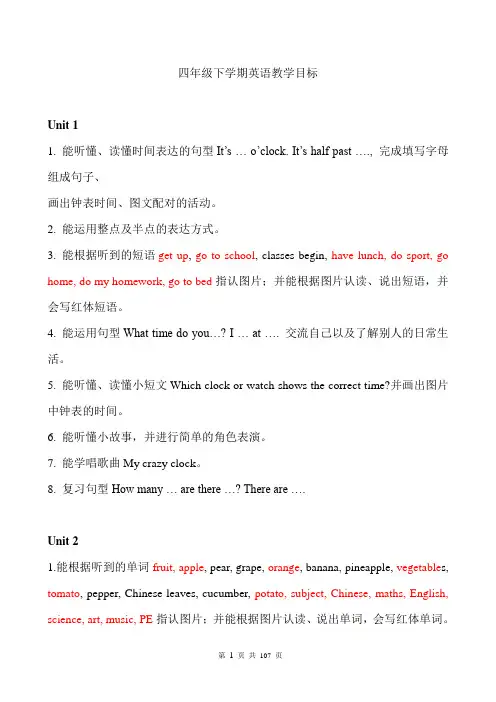
四年级下学期英语教学目标Unit 11. 能听懂、读懂时间表达的句型It’s … o’clock. It’s half past …., 完成填写字母组成句子、画出钟表时间、图文配对的活动。
2. 能运用整点及半点的表达方式。
3. 能根据听到的短语get up, go to school, classes begin, have lunch, do sport, go home, do my homework, go to bed指认图片;并能根据图片认读、说出短语,并会写红体短语。
4. 能运用句型What time do you…? I … at …. 交流自己以及了解别人的日常生活。
5. 能听懂、读懂小短文Which clock or watch shows the correct time?并画出图片中钟表的时间。
6. 能听懂小故事,并进行简单的角色表演。
7. 能学唱歌曲My crazy clock。
8. 复习句型How many … are there …? There are ….Unit 21.能根据听到的单词fruit, apple, pear, grape, orange, banana, pineapple, vegetable s, tomato, pepper, Chinese leaves, cucumber, potato, subject, Chinese, maths, English, science, art, music, PE指认图片;并能根据图片认读、说出单词,会写红体单词。
2. 能用句型I like ….介绍自己喜欢的食物,并树立科学的饮食观。
3. 能听懂、读懂介绍朋友的短文,完成写出人名、填写表格、补全句子的活动。
4. 能运用句型My best friend is …. He / She is…. His/ Her favourite … is…. He / She likes….He / She has got…. 来描述自己或他人的朋友。
剑桥(joinin)版小学英语四年级下册教案(全册)1
能正确理解并按类别划分。
4. 能正确理解句子并根据听到的录音结合图片标号。
5. 能会认读有关月份的单词,并圈出来,正确地写一写。
6. 能听懂、读懂对话内容,根据对话内容填空并能在提示下进行复述。
7. 能读懂对话, 并给问句找到相应的答句。 。
8. 能根据图片正确理解句子并作出相应判断, 看图,结合图片信息回答有关 there
第二课时: 2, 3,4,Revision1(Page26-1)
第三课时: 5a,5b, Group work,Revision1(Page27-3)
第四课时: 6,Revision1(Page28-4)
第五课时: 7, 8,Pair work
第一课时: 1a,b
教学内容:
本课时的教学重点是能根据听到或给出的时间句型指认相关图片,知道
It's …
clock. 指的是整点,而 It's half past … .表达的是几点半,并根据找出的字母认
识单词 midnight 。
教学建议:
重点是复习 1-12 的数字单词 。 区分 It's … clock指. 的是整点,而 It's half
past … .表达的是几点半。可要求学生自制钟面一个,课堂上利用自己制作的
教
1.根据课文特点和学生实际情况,用图片、歌曲和表演等激发兴趣法,循序渐进
法
引导法,听读感悟法进行教学。
与
2、通过情境展示,引导学生听读自悟。
学
3、为学生提供多种形式的听说读写训练并进行适时评价,促使学生熟练掌握所
法
学知识并不断提高听说读写能力。
’ clock.
第一课时: part1a,1b
剑桥版join in 四年级下册英语全册教案 2
剑桥版join in 四年级下册英语全册教案 1课题:Let’s join in! 第Starter 单元第 1 课第周学科:英语年级:四教师:_____ 审核:_____课题:Let’s join in! 第Starter 单元第 2 课第周学科:英语年级:四教师:_____ 审核:_____课题:Let’s join in! 第Starter 单元第 3 课第周学科:英语年级:四教师:_____ 审核:_____课题:Let’s join in! 第Starter 单元第 4 课第周学科:英语年级:四教师:_____ 审核:_____学科:英语年级:四单元及课题: Unit 1- Time 单元总课时:6课时本课课时:6-1 教师:_____ 审核:_____学科:英语年级:四单元及课题: Unit 1- Time 单元总课时:6课时本课课时:6-2 教师:_____ 审核:_____学科:英语年级:四单元及课题: Unit 1- Time 单元总课时:6课时本课课时:6-3 教师:_____ 审核:_____学科:英语年级:四单元及课题: Unit 1- Time 单元总课时:6课时本课课时:6-4 教师:_____ 审核:_____学科:英语年级:四单元及课题: Unit 1- Time 单元总课时:6课时本课课时:6-5 教师:_____ 审核:_____学科:英语年级:四单元及课题: Unit 1- Time 单元总课时:6课时本课课时:6-6 教师:_____ 审核:_____学科:英语年级:四单元及课题: Unit 2- Friends 单元总课时:4课时本课课时:4-1 教师:_____ 审核:_____学科:英语年级:四单元及课题: Unit 2- Friends 单元总课时:4课时本课课时:4-2 教师:_____ 审核:_____学科:英语年级:四单元及课题: Unit 2- Friends 单元总课时:4课时本课课时:4-3 教师:_____ 审核:_____学科:英语年级:四单元及课题: Unit 2- Friends 单元总课时:4课时本课课时:4-4 教师:_____ 审核:_____学科:英语年级:四单元及课题: Unit 3 - Animals 单元总课时:4课时本课课时:4-1 教师:_____ 审核:_____学科:英语年级:四单元及课题: Unit 3 - Animals 单元总课时:4课时本课课时:4-2 教师:_____ 审核:_____学科:英语年级:四单元及课题: Unit 3 - Animals 单元总课时:4课时本课课时:4-3 教师:_____ 审核:_____学习目标:1、学会用: elephant. Crocodile.Does it live in Africa?Has it got two legs?Can it fly?2、学会书写: Can it …? Has it got…? Does it live..? Does it eat…?Let the pupils play the guessing game.Let the pupils learn to use: Guess my favourite animals.3、能增强保护动物的意识。
外研社剑桥小学英语Joinin四年级上册整体课时教案
Starter Unit Let's begin第一学时:The pupils learn to understand:How are you today? I’m fine/OK.Goodbye.The pupils learn to use:What’s your name? I’m (Alice).How are you? I’m fine. I’m OK.Activities and skills:Decoding meaning from teacher input.Using phrases for interaction in class.Greeting each other.I Introduce oneself.Asking someone’s mane.Teaching process:Step 1: Warm—up.Sing a song. Hello, what’s your name?Step 2: Presentation.1. What’s your name? I’m….(1) The teacher introduces herself, saying:Hello, /Good morning, I’m Miss Sun.(2) Asks a volunteer’s name:What’s your name?The teacher prompt the pupil by whispering, I’m (Alice).(3) Asks all the pupils the same question and help those who need it by whispering I’m….2. How ar e you today? I’m fine. I’m OK.(1)The teacher explains the meaning of How are you today?(2)Tell the class to ask the question all together and introduce two answers, I’m (not very) fine/I’m Ok.(3)Asks all the pupils the same question and make sure that all the students can reply.Step3: Speak English in class.1. Tells the pupils to open their books at page3, look at the four photographs, and listen to the tape.2. Asks the pupils to dramatise the situations depicted in the four photographs. A volunteer will play the part of the parts of the other pupils, answering as a group.第二学时:The pupils learn to use these new words:Sandwich, hamburger, hot dog, puller, cowboy, jeans, cinema, walkman, snack bar, Taxi, clown, superstar.Activities and skills:Singing the song and colouring picture frames.Teaching process:Step 1:Warm—up:Greetings:(1)Good morning!(2)I’m Miss Sun. What’s your name?I’m (Alice, John…).(3)How are you today?I’m fine/OK.Step 2:New words.1.Learn to say these words one by one using flash cards.2.Guessing game.Is it a cowboy/snack bar…?No, it isn’t. Yes, it is.3.Read them following teacher.4.Colour the frames.(1)Open book at page4, take your colour pens. Listen and colour.(2)Colour your (hamburger, orange…).(3)Let’s check.The hamburger is orange.Step 3: Sing the song.1.Listen to the tape.2.Teacher sings the words.3.Learn to say the words.4.Let’s sing it one sentence by one sentence.5.Sing the song and do the actions together.Step 4: Say good—bye.Goodbye, children.Goodbye, Miss Sun. See you next time.第三学时:The pupils learn to understand:Watch me. Stretch. Clap your hands. Stand back to back.Stand nose to nose. Stand arm in arm.The pupils learn to use:Good morning./Morning. Good afternoon. Good evening.Good night.Activities and skills:Carrying out action story.Listening to the tape and filling numbers.Teaching process:Step 1: Warm—up(1)Greetings.(2)Play guessing game with flash cards.(3)Sing the song: English is easy.Step 2: Mime the action story.1.The teacher and the pupils listen to the instructions on the cassette. The teacher performs each action and the pupils watch and then imitate the teacher. Repeat this stage several times.2.The teacher gives the instructions in the same order which the pupils heard them on the cassette during Phase 1. The pupils listen and do the actions one at a time, following the teacher’s instructions.3.The teacher gives the instructions in jumbled order. The pupils listen and performs the actions one at a time.Step 3:Listen and fill in the numbers.(1)Listen and mime.(2)Fill in the numbers.(3)Check it. Make sure that everyone is correct.Step 4: Learn to say.The teacher draws a clock on blackboard. When it is 7:30, says “Good morning” or “Morning” to the pupils. The pupils answer “Good morning” or “Morning”.“Good afternoon”, “Good evening” and “Good night” are the same above.第四学时:The pupils learn to use:How are you? I’m fine/very well/OK.Thank you. And you?Nice to meet you. Nice to meet you, too.Activities and skills:Speaking and comprehension:Teaching process:Step1: Warm—up.1.Greetings.Good morning. /Morning.Good afternoon.2.Sing a song: Join in.Step 2: Let’s read and act.1.T: Hello, I’m Miss Sun. What’s your name?S: Hi, I’m Alice.T: Nice to meet you.Tell the student that he or s he should say “Nice to meet you, too.”Have this conversation with others, and make sure that all the pupils can say it correctly.2.Other sentences just to be taught and learnt like those above.3.Actions:(1). Pair work: Two pupils to act the conversations.(2). Boys and girls competition.Step 3: The end.Goodbye, children.Goodbye, Miss Sun.Unit 1 Numbers第一学时:The pupils learn to understand:The tiger jump.Do the numbers rock.The pupils learn to say:Numbers 1—12.Twelve o’clo ck; do the numbers rock.Yippee!Let’s do the tiger jump.Your turn.Activities and skills:Singing the song: The numbers rock.Saying the chant : The tiger jump.Colouring the numbers.Listening to conversations and matching the names of children with numbers on dice. Playing two number games.Teaching process:Step 1: Warm—up.1.Count numbers from 1 to 10.2.Sing the song. Hop.Step 2: Listen and sing the song. The numbers rock.1.Learn to say:11 eleven, 12 twelve. Twelve o’clock.2.Listen and say the chant.Step 3: Listen and say the chant.1.The teacher says the chant and performances in the same order, the pupils follow.2.Teacher says, pupils do in the same order.3.The teacher says and pupils do in the jumbled order.4.Listen to the tape and say the chant, do the actions.Step 4: Colour the numbers.1.Show numbers’ cards 1—12 to the pupils. Count them.2.Open book at page9, match numbers with the words.3.Colour them and check them.Step 5: Listen and match.1.Teacher writes numbers on the blackboard. The pupils read them.For example: 3, 6, 1 5, 4 5, etc.2.Listen and match then check.3.learn to say “Your turn.”4.Play the game in class.第二学时:The pupils learn to understand:What’s in the box?Guess the number.Super prize!Come on, (Fred).Here is your prize, Emma.Thank you, Emma.Great!The pupils learn to use:What’s in the box?Snails! Yuk!How many?Activities and skills;Listening to and understanding a story.Playing game: “Guess the number.”Teaching process:Step 1: Warm—up.1.Say the chant : The tiger jump.2.Sing the song: The numbers rock.Step 2: A game. Guess the number.1.Count numbers 1—12.2.Shows the pupils numbers’ cards, guess the number.3.Take a box, put some glass balls in it. Shows them a glass ball, asks:What’s this? What’s in the box? How ma ny?If the pupils are right, says “Great! Here is your prize.” And give them a glass ball.Step 3: A story. The snails.1. Teacher says, You will hear a story. The snails. Please listen carefully.2. Listen to the tape several times.3. Make sure that the pupils fully understand the meaning of this story.4.Play this game in class.第三学时:The pupils learn to understand:Guess the number.The pupils learn to use:Twelve is two plus ten, now let’s start again.How many?Yes. / No.Activities and skills:Saying the rhyme.Playing two number games.Teaching process:Step 1: Warm—up.Sing the song. The numbers rock.Step 2: Listen and say the rhyme.1.Count numbers 1—12.2.Read the words line by line several times.3.listen to the tape, say the rhyme.4.Asks a group of 6-7 pupils stand in a circle, and say the rhyme, see who is left out.Step 3: Play a game.1.Teacher asks a pupil to come to the front of the class and demonstrate the game as shown in the first two pictures.2.Play in pairs and proceed in the same way for the second game.3.Play this game one by one.第四学时:The pupils learn to understand and use:What’s your phone number?Activities and skills:Listening and taking notes of phone numbers and saying what they are.Asking other pupils for their phone numbers and taking notes.Teaching process:Step1: Warm—up.1. Count numbers 1—12.2. Say the rhyme.Step 2: Listen and write the phone numbers.1.Draw a big telephone on the board. Introduce the word Phone or telephone immediately followed by the sentence M y phone number is ….2.Listen and write.Tell the pupils that they are going to hear some recorded interviews, and that they have to listen and discover the telephone numbers of a few children.Read the names of the children out loud and ask the pupils to repeat them.Listen to the tape several times and write.3.Let’s check.Step 3: Write your phone numbers.1.The pupils write their phone number. Tell them how to read the number.2.Read your number yourself.Step 4: Asks children’s phone number.1.Teacher asks, wh at’s your phone number? A volunteer answers, other pupils write down.2.Work in pairs.3.The pupils ask and answer each other, and write.4. Let’s check.第五学时:Teaching aims:1.Learn to say:How many girls/boys/flags…can you see?Let me count. I can see….2.Learn to say:What is (seven) plus (twelve)?What is (eleven) minas (nine)?3.Write the numbers 1—12.Teaching process:Step 1: A game.Prepare a box which is full of glass balls. Shows them the box, and asks,what’s in it? Let pupil guess, and then someone touches it. (Glass balls.)How many? How many glass balls? How many glass balls can you see? Count, please. The pupil counts. One, two, three, four…Step 2: Learn to say.1.Teacher chooses a group of pupils, and asks, how many girls can you see? Tells them to reply, let me count. And then, count. One, two,…. Tells them to say, I can see…2.Repeat this exercise several times.3.Ask and answer with other words which they learned, such as boys, flags, dogs…Step 3: Learn to say.1.Write those below on the blackboard:7+5 8+2 11-96+4 12-9 2+2Point a pupil to read them.2.The teacher asks What is 7 plus 5?Make sure that each pupil can reply “It’s…” correctly.3. Pupils open book at page 15, work in pairs.Some pairs of pupils wok in class.Step 4: Complete the word puzzle.1.Show the pupils flashcards of numbers 1—12. Read them, and spell the words.2.Open book at page 15, complete the 14th exercise.3.Check it.Unit 2 Colours第一学时:The pupils learn to understand:What colour is this/The pupils learn to use:Colours: red, orange, yellow, green, blue, purple, pink, black, white.I like (green) and (red); I like orange, too.Oh, what a rainbow!Activities and skills:Listening to words and pointing at the appropriate pictures in the box.Sing a song.Teaching process:Step 1: warm—up.1. Greetings.Good morning. / Good afternoon.2. Sing a song. Butterfly.Step 2: Listen and point—presentation.1.Introduce the following colours: red, orange, yellow, green, blue, purple, pink, white and black.Show the pupils colours with the help of coloured flash cards and objects in the classroom,2.Say the words.(1)Show a colour and say the word several times, then ask the pupils to repeat it.(2)Name a colour and ask the pupils to touch something of that colour.3. A game.(1)Teacher names a colour, four pupils touch an object of the correct colour. The last pupil is “out”. The winner is the person who touches the correct one first.(2)Asks of the pupils to take over the role of the teacher.(3)Proceed in the same way for the other remaining colours.Step 3: Listen and point.Open their book at page 16, listen to the tape carefully, point the corresponding colour.Step 4: Listen and sing s song. Rainbow.1.Draw a picture of a rainbow on the board and introduce the word Rainbow.2.Listen to the word and repeat it.3.Sing the song following the tape.第二学时:The pupils learn to understand:1.What colour is (the wizard’s house)?2.I’m from Italy; (Great Britain; Argentina; Brazil).The pupils learn to use:I’m (Lucia). I’m from China. This is my flag.Activities and skills:Finding out from a listening text what colour the wizard’s house is (listening for detail).第三学时:The pupils learn to understand:Help.Open the door.The pupils learn to use:(Green), please. Here you are.Good night! Good morning!What’s this? Wow!Activities and skills:Listening to and understanding a story.Teaching process:Step 1: Warm—up.1.Sing a song. The rainbow.2.(1) Teacher walks around the classroom asking the pupils:Blue, please. Green, please, etc.The pupils should give me a colored pencil requested.(2) Do the same exercise by the pupils in pairs.Step 2: The story.1.Introduce and practise new vocabulary.Here you are. Help. Open the door. What’s t his?2.Pupils listen to the text two or three times with their books closed and try to imagine what is happening from the tone of the voices and blackboard noises.3.Pupils listen two or three times with their books open.4.Pupils listen one more time with their eyes closed and try to imagine what they saw in the text.Step 3: Act out the story.Two pupils for wizards, somebody to make the noises of boiling water, and explosion, colored bottles.第四学时:The pupils learn to understand:What’s my favour ite colour? Is it (blue)?What’s your favourite colour?Yes, that’s right.The pupils learn to use:Guess.What’s my favourite colour? Is it (blue)?What’s your favourite colour?Yes, that’s right.Activities and skills:Playing a game based on the principle of information gap.Completing dialogues in writing.Listening to a chant and circling patches of colour.Saying a chant.Doing a crossword puzzle.Teaching process:Step 1: Play a guessing game.1.Ask a pupil to touch a part of the coloured fish.The teacher can’t see what colour the pupil is touching and, naming several different colours, should try to guess.2.Once the pupils have understand the way game works, they can play in pairs and exchange roles.Step 2: Complete the dialogues.1.Learn to write the words and sentence:Green, blue, white, please.Here you are.2.Ask the pupils to look carefully at the four scenes and to complete the dialogues according to what they see in the pictures.Step 3: A chant.1.The pupils should listen to the chant once all the way through.2.Then they listen a second time, but this time the tape should be stopped after each question to give the pupils time to circle the colour.3.Finally they listen a third time to check the answers.The teacher should check that the pupils have understood and ask which colours they have circled. The pupils say the colours in the correct order.4.The teacher writes them on the blackboard. The pupils copy the words.5.Repeat the chant in two separate groups.第五学时:The pupils learnt to understand:What about you?What about this?What’s that over there?The pupils learn to use:I’m from (America).I like (red) best.What’s your favourite colour?What colour do you like?Activities and skills:Speaking those sentences in groups.Talking about the birthplace and the favourite colours of themselves.Teaching process:Step1: Warm—up1.Say the chant: what’s your favourite colour?2.Revise the words: Great Britain, Italy, Brazil, Argentina.I’m from China.Step 2: Let’s learn and work in groups.1.Introduce new words.America, England, Canada, best, about.2.Learn to say.I’m….I’m from….I like (red) best.3.Introduce how to use “what about you?”. Make sure that everyone has understood it.4.Read the sentences.Step 3: Work in the groups.1.Pair work.2.Teacher and student act in class.3.Work in tablemates as the model.Step 4: Let’s talk.1. Introduce new words: jeep, over there.ing some flashcards, ask and answer.T: What’s this? (A car.)S: It’s a car.T: What colour is it?S: It’s (red).And tell the volunteer to say: It’s a Chinese car. All the class repeat it.The teacher shows them another flashcard, and asks: What about this?Make sure that the student can answer it correctly.3.Talk about the flashcards in pairs.4.Let’s talk in class.Unit 3 School things第一学时:The pupils learn to understand:What colour is the wizard’s schoolbag?The pupils learn to use:Pen, pencil, pencil case, schoolbag, ruler, eraser, book..Activities and skills:Listening to the words on the tape and filling in the numbers in the book.Listening to the tape and finding out what colour the wizard’s schoolbag is.Teaching process:Step1: Warm--up.1. Show pupils some school things, such as:pencil, book, pen, schoolbag, pencil case. Ask pupils: What’s this? It’s a (pen).2. A game Toby says:Touch your (pen). Take your (book).Step2: Listen and fill in the numbers.1.Introduce the new vocabulary using regalia, rule, eraser,2.The pupils open their books at Page 24.The teacher reads the words, first in the order in which they are presented and then in jumbled order, ask the pupils to point to the corresponding picture.3.Listen and fill in the numbers.(1)The first time, the pupils listen to the tape without interruptions for general do the exercise by themselves.(2)The second time, the pupils listen to the tape without interruptions so that everybody can do the exercise.Check the answer. Name the objects and ask the pupils to answer with the corresponding numbers.Step3. Listen. What colour is the wizards schoolbag.1.Tell the pupils in Chinese that they have to discover the colour of the wizards schoolbag.2.Give them an example.The pupils point to the word start, the teacher says blue and the pupils point to the blue square. Then say ruder and the pupils touch the ruder.Proceed in this way from ruder to yellow, and then to pencil to blue to eraser.At this point ask what colour is the wizards schoolbag? (Blue).3.Listen to the tape and follow the sequence of squares using a pencil.4.Listen two or three times to check the answer.第二学时:The pupils learn to understand:Open your (schoolbag).Take out (a ruler).Take out (two books).What’s this? A skipping rope.Hooray!The pupils learn to use:Three pens, four pencils, two books.Activities and skills:Understanding instructions and miming actions.Listening to the tape and filling in numbers.Teaching process:Step 1: Warm—up.Ask and answer.Show the pupils a ruler, a pen ,a schoolbag, two erasers, four books, three pencils. Ask: What’s this? What colour is it? How many books can you see? Etc.Step 2: New word.Show them a skipping rope and teach the new word.Step 3: Mime the action story.1.The teacher and the pupils listen to the instructions on the cassette. The teacher performs each action and the pupils watch and then imitate the teacher.Repeat this stage several times.2.The teacher gives the instructions in the same order which the pupils heard them on the cassette during Phase 1. The pupils listen and do the actions one at a time, followi ng the teacher’s instructions.3.The teacher gives the instructions in jumbled order. The pupils listen and performs the actions one at a time.Step 4:Listen and fill in the numbers.(4)Listen and mime.(5)Fill in the numbers.(6)Check it. Make sure that everyone is correct.第三学时:The pupils learn to understand:How many (red) things are there?The pupils learn to use:Two pens, three erasers, four pens, five rulers.Activities and skills:Reading what is in the picture and colour frames around word groups in the appropriate colour.Counting school things in a picture puzzle.Teaching process:Step1: Warm—up.A guessing game.1. Show the pupils a box which is full of pens, pencils, rulers, erasers, and books. And ask the pupils to guess how many pens/ pencils/ rulers/erasers/books are there? T: Guess! How many (pens)?2.When the pupils guess correctly, ask them: What colou are the (two pens)?Step 2: Read and colour the frames.1.Introduce how to do the exercise.Point out to the pupils that there are 10 pictures and only five boxes on the right. The pupils have to colour the frames of the boxes on the right following the example. The frame of the box containing the words two pens, is orange like the two pens in the drawing.2.The pupils colour the frames themselves.3.Check the answer.Ask the pupils to say which colours match which words.Step3: Count and write the numbers.1.Read the sentences several times. And translate the questions.2.The pupils write exercise in the book.3.Check the answer.Ask the question and the pupils answer orally.第四课时:Teaching aim And demand:1. The pupils learn to understand:Stop it.Come here, Timmy.Help me, please.Where’s my pencil case?It’s not here.I’ve got it!2. Acticities and skills:Decoding the meaning of the language in a story.Important and Difficult front:Understand the sentences of the story.Teaching process:Step 1:Warming-up1. Sing an English song: Join in.2. Revise the school thing. Which have learnt in this unit.3. Revise the sentence: Here is your prize. Here is my prize.Step 2 : Presentation1. Listen to the story.2. Ask the students to open their books at page 28.3. Ask them listen to the tape, listen to an English story.4. Ask the students to tell the meaning of the story.Step 3 : Learn to understand the sentences.1. A sk some students do a action, then say: Stop it, xxx.” Let the students tell the meaning of the sentence. Then practise it.2.Pretend to find something, and say: Where’s my pen?” Ask the students to say what am I doing. And tell the meaning of the sentence.3. A sk someone xxx, help me, please.” Let him/her find things with me. Then ask them to tell the meaning of the sentence.4. Practise the two Sentences in pairs.5. S ay:It’s not here,” while finding the thing. Le t them say the meaning of the sentence. Then practise it.6.When finding the thing, say: I’ve got it!” Let the students tell the meaning of the sentence. then practise to say it.Step 4 : Consolidation1. Listen again and say the sentences after the tape.2. Perform the story in the class.第五学时:Teaching aim And demand:1. The pupils learn to use:How many desks are there?What about Chairs?How many pens have you got?2. Activities and skills:Let’s read.Let’s work in groups.Important and difficult point: Read the conversation.Teaching process:Step 1 : Revision1. Sing an English song: In our classroom.2. Show some pictures to the students and ask them to read it. (desks). (chairs).3. Revise the colours.4. Revise the sentences. Which they have leaned in previous class.5. Spell the words.Step 2 : PresentationA: Learn to say the conversation.1. Show a picture to the students.2. A sk them How many desks are there”?3. Ask: What about Chairs? How many chairs are there?”4. Show some other things to the student, practise to the sentence How many(desks) are there?”5. Read the conversation to the students, ask them to tell me the meaning of the conversation.6. Read the conversation after the teacher several times. Then practise by themselves in pairs, until they can read it correctly.7. Ask someone to perform the conversation in the front of the classroom.Step 3 : Play a game and do the group work.1. Send something to the students.2. Ask them one by one: How many pens have you got?” Answer the question in stead of the students. Then ask them to tell me the meaning of the sentence.3. Ask them to read the sentence after the teacher several times.4. Practise the sentence by themselves, until they can read it correctly.5. Do the group work.第六学时(12. Revision)Teaching aim And demand:1. The pupils learn to read the sentences:I have got (a small room).It’s (nice) and (clean).There is (a bed) (in my room).There is (a computer) (on the desk).I often work at the desk.2. Activitise and skills: Read the text.Important and difficult point:Can read the text of the lesson.Teaching process:Step 1 :Revision1. Sing an English song.2. Spell and read the words:pencil, pencil case, pen, book, eraser, ruler, schoolbag.3. Look the pictures and say.Two pencils two blue pencils ect.5. Ask and answer:How many pencils are there?How many blue things are there?How many pens have you got?Step 2 :PresentationA : Look at the pictures, learn to say the new words.1. Point the thing and say the English of it.2. Ask the students to read the word after the teacher. (bed computer)3. Practise to say the words by themselves, and then say out loudly, until they can red it correctly.B : Look at the picture again. Ask and answer:Where is the (bed)?1. Ask the students to look at the picture and answer: Where is the bed?2. A nswer in stead of the students: It’s in the room.e the same way to teach:It’s by the window.It’s on the desk.Step 3: Learn to say the text.1. Look at the picture and listen to the teacher read the text.2. Ask them to tell the meaning of the text.3. Read the text after the teacher several times.4. Practise to read the text by themselves, until they can read it correctly.5. Ask someone to point the picture and say the text.Unit 4 Pets第一学时:Teaching aim And demand:1. The pupils learn to use:What have you got?Have you got a pet? Yes, I have.2. Learn to use the words:Cat dog mouse fish budgie, rabbit. Hamster.3. Activities and skills:Saying a chantListening to a cassette and finding out what the wizard’s pet is.Important and difficult point:pictures, radio and tape.Teaching process:REVISION:1. Sing an English song: join in.2. Conversation:What’s your favourite colour?What colour is the schoolbag? ect.PRESENTATION:A: Learn to say the six new words.1. Learn to say the word: cat.Show a picture of a cat to the students, tell them: This is a cat.” Ask them to read the word after the teacher several times. Then practise by themselves, until they can read the word correctly.e the same way to teach the other words: dog, mouse, fish, budgie, rabbit.3.Fun time.Listen to the sound of these animals or mine these animals. Ask the students to say the words and at the same time point to the corresponding flashcard.B: Learn to say the sentences.1. Learn to say the sentence: Have you got a pet?Pretend to need a pen and ask a pupil: Have you got a pen? If necessary translate the sentence.2. Read the sentence after the teacher several times.3. Practise the sentence by themselves:Use the flashcard and ask the students:Have you got a (hamster)? And then answer “Yes.” And then ask the students to ask the teacher answer.e the same way to teach:What have you got?C: Listen and say the chant.Play the chant two or three times and ask the pupils to repeat it, until they can read it correctly.D: Listen and find the wizard’s pet.Ask the same way before.BLACKBOARD DESIGN:PetsCat dog mouseFish budgiz rabbitHamster.。
剑桥版join in 四年级下册英语全册教案 1
剑桥版Join in四年级下册英语全册教案Unit 3 Animals教学目标知识与技能Words: cow /duck/ elephant/ farm/ fat/ fox /lion/ pig /sheep.Guess the animals:Does it…? Has it…? Is it…? Can it…?过程与方法Look, listen and say情感态度价值观We should love and look after animals.重点The new words. 突破方法Listen, read and repeat.难点Use Does it…? Has it…? Is it…?Can it…?突破办法The teacher leads to worktogether教法Listen, read and say. 学法Work together.教具准备Tape ,pictures and flash .课时Five设计理念本设计旨在体现教师引导,学生自主、交流合作、探究的学习方式;提高全体学生的听说读写的能力和运用英语交流的水平。
板书设计Unit 3 Animalsline pig cow hippofox wolf sheep snake duck Does it live on a farm…?Has it got…?Is it…?Can it…?Does it eat…?Is it a…?教师导引学情预设实际生成课题主备人主讲人授课日期缺课学生Unit 4 My room教学目标知识与技能Learn to use: mirror, picture, wardrobe, curtains, window, TV, table,sofa, and lamp.How much is (the lamp)? Wh ere’s my pencil case?The pencil case is on/under/ behind/in front of /in .....过程与方法Listen and filling in the numbers.Sing the chant.Learn the story and text, then write the sentences and My classroom 情感态度价值观To love our room.重点The new words. 突破方法Look, listen, say and write.难点Mime the story.突破办法利用课内外资源,通过合作、交流突破。