
最新人教版pep版五年级英语上册Unit 6 Part B Let's learn 说课稿
PEP五上Unit 6 B Let’s learn说课稿
一、说教学内容
今天我说课的内容是PEP BOOK 5 Unit 6 In a nature park.的第四课时,主要学习bridge, house, road, building, tree, village, city七个新词。
并能够运用句型There are / is … in the city / village,描述城市、乡村的景物。
二、说教材
本节课是单词教学。
它是在学生初步学习了A部分的单词和句型“There is…之后进行教学的。
通过学习新词,感知句子There are…本课时容量大,但难度不大,并受到学生的喜爱.
三、说教学目标
《英语课程标准》指出:激发和培养学生学习英语的兴趣,使学生树立自信心,养成良好的学习习惯和形成有效的学习策略,发展学生自主学习的能力和合作精神是小学英语教学的基本任务。
在认真分析教材的基础上,我针对学生实际,将本课时的教学目标及重,难点确定如下:
1、能够听、说、读、写单词bridge, house, road, building, tree.
2、能够听、说、认读单词city, village
3、能够运用句型There are / is … in the city / village,描述城市、乡村的景物。
四、说教学重点
1、掌握Let’s learn中的七个有关自然景物的单词bridge, house, road,
building, tree, village, city ,其中前五个单词要求听、说、读、写四方面掌握。
2、在情景中理解单词的同时掌握句型There is / are… ,能恰当地用此句型简单描述城市和村庄的景物There are … in the ci ty / village. ,结合句型教师引导学生代换单词,描述周围事物,如:教室、校园等,从而进一步运用句型。
五、说教学难点
1、如何利用所提供的情景以旧引新,让学生进入运用语言的状态。
2、名词复数的运用和读音。
六、说教学准备
本课时的单词卡片和图片,课件
七、说教法、学法
小学英语教学应把培养学生的学习兴趣,调动学生学习英语的主动性、积极性作为教学的主要目的。
在本课教学中以情景教学为主。
并通过游戏、竞赛、简笔画等形式激发学生的兴趣,使每位学生都能积极地参与进来。
八、说教学过程
(一)自由练说,促进语言实际运用能力的提高
学生在一个平等尊重的氛围中,他们的思维是放松的,敢于说、敢于参与教学。
教师要真心诚意地把学生当成学习的主人,努力提高“导”的艺术,从而在教学中恰到好处地去启发、点拨、尽可能地给学生多一点思考的时间,多一点活动的余地,多一点表现自己的机会,这样
才能使课堂氛围充满活力。
因此,我在这个环节让学生自由练说There be 句型,复习A部分已学国的四会单词以及句型。
同时运用的竞赛的方法,激发学生的参与热情,活跃了课堂气氛,同时也为新知做好铺垫。
(二)歌曲吟唱,激发学生学习的兴趣
教育家托尔斯泰说过:“成功的教学所必须的不是强制,而是激发学生的兴趣,兴趣是推动学生学习的强大动力,是学生参与教学活动的基础。
激发学生参与学习的兴趣,是新课导入的关键。
Well begun, half done. 精彩的课堂开头,往往给学生带来新意、亲切的感觉,不仅能使学生迅速地兴奋起来,而且还会使学生把学习当成一种自我需要,自然地进入学习新知的情景。
因此,在热身的时候,首先让学生演唱歌曲:“The panda”,这样的导入能很快吸引住学生,同时还渲染了学生学习英语的良好气氛。
(三)呈现新知,合作互动。
在小学英语课堂中使学生保持一种积极的紧张感,能够激发他们学习的外部动机,引发他们一系列的自主活动,促进外部动机向内部动机的转化。
Today, we are going to learn“Unit 6. In a Nature Park”. I’ll divide you into four groups . Which one is best, they’ll get the flag, OK? Now, Let’s start.于是我提出问题Can you say something about the panda?.引入学习主题,并通过简笔画创设情景,自然引入新词的学习。
游戏所带来的乐趣会使每一位参与者保持一种积极的心态。
游戏是儿童学习的一种重要途径,也是激发学生学习兴趣的最佳方
法。
因此,在操练时,我首先进行了一些机械的练习,如:“Listen, point and repeat. ”听音、指词、跟读,“Can you help me?”你能帮助我拼出单词吗?同时在学习生词时感知“There are…”句型,做到“词不离句,句不离词”,重视对学生思维,观察能力的培养,特别是对学生合作学习能力的培养,让学生们们在师生,生生,小组等不同的合作方式中,学会倾听,学会评价,为学生的终身学习奠定基础。
(四)课堂总结,及时评价。
通过对知识的小结,帮助学生将本课的信息进行加工、储存,从而明确教学目标、重点和难点;对学生的表现进行总结评价,以评价促发展,培养小组团队精神,激励学生大胆开口,积极活动,为小组争得荣誉。
人教pep版小学英语五年级上册说课稿:unit_6_part_b_let's_learn_说课稿【精品】
PEP五上Unit 6 B Let’s learn说课稿一、说教学内容今天我说课的内容是PEP BOO 5 Unit 6 In a nature par.的第四课时,主要学习bridge, house, road, building, tree, village, city七个新词。
并能够运用句型There are / is …in the city / village,描述城市、乡村的景物。
二、说教材本节课是单词教学。
它是在学生初步学习了A部分的单词和句型“There is…之后进行教学的。
通过学习新词,感知句子There are…本课时容量大,但难度不大,并受到学生的喜爱.三、说教学目标《英语课程标准》指出:激发和培养学生学习英语的兴趣,使学生树立自信心,养成良好的学习习惯和形成有效的学习策略,发展学生自主学习的能力和合作精神是小学英语教学的基本任务。
在认真分析教材的基础上,我针对学生实际,将本课时的教学目标及重,难点确定如下1、能够听、说、读、写单词bridge, house, road, building, tree.2、能够听、说、认读单词city, village3、能够运用句型There are / is …in the city / village,描述城市、乡村的景物。
四、说教学重点1、掌握Let’s learn中的七个有关自然景物的单词bridge, house, road, building, tree, village, city ,其中前五个单词要求听、说、读、写四方面掌握。
2、在情景中理解单词的同时掌握句型There is / are…,能恰当地用此句型简单描述城市和村庄的景物There are …in the city / village. ,结合句型教师引导学生代换单词,描述周围事物,如:教室、校园等,从而进一步运用句型。
五、说教学难点1、如何利用所提供的情景以旧引新,让学生进入运用语言的状态。
(PEP)五年级英语上册教案 Unit 6 Part B Let’s learn

Part B Let’s learn & Write and say教学目标学生能够听、说、读、写单词“house, tree, bridge, building, village”。
学生能够熟练运用上述单词描述自然公园里的景物。
学生能够观察Let’s learn 板块的图片,并运用句型“There is…”和“There are…”完成四个描述该图的句子。
教学重点学生能够听、说、读、写并熟练运用单词“house, tree, bridge, building, village”。
教学难点学生能够用所学单词和句型来描述自然公园里的景物。
教学准备PPT课件、课文录音、视频、卡片等。
教学过程Step 1: Warm-up & Lead-in1. Greetings.2. Sing a song.Play the cartoon of the song—In a nature park. (出示课件)Students enjoy the song and sing it.3. Revision.Show the picture of the main scene on the PPT. (出示课件)T:Miss White and the children are in a nature park. Look! What’s in the park? Is there a lake?Ss: Yes, there is.T: Are there any fish?Ss: Yes, there are.…Students work in groups to talk about the park. Ask several groups to describe the park.4. Lead-in.T: Cool! Miss White and the children are in a nature park. There is a lake in the park. There is a river, too. There are many pretty fish in the river. What else is in the park? Let’s go to see.Write down the topic on the blackboard.Step 2: Presentation1. Look and say.Present the picture of “Let’s learn”. (出示课件) Talk about the picture with students. Use some questions to lead their learning.T:Who are they? Where are they? What’s in the picture? Is there a…? Are there…?2. Learn the new word “village”.Point to the picture and say.T:There is a village in the nature park. Now Miss White and the children are in the village. What do you think of the village?Lead students to describe the village.Ss:It’s small/quiet/beautiful/clean/nice…Write down the word “village” on the blackboard. Use the recording to teach the word. (出示课件)Students read the word one by one.Point to the picture and lead students to practice the word like this: Village,↗ village.↘ There is a village.Students ask and answer to practice the word.A: Is there a village?B: Yes, there is.3. Learn the new word “house”.Point to the house in the picture and ask.T: Are there any houses?Ss: Yes, there are.Write down the word “house” on the blackboard. Lead st udents to read the word “house” with the word “mouse”. Then use the recording to teach the word. (出示课件)Teach them to read the plural form “houses”. Students read the word in groups.Point to the picture and lead students to practice the word like this: Houses, ↗ houses.↘ There are many houses.Students ask and answer to practice the word.A: Are there any houses? B: Yes, there are.4. Learn the new word “building”.Point to the building in the picture and ask.T:What’s this?Ss:It’s a building.Show the pictures of a house and a building on the PPT. (出示课件) Help students understand the similarities and differences between “building” and “house”.Write down the word “building (build + ing=building)” on the blackboard. Use the recording to teach the word “building”. (出示课件)Students read the word three times.Point to the picture and lead students to practice the word like this: Building,↗ building.↘ There is a building.Students ask and answer to practice the word.A: Is there a building?B: Yes, there is.5. Learn the new word “bridge”.Show the picture of “Let’s learn” again.(出示课件) Talk about the picture with students. Use some questions to lead their learning.T: Where are Miss White and Zhang Peng?Ss:They’re in front of a building.T: Where are Chen Jie and Amy? Can you find them?Lead students to answer “They are on a bridge.”T: Yes, there is a bridge in the village. Chen Jie and Amy are on the bridge. They’re taking pictures.Write down the word “bridge” on the blackboard. Teach students to spell the word by natural spelling.Use the recording to teach the word. (出示课件) Teach them to read the plural form “bridges”. Students read the word in groups.Point to the picture and lead students to practice the word like this: Bridge, ↗ bridge. ↘There is a bridge.Students ask and answer to practice the word.A: Is there a bridge?B: Yes, there is.6. Learn the new word “tree”.Point to the tree in the picture and ask.T: What else can you see in the village?Lead students to answer “There are many trees.”Write down the word “tree” on the blackboard. Teach students to spell the word by natural spelling. Use the recording to teach the word. (出示课件) Teach them to read the plural form “trees”. Students read the word in groups.Point to the picture and lead students to practice the word like this: Trees,↗ trees.↘ There are many trees.Students ask and answer to practice the word.A: Are there any trees?B: Yes, there are.7. Read and act.(1)Play the recording. (课件出示:教材P62 Let’s learn板块的音频)(2)Students read the words and the dialogue after the recording. Then practice by themselves.(3)Students act out the dialogue in pairs.Step 3: Practice1. Flashing cards.Use the word cards to play a game. Students read the words “village, house, building, bridge, tre e” as fast as they can.2. Let’s chant.Show the chant on the PPT. Let students practice the chant.3. Ask and answer.Students look at the picture of “Let’s learn” and make dialogues in pairs.They can start like this:A: Are there any houses in the village?B: Yes, there are.A: Are there any bridges in the village?B: Yes, there is one.Ask several students to show to the class. The other students evaluate their performances.Step 4: Consolidation & Extension“Write and say”.1. Let’s introduce.Students work in groups and try to say some sentences to introduce the picture of “Let’s learn” on page 62.2. Write down the sentences.Students try to write four sentences about the picture by using the sentence patterns “There is…” and “There are…”Students check the sentences in groups.3. Show the sentences.Choose some students to show their sentences to the class. Other students try to make evaluations.板书作业1. Copy the words of “Let’s learn” 3 times.2. Describe a nature park to your parents.教学反思教师充分结合图片和对话,以多种方式引导学生学习新词,激发学生的学习兴趣。
人教版五年级上册英语第六单元B Let’s learn说课稿

PEP五上Unit 6 B Let’s learn说课稿一、说教学内容今天我说课的内容是PEP BOOK 5 Unit 6 In a nature park.的第四课时,主要学习bridge, house, road, building, tree, village, city七个新词。
并能够运用句型There are / is … in the city / village,描述城市、乡村的景物。
二、说教材本节课是单词教学。
它是在学生初步学习了A部分的单词和句型“There is…之后进行教学的。
通过学习新词,感知句子There are…本课时容量大,但难度不大,并受到学生的喜爱.三、说教学目标《英语课程标准》指出:激发和培养学生学习英语的兴趣,使学生树立自信心,养成良好的学习习惯和形成有效的学习策略,发展学生自主学习的能力和合作精神是小学英语教学的基本任务。
在认真分析教材的基础上,我针对学生实际,将本课时的教学目标及重,难点确定如下:1、能够听、说、读、写单词bridge, house, road, building, tree.2、能够听、说、认读单词city, village3、能够运用句型There are / is … in the city / village,描述城市、乡村的景物。
四、说教学重点1、掌握Let’s learn中的七个有关自然景物的单词bridge, house, road, building, tree, village, city ,其中前五个单词要求听、说、读、写四方面掌握。
2、在情景中理解单词的同时掌握句型There is / are… ,能恰当地用此句型简单描述城市和村庄的景物There are … in the city / village. ,结合句型教师引导学生代换单词,描述周围事物,如:教室、校园等,从而进一步运用句型。
五、说教学难点1、如何利用所提供的情景以旧引新,让学生进入运用语言的状态。
pep五年级英语上册Unit 6 B Let's learn-优质课件
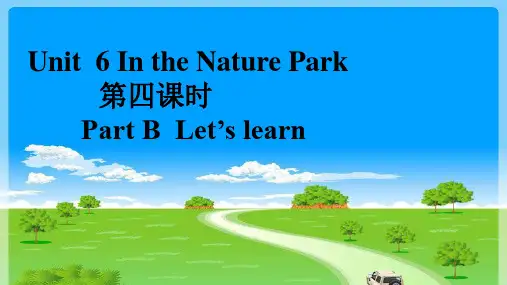
house
building
house
building
house
village
There are many houses in the village.
There are some trees near the vilage.
tree
Are there any bridges on the mountain?
ห้องสมุดไป่ตู้
Yes, there are. There is one.
brigde
village house tree
building
bridge
Picture 1
Picture 2
Are there any ….s in picture one/two. Yes, there are./No, there aren’t.
Unit 6 In the Nature Park 第四课时
Part B Let’s learn
There is a lake in the forest.
What’s on the mountain?
•
9、要学生做的事,教职员躬亲共做; 要学生 学的知 识,教 职员躬 亲共学 ;要学 生守的 规则, 教职员 躬亲共 守。20 21/7/2 62021/ 7/26Monday, July 26, 2021
• 17、儿童是中心,教育的措施便围绕他们而组织起来。2021/7/262021/7/262021/7/262021/7/26
• 2、Our destiny offers not only the cup of despair, but the chalice of opportunity. (Richard Nixon, American President )命运给予我们的不是失望之酒,而是机会之杯。二〇二一年六月十七日2021年6月17日星期四 • 3、Patience is bitter, but its fruit is sweet. (Jean Jacques Rousseau , French thinker)忍耐是痛苦的,但它的果实是甜蜜的。10:516.17.202110:516.17.202110:5110:51:196.17.202110:516.17.2021 • 4、All that you do, do with your might; things done by halves are never done right. ----R.H. Stoddard, American poet做一切事都应尽力而为,半途而废永远不行6.17.20216.17.202110:5110:5110:51:1910:51:19 • 5、You have to believe in yourself. That's the secret of success. ----Charles Chaplin人必须相信自己,这是成功的秘诀。-Thursday, June 17, 2021June 21Thursday, June 17, 20216/17/2021
人教PEP版英语五年级上册Unit 6 Part B
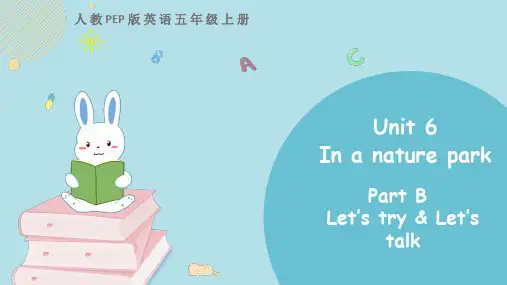
Let’s watch the video. 点击画面 播放视频
Listen and fill in the blanks.
Zhang Peng: The nature park is so __q_ui_e_t_. Miss White: Yes, Zhang Peng. There __ar_e_n_’t_ many people. Zhang Peng: Are there any tall _b_ui_ld_i_ng_s__ in the nature
人 教 PEP 版 英 语 五 年 级 上 册
Unit 6 In a nature park
Part B Let’s try & Let’s
talk
Warm up
Let’s chant
There is a lake in the park. There is a lake in the park. There is a forest near the lake. There is a forest near the lake. There is a river near the lake. There is a river near the lake. There is a fish in the river. There is a fish in the river.
Practice in pairs.
Are there any mountains in the
park?
Sorry, you are not my friend.
No,there aren’t.
Exercises 一、将下列句子改为否定句。
1. There is a clock on the desk. __T_h_e_r_e_is_n_’t_a__c_lo_c_k_o_n_t_h_e_d_e_s_k_. ____________
pep五年级英语上册Unit6 B lets learn-优质课件
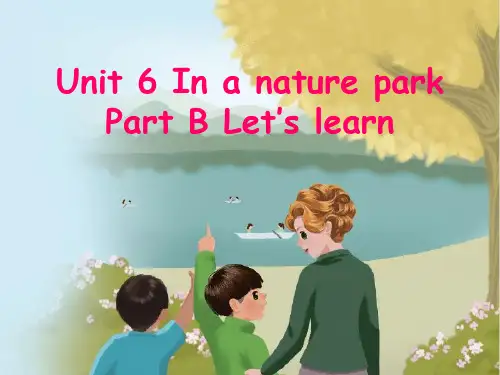
There is a lake in the forest.
What’s on the mountain?
•1、使教育过程成为一种艺术的事业。 •2、教师之为教,不在全盘授予,而在相机诱导。2021/10/222021/10/222021/10/2210/22/2021 8:05:52 AM •3、一年之计,莫如树谷;十年之计,莫如树木;终身之计,莫如树人4、智力教育就是要扩大人的求知范围 •5、教育是一个逐步发现自己无知的过程。 •6、要经常培养开阔的胸襟,要经常培养知识上诚实的习惯,而且要经常学习向自己的思想负责任。2021年10月 2021/10/222021/10/222021/10/2210/22/2021
Are there any houses on the mountain? Yes, there are.
building
Are there any buildings on the mountain? Yes, there are.
house:房子,是我们 居住的那种民宅用的 比较多;
building:建筑物, 泛指各种建筑物, 一般指较大的建 筑.
Yes, there are. There is one.
brigde
village house tree
building
bridge
Picture 1
Picture 2
Are there any ….s in picture one/two. Yes, there are./No, there aren’t.
.
2.bridge(复数)
.
The third egg
人教PEP版五年级英语上册 Unit 6 Part B 第一课时 教学课件完整版
三、选择填空。
1. —Are there ___B__ flowers in the park?
—Yes, there are.
A. a
B. any
C. Some
2. There ___C__ a tree and many flowers near the lake.
A. am
B. are
C. is
Language points
There be句型变一般疑问句的方法
将be动词放句首,some变any,其余照抄。 肯定回答:Yes, there is/are. 否定回答:No, there isn’t/aren’t.
e.g. —Is there a pencil on the desk? —Yes, there is. —Are there any pencils on the desk? —Yes,there are.
Lead in
forest lake
river hill
mountain
Ask and answer
Is there a … in the park?
Let’s try
Where are the tables? Listen and fill in the blank.
The tables are beside the __la_k_e__.
人 教 PEP 版 英 语 五 年 级 上 册
Unit 6 In a nature park
Part B Let’s try & Let’s
There is a lake in the park. There is a lake in the park. There is a forest near the lake. There is a forest near the lake. There is a river near the lake. There is a river near the lake. There is a fish in the river. There is a fish in the river.
【人教pep版】2019年秋小学英语五年级上册:Unit 6 Part B Let's learn 说课稿【精品】.doc
PEP五上Unit 6 B Let’s learn说课稿一、说教学内容今天我说课的内容是PEP BOOK 5 Unit 6 In a nature park.的第四课时,主要学习bridge, house, road, building, tree, village, city七个新词。
并能够运用句型There are / is … in the city / village,描述城市、乡村的景物。
二、说教材本节课是单词教学。
它是在学生初步学习了A部分的单词和句型“There is…之后进行教学的。
通过学习新词,感知句子There are…本课时容量大,但难度不大,并受到学生的喜爱.三、说教学目标《英语课程标准》指出:激发和培养学生学习英语的兴趣,使学生树立自信心,养成良好的学习习惯和形成有效的学习策略,发展学生自主学习的能力和合作精神是小学英语教学的基本任务。
在认真分析教材的基础上,我针对学生实际,将本课时的教学目标及重,难点确定如下:1、能够听、说、读、写单词bridge, house, road, building, tree.2、能够听、说、认读单词city, village3、能够运用句型There are / is … in the city / village,描述城市、乡村的景物。
四、说教学重点1、掌握Let’s learn中的七个有关自然景物的单词bridge, house, road, building, tree, village, city ,其中前五个单词要求听、说、读、写四方面掌握。
2、在情景中理解单词的同时掌握句型There is / are… ,能恰当地用此句型简单描述城市和村庄的景物There are … in the ci ty / village. ,结合句型教师引导学生代换单词,描述周围事物,如:教室、校园等,从而进一步运用句型。
五、说教学难点1、如何利用所提供的情景以旧引新,让学生进入运用语言的状态。
人教版PEP英语五年级上册Unit 6 B Let's talk-课件
Are there any flowers in the nature park?
Yes, there are.
•9、要学生做的事,教职员躬亲共做;要学生学的知识,教职员躬亲共学;要学生守的规则,教职员躬亲共守。2021/7/292021/7/29Thursday, July 29, 2021 •10、阅读一切好书如同和过去最杰出的人谈话。2021/7/292021/7/292021/7/297/29/2021 4:57:04 AM •11、只有让学生不把全部时间都用在学习上,而留下许多自由支配的时间,他才能顺利地学习……(这)是教育过程的逻辑。2021/7/292021/7/292021/7/29Jul-2129-Jul-21 •12、要记住,你不仅是教课的教师,也是学生的教育者,生活的导师和道德的引路人。2021/7/292021/7/292021/7/29Thursday, July 29, 2021
Z: The nature park is so beautiful . M: Yes, Zhang Peng. there are many flowers. Z: Are there any tall _b_u_i_l_d_i_n_g_sin the nature park? M: No, there _a_r_e_n_’_t_. Z: Are there any _a_n__im__a__ls_ ? M: Yes, there are. There are _d_u__c_k_s_ and r_a_b__b_i_t_s.
• You have to believe in yourself. That's the secret of success. 人必须相信自己,这是成功的秘诀。
pep五年级英语上册Unit 6 B Let's talk-优质课件.ppt
。2020年12月14日星期一2020/12/142020/12/142020/12/14
• 15、会当凌绝顶,一览众山小。2020年12月2020/12/142020/12/142020/12/1412/14/2020
• 16、如果一个人不知道他要驶向哪头,那么任何风都不是顺风。2020/12/142020/12/14December 14, 2020
• 14、Thank you very much for taking me with you on that splendid outing to London. It was the first time that I had seen the Tower or any of the other famous sights. If I'd gone alone, I couldn't have seen nearly as much, because I wouldn't have known my way about.
• 9、春去春又回,新桃换旧符。在那桃花盛开的地方,在这醉人芬芳的季节,愿你生活像春天一样阳光,心情像桃花一样美丽,日子像桃子一样甜蜜。 2020/12/142020/12/14Monday, December 14, 2020
• 10、人的志向通常和他们的能力成正比例。2020/12/142020/12/142020/12/1412/14/2020 11:02:54 PM • 11、夫学须志也,才须学也,非学无以广才,非志无以成学。2020/12/142020/12/142020/12/14Dec-2014-Dec-20 • 12、越是无能的人,越喜欢挑剔别人的错儿。2020/12/142020/12/142020/12/14Monday, December 14, 2020 • 13、志不立,天下无可成之事。2020/12/142020/12/142020/12/142020/12/1412/14/2020