
甘肃省镇原县第二中学2020-2021学年高一上学期期中考试英语试卷
2020—2021学年度第一学期期中考试试题高一英语说明: 本试卷分第Ⅰ卷(选择题75分) 和第Ⅱ卷(非选择题45分) 两部分. 满分120分, 考试时间100分钟.第Ⅰ卷第一部分阅读理解(共两节,满分40分)第一节(共15小题,每小题2分,满分30分)阅读下列短文,从每小题所给的四个选项A、B、C、D中,选出一个最佳选项.AIn most parts of the world,many students help their schools make less pollution(污染).They join“environment clubs(环境俱乐部)”. In an environment club,people work together to make our environment clean.Here are some things students often do.No-garbage(垃圾)lunches. How much do you throw away after lunch? Environment clubs ask students to bring their lunches in bags that can be used again. Every week they will choose the classes that make the least garbage and report them to the whole school!No-car day. On a no car day,nobody comes to school in a car—not the students and not the teachers! Cars give pollution to our air,so remember:Walk,jump,bike or run. Use your legs! It' s lots of fun!Turn off the water! Did you know that some toilets can waste20~40 m3 of water an hour? In a year,that would fill a small river! In environment clubs,students mend those broken toilets.We love our environment. Let' s work together to make it clean.1.Environment clubs ask students __________.A.to run to school every dayB.to take exercise every dayC.not to forget to take carsD.not to throw away lunch bags2.From the passage we know the students usually have lunch________.A.at school B.in shops C.in clubs D.at home3.On a no car day,________will take a car to school.A.both students and teachers B.only studentsC.neither students nor teachers D.only teachers4.After students mend toilets,they save________ .A.a small river B.a club C.a lot of water D.a toiletBEarly rising is helpful in more than one way. First, it helps us to have good health. We all need fresh air. It makes our health better to take morning exercises. The air is never so fresh as early in the morning. Early rising helps us in our studies. In the morning we learn more quickly and find it easy to learn something by heart. Early rising makes people able to plan the work for the day. We can' t work well without a good plan. Just as the plan for the year should be made in the spring, the plan for a day should be made in the morning. Early rising gives us enough time to get ready for our work, such as to wash our hands and eat our breakfast. So the popular saying says, “Early to bed and early to rise makes a man healthy, wealthy(富有的) and wise.”5. What does “early rising” mean?It means _______ early in the morning.A. waking upB. getting upC. having breakfastD. making a day' s plan6. Why does the passage advise us to take exercises early in the morning?A. Because we can save much time.B. Because we are not busy in the morning.C. Because air in the morning is very fresh.D. Because we don' t need to prepare for breakfast.7. We can work well with _____.A. enough timeB. a good readingC. clean handsD. a good planCAs parents, if you want to keep your children learning over this summer break, here is an idea. Parents and children can learn a second language together. No need to spend any money or sign up for a class. The Internet and the library are the only essentials(必需品) that are needed.Together parents and children can select a second language that they can learn together. Once a language has been chosen, begin to search the Internet to find out much information about the history of that language and where it comes from. Then go to the library to check out books, videos, and audiotape on learning to speak that language. Together, read the books, watch the videos, and listen to the audiotape, while practicing, speaking and writing the new language to each other.Parents and children can use their new language in the following ways. For example, go to a restaurant where that language is spoken. In addition, have daily conversations in the newly learned second language. By learning and using this language, it builds a bond(联系) between the parents and the children. Moreover, it promotes (促进) learning in a fun way during the summer break.Furthermore, you can click https://translate.google. com, which is a great online resource to use when learning to speak a second language. This is an excellent Google free online translation service that allows people to select their first language and the second language that they are learning and to translate quickly. For example, a person’s primary language is English and the second language tha t he’s learning is French. He can put in words or sentences in English and it will translate them into French quickly. In a word, learning a second language can be fun for all ages.8. Once you have decided to learn a second language, ________.A. you must sign up for a classB. you should buy some related booksC. you can turn to a teacher for helpD. you can visit a library free of charge9. Which of the following can help learn a second language according to the passage?A. Books and cameras.B. Audiotape and play.C. Videos and audiotape.D. Books and phones.10. As parents and kids learn a language together, ________.A. they can possibly become the best language usersB. they can go to different kinds of restaurants togetherC. they can improve their abilities as soon as possibleD. they can get along better with each other than ever11. What’s the main idea of the passage?A. Parents and kids can spend a meaningful vacation.B. Kids are out of school and have a full rest at home.C. Parents mu st focus their attention on kids’ education.D. Kids must learn a second language in their free time.DIt is easier to go down the hill than to climb up the hill, so it is easier to fall into bad habits than into good ones. Bad habits do not come suddenly.They come little by little without one being aware of their danger. School boys first pick up little bad habits in the school and on the street. When they can't write their lessons, they copy from their schoolmates. If they see bigger boys smoking, they also want to learn to smoke. If they see their friends gambling(赌博), they want to gamble. When they get bigger, the habits become stronger and stronger, so that they can no longer get rid of them. From copying, they learn to steal, from gambling, they learn to cheat. At last they become distrusted by everybody. How necessary it is that we get rid of the bad habits in the beginning.12. It is easier to fall into ______ than into ______ .A.good habits,bad onesB.bad habits,good onesC.bad habits,good oneD.good habits,bad one13 .Bad habits come ______.A.suddenlyB.little by littleC.faster and fasterD.slower and slower14. When school boys get bigger, their bad habits become ______ .A.stronger and strongerB.weaker and weakerC.better and betterD.less and less15. It is important for us to ______ .A.copy othersB.learn steal and cheatC.get rid of the bad habits in the beginningugh at others第二节(共5小题,每小题2分,满分10分)根据短文内容,从短文后的选项中选出能填入空白处的最佳选项。
2020-2021学年度高一上学期期中考试英语试卷及答案(含两套题)

2020-2021学年度高一上学期期中考试英语试卷及答案考试时间:120分钟试卷满分:150分第一部分听力(共两节,每小题1.5分,满分30分)该部分分为第一、第二两节。
注意:回答听力部分时,请先将答案标在试卷上。
听力部分结束前,你将有两分钟的时间将你的答案转涂到客观题答题卡上。
第一节(共5小题)听下面5段对话,每段对话后有一个小题,从题中所给的A、B、C三个选项中选出最佳选项,并标在试卷的相应位置。
听完每段对话后,你都有10秒钟的时间来回答有关小题和阅读下一小题。
每段对话仅读一遍。
1. How will the woman go home?A. By car.B. By bus.C. By bike.2. In what case is the park free?A. For a single person.B. For exercise.C. Before 7 o’clock.3. What will the man do today?A. See a movie.B. Go shopping.C. Look after his grandma.4. What time will the library be open on Saturdays?A. 8:00 a.m. to 9:00 p.m.B. 9:00 a.m. to 5:00 p.m.C. Closed.5. Where does the man live now?A. In England.B. In America.C. In India.第二节(共15小题)听下面5段对话。
每段对话后有几个小题,从题中所给的A、B、C三个选项中选出最佳选项,并标在试卷的相应位置。
听每段对话前,你将有时间阅读各个小题,每小题5秒钟;听完后,各小题将给出5秒钟的作答时间。
每段对话读两遍。
听第6段材料,回答第6、7题。
6. What are the speakers mainly talking about?A. School life.B. Different cultures.C. Their teachers.7. Which subject does the woman dislike?A. History.B. English.C. Math.听第7段材料,回答第8、9题。
2020-2021学年度高一上学期期中考试英语试卷及答案(含两套题)
2020-2021学年度高一上学期期中考试英语试卷及答案考试时间:120分钟试卷满分:150分第一部分阅读理解(共两节,满分60分)第一节(共15小题;每小题3分,满分45分)阅读下列短文,从每题所给的A、B、C和D四个选项中,选出最佳选项。
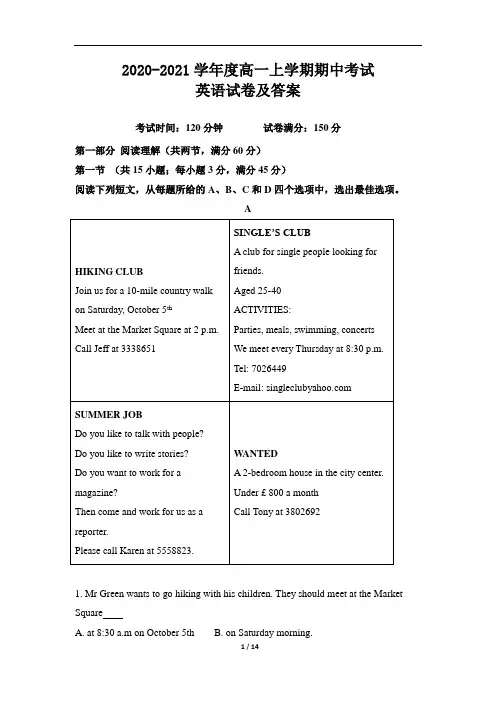
A1. Mr Green wants to go hiking with his children. They should meet at the Market SquareA. at 8:30 a.m on October 5thB. on Saturday morning.C. At 2 p.m on October 5thD. on Sunday morning.2. Who can join the Singles’ Club ?A. A 10-year-old boy.B. A married woman of 25.C. Young parents.D. A 28-year-old single man.3. Alice wants to practice writing stories in her summer holiday. She had betterfor more information.A. make a phone call to KarenB. join the Hiking ClubC. send an e-mail to Singles’ cl ubD. call Tony at 3338651BI got into the teaching profession purely by choice. I was then in 9th grade when my mathematics teacher asked me to take on a class for a few students to whom the subject seemed difficult. And believe me, I enjoyed the entire teaching process. I never knew teaching would be so interesting. I loved my freshmen and was delighted to teach my so-called students who came up with lots of good questions.After my post-graduation, I worked as a software developer with a public sector(部门) in Bangalore for a few years. But I realized that no job could provide me with the satisfaction that I experienced while teaching and training. I always wanted to connect with a wider group of people. In fact, I felt it was a timely realization for me to choose the teaching profession. I applied to a few colleges, and finally I was chosen as a lecturer, and I had to lecture graduate and post-graduate students in a college.On the first day, I was nervous thinking that I had to teach the senior classes. But now I can say that giving lectures was one of the best experiences of my life. I was a Computer Science and Information Technology lecturer, but I tried to help my students with subjects that were not within my domain(范围). It was a new feeling to me every morning before I went to the classes. I used to feel energized and excited thinking that the class would be lit up with bright faces to greet me, “Good morning, Madam.”To me each day was a new beginning, with new feelings, new experiences andnew questions. I loved to explore their young minds and read their inquisitive (询问的) faces when a particular topic seemed hard. It was extremely challenging to motivate them to participate, think critically, question and also respect others’ points of view. Though few things never seemed easy, it was extremely exciting to make them believe that they really can. That is the reason I love to teach.4. From the first paragraph we know that____.A. the author's math teacher was often away from workB. the author became a real teacher in 9th gradeC. the author joined the teaching profession because she had toD. a great many questions were put forward by the author's “students”5. When the author worked as a software developer, she might feel______.A. interestedB. dissatisfiedC. nervousD. proud6. What can we learn about the author?A. She liked the students most who often challenged her to read.B. She was too nervous to speak a word in her first class.C. New feelings, experiences and questions made her feel each day new.D. She was unwilling to solve her students' questions out of her domain.7. What would be the best title for this text?A. Why I Love to TeachB. What My Life Is LikeC. How I Was Chosen as a LecturerD. My First Lesson as a TeacherCMore Americans expect to work past their 65th birthdays and never retire, says a recent study.The Associated Press with the NORC Center for Public Affairs Research surveyed 1,075 people, who were aged 50 and older. One-fourth of them said they never plan to retire. Among low-income earners in that age group this is even more true than for high-income earners.In America, the age of 65 is the traditional age to retire. Sixty percent of people aged 50 to 64 said they expect to work past their 65th birthday. More than half ofthose who are already older than 65 said they plan to keep working, too. They say they are working an average of 31 hours per week.Those 50 years of age or older said finances (财务) are the most important factor in the decision on when to retire. A majority of older workers — especially those who are 65 and older — plan to change their employers, or move into an entirely new profession, as they head into the later years.One-third of people earning less than $50,000 a year said they will keep working. About 20 percent of those who earn more than $100,000 said they will never retire.As baby boomers — people born between 1946 and 1964 — reach age 65, the United States’ general population will have more older people than ever before. The number of Americans 65 and older jumped 21 percent — or to 35.5 million —between 2002 and 2012. That number is expected to reach 92 million by 2060.8. What can we learn from Paragraphs 1&2 ?A. Low-income earners were more willing to continue working.B. High-income earners were not willing to work past 65.C. 1,075 people who were 50 took part in the study.D. Americans were not sure when to retire.9. Which of the following might most probably affect Americans’ retirement age?A. Their decision.B. Working hours.C. The money that they make.D. The traditional age to retire.10. What would happen in the career of most older workers?A. They would be paid less.B. They would change their jobs.C. They would earn more money.D. They would have a talk with employers.11. What is the main idea of this passage?A. America will have more older people.B. Older Americans have to work past 65.C. American people will have new jobs after 65.D. More Americans choose to work for more years.DDon’t be afraid! We are not encouraging people to steal. It’s one of the most popular topics currently talked about by people in cities, together with,“How many vegetables did you steal today?” or, “It’s harvest time for your peaches,” and,“I bought you a new car today.”Listening to a conversation like this, you do not have to feel strange. These people don’t really have their own farms or so much money that they can casually (随意地) buy someone else a car.They are just playing games on Social Networking Sites(SNS) like. Can you imagine millions of people in China spending lots of time on SNS playing games and talking to friends? This is especially true of white-collar workers in cities. Take for example — the number of current members has already hit 38 million.However, the large number of people using SNS highlights another problem. That is, lots of people choose to escape from reality. NSN just offers them a virtual(虚拟的) environment where they can escape from reality.Different games provide netizens with different experiences: dreaming, chatting and playing. It offers people the opportunity to escape from reality. But the virtual world is not the real one; no one can live in it forever, and reality is not as surfing on the Internet.Since this kind of social networking sites have become so popular, people have started to think about moving it into the real world. And as far as we know, a farmland of this kind exists in Shanghai where it has reached its first base.After playing the “Happy Farm” ga me on , would you like to put yourself among the real world while smelling the fragrances (芳香) of the countryside? Recently a farmland service called “Happy Farm in Reality” was opened in the suburbs of Shanghai where white-collar workers can experience the real farmers’ life for themselves.12. What’s the writer’s purpose for the first paragraph?A. To encourage readers to be brave.B. To tell the readers not to steal.C. To tell the readers some shocking news.D. To introduce some game.13. W hat does the underlined word “it” in Paragraph 5 refer to?A. The real world.B. Farmland in Shanghai.C. The virtual world.D. An expensive car.14. Which of the following is NOT true?A. Millions of people in China are spending lots of time on SNS.B. People steal vegetables on SNS for a living.C. Lots of people play games on SNS to escape from reality.D. White-collar workers can have the real farmers’ life.15. You can find the passage in the part of a newspaper.A. politicsB. entertainmentC. economyD. sports第二节(共5小题;每小题3分,满分15分)根据短文内容,从短文后的选项中选出能填入空白处的最佳选项。
甘肃省镇原县第二中学2020-2021学年高二期中考试英语试卷
2020—2021学年度第一学期期中考试试题高二英语第Ⅰ卷第一部分阅读理解(共两节,满分40分)第一节(共15小题;每小题2分,满分30分)阅读下列短文,从每题所给的四个选项(A、B、C和D)中选出最佳选项,并在答题卡上将该项涂黑。
AYou may need to give first aid. First aid is defined as the emergency care given to a sick or injured person. The goals of first aid are to prevent death and to prevent injuries from becoming worse.Each emergency condition is different. However, the following rules apply to any kind of emergency.☆Be aware of your limitations. Do not try to do more than you are able to. Nor should you do things if you are unfamiliar with them. Do what you can under the conditions at the time.☆ Stay calm. Acting calmly will help the victim feel safe.☆ Take a quick look to see if the victim is bleeding, and if there is a pulse.☆ Keep the victim lying down and do not move him or her. You could make an injury worse if you move the victim.☆ Take necessary emergency steps.☆ Call for help or ask someone to make the EMS system(急救系统) start.☆ Do not remove clothing unless you have to. If clothing must be removed, tear theclothes along the seams(线缝).☆Keep the victim warm. Cover the victim with a blanket. Coats and sweaters can be used if a blanket cannot be found.☆ Reassure the victim. Explain what is happening and that help has been called.☆ Do not give the victim any food or fruits.☆Keep the bystanders away from the victim. Bystanders want to have a look, offer advice, and say something about the victim’s condition. The victim may believe that the condition is worse than it really is.1. When a person is badly injured on the road, you should .A. act worriedly and hurriedlyB. do whatever you want to freelyC. not move him or herD. make the injured person stand up2. Which of the following statements is TRUE according to the passage?A. You should help an injured person in any condition.B. Don’t remove the clothing of the injured person whatever happens.C. It is necessary to cover the victim with a blanket.D. If the injured person feels hungry, you should give him or her some food.3. Why should bystanders be kept away from the victim?A. Because bystanders can prevent the victim from receiving first aid.B. Because what they say can make the victim think the condition is very bad.C. Because the victim doesn’t want to accept the advice of bystanders.D. Because the victim hates being surrounded by bystanders.BI was attending a party one night given in Sir Ross’s honor. During the dinner, the man sitting next to me told a humorous story and spoke of the quotation: “There’s a divinity(神) that shapes our ends. Rough-hew them how we will.”The storyteller mentioned that the quotation was from the Bible. He was wrong. I knew that; I knew it positively. There couldn’t be the slightest doubt about it. And so, to get a feeling of importance and show my high quality, I chose myself as an unwelcome person to correct him. He stuck to his guns. “What? From Shakespeare? Impossible! Absurd ! That quotation was from the Bible. ”The storyteller was sitting at my right hand, and Frank Gammond, an old friend of mine, was seated at my left hand. Mr. Gammond had devoted years to the study of Shakespeare, so the storyteller and I agreed to leave the question to Mr. Gammond. Mr. Gammond listened, kicked me under the table, and then said, “Dale, you are wrong. The gentleman is right. It is from the Bible.”On our way home that night, I said to Mr. Gammond, “Frank, you knew that quotation was from Shakespeare.”“Yes, of course,” he replied. “Hamlet, Act V, Scene 2. But we were guests on a festive occasion, my dear Dale. Why prove to a man he is wrong? Is that going to make him like you? Why not let him save his face? He didn’t ask for your opinion. He didn’t want it. Why argue with h im?”The man who said that taught me a lesson I would never forget. I not only had made the storyteller uncomfortable, but had put my friend in an embarrassing situation. How much better it would have been if I hadn’t become argumentative.Nine times out of ten, an argument ends with each of the contestants(竞争者) more firmly convinced than ever that he is absolutely right. You can’t win an argument. You can’t because if you lose it, you lose it; and if you win it, you lose it.4. At the party, the author tried to get a feeling of importance by ___________ .A. telling a humorous storyB. showing off his rich knowledgeC. teaching the storyteller a lessonD. correcting the storyteller’s mistake5. The underlined sentence in Paragraph 2 means that ___________ .A. he realized he was wrongB. he didn’t change his mindC. he felt sorry for what he saidD. he wanted to fight with the author6. What do we learn about Frank Gammond?A. He was very humorous.B. He was very thoughtful.C. He knew much about the Bible.D. He didn’t know much about Shakespeare.7. What does the author learn from his friend Gammond?A. Having an open mind.B. Respecting others opinion.C. Never getting into an argument.D. Avoiding making mistakes in public.CAsk someone what they have done to help the environment recently and they will almost certainly mention recycling. Recycling in the home is very important of course. However, being forced to recycle often means we already have more material than we need. We are dealing with the results of that over-consumption in the greenest way possible, but it would be far better if we did not bring so much material home in the first place.The total amount of packaging increased by 12% between 1999 and 2005. It now makes up a third of a typical household’s waste in the UK. In many supermarkets nowadays food items are packaged twice with plastic and cardboard.Too much packaging is doing serious damage to the environment. The UK, for example, is running out of it for carrying this unnecessary waste. If such packaging is burnt, it gives off greenhouse gases which go on to cause the greenhouse effect. Recycling helps, but the process itself uses energy. The solution is not to produce such items in the first place. Food waste is a serious problem, too. Too many supermarkets encourage customers to buy more than they need. However, a few of them are coming round to the idea that this cannot continue, encouraging customers to reuse their plastic bags, for example.But this is not just about supermarkets. It is about all of us. We have learned to associate packaging with quality. We have learned to think that something unpackaged is of poor quality. Th is is especially true of food. But it also applies to a wide range of consumer products, which often have far more packaging than necessary.There are signs of hope. As more of us recycle, we are beginning to realize just how much unnecessary material we are collecting. We need to face the wastefulness of our consumer culture, but we have a mountain to climb.8. What does the underlined word “over-consumption” refer to?A. Using too much packaging.B. Recycling too much waste.C. Making more products than necessary.D. Having more material than is needed.9. The author uses figures in Paragraph 2 to show .A. the tendency of cutting household wasteB. the increase of packaging recyclingC. the rapid growth of supermarketsD. the fact of packaging overuse10. What can be inferred from Paragraph 4?A. Unpackaged products are of bad quality.B. Supermarkets care more about packaging.C. It is improper to judge quality by packaging.D. Other products are better packaged than food.11. What can we learn from the last paragraph?A. Fighting wastefulness is difficult.B. Needless material is mostly recycled.C. People like collecting recyclable waste.D. The author is proud of his consumer culture.DIt’s 8 a. m., Tuesday, Nov. 18, 2028, and you are head ing for a business appointment 300 miles away. You step into your circle, a two-passenger air-cushion car, press a series of buttons and the national traffic computer notes your destination, figures out the current traffic situation and signals your car to slide out of the garage. Hands free, you sit back and begin to read the morning paper — which is mashed on a flat TV screen over the car’s dashboard. Tapping a button changes the page.The car speeds up to 150 mph in the city’s countryside, and then hits 250 mph in less built-up areas, driving over the smooth plastic road. You fly past a string of cities, many of them covered by the newdomes(圆屋顶) that keep them evenly climatized all year round. Traffic is heavy, typically, but there’s no need to worry. The traffic computer, which sends and receives signals to and from all cars on the road between cities, keeps vehicles at least 50 yds apart. There hasn’t been an accident since the system began.Suddenly your TV phone buzzes. A business partner wants a sketch of a new kind of impeller your firm is producing for sports boats. You reach for your case and draw the diagram with a pencil-thin infrared flashlight(红外线手电筒) on what looks like a TV screen lining the back of the case. The diagram is sent to a similar s creen in your partner’s office, 200 miles way. He presses a button and a fixed copy of the sketch rolls out of the machine. He wishes you good luck at the coming meeting and signs off.Ninety minutes after leaving your home, you slide beneath the dome of your destination city. Your car slows down and heads for an outer-core office building where you’ll meet your colleagues. After you get out, the vehicle parks itself in a garage to await your return. Private cars aren’t allowed inside most city cores. Moving sidewalks and trams(有轨电车) carry the public from one location to another.12. The traffic computer in your car can .A. keep your car at a safe distance from other carsB. keep your car at the same speed in different situationsC. keep your car receiving signals of TV programsD. keep your car driving while avoiding heavy traffic13. Why are the cities covered by the new domes?A. To prevent people from being wet in the rain.B. To stop the climate of the cities changing violently all year.C. To protect the travelers against the strong sunshine.D. To make the city have the same weather all year.14. What will the city be like in the future?A. No accidents will happen because of heavy traffic.B. The sidewalk can move itself up and downC. The road will be built with the plastic material.D. The car can park itself on a dome to wait for your return.15. The passage is most probably taken from .A. a popular science magazineB. a short story collectionC. a research paperD. a personal diary第二节(共5小题;每小题2分,满分10分)根据短文内容,从短文后的选项中选出能填入空白处的最佳选项。
2020-2021学年高一第一学期期中考试英语试卷

2020-2021学年上学期期中测试高一英语试题姓名:___________班级:___________考号:___________一、听力部分(每小题1.5分,共30分)(一)短对话1.What did the woman drop? A.Her wallet. B.Her bag. C.Her passport.2.What makes the coffee taste bad according to the woman?A.The old beans. B.The water. C.The dirty pot.3.What will the speakers do on Thursday?A.Have a day off. B.Go to the museum. C.Play basketball.4.Why does the woman want to invite her parents?A.They like skiing. B.They want to climb mountains. C.They can look after the children.5.How does the man feel about the changing weather? A.Confused. B.Annoyed.C.Excited.(二)长对话听下面一段较长对话,回答以下小题。
6.Where are the speakers? A.At school. B.At a factory. C.At a music store.7.What does the man want the students to learn in the class trip?A.How music is played .B.How concerts are organized. C.How musical instruments are made.8.Where does Emma come from? A.America. B.Japan. C.Britain.9.When did Emma meet Frank? A.In April. B.In July. C.In December.10.What’s the relationship be tween Emma and Frank?A.Co-workers. B.A couple. C.Friends.11.What are the speakers mainly talking about?A.The man’s eating habits.B.Their work schedule. C.The woman’s health problem.12.What does the man think of eating at 2:00 p.m.?A.It makes him healthier. B.It makes him tired. C.It makes him unable to concentrate.13.How many cups of tea does the man drink in the morning?A.About two. B.About four. C.About eight.14.What is the second time the man’s alarm goes off?A.6:00 a.m. B.6:10 a.m.C.6:20 a.m.15.Why does the man like to set his alarm this way?A.He doesn’t want to feel in a rush.B.He is worried about being late.C.He wants to have more time to sleep deeply.16.What does the woman suggest the man do about the alarm at the end?A.Set it for 7:30 a.m. B.Set it for 8:00 a.m. C.Stop using it.(三)短文听下面一段独白,回答以下小题。
2020-2021学年度高一上学期期中考试英语试卷及答案(含五套题)
2020-2021学年度高一上学期期中考试英语试卷及答案考试时间:120分钟试卷满分:150分第一部分阅读理解(共两节,满分40分)第一节(共15小题;每小题2分,满分30分)阅读下列短文,从每题所给的A、B、C和D四个选项中,选出最佳选项。
AWhat’s happening?Your guide to the best place to go in townThe Art of the CameraBeautiful exhibition from some of the best young photographers working today.Stamford Hall, June 20th—30thFreeFilm ClubTonight’s movie at the Young People’s Film Club is the last of the series starring the Oscar-winning actor Johnny Depp. It’s the wonderful pirates of the Carbbean!Starts 6;30 pm. Tickets £3Winning V oicesMore than 20 bands ( 乐队) play their best songs in a competition to win a great prize: a place in the national final and the chance to record a CD.Stretford Student Center, 6 pmTickets £10 and £7.5Streetlife Dance GroupCome and see the amazing “SDG” at the Atlas Centre. Twenty- four dancers aged between 11 and 18 show off their skills in street dancing for you.Starts 7 pm. Tickets£15.Young Vic TheatreThe final per formance of Shakespeare’s Romeo and Juliet is tonight. This is yourlast chance to see this wonderful play. Don’t miss it.Starts 8 pm. Tickets £9, £7 and £5.5021. What can we learn about the Art of the Camera?A. It lasts half a monthB. It shows some old photosC. It is open to the public for freeD.It is held by 24 young artists22. Where can you watch street dancing ?A. At the Atlas CentreB.In Stamford HallC. At Young Vic TheatreD. At Stretford Student Centre23. If John only has £4, what could he do?A. See Romeo and JulietB.Watch Winning V oicesC.Watch Streetlife Dance GroupD. See Pirates of the CaribbeanBA long time ago, there was a farmer who had ten donkeys(驴). One evening, after a long day of hard work, the farmer returned home with the donkeys and began to tie them to the stakes(桩). When he finished nine donkeys, he found that the tenth rope was gone.What now? He could not let the last donkey run around all night. It would surely run away. Suddenly, he saw that, under a tree, there was a monk(和尚). The farmer ran to the monk and asked for voice. The monk said, “The only thing you have to do to the tenth donkey is make the movements(动作) you would have made with a rope in your hands. Pretend (假装) to tie the donkey. That’s all.”The farmer returned to the tenth donkey, pretended to fasten(拴紧) a rope around its neck and then to tie the rope to a stake. He then entered his little house, half trusting the monk’s advice, half worried that his donk ey would run away in the middle of the night.When he went outside very early the next morning, all the donkeys were still standing nicely next to their stakes, even the tenth one. The farmer untied the donkeys and wanted to take them to the field. But to his surprise, donkey number ten refused to move an inch. The farmer pulled and shouted but the animal just didn’t move.Suddenly, the farmer thought of what he had done to the donkey the night before. With a great “ah ha”, he returned to donkey number ten,and just after a simple movement the donkey happily walked with him to the field.24. What was the farmer’s problem when he tied the donkey?A. He needed one more rope.B. The tenth stake was gone.C. The tenth donkey ran away.D. He had left a rope in the field.25. Following the monk’s advice, what did the farmer do?A. He pretended to tie the tenth donkey.B.He went to sleep straight.C. He watched the tenth donkey all night.D. He tied the tenth donkey to the ninth stake.26. What did the farmer find in the next morning?A. All the donkeys were gone.B. The tenth donkey didn’t run away.C. Donkey number ten was running around.D. The donkeys went to the field by themselves.27. What does the underlined part“ a simple movement”refer to?A. Taking away the tenth stake.B. Pretending to untie the donkey.C. Pretending to cut the tenth rope.D. Trying the tenth donkey with a real rope.CFirst Lady Michelle Obama is a big fan of volunteering. V olunteering means working for free to help someone else. Mrs. Obama says volunteering is very important. “It should be part of everyone’s life, ” she says.Many teens agree. They say that helping others feels great and makes a difference. These days, more teens volunteer than work for pay. Teens clean up parks, walk dogs at animal shelters , visit the elderly and more.Some cities ---- including Seatle, Chicago, and Washingtong,D.C. ----require high school students to volunteer. Students must volunteer in order to graduate. Thestudent volunteers learn new skills and help their communities .Many parents are in favor of the idea ---- they say volunteering helps teens build job skills. But most teens don’t want to be forced to volunteer. They say they are busy. And they say voluntee ring is only fun if it’s a choice.Read both sides of the debate and decide.YESV olunteering can help teens get into college or get a job.Many cities and towns need help. V olunteers can help keep important programs going.Not all teens will volunteer if it isn’t required. Schools should repuire students to do all they can to get ready for adult life.NOMost teens are already very busy with classes, homework, jobs and sports. Forcing them to do more isn’t fair.It should be up to each person. Helping out doesn’t feel as good if you have to do it.Finding a volunteer job isn’t always easy. Students shouldn’t be kept from graduating because of something they can’t control.28. The writer mentions Michelle Obama in order to ,A. explain what volunteering isB. show she enjoys volunteeringC. tell what she does for the US D . introduce the topic of the text29. According to the text, in Chicago, .A. more people would rather work for payB. finding a volunteer job is quite easyC. volunteering is a must for high school studentsD. college students have to volunteer before graduation30. The underlined part “are in favor of “in the text means” .A. dropB. developC. likeD.catch31. Which question does the text mainly discuss?A. Is volunteering good for students?B.Which volunteer jobs shouldstudents do?C. What is the best time to volunteer?D. Should students be required to volunteer?DCoffee is an important part of Italian culture and since arriving here over six months ago, I have drunk a lot of it!Of course, coffee is also very popular in the UK but coffee culture in Italy is completely different. In Italy, when you order a coffee in a cafe or bar(酒吧), you are served with a tiny, bitter espresso. This is “normal (正常的) coffee” for Italians and they are not so interested in the huge coffees that we drink in the UK. If you want more than one sip(小口) of coffee in Italy, lungo is a good choice. In addition, while takeaway coffee is quite popular among Brits, it is not very common at all in Italy. Generally, Italians prefer to drink their tiny coffees while standing at the bar and, for many, this short break is an important part of their day.Usually, breakfast in a bar in Italy -includes a coffee and a pastry (酥皮糕点). Cappuccinos are very popular at breakfast time and, for me, a creamy cappuccino and a pastry with chocolate is the perfect way to start the day.Finally, I have found that coffee in Italy, such as espresso or macchiato (an espresso with a drop of milk), is so much cheaper than coffee in the UK. They are small, of course, but this means that in Italy it is possible to go out for coffee every day without breaking the bank.32.How is Paragraph 2 mainly developed?A.By time.B. By space.C. By comparisonD.By example.33.Which coffee will you get in Italy if you order one without special instructions?A. Espresso.B. Lungo.C. Cappuccino.D. Macchiato.34.What can we learn about the coffee culture in Italy?A.Takeaway coffee is very popular among Italians.B.Italians are very often seen drinking huge coffees.C.Few Italians take short breaks from work for coffee.D.Coffees are often served along with pastries during breakfasts.35.What does the author think of Italian coffee?A.She loves its bitter taste.B.It is too expensive for her.C.The cup it is served in is too small.D.It is a good choice for breakfast.第二节(共5小题;每小题2分,满分10分)根据短文内容,从短文后的选项中选出能填入空白处的最佳选项。
2020-2021学年高一上学期期中考试英语试题(含答案)
2020-2021学年度第一学期高一年级期中考试英语试题(含答案)试卷说明:满分150分;考试时间:120分钟;试题难度:0.6-0.7第一部分阅读理解 (共两节,满分50分)第一节阅读阅读下列短文,从每题所给的A、B、C和D四个选项中,选出最佳选项 (共15小题;每小题2.5分,满分37.5分)。
AThese people are studying English. However, they are now facing some problems.I am Pablo. I work 50 hours a week as a taxi driver, so I talk with people all day. They understand me, but I know I make a lot of mistakes. No one corrects me. My vocabulary is strong. Grammar is my problem. I’m trying to change little by little. For example, I don’t use the past tense.I always say, “I drive him to the office this morning” instead of “I drove him to the office this morning”.My name is Maria Luisa. I’m teaching myself English, and I’m good at grammar. However, it’s really difficult to find ways to practice English. I live in an area where everyone speaks my language. My neighbours and friends speak Spanish. I can speak Spanish in the supermarket and at the post office.I am Li Ping. I understand the grammar and the readings in my class and I think my writing is good, but I’m very nervous when I speak English. I don’t want to make any mistakes because I’m afraid people will think that I’m stupid. Also, my pronunciation isn’t good. When I speak, people often say, “What? Say that again. ”I am Yoshi. I have been in the United States for one year. I’m studying hard and I know grammar well, but the vocabulary is very difficult. When I listen, I don’t understand many of the words. When I try to read, there are three or four new words in every sentence. I feel discouraged.1. What would be the best advice for Maria Luisa?A. Try to have a wide vocabulary.B. Make friends with English-speaking people.C. Read as many English books as possible.D. Develop a good knowledge of grammar.2. Why do people find it hard to understand Li Ping’s English?A. Her voice is very low.B. Her grammar is terrible.C. She can’t pronounce words correctly.D. She speaks at a very fast speed.3. What can we learn about Yoshi?A. He has a very small vocabulary.B. He is very good at listening.C. He has learned English for years.D. He was born in the United States.BParents often believe that they have a good relationship with their teenagers. But last summer, Joanna and Henry noticed a change in their older son. Suddenly he seemed to be talking far more to his friends than to his parents. “The door to his room is always shut. ”Joanna noted.Tina and Mark noticed similar changes in their 14-year-old daughter. “She used to sit in my arms on the sofa and talk with me,” said Mark. “Now we joke that she does this only when she wants something. Sometimes she wants to be treated like a little girl and sometimes like a young lady. The problem is figuring out which time is which.”Before age 11, children like to tell their parents what’s on their minds. “In fact, parents are first on the list.” said Michael Riera, author of Uncommon Sense for Parents with Teenagers. “This completely changes during the teen years.” Riera explained. “They talk to their friends first, then maybe their teachers, and their parents last.”Parents who know what’s going on in their teenagers’ lives are in the best position to help them. To break down the wall of silence, parents should create chances to understand what their children want to say, and try to find ways to talk and write to them. And they must give their children a mental (思想的) break, for children also need freedom, though young. Another thing parents should remember is that to be a friend, not a manager, with their children is a better way to know them.4. “The door to his room is always shut. ” suggests that the son ______.A. dislikes to open his doorB. begins to hate his parentsC. is always busy with his studiesD. keeps himself away from his parents5. What troubles Tina and Mark most?A. Their daughter isn’t as lovely as before.B. They can’t read their daughter’s mind exactly.C. They don’t know what to say to their daughter.D. Their daughter talks with them only when she needs money.6. Which of the following best explains “the wall of silence” in the last paragraph?A. Teenagers talk a lot with their friends.B. Teenagers talk little about their own lives.C. Teenagers do not talk much with their parents.D. Teenagers do not want to understand their parents.7. What can we learn from the passage?A. Parents are patient with their silent teenagers.B. Parents should try to understand their teenagers.C. Parents are unhappy with their growing children.D. Parents should have suitable ways to talk with their teenagers.CTwo weeks ago, a 5-year-old girl named Sunshine Oelfke emptied out her piggy bank (存钱罐) onto the living room floor and immediately started counting. Her grandmother, Jackie Oelfke, thought she was playing as she carefully lined up the coins, but then she saw the girl put the coins into a plastic bag and place it in her backpack.“That aroused my curiosity,” Jackie told CBS News. “Nobody messes with the piggy bank.” After observing Sunshine work a few minutes longer, Jackie decided to find out why the little girl broke into her savings.“What are you doing with that money?” Jackie asked her granddaughter.“I’m taking it to school,” Sunshine replied. The little girl finally stated the real reason why she needed the money. “I’m going to take it for milk money. My friend Layla doesn’t get milk—hermom doesn’t have milk money but I have. ”Jackie’s heart melted at Sunshine’s words. Choked with strong feelings, Jackie held her sweet granddaughter tightly in her arms.Last week, Jackie and Sunshine met with her teacher, Rita Hausher, and handed her the $30 that Sunshine had saved. There are 20 kids in Sunshine’s class and about half don’t get milk. It costs﹩0.45 a carton (纸盒). The total adds up to about﹩180 a month for every child in the class to have milk every day.After dropping Sunshine off at school, Jackie posted a tearful video on Facebook to explain her granddaughter’s plan. To her surprise, dozens of people offered to donate towards the cause. Within a week, Jackie raised more than $1, 000. Now every student in Sunshine’s class can get free milk for the rest of the year.Jackie said Sunshine doesn’t see her kind act as a big deal. She was just trying to look out for her friends. “She doesn’t understand the effect she’s brought about,” Jackie said. “But now she knows she can do whatever she puts her mind to. ”8. Why did Sunshine empty her piggy bank?A. She wanted to play with the coins.B. She needed to train her counting skills.C. She intended to pay for her friend’s milk.D. She hoped to show off her savings in class.9. How did Jackie feel on hearing Sunshine’s words?A. Touched.B. Curious.C. Proud.D. Relieved.10. In Jackie’s eyes, what did Sunshine learn from the experience?A. Many hands make light work.B. Two heads are better than one.C. A friend in need is a friend indeed.D. Nothing is impossible to a willing heart.11. What is the best title for this passage?A. Small Coins, Big DeedsB. Jackie’s Piggy BankC. A Moved GrandmotherD. Piggy Bank and Carton MilkDSmartphones, tablets and smart watches are banned at school for all children under 15 in France. Under the ban students are not able to use their phones at all during school hours, including meal breaks.“I think it's a good thing. School is not about being on your phone,” Paris mum MarieCaroline Madeleine told AFP. “It's hard with kids. You can't control what they see and that's one of the things that worries me as a parent.”There is no law like this in Australia, but some Australian schools have banned phones.McKinnon Secondary School in Victoria introduced a total ban in February and Principal Pitsa Binnion said this had been a success.McKinnon students still have a Chromebook to use in every class for daytoday learning but they're not allowed to use social media. Ms Binnion said at first “Teachers cheered and students moaned (抱怨),” but now they're seeing the positives.“They come to school and they're not allowed to use phones at all during the school day, including lunch breaks,” she said.“It's been wonderful in terms of students communicating with each other at lunchtime and not looking at their screens,” she said.Ms Binnion also leads by example and doesn't use her mobile phone in school.“I think anyone can do it if we've done it.”Not everyone agrees with the bans. Western Sydney University technology researcher DrJoanne Orlando wrote in online magazine The Conversation earlier this year that Australia should not ban phones in schools because it's important to educate kids to live in the age they are raised in.“A good education for students today is knowing how to use technology to learn, communicate and work with ideas,” she wrote. “Banning students from using smartphones is a 1950s response (反应) to a 2018 stateofplay.”12.Why did Madeleine welcome the ban?A.School is for studying. B.Kids behave badly nowadays. C.Teachers find it hard to control kids. D.Her kids depend too much on phones. 13.What can we learn about the ban in McKinnon Secondary School?A.Some teachers were against it at first.B.Students can now see the good of the ban.C.Students can use their phones at lunch breaks.D.Teachers have stopped using phones at school as well.14.What does the underlined word “Chromebook” in Paragraph 5 probably refer to?A.A book.B.A notebook. C.A learning website.D.A kind of computer. 15.What does Dr Joanne Orlando think of banning phones in schools?A.It will disconnect parents and kids.B.It will cause kids to communicate less.C.It will prevent kids being techminded.D.It will make education go back 60 years.第二节七选五根据短文内容,从短文后的选项中选出能填入空白处的最佳选项。
2020-2021学年度高一上学期期中考试英语试卷及答案
2020-2021学年度高一上学期期中考试英语试卷及答案考试时间:120分钟试卷满分:120分第一卷(共85分)第一部分听力(共20小题,每题1分,满分20分)第一节听下面5段对话。
每段对话后有一个小题,从题中所给的A、B、C三个选项中选出最佳选项。
听完每段对话后,你都有10秒钟的时间来回答有关小题和阅读下一小题。
每段对话仅读一遍。
1. What color book does the man want?A. The red one.B. The blue one.C. The black one.2. What did the woman do on her vacation?A. She went for a bike ride.B. She relaxed on the beach.C. She cooked a fancy dinner.3. When does the man have breakfast on weekends?A. At about 9:00.B. At about 10:00.C. At about 11:00.4. What will Lisa do after school?A. Go home directly.B. Come to Tim’s house.C. Stay late to do homework.5. What does the woman say about her house?A. It’s next to a bar.B. It’s in the city center.C. It’s not comfortable inside.第二节听下面5段对话或独白。
每段对话或独白后有几个小题,从题中所给的A、B、C三个选项中选出最佳选项。
听每段对话或独白前,你将有时间阅读各个小题,每小题5秒钟;听完后,各小题将给出5秒钟的作答时间。
每段对话或独白读两遍。
甘肃省镇原县二中2020-2021学年高一英语上学期第一次月考试题
甘肃省镇原县二中20212021学年高一英语上学期第一次月考试题高一(英语)第I卷(选择题共85分)1.本试卷分第Ⅰ卷(选择题)和第Ⅱ卷(非选择题),满分120分。
第一部分:语言知识运用(共两节,满分45分)。
第一节:单项填空(共15小题;每小题1分,满分15分)从A、 B、 C、 D 四个选项中,选出能够填入空白处的最佳选项。
1._______ is no use pulling a long face. No one can help the fact that it is raining.A. OneB. ThisC. ThatD. It2. Follow your doctor’s advice, ______ your cough will get worse.A. andB. orC. thenD. so3.My car is broken. I had to pay out $200 to get it________.A. repairB. repairingC. repairedD. to repair4. It took a long time for him to______ from a bad cold.A. disagreeB. recoverC. concernD. calm5.On his way home from Beijing he told me he _______here again.A. had visitedB. has visitedC. would visitD. will visit6.---- Would you like to have a drink with us?----________.A. You’re right.B. Yes, I’ll take it.C. You’re welcome.D. Yes, I’d love to.7.It is the third time he_______ with her in a week.A. has quarreledB. quarreledC. had quarreledD. quarreling8._______ get more land, the farmers tried many ways to fill the lake.A. So as toB. So thatC. In order toD. In order that9. We study several subjects,_______ Chinese, maths, English and so on.A. such asB. for exampleC. such thatD. beyond example10.Students should______ everything important that their teachers give in class.A. set upB. set outC. set asideD. set down11. Jay is invited to play____ part in a party held in Shanghai and he will go thereby____ air.A. the ; theB. the; 不填C. a; 不填D. a; the12.Because Jim doesn’t eat on time, he often_______ stomachache.A. recovers fromB. suffers fromC. goes throughD. looks through13.He looks honest, but________ he lies all the time.A. finallyB. entirelyC. actuallyD. gradually14.Being the only boy wearing a red coat that day, Jack_____ very easily.A. is realizedB. is recognizedC. was realizedD. was recognized15.The teacher asked Lily______.A. whose bag it isB. whose bag it wasC. whose bag is itD. whose bag was it第二节完型填空(共20小题;每小题1.5分,满分30分)Many people go to school for an education. They learn languages, history, geography, physics, chemistry and mathematics. 16 go to school to learn a 17 so that they can make a 18 . School education is very important and 19 , yetno one can learn everything from 20 . A teacher, no matter 21 he knows, cannot teach his students 22 they want to know. The teach er’s job is 23 his students how to learn. He teaches them how to learn. He teaches them how to read and how to think. So, much more is 24 outside school by the students themselves.It is always 25 important to know how to study by oneself than to memorize some facts or a formula (公式). 26 is quite easy to learn a certain fact in history or a formula in 27 . But it is very difficult to use a formula 28 a maths problem. Great scientists, such as Einstein, Newton and Galileo 29 everything from school. But they 30 successful. They invented 31 things for mankind. The reason for their success is 32 they know how to study. They read books that 33 at school. They worked hard all their 34 , wasting not a single moment. They would ask many questions as they read and they did thousands of experiments.35 , they knew how to use their brains.16. A. the other B. Another C. Others D. Other17. A. skill B. method C. way D. technical18. A. house B. money C. friends D. living19. A. useful B. useless C. no use D. usual20. A. university B. college C. school D. classes21. A. how B. how much C. what D. how many22. A. all thing B. whole thing C. anything D. everything23. A. shows B. shown C. show D. to show24. A. to be learned B. to learn C. learned D. learning25. A. most B. more C. the most D. the more26. A. This B. That C. It D. What27. A. Chinese B. English C. politics D. mathematics28. A. to work out B. in working out C. to make out D. in making out29. A. did get B. didn’t get C. had got D. have got30. A. all were so B. all so were C. so much D. so many31. A. such more B. such many C. so much D. so many32. A. what B. that C. which D. whether33. A. were not taught B. were always taughtC. are never teachingD. are always teaching34. A. live B. life C. lifes D. lives35. A. Above all B. After all C. First of all D. All at once 第二部分:阅读明白得(语篇能力,共20 题,36—55题,每题2分)阅读下列短文,从每题所给的A、B、C、D四个选项中,选出最佳选项。
2020-2021学年度高一上学期期中考试英语试卷及答案(含三套题)
2020-2021学年度高一上学期期中考试英语试卷及答案考试时间:120分钟试卷满分:150分第一部分阅读理解(共两节,满分40分)第一节(共15小题;每小题2分,满分30分)阅读下列短文,从每题所给的A、B、C和D四个选项中,选出最佳选项。
AWhat’s happening?Your guide to the best place to go in townThe Art of the CameraBeautiful exhibition from some of the best young photographers working today.Stamford Hall, June 20th—30thFreeFilm ClubTonight’s movie at the Young People’s Film Club is the last of the series starring the Oscar-winning actor Johnny Depp. It’s the wonderful pirates of the Carbbean!Starts 6;30 pm. Tickets £3Winning V oicesMore than 20 bands ( 乐队) play their best songs in a competition to win a great prize: a place in the national final and the chance to record a CD.Stretford Student Center, 6 pmTickets £10 and £7.5Streetlife Dance GroupCome and see the amazing “SDG” at the Atlas Centre. Twenty- four dancers aged between 11 and 18 show off their skills in street dancing for you.Starts 7 pm. Tickets£15.Young Vic TheatreThe final per formance of Shakespeare’s Romeo and Juliet is tonight. This is yourlast chance to see this wonderful play. Don’t miss it.Starts 8 pm. Tickets £9, £7 and £5.5021. What can we learn about the Art of the Camera?A. It lasts half a monthB. It shows some old photosC. It is open to the public for freeD.It is held by 24 young artists22. Where can you watch street dancing ?A. At the Atlas CentreB.In Stamford HallC. At Young Vic TheatreD. At Stretford Student Centre23. If John only has £4, what could he do?A. See Romeo and JulietB.Watch Winning V oicesC.Watch Streetlife Dance GroupD. See Pirates of the CaribbeanBA long time ago, there was a farmer who had ten donkeys(驴). One evening, after a long day of hard work, the farmer returned home with the donkeys and began to tie them to the stakes(桩). When he finished nine donkeys, he found that the tenth rope was gone.What now? He could not let the last donkey run around all night. It would surely run away. Suddenly, he saw that, under a tree, there was a monk(和尚). The farmer ran to the monk and asked for voice. The monk said, “The only thing you have to do to the tenth donkey is make the movements(动作) you would have made with a rope in your hands. Pretend (假装) to tie the donkey. That’s all.”The farmer returned to the tenth donkey, pretended to fasten(拴紧) a rope around its neck and then to tie the rope to a stake. He then entered his little house, half trusting the monk’s advice, half worried that his donk ey would run away in the middle of the night.When he went outside very early the next morning, all the donkeys were still standing nicely next to their stakes, even the tenth one. The farmer untied the donkeys and wanted to take them to the field. But to his surprise, donkey number ten refused to move an inch. The farmer pulled and shouted but the animal just didn’t move.Suddenly, the farmer thought of what he had done to the donkey the night before. With a great “ah ha”, he returned to donkey number ten,and just after a simple movement the donkey happily walked with him to the field.24. What was the farmer’s problem when he tied the donkey?A. He needed one more rope.B. The tenth stake was gone.C. The tenth donkey ran away.D. He had left a rope in the field.25. Following the monk’s advice, what did the farmer do?A. He pretended to tie the tenth donkey.B.He went to sleep straight.C. He watched the tenth donkey all night.D. He tied the tenth donkey to the ninth stake.26. What did the farmer find in the next morning?A. All the donkeys were gone.B. The tenth donkey didn’t run away.C. Donkey number ten was running around.D. The donkeys went to the field by themselves.27. What does the underlined part“ a simple movement”refer to?A. Taking away the tenth stake.B. Pretending to untie the donkey.C. Pretending to cut the tenth rope.D. Trying the tenth donkey with a real rope.CFirst Lady Michelle Obama is a big fan of volunteering. V olunteering means working for free to help someone else. Mrs. Obama says volunteering is very important. “It should be part of everyone’s life, ” she says.Many teens agree. They say that helping others feels great and makes a difference. These days, more teens volunteer than work for pay. Teens clean up parks, walk dogs at animal shelters , visit the elderly and more.Some cities ---- including Seatle, Chicago, and Washingtong,D.C. ----require high school students to volunteer. Students must volunteer in order to graduate. Thestudent volunteers learn new skills and help their communities .Many parents are in favor of the idea ---- they say volunteering helps teens build job skills. But most teens don’t want to be forced to volunteer. They say they are busy. And they say voluntee ring is only fun if it’s a choice.Read both sides of the debate and decide.YESV olunteering can help teens get into college or get a job.Many cities and towns need help. V olunteers can help keep important programs going.Not all teens will volunteer if it isn’t required. Schools should repuire students to do all they can to get ready for adult life.NOMost teens are already very busy with classes, homework, jobs and sports. Forcing them to do more isn’t fair.It should be up to each person. Helping out doesn’t feel as good if you have to do it.Finding a volunteer job isn’t always easy. Students shouldn’t be kept from graduating because of something they can’t control.28. The writer mentions Michelle Obama in order to ,A. explain what volunteering isB. show she enjoys volunteeringC. tell what she does for the US D . introduce the topic of the text29. According to the text, in Chicago, .A. more people would rather work for payB. finding a volunteer job is quite easyC. volunteering is a must for high school studentsD. college students have to volunteer before graduation30. The underlined part “are in favor of “in the text means” .A. dropB. developC. likeD.catch31. Which question does the text mainly discuss?A. Is volunteering good for students?B.Which volunteer jobs shouldstudents do?C. What is the best time to volunteer?D. Should students be required to volunteer?DCoffee is an important part of Italian culture and since arriving here over six months ago, I have drunk a lot of it!Of course, coffee is also very popular in the UK but coffee culture in Italy is completely different. In Italy, when you order a coffee in a cafe or bar(酒吧), you are served with a tiny, bitter espresso. This is “normal (正常的) coffee” for Italians and they are not so interested in the huge coffees that we drink in the UK. If you want more than one sip(小口) of coffee in Italy, lungo is a good choice. In addition, while takeaway coffee is quite popular among Brits, it is not very common at all in Italy. Generally, Italians prefer to drink their tiny coffees while standing at the bar and, for many, this short break is an important part of their day.Usually, breakfast in a bar in Italy -includes a coffee and a pastry (酥皮糕点). Cappuccinos are very popular at breakfast time and, for me, a creamy cappuccino and a pastry with chocolate is the perfect way to start the day.Finally, I have found that coffee in Italy, such as espresso or macchiato (an espresso with a drop of milk), is so much cheaper than coffee in the UK. They are small, of course, but this means that in Italy it is possible to go out for coffee every day without breaking the bank.32.How is Paragraph 2 mainly developed?A.By time.B. By space.C. By comparisonD.By example.33.Which coffee will you get in Italy if you order one without special instructions?A. Espresso.B. Lungo.C. Cappuccino.D. Macchiato.34.What can we learn about the coffee culture in Italy?A.Takeaway coffee is very popular among Italians.B.Italians are very often seen drinking huge coffees.C.Few Italians take short breaks from work for coffee.D.Coffees are often served along with pastries during breakfasts.35.What does the author think of Italian coffee?A.She loves its bitter taste.B.It is too expensive for her.C.The cup it is served in is too small.D.It is a good choice for breakfast.第二节(共5小题;每小题2分,满分10分)根据短文内容,从短文后的选项中选出能填入空白处的最佳选项。
甘肃省镇原县二中2020学年高一英语上学期期末考试试题
2020学年度第一学期期末考试试题高一(英语)(满分:120分时间:100分钟)第一部分阅读理解(共两节,满分40分)第一节(共15小题;每小题2分,满分30分)阅读下列短文,从每题所给的四个选项(A、B、C和D)中,选出最佳选项A1. This passage is most probably taken from the writer's________.A. researchB. diaryC. novelD. school paper2. What does the underlined word "haste" in the passage mean?A. ExcitementB. HopeC. HurryD. Disappointment3. According to the passage, why could the writer and her friends stay out as long as they wanted?A. Because they were leaving the next day.B. Because they had nothing to do at home.C. Because the stores were open until midnight.D. Because it didn't get dark until about 11:00 pm.BA student is learning to speak British English. He wonders: Can I communicate with Americans? Can they understand me? Learners of English oftenask: What are the differences between British and American English? How important are these differences?Certainly, there are some differences between British and American English. There are a few differences in grammar. For example, speakers of British English say “in hospital” and "Have you a pen?” , Americans say “in the hospital” and ‘Do you have a pen?’. Pronunciation is sometimes different. Americans usually sound theirs in words like “bird” and “hurt”. Speakers of British English do not sound theirs in these words. There are differences between British and American English in spelling and vocabulary. For example, “colour” and “honour” are British, “color” and “honor” are American. These differences in grammar, pronunciation, spelling and vocabulary are not important, however. For the most part, British and American English are the same language.4. According to this passage, a student who is learning to speak American English might be afraid that __________ .A. British people cannot understand himB. American people cannot understand himC. the grammar is too hard for himD. the spelling is too hard for him5.American English and British English are different in .A. spellingB. pronunciationC. grammarD. all of the above6. Most______________ say “Do you have a watch?”A. British peopleB. AmericansC. childrenD. teachers7. According to this passage, British people and Americans have _______difficulty in understanding each other.A. littleB. muchC. someD. greatCWhen we were very small, we realized that having friends was important. Some of us even had imaginary(想象中的)friends. The need for friends continued as we grew into our teens. Friends played a big part in forming our personalities(性格). As adults, it is still important for us to have friends.True friends are people who like us though we made mistakes and who listen to us and tell us the truth. Friends support our decisions and tell us when we’re foolish. They laugh with us and share our sadness. They are our partners and share interests with us. They stimulate us when we are feeling down. They are people we aren’t afraid of telling our secret wishes to or what is really on our minds.Friends are our supporters. When you can depend on friends, you feel safe and warm. Friends offer acceptance and emotional(情感的)support. At times, they also help with our everyday lives, cooking a meal, doing chores, or giving us a lift when we need one. Friends also are there to offer advice, an ear to listen, or a shoulder to cry on.Friends also help us reduce stress. Not only do they listen to us when we feel stressed, but they also discuss what is stressing us. Sharing interests and doing activities with friends help us forget about problems at work or at home. For a short time, we can lose ourselves in a pleasant activity and perhaps laugh and breathe more easily.8. What is the best title for the passage?A. How to Reduce StressB. How to Make New FriendsC. The Importance of FriendsD. The Qualities of Good Friends9. The underlined word “stimulate” in Paragraph 2 probablymeans________.A. educateB. encourageC. surpriseD. dislike10. We can learn from the third paragraph that friends always________.A. laugh at us when we’re foolishB. tell us other people’s secretsC. share our sadness and interestsD. support us when we need help11. We can learn from the passage that________.A. people should make friends anytimeB. friends are people who allow you to cryC. a friend helps you in many waysD. good friends are always difficult to meetDAs you grow rapidly through your teenage years, you will experience a lot of changes. The changes may seem difficult and they may seem to happen quickly. Don’t panic! You will deal successfully with them! You are a young adult now!With more responsibility, you will find more freedom to make your own choices. This is a time to be well informed about your choices so that you can make healthy balanced decisions that will help shape your future. You may already know your career path or you may have no idea at all what you want to do. Both situations are fine! Work hard and the right opportunity will present itself to you.Young adulthood means greater freedom and more choices. You will probably want to be independent. But try not to shut your family out of your life. You should learn to think of others even though you are old enough to look after yourself. Your family have been with you since you came into this world. It is also perfectly natural in this time for you to spend more time withyour friends than your family. Choose your friends wisely. A true friend will stand by you no matter what happens. This period is part of the life cycle. There are some people who will be with you throughout life’s journey and there will be some people with whom you part and go separate ways. Leaving school can be hard. The reality is that you may not ever see all of your classmates again.You are a young adult. It is your life. No one can live it for you. The choices that you make from now on will be your choices. So making the right choices will be important to you. Life is for living. Enjoy your life wisely!12. The best title for this passage would be_____.A. The Choices in LifeB. The Key to SuccessC. Say Goodbye to the PastD. Becoming a Young Adult13. Who do the underlined words “some people” (Para4 )probably mean?A. your parentsB. your classmatesC. true friendsD. your relatives14.As far as the author is concerned, teenage years are_____.A. a period of complete freedomB. too hard for young people to get throughC. an important time for the young to make the right choicesD. a very important period for young students to leave their parents15. Who is the passage mainly intended for?A. Teenagers.B. Teachers.C. Young parentsD. Adults. 第二节(共5小题;每小题2分,满分10分)根据短文内容,从短文后的选项中选出能填入空白处的最佳选项。