
2020版高考英语一轮复习第1部分Module2TrafficJam教学案(含解析)外研版必修4
Module 2 Traffic Jam[单词拼写应用]核心单词1.display vt.展示;陈列2.receipt n.收据3.fare n.车费4.destination n.目的地;终点5.provide vt.提供6.blow vt.吹响(乐器,号角等)[语境运用] 用所给词的适当形式填空。
1.The website provides(provide) students with free information about how to choose a good college.2.It is said that train fares(fare) are going to be increased again.3.It's the first time that the painting has been displayed(display) to the public. 4.The box-office receipts(receipt) don't live up to the manager's expectations. 5.He blew(blow) out all the candles on his birthday cake at one go.拓展单词1.permit n.执照;许可证→permission n.允许2.limit vt.&n.限制→limited adj.有限的→unlimited adj.无限的3.impress vt.给……留下印象→impression n.印象→impressive adj.给人印象深刻的4.convenient adj.方便的→convenience n.方便;便利5.explore vt.探索→explorer n.探索者→exploration n.探索6.react vi.反应→reaction n.反应7.solve v.解决→solution n.解答;答案8.mood n.心情;心境→moody adj.喜怒无常的9.register vi.登记;记录→registration n.执照;登记[语境运用] 用所给词的适当形式填空。
1.He doesn't get a driving permit.That's to say, he doesn't get any permission of driving.(permit)2.The natural resources we have are limited.Therefore we have no reason to waste the precious resources without limit.(limit)3.When asked about his impression of Beijing, he said that he was deeply impressed by its unique human landscape, and that the Palace Museum was the most impressive architecture he'd ever seen. (impress)4.Most of us like the convenience of using credit cards to buy things as it is convenient to carry.(convenient)5.As an explorer,he dreams of exploring the outer space one day.(explore) 6.How did he react to the teacher's words? I don't know his reaction.(react) 7.Bob is moody,so I'm in no mood to talk with him about the business.(mood)阅读单词1.trolleybus n.电车2.wire n.电线3.cab n.出租汽车;计程车4.route n.路线5.single n.单程票6.return n.往返票拓展联想1.“(不)许可”单词大观园①permit v.允许②allow v.允许③forbid v.禁止④ban v.& n.禁止⑤prohibit v.禁止2.“费用”名词大全①fare 车费②expense 花费③charge 费用;价钱④fee 费用;酬金⑤tip 小费3.“提供”动词一览①provide 提供②offer 主动提供③supply 供应④equip 配备,供应⑤furnish 供应[短语多维运用]高频短语1.be connected to 与……相连2.in no time 马上;一会儿;立刻3.get around 到处旅行;四处走动4.under construction 正在建设之中5.switch off 关上(电灯、电视等);断掉(电源)6.in a good mood 情绪、心情好[语境运用] 选用上面短语的适当形式填空。
A new main road,through which our village will ①be connected to the city,is ②under construction now.It will be completed ③in no time.When it is finished,it will be convenient for us to go to the city to ④get around.Whenever we think of it,we are ⑤in a good mood and wear sweet smiles.7.be/get stuck in 被困在……8.have a good view of 清楚地看到9.keep cool 保持冷静10.what's more 而且;此外11.drive sb.mad 使某人发疯12.no way (俚语)肯定不;没门儿[语境运用] 选用上面短语的适当形式填空。
Living in tall building,we can ⑥have a good view of the city.But sometimes we may ⑦be stuck in the lift,which can ⑧drive us mad.If we are meeting with this situation,the most important is to ⑨keep cool.⑩What's more,we should ask for help through our mobile phones.We should have a belief that help will come soon.拓展联想1.“立刻,即刻”短语小聚①in no time②at once③right now/away④in a flash⑤in an instant2.“no+n.”短语大观园①no way没门②no problem 没问题③no hurry 别慌 ④no doubt 毫无疑问 ⑤no wonder 难怪3.由“what's more”想到的 ①what's worse 更糟的是②to make matters worse 更糟的是 ③worse still 更糟的是 ④on the other (hand) 另一方面 ⑤in addition 而且;此外[句式 结构仿写]精讲4个考纲单词1.permit n .执照;许可证 v .许可;允许;准许 (1)单句语法填空①The visitors are reminded that the museum doesn't permit smoking (smoke). ②Passengers are permitted to carry (carry) only one piece of hand luggage onto the plane.③No reference books are to be taken out of the reading room without permission (permit).(2)[链接写作]——句式升级普通表达:If time permits ,I expect to have more spare time to spend with my friends so that we can have a better relationship.高级表达:Time permitting ,I expect to have more spare time to spend with my friends so that we can have a better relationship.(独立主格)先理解再牢记(1)permit doing sth. 允许做某事 permit sb.to do sth.允许某人做某事 (2)⎭⎪⎬⎪⎫weather/time permitting if weather/time permits 天气/时间允许的话 (3)permission n .允许;许可 ask for permission 请求许可 without permission 未经许可[名师点津] permit 既可以用于permit doing sth.,也可用于permit sb.to do sth.。
有相同用法的动词还有:advise ,allow ,forbid 等。
2.limit vt.限制 n .限制;范围;界限 (1)单句语法填空①Life is limited,but there is no limit to serving (serve) the people. ②In my opinion,keeping dogs shouldn't be banned ,but should be within the limit of certain areas.(2)[链接写作]——词汇升级普通表达:In my opinion ,you'd better limit the expense of your trip. 高级表达:In my opinion ,you had better set a limit to the expense of your trip.(limit to)先理解再牢记(1)limit...to... 把……限制到…… be limited to 局限于……(2)set a limit to sth. 对……规定限度 within the limits of 在……范围内 beyond the limit 超过限度3.provide vt.提供;规定;准备;供应 (1)单句语法填空①The hospital has a commitment to provide the best possible medical care for the patients.②You can use the room provided/providing (provide) that you keep it clean and tidy.(2)[链接写作]——完成句子/句式升级①我认为,兼职工作可以给大学生提供一个宝贵的机会去更多地了解外面的世界。
高中英语Module 2 Traffic Jam优秀教案
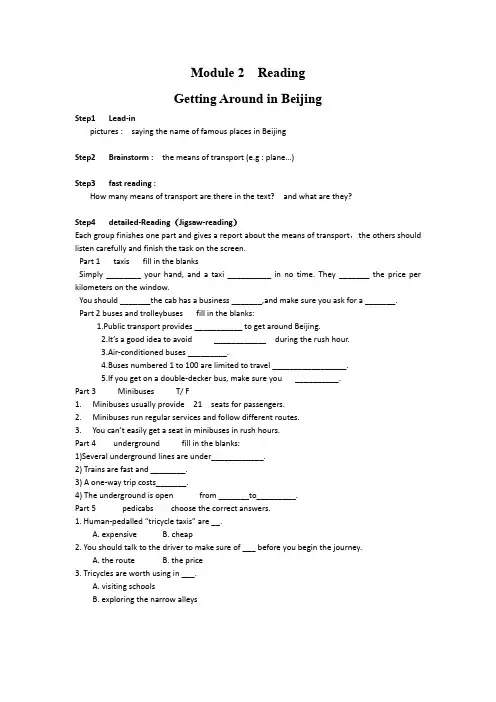
Module 2 ReadingGetting Around in BeijingStep1 Lead-inpictures : saying the name of famous places in BeijingStep2 Brainstorm :the means of transport (e.g : plane…)Step3 fast reading :How many means of transport are there in the text? and what are they?Step4 detailed-Reading(Jigsaw-reading)Each group finishes one part and gives a report about the means of transport,the others should listen carefully and finish the task on the screen.Part 1 taxis fill in the blanksSimply ________ your hand, and a taxi __________ in no time. They _______ the price per kilometers on the window.You should _______the cab has a business _______,and make sure you ask for a _______.Part 2 buses and trolleybuses fill in the blanks:1.Public transport provides ___________ to get around Beijing.2.It’s a good idea to avoid ____________ during the rush hour.3.Air-conditioned buses _________.4.Buses numbered 1 to 100 are limited to travel _________________.5.If you get on a double-decker bus, make sure you __________.Part 3 Minibuses T/ F1.Minibuses usually provide 21 seats for passengers.2.Minibuses run regular services and follow different routes.3.You can’t easily get a seat in minibuses in rush hours.Part 4 underground fill in the blanks:1)Several underground lines are under____________.2) Trains are fast and ________.3) A one-way trip costs_______.4) The underground is open from _______to_________.Part 5 pedicabs choose the correct answers.1. Human-pedalled “tricycle taxis” are __.A. expensiveB. cheap2. You should talk to the driver to make sure of ___ before you begin the journey.A. the routeB. the price3. Tricycles are worth using in ___.A. visiting schoolsB. exploring the narrow alleysStep 5 Play a game(question or surprise)1. How easy is it to find a taxi in Beijing ?2. What colour are most taxis ?3. What’s the problem with buses ?4. Which is the best bus for tourist ?5. How many people can get in a minibus ?6. What are the advantages of the underground ?7. When does it close at night ?8. What can you visit in a pedicab?Step 6 show timeMake a dialogueExample:Tourist :I want to travel around in Beijing. I am at Tian’an men Square now. I want to go to The Great Wall / Forbidden City / an Alley near Summer Palace / a supermarket in Chang’an Street. But, which means of transport can I take?Taxi: I am a taxi. Choose me! I can help you. Because …Bus: I am… Choose me! I can help you. Because …Minibus: I am… Choose me! I can help you. Because …Underground: I am… Choose me! I can help you. Because …Pedicab/tricycle: I am… Choose me!I can help you. Because …Tourist: Be quiet! Each coin has two sides ,so you also have disadvantages….I want to go to a supper market in Chang’an Street, It’s near the Tian’an men Square, I think I can choose…Step7 Homework(Writing practice)假如你是李华,你的英国朋友Peter写信告诉你,他这个寒假将来北京旅游,向你咨询北京的景点及交通状况,请给Peter写一封回信,提出自己的建议。
高中英语_一轮复习Traffic Jam 教学设计学情分析教材分析课后反思

教学设计T: Have you ever heard this news?S: Yes.T: Because the old bridge on Tuhai River is under repair now, so a lot of cars are crowded on the new bridge, causing traffic jams in rush hours. But I think the traffic problems in Zhanhua is much better than that of some big cities, such as Beijing, Shanghai. Do you think so?学情分析1. 知识基础:在复习本模块的知识之前,学生通过对前三册的复习,已经掌握了大部分的词汇、短语及基本用法,为本节课的学习打下了坚实的基础。
2.生活经验准备:对于本模块堵车这一话题,在日常生活中是时有发生的事,也是常见的事,所以对于学生来说这一话题的复习并不陌生。
3. 方法基础:学校长期以来培养学生以小组合作,自主学习这种学习方式来进行英语学习,通过一个学期的学习,学生已经基本适应了这种学习方式。
4. 课前准备:在本节课开始之前,让学生对本模块所要复习的基本知识进行了总体的回归,因此,在课堂上只需对他们未能掌握的用法以及拓展的知识进行点拨即可。
效果分析在本节课的最后通过让学生填写学习评价表的形式对本节课的学习效果进行了评测,评测结果如下:1. 有85%的同学能记住所有的单词、短语及句式,10%记住了一部分,5%记住了很少。
2. 有78%的同学能说出本节课的重点知识,17%说出很少一部分,5%没能记住。
3. 有90%的同学积极参与到小组讨论环节中,10%的同学不能参与到小组活动中。
4. 有92%的同学认为通过小组很作能很好的学习本节课的内容,而8%的同学认为小组合作没能发挥积极的作用。
高中英语Module 2 Traffic Jam教案
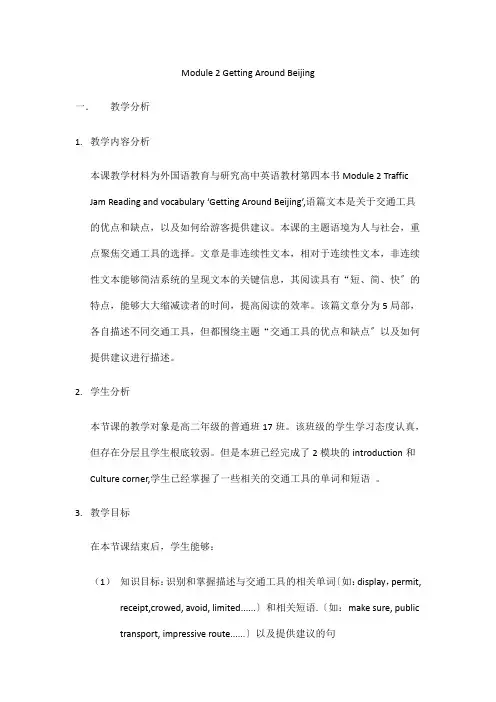
Module 2 Getting Around Beijing一.教学分析1.教学内容分析本课教学材料为外国语教育与研究高中英语教材第四本书Module 2 Traffic Jam Reading and vocabulary ‘Getting Around Beijing’,语篇文本是关于交通工具的优点和缺点,以及如何给游客提供建议。
本课的主题语境为人与社会,重点聚焦交通工具的选择。
文章是非连续性文本,相对于连续性文本,非连续性文本能够简洁系统的呈现文本的关键信息,其阅读具有“短、简、快〞的特点,能够大大缩减读者的时间,提高阅读的效率。
该篇文章分为5局部,各自描述不同交通工具,但都围绕主题“交通工具的优点和缺点〞以及如何提供建议进行描述。
2.学生分析本节课的教学对象是高二年级的普通班17班。
该班级的学生学习态度认真,但存在分层且学生根底较弱。
但是本班已经完成了2模块的introduction和Culture corner,学生已经掌握了一些相关的交通工具的单词和短语。
3.教学目标在本节课结束后,学生能够:(1)知识目标:识别和掌握描述与交通工具的相关单词〔如:display,permit, receipt,crowed, avoid, limited......〕和相关短语.〔如:make sure, publictransport, impressive route......〕以及提供建议的句You should....Make sure you.....It is a good idea to .......(2)能力目标:a. 能够快速出文本中获得信息。
b.能够通过画思维导图,理清文章结构。
C. 能够为游客提供选择交通工具的建议。
(3)情感目标:了解交通工具的开展史,培养对高科技的正确认识。
4教学重难点:获取每个交通工具的优缺点以及作者提供的建议。
给游客提供选择交通规则的建议。
二.教学过程1.依托标题,预测主题内容,激发学生的探热情。
Traffic jam教学设计

2.Share their ideas and have a discussion to better their answers
3.Work together to finish their composition with the help of the teacher
Teaching Methods
Task-based teaching , classroom activities group competition teaching
Teaching Procedures
Teacher’s Activities
Students’Activities
Design ideas
Teaching Design for
Module 2 Traffic Jam(Revision)
Teaching Subject
Traffic Jam
Time
45 minutes
Material Analysis
This passage mainly talks about advantages and disadvantages of
3.Fill in the blanks in a given passage to review the key words and their usages in this module
Enrich and consolidate their basic knowledge, go over words and expressions as well as advanced sentence patterns
Traffic Jam教案

Module 2 Traffic Jam教案Period 1 Introduction, Speaking, Cultural CornerTeaching Goals:1.To know something about means of transport;2.To learn some words to describe traffic problems;3.To know something about congestion charge.Teaching Procedures:Step 1. Introduction1. Ask Ss to name the following means of transport.Suggested Answers:(1) a double-decker bus (2) underground (3) motorbike (4) helicopter (5) trolleybus2. Ask Ss to match some words with their definitions in Activity 1 on page 11.3. Ask Ss to work in pairs and answer questions according to the box in Activity 2. Such as:(1) How do you travel every day?(2) How do you travel sometimes?(3) How do you often travel?(4) What have you never traveled by?4. Ask Ss to answer the questions Activity 3.Step 2. Speaking1. Ask Ss to talk about a traffic problem they met. Give Ss the key words:For your reference:travel by / rush hour / be stuck in / traffic jam / be going / last / take some measures / solutions to the problems.Step 3. Cultural Corner1. Fast readingAsk Ss to read the text quickly and answer the two questions.(1)What is a congestion charge?(2) Does the congestion charge work?Suggested Answers:(1) A congestion charge is a tax for cars entering the center of the city.(2) After only six months, traffic coming into central London was reduced by 30 percent, and journey times by 15 percent.2. Intensive readingAsk Ss to read the text carefully and answer more questions:(1) Which cities have traffic problems? Give some examples.(2) Why are the roads in London so busy?(3) What do the Londoners think of the solution?Suggested Answers:(1) Besides Beijing, there are Sao Paolo in Brazil, Lagos in Nigeria, and Los Angeles in the USA.(2) Because the roads are planned and built before cars.(3) Most people think the congestion charge is expensive and limit their freedom, while a few people think the charge should be much higher.Step4. Homework1. Ask Ss to review the expressions of traffic problems.2. Ask Ss to practise talking about traffic problems.3. Ask Ss to preview Reading and Vocabulary in the module.。
高中英语Module 2 Traffic Jam优秀教案

Module 2 Traffic JamPart One Teaching DesignPeriod 1 Reading—Getting Around in Beijing■Teaching Goals●To learn to read passages with Imperatives about traffic jams●To learn to read with strategies■ProceduresStep 1: Warming up by defining traffic jam in the introduction part.Show the pictures of the means of transport.Ask students to macth them with the definition.What is traffic jam or traffic congestion?Traffic jam is a number of vehicles blocking one another until they can scarcely move.Traffic congestion occurs when the volume of traffic on a roadway is high enough to become detrimental to its performance. In congested conditions, vehicle speeds are reduced, increasing drive times. These conditions are also more frustrating for drivers (see road rage), and automobile accidents may be more frequent. Furthermore, vehicles burn unnecessary fuel when stuck at idle.A period of extreme traffic congestion is known as a traffic jam.Warming up by looking and sayingLook at the pictures on the screen. They are pictures of traffic jam. Could you say something about traffic jam?Step 1: Before you readPlease go over the word list for this module, paying attention to the pronunciation of the word, the relationship between its pronunciation and its spelling.Step 2: While you read1. Type of writing and summaries of Getting Around in Beijing Getting Around in BeijingTaxis Buses and trolleybuses Minibuses Underground PedicabsTaxis are on the streets 24 hours a day. Public transport provides a cheap wayto get aroundin Beijing. Minibuses with seatsfor 12 passengers offer an alternative to expensive taxis andcrowded public transportin some areas.There are four underground lines in Beijing, and several lines areunder construction.Tourists like these human -pedalled “tricycle taxis 〞, but they can be expensive. 2. A diagram of Getting Around in Beijing3. Complete the article with one word in each blankTaxis are on the streets in Beijing 24 hours a day. You simply _1_ your hand, and a taxi will appear in front of you in no time. 20,000 buses and _2_ in Beijing provide a cheap way to get around. But you will be displeased as they can _3_ very crowded sometimes. Avoiding public transport during the rush _4__ may be a good idea. Then you might decide to take a minibus with seats for 12 _5_. It offers an alternative to expensive taxis and crowded public transport in some _6_. In Beijing you find four underground lines and several lines more under construction. Underground _7_ are fast and convenient, but rush hours can be frightening. Tourists to Beijing _8__ human -pedalled “tricycle taxis 〞, but they may not be as cheap as other _9_ of transport. Tricycles are worth taking if you want to see the narrow _10_ (hutong) of old Beijing.Keys : 1raise 2 trolleybuses 3 get 4 hour 5 passengers6 areas7 trains8 like9 means 10 alleys4. Answer the reading comprehension questions according to the textGetting Around in BeijingTaxis Buses andtrolleybuses Minibuses Underground Pedicabs1. Taxis are usually red in color, and they display the _____ on the _____.A. price pre kilometer, windowB. routes, doorC. signs, backD. words of warning, front2. Fares for _____ are cheap, starting at 1 yuan. Air-conditioned buses cost more.A. taxisB. underground trainsC. minibusesD. buses and trolleybuses3. _____ run regular services and follow the same routes as ______.A. Taxis, underground trainsB. Minibuses, large public busesC. Pedicabs, Buses and trolleybusesD. Underground trains, pedicabs4. The underground is open from _____ am to _____ pm.A. 4:00, 12:00B. 5:00, 11:00C. 6:00 am to 10:00D. 7:00 am to 21:00Step 4: Post-reading 1. Copy all the useful expressions into your Expression Book.2. Making sentences with expressions from the textYou are going to make your own sentences with the expressions form this module.。
新课改2020版高考英语一轮复习Module2TrafficJam学案含解析外研版必修4
(一)课前自主学习Ⅰ.阅读单词——————知其意电车. ...出租汽车;计程车带空调的. . ..双层公共汽车骑车;踩……的踏板... . 三轮脚踏车. . 道路施工)常作复数(..喇叭;号角Ⅱ.重点单词——————写其形..电线. .[纵联]展示;陈列..收据. .[纵联]车费.. 目的地;终点..路线..[纵联]提供..单程票.单一的;单身的;单程的..往返票.返回;报答..吹响(乐器,号角等)..拥塞;堆积Ⅲ.拓展单词——————通其变 . .郊区的;市郊的→ .郊区. .执照;许可证→ .许可;允许[纵联]..限制;限定.界限;限度→.有限的→.无限的. .给人印象深刻的→.使印象深刻;使铭记→ .印象→.印象深刻的. .方便的→ .方便;便利..探索→.探索者→.探索..反应→.反应;回应..解答;答案→.解决;解答..心情;心境→.喜怒无常的..执照;登记→.登记;记录纵联.“展示,展览”大家看①..展示;陈列②..展示③.展览④.展示;展览会⑤在展出;展览中纵联.“费用”都要考虑到①车费②花费③费用;价钱④罚款⑤费用;酬金⑥小费纵联.“提供,供应”多多益善①提供②主动提供③供应④配备;供应⑤供应⑥提供;给予纵联.“允许;禁止”要说明①.允许②.允许③.允许④..禁止⑤.禁止⑥.禁止单元话题——交通子话题公路①.人行道②.车辆;交通工具③.摩托车④.(美)高速公路⑤.高速公路⑥.卡车;货车⑦.拖拉机⑧.有轨电车⑨.车库;汽车修理厂⑩私人汽车子话题铁路①.地铁②.隧道③.地铁;地道④.轨道⑤.客车厢⑥.平台;月台,站台⑦ 高速铁路⑧特快列车[学考对接·活学活用]高考采撷(一) 阅读中的词汇应用❶) ( ), ,(·北京高考阅读.❸❷)排放((), .①写出在本单元中的近义词:②用本单元的词汇替换:。
可接双宾语结构,即 .③用的正确形式填空:。
Module2TrafficJam教案
Module 2 Traffic Jam教案I.教学内容分析本模块以Traffic Jam为话题,介绍了北京的各种交通方式及其特点,以及伦敦的城市增容费的问题。
旨在使学生能够运用所学内容描述各种交通方式,讨论与交通有关的话题。
通过本模块学习,学生要对交通问题有所了解,学会写他们所在城市的交通现状以及交通问题。
Introduction部分通过对不同交通方式的介绍引出话题,把学生引到Traffic Jam的话题上。
为进一步学习课文打下基础。
Reading and Vocabulary部分通过阅读Getting Around in Beijing,让学生学习相关词汇,学会归纳文章的主旨大意;分析文章的结构和写作技巧;并围绕文章内容,进行听、说、读、写等各项活动。
Function部分学习怎么向人提出建议,让学生通过相关练习活动掌握这种表达法。
Listening and Speaking部分听取五个人讲述自己所遇到的交通问题的录音,培养学生准确获取有效信息、完成相关练习的能力。
Vocabulary部分学习有关城市交通的复合词,通过有关练习让学生理解并掌握这些词的含义。
Pronunciation部分通过听力的训练,让学生掌握英语中的连读,加强语音、语调的训练。
Grammar部分通过几个交通标志的含义,要求学生识别祈使句,并了解祈使句的用法。
Speaking部分是阅读文章后所展开的一项活动,要求学生能够模仿其内容来谈论自己遇到过的交通问题。
Writing部分先给出一篇说明交通问题的现状及解决方法的范文,通过设置的几个问题,要求学生仿照范文,借鉴listening and speaking中的观点写出对交通问题的认识的文章。
Everyday English部分围绕日常生活中常见的交际用语,主要通过选择题的形式使学生熟练掌握这几个表达。
Cultural Corner部分是一篇介绍伦敦的城市增容费的问题的文章,帮助学生了解伦敦的城市交通现状、征收城市增容费的来历,扩大学生的知识面。
2020版高考英语一轮复习第1部分Module2TrafficJam教学案含解析外研版必修4
Module 2 Traffic Jam[单词拼写应用]核心单词1.display vt.展示;陈列2.receipt n.收据3.fare n.车费4.destination n.目的地;终点5.provide vt.提供6.blow vt.吹响(乐器,号角等)[语境运用] 用所给词的适当形式填空。
1.The website provides(provide) students with free information about how to choose a good college.2.It is said that train fares(fare) are going to be increased again.3.It's the first time that the painting has been displayed(display) to the public. 4.The box-office receipts(receipt) don't live up to the manager's expectations. 5.He blew(blow) out all the candles on his birthday cake at one go.拓展单词1.permit n.执照;许可证→permission n.允许2.limit vt.&n.限制→limited adj.有限的→unlimited adj.无限的3.impress vt.给……留下印象→impression n.印象→impressive adj.给人印象深刻的4.convenient adj.方便的→convenience n.方便;便利5.explore vt.探索→explorer n.探索者→exploration n.探索6.react vi.反应→reaction n.反应7.solve v.解决→solution n.解答;答案8.mood n.心情;心境→moody adj.喜怒无常的9.register vi.登记;记录→registration n.执照;登记[语境运用] 用所给词的适当形式填空。
高考英语一轮复习教案:Module《TrafficJam》(外研版必修四
Module 2Traffic Jam【美文阅读】Nowadays traffic congestion is a big problem in most of our cities.Have you got any ideas about what has brought about this and how to solve it?There are many causes for this problem,but the following may bethe most important ones.The first cause is the great increase in the number of privatecars.Cars take up more space but they carry fewer people.Someprivate car drivers,ignoring(忽视)traffic regulations,drive only forthe sake of their own convenience,blocking the way of other publictransportation vehicles.The second cause is the slow and inefficientconstruction and improvement of the roads and streets.With a large population and numbers of automobiles increasing,some roads still remain unimproved,which will surely lead to problems.The last cause is the insufficient(不足够的)management of the traffic system and the people's lack of awareness of traffic rules.Many pedestrians(行人)cross the streets even when the traffic lights are against them,which is an obstacle(障碍物)to the flow of traffic.Then how to solve this problem?Some suggest laying down more roads to make the traffic less crowded and speed up the flow of traffic.Others believe that we should open up more public bus routes,so that more people will take the public buses instead of travelling by car and bicycle.Though the above two views sound reasonable,they have their own drawbacks(缺陷).The former may take up much land which could be used for farms and houses.The latter may cause inconvenience for those who are used to travelling by car or bicycle.I think the best answer to the traffic problem is a combination of the two.More roads can be built to hold more traffic and meanwhile more public bus routes can be opened up to those who prefer to use the public transportation.【诱思导学】Suppose you are traveling in Beijing,discuss in groups,and decide which means of transport you will choose and tell why.【答案】略Period ⅠPreviewing(教师用书独具)●教学目标本课时主要是通过学生对学案所给出的内容的学习,了解本课文中所出现的词汇,初步了解课文以及相关的背景知识,对下一堂课对课文的全面理解起到一个铺垫作用。