
U7T2SC仁爱英语unit7topic2sectionC
Unit 7 Food Festival
Topic 2 I’m not sure whether I can cook it well
Section C 教学设计
主备人:赵书婷
一、教学内容及分析
Unit7 Topic2 Section C是仁爱英语八年级新教材下册第七单元第二个话
题的第三部分。
本节课主要内容是了解西方餐桌礼仪,学会对中国的餐桌礼仪进行介绍。
根据新课程标准对八年级初中阅读的要求——“能根据上下文理解生词词义,能找出文章的主题,能运用不同的阅读策略获取信息”,我认为突破主要内容的方法是通过新单词、阅读技巧的教学以及课堂活动的开展,巩固学生对西方餐桌文化的认识,教会学生对中国的餐桌礼仪进行介绍。
在Section A和SectionB中,学生通过听说训练已经对一些食物的制作和部分国家的饮食习惯有所了解,Section C就是这此基础上的拓展和延伸,不同国家
文化的学习,跨文化的交际对学生学习英语是很重要的,而本课的教学正有利于培养学生的跨文化意识。
二、教学目标及分析
结合单元要求和本节特点,依据新课程标准中提出的三维目标要求,我将本节课的教学目标确立如下:
1、知识与能力目标:识记本节阅读内容中的单词、短语和句型;掌握西方餐桌礼仪。
2、过程与方法:通过略读、扫读、和精读等阅读技巧,帮助学生有效理解西方餐桌礼仪。
3、情感、态度、价值观目标:了解并尊重异国文化,增强跨文化意识。
三、问题诊断与分析
在本节课教学中,学生可能遇到的问题是:1、阅读中无法通过阅读方法快速把握文章细节;2、无法通过中西文化的对比,有效介绍中国餐桌礼仪。
解决问题的关键是:1、鼓励学生在预习是自己查生词,并引导他们对生词词义进行猜测。
2、通过举例给出示范,引导学生思考讨论。
四、教学支持条件分析
本节课在导入的时候需要用到PPT呈现图片;在阅读的时候需要播放音频来帮助学生更直观的理解文章内容,完成阅读任务。
五、教学过程设计
Lead-in: Do you think it is polite to do like that when eating?(设计意图:通过呈现与餐桌礼仪相关的图片,询问学生的观点,引入本节课主题餐桌礼仪,并为后面学生描述中国的餐桌礼仪进行铺垫)
Q1:How many do you know about the western table manners?
Suppose you would go to a formal western dinner party for the first time, but you don’t know their table manners. Do you want to get some advice?(设计意图:创设情境,引导学生阅读文章)
q1: Do you know the names of these eating tools?(设计意图:看图片复习各种
餐具名称)
q2: Can you answer the questions? Listen to the tape and skim the passage. (设计意图:通过听和略读,把握文章主旨大意及文体类型)
1.What’s the passage mainly talking about? ( A )
A.How to follow the western table manners?
B.How to use forks and knives?
C.Go to a western dinner part.
D.Learn about the western dinnerware(正餐餐具).
2.Where is the passage from? ( B )
A.Story book
B. Magazine(杂志)
C. A tour guide
D. History book
q3: Are these statements T or F? Scan the passage. (设计意图:通过扫读,查找文章细节信息,并进行判断)
1.When you start dining, you should take your napkin first and put it on your lap. (T)
2.At the table, people always keep the fork in their left hands. (F)
3.It’s impolite to eat up the food on your plate. (F)
4.It’s polite to speak loudly and smile a lot. (F)
5.When you drink to someone, you should raise your glass and take only a little. (T)
q4. What should you do in a western dinner party? Read the passage carefully, then answer questions correctly. (设计意图:通过回答文章细节信息,进一步熟悉西方餐桌礼仪,理解文章大意)
1.What will you do when you sit down at the table?
You should take your napkin and put it on your lap.
2.What should you do when start dining?
When you start dining, you should keep the fork in your right hand.
3.What should you do if you use your knife?
You should put the fork in your left hand.
4.What should you do when you drink to someone?
You should raise your glass and take only a little.
变式练习:pair-work: One student tells the western table manners while the others act out a short play.
Q2: How many do you know about Chinese table manners?
Work in groups and compare them with western table manners. (设计意图:课前让学生查询关于中国餐桌礼仪的信息,然后课中通过与西方餐桌礼仪进行对比,介绍中国的餐桌礼仪)
I think (that) it is polite / impolite …in China.
I think (that) you had better do / should do …in China.
例题:I think that it is impolite to point at people with chopsticks in china.
变式练习:Group-work: Discuss and introduce more Chinese table manners.
Eat the food with chopsticks
Eat up the food on your plate
Make noise during the meal
Stand up when you drink to someone
Use the public chopsticks to take meals on the table.
Use the chopsticks to clean tooth
Talk with chopsticks in hand
Put the chopsticks orderly at the right side of the bowl after eating
六、本课小结
1、Learn about the western and Chinese table manners.
2、Learn the ways of reading comprehension(略读、扫读、精读).
3、Learn some words, phrases and sentence structure; practice spoken English.
情感教育:
Every culture in the world is equal, we shouldn’t use our own culture and value to judge foreign culture. We should remember “When in Rome, do as the Romans do”.。
仁爱英语初中八年级下册Unit7 Topic 2 Section C课件
7. Remember not to drink too much. 记住不要喝太多的酒。 remember to do sth.与remember doing sth. 的区别:前者是提醒别忘做某事,这个动 作在说话的时候还没做;后者是已做过某 事,说话的时候动作已完成。如: Remember to close the door, please. 记着关门。 I remember closing the door. 我记得我关了门了。
2) had better意为“最好”,用于表示对 别人的劝告、建议或表示一种愿望,后 要跟动词原形。又如: We had better learn by heart as many sentence patterns as we can. 我们最好尽可能多背句型。 You had better cross out the last name. 你最好把最后一个名字划掉。 You had better have another think. 你最好再想一想。
3. What should you do wheep the fork in you
right hand. If you use your knife,
then put the fork in your left hand.
4. Is it polite to speak loudly at table? No, it isn’t. You should speak quietly and smile a lot.
Follow this road until you get to the
corner, then turn left. 沿着这条路走到拐角处, 然后向左转。 You speak so fast that I can not follow you. 你讲得这么快,我都没有听懂。(此句中 follow=understand)
新版仁爱七年级教案Unit7 Topic2 Section C

Unit7 Topic2 Section CⅠ. Background Information1, Student: 49 (25M/24F), intermediate level2, Time & Date: 10:40-11:20, May 12th3, Time Duration: 40 minutes4, Lesson Type: Reading & Writing (First Period)5, Teaching Material: Unit7 Topic2 Section C(Project English)6,Teaching Aids: PPT, picture, chalk, blackboardⅡ. Language Content1, V ocabulary: 1) Productive vocabulary: ago2) expressions: when sb was, ...ago, last..., in thepast,not...at all, a little, not very well,very well, it's time for...2, Function: talk about the can/could for ability using the phrases to describe the past time and the degree of can/couldⅢ. Teaching Objectives1, Instructional ObjectivesAt the end of the class, the students should be able to:1) know how to use the expressions to describe the past time2) know how to use different expressions to describe the degree2, Educational ObjectivesAt the end of the class, the students should be able to:1) be confident when talking about his/her ability both in the pastand now3, Personal ObjectivesAt the end of the class, the teacher should be able to:1) be better at designing activities to help and lead students to learnⅣ. Focal and Difficult Point1, Focal point: 1) how how to describe the past time2) know how to describe the degree2, Difficult point: 1) how to write a passage talking about ability bothin the past and now clearly and fluentlyⅤ. Teaching ProcedureStage 1: Pre-reading (16 min)Step 1: Getting in (1 min)Purpose: to draw students’ attention and arouse students’ in terestInstructions:T: Good morning class! Can you remember what you could or couldn't do before? Ok , today we are going to learn how to say it.Step 2: Presenting several groups of pictures (8 min)Purpose: to make students notice the two different pictures in one group, one picture of the past, one of nowInstructions:T: Look at the picture, in picture one, the boy and the girl couldn't sing, but inpicture two, they can. Look at the words below the picture, two years ago, itmeans 两年前, ...ago means 多少时间以前, for example 一年前,一周以前,四个月以前. Try your best to say it using ago.T: Now, look at the blue words, it's not...at all and well. So now we can make asentence, Two years ago, they couldn't sing at all, but now they can sing well.Step 3 Present the students more pictures and key words to lead them to make sentences, describing the past time, the degree and using differentphrases(4 min)Purpose: to help students use the expressions more flexiblyInstructions:T: There several pictures, try to make sentence according to the key wordsStep 4 Presenting some pictures and sentences to explain the new phrases (2 min) Purpose: helping the students understand the new phrases, andreading more smoothlyT: This time, look at the picture and the sentence, try your best to understand the words in red. (It's time for, have a good time)Stage 2 while-reading (11 min)Step 1 skimming (3 min)Purpose: to help students to get the main idea of the passageT: I'll give you two minutes to read this passage and then tell me what it talks aboutStep 2 Scanning (3 min)Purpose: to lead the students to find out the expressions of past time and degree Instructions:T: This time I want you to underline to words and phrases of the past time and degree. Pay attention to the use of can/could/couldn't/can't.Step 3 Filling the table (5 min )Purpose: to help students to summarize the main information of the whole passage Instructions:T: let's read the passage together.T: Now, I 'll give you four minutes to complete the table.Stage 3 Post-reading (13 min)Step 1 Lead students to make his/her own table imitating the table on the book(4 min)Purpose: to prepare for the following writing taskInstructions:T: Now, I want to you to make a table of your own, what you can/could orcan't/couldn't. I'll give you 3 minutesStep 2 say the sentence out according to the table (4 min)Purpose: sentence writingInstructions:T: Now tell us what what you can/could or can't/couldn't do, don't forget to use the expressions to describe the past time.Step 3 Writing (5min)Purpose: to train the students how to write a passage clearsInstructions:T: Now I'll give you 5 minutes to write your own passage. Then some of youcan show it to others if you like.Ⅵ. Blackboard Designago a year ago, four days ago, three months agoWhen...was when I was three, when he was 7years old, when you were 1Last last week, last night last yearHave a good timeIt's time for。
仁爱版英语七年级下册Unit7_Topic2_SectionC_教案

仁爱版英语七年级下册Unit7 Topic2 SectionC 精品教案Ⅰ. Material analysis本课是第七单元话题二的第三课时。
本节课主要活动是1a和2。
通过读前检测和阅读理解,锻炼学生语篇理解能力,学会用情态动词can和could谈论个人能力,并复习有关程度的表达法。
还将进一步操练谈论过去和现在经历的表达法,学习有关过去不会做和现在会做的活动,锻炼学生运用知识和技能解决实际问题的能力。
语音板块将进行单词匹配音标的练习和句子升降调的操练和模仿,要求学生注意单词及句子的重音位置,了解语音语调。
Ⅱ. Teaching aims1.Knowledge aims能根据已学语音、音标及发音规则,正确朗读和拼写下列词汇:ago熟练掌握并应用表示过去不能做couldn’t和现在能做could do事情的表达方式,如:One year ago, she couldn’t do it at all.When she was five, she could dance just a little.She can do it well now. But she couldn’t do it at all in the past.巩固现在进行时的表达方式:Maria is performing ballet.能够掌握并应用情态动词could,如:One year ago, she couldn’t do it at all.When she was five, she could dance just a little.能够掌握句子的升降调及单词在句子中的重音;能根据发音规则拼读单词。
2.Skill aims能够听懂有关谈论现在和过去能做和不能做的事情的对话和简单的故事;能够在老师的帮助下或根据图片用所学的表达法叙述现在能做和不能做的事情,谈论过去的经历;能够连贯、流畅地朗读课文;能够参照图片或范例,应用转折连词but编写句子。
仁爱版七年级英语下册Unit 7 Topic2SectionC教案
Unit 7 Topic2 Can you sing an English song?Section C教师: 年级:七年级教材:仁爱版七年级下册课题:Unit7, Topic2 Can you sing an English song?(Section C) 授课时间:45分钟一、学生分析学生来自乡镇中学,大部分学生在小学学过些英语,少部分在小学时没开设英语课,英语基础属一般,但都能积极参加课堂活动,有活泼、好动和爱玩的特点,需培养良好的学英语的习惯。
二、教材分析本话题通过对话、短文及综合探究活动,谈论人们现在和过去能做和不能做的事情,并深入学习情态动词“can/could”。
三、教学目标1、语言知识目标:(1)扩大词汇量ago(2) 掌握情态动词can/could在句型中的转换和在表能力语境中的运用。
2、语言能力目标:(1)引导学生学会发现和归纳情态动词运用的规律的能力。
(2)培养学生能听懂、说出和写出“自己和他人能和不能做的事情”的简单的句子。
(3) 能读准重音在不同音节的单词以及读准句子的重音和语调。
3、情感目标:营造师生平等、民主的氛围,引导学生合作和互助的精神,并主动参与学习活动。
4、学习策略目标:培养学生预习、听讲、整理知识点,在特定的语境中进行简单的对话和交流;学会观察、分析和归纳语法知识的策略。
四、教学策略本节课借助多媒体,运用图片、简笔画、音乐、活动Flash等方法创设教学情景,用“导”、“引”方法调动学生积极性,让学生合作、自主、探究学习,使学生在宽松、愉悦的氛围中达到学习目标。
五、教学重点学习用情态动词could/couldn’t表达能够和不能够做某事。
六、教学难点用can 表达由现在能不能够过度到could过去能不能做某事。
八、教学步骤Teaching proceduresSteps Teacher’s activities Students’ activities AimsStep1:Warming up 1.Ask the students tolisten to the song “I cansing well”and writedown the missing wordson the screen. 1. Listen carefullyand try to catch themissing words.2. Try to singtogether.通过歌曲活跃课堂气氛,复习can 的用法。
仁爱英语八下Unit7Topic2SectionC课件
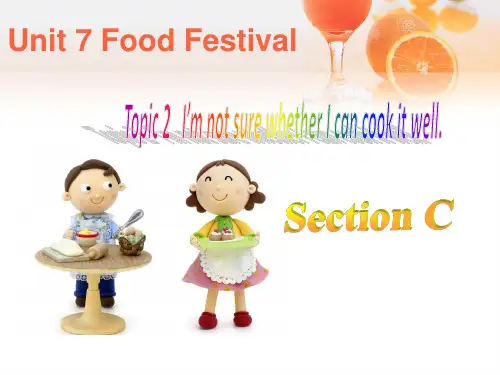
Do you remember how to make a sandwich?
First, take two pieces of bread and spread butter on them.
Next, cut a pear into small pieces carefully.
2019/3/10
First,talk with your partner about western table manners.
When you sit down at the table, ... The dinner always starts with … You should keep the fork ... If you use your knife, ... Don’t take … Don’t speak … When you drink to someone, you 'd better...
B
C
A
B
D I know Indians eat with their right hands. I don't know if there's no need for knives,forks or chopsticks. No, there's no need.
宾语从句用陈述句语序
Do you know if / whether he likes Times English Post?
n.手指
Write a short passage about table manners in China, using object clauses and the information you have collected in 1c.
仁爱版七年级英语下册unit 7 Topic 2 Section C讲学稿

unit 7 Topic 2 Section C讲学稿学习目标与要求:1)复习情态动词can, can’t的用法;2)能熟练运用can,could和couldn’t进行表述。
模块一:自主学习(独立进行)预时24分钟(Self-study & Self-exploration)学法指导及学习内容(含时间安排)随堂笔记Step1通读天地---培养语感(6’)1熟读本节课P 131 (67—68)的单词。
(2’)2请同学们大声朗读P67--1a的短文,试试看,读三遍以上看看自己能在哪个等级上达标:★大声通顺的朗读★★有感情的流利朗读★★★在理解的基础上熟练背诵Step 2 自主学习(15’)(一).独立完成书本P67-1a的练习。
(二)自主翻译下列句型,并在课本上划出相应的重点句子。
1 The children are all having a good time .________________________________________.2 She couldn’t do it at all .________________________________________.3 It’s ti me for outdoor activities .________________________________________.4 She can fly kites very well now ._______________________________________.(三)请同学们独立完成知识点归纳.3.1 请看:1)But one year ago, she couldn’t do it at all. 但是在一年前,她根本不会。
2)--Could you help me ,please? ---O f course.您能帮一下忙吗?--Could I ask you some questions? –Of course you can.归纳:1)can的过去式是:________,could not _____________(缩写形式),could表示过去“_____”,couldn’t 表过去“_______”。
【公开课教案】仁爱英语七年级-Unit-7-Topic-2--Section-C教学设计
仁爱英语Unit 7 Topic 2- Section C教学设计Teaching aims: 1.情态动词can 与can’t 的过去式2. 过去时间two years ago, last year, last night , when I wasat the age of five 等3. 能运用could ,couldn’t 表达过会会做与不会做的事情。
Teaching steps:Step 1. Revison1. Sing the song” Happy birthday”2.Revise the words, phrases and important sentences\3. A group of students act some conversations.Step 2. Presentatione the words “ can ““could”“ can’t”“ couldn’t” to make lots of sentencesfor example: I can play ping-pong, but I couldn’t do it two years ago.I can perform Chinese Kung Fu, but I couldn’t do it two years ago.He can count numbers, but he couldn’t do it at all when he was two.She can ride a bike now, but she couln’t do it all all five years ago?........Step 3. Reading and finish the form1.Present the question: What are they doing? Let the students listen to 1acarefully and find out the anwer to the following questions:What’s Jane doing?2.Let Students read 1a and finish the form 1b then check the answer.3.Read the text again.4.Retell the text.Step 4 Writing1. Show the pictures of Page 68 and Let the students write down the answersThen check the answers.Step5. Summary1. Can 的过去式could, can’t 的过去式couldn’t2. one year ago, two years ago, three years ago, a month ago, two months agolast year, last night, last week, when I was at the age of fivewhen he was at age of six......2.Could you........? Yes, I could. No, I couldn’tCould he / she......? Yes, he/ she could. No, he/ she couldn’tStep6 Summary and homework1.Copy the words of Topic 22.Make five sentenses, using” can, couldn’t3.Finish the exercise Section C of workbook.教学反思:成功之处: 不足之处: 改进措施:。
【公开课课件】仁爱英语-七年级-Unit-7-Topic-2-Section-C教学设计
last year/this year
He can ride a bike this year, But he couldn’t do it last year.
Step 3 reading (阅读)
1b. Read 1a and complete the table.
P67
Name
Jane
Activity fly a kite
钢琴 p_ _no ia e 芭蕾舞 ball_t
e 别的 e _ls_
i o 迪斯科 d_sc__ a g_ e 年龄 _ or 单词 w_ _d
ar_t 聪明 sm_
ou 数数 c_ _nt
er 表演 p_ _form
Tomorrow is my birthday. have a good time 玩得开心) I think I’ll_______________(
A. can B. could
别的 else_______ A: What can you do? B: I can play the piano. A: What else can you do? B: I can perform ballet.
单词 word________ English words_________ Can you spell the word? Yes, I can. / Sorry, I can’t
perform Chinese kung fu
Can you sing the English song ” Happy birthday to you” now? A. Yes, I can. B. No, I can’t
Step 2—新课重点口语操练
本课重点
仁爱版七年级下册英语第七单元Topic2-SectionC课件
单击此处输入标题文字
填加 标题
单击添加标题 点击添加文本
填加文字
单击添加标题 点击添加文本
填加文字
填加文字
章节
3
这里输入您的标题三
点击这里输入您的标题
您的文本您的文本 您的文本您的文本 您的文本您的文本
您的文本您的文本 您的文本您的文本 您的文本您的文本
您的文本您的文本 您的文本您的文本 您的文本您的文本
单击此处填加文字内容 单击此处填加文字内容 单击此处填加文字内容
单击此处填加标题
单击此处填加文字内容 单击此处填加文字内容 单击此处填加文字内容
单击此处填加标题
单击此处填加文字内容 单击此处填加文字内容 单击此处填加文字内容
单击此处填加标题
章节
5
这里输入您的标题五
点击这里输入您的标题
01
某某方面: 这里输入你的文本内容这里输入你的文本内容这里输入你的文本内容这里输入你的文本内容你的文本内容
02
03
单击此处添加标题 单击这里输入内容,单击这里输入内容 单击这里输入内容,单击这里输入内容 单击这里输入内容,单击这里输入内容
单击此处添加标题 单击这里输入内容,单击这里输入内容 单击这里输入内容,单击这里输入内容 单击这里输入内容,单击这里输入内容
点击这里输入您的标题
您的文本内容
您的文本内容
您的文本您的文本 您的文本您的文本 您的文本您的文本
文本
点击这里输入您的标题
标题
单击此处添加段落文字内容
单击此处添加段落文字内容
单击处添加内容
单击添加段落文字 单击添加段落文字
此处添加内容
单击添加段落文字 单击添加段落文字
仁爱版英语七年级下册 Unit 7 Topic2 SectionC (共25张PPT)
Nothing is impossible.
(一切皆有可能。)
1.Make five sentences about yourself by using can, canot,could or couldn’t. 2.Finish Section C in your workbook.
Pre-reading
now
two years ago
I can play the piano a little now, but I couldn’t do it two years ago.
当你五岁时
What could you do when you were five years old? I could ______ when I was five years old. Could you ride a bike when you were five years old? Yes, I could. No, I couldn't.
Read 1a and complete the table.(读1a完成表格)
Name Activity In the past Now
Jane
Maria
Michael and
Kangkang
fly a kite
perform ballet
play ping-pong
couldn't...at all could … just a
Pre-reading
Make sentences(造句) by using the following outdoor activities.
fly a kite play ping-pong play basketball swim with friends