
中考译林版牛津英语第一轮复习教学案7下 unit2
7下Unit 2 Neighbours一、复习单词A. 易拼错单词neighbour community skill problem something anythingsomeone (an) engineer college notice police station post officeB. 词性变化visit-visitor like(prep)-unlike wait-waiter/waitress help-helpful/helplessbreak-broken fix –fixed-fixing sound-sound(s) luck-lucky-luckilymanage-manager policeman-policemen postman-postmensick-sickness/illness company-companies person-personal-personalityart-artist information(uc) good/well-better-best worry-worried/worrying design-designed-designer notice(n)-notice(v注视) below-aboveC. 单词用法1.will ,shall 为情态动词,+动词原形注:shall 与主语I ,we 连用情态动词总结:need, can , could, would, must, may , might ,should ,could①The girl__________(water) the flowers if her father comes home late.②It`s said they ____________(donate) one million to those homeless children who survivedthe earthquake to build a new home in the next month.2. visitvisitor参观者,类似结构:inventor,发明家,actor演员,director,导演n. on a visit to spv. visit+sp, travel to +speg: ①The bag seems to be one of the _____________.② He ___________over two hundred places of interest so far .A. visitedB. traveledC. has visitedD. has traveled3.helpn . 帮助v. help sb do sth /help sb with sthadj. helpful/unhelpful 不乐于助人的helpless无助的①In order to finish the project on time, we still need a lot of___________.②I will vote for him. He is ______________I have ever seen.with the help of sb 在某人的帮助之下without one`s help没有某人的帮助4.something 指物的不定代词,一律当单数讲;反意疑问句用it 代替,否定句中改为anything ,nothing 表否定,没有。
形容词修饰不定代词要后置,something interesting , something else important不定式修饰要后置something to eat①Something is wrong with the computer,______ ___________?②Could you tell me _____________? (一些有趣的事)I feel sleepy.注:would you like /could you /can I结构还用something, 表委婉语气,或希望得到肯定回答。
5.fix 修理-fixed-fixing=mend=repair① He has had my bike __________(fix).②When I was young, I always liked_____________(fix) the toys.③Before my father used the car, he ___________(mend) it well.6.luck(n)-lucky-luckily 反义词unlucky-luckily①_________unlucky experience(冠词)②__________, we got to the top of the hill successfully.③How __________he is to fail the exam again!注:un做否定前缀时,冠词用an .7.by train /bus/ship/bike注意:by +交通工具表方式时,交通工具不做任何变化。
①He goes to work _____ car every day, but this morning he goes there _____a car.(介词)②We can do it _______hands or ______foot.(介词).by the time( of) …到---时by the end of 到…为止by the way 顺便说一下by sb 被某人The window was broken by a little boy.①By the time we got there, the man__________(die).②By the end of last month, they ___________(make) hundreds of buildings.8.sick(adj)-sicknessa sick man (ill 不能用做前置定语)9.soundn. 声音,(大自然的声音)voice 人的嗓音,noise 噪音,(不悦耳的声音)Link verb. sound beautiful, sound sweetsound like +n,①Don`t make such a big_____________. My father is sleeping.②I like the ________of nature, and it makes me calm down.10. noticen. 布告,通知v. notice sb do /doing sth 注意到某人做某事/正在做某事①Did you notice two boys__________(play) badminton when you walked past.11. worry-worried(adj)worry about sb- be worried about sb担心某人①What a ___________piece of news it is! It makes all of us ____________.②Jim, ____________(not worry) about the result. I`m sure you will pass it.二、重点词组、句型用法1. I am afraid they won`t welcome visitors like you.be afraid to do sth /be afraid of sth /be afraid +从句welcome to China/welcome back home--Thank you---You are welcomelike (prep)-(反义词)unlikeeg: He,_______his elder brother, likes chatting with others.2.It`s good to live in a neighbour like that.it`s good to do sth be +形容词/+ 名词词组/介词短语to do sth① It`s my job __________(take) care of my sister when my mother is away.② Why is he in a hurry__________(get) on the bus?3.What are your neighbours like?What`s sb/sth like?你认为…怎么样?(用形容词回答)What do you think of sth /sb?=how do you like sth/sb?4.They often meet at the community centre and share their different skills.share sth with sb/sharing/shareddifferent +名词复数5.There`s something wrong with my computer.=something is wrong with sthThere`s something wrong with my computer, isn`t there?something is wrong with my computer, isn`t it?eg: Nothing has happened so far,_______________?6.My cousin Annie`s bicycle is broken, so she`s going to ask someone to fix it.break-broke-brokensth break down (不用被动)break into a big bank闯入一家大银行ask sb to do sth/ ask sb not to do sthask for help/advice 寻求帮助/意见7.That sounds like a good idea.sound like +名词词组look like my father/look happy8. Are you worrying about what to wear to a party or how to design your home?worry about sth/sbworry about +特殊疑问词+to do sth①I don`t know who _________(ask) for help.②Do you know when __________(start)?9.When people do not know what to wear or how to design their homw, the artists will give them some ideas.when 当……时,引导时间状语从句,主将从现; 也可以直接加Ving。
2023年牛津译林版七年级英语下册Unit2 Grammar教学案

备课日期年教学课题Unit 2 Neighbours课时安排4 月日Grammar7教学目标To grasp the words:shall fireTo grasp the phrases: the day after tomorrow make a fire重点1. 能用will、shall和be going to表示将来。
2. 能正确使用一般将来时的肯定、否定、疑问式和肯定、否定回答。
难点教学过程设计集体备课二次备课A Simple future tense with will and shallStep 1 Revision1. Where does Simon live? What do you think of the communitycentre in his neighbourhood? Do you think Simon is lucky to live insuch a neighbourhood? Why?2. Here are some people who lives in Simon’s neighbourhood. Theyhave some problems. How can they get help from the communitycentre?(1) Mr. Green’s com puter doesn’t work well.(2) Lily’s bicycle is broken.(3) Little Tom has problems with his homework.(4) Grandma Chen is sick these days.Step 2 Presentation1. What will you do if you have problems with your homework?2. What do we use will or shall to talk about? We use will or shall to talk about things that will happen and plans that we’re making now. This is an example of the simple future tense.3. If someone has problems with his or her homework, he or she will ask the teacher for help. He or she won’t copy the others’answers. What’ll you do? Will you ask your teacher for help? Will your parents help you?4. What do we use for “I” or “we”? What do we use for “he”, “she”, “it” and “they”?5. How do you make negative sentences? Can you tell me how to ask and answer questions?Step 3 PracticeB Simple future tense with be going toStep 1 Presentation 背诵一般将来时的两种结构。
牛津译林版七年级英语下学期期中复习教学案设计(Unit1-Unit2)

七年级英语下学期期中复习教案(U1-U2)教学目标:1、掌握U1-U2重点单词、重点短语2、掌握基数词、序数词的组成与应用【同步知识梳理】Unit 1一、复习单词A、拼读易错的单词palace, Canada, France, Japan, Russia, capital, mile, garden, centre, bathroom, beach, zero, hundred, thousand, million, square, area, fork, fridge, shower, video, machine, message, double, field, inviteB、重点单词用法1、country(pl)__________ balcony (pl) _________ beach (pl.)__________foot (pl)_____________ knife (pl)___________ video (pl)___________study (pl)__________Key:countries, balconies, beaches, feet, knives, videos, studies2、next to (prep.) 紧邻,在……近旁介词,后面加宾语,人称代词用宾格She sits next to___________(I).His classroom is next to_________(I).Key:me, minedian,Canadian,Britain,British,English,Russian,Russian,Russian4、own①(adj.) 自己的用于形容词性物主代词或名词所有格后,加强语气of one’s own 属于某人自己的I have___________(我自己的) bedroom. = I have the bedroom _____________.When children grow up, they will have families__________________.A. on their ownB. of ownC. their own familiesD. of their ownKey: my own, of my own, D②(vt.) 拥有owner (n.) 物主,所有人He______________(own) a big company in New York.He is the______________(own) of a big company in New York.③on one’s own = by oneself = alone 独自The old man lives a_________. (on his own)Key:owns,owner,alone5、square①(adj.) 平方的square metre 平方米Red Square in Moscow is about 91,000 ___________________in size.莫斯科的红场面积约九万一千平方米。
unit2精品教案牛津译林英语七年级下册

unit 2 精品教案牛津译林英语七年级下册一、教学内容本节课选自牛津译林英语七年级下册的Unit 2,主要内容包括:2. 详细内容:本单元主要围绕学校场所和设施展开,学习如何介绍学校各个场所的名称和位置,以及如何描述学校的日常活动。
二、教学目标1. 能够听懂、会说、会读、会写与学校场所和设施相关的词汇和句型。
2. 能够运用所学知识,向别人介绍自己的学校。
3. 提高学生的英语口语表达能力和合作学习能力。
三、教学难点与重点1. 教学难点:如何正确使用there be句型和方位词描述学校的场所和设施。
2. 教学重点:掌握与学校场所和设施相关的词汇和句型,并能运用到实际情境中。
四、教具与学具准备1. 教具:PPT、图片、磁带、录音机2. 学具:课本、练习本、彩色笔五、教学过程1. 引入:通过展示一组学校场所的图片,引导学生用英语说出各个场所的名称,激发学生的学习兴趣。
2. 呈现:教师播放教材中的听力材料,让学生跟读,学习there be句型和方位词,引导学生用所学句型描述图片中的学校场所。
3. 实践:学生分小组,根据所给情景,运用所学知识进行角色扮演,向别人介绍自己的学校。
4. 例题讲解:教师针对学生在实践中出现的错误,进行讲解和纠正。
5. 随堂练习:学生完成课后练习,巩固所学知识。
六、板书设计1. 词汇:classroom, library, playground, canteen, there be, in, on, under, near2. 句型: What's in the picture? There is aclassroom/library/playground/canteen.Where is theclassroom/library/playground/canteen? It's in/on/under/near七、作业设计1. 作业题目:根据所学内容,编写一段对话,向别人介绍你的学校。
unit2教案牛津译林英语七年级下册

unit 2 教案牛津译林英语七年级下册一、教学内容本节课选自牛津译林英语七年级下册Unit 2 Neighbours,详细内容包括:Section A 1a2d,主要围绕邻居之间的相互认识和交流展开,通过丰富的语言场景,让学生掌握如何用英语介绍自己、询问他人信息以及描述日常生活。
二、教学目标1. 能够听懂、会说、会读、会写与邻居交流相关的词汇和句型。
2. 能够运用所学知识,进行自我介绍,询问邻居信息,并描述日常生活。
3. 培养学生的合作意识和口语表达能力,激发他们与他人交往的兴趣。
三、教学难点与重点1. 教学重点:掌握词汇(如:lazy、outgoing、neighbour、boring等)和句型(如:What's your name?、How old are you?、What do you do?等)。
2. 教学难点:如何运用所学词汇和句型进行流畅的口语表达和交流。
四、教具与学具准备1. 教具:多媒体教学设备、单词卡片、黑板、粉笔。
2. 学具:学生用书、练习本、彩色笔。
五、教学过程1. 导入:通过展示一组邻居之间的生活场景图片,引导学生用英语进行讨论,激发学生兴趣。
2. 新课内容展示:呈现Section A 1a2d的对话,让学生听、说、读、写,掌握词汇和句型。
3. 实践情景引入:分组让学生模拟邻居之间的交流场景,进行角色扮演,巩固所学知识。
4. 例题讲解:针对重点句型和语法,设计例题进行讲解,帮助学生理解。
5. 随堂练习:设计相关练习题,让学生当堂完成,检查学习效果。
6. 小组合作:分组让学生讨论如何用所学知识进行自我介绍和询问邻居信息,培养学生的合作意识。
六、板书设计1. Unit 2 Neighbours2. 词汇:lazy、outgoing、neighbour、boring等3. 句型:What's your name?、How old are you?、What do you do?等4. 重点语法:介绍一般现在时七、作业设计1. 作业题目:(1)抄写本节课所学的词汇和句型,每个写三遍。
牛津译林版七年级下全册单元英语精品教案 Unit2教案(表格式)
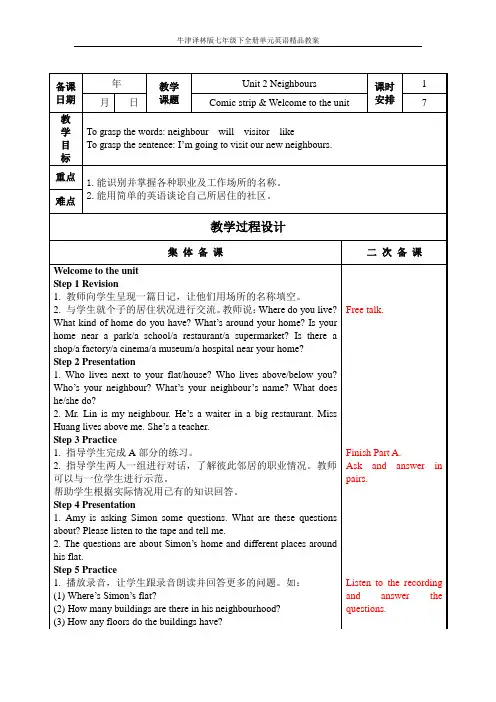
备课 日期
年
教学 课题
Unit 2 Neighbours
课时 安排
2
牛津译林版七年级下全册单元英语精品教案
月 教 学 目 标 重点 难点
日
Reading 1 something
Read the dialogue and act it out. Make up new dialogues.
Listen to the tape and find out the answer.
Do some exercises.
课后 作业 教学 反思
1. Recite the words and phrases. 2. Recite the dialogue in Part B. 初步接触一般将来时和 It is + adj. + to do 结构。掌握一些职业及提问方式。 有能力的同学背诵 P19 对话。
1.能识别并掌握各种职业及工作场所的名称。 2.能用简单的英语谈论自己所居住的社区。
教学过程设计
集 体 备 课 Welcome to the unit Step 1 Revision 1. 教师向学生呈现一篇日记,让他们用场所的名称填空。 2. 与学生就个子的居住状况进行交流。 教师说: Where do you live? What kind of home do you have? What’s around your home? Is your home near a park/a school/a restaurant/a supermarket? Is there a shop/a factory/a cinema/a museum/a hospital near your home? Step 2 Presentation 1. Who lives next to your flat/house? Who lives above/below you? Who’s your neighbour? What’s your neighbour ’s name? What does he/she do? 2. Mr. Lin is my neighbour. He’s a waiter in a big restaurant. Miss Huang lives above me. She’s a teacher. Step 3 Practice 1. 指导学生完成 A 部分的练习。 2. 指导学生两人一组进行对话,了解彼此邻居的职业情况。教师 可以与一位学生进行示范。 帮助学生根据实际情况用已有的知识回答。 Step 4 Presentation 1. Amy is asking Simon some questions. What are these questions about? Please listen to the tape and tell me. 2. The questions are about Simon’s home and different places around his flat. Step 5 Practice 1. 播放录音,让学生跟录音朗读并回答更多的问题。如: (1) Where’s Simon’s flat? (2) How many buildings are there in his neighbourhood? (3) How any floors do the buildings have? 二 次 备 课
牛津译林版七年级英语下册 Unit 1-2复习教案

uniit1—unit2一.Teaching aims:1 )uni1—unit2 : words ,phrases and sentences2) the prepositions of places: above over ,on, in, behind, under, in front of in the front of. between and, next to .3) Cardinal numbers and Ordinal numbers4) how much ,how many and noun+’s5)possessive adjectives and pronous6)the definite article“the”二.Teaching difficulties:Master some words a nd phrases, the understanding of the sentences.三.Teaching steps:Step one: Revision(unit1)—free talk1. Show some sentences. Get the student to say them in English.2. Get the stude nt to give free talks on “My Dream Home”.Step two. PresentationShow some important phrases and ask students to say them.Step three. ExplainationExplain some important sentences to studentsStep four. PresentationShow some pictures about prepositions of place and do som e exercises.Step five.PresentationGive some cardinal numbers and ordinal numbersLet students read them...Tell them how to change them.Step six ;(unit2)PresentationGive some useful phrases ,let st u dents to answer themStep seven :Prac ticingLet students do some exercisesStep eight: ConclusionGive studen ts some sen te nces and l et them work out the rule about how many ,how much Step nine; PractisingDo some exerci ses about grammarStep ten: Homework.Revise unit 3-unit4。
最新牛津译林版中学七年级英语下册 Unit 1-2复习教案
精品教育资料uniit1—unit2一.Teaching aims:1 )uni1—unit2 : words ,phrases and sentences2) the prepositions of places: above over ,on, in, behind, under, in front ofin the front of. between and, next to .3) Cardinal numbers and Ordinal numbers4) how much ,how many and noun+’s5)possessive adjectives and pronous6)the definite article“the”二.Teaching difficulties:Master some words a nd phrases, the understanding of the sentences. 三.Teaching steps:Step one: Revision(unit1)—free talk1. Show some sentences. Get the student to say them in English.2. Get the stude nt to give free talks on “My Dream Home”.Step two. PresentationShow some important phrases and ask students to say them.Step three. ExplainationExplain some important sentences to studentsStep four. PresentationShow some pictures about prepositions of place and do som e exercises.Step five.PresentationGive some cardinal numbers and ordinal numbersLet students read them...Tell them how to change them.Step six ;(unit2)PresentationGive some useful phrases ,let st u dents to answer themStep seven :Prac ticingLet students do some exercisesStep eight: ConclusionGive studen ts some sen te nces and l et them work out the rule about how many ,how muchStep nine; PractisingDo some exerci ses about grammarStep ten: Homework.Revise unit 3-unit4精品教育资料 1。
unit 2 教案牛津译林英语七年级下册
3.Read & answer(ABC)
1)Whatdoes Eddie do when he visits his neighbours?
2) If you have a neighbour like Eddie, do you welcome him?
(4)It’s good to live ina neighbourhood like that.
Teaching methods:Task-Based Language Teaching
Teaching Procedures
Designing aims
Step1: Free talk(ABC)
Last time, we talked aboutyour dream home.
3.Value objectives:(ABC)
To develop students’ right attitude tohelp others.
Teachingkeypoints and difficult points:
1.Words:neighbour, will, visitor, like(ABC)
通过小组活动,提高学生对文本的理解。
Step5:Report(AB)
Givea report about your neighbours.
学生根据所学内容,谈论自己的邻居,达到语言的输出。
Step6: Homework
3.Review what we’ve learned today.(ABC)
4.Write down an article about your neighours.(AB)
unit2优质教案牛津译林英语七年级下册
unit 2 优质教案牛津译林英语七年级下册一、教学内容本节课选自牛津译林英语七年级下册Unit 2,主要围绕“Where’s your school?”主题展开。
教学内容包括:Grammar部分,学习一般现在时用法;Reading部分,阅读短文理解文章大意,学习描述地点词汇和句型;Vocabulary部分,学习与学校设施相关词汇;Use of English部分,学会用英语描述学校方位和路线。
二、教学目标1. 让学生掌握一般现在时用法,并能运用到实际情景中。
2. 培养学生阅读能力,能理解并运用描述地点词汇和句型。
3. 提高学生听说能力,能用地道英语描述学校方位和路线。
三、教学难点与重点1. 教学难点:一般现在时用法,描述地点词汇和句型。
2. 教学重点:运用一般现在时描述学校日常活动,用地道英语描述学校方位和路线。
四、教具与学具准备1. 教具:PPT,教学视频,地图,卡片。
2. 学具:课本,练习册,字典。
五、教学过程1. 导入:通过展示一组学校图片,引导学生用英语描述图片中场景,自然引入主题。
2. 新课内容呈现:a. 学习Grammar部分,讲解一般现在时用法,举例说明。
b. 学习Reading部分,阅读短文,引导学生找出描述地点词汇和句型,并进行讲解。
c. 学习Vocabulary部分,通过图片展示,教授与学校设施相关词汇。
3. 实践活动:a. 角色扮演:学生分成小组,扮演导游和游客,用地道英语描述学校方位和路线。
b. 小组讨论:讨论一般现在时在生活中运用,举例分享。
4. 例题讲解:针对Grammar和Reading部分,设计相关例题,进行讲解。
5. 随堂练习:针对新课内容,设计练习题,检查学生对知识掌握。
六、板书设计1. Unit 2 Where’s your school?2. 内容:a. 一般现在时用法b. 描述地点词汇和句型c. 学校设施相关词汇七、作业设计1. 作业题目:a. 用一般现在时描述你学校一天。
【牛津译林版】中考英语一轮复习教案:7下 unit 2 Neighbours
7下Unit 2 Neighbours一、复习单词A. 易拼错单词neighbour community skill problem something anythingsomeone (an) engineer college notice police station post officeB. 词性变化visit-visitor like(prep)-unlike wait-waiter/waitress help-helpful/helplessbreak-broken fix –fixed-fixing sound-sound(s) luck-lucky-luckilymanage-manager policeman-policemen postman-postmensick-sickness/illness company-companies person-personal-personalityart-artist information(uc) good/well-better-best worry-worried/worrying design-designed-designer notice(n)-notice(v注视) below-aboveC. 单词用法1.will ,shall 为情态动词,+动词原形注:shall 与主语I ,we 连用情态动词总结:need, can , could, would, must, may , might ,should ,could①The girl__________(water) the flowers if her father comes home late.②It`s said they ____________(donate) one million to those homeless children who survived theearthquake to build a new home in the next month.2. visitvisitor参观者,类似结构: inventor,发明家,actor演员,director,导演n. on a visit to spv. visit+sp, travel to +speg: ①The bag seems to be one of the _____________.② He ___________over two hundred places of interest so far .A. visitedB. traveledC. has visitedD. has traveled3.helpn . 帮助 v. help sb do sth /help sb with sthadj. helpful/unhelpful 不乐于助人的 helpless无助的①In order to finish th e project on time, we still need a lot of___________.②I will vote for him. He is ______________I have ever seen.with the help of sb 在某人的帮助之下without one`s help没有某人的帮助4.something 指物的不定代词,一律当单数讲;反意疑问句用it 代替,否定句中改为anything ,nothing 表否定,没有。