
沪教小学英语 三年级起点 六年级 上 知识点汇总
3.语音:s c z s t
1
3.语音:-r
2.词组:be
则
3.语音:e a。
借助didn't 2.a lot of/a little/
块
2.Should
3.ch g j
2.there be 句型
3.重点词
away/gro
5.语音:ue u-e
other cou
st
1.一般将来时和一般过去时的区别
2.不规则动词的过去式:ran met came gave fell
3.语音:s c z s ts ds的发音
1.过去时的特殊疑问句
2.不规则动词的过去式:bought learnt
3.语音:or al au oor o a的发音
1.by用法;How long 用法
2.词汇:in the north/east/south/west of
3.语音:-r的发音
语法知识
e动词的一般过去时,was和were的用法
2.词组:be born in
3.语音:e的字母组合及y,i的发音
动词的一般过去时,动词过去式的变化规
则
2.不规则动词的过去式:took went did spent
3.语音:e a ea的发音
动词的一般过去时的否定句,一般疑问句。
借助didn't或者did
2.a lot of/a little/some的用法,区分:一般现在时和一般过去时的区别2.不规则动词的过去式:made could
2.Should 用法
3.ch g j sh s
2.there be 句型的过去时
3.重点词汇
be in danger/take care of/go for a walk/drive
away/grow up
4.不规则动词的过去式:drove found sent saw
5.语音:ue u-e oo u 的发音
点句型:Would you like to have e-friend in
other countries?
Yes,I'd like to./No,I wouldn't.
动词短语
语音:tr dr
stop的用法;should的用法。
上海六年级上英语知识点

上海六年级上英语知识点一、词汇1. 名词:nouns苹果 - apple桌子 - desk猫 - cat2. 动词:verbs看 - see吃 - eat跑 - run3. 形容词:adjectives大 - big美丽 - beautiful高兴 - happy4. 副词:adverbs快速地 - quickly静静地 - quietly很 - very二、语法1. 句子结构英语句子的基本结构是主语+谓语+宾语。
例如:I eat an apple.(我吃一个苹果。
)2. 时态a. 一般现在时:表示经常性或习惯性的动作例如:I go to school every day.(我每天去学校。
)b. 一般过去时:表示过去发生的动作或状态例如:She watched a movie yesterday.(她昨天看了一部电影。
)c. 一般将来时:表示将来要发生的动作例如:We will visit Shanghai next week.(我们下周将要访问上海。
)3. 名词单复数a. 单数形式:一个名词表示一个事物例如:a book(一本书)a cat(一只猫)b. 复数形式:一般在名词后面加-s或-es例如:books(书)cats(猫)4. 形容词比较级和最高级a. 比较级:表示两种事物之间的比较例如:taller(比...高)b. 最高级:表示三种或三种以上事物之间的比较例如:the tallest(最高的)三、听力技巧1. 注意听力材料中的关键词在听力中,经常会出现一些与题目相关的关键词,可以帮助我们更快地找到答案。
2. 着重注意数词、时间、地点等信息数词、时间、地点等词语通常是回答问题的重要线索,需要特别注意。
3. 利用上下文理解语境听力材料中的语境信息能够帮助我们理解某些词语的含义和句子的整体意思。
四、阅读技巧1. 首先,快速浏览全文在阅读之前,先快速浏览全文,了解文章的大致内容和结构。
2. 然后,仔细阅读每个段落针对每个段落,做到理解每个句子的意思,找出关键词。
小学英语沪教版(三年级起点)六年级上册知识点总结

小学英语沪教版(三年级起点)六年级上册知识点总结在这个单元,学生将研究如何用英语进行问候和自我介绍。
他们将练常见的问候语,比如"Hello"、"Good morning"和"How are you?"。
他们还将学会问答一些关于个人信息的简单问题,如姓名、年龄和国籍。
Unit 1: Greetings研究如何用英语进行问候和自我介绍练常见的问候语,如"Hello"、"Good morning"和"How are you?"研究问答一些关于个人信息的简单问题,如姓名、年龄和国籍本单元主要介绍家人和家庭关系。
学生将研究与家庭有关的词汇,如爸爸、妈妈、哥哥、姐姐和祖父母。
他们将练使用物主代词('my'。
'your'。
'his'。
'her')来描述家人。
本单元中,学生将研究关于日常生活和时间表达的内容。
他们将研究与日常活动相关的词汇,如“起床”、“吃早餐”、“上学”和“做作业”。
他们将练使用一般现在时来谈论日常生活。
本单元介绍与食物和饮料相关的词汇。
学生将研究常见水果、蔬菜和饮料的名称。
他们将练使用诸如“I like”、“I don't like”和“Do you like?”等表达方式来谈论食物偏好。
在本单元中,学生将研究以下内容:研究并记忆常见水果的名称,如apple(苹果)、banana(香蕉)、orange(橙子)等。
研究并记忆常见蔬菜的名称,如carrot(胡萝卜)、tomato(西红柿)、cucumber(黄瓜)等。
研究并记忆一些常见饮料的名称,如milk(牛奶)、juice(果汁)、water(水)等。
练使用表达喜欢和不喜欢的句型,如“I like apples.”、“I don'tlike bananas.”等。
三年级起点六年级上册英语单元知识点总结
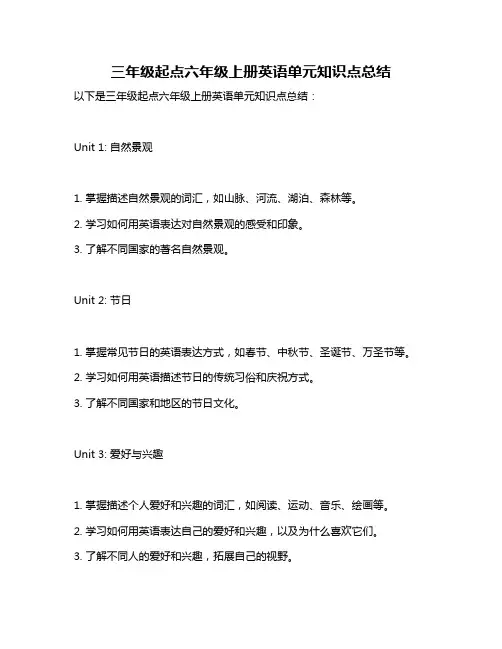
三年级起点六年级上册英语单元知识点总结
以下是三年级起点六年级上册英语单元知识点总结:
Unit 1: 自然景观
1. 掌握描述自然景观的词汇,如山脉、河流、湖泊、森林等。
2. 学习如何用英语表达对自然景观的感受和印象。
3. 了解不同国家的著名自然景观。
Unit 2: 节日
1. 掌握常见节日的英语表达方式,如春节、中秋节、圣诞节、万圣节等。
2. 学习如何用英语描述节日的传统习俗和庆祝方式。
3. 了解不同国家和地区的节日文化。
Unit 3: 爱好与兴趣
1. 掌握描述个人爱好和兴趣的词汇,如阅读、运动、音乐、绘画等。
2. 学习如何用英语表达自己的爱好和兴趣,以及为什么喜欢它们。
3. 了解不同人的爱好和兴趣,拓展自己的视野。
Unit 4: 动物世界
1. 掌握常见动物的英语表达方式,如猫、狗、鸟、鱼等。
2. 学习如何用英语描述动物的外貌特征、习性和生活环境。
3. 了解保护动物的重要性,培养爱护动物的意识。
Unit 5: 科普知识
1. 掌握关于科技发展的词汇,如机器人、人工智能、太空探索等。
2. 学习如何用英语表达对科技发展的看法和展望。
3. 了解科技在生活中的应用和影响。
以上是六年级上册英语五个单元的知识点总结,希望对你有所帮助。
由于英语知识点较多,在学习过程中,建议结合教材和课堂讲解,多做练习,加深理解和记忆。
沪教小学英语 三年级起点 六年级 上 知识点汇总
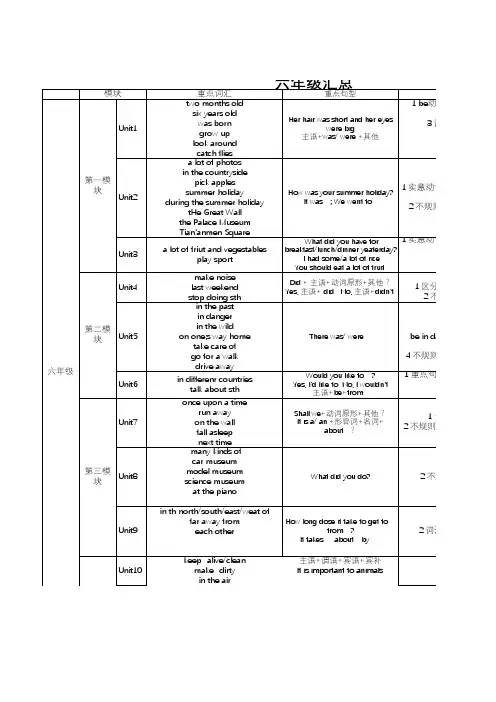
3.语音:s c z s t13.语音:-r2.词组:be则3.语音:e a。
借助didn't 2.a lot of/a little/块2.Should3.ch g j2.there be 句型3.重点词away/gro5.语音:ue u-eother coust1.一般将来时和一般过去时的区别2.不规则动词的过去式:ran met came gave fell3.语音:s c z s ts ds的发音1.过去时的特殊疑问句2.不规则动词的过去式:bought learnt3.语音:or al au oor o a的发音1.by用法;How long 用法2.词汇:in the north/east/south/west of3.语音:-r的发音语法知识e动词的一般过去时,was和were的用法2.词组:be born in3.语音:e的字母组合及y,i的发音动词的一般过去时,动词过去式的变化规则2.不规则动词的过去式:took went did spent3.语音:e a ea的发音动词的一般过去时的否定句,一般疑问句。
借助didn't或者did2.a lot of/a little/some的用法,区分:一般现在时和一般过去时的区别2.不规则动词的过去式:made could2.Should 用法3.ch g j sh s2.there be 句型的过去时3.重点词汇be in danger/take care of/go for a walk/driveaway/grow up4.不规则动词的过去式:drove found sent saw5.语音:ue u-e oo u 的发音点句型:Would you like to have e-friend inother countries?Yes,I'd like to./No,I wouldn't.动词短语语音:tr drstop的用法;should的用法。
上海教育出版社:六年级英语上册(三年级起点)单词表(带音标)

面临危险
Unit 6
e-friend
[i:frend]
网友
country
[ˈkʌntri]
国家
other
[ˈʌðə(r)]
其他的
team
[ti:m]
(游戏或运动的)队
hobby
[ˈhɒbi]
业余爱好
grade
[greid]
年级
yourself
[jɔ:ˈself]
你自己
Unit 7
建筑物,楼房
sushi
[ˈsu:ʃi]
寿司(日本食物)
Unit 10
air
[eə]
空气
everywhere
[ˈevriweə]
处处,到处
alive
[əˈlaiv]
活着的
balloon
[bəˈlu:n]
气球
factory
[ˈfæktri]
工厂
smoke
[sməʊk]
烟
dirty
[ˈdə:ti]
脏的
clean
野生环境,野生的
south China tiger
[sauθ ˈtʃ ainə ˈtaiɡə]
华南虎
bluewhale
[blu:weil]
蓝鲸
way
[wei]
路,方式,方法
die
[dai]
死,死亡
rhino
[ˈrainəʊ]
犀牛
learn
[lə:n]
学会,学习
send
[send]
安排去,寄,送
indanger
[ˈdʒu:njə haisku:l]
初级中学
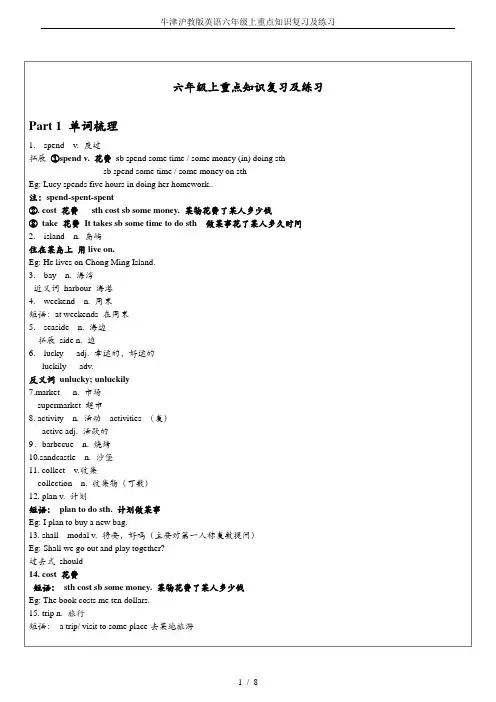
(word完整版)牛津沪教版英语六年级上重点知识复习及练习
2. “Instead of helping you, your own language gets in your way.”This sentence means that memorizing your own language can ________.A.help you to study English wellB.stop you mastering EnglishC.make English easy to learnD.help you notice mistakes3.Equally important is to feel the language. “to feel the language” here means________.A.to get a knowledge of English by touchingB.to be able to read and write EnglishC.to translate English into your own by imaginingD.to be able to experience the rich sensation of the languageBWhen we can see well, we do not think about our eyes often. It is only when we can not see perfectly that we come to see how important our eyes are.People who are nearsighted can only see things that are very close to their eyes. Many people who do a lot of close work, such as writing and reading, become nearsighted. Then they have to wear glasses in order to see distant things clearly. People who are farsighted face just the opposite problem. They can see things that are far away, but they have difficulty reading a book unless they hold it at arm’s length. If they want to do much reading, they must get glasses too.Other people do not see clearly because their eyes are not exactly the right shape. This, too, can be corrected by glasses. Some people’s eyes become cloudy because of cataracts. Long ago these people often became blind. Now, however, it is possible to operate on the cataracts and remove them.When night falls, colors become fainter to the eyes and finally disappear. After your eyes have grown used to the dark, you can see better if you use the side of your eyes rather than the centers. Sometimes, after dark, you see a small thing to one side of you, which seems to disappear if you turn your head in its direction. This is because when you turn your head, you are looking at the thing too directly. Men on guard duty sometimes think they see something moving to one side of them. When they turn to look straight at it, they can not see it any more, and they believe they were mistaken. However, this mistake happens because the center of the eye, which is very sensitive in daylight, is not as sensitive as the sides of the eye after dark.4.We don’t know that our eyes are of great importance until ________.A. we think about our eyesB. we cannot see clearlyC. we wear glassesD. we have to do much reading5.According to the passage, a ________ is more likely to be nearsighted.A.tailorB. doctorC. guardD.painter6.People who are farsighted ________ .A.cannot do a lot of close work without glassesB.can only see things that are very close to their eyesC.have difficult y reading a book if they hold it at arm’s lengthD.have the same problem as the nearsighted people7.To see a small thing at night, it is better to look ________ .A.with wide open eyesB.with half shut or narrowed eyesC.straight at itD.in a slightly different directionC Read and answer the questions.Children from all over the word like to celebrate (庆祝) their birthdays. American children are of no difference. American children usually celebrate with a party. They invite their friends to join the party. The party may not be held on the exact date of birthday if it comes to a school day. It may be held on the closest weekend instead.Today two kinds of parties are the most popular. One is held at home. Parents make their house beautiful with balloons and coloured paper. They prepare a special birthday meal. The children play games. The other one is held away from home. Some are at a special restaurant. The children eat pizza and ice cream. The waiters, who serve the food, also sing and tell jokes to the children. Other parties may be held at a park, a movie theatre or some other places.( ) 2 They are going to the supermarket by bus.( ) 3 The supermarket is not far away from their home.( ) 4 Dick's mother is going to buy a lot of food for the next week.( ) 5 Dick is going to buy a video game machine but he can't play it all the time.( ) 6 They are going to stay in the supermarket for 5 hours.Ⅴ.Choose the right answer.It's Sunday. Mother, father and the children are going to the beach.Alice: Where are we going, Dad?Father. Let's look at the map. Let me see. We will go to the East Point Beach.Mother: We'll swim in the sea.David: Are we going to have a picnic?Alice: Yes, of course.David: That's nice.Father: Come on! Let's all get in the car!Alice: What's wrong (怎么了), Dad?Father: The car can't start (发动)!Mother: So we will all stay at home.Alice: Let's have a picnic in the garden!David: Great!( )1 The family is going to ____________ .A. swim in the seaB. have a picnicC. swim and have a picnic( )2 They are going there ____________ .A. by busB. by carC. by underground( )3 They won't go to the beach ______________ .A. because it is rainyB. because Father is not fineC. because the car doesn't start( ) 4 They will have the picnic _____________ in the end.A. on the beachB. in the gardenC. in the carⅥ.Read the passage and fill in the blanks with proper words.It will be grandfather's s______________ birthday next Sunday. We are going to have a big birthday p____________. Uncles and aunts will buy some p______________for him. But I want to make a nice birthday c______________for grandfather. Mum and Dad are going to buy a lot of food from the s______________.【Keys】I. 1. Tom is speaking Chinese.。
沪教版六年级英语上册知识点
沪教版六年级英语上册知识点一、单词和短语1. 数字:one, two, three, four, five, six, seven, eight, nine, ten2. 问候语:hello, hi, good morning, good afternoon, goodbye3. 介绍自己:My name is…, I am… years old, I am from...4. 家庭成员:father, mother, brother, sister, grandparents5. 动物:cat, dog, bird, rabbit, fish6. 学校:classroom, teacher, student, desk, chair7. 食物:apple, banana, orange, milk, bread8. 颜色:red, yellow, blue, green, pink9. 运动:football, basketball, swimming, running, cycling二、重点语法1. 一般现在时:主语+动词原形例如:- My mother cooks dinner every day.- We play basketball on Sundays.- I like to eat apples.2. 情态动词 can 的用法:表示能力或许可例如:- I can swim in the pool.- Can you speak Chinese?- She can play the piano very well.3. 名词所有格的用法:'s 或'例如:- Tom's backpack is blue.- The dog's tail is wagging.- My parents' car is new.三、句型1. 问候语句- Hello, how are you?- Hi, good morning!- Good afternoon, nice to meet you.2. 自我介绍句- My name is Lisa. I am 11 years old.- I am from China.- I have one brother and one sister.3. 询问其他人情况- How old are you?- Where are you from?- Do you have any hobbies?4. 描述动物外貌特征- The cat is small and gray.- The dog has long ears.- The bird has colorful feathers.5. 谈论学校事物- Our classroom is clean and tidy.- The teacher is standing in front of the class. - The students are sitting at their desks.6. 询问食物偏好- What is your favorite food?- Do you like to eat bananas?- I prefer to drink milk.7. 描述颜色- The apple is red.- The banana is yellow.- The sky is blue.8. 谈论运动爱好- I like to play football.- She enjoys swimming in the pool.- They often run in the park.四、实用句型1. How do you do?(你好,很高兴认识你。
沪教版英语知识点六年级
沪教版英语知识点六年级知识点1: 情态动词\情态动词是一类特殊的动词,用来表示说话人对某种行为或状态的态度、意愿、能力等。
在英语中,常用的情态动词有can、could、may、might、must、shall、should、will、would等。
1. can和could用于表示能力或许可:- I can swim.(我会游泳。
)- Could you help me with my homework?(你能帮我做作业吗?)2. may和might用于表示允许或可能:- You may go to the park after finishing your homework.(你可以在做完作业后去公园。
)- It might rain tomorrow.(明天可能会下雨。
)3. must表示必须或推测:- You must finish your homework before watching TV.(你必须先完成作业再看电视。
)- He must be tired after working all day.(他一整天工作下来一定累了。
)4. shall和should用于表示建议或义务:- Shall we go for a walk?(我们去散步吧?)- You should eat more fruits and vegetables for a healthy diet.(为了健康饮食,你应该多吃水果和蔬菜。
)5. will和would表示意愿或愿意:- I will help you with your project.(我愿意帮你完成这个项目。
)- Would you like some tea?(你想喝点茶吗?)总结:情态动词在英语中起着重要的作用,通过运用不同的情态动词,可以更准确地表达自己的意思。
知识点2: 现在完成时\现在完成时是英语中一种常用的时态,表示动作或状态发生在过去,对现在产生了影响或有关联。
沪教版三年级起点小学英语六年级上(英语单词表)
沪教版三年级起点小学英语六年级上(英语单词表,带发音)Unit 1Unit 2month英音 [m ʌnθ]美音 [m ʌnθ]n. 月,一个月的时间cute英音 [kju ːt]美音 [kju ːt]adj. 可爱的;漂亮的;聪明的,伶俐的pretty英音 [ˈpr ɪti]美音 [ˈpr ɪti]n. 有吸引力的事物(尤指饰品);漂亮的人adj. 漂亮的;可爱的;优美的 adv. 相当地;…handsome英音 [ˈhæns əm]美音 [ˈhæns əm]adj. (男子)英俊的;可观的;大方的,慷慨的;健美而端庄的turtle英音 [ˈt ɜːt(ə)l]美音 [ˈt ɜːrtl]n. 龟,甲鱼;海龟catch英音 [kæt ʃ]美音 [kæt ʃ]n. 捕捉;捕获物;窗钩 vt. 赶上;抓住;感染;了解 vi. 赶上;抓住fly英音 [fla ɪ]美音 [fla ɪ]n. 飞行;苍蝇;两翼昆虫 adj. 敏捷的 vi. 飞;驾驶飞机;飘扬 vt. 飞行;飞越;使飘扬grow up英音 [ɡr əʊ ʌp]美音 [ɡro ʊ ʌp]na. 长大junior high school n. (美国)初级中学born英音 [b ɔːn]美音 [b ɔːrn]v. 出世(bear的过去分词) adj. 天生的be bornv. 出生famous英音 [ˈfe ɪm əs]美音 [ˈfe ɪm əs]adj. 著名的;极好的,非常令人满意的Unit 3during 英音 [ˈdj ʊər ɪŋ]美音 [ˈd ʊr ɪŋ]prep. 在…的时候,在…的期间spend 英音 [spend]美音 [spend]n. 预算 vt. 度过,消磨(时光);花费;浪费;用尽 vi. 花钱;用尽,耗尽everyone 英音 [ˈevriw ʌn]美音 [ˈevriw ʌn]n. 每个人 pron. 每个人;人人countryside 英音 [ˈk ʌntrisa ɪd]美音 [ˈk ʌntrisa ɪd]n. 农村,乡下;乡下的全体居民pick 英音 [p ɪk]美音 [p ɪk]n. 选择;鹤嘴锄;挖;掩护 vi. 挑选;采摘;挖 vt. 拾取;精选;采摘;掘summer holidayn. 暑假healthy英音 [ˈhelθi]美音 [ˈhelθi]adj. 健康的,健全的;有益于健康的unhealthy英音 [ʌn ˈhelθi]美音 [ʌn ˈhelθi]adj. 不健康的;危险的;有害身心健康的hamburger英音 [ˈhæmb ɜːɡə(r)]美音 [ˈhæmb ɜːrɡər]n. 汉堡包,火腿汉堡;牛肉饼,肉饼;碎牛肉cola英音 [ˈk əʊl ə]美音 [ˈko ʊl ə]n. 可乐;可乐树(其子含咖啡碱)yesterday英音 [ˈjest əde ɪ]美音 [ˈjest ərde ɪ; ˈjest ərdi]n. 昨天;往昔 adv. 昨天fruit英音 [fru ːt]美音 [fru ːt]n. 水果;产物 vt. 使……结果实 vi. 结果实pie 英音 [pa ɪ]美音 [pa ɪ]n. 馅饼;饼图;爱说话的人 vt. 使杂乱pizza英音 [ˈpi ːts ə]美音 [ˈpi ːts ə]n. 比萨饼(一种涂有乳酪核番茄酱的意大利式有馅烘饼)Unit 4Unit 5sandwich 英音 [ˈsænw ɪt ʃ; ˈsænw ɪd ʒ]美音 [ˈsænw ɪt ʃ; ˈsænw ɪd ʒ]n. 三明治;夹心面包 vt. 夹入;挤进;把...做成三明治vegetable 英音 [ˈved ʒt əb(ə)l]美音 [ˈved ʒt əbl]n. 蔬菜;植物;植物人 adj. 蔬菜的;植物的chicken 英音 [ˈt ʃɪk ɪn]美音 [ˈt ʃɪk ɪn]n. 鸡肉;小鸡;胆小鬼,懦夫 adj. 鸡肉的;胆怯的;幼小的chocolate 英音 [ˈt ʃɒkl ət]美音 [ˈt ʃɔːkl ət]n. 巧克力,巧克力糖;巧克力色 adj. 巧克力色的;巧克力口味的a little n. 一点fish and chips英音 [ˌf ɪʃ ən ˈt ʃɪps]美音 [ˌf ɪʃ ən ˈt ʃɪps]n. 炸鱼加土豆条;炸鱼薯条neighbour英音 [ˈne ɪb ə(r)]美音 [ˈne ɪb ər]n. n. 邻居;同胞;仁慈的人 vt. 邻接 vi. 住在邻近;毗邻;友善,和睦 adj. 邻居的;邻近的son 英音 [s ʌn]美音 [s ʌn]n. 儿子;孩子(对年轻人的称呼);男性后裔daughter英音 [ˈd ɔːt ə(r)]美音 [ˈd ɔːt ər]n. 女儿;[遗][农学] 子代 adj. 女儿的;子代的noisy 英音 [ˈn ɔɪzi]美音 [ˈn ɔɪzi]adj. .嘈杂的;喧闹的;聒噪的owl 英音 [a ʊl]美音 [a ʊl]n. 猫头鹰;枭;惯于晚上活动的人dig 英音 [d ɪɡ]美音 [d ɪɡ]n. 戳,刺;挖苦 vi. 挖掘 vt. 挖,掘;探究make noise制造噪音;发出噪音;发出声音thousand英音 [ˈθa ʊznd]美音 [ˈθa ʊz(ə)nd]n. 一千;一千个;许许多多 adj. 成千的;无数的hundred英音 [ˈh ʌndr əd]num. 百;百个 n. 一百;许多 adj. 一百的;许多的Unit 6美音 [ˈhʌndrəd]wild英音 [waɪld]美音 [waɪld]n. 荒野 adj. 野生的;野蛮的;狂热的;荒凉的 adv. 疯狂地;胡乱地South Chinatiger无blue whale英音 [ˌbluːˈweɪl]美音 [ˌbluːˈweɪl]n. 【动】蓝鲸way英音 [weɪ]美音 [weɪ]n. 方法;道路;方向;行业;习惯 adj. 途中的 adv. 大大地;远远地die英音 [daɪ]美音 [daɪ]n. 冲模,钢模;骰子 vi. 死亡;凋零;熄灭 vt.死,死于…rhino英音 [ˈraɪnəʊ]美音 [ˈraɪnoʊ]n. 犀牛(等于rhinoceros);钱;现金learn英音 [lɜːn]美音 [lɜːrn]vt. 学习;得知;认识到 vi. 学习;获悉send 英音 [send]美音 [send]n. 上升运动 vi. 派人;寄信 vt. 发送,寄;派遣;使进入;发射in danger na. 在危险中in the past na. 在过去take care of na. 照看;处理;清除go for a walk v. 出去散步drive away v. 赶走e-friend英音 [ˈiː frend]美音 [ˈiː frend]= e-palcountry英音 [ˈkʌntri]美音 [ˈkʌntri]n. 国家,国土;国民;乡下,农村;乡村;故乡 adj. 祖国的,故乡的;地方的,乡村的;…other英音 [ˈʌðə(r)]adj. 其他的,另外的 pron. 另外一个Unit 7team 英音 [ti ːm]美音 [ti ːm]n. 队;组 vt. 使合作 vi. 合作hobby英音 [ˈh ɒbi]美音 [ˈhɑːbi]n. 嗜好;业余爱好grade英音 [ɡre ɪd]美音 [ɡre ɪd]n. 年级;等级;成绩;级别;阶段 vt. 评分;把…分等级 vi. 分等级;逐渐变化yourself英音 [j ɔːˈself]美音 [j ɔːr ˈself; j ʊr ˈself; j ər ˈself]pron. 你自己would likev. 想要shall英音 [ʃəl; ʃæl]美音 [ʃəl; ʃæl]aux. 应;会;将;必须princess英音 [ˌpr ɪn ˈses; ˈpr ɪnses]美音 [ˈpr ɪnses]n. 公主;王妃;女巨头police英音 [p əˈli ːs]美音 [p əˈli ːs]n. 警察,警方;治安 adj. 警察的;有关警察的 vt. 监督;管辖;维持治安;为…配备警察exciting英音 [ɪk ˈsa ɪt ɪŋ]美音 [ɪk ˈsa ɪt ɪŋ]adj. 令人兴奋的;使人激动的 v. 激动;刺激(excite的ing形式);唤起brave英音 [bre ɪv]美音 [bre ɪv]n. 勇士 adj. 勇敢的;华丽的 vt. 勇敢地面对policeman英音 [p əˈli ːsm ən]美音 [p əˈli ːsm ən]n. 警察,警员;[分化] 淀帚(橡皮头玻璃搅棒)boring英音 [ˈb ɔːr ɪŋ]美音 [ˈb ɔːr ɪŋ]n. 钻孔 adj. 无聊的;令人厌烦的 v. 钻孔;使厌烦;挖空(bore的ing形式)queen英音 [kwi ːn]美音 [kwi ːn]n. 女王,王后;(纸牌中的)皇后;(蜜蜂等的)蜂王 vt. 使…成为女王或王后 vi. 做女王mirror英音 [ˈm ɪr ə(r)]n. 镜子;真实的写照;榜样 vt. 反射;反映Unit 8fairest adj. 最美的(fair最高级)kill英音 [k ɪl]美音 [k ɪl]vt. 杀死;扼杀;使终止;抵消 vi. 杀死 n. 杀戮;屠杀 adj. 致命的;致死的asleep英音 [əˈsli ːp]美音 [əˈsli ːp]adj. 睡着的;麻木的;长眠的 adv. 熟睡地;进入睡眠状态next time adv. 下一次once upon a time na. 从前;很久很久以前;古时候fall asleepna. 入睡bee 英音 [bi ː]美音 [bi ː]n. 蜜蜂,蜂;勤劳的人insect英音 [ˈɪnsekt]美音 [ˈɪnsekt]n. 昆虫;卑鄙的人ant 英音 [ænt]美音 [ænt]n. 蚂蚁anything 英音 [ˈeniθɪŋ]美音 [ˈeniθɪŋ]pron. 任何事kind 英音 [ka ɪnd]美音 [ka ɪnd]n. 种类;性质 adj. 和蔼的;宽容的;令人感激的finger 英音 [ˈf ɪŋɡə(r)]美音 [ˈf ɪŋɡər]n. 手指;指针,指状物 vt. 伸出;用手指拨弄vi. 用指触摸;拨弄dancer 英音 [ˈdɑːns ə(r)]美音 [ˈdæns ər]n. 舞蹈家;舞蹈演员;舞女;跳舞者insect museum 无car museum 无model car汽车模型;模型车;车模音箱Unit 9Unit 10science museum n. 科学馆many kinds of许多种;许多种类的;许多种的capital英音 [ˈkæp ɪt(ə)l]美音 [ˈkæp ɪt(ə)l]n. 首都,省会;资金;大写字母;资本家 adj.首都的;重要的;大写的north英音 [n ɔːθ]美音 [n ɔːrθ]n. 北,北方 adj. 北方的;朝北的 adv. 在北方,向北方east英音 [i ːst]美音 [i ːst]n. 东方;东风;东方国家 adj. 东方的;向东的;从东方来的 adv. 向东方,在东方west英音 [west]美音 [west]n. 西;西方;西部 adj. 西方的;朝西的 adv.在西方;向西方;自西方south英音 [sa ʊθ]美音 [sa ʊθ]n. 南方,南边;南部 adj. 南的,南方的 adv.在南方,向南方palace英音 [ˈpæl əs]美音 [ˈpæl əs]n. 宫殿;宅邸;豪华住宅most英音 [m əʊst]美音 [mo ʊst]adv. 最;非常,极其;最多;几乎 adj. 大部分的,多数的;最多的 n. 大部分,大多数tourist英音 [ˈt ʊər ɪst]美音 [ˈt ʊr ɪst]n. 旅行者,观光客 adj. 旅游的 vt. 在旅行参观vi. 旅游;观光 adv. 坐旅游车厢;坐经济舱building英音 [ˈb ɪld ɪŋ]美音 [ˈb ɪld ɪŋ]n. 建筑;建筑物 v. 建筑;建立;增加(build 的ing形式)sushi英音 [ˈsu ːʃi]美音 [ˈsu ːʃi]n. 寿司(生鱼片冷饭团)in the north of na. 在…的北部in the east ofna. 在…的东部Unit 11air英音 [e ə(r)]美音 [er]n. 空气,大气;天空;样子;曲调 vt. 使通风晾干;夸耀vi 通风everywhere英音 [ˈevriwe ə(r)]美音 [ˈevriwer]n. 每个地方 adv. 到处alive 英音 [əˈla ɪv]美音 [əˈla ɪv]adj. 活着的;活泼的;有生气的balloon 英音 [b əˈlu ːn]美音 [b əˈlu ːn]n. 气球 adj. 像气球般鼓起的 vt. 使像气球般鼓起;使激增 vi. 激增;膨胀如气球factory 英音 [ˈfæktri; ˈfækt əri]美音 [ˈfæktri; ˈfækt əri]n. 工厂;制造厂;代理店smoke 英音 [sm əʊk]美音 [smo ʊk]n. 烟;抽烟;无常的事物 vt. 吸烟;抽 vi. 冒烟,吸烟;抽烟;弥漫dirty 英音 [ˈd ɜːti]美音 [ˈd ɜːrti]adj. 下流的,卑鄙的;肮脏的;恶劣的;暗淡的 vt. 弄脏 vi. 变脏clean 英音 [kli ːn]美音 [kli ːn]n. 打扫 adj. 清洁的,干净的;清白的 vt. 使干净 vi. 打扫,清扫 adv. 完全地hurt 英音 [h ɜːt]美音 [h ɜːrt]n. 痛苦;危害;痛苦的原因 vt. 使受伤;损害;使疼痛;使痛心 adj. 受伤的;痛苦的;…fresh 英音 [fre ʃ]美音 [fre ʃ]n. 开始;新生;泛滥 adj. 新鲜的;清新的;淡水的;无经验的 adv. 刚刚,才;最新地plant 英音 [plɑːnt]美音 [plænt]n. 工厂,车间;植物;设备;庄稼 vt. 种植;培养;栽培;安置 vi. 种植keep ... alive na. 把(鱼)养着;让(火)烧着;使继续下去plant trees种树;植树;植树造林wood英音 [w ʊd]美音 [w ʊd]n. 木材;木制品;树林 vt. 植林于;给…添加木柴 vi. 收集木材cool英音 [ku ːl]美音 [ku ːl]n. 凉爽;凉爽的空气 adj. 凉爽的;冷静的;出色的 vt. 使…冷却;使…平静下来 vi. 变凉…Unit 12使冷却;使平来变match英音 [mætʃ]美音 [mætʃ]vt. 使比赛;使相配;敌得过,比得上;相配;与…竞争 vi. 比赛;匹配;相配,相称;相比…miss英音 [mɪs]美音 [mɪs]n. 女士,小姐,年轻未婚女子 vt. 错过,想念,缺(勤)have to英音 [ˈhæv tu]美音 [ˈhæv tə; ˈhæf tə]modalv. 不得不;必须;劝告或建议时用;表示一定真实或肯定发生 v. 不得不;必须;一…cut ... down na. 砍倒;削减;减价;夺去…活动力look for英音 [ˈlʊk fɔː(r)]美音 [ˈlʊk fɔːr]v. 寻找;探索;渴望;盼望Earth英音 [ɜːθ]美音 [ɜːrθ]n. 地球;地表,陆地;土地,土壤;尘事,俗事;兽穴 vt. 把(电线)[电] 接地;盖…part英音 [pɑːt]美音 [pɑːrt]n. 部分;角色;零件;一些;片段 adj. 部分的 vt. 分离;分配;分开 adv. 部分地 vi. 断…forest英音 [ˈfɒrɪst]美音 [ˈfɔːrɪst]n. 森林 vt. 植树于,使成为森林land 英音 [lænd]美音 [lænd]n. 国土;陆地;地面 vt. 使…登陆;使…陷于;将…卸下 vi. 登陆;到达ocean英音 [ˈəʊʃ(ə)n]美音 [ˈoʊʃn]n. 海洋;大量;广阔rubbish英音 [ˈrʌbɪʃ]美音 [ˈrʌbɪʃ]n. 垃圾,废物;废话 adj. 毫无价值的sick英音 [sɪk]美音 [sɪk]adj. 厌恶的;病态的;不舒服;渴望的;恶心的 ;生病的 n. 病人 vt. 使狗去咬;呕吐;追…recycle英音 [ˌriːˈsaɪkl]美音 [ˌriːˈsaɪkl]n. 再生;再循环;重复利用 vt. 使再循环;使…重新利用 vi. 重复利用glass英音 [ɡlɑːs]美音 [ɡlæs]n. 玻璃;玻璃制品;镜子 vt. 反映;给某物加玻璃 vi. 成玻璃状own英音 [əʊn]美音 [oʊn]vt. 拥有;承认 vi. 承认 adj. 自己的;特有的n. 自己的so many na. 那么多的;很多(的);和…一样多的;全都是pick up v. 拾起;探出;重新开始shopping bag n. 购物袋;(纸或塑料的)购物袋plastic bag n. 胶袋。
沪教版六上英语知识点总结
沪教版六上英语知识点总结Unit 1:Hello, boys and girls!本单元主要介绍基本的问候语和自我介绍的表达方式,学习了英式英语的发音及正确的读音。
重点掌握句型:Hello! I’m...等.Unit 2:Let’s make friends!本单元教授介绍他人的基本信息,学习了一些国家名称和对应的国旗,并学习了一些基本的对话,重点掌握句型:This is...He/She is...等。
Unit 3:I lost my books.本单元主要学习校园调查,掌握一些关于寻物启示和寻物启示的表达方式,以及表达自身丢失物品的相应句型,重点掌握句型:Whereis/are...? I lost my...等。
Unit 4: Nice to meet you.本单元主要学习了询问姓名和称呼的方式,能够正确地用英语自我介绍,并初步了解了中国传统节日,春节。
掌握一些节日问候语,重点掌握句型:What’s your name? My name is... Nice to meet you.等。
Unit 5: I have a small cat.本单元主要学习动物的名称,掌握询问和回答动物名称的句型,了解动物的习性和特征,掌握描述动物特征的形容词,重点掌握句型:What’s this/that? It’s a/an...等。
Unit 6: How many apples do you want?本单元主要学习数字1-100的表达方式,能够详细描述物品的数量,能够向他人询问需要的数量,重点掌握句型:How many...do you want?I want...等。
Unit 7: How much are these socks?本单元主要学习货币和购物的表达方式,能够向店员询问物品价格,并描述钱的数量,重点掌握句型:How much is/are...? It’s... Yuan.等。
Unit 8: What would you like?本单元主要学习点餐、介绍食物和饮料的名称,以及询问对其中一种食物和饮料的喜好程度,了解不同国家的饮食文化,重点掌握句型:What would you like? I’d like...等。