
2017年下半年大学英语六级考试
2017年下半年大学英语四、六级考试常州纺织服装职业技术学院
考点代码:32405
校区代码:0
工
作
秩
序
册
2017年12月
一、考点工作人员
1、主考:张文明
2、副主考:夏冬
3、主考助理:刘友全
4、考务组:祝燕芳、刘玮、尹金花、曹振宇、张波、徐昱、戴敏、
伍祁蔚、邹莹
5、保卫组:文博
6、保密组:文博、尹金花
7、巡考组:姜燕、陆亚波
8、后勤保障组:贾敏慧、侯艳洪
二、考试时间:2017年12月16日
四级:上午9:00-11:20 六级:下午15:00- 17:25 三、具体分工安排
12月15日下午
16:00 后勤保障组布置考场,张贴考场门贴。
16:30 巡考组成员检查考场,对不符合要求的考场进行整改。
17:10 保卫组封闭考场,组织人员在考场大楼外拉警戒线,严禁无关人员进出考场。
12月16日各工作小组准时到达指定地点。
7:40 各考务组成员、场外巡考员及工作人员到岗。
7:50 各监考人员到考务办公室9320,考务会。
14:00 各考务组成员、场外监考员及工作人员到考务办公室。
14:10 监考人员到考务办公室(9320),考务会。
四、四级操作规程(见监考手册)
7:50:各监考人员准时到达考务办公室
1、四级监考人员务必于上午7:50之前到9320考务办公室集中;
六级监考人员务必于下午14:10在9320考务办公室集中。
2、8:00在指定的考务办公室领取信封、试卷、监考牌等监考用
品。
各监考老师须将工作秩序册和监考工作材料一并带入考场。
信封内有:①考生签到表②承诺书③座位贴④铅笔⑤粉笔(①②④⑤须回收)
●8:45 组织考生入场、宣读四六级考试考生守则
1、监考人员进考场,按S型排列座位号。
2、监考老师在黑板上书写以下内容:
2017年下半年大学英语四级考试
考试时间:9:00-----11:20
收卷时间:10:10 收答题卡1
11:20收答题卡2和试题册
3、准考证须与学生证或身份证、考生签到表、座位贴上信息一
致。
●9:00:禁止迟到考生入场。
发放答题卡1和试题册,试题册
要背面向上方到考生桌子左上角,并要求考生不得提前翻
阅,否则按违规处理。
监考老师指导学生正确填涂信息并
将条形码粘贴至答题卡1的条形码粘贴框内。
●9:05:发放答题卡2,考生填涂答题卡2,监考老师首次检
查学生条形码粘贴是否正确。
●9:10:考生开始作答,提示考生以下内容:
(1)作文题目在试题册背面,使用黑色签字笔在答题卡1上作答,期间不得打开试题册。
(2)作文题考试时间为30分钟,之后将立即进行听力考试。
”●9:35:提示考生5分钟后结束写作考试并开始进行听力考试。
●9:40:听力考试正式开始,命令考生打开试题册,带上耳机
并提示考生“听力录音播放完毕后,将立即回收答题卡1”。
监考员有权制止其他任何人在听力部分考试时进入考场。
●10:10:听力考试结束,命令考生停止答题并摘下耳机。
收答
题卡1,监考老师再次检查考生条形码粘贴是否正确。
监考老师逐一核验答题卡1粘贴条形码是否规范,按规定
整理答题卡1,在本考场等待场外巡考员前来核对无误后
密封,同时将承诺书、签到表、铅笔、粉笔交场外巡考员
回收。
●10:15:
1、监考老师须将缺考考生准考证号的最后2位数填涂在2张答
题卡准考证号栏最后2位上,并填写该考生姓名,条形码无需揭下粘贴。
严禁将缺考考生的试题册和答题卡作为备用试题册和答题卡作为备用试题册和备用答题卡使用。
2、缺考考生信息须与考生签到表、密封袋上信息一致。
●11:10:提醒考生考试结束还有十分钟
1、提醒考生检查试卷、答题卡上的考生信息是否填全。
2、提醒考生填涂答题卡。
●11:20:宣布考试结束
●考试收尾
1、监考员按座位号小号在上,大号在下的顺序(包括缺考考生的
答题卡)整理答题卡。
监考老师第三次检查考生条形码粘贴是否正确。
2、监考老师须及时填写答题卡密封袋上的相关信息。
五、六级操作规程(参照四级流程,具体见监考材料)
六、注意事项
1、监考期间所有巡考员、监考人员的手机一律调成静音或震动。
2、监考人员在监考过程中,遇到任何特殊情况,第一时间报告
场外巡考员。
3、开考后,监考老师须认真核对签到表、考生诚信承诺书,核
对无误后在签到表、承诺书的右上角填写监考老师的姓名、手机号码和考场号、教室编号、准考证号码段。
七、考场及监考教师安排:
(1)英语四级考场及监考人员安排表:。
2017年全国大学英语六级(CET6)考试真题及解析
2017 年大学英语六级考试真题试卷及答案明确的目标是前进的动力。
只有确定了目标,才能朝着这个方向努力,下面是为大家搜索整理的 2017 年 6 月大学真题试卷及答案,希望大家能有所收获,更多精彩内容请及时关注我们 !Part I Writing.Directions: For this part, you are allowed 30 minutes to write a short essay entitled The Civil Servant Test Craze. Your essay should start with a brief description of the picture. You should write at least 150 words but no more than 200 words.For this part, you are allowed 30 minutes to write an essay explaining why it is unwise to judge a person by their appearance. You can give examples to illustrate your point. Youshould write at least 150 words but no more than 200 words.Section A2、Questions2-11 are based on the following passage.Fear can be an effective way to change behavior. One study compared the effects of high, fear and low-fear appeals on changes in attitudes and behaviors related to the dental hygiene(卫生).One group of subjects was shown awful pictures of(36)_____teeth and diseasedgums;another group was shown less frightening materials such as plastic teeth,charts,and graphs.Subjects who saw the frightening materials reported more anxiety and a greater(37)_____to change the way they took care of their teeth than the low-fear group did.But were these reactions actually(38)_____into better dental hygiene practices? To answer thisimportant question,subjects were called back to the laboratory on two(39)_____(five daysand six weeks after the experiment..They chewed disclosing wafers(牙疾诊断片 )that give a red stain to any uncleaned areas of the teeth and thus provided a direct(40)_____of how well they were really taking care of their teeth.The result showed that the high.fear appeal did actually result in greater and more(41)_____changes in dental hygiene.That,isthe subjects(42)_____to high-fear warnings brushed their teeth more(43)_____than did those who saw low-fear warnings.However, to be all effective persuasive device it is very important that the message not be too frightening and that people be given(44)_____guidelines to help them to reduce the cause ofthe fear.If this isn,’theydonemay reduce their anxiety by denying the message or the(45)_____of the communicator.If that happens, it is unlikely that either attitude or behavior change will occur.注意:此部分试题请在答题卡 2 上作答。
2017六级试题及答案
2017六级试题及答案2017年六级考试题目及答案如下:一、听力部分(共20小题,每小题1.5分,满分30分)1. B) Borrow some money from the bank.2. C) She has already seen it.3. A) The woman has to postpone her trip.4. C) The woman could go cycling with the man.5. B) Register to become a volunteer.6. B) Postpone the presentation.7. A) The man should wait for the woman in the office.8. C) Attend the meeting next week.9. B) They will have a training session next Monday.10. A) Change the date of their appointment.11. C) Taking a bus to the shopping mall.12. B) They haven't filled out the registration form yet.13. A) The woman should take her umbrella with her.14. B) He bought the tickets online.15. C) The man lost his way.16. B) To ask for the professor's remarks on their presentation.17. C) Take measurements of the building.18. A) Offer help to the man.19. B) The man is going to the concert alone.20. C) Get some fruit juice.二、阅读部分21. C) It teaches people how to eat out healthily.22. B) Interviewees are not likely to mention their mistakes.23. D) It fails to take into account other factors that influence ethics.24. C) Implementing practical measures to reduce traffic congestion.25. D) The economic crisis has badly affected college graduates.26. A) His confidence helped him succeed in the contest.27. B) It helps them to cope with their changing roles.28. A) It is important to improve our irrigation systems.29. D) It fosters their creativity and problem-solving skills.30. C) Exploring other parts of the world during winter vacations.31. B) Technical knowledge.32. D) They are desperately eager to have stable jobs.33. C) People overestimate the benefits of innovations.34. D) Incorporating playfulness into day-to-day activities.35. A) They tend to exceed mobile data limits.36. C) It affects their learning and social skills.37. B) It is becoming more widespread.38. A) Maintain a positive attitude towards life.39. D) They feel stressed due to higher expectations.40. B) Adjust to the fast pace of campus life.三、写作部分(一)作文Topic: The Impact of Social Media on RelationshipsWith the rapid development of social media in today's society, its impact on relationships has become a subject of great concern. This essay aims to explore the positive and negative effects that social media has on interpersonal relationships.Firstly, social media platforms facilitate communication between individuals, allowing them to connect and reconnect with others easily. Distance is no longer a barrier, and people can maintain relationships with friends and family across the globe. This has greatly enriched the quality and diversity of relationships. Moreover, social media provides a platform for sharing personal experiences and emotions, which strengthens the bond between individuals.On the other hand, excessive use of social media can lead to negative consequences in relationships. As individuals become overly engrossed invirtual interactions, they may neglect face-to-face communication with their loved ones. This can create a sense of detachment and hinder the development of more profound connections. In addition, the portrayal of idealized lives on social media often leads to comparison and envy, which can cause strain in relationships.To mitigate the negative impact of social media on relationships, it is essential for individuals to strike a balance between online and offline interactions. Allocating dedicated time for face-to-face communication and minimizing distractions from smartphones and social media would contribute to the cultivation of stronger relationships. Furthermore, individuals should actively reflect upon the authenticity and validity of the information presented on social media to prevent negative emotions from affecting their perceptions of relationships.In conclusion, social media has a significant influence on relationships. While it has the potential to enhance and strengthen connections, caution should be exercised to avoid its adverse effects. By utilizing social media responsibly and maintaining a healthy balance, individuals can foster and preserve meaningful relationships in the digital era.四、完形填空41. D) criticize42. C) essentially43. A) subjected44. B) definitions45. C) specialized46. D) valuable47. B) has taken on48. A) examined49. D) pattern50. C) similar51. A) anticipate52. D) experienced53. B) accordance54. A) implies55. B) resembles56. D) rely on57. C) in addition58. A) rooted59. D) otherwise60. B) favor五、翻译部分61. 通过技术的帮助,我们可以更方便地与朋友和家人保持联系。
2017年6月大学英语六级考试真题与答案解析(共三套)
2017年6月大学英语六级考试真题及答案解析(第一套)Part I Writing (30 minutes)Directions: Suppose you are asked to give advice on whether to attend a vocational college or a university, write an essay to state your opinion. You are required to write at least 150 words but no more than 200 words.【参考范文】Whether to Attend a Vocational College or a University?It’s an undisputable truth that virtually all high school graduates will encounter the choices between a vocational college and a university. And when it comes to this question, students’ideas are not cut from the same cloth. In point of which to choose and what to be taken into consideration, my advices are as follow.In the first place, we should be conscious of the fact that both of the two choices have its own superiorities. For instance, a vocational college specializes in cultivating human resources with practical capabilities; while a university serves as the cradle of academic researchers in different fields. Then it does follow that high school graduates should have a clear picture of themselves. That is to say, they should know their merits and demerits and their choices must give play to their strengths whilst circumvent weaknesses. In addition, interest is the best teacher and it’s also the premise of learning on one’s own initiative. Thus interest must be taken into account because it can not only decide how far one can reach academically and professionally but also how happy and fulfilled one will be.In brief, all above just goes to show that there really is no one-size-fits-all answer for the question. The key lies in a clear cognition, accurate self-positioning and the interest of oneself. Only then can every one find a right path that works best for us.Part II Listening Comprehension (30 minutes)Section ADirections: In this section, you will hear two long conversations. At the end of each conversation, you will hear four questions. Both the conversation and the questions will be spoken only once. After you hear a question, you must choose the best answer from the four choices marked A), B), C) and D). Then mark the corresponding letter on Answer Sheet 1 with a single line through the centre.Questions 1 to 4 are based on the conversation you have just heard.1. A) He would feel insulted. B) He would feel very sad.C) He would be embarrassed. D) He would be disappointed.【答案】A【解析】题目问如果男士在二手书店中发现了自己写的书,那么男士会感觉怎样。
2017年下半年全国大学英语四六级考试
2017年下半年全国大学英语四六级考试
的通知
一、2017年下半年全国英语四六级考试于2017年12月16日(周六)举行,英语四级考试时间为9:00-11:20;英语六级考试时间为15:00-17:25。
二、考生须考前认真阅读《违规处理规定》、《考生守则》等规定,考试中自觉遵守有关规定和纪律,诚信应考,如有违纪作弊行为,学校将根据有关规定,对其进行严肃处理。
三、考生须凭准考证、学生证、及有效身份证明原件入场,缺一不可。
如有丢失,考生应按照以下要求办理:
1.身份证:学生须凭公安户籍部门开具的贴有近期免冠照片的身份证号码
证明入场。
2.学生证:考生可到学生院系开具有本人近期免冠照片的信息单,并在照
片上加盖院系公章。
3.准考证:考生须妥善保管准考证,不得丢失;如丢失,考生须到学生院
系申请,由院系统一到教务处考务科补办。
补办日期:12月14日8:30—12:00。
特别说明:考试当天不补办任何证件。
根据学校规定,英语六级考试旷考者,取消下一次报名资格!
教务处
2017年12月。
2017年12月大学英语六级考试真题附答案解析(三套全)
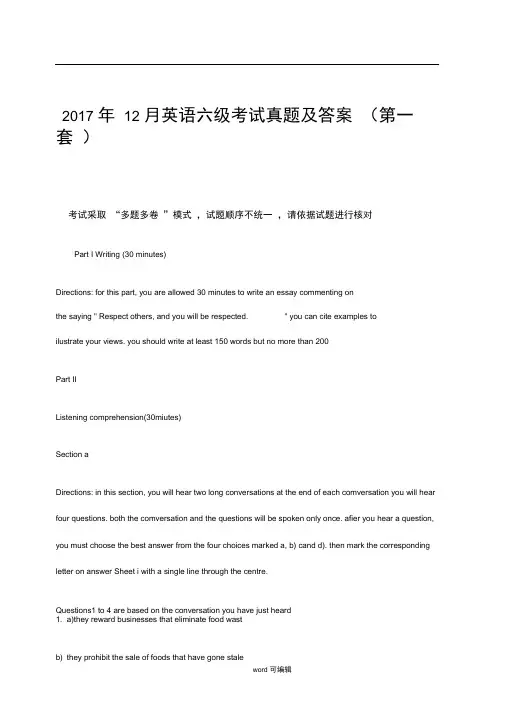
2017 年12 月英语六级考试真题及答案(第一套)考试采取“多题多卷”模式,试题顺序不统一,请依据试题进行核对Part I Writing (30 minutes)Directions: for this part, you are allowed 30 minutes to write an essay commenting onthe saying " Respect others, and you will be respected. " you can cite examples toilustrate your views. you should write at least 150 words but no more than 200Part IIListening comprehension(30miutes)Section aDirections: in this section, you will hear two long conversations at the end of each comversation you will hear four questions. both the comversation and the questions will be spoken only once. afier you hear a question, you must choose the best answer from the four choices marked a, b) cand d). then mark the corresponding letter on answer Sheet i with a single line through the centre.Questions1 to 4 are based on the conversation you have just heard1. a)they reward businesses that eliminate food wastb) they prohibit the sale of foods that have gone stalec) they facilitate the donation of unsold foods to the needyd) they forbid businesses to produce more foods than needed2. a)it imposed penalties on businesses that waste foodb) it passed a law aiming to stop overproductionC)it voted gainst food import from outside europe d) it prohibited the promotion of bulk food sales.3. a) it has warmed its people against possible food shortage.b) it has penalized businesses that keep overproducing foodsc) it has started a nationwide campaign against food waste.d) it has banned supermarkets from dumping edible foods.4 .a)the confusion over food expiration labels.b) the surplus resulting from overproductionc) americans' habit of buying food in bulkd) a lack of regulation on food consumptionQuestions 5 to 8 are based on the conversation you have just heard.5. a) it has started a week-long promotion campaign.b) it has just launched its annual anniversary salesc) it offers regular weekend sales all the year roundd) it specializes in the sale of ladies designer dresses6. a)price reductions for its frequent customers.b) coupons for customers with bulk purchases.c) free delivery of purchases for senior customers.d) price adjustments within seven days of purchase.7. a)mail a gift card to her.b) allow her to buy on credic) credit it to her accountd) give her some coupons.8. a) refunding for goods returnedb) free installing of appliances.c) prolonged goods warranty.d) complimentary tailoringSection bDirections: in this section, you will hear two passages. at the end of each passage, you will hear Iree or four questions. both the passage and the questions will be spoken only once After you hear a question, you must choose the best answer from the four choices marked a, b, cand d). then mark the corresponding letter on answer Sheet 1 with a single line through the centre.Questions 9 to 11 are based on the passage you have just heard9. a)they are thin, tall, and unlike real human beings.b) they have more than twenty different hair texturesc) they have twenty-four different body shapes in totald) they represent people from virtually all walks of life.10. a)they do not reflect young girls aspirationsb) they are not sold together with the originalc) their flat feet do not appeal to adolescentsd) their body shapes have not changed much11. a)in toy storesb) in shopping malls.c) on the internetd) at barbie shopsQuestions 12 to 15 are based on the passage you have just heard.12. a )moveable metal type began to be used in printingb) chinese printing technology was first introducec) the earliest known book was publishedd) metal type was imported from korea13. a) it had more than a hundred printing presses.b) it was the biggest printer in the 16th century.c) it helped the german people become literate.d) it produced some 20 million volumes in total14. a)it pushed handwritten books out of circulation.b) it boosted the circulation of popular works.c) it made writing a very profitable career.d) it provided readers with more choices.15. a) it accelerated the extinction of the latin language.b) it standardized the publication of grammar books.c) turned translation into a welcome profession.d) it promoted the growth of national languagesSection cDirections: in this section, you will hear three recordings of lectures or talks followed by three or four questions. the recordings will be played only once. after you hear a question,you must choose the best answer from the four choices marked a, b, c and d)Then mark the corresponding letter on answer sheet 1 with a single line through centre.Questions 16 to 18 are based on the recording you have just heard.16. a) they get bored after working for a period of time.b) they spend an average of one year finding a job.c) they become stuck in the same job for decades.d) they choose a job without thinking it through.17. a)see if there will be chances for promotion.b) find out what job choices are available.c) watch a film about ways of job hunting.d) decide which job is most attractive to you.18. a)the qualifications you have.b) the pay you are going to get.c) the culture of your target company.d) the work environment you will be in.19. a) it is as important as christmas for african-americans.b) it is a cultural festival founded for african-americans.c) it is an ancient festival celebrated by african-americans.d) it is a religious festival celebrated by african-americans20. a)to urge african-americans to do more for society.b) to call on african-americans to worship their godsc) to help african-americans to realize their goals.d) to remind african-americans of their sufferings.21. a)faith in self-determinationb) the first fruits of the harvestc) unity and cooperative economics d creative work and achievement.22. a)they recite a principleb) they take a solemn oathc) they drink wine from the unity cupd) they call out their ancestors' names.Questions 23 to 25 are based on the recording you have just heard23. a) it is one of the world's most healthy diets.b) it contains large amounts of dairy products.c) it began to impact the world in recent years.d) it consists mainly of various kinds of seafood.4. a) it involved 13, 000 researchers from asia, europe and america.b) it was conducted in seven mid-eastern countries in the 1950sc) it is regarded as one of the greatest researches of its kind.d) it has drawn the attention of medical doctors the world over.25. a) they care much about their health.b) they eat foods with little fat.c)they use little oil in cookingd) they have lower mortality ratesPart III Reading Comprehension(40 minutes)Section ADirections: In this section, there is a passage with ten blanks. You are required to select one word for each blank from a list of choices given in a word bank following the passage. Read the passage through carefully before making your choices. Each choice in the bank is identified by a letter. Please mark the corresponding letter for each item on Answer Sheet 2 with a single line through the centre. You may not use any of the words in the bank more than once.In the past 12 months,Nigeria has suffered from a shrinking economy, a slidingcurre ncy, and a proIon ged fuel shortage. Now, Africa ' s largest in facing a food crisis asmajor tomato fields have bee n destroyed by an in sect,lead ing to a n ati on wide shortage and escalating prices.The in sect, Tutaabsoluta, has destroyed 80% of farms in Kaduna, Nigeria's largesttomato produc ing state, leadi ng the gover nment there to declare a state of26 .The in sect, also known as the tomato leaf miner, devastates crops by 27 onfruits and diggi ng into and moving through stalks .It 28 in credibly quickly,breeding up to 12 generations per year if conditions are favorable. it is believed tohave 29 in South America in the early 1900s, and later spread to Europe before cross ing over to sub-Sahara n Africa.In Nigeria, where tomatoes are a staple of local diets,the in sect's effects aredevastat ing. Retail prices for a 30 of tomatoes at local markets have rise n from $0. 50to $2.50. Farmers are report ing steep losses and a new $20 milli on tomato-paste factory has 31 producti on due to the shortages.Given the moth's ability also to attack crops like pepper and potatoes, AuduOgbeh, Nigeria's minister of agriculture, has warned that the pest may"create seriousproblems for food 32 "in the coun try.Ogbeh says experts are in vestigati ng how tocon trol the pest ' s damage and preve nt its spread, which has gone largely 33 un tilnow.Despite being the continen t's sec on d-largest producer of tomatoes, Nigeria is 34 on $1 billi on worth of tomato-paste imports every year.as around 75% of thelocal harvest goes to waste tha nks to a lack of proper storage facilities. A further 35 inlocal supplies is yet ano ther un welcome setback to the in dustry.A)dependent I ) originatedB) Embark ing J) reducti onC) emerge nc K) reproducesD) feedi ng L ) securityE) grazes M ) terrorF) halted N) uncheckedG) han dful O ) uncheckedH) multitudeSectio n BDirections: In this secti on, you are going to read a passage with ten stateme nts attached to it. Each statement contains information given in one of the paragraphs. Identify the paragraph from which the information is derived. You may choose a paragraph more than once. Each paragraph is marked with a letter. Answer the questio ns by marking the corresp onding letter on An swer Sheet 2.who's really addicting you to Technology?A. "Nearly everyone i know is addicted in some measure to the internet, "wrote tony Schwartz in The New York Times. it's a common complaint these days. A steady stream of similar headlines accuse the net and its offspring apps, social media sites and online games of addicting us to distractionB. There's little doubt that nearly everyone who comes in contact with the net has difficulty concentration than it takes to post a status update. as one person ironically put it in the comments section of Schwartz'sonline article, "As I was reading this very excellent article.I stopped at least half a dozen times to cheek my email.C. There's something different about this technology: it is both invasive and persuasive.but who's at fault for its overuse ?To find solutions, it's important to understand whatwe ' re dealing with.There are four parties conspiring to keep you connected the tech,your boss, your friends and you.D. The technologies themselves and their makers, are the easiest suspects to blame for our diminishing attention spans. Nicholas Carr,author of The Shallows :what the internet is doing Our brains, wrote, The net is designed to be an interruption system, a machine geared to dividing attention.E. Online services like Facebook, twitter and the like, are called out ofmanipula-tion--making ,products so good that people can't stop using them. afterstudying these products for several years, I wrote a book about how they do it. I learnedit all starts with the business model. since these services rely on advertising revenue, The more frequentlyyou use money they make.It teams of people focused on engineering their services to be as engaging as possible. these products aren't habit-forming by chance; it's by design.' s no wminpdaenr itehseseemcpoloy they have an incentive to keep us hooked.F. However, as good as these services are, there are simple steps we can take to keepthem at bay.For example, we can change how often we receive the distracting notifications that trigger our urge to check.According to adam marchick, ceo of mobile marketing company kahuna, less than 15 percentof smartphone users ever bother to adjust their notification setlings--meaning the remaining 85 percent of us default to the app makers' every preset trigger.Google and Apple have made it far too difficult to adjust these settings so it's up to us to take steps ensure we set these triggers to suit our own needs, not the needs of the app makers.G.While companies like Facebook harvest attention to generate revenue fromadvertisers, other technologies have no such agenda. take email, for example. this system couldn't care less how often you use it. Yet t o many, email is the mosthabit-forming medium of all.We check email at all hours of the day--we're obsessed, butwhy? Because that's what the boss wants.For almost all white-collar jobs, A slowResponse to a message could hurt not only your reputation but also your livelihood.H. Your friends are also responsible.Think about this familiar scene.People gathered around a table,enjoying food and each others company. there's laughter and a bit of kidding. Then, during an interval in the conversation, someone takes out their phone to check who knows what.Barely anyone notices and no one says a thing.I. Now imagine the same dinner,but instead of checking their phone, the person belches(打嗝)-loudly.Everyone notices. unless the meal takes place in a beer house, this is considered bad manners. The impolite act violates the basic rules of etiquette. one has to wonder why don ' t we apply the same social norms to checking phones during meals,meetings and conversations as we do to other antisocial behaviors somehow, we accept it and say nothingwhen someone offends.J. The reality is taking one's phone out at the wrong time is worse than belching because, unlike other minoroffense, checking tech is contagious. once one person looks at their phone,other people feel compelled to dothe same, starting a chain reaction. the more people are on their phones, the fewer people are talking untilfinally you are the only one left not reading email or checking twitter. from a societal perspective, phonechecking is less like belching in public and more like another bad habit. our phones are like cigarettes-something to do when were bored or when our fingers need something to toy with seeing others enjoy asmoke,or sneak a quick glance, is too tempting to resist and soon everyone is doing it.K. The technology, your boss, and your friends, all influence how often you find yourself using (or overusing )these gadgets. but there's still someone who deserves scrutiny--the person holding the phone. L. I have a confession. even though i study habit-forming technology for a living, disconnecting is not easyfor me.I'm online far more than I'd like like Schwartz and so many others, I often find myself distracted andoff tack.I wanted to know why so i began self-monitoring to try to understand my behavior. that's when idiscovered an uncomfortable truth. i use technology as an escape. when I'm doing something I'd rather notdo, or when I'm someplace I'd rather not attention was often a good thing, like when passing time on publictransportation, but frequently my tech use was not so benign.when i faced difficult work, like thinking through an article idea or editing the same draft for the hundredthtime, for example, a more sinister screen would draw me in. i could easily escape discomfort.temporarlly.byanswering email or browsing ing the web under the pretense of so-called"research. "though I desperatelywanted to lay blame elsewhere, i finally had to admit that my bad habits had less to do with new-age.technology and more to do with old-fashioned procrastination( 拖延 )M. it's easy to blame technology for being so distracting, but distraction is nothing new.Aristotle and Socrates dehated nature of “ akrasia--our”tendency to do things agninstour interests. If we're honest with ourselves, tech is just another way to occupy our time and minds,if we weren ' t on our deWviec'es.d likely do similarly unproductive.N. personal technology is indeed more engaging than ever, and there's no doubt companies are engineeringtheir products and services to be more compelling and attractive but would want it any other way theintended result of making something better is that people use it more. that's not necessarily a problem, that'sprogress.O. These improvements don't mean we shouldn't attempt to control our use of technology. In order to makesure it doesn't control us, we should come to terms withthe fact that it's more than the technology itself that workplace culture, social norns ands responsible for our habits. ou individual behaviors all play a part to put technology in its place, we must be conscious notonly of how technology is changing, but also of how it is changing us.36.Online services are so designed that the more they are used, the more profit they generate.37. The author admits using technology as an escape from the task at hand.38. Checking phones at dinners is now accepted as normal but not belching39. To make proper use of technology, we should not only increase our awareness of how it is changing butalso how it is impacting us.40. Most of us find it hard to focus on our immediate tasks because of internet distractions41. when one person starts checking their phone, the others will follow suit.42. T he great majority of smartphone users don' t take the trouble to adjust their settings to suit their ownpurposes.43. T he internet is regarded by some as designed to distract our attention.44. The author attributes his tech addiction chiefly to his habit of putting off doing what he should45. W hite-collar workers check email round the clock because it is required by their employersSection BDirections: In this section, you are going to read a passage with ten statements attached to it. Eachstatement contains information given in one of the paragraphs. Identify the paragraph from which theinformation is derived. You may choose a paragraph more than once. Each paragraph is marked with a letter. Answer the questions by marking the corresponding letter on Answer Sheet 2.who's really addicting you to Technology?A. "Nearly everyone i know is addicted in some measure to the internet, "wrote tony Schwartz in The New York Times. it's a common complaint these days. A steady stream of similar headlines accuse the net and its offspring apps, social media sites and online games of addicting us to distractionB. There's little doubt that nearly everyone who comes in contact with the net has difficulty concentration than it takes to post a status update. as one person ironically put it in the comments section of Schwartz's online article, "As I was reading this very excellent article.I stopped at least half a dozen times to cheek my email.C. There's something different about this technology: it is both invasive and persuasive. but who's at fault for its overuse ?To find solutions, it's important to understand whatwe ' re dealing with.There are four parties conspiring to keep you connected the tech, your boss, your friends and you.D. The technologies themselves and their makers, are the easiest suspects to blame for our diminishing attention spans. Nicholas Carr,author of The Shallows :what theinternet is doing Our brains, wrote, The net is designed to be an interruption system, a machine geared to dividing attention.E. Online services like Facebook, twitter and the like, are called out of manipula-tion--making ,products so good that people can't stop using them.after studying these products for several years, I wrote a book about how they do it. I learned it all starts with the business model. since these services rely on advertising revenue, The more frequently you use money they make.It ' s no winder these companies employ teams of people focused on engineering their services to be as engaging as possible.these products aren't habit-forming by chance; it's by design. they have an incentive to keep us hooked.F. However, as good as these services are, there are simple steps we can take to keep them at bay.For example, we can change how often we receive the distracting notifications that trigger our urge tocheck.According to adam marchick, ceo of mobile marketing company kahuna, less than 15 percent of smartphone users ever bother to adjust their notification setlings--meaning the remaining 85 percent of us default to the app makers' every preset trigger.Google and Apple have made it far too difficult to adjust these settings so it's up to us to take steps ensure we set these triggers to suit our own needs, not the needs of the app makers.G.While companies like Facebook harvest attention to generate revenue from advertisers, other technologies have no such agenda. take email, for example. this system couldn't care less how often you use it. Yet t o many, email is the mosthabit-forming medium of all.We check email at all hours of the day--we're obsessed, butwhy? Because that's what the boss wants.For almost all white-collar jobs, A slowResponse to a message could hurt not only your reputation but also your livelihood.H. Your friends are also responsible.Think about this familiar scene.People gathered around a table, enjoying food and each others company. there's laughter and a bit of kidding. Then, during an interval in the conversation, someone takes out their phone to check who knows what.Barely anyone notices and no one says a thing.I. Now imagine the same dinner,but instead of checking their phone, the personbelches(打嗝)-loudly.Everyone notices. unless the meal takes place in a beer house, this is considered bad manners. The impolite act violates the basic rules of etiquette. one hasto wonder why don ' t we apply the sameciasol norms to checking phones during meals,meetings and conversations as we do to other antisocial behaviors somehow, we accept it and say nothing when someone offends.J. The reality is taking one's phone out at the wrong time is worse than belching because, unlike other minor offense, checking tech is contagious. once one person looks at their phone,other people feel compelled to do the same, starting a chain reaction. the more people are on their phones, the fewer people are talking until finally you are the only one left not reading email or checking twitter. from a societal perspective, phone checking is less like belching in public and more like another bad habit. our phones are like cigarettes-something to do when were bored or when our fingers need something to toy with seeing others enjoy a smoke,or sneak a quick glance, is too tempting to resist and soon everyone is doing it.K. The technology, your boss, and your friends, all influence how often you find yourself using (or overusing )these gadgets. but there's still someone who deserves scrutiny--the person holding the phone. L. I have a confession. even though i study habit-forming technology for a living, disconnecting is not easy for me.I'm online far more than I'd like like Schwartz and so many others, I often find myself distracted and off tack.I wanted to know why so i began self-monitoring to try to understand my behavior. that's when i discovered an uncomfortable truth. i use technology as an escape. when I'm doing something I'd rathernot do, or when I'm someplace I'd rather not attention was often a good thing, like whenpassing time on public transportation, but frequently my tech use was not so benign. when i faced difficult work, like thinking through an article idea or editing the same draft for the hundredth time, for example, a more sinister screen would draw me in. i could easily escape discomfort.temporarlly.by answering email orbrowsing ing the web under the pretense of so-called"research. "though I desperately wanted to lay blame elsewhere, i finally had to admit that my bad habits had less to do with new-age.technology and more to do with old-fashioned procrastination(拖延)M. it's easy to blame technology for being so distracting, but distraction is nothing new.Aristotle and Socrates dehated nature of “ akrasia--our”tendency to do things agninstour interests. If we're honest with ourselves, tech is just another way to occupy our time and minds,if we weren ' t on our deWviec'es.d likely do similarly unproductive.N. personal technology is indeed more engaging than ever, and there's no doubt companies are engineering their products and services to be more compelling and attractive but would want it any other way the intended result of making something better is that people use it more. that's not necessarily a problem, that's progress.O. These improvements don't mean we shouldn't attempt to control our use of technology. In order to make sure it doesn't control us, we should come to terms with the fact that it's more than the te chnology itself that ' s responsible for our habits. ourworkplace culture, social norns and individual behaviors all play a part to put technologyin its place, we must be conscious not only of how technology is changing, but also of how it is changing us.36.Online services are so designed that the more they are used, the more profit they generate.37. The author admits using technology as an escape from the task at hand.38. Checking phones at dinners is now accepted as normal but not belching39. To make proper use of technology, we should not only increase our awareness of how it is changing but also how it is impacting us.40. Most of us find it hard to focus on our immediate tasks because of distractions41. when one person starts checking their phone, the others will follow suit.42. T he great majority of smartphone users don' t take the trouble to adjust their settings to suit their own purposes.43. T he internet is regarded by some as designed to distract our attention.44. The author attributes his tech addiction chiefly to his habit of putting off doing what he should45. W hite-collar workers check email round the clock because it is required employers Part IVTranslation (30 minutes)Directions: for this part, you are allowed 30 minutes to translate a passage from chinese into English. you should write your answer on answer sheet 2. internet by their太湖是中国东部的一个淡水湖,占地面积2250 平方公里,是中国第三大淡水湖,仅次于鄱阳和洞庭。
2017年6月大学英语六级考试真题及答案解析(共三套)

2017年6月大学英语六级考试真题及答案解析(共三套)2017年6月大学英语六级考试真题及答案解析(第一套)Part I Writing (30 minutes)Directions: Suppose you are asked to give advice on whether to attend a vocational college or a university, write an essay to state your opinion. You are required to write at least 150 words but no more than 200 words.【参考范文】Whether to Attend a Vocational College or a University?It’s an undisputable truth that virtually all high school graduates will encounter the choices between a vocational college and a university. And when it comes to this question, students’ ideas are not cut from the same cloth. In point of which to choose and what to be taken into consideration, my advices are as follow.In the first place, we should be conscious of the fact that both of the two choices have its own superiorities. For instance, a vocational college specializes in cultivating human resources with practical capabilities; while a university serves as the cradle of academic researchers in different fields. Then it does follow that high school graduates should have a clear picture of themselves. That is to say, they should know their merits and demerits and their choices must give play to their strengths whilst circumvent weaknesses. In addition, interest is the best teacher and it’s also the premise of learning on one’s own initiative. Thus interest must be taken into account because it can not only decide how far one can reach academically and professionally but also how happy and fulfilled one will be.In brief, all above just goes to show that there really is noone-size-fits-all answer for the question. The key lies in a clear cognition, accurate self-positioning and the interest of oneself. Only then can every one find a right path that works best for us.Part II Listening Comprehension (30 minutes)Section ADirections: In this section, you will hear two long conversations. At the end of each conversation, you will hear four questions. Both the conversation and the questions will be spoken only once. After you hear a question, you must choose the best answer from the four choices marked A), B), C) and D). Then mark the corresponding letter on Answer Sheet 1 with a single line through the centre.Questions 1 to 4 are based on the conversation you have just heard.1. A) He would feel insulted. B) He would feel very sad.C) He would be embarrassed. D) He would be disappointed.【答案】A【解析】题目问如果男士在二手书店中发现了自己写的书,那么男士会感觉怎样。
2017年6月大学英语六级真题 答案解析 全三套
2017 年6 月大学英语六级考试真题(第1 套)Part ⅠWriting (30 minutes)Directions: Suppose you are asked to give advice on whether to attend a vocational college or a university, write an essay to state your opinion. You are required to write at least 150 words but no morethan 200 words.Part ⅡListening Comprehension (30 minutes)Section ADirections : In this section, you will hear two long conversations. At the end of each conversation, you will hear four questions. Both the conversation and the questions will be spoken only once. Afteryou hear a question, you must choose the best answer from the four choices marked A), B), C)and D). Then mark the corresponding letter on Answer Sheet 1 with a single line through thecentre.Questions 1 to 4 are based on the conversation you have just heard.1.A) He would feel insulted. B) He would feel very sad.C) He would be embarrassed. D) He would be disappointed.2.A) They are worthy of a prize. B) They are of little value.C)They make good reading. D) They need improvement.3.A) He seldom writes a book straight through.B)He writes several books simultaneously.C)He draws on his real-life experiences.D)He often turns to his wife for help.4.A) Writing a book is just like watching a football match.B)Writers actually work every bit as hard as footballers.C)He likes watching a football match after finishing a book.D)Unlike a football match, there is no end to writing a book.Questions 5 to 8 are based on the conversation you have just heard.5.A) A chievements of black male athletes in college.B)Financial assistance to black athletes in college.C)High college dropout rates among black athletes.D)Undergraduate enrollments of black athletes.6.A) They display great talent in every kind of game.B)They are better at sports than at academic work.C)They have difficulty finding money to complete their studies.D)They make money for the college but often fail to earn a degree.7.A) About 15%. B) Around 40%.C)Slightly over 50%. D) Approximately 70%.8.A) Coaches lack the incentive to graduate them.B)College degrees do not count much to them.C)They have little interest in academic work.D)Schools do not deem it a serious problem.Section BDirections: In this section, you will hear two passages. At the end of each passage, you will hear three or four questions. Both the passage and the questions will be spoken only once. After you hear aquestion, you must choose the best answer from the four choices marked A), B), C) and D).Then mark the corresponding letter on Answer Sheet 1 with a single line through the centre. Questions 9 to 12 are based on the passage you have just heard.9.A) Marketing strategies. B) Holiday shopping.C) Shopping malls. D) Online stores.10.A) About 50% of holiday shoppers.B)About 20-30% of holiday shoppers.C)About 136 million.D)About 183.8 million.11.A) They have fewer customers.B)They find it hard to survive.C)They are thriving once more.D)They appeal to elderly customers.12.A) Better quality of consumer goods.B)Higher employment and wages.C)Greater varieties of commodities.D)People having more leisure time.Questions 13 to 15 are based on the passage you have just heard.13.A) They are new species of big insects.B)They are overprescribed antibiotics.C)They are life-threatening diseases.D)They are antibiotic-resistant bacteria.14.A) Antibiotics are now in short supply.B)Many infections are no longer curable.C)Large amounts of tax money are wasted.D)Routine operations have become complex.15.A) Facilities.B)Expertise.C)Money.D)Publicity.Section CDirections: In this section, you will hear three recordings of lectures or talks followed by three or four questions. The recordings will be played only once. After you hear a question, you must choosethe best answer from the four choices marked A), B), CJ and D). Then mark the correspondingletter on Answer Sheet 1 with a single line through the centre.Questions 16 to 18 are based on the recording you have just heard.16.A) It is accessible only to the talented.B)It improves students’ ability to t hink.C)It starts a lifelong learning process.D)It gives birth to many eminent scholars.17.A) They encourage academic democracy.B)They promote globalization.C)They uphold the presidents’ authority.D)They protect students’rights.18.A) His thirst for knowledge. B) His eagerness to find a job.C) His contempt for authority. D) His potential for leadership.Questions 19 to 22 are based on the recording you have just heard.19.A) Few people know how to retrieve information properly.B)People can enhance their memory with a few tricks.C)Most people have a rather poor long-term memory.D)People tend to underestimate their mental powers.20.A) They present the states in a surprisingly different order.B)They include more or less the same number of states.C)They are exactly the same as is shown in the atlas.D)They contain names of the most familiar states.21.A) Focusing on what is likely to be tested.B)Having a good sleep the night before.C)Reviewing your lessons where the exam is to take place.D)Making sensible decisions while choosing your answers.22.A) Discover when you can learn best.B) Change your time of study daily.B)Give yourself a double bonus afterwards.D) Follow the example of a marathon runner.Questions 23 to 25 are based on the recording you have just heard.23.A) He is a politician. B) He is a businessman.C)He is a sociologist. D) He is an economist.24.A) In slums.B)In Africa.C)In pre-industrial societies.D)In developing countries.25.A) They have no access to health care, let alone entertainment or recreation.B)Their income is less than 50% of the national average family income.C)They work extra hours to have their basic needs met.D)Their children cannot afford to go to private schools.Part III Reading Comprehension (40 minutes) Section ADirections: In this section, there is a passage with ten blanks. You are required to select one word for each blank from a list of choices given in a word bank following the passage. Read the passagethrough carefully before making your choices. Each choice in the bank is identified by a letter.Please mark the corresponding letter for each item on Answer Sheet 2 with a single linethrough the centre. You may not use any of the words in the bank more than once.Questions 26 to 35 are based on the following passage.Let ’s all stop judging people who talk to themselves. New research says that those who can ’t seem to keep their inner monologues( 独 白 ) in are actually more likely to stay on task, remain 26 better and show improved perception capabilities. Not bad, really, for some extra muttering.According to a series of experiments published in the Quarterly Journal of Experimental Psychology by professors Gary Lupyan and Daniel Swignley, the act of using verbal clues to 27 mental pictures helps people function quicker. In one experiment, they showed pictures of various objects to twenty 28 and asked them to find just one of those, a banana. Half were 29 to repeat out loud what they were looking for and the other half kept their lips 30 . Those who talked to themselves found the banana slightly faster than those who didn ’t ,the researchers say. In other experiments, Lupyan and Swignley found that 31 the name of a common product when on the hunt for it helped quicken someone’s pace, but talking about uncommon items showed no advantage and slowed you down.Common research has long held that talking themselves through a task helps children learn, although doin g so when you’ve 32 matured is not a great sign of 33 . The two professors hope to refute that idea, 34 that just as when kids walk themselves through a process, adults can benefit from using language not just to communicate, but also to help “augment thinking”.Of course, you are still encouraged to keep the talking at library tones and, whatever you do, keep the information you share simple, like a grocery list. At any 35 , there’s still such a thing as too much information.Section BDirections: In this section, you are going to read a passage with ten statements attached to it. Eachstatement contains information given in one of the paragraphs. Identify the paragraph fromwhich the information is derived. You may choose a paragraph more than once.Eachparagraph is marked with a letter. Answer the questions by marking the correspondingletter on Answer Sheet 2.Rich Children and Poor Ones Are Raised Very Differently[A] The lives of children from rich and poor American families look more different than ever before.[B] Well-off families are ruled by calendars, with children enrolled in ballet, soccer and after-school programs, according to a new Pew Research Center survey. There are usually two parents, who spend a lotA) Apparently B) Arrogance C) Brilliance D) Claiming E) Dedicated F) Focused G) Incur H) Instructed I) ObscurelyJ) SealedK) spectatorsL) TriggerM) UtteringN) VolumeO) Volunteersof time reading to children and worrying about their anxiety levels and hectic schedules.[C]In poor families, meanwhile, children tend to spend their time at home or with extended family. They are more likel y to grow up in neighborhoods that their parents say aren’t great for raising children, and their parents worry about them getting shot, beaten up or in trouble with the law.[D]The class differences in child rearing are growing — a symptom of widening inequality withfar-reaching consequences. Different upbringings set children on different paths and can deepen socioeconomic divisions, especially because education is strongly linked to earnings. Children grow uplearning the skills to succeed in their socioeconomic stratum (阶层), but not necessarily others.[E]“Early childhood experiences can be very consequential for children’s long-term social, emotional and cognitive development,” said Sean Reardon, professor of poverty and inequality in education at Stanford University. “And because those influence educational success and later earnings, early childhood experiences cast a lifelong shadow.” The cycle continues: Poorer parents have less time and fewer resources to invest in their children, which can leave children less prepared for school and work, which leads to lower earnings.[F]American parents want similar things for their children, the Pew report and past research have found: for them to be healthy and happy, honest and ethical, caring and compassionate. There is no best parenting style or philosophy, researchers say, and across income groups, 92% of parents say they are doing a good job at raising their children. Yet they are doing it quite differently. Middle-class and higher- income parents see their children as projects in need of careful cultivation, says Annette Lareau, whose groundbreaking research on the topic was published in her book Unequal Childhoods: Class, Race and Family Life. They try to develop their skills through close supervision and organized activities, and teach children to question authority figures and navigate elite i nstitutions.[G]Working-class parents, meanwhile, believe their children will naturally thrive, and give them far greater independence and time for free play. They are taught to be compliant and respectful to adults. There are benefits to both approaches. Working-class children are happier, more independent, complain less and are closer with family members, Ms. Lareau found. Higher-income children are more likely to declare boredom and expect their parents to solve their problems. Yet later on, the more affluent children end up in college and on the way to the middle class, while working-class children tend to struggle. Children from higher-income families are likely to have the skills to navigate bureaucracies and succeed in schools and workplaces, Ms. Lareau said.[H]“Do all parents want the most success for their children? Absolutely,” she said. “Do some strategies give children more advantages than others in institutions? Probably they do. Will parents be damaging children if they have one fewer organized activity? No, I really doubt i t.”[I]Social scientists say the differences arise in part because low-income parents have less money to spend on music class or preschool, and less flexible schedules to take children to museums or attend school events. Extracurricular activities reflect the differences in child rearing in the Pew survey, which was of a nationally representative sample of 1,807 parents. Of families earning more than $75,000 a year, 84% say their children have participated in organized sports over the past year, 64% have done volunteer work and 62% have taken lessons in music, dance or art. Of families earning less than $30,000, 59% of children have done sports, 37% have volunteered and 41% have taken arts classes.[J]Especially in affluent families, children start young. Nearly half of high-earning, college-graduate parents enrolled their children in arts classes before they were 5, compared with one-fifth of low-income, less- educated parents. Nonetheless, 20% of well-off parents say their children’s schedules are too hectic, compared with 8% of poorer parents.[K]Another example is reading aloud, which studies have shown gives children bigger vocabularies and better reading comprehension in school. 71% of parents with a college degree say they do it every day, compared with 33% of those with a high school diploma or less. White parents are more likely than others to read to their children daily, as are married parents. Most affluent parents enroll their children in preschool or day care, while low-income parents are more likely to depend on family members. Discipline techniques vary by education level: 8% of those with a postgraduate degree say they often beat their children, compared with 22% of those with a high school degree or less.[L]The survey also probed attitudes and anxieties. Interestingly, parents’ attitudes toward education do not seem to reflect their own educational background as much as a belief in the importance of education for upward mobility. Most American parents say they are not concerned a bout their children’s grades as long as they work hard. But 50% of poor parents say it is extremely important to them that their children earn a college degree, compared with 39% of wealthier parents.[M]Less-educated parents, and poorer and black and Latino parents are more likely to believe that there is no such thing as too much involvement in a child’s education. Parents who are white, wealthy or college- educated say too much involvement can be bad. Parental anxieties reflect their circumstances. High- earning parents are much more likely to say they live in a good neighborhood for raising children. While bullying is parents’ greatest concern over all, nearly half of low-income parents worry their child will get shot, compared with one-fifth of high-income parents. They are more worried about their children being depressed or anxious.[N]In the Pew survey, middle-class families earning between $30,000 and $75,000 a year fell right between working-class and high-earning parents on issues like the quality of their neighborhood for raising children, participation in extracurricular activities and involvement in their children’ s education.[O]Children were not always raised so differently. The achievement gap between children from high- and low-income families is 30-40% larger among children born in 2001 than those born 25 years earlier, according to Mr. Reardon’ s research. People used to live near people of different income levels; neighborhoods are now more segregated by income. More than a quarter of children live in single-parent households — a historic high, according to Pew 一and these children are three times as likely to live in poverty as those who live with married parents. Meanwhile, growing income inequality has coincided with the increasing importance of a college degree for earning a middle-class w age.[P]Yet there are recent signs that the gap could be starting to shrink. In the past decade, even as income inequality has grown, some of the socioeconomic differences in parenting, like reading to children and going to libraries, have narrowed.[Q]Public policies aimed at young children have helped, including public preschool programs and reading initiatives. Addressing differences in the earliest years, it seems, could reduce inequality in the next generation.36.Working-class parents teach their children to be obedient and show respect to adults.37.American parents, whether rich or poor, have similar expectations of their children despite different ways of parenting.38.While rich parents are more concerned with their children’s psychological well-being, poor parents are more worried about their children’s safety.39.The increasing differences in child rearing between rich and poor families reflect growing social inequality.40.Parenting approaches of working-class and affluent families both have a dvantages.41.Higher-income families and working-class families now tend to live in different neighborhoods.42.Physical punishment is used much less by well-educated parents.43.Ms. Lareau doesn’t believe participating in fewer after-class activities will negatively affect children’s development.44.Wealthy parents are concerned about their children’s mental health and busy schedules.45.Some socioeconomic differences in child rearing have shrunk in the p ast ten years.Section CDirections: There are 2 passages in this section. Each passage is followed by some questions or unfinished statements. For each of them there are four choices marked A, B, C and D. Youshould decide on the best choice and mark the corresponding letter on Answer Sheet 2 with asingle line through the centre.Passage OneQuestions 46 to 50 are based on the following passage.Tennessee’s technical and community colleges will not outsource(外包) management of their facilities to a private company, a decision one leader said was bolstered by an analysis of spending at each campus.In an email sent Monday to college presidents in the Tennessee Board of Regents system, outgoing Chancellor John Morgan said an internal analysis showed that each campus’ spending on facilities management fell well below the industry standards identified by the state. Morgan said those findings —which included data from the system’s 13 community colleges, 27 technical colleges and six universities —were part of the decision not to move forward with Governor Bill Haslam’s proposal to privatize management of state buildings in an effort to save money.“While these numbers are still being validated by the state, we feel any adjustments they might suggest will be immaterial,” Morgan wrote to the presidents. “System institutions are operating very efficiently based on this analysis, raising the question of the value of pursuing a broad scale outsourcing initiative.”Worker’s advocates have criticized Haslam’s plan, saying it would mean some campus workers would lose their jobs or benefits. Haslam has said colleges would be free to opt in or out of the out souring plan, which has not been finalized.Morgan notified the Haslam administration of his decision to opt out in a letter sent last week. That letter, which includes several concerns Morgan has with the plan, was originally obtained by The Commercial Appeal in Memphis.In an email statement from the state’s Office of Customer Focused Government, which is examining the possibility of outsourcing, spokeswoman Michelle R. Martin said officials were still working to analyze the data from the Board of Regents. Data on management expenses at the college system and in other state departments will be part of a “business justification” the state will use as officials deliberate the specifics of an outsourcing plan.“The state’s fac ilities management project team is still in the process of developing its business justification and expects to have that completed and available to the public at the end of February,” Martin said. “At this time there is nothing to take action on since the analysis has yet to be completed.”Morgan’s comments on outsourcing mark the second time this month that he has come out against one of Haslam’s plans for higher education in Tennessee. Morgan said last week that he would retire at the end of January beca use of the governor’s proposal to split off six universities of the Board of Regents system and create separate governing boards for each of them. In his resignation letter, Morgan called the reorganization “unworkable”.46.What do we learn about the decision of technical and community colleges in Tennessee?A)It is backed by a campus spending analysis.B)It has been flatly rejected by the governor.C)It has neglected their faculty’s demands.D )It will improve their financial situation.47.What does the campus spending analysis reveal?A)Private companies play a big role in campus management.B)Facilities management by colleges is more c ost-effective.C)Facilities management has greatly improved in recent years.D)Colleges exercise foil control over their own financial a ffairs.48.Workers’ supporters argue that Bill Haslam’s proposal would .A)deprive colleges of the right to manage their facilitiesB)make workers less motivated in performing dutiesC)render a number of campus workers joblessD)lead to the privatization of campus facilities49.What do we learn from the state spokeswoman’s response to John Morgan’s d ecision?A)The outsourcing plan is not yet finalized.B)The outsourcing plan will be implemented.C)The state officials are confident about the outsourcing plan.D)The college spending analysis justifies the outsourcing plan.50.Why did John Morgan decide to resign?A)He had lost confidence in the Tennessee state government.B)He disagreed with the governor on higher education policies.C)He thought the state’s outsourcing proposal was simply unworkable.D)He opposed the governor’s plan to reconstruct the college board system.Passage TwoQuestions 51 to 55 are based on the following passage.Beginning in the late sixteenth century, it became fashionable for young aristocrats to visit Paris,Venice, Florence, and above all, Rome, as the culmination(终极) of their classical education. Thus wasborn the idea of the Grand Tour, a practice which introduced Englishmen, Germans, Scandinavians, and also Americans to the art and culture of France and Italy for the next 300 years. Travel was arduous and costly throughout the period, possible only for a privileged class—the same that produced gentlemen scientists, authors, antique experts, and patrons of the arts.The Grand Tourist was typically a young man with a thorough grounding in Greek and Latin literature as well as some leisure time, some means, and some interest in art. The German traveler Johann Winckelmann pioneered the field of art history with his comprehensive study of Greek and Roman sculpture; he was portrayed by his friend Anton Raphael Mengs at the beginning of his long residence in Rome. Most Grand Tourists, however, stayed for briefer periods and set out with less scholarly intentions, accompanied by a teacher or guardian, and expected to return home with souvenirs of their travels as well as an understanding of art and architecture formed by exposure to great masterpieces.London was a frequent starting point for Grand Tourists, and Paris a compulsory destination; many traveled to the Netherlands, some to Switzerland and Germany, and a very few adventurers to Spain, Greece, or Turkey. The essential place to visit, however, was Italy. The British traveler Charles Thompsonspoke for many Grand Tourists when in 1744 he described himself as “being impatiently desirous of viewing a country so famous in history, a country which once gave laws to the world, and which is at present the greatest school of music and painting, contains the noblest productions of sculpture and architecture, and is filled with cabinets of rarities, and collections of all kinds of historical relics”. Within Italy, the great focus was Rome, whose ancient ruins and more recent achievements were shown to every Grand Tourist. Panini’s Ancient Rome and Modem Rome represent the sights most prized, including celebrated Greco-Roman statues and views of famous ruins, fountains, and churches. Since there were few museums anywhere in Europe before the close of the eighteenth century, Grand Tourists often saw paintings and sculptures by gaining admission to private collections, and many were eager to acquire examples of Greco-Roman and Italian art for their own collections. In England, where architecture was increasingly seen as an aristocratic pursuit, noblemen often applied what they learned from the villas of Palladio in the Veneto and the evocative ( 唤起回忆的) ruins of Rome to their own country houses and gardens.51.What is said about the Grand Tour?A)It was fashionable among young people of the time.B)It was unaffordable for ordinary people.C)It produced some famous European artists.D)It made a compulsory part of college education.52.What did Grand Tourists have in common?A)They had much geographic knowledge.B)They were courageous and venturesome.C)They were versed in literature and interested in art.D)They had enough travel and outdoor-life experience.53.How did Grand Tourists benefit from their travel?A)They found inspiration in the world’s greatest masterpieces.B)They got a better understanding of early human civilization.C)They developed an interest in the origin of modem art forms.D)They gained some knowledge of classical art and architecture.54.Why did many Grand Tourists visit the private collections?A)They could buy unique souvenirs there to take back home.B)Europe hardly had any museums before the 19th century.C)They found the antiques there more valuable.D)Private collections were of greater variety.55.How did the Grand Tour influence the architecture in England?A)There appeared more and more Roman-style buildings.B)Many aristocrats began to move into Roman-style villas.C)Aristocrats,country houses all had Roman-style gardens.D) Italian architects were hired to design houses and gardens.Part IV Translation (30 minutes) Directions: For this part, you are allowed 30 minutes to translate a passage from Chinese intoEnglish. You should write your answer on Answer Sheet 2.唐朝始于618 年,终于907 年,是中国历史上最灿烂的时期。
2017年6月大学英语六级考试真题及答案解析(第二套加第三套)
Part I Writing (30 minutes)
Directions: Suppose you are asked to give advice on whether to major in science or humanities at college, write an essay to state your opinion. You are required to write at least 150 words but no more than 200 wo是怎么对这一主题感兴趣的。男士在回答时提到, 对逼近的危险的恐惧成为了这一大型拍摄项目的主题。由此可推断出,《洪水将至》是一本 摄影集。故选 D。
6. A) When painting the concert hall of Bruges. B) When vacationing in an Italian coastal city. C) When taking pictures for a concert catalogue. D) When writing about Belgium’s coastal regions. 【答案】C 【解析】男士在回答女士的问题(一开始是怎么对这一主题感兴趣的)时提及,“2006 年,布鲁日城的音乐厅让我为一个新的音乐节的目录拍一些关于水的主题的照片”。由此可 知,男士是在为音乐节目录拍照时想出了这一作品的主题。故选 C。 7. A) The entire European coastline will be submerged. B)The rich heritage of Europe will be lost completely. C)The seawater of Europe will be seriously polluted. D)The major European scenic spots will disappear. 【答案】A 【解析】男士在对话中提及,传媒报导中有大量警惕性文章是关于即将发生的气候突 变。并且对话中女士问男士,关于书中的原话“我不想拍摄灾难,我想拍摄即将发生的灾难” 能否说些什么。男士在回答,整个欧洲的海岸线被淹没只是时间问题,这一点现在非常清楚。 由此可知,气候突变发生时,整个欧洲的海岸线将被淹没。故选 A。 8. A) Its waterways are being increasingly polluted. B)People cannot get around without using boats. C)It attracts large numbers of tourists from home and abroad. D)Tourists use wooden paths to reach their hotels in the morning. 【答案】D 【解析】对话中男士在回答女士的问题(关于历史在这个项目中的作用)时提及,威 尼斯是一座一直受到海水威胁的城市,在那里每天早上会建起接木桥让游客通往旅馆。故选 D。 Section B Directions: In this section, you will hear two passages. At the end of each passage, you will hear three or four questions. Both the passage and the questions
打印版2017年6月大学英语六级真题+答案解析-全三套
2017 年6 月大学英语六级考试真题(第1 套)Part ⅠWriting (30 minutes)Directions: Suppose you are asked to give advice on whether to attend a vocational college or a university, write an essay to state your opinion. You are required to write at least 150 words but no morethan 200 words.________________________________________________________________________________________________________________________________________________________________________________________________________________________________________________________________________________________________________________________________________________________________________________________________________________________________________________________________________________________________________________________________________________________________________________________________________________________________________________________________________________________________________________________________________________________________________________________________________________________________________________________________________________________________________________________________________________________________________________________________________________________________________________________________________________________________________________________________________________________________________________________________________________________________________________________________________________________________________________________________________________Part ⅡListening Comprehension (30 minutes)Section ADirections : In this section, you will hear two long conversations. At the end of each conversation, you will hear four questions. Both the conversation and the questions will be spoken only once. After youhear a question, you must choose the best answer from the four choices marked A), B), C) andD). Then mark the corresponding letter on Answer Sheet 1 with a single line through thecentre.Questions 1 to 4 are based on the conversation you have just heard.1.A) He would feel insulted. B) He would feel very sad.C) He would be embarrassed. D) He would be disappointed.2.A) They are worthy of a prize. B) They are of little value.C)They make good reading. D) They need improvement.3.A) He seldom writes a book straight through.B)He writes several books simultaneously.C)He draws on his real-life experiences.D)He often turns to his wife for help.4.A) Writing a book is just like watching a football match.B)Writers actually work every bit as hard as footballers.C)He likes watching a football match after finishing a book.D)Unlike a football match, there is no end to writing a book.Questions 5 to 8 are based on the conversation you have just heard.5.A) A chievements of black male athletes in college.B)Financial assistance to black athletes in college.C)High college dropout rates among black athletes.D)Undergraduate enrollments of black athletes.6.A) They display great talent in every kind of game.B)They are better at sports than at academic work.C)They have difficulty finding money to complete their studies.D)They make money for the college but often fail to earn a degree.7.A) About 15%. B) Around 40%.C)Slightly over 50%. D) Approximately 70%.8.A) Coaches lack the incentive to graduate them.B)College degrees do not count much to them.C)They have little interest in academic work.D)Schools do not deem it a serious problem.Section BDirections: In this section, you will hear two passages. At the end of each passage, you will hear three or four questions. Both the passage and the questions will be spoken only once. After you hear aquestion, you must choose the best answer from the four choices marked A), B), C) and D).Then mark the corresponding letter on Answer Sheet 1 with a single line through the centre. Questions 9 to 12 are based on the passage you have just heard.9.A) Marketing strategies. B) Holiday shopping.C) Shopping malls. D) Online stores.10.A) About 50% of holiday shoppers.B)About 20-30% of holiday shoppers.C)About 136 million.D)About 183.8 million.11.A) They have fewer customers.B)They find it hard to survive.C)They are thriving once more.D)They appeal to elderly customers.12.A) Better quality of consumer goods.B)Higher employment and wages.C)Greater varieties of commodities.D)People having more leisure time.Questions 13 to 15 are based on the passage you have just heard.13.A) They are new species of big insects.B)They are overprescribed antibiotics.C)They are life-threatening diseases.D)They are antibiotic-resistant bacteria.14.A) Antibiotics are now in short supply.B)Many infections are no longer curable.C)Large amounts of tax money are wasted.D)Routine operations have become complex.15.A) Facilities.B)Expertise.C)Money.D)Publicity.Section CDirections: In this section, you will hear three recordings of lectures or talks followed by three or four questions. The recordings will be played only once. After you hear a question, you must choosethe best answer from the four choices marked A), B), CJ and D). Then mark the correspondingletter on Answer Sheet 1 with a single line through the centre.Questions 16 to 18 are based on the recording you have just heard.16.A) It is accessible only to the talented.B)It improves students’ ability to t hink.C)It starts a lifelong learning process.D)It gives birth to many eminent scholars.17.A) They encourage academic democracy.B)They promote globalization.C)They uphold the presidents’ authority.D)They protect students’rights.18.A) His thirst for knowledge. B) His eagerness to find a job.C) His contempt for authority. D) His potential for leadership.Questions 19 to 22 are based on the recording you have just heard.19.A) Few people know how to retrieve information properly.B)People can enhance their memory with a few tricks.C)Most people have a rather poor long-term memory.D)People tend to underestimate their mental powers.20.A) They present the states in a surprisingly different order.B)They include more or less the same number of states.C)They are exactly the same as is shown in the atlas.D)They contain names of the most familiar states.21.A) Focusing on what is likely to be tested.B)Having a good sleep the night before.C)Reviewing your lessons where the exam is to take place.D)Making sensible decisions while choosing your answers.22.A) Discover when you can learn best.B) Change your time of study daily.B)Give yourself a double bonus afterwards.D) Follow the example of a marathon runner.Questions 23 to 25 are based on the recording you have just heard.23.A) He is a politician. B) He is a businessman.C)He is a sociologist. D) He is an economist.24.A) In slums.B)In Africa.C)In pre-industrial societies.D)In developing countries.25.A) They have no access to health care, let alone entertainment or recreation.B)Their income is less than 50% of the national average family income.C)They work extra hours to have their basic needs met.D)Their children cannot afford to go to private schools.Part III Reading Comprehension (40 minutes) Section ADirections: In this section, there is a passage with ten blanks. You are required to select one word for each blank from a list of choices given in a word bank following the passage. Read the passagethrough carefully before making your choices. Each choice in the bank is identified by a letter.Please mark the corresponding letter for each item on Answer Sheet 2 with a single linethrough the centre. You may not use any of the words in the bank more than once.Questions 26 to 35 are based on the following passage.Let’s all stop judging people who talk to themselves. New research says that those who can’t seem to keep their inner monologues( 独白) in are actually more likely to stay on task, remain 26 better and show improved perception capabilities. Not bad, really, for some extra muttering.According to a series of experiments published in the Quarterly Journal of Experimental Psychologyby professors Gary Lupyan and Daniel Swignley, the act of using verbal clues to 27 mental pictures helps people function quicker.In one experiment, they showed pictures of various objects to twenty 28 and asked them to findjust one of those, a banana. Half were 29 to repeat out loud what they were looking for and the other half kept their lips 30 . Those who talked to themselves found the banana slightly faster than those who didn’t,the researchers say. In other experiments, Lupyan and Swignley found that 31 the name of a common product when on the hunt for it helped quicken someone’s pace, but talking about uncommon items showed no advantage and slowed you down.Common research has long held that talking themselves through a task helps children learn, although doing so when you’ve 32 matured is not a great sign of 33 . The two professors hope to refute that idea, 34 that just as when kids walk themselves through a process, adults can benefit from using language not just to communicate, but also to help “augment thinking”.Of course, you are still encouraged to keep the talking at library tones and, whatever you do, keep the information you share simple, like a grocery list. At any 35 , there’s still such a thing as too much information.Section BDirections: In this section, you are going to read a passage with ten statements attached to it. Each statement contains information given in one of the paragraphs. Identify the paragraph fromwhich the information is derived. You may choose a paragraph more than once.Eachparagraph is marked with a letter. Answer the questions by marking the correspondingletter on Answer Sheet 2.Rich Children and Poor Ones Are Raised Very Differently[A]The lives of children from rich and poor American families look more different than ever before.[B]Well-off families are ruled by calendars, with children enrolled in ballet, soccer and after-school programs, according to a new Pew Research Center survey. There are usually two parents, who spend a lotof time reading to children and worrying about their anxiety levels and hectic schedules.[C]In poor families, meanwhile, children tend to spend their time at home or with extended family. They are more likely to grow up in neighborhoods that their parents say aren’t great for raising children, and their parents worry about them getting shot, beaten up or in trouble with the law.[D]The class differences in child rearing are growing — a symptom of widening inequality withfar-reaching consequences. Different upbringings set children on different paths and can deepen socioeconomic divisions, especially because education is strongly linked to earnings. Children grow up learning the skills to succeed in their socioeconomic stratum (阶层), but not necessarily others.[E]“Early childhood experiences can be very consequential for children’s long-term social, emotional and cognitive development,” said Sean Reardon, professor of poverty and inequality in education at Stanford University. “And because those influence educational success and later earnings, early childhood experien ces cast a lifelong shadow.” The cycle continues: Poorer parents have less time and fewer resources to invest in their children, which can leave children less prepared for school and work, which leads to lower earnings.[F]American parents want similar things for their children, the Pew report and past research have found: for them to be healthy and happy, honest and ethical, caring and compassionate. There is no best parenting style or philosophy, researchers say, and across income groups, 92% of parents say they are doing a good job at raising their children. Yet they are doing it quite differently. Middle-class and higher- income parents see their children as projects in need of careful cultivation, says Annette Lareau, whose groundbreaking research on the topic was published in her book Unequal Childhoods: Class, Race and Family Life. They try to develop their skills through close supervision and organized activities, and teach children to question authority figures and navigate elite i nstitutions.[G]Working-class parents, meanwhile, believe their children will naturally thrive, and give them far greater independence and time for free play. They are taught to be compliant and respectful to adults. There are benefits to both approaches. Working-class children are happier, more independent, complain less andare closer with family members, Ms. Lareau found. Higher-income children are more likely to declare boredom and expect their parents to solve their problems. Yet later on, the more affluent children end up in college and on the way to the middle class, while working-class children tend to struggle. Children from higher-income families are likely to have the skills to navigate bureaucracies and succeed in schools and workplaces, Ms. Lareau said.[H]“Do all parents want the most success for their children? Absolutely,” she said. “Do some strategies give children more advantages than others in institutions? Probably they do. Will parents be damaging children if they have one fewer organized activity? No, I really doubt i t.”[I]Social scientists say the differences arise in part because low-income parents have less money to spend on music class or preschool, and less flexible schedules to take children to museums or attend school events. Extracurricular activities reflect the differences in child rearing in the Pew survey, which was of a nationally representative sample of 1,807 parents. Of families earning more than $75,000 a year, 84% say their children have participated in organized sports over the past year, 64% have done volunteer work and 62% have taken lessons in music, dance or art. Of families earning less than $30,000, 59% of children have done sports, 37% have volunteered and 41% have taken arts classes.[J]Especially in affluent families, children start young. Nearly half of high-earning, college-graduate parents enrolled their children in arts classes before they were 5, compared with one-fifth of low-income,less- educated parents. Nonetheless, 20% of well-off parents say their children’s schedules are too hectic, compared with 8% of poorer parents.[K]Another example is reading aloud, which studies have shown gives children bigger vocabulariesand better reading comprehension in school. 71% of parents with a college degree say they do it every day, compared with 33% of those with a high school diploma or less. White parents are more likely than othersto read to their children daily, as are married parents. Most affluent parents enroll their children in preschoolor day care, while low-income parents are more likely to depend on family members. Discipline techniques vary by education level: 8% of those with a postgraduate degree say they often beat their children, compared with 22% of those with a high school degree or less.[L]The survey also probed attitudes and anxieties. Interestingly, parents’ attitudes toward education do not seem to reflect their own educational background as much as a belief in the importance of education for upward mobility. Most American parents say they are not concerned about their children’s grades as long as they work hard. But 50% of poor parents say it is extremely important to them that their children earn a college degree, compared with 39% of wealthier parents.[M]Less-educated parents, and poorer and black and Latino parents are more likely to believe thatthere is no such thing as too much involvement in a child’s education. Parents who are white, wealthy or college- educated say too much involvement can be bad. Parental anxieties reflect their circumstances.High- earning parents are much more likely to say they live in a good neighborhood for raising children. While bullying is parents’ greatest concern over all, nearly half of low-income parents worry their childwill get shot, compared with one-fifth of high-income parents. They are more worried about their children being depressed or anxious.[N]In the Pew survey, middle-class families earning between $30,000 and $75,000 a year fell right between working-class and high-earning parents on issues like the quality of their neighborhood for raising children, participation in extracurricular activities and involvement in their children’ s education.[O]Children were not always raised so differently. The achievement gap between children from high-and low-income families is 30-40% larger among children born in 2001 than those born 25 years earlier, according to Mr. Reardon’ s research. People used to live near people of different income levels; neighborhoods are now more segregated by income. More than a quarter of children live in single-parent households — a historic high, according to Pew 一and these children are three times as likely to live in poverty as those who live with married parents. Meanwhile, growing income inequality has coincided with the increasing importance of a college degree for earning a middle-class w age.[P]Yet there are recent signs that the gap could be starting to shrink. In the past decade, even asincome inequality has grown, some of the socioeconomic differences in parenting, like reading to children and going to libraries, have narrowed.[Q]Public policies aimed at young children have helped, including public preschool programs and reading initiatives. Addressing differences in the earliest years, it seems, could reduce inequality in the next generation.36.Working-class parents teach their children to be obedient and show respect to adults.37.American parents, whether rich or poor, have similar expectations of their children despitedifferent ways of parenting.38.While rich parents are more concerned with their children’s psychological well-being, poor parents are more worried about their children’s safety.39.The increasing differences in child rearing between rich and poor families reflect growing social inequality.40.Parenting approaches of working-class and affluent families both have a dvantages.41.Higher-income families and working-class families now tend to live in different neighborhoods.42.Physical punishment is used much less by well-educated parents.43.Ms. Lareau doesn’t believe participating in fewer after-class activities will negatively affect children’s development.44.Wealthy parents are concerned about their children’s mental health and busy schedules.45.Some socioeconomic differences in child rearing have shrunk in the p ast ten years.Section CDirections: There are 2 passages in this section. Each passage is followed by some questions or unfinished statements. For each of them there are four choices marked A, B, C and D. You should decideon the best choice and mark the corresponding letter on Answer Sheet 2 with a single linethrough the centre.Passage OneQuestions 46 to 50 are based on the following passage.Tennessee’s technical and community colleges will not outsource(外包) management of their facilities to a private company, a decision one leader said was bolstered by an analysis of spending at each campus.In an email sent Monday to college presidents in the Tennessee Board of Regents system, outgoing Chancellor John Morgan said an internal analysis showed that each campus’ spending on facilities management fell well below the industry standards identified by the state. Morgan said those findings —which included data from the system’s 13 community colleges, 27 technical colleges and six universities —were part of the decision not to move forward with Governor Bill Haslam’s proposal to privatize management of state buildings in an effort to save money.“While these numbers are still being validated by the state, we feel any adjustments they might suggest will be immaterial,” Morgan wrote to the presidents. “System institutions are operating very efficiently based on this analysis, raising the question of the value of pursuing a broad scale outsourcing initiative.”Worker’s advocates have criticized Haslam’s plan, saying it would mean some campus workers would lose their jobs or benefits. Haslam has said colleges would be free to opt in or out of the out souring plan, which has not been finalized.Morgan notified the Haslam administration of his decision to opt out in a letter sent last week. That letter, which includes several concerns Morgan has with the plan, was originally obtained by The Commercial Appeal in Memphis.In an email statement from the state’s Office of Customer Focused Government, which is examining the possibility of outsourcing, spokeswoman Michelle R. Martin said officials were still working to analyze the data from the Board of Regents. Data on management expenses at the college system and in other state departments will be part of a “business justification” the state will use as offici als deliberate the specifics of an outsourcing plan.“The state’s facilities management project team is still in the process of developing its businessjustification and expects to have that completed and available to the public at the end of February,” Ma rtin said. “At this time there is nothing to take action on since the analysis has yet to be completed.”Morgan’s comments on outsourcing mark the second time this month that he has come out against one of Haslam’s plans for higher education in Tennessee. Morgan said last week that he would retire at the end of January because of the governor’s proposal to split off six universities of the Board of Regents system and create separate governing boards for each of them. In his resignation letter, Morgan called the reorganization “unworkable”.46.What do we learn about the decision of technical and community colleges in Tennessee?A)It is backed by a campus spending analysis.B)It has been flatly rejected by the governor.C)It has neglected their faculty’s demands.D )It will improve their financial situation.47.What does the campus spending analysis reveal?A)Private companies play a big role in campus management.B)Facilities management by colleges is more c ost-effective.C)Facilities management has greatly improved in recent years.D)Colleges exercise foil control over their own financial a ffairs.48.Workers’ supporters argue that Bill Haslam’s proposal would .A)deprive colleges of the right to manage their facilitiesB)make workers less motivated in performing dutiesC)render a number of campus workers joblessD)lead to the privatization of campus facilities49.What do we learn from the state spokeswoman’s response to John Morgan’s d ecision?A)The outsourcing plan is not yet finalized.B)The outsourcing plan will be implemented.C)The state officials are confident about the outsourcing plan.D)The college spending analysis justifies the outsourcing plan.50.Why did John Morgan decide to resign?A)He had lost confidence in the Tennessee state government.B)He disagreed with the governor on higher education policies.C)He thought the state’s outsourcing proposal was simply unworkable.D)He opposed the governor’s plan to reconstruct the college board system.Passage TwoQuestions 51 to 55 are based on the following passage.Beginning in the late sixteenth century, it became fashionable for young aristocrats to visit Paris, Venice, Florence, and above all, Rome, as the culmination(终极) of their classical education. Thus was born the idea of the Grand Tour, a practice which introduced Englishmen, Germans, Scandinavians, and also Americans to the art and culture of France and Italy for the next 300 years. Travel was arduous and costly throughout the period, possible only for a privileged class—the same that produced gentlemen scientists, authors, antique experts, and patrons of the arts.The Grand Tourist was typically a young man with a thorough grounding in Greek and Latin literature as well as some leisure time, some means, and some interest in art. The German traveler Johann Winckelmann pioneered the field of art history with his comprehensive study of Greek and Roman sculpture; he was portrayed by his friend Anton Raphael Mengs at the beginning of his long residence in Rome. Most Grand Tourists, however, stayed for briefer periods and set out with less scholarly intentions, accompanied by a teacher or guardian, and expected to return home with souvenirs of their travels as well as an understanding of art and architecture formed by exposure to great masterpieces.London was a frequent starting point for Grand Tourists, and Paris a compulsory destination; many traveled to the Netherlands, some to Switzerland and Germany, and a very few adventurers to Spain, Greece, or Turkey. The essential place to visit, however, was Italy. The British traveler Charles Thompsonspoke for many Grand Tourists when in 1744 he described himself as “being impatiently desirous of viewing a country so famous in history, a country which once gave laws to the world, and which is at present the greatest school of music and painting, contains the noblest productions of sculpture and architecture, and is filled with cabinets of rarities, and collections of all kinds of historical relics”. Within Italy, the great focus was Rome, whose ancient ruins and more recent achievements were shown to every G rand Tourist. Panini’s Ancient Rome and Modem Rome represent the sights most prized, including celebrated Greco-Romanstatues and views of famous ruins, fountains, and churches. Since there were few museums anywhere in Europe before the close of the eighteenth century, Grand Tourists often saw paintings and sculptures by gaining admission to private collections, and many were eager to acquire examples of Greco-Roman and Italian art for their own collections. In England, where architecture was increasingly seen as an aristocratic pursuit, noblemen often applied what they learned from the villas of Palladio in the Veneto and the evocative ( 唤起回忆的) ruins of Rome to their own country houses and gardens.51.What is said about the Grand Tour?A)It was fashionable among young people of the time.B)It was unaffordable for ordinary people.C)It produced some famous European artists.D)It made a compulsory part of college education.52.What did Grand Tourists have in common?A)They had much geographic knowledge.B)They were courageous and venturesome.C)They were versed in literature and interested in art.D)They had enough travel and outdoor-life experience.53.How did Grand Tourists benefit from their travel?A)They found inspiration in the world’s greatest masterpieces.B)They got a better understanding of early human civilization.C)They developed an interest in the origin of modem art forms.D)They gained some knowledge of classical art and architecture.54.Why did many Grand Tourists visit the private collections?A)They could buy unique souvenirs there to take back home.B)Europe hardly had any museums before the 19th century.C)They found the antiques there more valuable.D)Private collections were of greater variety.55.How did the Grand Tour influence the architecture in England?A)There appeared more and more Roman-style buildings.B)Many aristocrats began to move into Roman-style villas.C)Aristocrats,country houses all had Roman-style gardens.D) Italian architects were hired to design houses and gardens.Part IV Translation (30 minutes)Directions: For this part, you are allowed 30 minutes to translate a passage from Chinese into English. You should write your answer on Answer Sheet 2.唐朝始于618 年,终于907 年,是中国历史上最灿烂的时期。
(完整版)2017年-6-月英语六级真题及答案(三套全),推荐文档
2017年 6 月英语六级真题及答案(三套全)2017年6月英语六级真题作文一:国内国外上大学Directions: Suppose you are asked to give advice on whether to attend college at home or abroad, write an essay to state your opinion. You are required to write at least 150 words but no more than 200 words.参考答案Nowadays, there has been a heated discussion as to a better choice between attending college at home and abroad. Views on the topic vary greatly among people from different walks of life. Some believe that it is a better choice to study in domestic colleges, but others consider it better to study abroad. I totally agree with the latter idea for the reasons presented below. To begin with, it harms the society in that the greater the competition is, the higher the recruitment requirements will become. Therefore, with experiences of studying abroad, graduates will become more competitive in job hunting. Furthermore, it is beneficial to the students themselves to study abroad. Without the choice to pursue overseas study, many great scholars today would never have achieved such great success. From my perspective, it is crucial that the government should encourage people to pursue overseas study. Also it is crucial that people should understand the meaning and value of attending college abroad. Only in this way can we achieve greater success.作文二:文科还是理科Directions: Suppose you are asked to give advice on whether to major in humanities or science, write an essay to state your opinion. You are required to write at least 150 words but no more than 200 words.参考范文:Living in a world which is full of changes and challenges,we are confronted with new problems every single day. Of all the issues, one might concern the high school graduates the most, and it is if there are two options: to major in science or humanities. As for me, I prefer the latter.Why,you may wonder, should I prefer to major in humanities. The reasons responsible for it can be listed as follows .Among the most important reasons cited by people is that to major in humanities,directly or indirectly,can not only enrich our basic knowledge about the diversified culture but also sharpen one’s insight in daily routine,which is of great importance in one’s growth.What’s more, to study humanities can give us an independent personality and a deeper vision towards the world, if it were not for those two attributes, how could we achieve great goals in this dog-eat-dog world.Above all, in such a society where emphasis,more often than not,is laid on the depth of one’s thought, to choose humanities as one’s major, must be the best way .To major humanities, so at least it seems to me, is preferable forcollege students, if they had the chance, in the process of which we will develop an innovative thought mode.As a proverb goes ,there is no difficulty that an innovative thought mode can not solve, no door that an innovative thought mode can not open, no mountain that an innovative thought mode can not surmount.作文三:选择综合类大学还是职业题目:Directions: Suppose you are asked to give advice on whether to attend a vocational college or a university, write an essay to state your opinion. You are required to write at least 150 words but no more than 200 words.参考范文:With the flourish of education industry, modern students are facedwith more alternatives to continue their further education. Both attending a vocational college or a university serves as two main options for the high school graduates. In terms of which to choose and what to be taken into consideration, I shall advise as follows:Primarily, self-orientation matters the most when it comes to a issue like this. Obviously, the main task of vocational college is cultivating human resource with practical capability. Instead, university serves as the cradle of academic researchers in different areas. Therefore, being aware of yourself-expectation with a clear future blueprint lays a foundation for this important decision.Apart from what has been mentioned above, personal interest also plays a key role in it. For both passion and motivation are derived from interest, which not only decide how far you can reach academically and professionally but also how happy and fulfilled you will be .To sum up, a clear recognition of self orientation and personal interest will decide whether you will tick the box of vocational college or university. Only in this way can we get the most out of the further education.六级听力解析:Long conversation 1Q1: B Having friendly colleagues解析:原文中前半部分男士说到:“The most important factor for the majority of the people interviewed was having friendly, supportive colleagues.” 对于大部分接受采访的人来说,最重要的因素是拥有友好的、互相支持的同事们。