
Unit1 七年级英语上册Topic3 SectionC教学设计 最新仁爱版
Unit1Topic3SectionC教学设计Ⅰ.Material analysis本节课是Section B部分所学内容的继续,主要活动是1a,2和3a。
在复习辨认物体的表达法的同时引入these和those的用法以及规则可数名词的复数变化规则。
此外,语音板块要求学生进行单词读写的训练以及让学生掌握一般疑问句和陈述句的语调变化。
Ⅱ.Teaching aims1.Knowledge aims能够掌握并正确运用新学习的单词:those,these,book,let,help,ruler等;能够熟练掌握和应用可数名词单复数的变化规则:一般在名词后加s;以s/x结尾加es;能够用英语熟练表达辨认物体的表达方式:What are these?What are those?They are…Are these/those…?Yes,they are.No,they aren’t.2.Skill aims能听懂有关辨认物体的表达方式;能识别出不同的语调,如陈述句和疑问句等;能运用表示辨认物体的表达方式进行简单的交流;能正确地朗读对话,并能注意语音语调;能写出辨认物体的简单句。
3.Emotional aims鼓励学生积极合作,参与课堂活动,大胆实践;培养学生学好英语的信心,鼓励学生积极大胆地开口讲英语。
Ⅲ.The key points and difficult points1.Key points正确使用表示辨认物体的表达方法;正确书写所学的单词;正确应用单数名词变复数的规律。
2.Difficult points单数名词变复数的规律:一般在名词后加s;以s/x结尾加es;单数句型和复数句型的转换:What’s this/that?It’s a/an…What are these/those?They are…Ⅳ.Learning strategies采用实物教学是学习英语的一种好方法。
Ⅴ.Teaching aids录音机、多媒体、闪卡和黑板。
Ⅵ.Teaching proceduresStep Interaction patterns Student activity Teacher activityIntroduction (5minutes)1.The whole classwork.2.The whole classwork.1.Students answer,“Hi!Good morning.Nice to meet you,too.”2.Do duty report.(老师指着一支铅笔)T:What’s this?Ss:It’s a pencil.(老师指着一块橡皮)T:What’s this inEnglish?Ss:It’s an eraser.(老师让一名学生举起他/她的钢笔)T:What’s that?Ss:It’s a pen.1.The teacher greets withstudents“Hello!Goodmorning.Nice to meetyou.”2.Help students revisethe expressions inSection B.Presentation (12minutes)1.The whole classwork.2.The whole classwork.3.The whole classwork.1.Do1a.Studentsanswer,“It’s a book.”2.Students say,“Theyare books.”3.Students answer,“They are…”1.Show a book and ask,“What’s this?”Helpstudents answer,“It’s abook.”Read the word forseveral times.2.Show two books tostudents and ask,“Whatare these?”Help studentssay,“They are books.”3.Point“a book(意为:一本书,two books意为:两本书。
表示两个或两个以上的人或物要把该名词变复数即:+s)”4.The whole class work.5.The whole class work.6.The whole class work.7.The whole class work.8.The whole class work.9.The whole class work.4.Students answer:“They are…”5.Students answer thequestions:“Yes,theyare./No,they aren’t”.6.Students look at thepictures and read theconversations bythemselves first.7.Students guess theorder of the fourpictures in pairs,thensome students tell theirideas about the orderof the pictures.8.Students check theanswers and follow thetape first.9.Students listen andfollow the tape again.Then Point some pens,pencils,erasers and ask,“What are these?”Letstudents answer,“Theyare…”4.Point to the objects onstudents’desks and ask,“What are those?”Letstudents answer,“Theyare…”5.Show some objects andask,“Are they…?”Help students answer,“Yes,they are./No,theyaren’t.”6.Show the pictures of1aon the screen and letstudents look at thepictures,then read theconversations bythemselves first.7.Give students1minute toguess the order of the fourpictures in pairs,thenchoose some students tonumber the pictures.8.Check the answers onthe screen and play thetape,and let studentsread after the tape first.9.Play the tape and letstudents listen and followthe tape again.Consolidation (10minutes)1.Pair work. pletethe conversations inpairs and four pairscheck the answer;1.Show the pictures of1bon the screen and givestudents two minutes tocomplete theconversations,thenchoose four pairs tocheck the answers;Use their objects to practice the sentences in pairs and some pairs show their conversations.Let students use their objects to practice the sentences in pairs and choose some pairs to show their conversations.Practice (12minutes)1.Group work andpair work.2.Pair work.3.The whole classwork.4.Individual work.5.The whole classwork.1.Do2.Make shortconversations in groups;“A:What’s this/that?B:It’s a/an…A:What are these/those?B:They are…”2.Two pairs show theirconversations,andsome pairs show thenext conversations;3.Look at theblackboard carefully.“book books,ruler,rulers,eraser,erasers,bus,buses,box,boxes…”4.Do3a.Read thewords by themselves;Then some of themread the words,writethe words bythemselves and checkthe answers.5.Do3b.First read thesentences in3b bythemselves;Then read after thetape and pay attentionto the rising tone andthe falling tone.1.Show the first grouppictures of2on screen,then let students makeshort conversations withthe sentences in pairs.2.Choose two pairs toshow the conversations,Then show the next twogroup pictures of2,andthen give students sometime to make up newconversations with thepictures.3.Write down the keysentences on theblackboard and askstudents to pay attentionthe words.4.Show the word cardsand let students try toread the words together;Then choose somestudents to read thewords and ask students towrite the words in theirbooks.5.Let students read3baloud by themselves andpay attention to the risingtone and the falling tone;Then play the tape andlet students read after thetape.Production (4minutes)1.Group work. e to theblackboard and make upmoreconversations;At last,the studentslisten to the teachercarefully.1.Put some objects on thedesk.Then choose somestudents to come to theblackboard and make upconversations with themin two minutes,thestudent who makes moreconversations is thewinner;Then make a summaryabout the game.2.Assign homework:Review the keysentences;Make a short dialogueorally;Copy the new words oneline;Preview Section D—Grammar and Functions.Teaching reflection:本节课由单数句型向复数句型的转换,学生会出现问题,因此,教师在教授过程中,要注意句型转换时词形的变化。
Unit1 Topic3 Section C教案 仁爱版七年级上册英语
Teaching designUnit 1, Topic 3(Book 7A)How Old Are You?Section C(1a-2)I.Teaching contents1a-2in Section C, Topic 3, Unit 1, Book 7A.II.Lesson typeReading.III.Analysis of the teaching materialsIt’s the fifth class of Topic 3, Unit 1. The purpose is to help the students master the first two changing rules of the plural forms of countable nouns and practice using the key sentence structures based on the language knowledge learned in Sections A and B.IV.Analysis of the studentsAs learners in the first stage, the students are very curious so they are interested in talking about something in English. And they have had the ability of asking and answering about the real objects after the learning of Sections A and B.V.Teaching aims1.Knowledge aims:Be able to use the new words and new sentence structures and know about the first two changing rules of the plural forms of countable nouns.2.Skill aims:Be able to talk about the real objects us ing the key structures.3.Emotional aims:Be able to be confident and active. Learn to work with others and help each other.VI.Key pointsMaster the key sentence structures:--What are these/those/they?--They’re....Difficult pointsConclude and master the first two changing rules of the plural forms of countable nouns.VII.Teaching and learning methodsCommunicative teaching method, real-object teaching method, audio-visual teaching method, task-based teaching method, autonomous learning method, inquiry learning method and cooperative learning method.VIII.Teaching strategies1.Warming up before the class can help students get ready for the class quickly and easily and presenting the objectives of this class can help the students learn with purpose.2.Learn new words using the old sentence patterns and learn new structures using the old words so that the students can master the new knowledge more quickly and easily.3.When learning new words, present the correct phonetic symbols in order to help the students pronounce correctly.4.Chanting while remembering words can not only help students memorize quickly but also make the class atmosphere lively.5.Different levels of reading can help students understand the use of the key structures better and improve their oral English level.6.Discussing, t alking and explaining in groups can not only help students practice their oral English but also inspire their potential in learning.7.The emotional teaching throughout the whole class which tells students to help each other can help the students know that they can not only master the English knowledge but also have the ability of being a useful man when learning English.8.Encouraging students in time by oral praise or a small object in time in class can be useful to the English beginner.9.End the class by a summary so that students can realize what they have mastered and consolidate the memory of numerals.10.Deal with the teaching material s suitably so as to make the teaching and learning clear.IX.Teaching procedures1.Warming up1)Greeting s.2)Sing The Apple Song together with the video in order to get the students to get ready for the class and make the atmosphere more lively.2.Lead-in1)Tell the students there are many apples in the video in order to lead to review the sentence pattern--What’s this/that? --It’s a/an...2)Show the objectives of this class to help the students know what they will do in this class so that they can learn with purpose. Then divide them into groups and announce the class rules--(A red paper apple will be given as a prize after finishing a task. The group which gets the most apples will be the winner.) in order to inspire them to compete or cooperate with their partners so that the class can be more efficient.At the same time, guide the students to help others when necessary and learn the new sentence--Let me help you.3.Pre-reading1)Review the sentence pattern“ --What’s this/that? --It’s a/an...”by showing some pictures in the ppt.2)Learn the new words while reviewing the sentence structures, presenting the phonetic symbols; Learn the new sentence structures“--What are these/those/they?--They are...”with the help of some more pictures or some real objects after mastering more words.The purpose is to help the students get the skill of English language step by step. At the same time, write down the key sentence structures and key words on the blackboard.3)Discuss in groups and c onclude the changing rules of the plural forms of countable nouns after observing the words written on the blackboard.Then share their opinions with other students in groups.4)Chant and remember in groups.4.While-reading1)Autonomous learningAsk the students to r ead 1a quickly to find out the plural forms of countable nouns.Then r ead 1a carefully to put the dialogues into a correct order.2)Cooperative learningDiscuss in groups to check the answers.Then r ead 1a in roles for acting it out.5.Post-reading1)Autonomous learningFinish 1b alone.2)Inquiry learningDiscuss in groups to check the answers. Ask the group leader of each group to explain in detail when someone meets problems.3)Cooperative learningMake up new conversations according to 1a, 1b and 2 by choosing two of the pictures in groups.Then share their conversations in the front.4)Summary and self-check.Sum up the key points learnt in this lesson and help the students to make a self-check in order to know their mastering situation.Then count the red paper apples in each group by practicing the sentence pattern “--What are these/those/they? --They are...”to find out the winner and encourage the students to help each other in their daily. At the same time,present “HELP EACH OTHER, DO BETTER”on the screen to achieve the e motional aims.X.Blackboard design:Unit 1, Topic 3(Book 7A)How Old Are You?Section C(1a-2)XI.Self reflectionTeaching activities are colorful, effective and useful. The students must be active and interested during the whole class and I think the effect must be good.。
仁爱版七年级上册英语教学设计:Unit1Topic3SectionC
-结合形成性评价和终结性评价,关注学生的过程表现和学习成果。
-设立个人成长记录袋,记录学生在词汇、语法、听力、口语等方面的进步。
5.课后拓展,巩固知识:
-布置与家庭主题相关的课后作业,如写一篇关于自己家庭成员的小短文,巩固所学知识。
-推荐相关的英语学习资源,鼓励学生自主学习,拓宽知识面。
-听力技能的提升,特别是对家庭成员及日常活动描述的细节理解。
-学生在口语表达中能够自然地运用所学词汇和语法,避免机械记忆和生硬翻译。
(二)教学设想
1.创设情境,激发兴趣:
-利用多媒体展示不同家庭的照片,让学生在观察中学习新词汇,激发学习兴趣。
-设计角色扮演活动,让学生模拟家庭成员,运用一般现在时进行对话,提高口语表达能力。
2.教学目标:
-掌握本节课的新词汇和一般现在时的语法结构。
-能够运用一般现在时描述家庭成员及其日常活动。
3.教学方法:
-采用听说法,让学生在听力练习中感知语言。
-运用归纳法,引导学生发现和总结语法规则。
(三)学生小组讨论
1.教学活动设计:
-将学生分成小组,每组选择一个家庭场景,用英语讨论并描述场景中的家庭成员及其日常活动。
仁爱版七年级上册英语教学设计:Unit1Topic3SectionC
一、教学目标
(一)知识与技能
在本章节的教学中,学生将通过学习Unit1 Topic3 SectionC的内容,掌握以下知识与技能:
1.词汇:学生能够熟练掌握并运用本节课的新词汇,如“family”, “mother”, “father”, “sister”, “brother”等与家庭相关的词汇,同时能够运用这些词汇进行简单的交流。
仁爱版英语七年级上册Unit1Topic3WhatclassareyouinSectionC学案
Unit1 Topic3 SectionC参考学案学习目标1、知识目标:学习识别复数物体及名词的单数和复数形式。
2、能力目标:会准确地表达可数名词的数量。
3、情感目标:通过认真观察能简单总结学习规律。
学习重点名词的单数和复数形式。
学习难点名词变复数的规则突破策略强化巩固练习【自主预习与探究】1.听录音或询问老师自读新单词,熟悉新单词。
2.查辅导资料找出询问复数名词数量的句子。
3.参考教材117页的讲解,找出单数名词变复数的规则及不规则名词的变化。
4.听录音,熟读1a,参考辅导资料,理解课文大意。
【小组预习检测】1.翻译句子这些是什么?_____________________________它们是书。
____________________那些是什么?________________________它们是尺子和铅笔。
____________________2.写出名词单数变复数的规则。
(1)____________________________________(2)____________________________________(3)____________________________________(4)_____________________________________(5)____________________________________3.你的疑惑_____________________________________________________________________组长签字__________ 科代表打等级__________(ABCD)【课堂导学】Step1: 课堂导入做游戏“蒙眼摸物”,复习上节课的句型。
导入新句型:What arethese/those?Step2:互动探究,合作学习1.听1a对话,根据图片进行对话练习。
让学生认真模仿语音语调,学习句子的升降调。
仁爱英语七年级上册Unit3,Topic1,SectionC教学设计
仁爱英语七年级上册Unit3,Topic1,SectionC教学设计仁爱英语七年级上册Unit 3,Topic 1,Section C教学设计A Teaching PlanTeacher: Lu Qinglin Time: November 19th, 2022年. Place: Class 1,Grade 7.I.Teaching content: Unit 3,Topic 1,Section C II.Teaching Aims and Demands: 1.New words and expressions.2.学习一般现在时的一般疑问句及其回答. III:Teaching difficult points:1.The present tense and the general question2. very much;a little ;a lot等表示程度。
IV. Teaching important points: Do; does ;very much; a little ;a lot ;etc. V.Teaching methods: 1.Dicussion method; 2.Teach and practice; VI. Teaching Aids:1.The multimedia;2.Other normal teaching tools.1仁爱英语七年级上册Unit 3,Topic 1,Section C教学设计2仁爱英语七年级上册Unit 3,Topic 1,Section C教学设计课后反思:3仁爱英语七年级上册Unit 3,Topic 1,Section C教学设计课堂练习I. 根据句子意思,填写所缺单词。
(部分词首字母已给出。
)1.Jack and I are in the same class, we are c_____________. 2. We s___________ English,Chinese and math in school. 3. ---Can you help me?? ---No p__________4. ---He doesn’t like speak English, his English is very p________.5. By the w______, where are you from?6. ---Let’s go to the English c_______ ---OK.7. He likes his pet a l________.8. This is a letter from my pen p______.9. English is very h___________ to us. 10. Maria, please s________ English in class. II. .根据句子意思,用单词的适当形式填空。
Unit1 Topic3 SectionC 教案仁爱版七年级英语上册
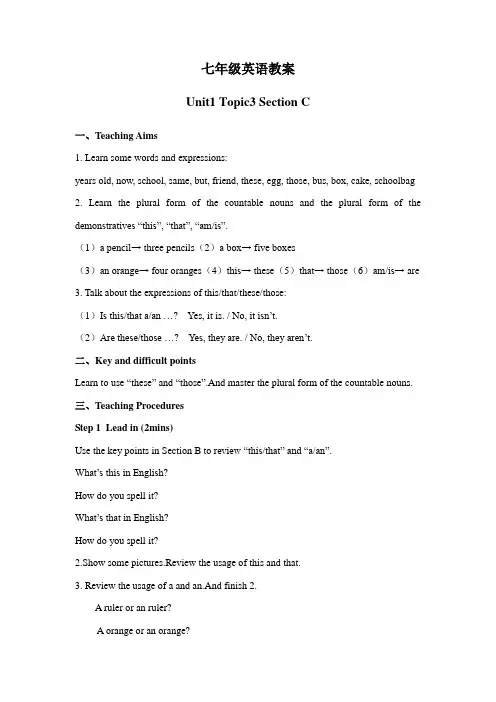
七年级英语教案Unit1 Topic3 Section C一、Teaching Aims1. Learn some words and expressions:years old, now, school, same, but, friend, these, egg, those, bus, box, cake, schoolbag 2. Learn the plural form of the countable nouns and the plural form of the demonstratives “this”, “that”, “am/is”.(1)a pencil→ three pencils(2)a box→ five boxes(3)an orange→ four oranges(4)this→ these(5)that→ those(6)am/is→ are 3. Talk about the expressions of this/that/these/those:(1)Is this/that a/an …? Yes, it is. / No, it isn’t.(2)Are these/those …?Yes, they are. / No, they aren’t.二、Key and difficult pointsLearn to use “these” and “those”.And master the plural form of the countable nouns.三、Teaching ProceduresStep 1 Lead in (2mins)Use the key points in Section B to review “this/that” and “a/an”.What’s this in English?How do you spell it?What’s that in English?How do you spell it?2.Show some pictures.Review the usage of this and that.3. Review the usage of a and an.And finish 2.A ruler or an ruler?A orange or an orange?Step 2 Thinking(5mins)The ways of the plural form of the countable nouns.1. Introduce someone including the following tips.2. Look, listen and learnStep 3 Discussion(5mins)Find the nouns and find out the rules of the plural form of the countable nouns. Step 4 Show time(5mins)Choose one student from each group to show the answer.Other students or the teacher evaluate the answers.Step 5 Practice(15mins)1.Listen to 1a and read after it.2.Translate 1a.And practice it with your partners.3.Show some pictures. And ask students to have dialogues.Is this an egg? Yes, it is.Are these eggs? Yes, they are.Are those cars? No, they aren’t.What are those in English? They’re buses.(划线生词要重读。
最新整理仁爱英语七年级上册UNIT1TOPIC3教案

Topic 3 What class are you in?Section AThe main activities are 1, 2a and 4a. 本课重点活动是1, 2a和4a。
Ⅰ.Teaching aims and demands 教学目标1. (1)Learn some numeral words:eleven, twelve, thirteen, fourteen, fifteen, sixteen, seventeen, eighteen, nineteen, twenty(2)Learn other new words and phrases:year, old, year(s) old, How old …?, class, in, grade, age, that2. Master the following special questions:(1)—How old are you?—I’m twelve.(2)—What class are you in?—I’m in Class Four, Grade Seven.(3)—What grade are you in?—I’m in Grade Seven.3. Talk about someone’s age, class and grade.Ⅱ. Teaching aids 教具数字卡片/教学挂图/录音机/投影仪或小黑板Ⅲ. Five-finger Teaching Plan 五指教学方案Step 1 Review 第一步复习(时间:7分钟)通过做游戏,师生对话,复习上节课的数词及重点句型,并导入新课。
1. (做游戏,复习数词0-10。
)(游戏规则:把学生分成十一人一组,每组第一名学生从zero开始报数,其后面的学生按顺序快速报数。
每逢三或三的倍数时,学生不说出该数,只是站起来后迅速坐下,然后下一个学生接着说下一个数。
仁爱版七年级上册英语说课稿:Unit1Topic3SectionC
(一)导入新课
为了快速吸引学生的注意力和兴趣,我将以一个有趣的游戏作为导入方式。游戏规则如下:我会展示一组人物图片,每张图片上都有一位人物,他们的外貌、性格和爱好各不相同。学生需要根据图片上的信息,用英语描述这些人物,看哪个小组能够在最短的时间内描述得最准确。通过这个游戏,学生可以在轻松愉快的氛围中复习和练习英语描述能力,同时激发他们对本节课的学习兴趣。
(二)媒体资源
为了辅助教学,我将使用多媒体课件、人物图片、视频等资源。多媒体课件能够清晰地展示语法结构和例句,帮助学生更好地理解和记忆;人物图片和视频能够让学生直观地了解不同人物的外貌特征,激发他们的学习兴趣,并为他们提供真实的语言环境。这些资源在教学中的作用是丰富教学内容,激发学生的学习兴趣,提高他们的语言实际运用能力。
(三)互动方式
在师生互动环节,我计划采用问题引导、讨论、问答等方式。通过提出问题,引导学生思考和回答,激发他们的学习兴趣和动力;通过讨论,让学生表达自己的观点,提高他们的口语表达能力;通过问答,检验学生对知识的掌握程度,及时进行反馈和指导。在生生互动环节,我计划采用小组合作、角色扮演等方式。通过小组合作,让学生相互讨论和帮助,提高他们的合作能力;通过角色扮演,让学生在模拟真实情境中运用所学知识,提高他们的语言实际运用能力。
(二)教学目标
1.知识与技能:学生能够掌握一般现在时的陈述句、疑问句和否定句结构,并能运用所学知识描述人物外貌、性格和爱好。
2.过程与方法:通过小组合作、角色扮演等活动,培养学生运用英语进行交流的能力,提高他们的口语表达能力。
3.情感态度与价值观:培养学生对英语学习的兴趣,增强自信心,使他们更加积极地参与英语课堂活动。
(四)总结反馈
在总结反馈阶段,我会引导学生进行自我评价,并提供有效的反馈和建议。具体方式如下:
仁爱版英语七年级上册Unit1Topic3SectionC教学设计
注意事项:
1.作业量适中,避免给学生造成过重的负担。
2.鼓励学生主动完成作业,培养他们的自主学习能力。
3.家长应关注学生的作业完成情况,并及时与教师沟通,共同解决学生在学习过程中遇到的问题。
4.教师在批改作业时,要关注学生的个体差异,给予针对性的评价和指导。
2.能够运用一般疑问句和特殊疑问句进行简单的日常交流,如:How are you? How old are you? What's your name? Where are you from?等。
3.能够运用所学词汇和句型进行自我介绍和询问他人的基本信息。
4.能够正确使用动词的现在时态进行简单的句子构建。
五、作业布置
为了巩固仁爱版英语七年级上册Unit1 Topic3 Section C所学的知识,确保学生对本节课内容的掌握,特布置以下作业:
1.写作作业:根据本节课所学的词汇和句型,编写一篇简短的英文对话,内容要求包括自我介绍和问候他人。要求学生注意使用正确的时态和语法结构,字数在50-80词左右。
d.写作训练:根据所学词汇和句型,让学生完成一篇简短的作文,巩固写作能力。
(五)总结归纳
1.教学活动:对本节课所学内容进行总结归纳。
2.教学设计:通过提问、复述等方式,帮助学生巩固所学知识,强调重点和难点。
3.教师总结:对本节课的重点词汇、句型以及语法知识点进行梳理,提醒学生注意课后复习。
4.布置作业:根据本节课所学内容,布置相应的课后作业,巩固所学知识。
2.重点:培养学生听力、口语、阅读和写作四项基本技能。
难点:提高学生在实际情境中的语言运用能力,尤其是口语表达和写作能力。
仁爱英语七年级上册UNIT1 TOPIC3教案
Topic 3 What class are you in?Section AThe main activities are 1, 2a and 4a. 本课重点活动是1, 2a和4a。
Ⅰ.Teaching aims and demands 教学目标1. (1)Learn some numeral words:eleven, twelve, thirteen, fourteen, fifteen, sixteen, seventeen, eighteen, nineteen, twenty(2)Learn other new words and phrases:year, old, year(s) old, How old …?, class, in, grade, age, that2. Master the following special questions:(1)—How old are you?—I’m twelve.(2)—What class are you in?—I’m in Class Four, Grade Seven.(3)—What grade are you in?—I’m in Grade Seven.3. Talk about someone’s age, class and grade.Ⅱ. Teaching aids 教具数字卡片/教学挂图/录音机/投影仪或小黑板Ⅲ. Five-finger Teaching Plan 五指教学方案Step 1 Review 第一步复习(时间:7分钟)通过做游戏,师生对话,复习上节课的数词及重点句型,并导入新课。
1. (做游戏,复习数词0-10。
)(游戏规则:把学生分成十一人一组,每组第一名学生从zero开始报数,其后面的学生按顺序快速报数。
每逢三或三的倍数时,学生不说出该数,只是站起来后迅速坐下,然后下一个学生接着说下一个数。
仁爱版七年级上册英语优秀教学案例:Unit1Topic3SectionC
在教学过程中,我会使用多媒体教学资源,如图片、视频和音频等,以激发学生的学习兴趣和积极性。同时,我会创设真实情境,让学生在实际交流中运用所学知识,提高他们的实际应用能力。
此外,我还会注重培养学生的合作意识和团队精神,通过小组讨论和合作完成任务的方式,促进学生之间的互动和交流。我将及时给予学生反馈和指导,鼓励他们积极参与课堂活动,提高他们的自信心和自主学习能力。
二、教学目标
(一)知识与技能
本节课的教学目标是在学生掌握了基本的英语语法和词汇的基础上,进一步学习日常生活中的问候和介绍。通过本节课的学习,学生将能够掌握以下知识点:
5.多元化的教学评价:教师在教学过程中采用反思与评价的教学策略,鼓励学生进行自我反思和相互评价。这种评价方式有助于学生发现自己的不足,提高自我认知和自我改进能力,使他们在不断进步中成长。
(三)情感态度与价值观
在本节课的学习过程中,学生不仅能够掌握英语知识,还能培养以下情感态度和价值观:
1.培养学生对英语学习的兴趣和积极性,让他们感受到学习英语的ห้องสมุดไป่ตู้趣。
2.培养学生的自信心和自主学习能力,让他们相信自己能够掌握英语交际能力。
3.培养学生的人际交往能力,让他们学会与他人沟通和合作,培养良好的团队合作精神。
(四)总结归纳
在总结归纳环节,我会组织学生进行小组汇报,让他们向全班同学展示他们小组的任务成果。在汇报过程中,我会引导学生用英语进行自我介绍和与他人问候,并鼓励其他学生进行提问和互动。通过总结归纳,学生可以巩固所学知识,并提高他们的口语表达能力和交际能力。