
文艺复兴简单英文介绍
文艺复兴 英文简介 ppt课件
Main Ideas
Texttudy
Feature: The Renaissance is characterised by seeking ideological emancipation, intellectual freedom and political awareness, based on cultural production and religious reformation. All these were undertaken or unfolded gradually but widely, extending its influences to every corner of Europe, with more and more people getting involved. The most striking feature of the Renaissance was doubtlessly the flourish of humanism.
文艺复兴 英文简介
Get Started
Get Started_1.3
as other important areas proceeded and the movement further separated itself from feudalistic tyranny, ecclesiastic bondage and sought intellectual freedom and ideological emancipation.
RENAISSANCE
文艺复兴 英文简介
Get Started
Get Started_1.2
The Renaissance refers to the period in European civilization towards the end of the Middle Ages, which was characterized by a surge of interest in classical learning and values.
文艺复兴和启蒙运动的中英文介绍
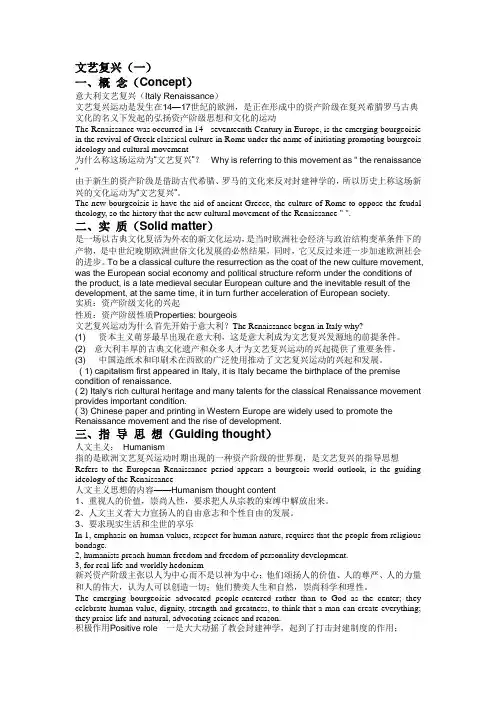
文艺复兴(一)一、概念(Concept)意大利文艺复兴(Italy Renaissance)文艺复兴运动是发生在14—17世纪的欧洲,是正在形成中的资产阶级在复兴希腊罗马古典文化的名义下发起的弘扬资产阶级思想和文化的运动The Renaissance was occurred in 14 - seventeenth Century in Europe, is the emerging bourgeoisie in the revival of Greek classical culture in Rome under the name of initiating promoting bourgeois ideology and cultural movement为什么称这场运动为“文艺复兴”?Why is referring to this movement as " the renaissance "由于新生的资产阶级是借助古代希腊、罗马的文化来反对封建神学的,所以历史上称这场新兴的文化运动为“文艺复兴”。
The new bourgeoisie is have the aid of ancient Greece, the culture of Rome to oppose the feudal theology, so the history that the new cultural movement of the Renaissance " ".二、实质(Solid matter)是一场以古典文化复活为外衣的新文化运动,是当时欧洲社会经济与政治结构变革条件下的产物,是中世纪晚期欧洲世俗文化发展的必然结果,同时,它又反过来进一步加速欧洲社会的进步。
To be a classical culture the resurrection as the coat of the new culture movement, was the European social economy and political structure reform under the conditions of the product, is a late medieval secular European culture and the inevitable result of the development, at the same time, it in turn further acceleration of European society.实质:资产阶级文化的兴起性质:资产阶级性质Properties: bourgeois文艺复兴运动为什么首先开始于意大利?The Renaissance began in Italy why?(1) 资本主义萌芽最早出现在意大利,这是意大利成为文艺复兴发源地的前提条件。
文艺复兴作文英文
文艺复兴作文英文英文:The Renaissance was a period of great cultural and intellectual growth that took place in Europe from the 14th to the 17th century. It was characterized by a renewed interest in classical art, literature, and philosophy, as well as a shift towards humanism and individualism.During this time, artists and thinkers began to focus on the individual and the human experience, rather than solely on religious or societal ideals. This led to the development of new forms of art, such as perspective in painting and the use of the sonnet in poetry.One of the most famous figures of the Renaissance was Leonardo da Vinci, who is known for his artistic masterpieces such as the Mona Lisa and The Last Supper, as well as his scientific and engineering inventions.The Renaissance had a profound impact on Western civilization, shaping the way we think about art, science, and the individual. It paved the way for the Enlightenment and the Scientific Revolution, which built upon the humanistic ideals of the Renaissance.中文:文艺复兴是欧洲14世纪到17世纪的一段文化和知识增长的时期。
文艺复兴_英文简介
Renaissance humanist,Catholic priest, and a theologian from The Netherlands. 伊拉斯谟(1466-1536)是一 家荷兰文艺复兴时期的人文 主义者,天主教神父和神学 家
Pieter Bruegel the Elder(老彼得·勃鲁盖 尔)
Map of Italian City-States (1494)
Siege of Constantinople – 1453 君士坦丁堡的陷落
Constantinople (modern-day Istanbul in Turkey) was the capital of the Byzantine Empire(拜占庭 帝国), the last vestige of the Eastern Roman Empire.
Michelangelo (1475-1564)
Pieta, is a sculptureof Mary holding the dead body of Jesus.
Michelangelo (1475-1564)
Ceiling of Sistine Chapel(西斯 廷教堂) took four years to
《巨人传》.
1492 in Spain!
Christopher Columbus discovered the Americas Granada was taken (this event is called the Reconquista), thus unifying the Iberian Peninsula Intensification (增强) of the Spanish Inquisition Jews and Muslims were expelled from the country 克里斯托弗·哥伦布发现美洲 格拉纳达(此事件被称为“收复失地运动),从 而 统一了伊比利亚半岛 西班牙宗教裁判所的强化 犹太人和穆斯林驱逐出境
5 文艺复兴介绍

Marlowe’s Plays
Tamburline the Great Desire for power The Jew of Malta Desire for wealth Doctor Faustus Desire for knowledge
cont'
Morality plays focused on the conflict between good and evil through allegorical characters. They were too abstract. So Vice, a lively figure approximated the modern clown, was introduced.
The English Renaissance
The English Renaissance stretched from later 15th century to early 17th century. From the first half of the 16th century, the English Renaissance began to develop into a flowering of literature. The highest glories of the English Renaissance include poetry and drama.
文艺复兴 英语名词解释
文艺复兴英语名词解释
文艺复兴 (Renaissance) 是一个起源于欧洲的思想文化运动,时间在 14 世纪中叶至 16 世纪。
该运动通常被视为一个复兴时期,即重新关注古希腊和罗马文化的时期。
在文艺复兴时期,人们开始对传统文化进行重新评估和重新评价,这种评估和评价不仅体现在艺术和文学上,也体现在科学、哲学、认识论等领域。
文艺复兴是一个历史性的阶段,它在欧洲学术界引起了巨大的变革。
文艺复兴时期的学者和思想家试图摆脱中世纪保守主义的束缚,向资产阶级表达新思想,挑战罗马教会的权威。
文艺复兴时期的艺术表现形式也变得更为自然、生动、优美,强调个体价值和自我意识。
文艺复兴对于欧洲文化和科学发展产生了深远的影响。
它开创了新的思想模式和学术传统,推动了欧洲学术的复兴和发展,影响了后来的文化、艺术和科学领域。
同时,文艺复兴也促进了欧洲各国之间的文化交流和合作,推动了欧洲一体化的进程。
文艺复兴英文资料
1RenaissanceThe Renaissance (UK/rɨˈneɪsəns/, US/ˈrɛnɨsɑːns/)[1] is a period in Europe, from the 14th to the 17th century, considered the bridge between the Middle Ages and modern history. It started as a cultural movement in Italy in the Late Medieval period and later spread to the rest of Europe, marking the beginning of the Early Modern Age.The Renaissance's intellectual basis was humanism, derived from the rediscovery of classical Greek philosophy, such as that of Protagoras, who said, that "Man is the measure of all things." This new thinking became manifest in art, architecture, politics, science and literature. Early examples were the development of perspective in oil painting and the recycled knowledge of how to make concrete. Although the inventionof metal movable type sped the dissemination of ideas from the later 15th century, the changes of the Renaissance were not uniformly experienced across Europe.As a cultural movement, it encompassed innovative flowering of Latin and vernacular literatures, beginning with the 14th century resurgence of learning based on classical sources, which contemporaries credited to Petrarch; the development oflinear perspective and other techniques of rendering a more natural reality in painting; and gradual but widespread educational reform. In politics, the Renaissance contributed to the development of the customs and conventions of diplomacy, and in science to an increased reliance on observation and inductive reasoning. Although the Renaissance saw revolutions in many intellectual pursuits, as well as social and political upheaval, it is perhaps best known for its artistic developments and the contributions ofsuch polymaths as Leonardo da Vinci and Michelangelo, who inspired the term "Renaissance man".[2][3]There is a consensus that the Renaissance began in Florence, in the 14thcentury.[4] Various theories have been proposed to account for its origins and characteristics, focusing on a variety of factors including the social and civic peculiarities of Florence at the time; its political structure; the patronage of its dominant family,the Medici;[5][6] and the migration of Greek scholars and texts to Italy following the Fall of Constantinople at the hands of the Ottoman Turks.[7][8][9] Other major centres were northern Italian city-states such as Venice, Genoa, Bologna, Milan andfinally Rome during the Renaissance Papacy.The Renaissance has a long and complex historiography, and, in line with general scepticism of discrete periodizations, there has been much debate among historians reacting to the 19th-century glorification of the "Renaissance" and individual culture heroes as "Renaissance men", questioning the usefulness of Renaissance as a term andas a historical delineation.[10] The art historian Erwin Panofsky observed of this resistance to the concept of "Renaissance":It is perhaps no accident that the factuality of the Italian Renaissance has been most vigorously questioned by those who are not obliged to take a professional interest in the aesthetic aspects of civilization—historians of economic and social developments, political and religious situations, and, most particularly, natural science—but only exceptionally by students of literature and hardly ever by historians of Art.[11]Some observers have called into question whether the Renaissance was a cultural "advance" from the Middle Ages, instead seeing it as a period of pessimismand nostalgia for classical antiquity,[12] while social and economic historians, especially of the longue durée, have instead focused on the continuity between the two eras[13] which are linked, as Panofsky himself observed, "by a thousand ties".[14]The word Renaissance, literally meaning "Rebirth" in French, first appears in English in the 1830s.[15] The word occurs in Jules Michelet's 1855 work, Histoire de France. The word Renaissance has also been extended to other historical and cultural movements, such as the Carolingian Renaissance and the Renaissance of the 12th century.[16]2RepresentativesAlfred Tennyson, among many others. In addition, the first use of the interlockingthree-line rhyme scheme, or the terza rima, is attributed to him.Dante has been called "the Father of the Italian language".[2] In Italy, Dante is often referred to as il Sommo Poeta("the Supreme Poet") and il Poeta; he, Petrarch, and Boccaccio are also called "the three fountains" or "the three crowns".The Divine Comedy describes Dante's journeythrough Hell (Inferno), Purgatory (Purgatorio), and Paradise (Paradiso)Dante, like most Florentines of his day, was embroiled in the Guelph–Ghibelline conflict. He fought in the Battle of Campaldino (June 11, 1289), with the Florentine Guelphs against Arezzo Ghibellines; then in 1294 he was among the escorts of Charles Martel of Anjou (grandson of Charles I of Naples, more commonly called Charles of Anjou) while he was in Florence. To further his political career, he became a pharmacist. He did not intend to practice as one, but a law issued in 1295 required nobles aspiring to public office to be enrolled in one of the CorporazionidelleArti e deiMestieri, so Dante obtained admission to the Apothecaries' Guild. This profession was not inappropriate, since at that time books were sold from apothecaries' shops. As a politician he accomplished little, but held various offices over some years in a city rife with political unrest.After defeating the Ghibellines, the Guelphs divided into two factions: the White Guelphs (Guelfi Bianchi)—Dante's party, led by VierideiCerchi—and the Black Guelphs (GuelfiNeri), led by Corso Donati. Although the split was along family lines at first, ideological differences arose based on opposing views of the papal role in Florentine affairs, with the Blacks supporting the Pope and the Whites wanting more freedom from Rome. The Whites took power first and expelled the Blacks. In response, Pope Boniface VIII planned a military occupation of Florence. In 1301, Charles of Valois, brother ofKing Philip IV of France, was expected to visit Florence because the Pope had appointed him peacemaker for Tuscany. But the city's government had treated the Pope's ambassadors badly a few weeks before, seeking independence from papal influence. It was believed that Charles had received other unofficial instructions, so the council sent a delegation to Rome to ascertain the Pope's intentions. Dante was one of the delegates.2. Leonardo da Vinci。
文艺复兴 英语作文
文艺复兴英语作文The Renaissance was a period of great cultural and intellectual growth in Europe. Artists, writers, and thinkers were inspired by the classical works of ancient Greece and Rome, leading to a revival of interest in humanism and individualism. This cultural movement had a profound impact on art, literature, science, and politics.During the Renaissance, artists like Leonardo da Vinci, Michelangelo, and Raphael produced some of the most famous works of art in history. Their paintings, sculptures, and architecture reflected a newfound interest in realism, perspective, and human anatomy. The Renaissance also saw the development of new artistic techniques, such as oil painting and linear perspective, which revolutionized the way art was created and viewed.In literature, writers like William Shakespeare, Dante Alighieri, and Petrarch explored themes of love, politics, and religion in their works. Shakespeare's plays, inparticular, are still performed and studied today for their complex characters, rich language, and timeless themes. The Renaissance also saw the rise of the printing press, which allowed for the mass production and distribution of books, leading to increased literacy and the spread of new ideas.In science, scholars like Nicolaus Copernicus, Galileo Galilei, and Johannes Kepler made groundbreaking discoveries in astronomy, physics, and mathematics. Copernicus proposed the heliocentric model of the universe, challenging the geocentric view that had been held for centuries. Galileo's observations with the telescope provided evidence to support Copernicus's theory, while Kepler's laws of planetary motion laid the foundation for modern astronomy.The Renaissance was not just a period of cultural and intellectual flourishing, but also a time of political and social change. The rise of powerful city-states like Florence, Venice, and Rome led to increased competition and conflict among rulers, merchants, and artists. The Protestant Reformation challenged the authority of theCatholic Church, leading to religious wars and the establishment of new Protestant sects.Overall, the Renaissance was a time of innovation, creativity, and exploration that laid the foundation for the modern world. Its legacy can be seen in the art, literature, science, and politics of today, reminding us of the enduring impact of this remarkable period in history.。
文艺复兴英文单词
文艺复兴英文单词单词:Renaissance1.1 词性:名词1.2 释义:文艺复兴(欧洲 14 至 16 世纪的文化运动、思想解放运动)1.3 英文释义:A period of great cultural and artistic change and development in Europe from the 14th to the 16th century.1.4 相关词汇:rebirth---2 起源与背景2.1 词源:源自法语,由 re-(再次)和 naissance(诞生)组成。
2.2 趣闻:文艺复兴时期产生了众多伟大的艺术家和作品,如达芬奇的《蒙娜丽莎》等,对欧洲乃至全球的文化发展产生了深远影响。
---3 常用搭配与短语3.1 短语:Renaissance art 文艺复兴艺术例句:The Renaissance art is famous for its beauty and detail.翻译:文艺复兴艺术以其美丽和细节而闻名。
3.2 短语:Renaissance literature 文艺复兴文学例句:Shakespeare is one of the most important figures in Renaissance literature.翻译:莎士比亚是文艺复兴文学中最重要的人物之一。
---4 实用片段(1) "I'm studying the Renaissance period in history class. It's so fascinating to learn about the great thinkers and artists of that time." said Tom. "Yes, the Renaissance was a time of great innovation and creativity." replied the teacher.翻译:“我在历史课上学习文艺复兴时期。
文艺复兴英文简介
The RenaissanceT he Renaissance refers to the period in European civilization towards the end of the Middle Ages, which was characterized by a surge of interest in classical learning and values.1.The origin of the RenaissanceThe Renaissance emerged when social instability, economic sluggishness and intellectual depression became so intolerable that most of the people, especially the intellectuals could no longer accept the worsening situation. The Renaissance as a movement first started in Florence and then expanded to Venice, Rome and other Italian cities before it swept the rest parts of Europe. Painting and sculpture were the most sensitive fields to the change with their subjects and tastes, shifting from dullness, stagnation, lack of emotion and divinity to dynamics, enthusiasm and humanitarianism. Literature and ideology soon followed as other important areas proceeded and the movement further separated itself from feudalistic tyranny, ecclesiastic bondage and sought intellectual freedom and ideological emancipation.2.The characteristics of the RenaissanceThe Renaissance is characterized by seeking ideological emancipation, intellectual freedom and political awareness, based on cultural production and religious reformation. All these were undertaken or unfolded gradually but widely, extending its influences to every corner of Europe, with more and more people getting involved. The achievements were seen principally in six areas, namely, painting, sculpture, poetry, fiction, drama and religious reformation as well as the change in the cultural and intellectual climate.3.The influence of the RenaissanceThe Renaissance was an important stage in the historical process of the Western civilization and indicated a transitional period from the Middle Ages to the modern era in the development of Western culture. Economic and intellectual changes during the Renaissance both helped to speed up Western social and cultural development and prepared the necessary conditions for the rapid progress in political, social and ideological areas of the Modern Age.文艺复兴是指由于意大利最早产生了资本主义萌芽,13世纪末在意大利兴起,以后扩散到西欧各国,16世纪盛行的一场思想文化运动。