
仁爱英语七年级上册unit3topic3知识总结
Unit3.Topic3.What would you like to drink?一.核心词汇 yourself would fish chicken about rice drink juice milk for idea water vegetable bread hamburger usually breakfast lunch supper food may take order sir something glass wait moment let well eat out dinner why dear kind be 二.常用词组 help oneself(to) would like what about…… all right good idea take one’s order something to drink/eat a glass of wait a moment eat out have dinner why not…. here you are such as三.重点句子 Would you like some eggs, Maria? Yes, please. No, thanks. I’d like some chicken. What about you, Jane? What would you like to drink? What do you usually have for breakfast, Michael? Would you like something to eat/drink?Would you like to have dinner with me? Yes, I’d like to. They are all kind to me.四,交际用语 Help yourselves/yourself( to some fish). Milk for me, please. May I take your order,sir? Wait a moment,please. May I help you,sir? Let me see. Why not have some fish and eggs? Good idea. Here you are. I’ m very glad to be here. 五.语法精粹 would like 句型 I would like an egg and some fish. Would you like some vegetables? What would you like to eat? Countable nouns and uncountable nous 六.其他学习辅音音标 /h/ /r/ /w/ /j/七.金点剖析1.Help yourselves!请随便(吃/喝)。
help oneself to….意为“请随便吃/喝…..”,是招待客人常用的交际用语。
后可接可数名词复数,也可接不可数名词。
当只有一位客人时,用yourself; 当有多位客人时,用yourselves.如:Help yourself to some bananas.请吃些香蕉吧。
Kids, help yourselves to some pizza.孩子们,请吃些比萨饼吧。
【即时演练】1.Help____ to some fish, dear friends.2.Kate, help____to some cakes.2.I’d like some chicken.我想吃一些肉。
I’d like 是I would like 的简写形式。
Would like 意为“想要…..,愿意….”,常用来表示婉转的请求以及征求对方的意见,相当于want,但比 want 语气委婉。
(1)would like 后面跟名词或代词。
如:I’d like some cakes=I want some cakes. 我想要一些蛋糕。
Would you like something to eat? 你想吃点东西吗?(2)would like 后跟动词时,用动词不定式形式(不定式由to+动词原形构成),即 would like to do sth, 意为“想要做某事”。
如:I’d like to visit my grandparents after school.放学后我想去看望我的祖父母。
Would you like to come to my home for supper.? 你愿意到我家来吃晚饭吗?(3)would like sb to do sth 意为“想要某人做某事”。
如:-What would you like me to do? 你想要我做什么?-I’d like you to help me with my English。
我想要你帮我学英语。
(4)Would you like +n? 的回答用Yes,please. 或No, thanks. 如:-Would you like some bread? 你想要点面包吗?-Yes,please./No,thanks. 好的,请把。
/不,谢谢。
3What about you, Jane? 简,你呢?(1)What about +sb?这一句型用来询问对方或第三者是否也具有上文提到过的情况、观点等。
如:I want to drink milk. What about you? 我想喝牛奶,你呢? I like English. What about Tom? 我喜欢英语,汤姆呢?(2)what about+ 名词、代词或动名词,表示说话人的建议或用来征询对方的意见。
如:What about this English book?这本英语书怎么样?What about something to eat/drink? 要不要吃、喝些什么? What about visiting the Great Wall? 去参观长城怎么样?【拓展】 What about …?相当于 How about…..?如:What about havig a cup of tea=How about having a cup oftea?4What do you usually have for breakfast,Michael? 迈克尔,你早餐通常吃什么?一般情况下,表示一日三餐的名词前不加冠词。
For 在句子中作介词,表示“为了….”, for+breakfast/lunch/supper 为固定搭配。
如:I’d like some rice for breakfast.我早餐想吃点米饭。
What would you like for lunch? 你午餐想吃点什么?5May I take your order,sir? 先生,你可以点菜了吗?(1)这是餐馆服务员询问客人是否准备点菜的常用语。
take one’s order 意为“记下顾客点的饭菜”。
服务员问顾客想吃点什么,也可以说May/Can I help you ?或 What can I do for you? (2)意为“先生,阁下”,用于对顾客,上级或陌生男性的尊称。
6.-Would you like something to drink? 你想喝点东西吗?-Yes,a glass of apple juice,please.是的,请来一杯苹果汁。
在英语中名词分为可数名词和不可数名词。
可数名词有单数和复数形式,不可数名词没有单复数形式变化,如想表示复数含义,可在不可数名词前加some,any或表示数量的短语。
如:some meat 一些肉 any milk 一些牛奶 a cup of tea 一杯茶 a bag of rice 一袋大米 a glass of water 一杯水 two bottles of orange juice 两瓶橙汁 three pieces of bread 三片面包 a piece of news 一则新闻7 Wait a moment, lease.请稍等片刻。
Moment n 片刻,瞬间。
如:just a moment=wait a moment 稍等片刻【拓展】 at the moment 此刻 in a moment 立即,马上 for the moment 暂时,目前8 Let me see.让我看看/想想。
这是口语中常用的句型。
Let sb do sth 意为“让某人做某事。
”常用于提出建议。
肯定回答一般用OK./All right.否定回答一般用 sorry,I….。
Let’s =Let us,是这一结构的特例。
如:Let’s visit the Great Wall 让我们去参观长城吧。
Let Tom help you.让汤姆帮助你。
9. Why not have some fish and eggs?为什么不来一些鱼肉和鸡蛋呢?Why not do sth?意为“为什么不….?何不…?表示说话人的建议或劝说。
其同义句型是Why don’t you/we do sth? 如:Why not give the letter to Maria?=Why don’t we give the letter to Maria? 为什么我们不把那封信给玛利亚呢? Why not study English with us? =Why don’t you study English with us? 你为什么不跟我们一起学英语呢?10. Here you are. 给你当别人向你要东西,你答应给别人并在递东西的同时说这句话。
注意此句与 You are here. 的区别。
后面的意思是“你在这儿”。
如:-Can I have your pen? 我可以用你的钢笔吗?-Here you are.给你。
Kate,you’re here.凯特,你在这儿。
11.They are all kind to me.他们都对我很友好。
be kind to sb 意为“对某人很友善。
”此时kind 与 friendly(友好的)可互换。
如:Our English teacher is friendly to us.我们的英语老师对我们很友善。
即时演练参考答案:1 yourselves 2yourself练习:一、选择(25分)()1、-- Do Fangfang and Liu Mei have ____ friends here? -- Yes, they do. A. few B. some C. any D. little()2. -- ______ I sit here? -- No problem. A. May B. DoC. DoesD. Have()3. Where does your brother live __________? A. in B. on C. at D. /()4. His English is ___________. A. a little B. a lot C. well D. poor()5. Linlin and Fangfang ________ here today. A. are at B. aren’t C. not D. isn’t()6. He ________ to the Great Walll. A. want to go B. wants to go C. want go D. wants go()7. – Where are _______? -- _______ are in ________ classroom.A. their, Their, theyB. they, They, theirC. their, They, theyD. they, Their, their()8. – What are they? -- They are ____. A. teachers B. old C. good girl D. Chinese()9.The books are those _______. A. girl’s B. girls’s C. girls D. girls’()10. I know those aren’t _______ factories. A. they B. their C. them D. him()11. _______ White is our English teacher. He’s an English man. A. Mr. B. Mrs. C. Miss D. Teacher()12. – What do you do? -- ______. A. Yes. I do B. No, I don’t C. I’m a doctor D. In a hospita l()13. – What does the boy _______? -- He has brown hair and grey eyes.A. likeB. lookC. look likeD. look the same()14. Our teachers are friendly _______ us. A. in B. on C. for D. to()15. – Would you like some bread? -- _________.A. Yes, pleaseB. No, I don’tC. Yes, I wouldD. No, I wouldn’t ()16. I’m very glad __________. A. be here B. come here C. to come to here D. to be here()17. – Would you like ________ milk? -- Yes, please. A. any B. some C. many D. a()18. We often have _____ noodles and meat _____ supper. A. many, for B. many, with C. some, for D. some, with()19. – What would you like to have? -- I’d like __________.A. two bowl of riceB. two bowls of ricesC. two bowls of riceD. two bowl of rices()20. Why not __________ some eggs for breakfast? A. having B. to have C. have D. to eat()21. – What about a glass of orange juice? -- _________.A. That’s OKB. Yes, I like itC. No, thanksD. No, I don’t like it ()22. Let’s ________ dinner. A. have B. to have C. has D. to has()23. What would you like __________? A. eat B. eating C. to eat D. eats()24. Jane, help _________ to some fish. A. you B. yourself C. yourselves D. your()25. –What’s that? -- _______ a picture _______ our family. A. Its’, of B. Its, of C. It’s, of D. It’s, for二、. 词汇: A. 用所给单词的适当形式填空. 1. Let’s ___________( go) shopping tomorrow.2. It __________ ( look) very nice.3. What does Steve __________ (look) like?4.__________ ( who) car is this?5. Miss Li is ___________ (they) Chinese teacher.B. 根据首字母提示填空. 6. Could you t___________ me your phone number?7. We can s__________ English here. 8. – May I call you Kate? -- S_______.9. Maria wants to v_________ the Great Wall. 10. – Do you like the Englishc_________? -- Yes, I like it very much.三. 句型转换.1. That letter is from Tom. (对画线部分提问) __________ is that letter from?2. He studies in Beijing. (对画线部分提问) Where ______ he ___________?。
七年级英语仁爱版上册Unit3_Topic3_课时同步练(解析版)_
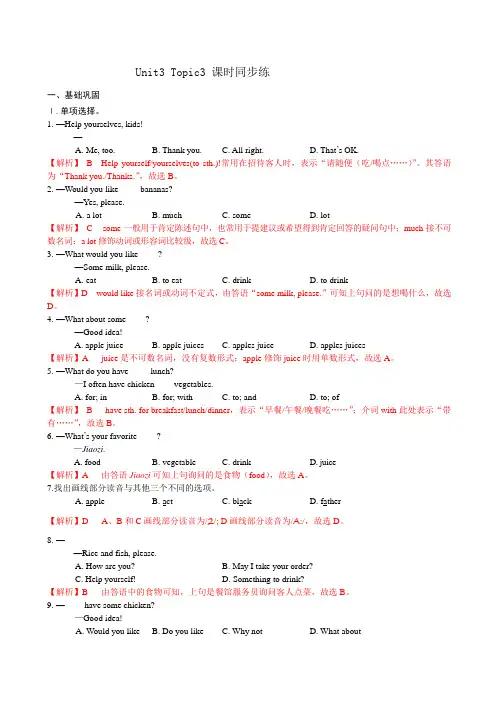
Unit3 Topic3 课时同步练一、基础巩固Ⅰ.单项选择。
1. —Help yourselves, kids!—______A. Me, too.B. Thank you.C. All right.D. That’s OK.【解析】B Help yourself/yourselves(to sth.)!常用在招待客人时,表示“请随便(吃/喝点……)”。
其答语为“Thank you./Thanks.”,故选B。
2. —Would you like ____ bananas?—Yes, please.A. a lotB. muchC. someD. lot【解析】C some一般用于肯定陈述句中,也常用于提建议或希望得到肯定回答的疑问句中;much接不可数名词;a lot修饰动词或形容词比较级,故选C。
3. —What would you like ____?—Some milk, please.A. eatB. to eatC. drinkD. to drink【解析】D would like接名词或动词不定式,由答语“some milk, please.”可知上句问的是想喝什么,故选D。
4. —What about some ____?—Good idea!A. apple juiceB. apple juicesC. apples juiceD. apples juices【解析】A juice是不可数名词,没有复数形式;apple修饰juice时用单数形式,故选A。
5. —What do you have ____ lunch?—I often have chicken ____vegetables.A. for; inB. for; withC. to; andD. to; of【解析】B have sth. for breakfast/lunch/dinner,表示“早餐/午餐/晚餐吃……”;介词with此处表示“带有……”,故选B。
仁爱英语七年级上册Unit3_topic2知识点讲解及随堂练习
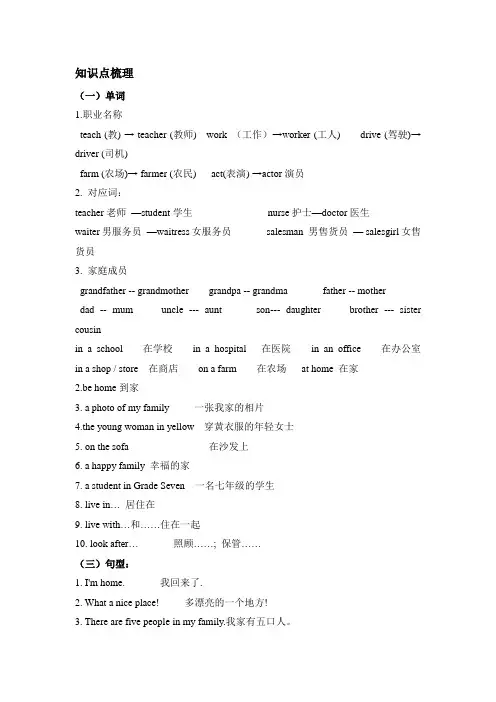
知识点梳理(一)单词1.职业名称teach (教) → teacher (教师) work (工作)→worker (工人) drive (驾驶)→driver (司机)farm (农场)→ farmer (农民) act(表演) →actor演员2. 对应词:teacher老师—student学生nurse护士—doctor医生waiter男服务员—waitress女服务员salesman 男售货员— salesgirl女售货员3. 家庭成员grandfather -- grandmother grandpa -- grandma father -- motherdad -- mum uncle --- aunt son--- daughter brother --- sister cousinin a school 在学校in a hospital 在医院in an office 在办公室in a shop / store 在商店on a farm 在农场at home 在家2.be home到家3. a photo of my family 一张我家的相片4.the young woman in yellow 穿黄衣服的年轻女士5. on the sofa 在沙发上6. a happy family 幸福的家7. a student in Grade Seven 一名七年级的学生8. live in…居住在9. live with…和……住在一起10. look after…照顾……;保管……(三)句型:1. I'm home. 我回来了.2. What a nice place! 多漂亮的一个地方!3. There are five people in my family.我家有五口人。
There be …“有……”,表示“某处有某人/物”,be动词的单复数形式根据所跟名词的单复数一致;people单复数同形。
仁爱版七年级上册英语-Unit2:Topic3单词汇总+知识梳理
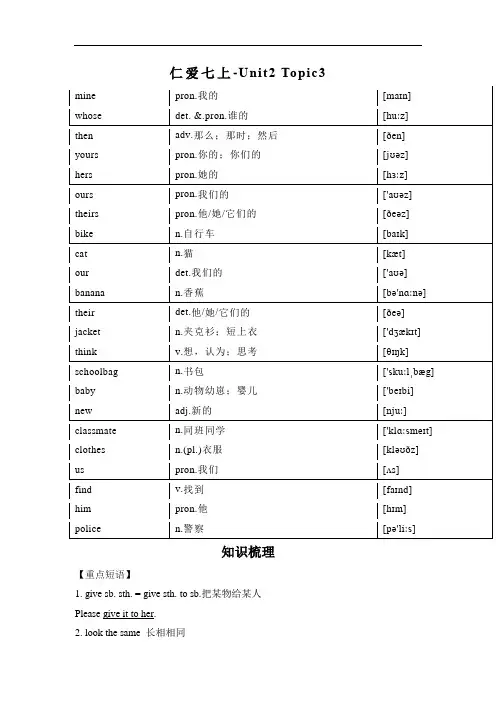
仁爱七上-Unit2 Topic3知识梳理【重点短语】1. give sb. sth. = give sth. to sb.把某物给某人Please give it to her.2. look the same 长相相同look different 长相不同,看起来不一样3. look like 看起来像He looks like his father. = He and his father look the same.4. next to 在……旁边The boy next to me is my good friend.5. in +颜色穿着……颜色的衣服in +a/an +颜色+衣服穿着……颜色的……The boy in a yellow T-shirt and gray pants is my good friend.6. (1) both两者都(be动词之后,实义动词之前)They both have brown hair and black eyes.They are both office workers.(2)all 三者或三者以上都They are all kind to me.7. 数字+(形状、大小)+颜色+n.two big red applesShe has short blond hair.【重点句型】1. Who is your favorite actor?2. We are in the same school, but we are in different grades.3. What do/does +主语+look like? ……长得怎么样?---What does he look like?--- He is not very tall but very strong.4. We don’t look the same, but we are good friends.We look the same, but we are in different clothes.5. ---What color is/are +主语?---It’s/ They’re +颜色.---What color is her hair?---It’s blond.6. This is my cap. = This cap is mine.Is this your cap? = Is this cap yours?---Whose cap is this? = Whose is this cap?--- It’s Sally’s.---Whose are these bananas?--- They’re their bananas/ theirs.7. His pants are blue and mine are white.(mine=my pants)My T-shirt is green and his is brown.(his=his T-shirt)8. I have small eyes, but he has big ones.(ones指代eyes)My jacket is blue and white. That one is blue. (one指代jacket)【重点语法】1. 动词原形和动词第三人称单数形式(1)主语是第三人称单数形式(he、she、it;单一的人;单一的名字;单一的事物),动词要用单三形式。
仁爱版英语七年级上册 Unit 1 topic3 知识归纳
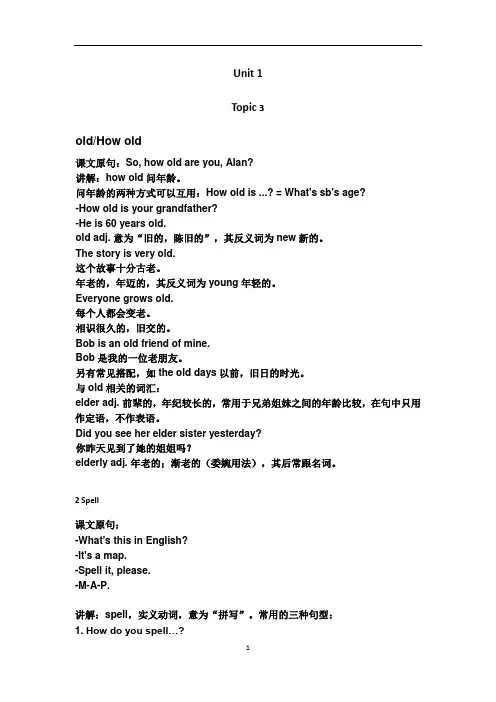
Unit 1Topic 3old/How old课文原句:So, how old are you, Alan?讲解:how old问年龄。
问年龄的两种方式可以互用:How old is ...? = What's sb's age?-How old is your grandfather?-He is 60 years old.old adj. 意为“旧的,陈旧的”,其反义词为new新的。
The story is very old.这个故事十分古老。
年老的,年迈的,其反义词为young年轻的。
Everyone grows old.每个人都会变老。
相识很久的,旧交的。
Bob is an old friend of mine.Bob是我的一位老朋友。
另有常见搭配,如the old days以前,旧日的时光。
与old相关的词汇:elder adj. 前辈的,年纪较长的,常用于兄弟姐妹之间的年龄比较,在句中只用作定语,不作表语。
Did you see her elder sister yesterday?你昨天见到了她的姐姐吗?elderly adj. 年老的;渐老的(委婉用法),其后常跟名词。
2 Spell课文原句:-What's this in English?-It's a map.-Spell it, please.-M-A-P.讲解:spell,实义动词,意为“拼写”。
常用的三种句型:1. How do you spell…?2. 祈使句:Spell it, please.3. Can you spell it please?grade/class1. class n. 班级;课如:-Which class are you in this year?-Class Three.—今年你在哪个班?—三班。
I have a history class at 9 o'clock.我9点钟有历史课。
仁爱版七年级英语上册Unit3Topic3WhatwouldyouliketodrinkC优质教案(2)
课题:Topic3Whatwouldyouliketodrink?SectionC第1课时一、导学目标1、复习SectionB的重要句型2、学习重要句型1)Wouldyouliketohavedinnerwithme?2)Whatwouldyouliketodrink?3)Helpyourse4)Whynotdo…?句型【阅读质疑合作探究】一)课前预习本课新单词,并自我检测:吃__________在外面___________下馆子__________吃正餐__________随便吃些鱼___________为什么不_______________一些喝的东西___________让我想想_______________在餐馆_______________二)走入新课1、熟读1a对话.注意文中MayIhelpyou,sir?这句话的使用情景2、自主完成课本P75页1b和P76页2、3、4a/4b.二、精讲点拨①letsb.dosth..让某人做某事。
e.g.Letmehelpyou.②Whynot+动词原形…….?用来提出建议或表示责备。
也可以变成Whydon’tyou+动词原形…….?e.g.Whydon’tyouhavesomejuice?注意:在whynotdosth.?=whydon’tyoudosth.?这两个句型中,因都表示建议、请求等委婉语气,故含有some时不能换成any.【多元互动合作探究】1、Heworkson a farm.(对划线部分提问)he ?2、I’dlikesome apples.(同上)like?3、Wouldyouliketodrinksomewater.(做否定回答)No,4、I’dlikesomecakes.(改为一般疑问句)you cakes?5、Whydon’tyouhavesomefish?(改为同义句)Why havesomefish?6、Janelikesapples.(对划线部分提问)_____________Jane_______?【训练检测目标探究】A.根据句意及首字母提示填词。
仁爱英语七年级上册Unit3-topic1复习
• 但是我只是有点喜欢。
• but I like it a little.
•
我们是好朋友,我们互相帮助。
• We are good friends and we help each other.
• she wants to visit Beijing. • She lives in England. • He works in a hospital. • She teaches in a high school. • She likes to play with Kitty.
• 了解很多关于 know a lot about
• 住在英国
live in England
词组
• 我们班的许多学生 many students in our class
• 一点点喜欢
like ... a little
• 一点也不喜欢 not like ... at all
• 不是很好
not very good
A. very
B. much
C. at all
D. little
8.I like the little cat a lot but she likes
it ____. B
A. a lot
B. a little
C. lot
D. much
9.Sally often helps me study English. And
可以这样说
My pen pel speaks English, but he knows a lot
about China.
. 10. 你想询问对方的国籍是不是美国,你可以这样问: Are you from America_? 11.当别人问你可不可以帮他做一件事情的时候 你可以这样
七年级仁爱英语上册知识点总复习.doc
Unit 1 Making New FriendsTopic 1 Welcome to China!一、重点词组及句子1、Good morning/afternoon/evening!早上好!/下午好!/晚上好!2、Welcome to SW 欢迎到某处来3、Thankyou!=Thanks!谢谢!4、Nice/Glad/Pleased to meet/see you.认识你很高兴。
(通常用于初次见面介绍相识之后,以示礼貌的常用语。
)5、Nice to meet you, too! Too意为"也”。
一般放在句末,可用逗号隔开。
6> How do you do?你好!首次见面的正式问候语。
通常回答也用How do you do?7、How are you?你好吗?通常用于熟人之间的问候,口语中类似的表达还有:How are you doing?回答时用I'm fine, thank you. / Fine, thanks. / Very well.(彳艮好。
)/ Not bad.(不错。
)/Just so-so.(还可以。
)等。
8、See you later = See you.再见。
是告别用语,类似的还有:See you then.到时候见。
Goodbye. / Bye-bye. / Bye.再见。
二、常用句型1、初次见面介绍某人时常用This is......2、自我介绍用I'm xxx.3、询问对方是不是某人用Are you xxx?肯定回答用:Yes, I am.(注意不能缩写)否定回答用:No, Tin not.三、语法要点1、Be动词的用法Be动词有三个am, is, are。
Am只能跟I搭配;is用于单数主语的后面he, she , it或是xxx; are用于复数主语的后面you, they, we.2、一般疑问句的用法如何将陈述句改为一般疑问句(1)如果句中有Be动词或是情态动词can, could, will, would, may等直接把Be动词或情态动词提到句首。
听写版仁爱英语七年级上册短语,功能句,语法 提纲
Unit 1知识点归纳Topic1短语1.早上/下午/晚上好2.见到你很高兴3.欢迎来到……4.这是……5.起立6.坐下7.再见8.再见9.再见功能句Functions●日常问候您好!你好!●用于第一次见面的问候很高兴见到你。
很高兴见到你。
你好!●用于熟人间的问候欢迎来到中国!谢谢你!谢谢!你好吗?很好,谢谢,你呢?/我很好。
●自我介绍我是......我的名字是......你是......吗?●介绍他人妈妈,这位是我的老师,布朗老师。
●其他给你。
谢谢。
语法Grammar: Present Simpie:to be1.I'm Kangkang. I'm=I ____ 我是康康。
我是=我2.--____ ____ Michael? 你迈克尔吗?--Yes, / No,3.Mr. Brown,___ ____my mom. 布朗老师,我妈妈。
4.be动词①.译为:①.包含:①用法:看主语,●我用(),你用(),()跟着他她它,名词单数用(),名词复数全用()●元音字母:元音:●大小写:●地名是字母缩写时候:Unit 1知识点归纳Topic2短语1.身份证号码2.来自3.来自4.电话号码5.打扰一下\请问6.姓氏7.名字8.全名功能句Functions打扰一下,你是简吗?是的,我是。
/不,我不是。
请问你叫什么名字?我的名字是萨莉。
你的电话号码是多少?你来自哪里?我来自加拿大。
他/她来自哪里?他/她来自日本。
语法Grammar:人称代词(主格)1.是什么2.是谁3.在哪里4.--__ she Canada? 她来自加拿大吗?--Yes, ./ No,5.--he Li Ming? 他是李明吗?-Yes, ./ No,6.--you Canada, too? 你也来自加拿大吗?-Yes, ./ No,7.--they England? 他们来自英国吗?-Yes, ./ No,8..--? 她们是谁?--Maria and Jane. 他们是玛利亚和简。
仁爱英语七年级上册语法精讲(一)
Unit 1-topic11. 动词be的用法动词be有三种形式:am, is, are, 它们都是“是”的意思,被称为“be动词”。
(1) am用于第一人称单数I。
其完全形式是I am ...,缩写形式是I’m ...,但I am在句末时不能缩写。
e.g. I am/I’m Li Lei. 我是李雷。
Are you Mr. Li? Yes, I am. 你是李先生吗?是的,我是。
(2) is用于第三人称单数。
e.g. My teacher is Miss Yang. 我的老师是杨小姐。
(3) are用于第二人称单数、复数或第一人称复数和第三人称复数。
e.g. You are Li Ping.你是李平。
My mom and I are at home. 妈妈和我都在家。
2. 打招呼时常用的交际用语(1)How are you?用于熟人之间,表示问候。
回答用Fine./I’m fine./I’m OK.Thanks.(2)How do you do?用于初次见面,伴随握手动作,是表示庄重、礼貌的正式问候语。
回答仍用How do you do?(3)Nice to meet you.经人介绍认识对方,礼节性地互致问候。
对方用Nice to meet you, too.来回答。
(4)Hi!和Hello!是熟悉的人之间打招呼或非正式的问候语,回答也用Hi!和Hello!意思均为“你好!”Unit 1-topic21. Where is she from?或Where’s she from?这是询问某人来自何处的一个特殊疑问句。
e.g. Where are you from?你来自哪里?I’m from China.我来自中国。
2. What is your name?或What’s your name?这是询问某人姓名时常用的一个特殊疑问句,回答时常用My name is ...或I’m ...e.g. What’s your name? 你叫什么名字?My name is Jane. 或I’m Jane. 我叫简。
(完整版)仁爱英语七年级上册unit1topic3知识总结
Unit1.Topic3. What class are in?一.核心词汇eleven twelve thirteen fourteen fifteen sixteen seventeen eighteen nineteen twenty year old class in grade age that English an/a eraser map spell can please pencil apple double toy desk pen ruler book car orange egg blackboard these those schoolbag cake bus box now school her phone his same but friend high二.常用词组year(s) old how old in English phone number in the same class good friends ID number junior high school三.重点句子What’s this/that in English?It’s a/anIs this/that a/an…..?Yes, it is/No, it isn’t.What are these/those?They’re……….Are these/those….?Yes, they are./No,they aren’t.四.交际用语How old are you? I’m twelve, too.What class/grade are you in? I’m in…..Who’s that? That’s Nancy.How old is she? She is fourteen.What class/grade is she in? She’s in……….How do you spell it? E-R-A-S-E-R,eraser.Can you spell it,please?Yes, M-A-P, map.Thank you. That’s OK./ You’re welcome.五.语法精粹指示代词:this/that/these/those的用法This is a book.Who’s that?These are eggs.What are those?名词复数They are books.a 与an 的区别It’s a map. It’s an eraser.六.其他元音字母Ii. Oo Uu在重读开音节和闭音节中的读音。