
人教版(PEP)小学英语六年级上册期末知识总结
人教版(PEP)小学英语六年级上册期末知识总结Unit 1 How can I get there?一、重点单词、短语Science科学, Museum博物馆, post office邮局, bookstore书店, cinema电影院, hospital医院,tasty美味的, buy买, London Eye伦敦眼, stomach胃,crossing十字路口, turn left向左转, turn right向右转go straight=walk straight直走next to 紧挨着/与……相邻far from 离……远near在……附近,behind在……后面, in front of 在……前面between…and… 在……和……之间二、按要求写单词hot(反义词)cold cool(反义词)warm too(同音词)to/two can not(缩写)can’t right(反义词)left/wrong buy(同音词)by/bye sea(同音词)see first(基数词)one four(序数词)fourth did (原形)do /does three(序数词)third give(过去式)gave三、重点句型1.Where is the museum shop?此问句是由特殊疑问词where 引导的一个特殊疑问句,where意为“在哪里,到哪里”,用来询问地点,放在句子的开头。
询问“某人或某物在哪里”的基本句型是:“ Where +is/are+ 主语?”,where is 后接名词或代词的单数形式,where are 后接名词或代词的复数形式。
表示地点的词:museum博物馆, post office邮局, bookstore书店, cinema电影院, hospital医院restaurant餐馆bank银行busstop公交车站lake湖library图书馆zoo动物园school学校park公园garden花园hotel旅馆2. It’s near the door.此句中near是表示位置的介词,意为“旁边,附近”,其同义句是:It’s next to the door.它在门的旁边。
表示位置的短语:next to the bookstore挨着书店near the hospital在医院附近near the post office在邮局附近over there 在那边on Dongfang Street在东方大街上in front of the school在学校前面3.How can we get there?此句用来询问“怎样去某地”,后面直接跟地点。
回答时,可以用“ Turn left, turn right, go straight.”等句来回答。
同义句:1.Can you tell me the way to+地点?2.Where is the +地点?3.Which is the way to +地点4. Turn left at the bookstore. Then turn right at the hospital.此句是指路的句型。
常用到的句型有:turn left, 向左转turn right, 向右转go straight直着走。
同时表示在某处的介词用at.5.Is the Thames far from here? No, it isn’t.此句是个be动词开头的一般疑问句,其回答要用Yes或No. 句中的far from意为“离……远”。
反义词组为next to.四、主题写作How to Get to the Science MuseumWe are going to the science museum tomorrow. The science museum is next to the hospital. It’s not far from our school. So we can go there on foot. First, gostraight from our school. Next, turn left at the post office and walk for about five minutes. Then turn right at the bookstore. We can find the hospital on the right. Walk straight, and we’ll see the science museum.Unit 2 Ways to go to school一、重点单词和短语on foot步行,by bus =take a bus 乘公交车,by plane乘飞机by taxi 乘出租车,by ship乘船,by subway乘地铁,by train乘火车by bike骑自行车,by ferry乘轮渡,Hooray!好极了slow down 慢下来,stop停,wait等,pay attention to注意cross the road横穿马路,traffic light通信号灯,at home在家,missed(miss的过去式)想念,different,不同,chopsticks,筷子(复数)cross穿过,look right向右看,same 相同的,door门,look at朝……看play with和……一起玩二、按要求写单词go (反义词)come foot(复数)feet child(复数)childrenearly(反义词)late good(反义词)bad坏take带走(反义词)bring拿来slow(反义词)quick/fast go (过去式)wentdo(过去式)did do(第三人称单数)does go(第三人称单数)goes same 相同的(反义词)different不同的miss(过去式)missed wrong错误(反义词)right正确can(否定形式)can’t三、重点句型分析1. How do you come to school? 你(们)怎么来学校的?此问句是由特殊疑问词how引导的特殊疑问句,用于询问对方的出行方式。
回答时要根据具体情况作答。
表示地点的词:Germany德国Munich慕尼黑England英国Australia澳大利亚school学校the park 公园the cinema电影院the hospital医院the post office 邮局the bus stop公共汽车站home家2. Usually, I come on foot. = Usually, I walk.通常情况下,我步行来。
此句是对出行方式的回答句。
其中usually意为“通常”,表示频率很大,on foot 意为“步行”。
一般用by表示出行方式。
By后面一定要直接加交通工具的单数形式,只有“小脚丫”foot与on 搭配,“步行”用on foot表示。
3. I must pay attention to the traffic lights.我必须注意交通信号灯。
Must是情态动词,意为“必须”后面跟动词原形。
动作词组:wear a helmet戴头盔pay attention to the traffic lights注意交通信号灯look right向右看4. Don’t go at the red light! 别闯红灯!此句是Don’t开头的否定祈使句,don’t后面跟动词原形。
意为“不要做某事”。
动作词组:run跑go at the red light闯红灯touch the door触摸门Eg. Don’t smoke.不要吸烟。
/禁止吸烟。
Don’t take photos.禁止拍照。
5.We must look right before crossing the road.我们在横穿马路前必须看看右边。
此句中must是情态动词,意为“必须”后面跟动词原形,在此句中before是一个介词,而介词后面跟动词-ing形式。
6. There is no door on the bus.公共汽车上没有门。
此句是there be句型的单数句,be动词要根据后面名词的单复数形式来决定,名词为单数或不可数名词就用there is,名词为复数就用there are. 此句中no door意为“没有门”,表示单数含义,因此要用there is开头。
四、主题写作Don’t Be Against the Traffic RulesI go to school from Mondays to Fridays. I go to school by bike at 7:30 in the morning. I have to cross two busy roads. I know the traffic rules well. Slow down and stop at a yellow light. Stop and wait at a red light. Go at a green light. I always ride on the right side of the road. I am never against the traffic rules.Unit 3 My weekend plan一、重点单词和短语visit拜访,film电影,see a film看电影,trip旅游,take a trip去旅游supermarket超市,evening晚上,傍晚tonight,在今晚tomorrow,明天next week下周,dictionary字典,comic滑稽的,comic book连环画册word book单词本,postcard明信片,learn学习,teach教,disturb打扰without没有,pool池子,jump in跳进,remember记住,lesson 课space太空,travel(尤指长途)旅游,half一半,price 价格,moon月亮make a snowman 堆雪人share sth(事)with sb(人)和某人分享某物,lots of= a lot of 许多二、按要求写单词look for (同义词) find leaf (复数) leaves picture (复数) picturessee (同义词) watch/look film (同义词) movie buy (反义词) sell am /is /are (原形) be is /am (复数)are this (反义词) that going (原形) go swim (现在进行时)swimming can(否定形式) can’t too(同音词) two /to clothe(复数)clothesice-skate(现在进行时)ice-skating autumn(同义词) fallautumn(反义词)spring teach (反义词) learn三、重点句型分析1. What are you going to do tomorrow? I’m going to have an art lesson.此句是个一般将来时态的特殊疑问句。
人教版(PEP)小学英语六年级上册知识点归纳

人教版(PEP)小学英语六年级上册知识点归纳Unit 1: How Can I Get There?In this unit。
we will learn some XXX.1.Key Words:Museum: a place where you can see art。
historical objects。
and other XXX.Bookstore: a shop where you can buy books.Cinema: a place where you can watch movies.XXX: to change n.Hospital: a place where people go to get medical treatment.Left: the opposite of right.Post office: a place where you can send letters and packages.Science: the study of the natural world.Right: the opposite of left.Straight: without XXX.Crossing: a place where two or XXX.eful Phrases:Post office: "Where is the post office?"Science museum: "Where is the science museum?"Pet hospital: "Where is the pet hospital?"XXX: "Where is XXX?"XXX: "Where is Beihai Park?"Palace Museum: "Where is the Palace Museum?"Go straight: "Go straight and you will see the bookstore on your left."Turn right/left: "Turn right at the crossing and you will see the hospital on your right."Next to: "The cinema is next to the bookstore."In front of: "The school is in front of the park."Near the park: "XXX is near the park."XXX: "XXX."mon ns:Excuse me: "Excuse me。
最新人教版PEP英语六年级上册知识点归纳

最新人教版PEP英语六年级上册知识点归纳Unit 1 How Can I Get There?In this unit。
we will learn vocabulary related to giving and receiving ns。
We will also learn some useful phrases and sentence patterns to help us navigate our way around a new place.Core Vocabulary1.Nouns: science。
museum。
bookstore。
cinema。
hospital。
crossing2.Verbs: turn3.Adverbs: left。
right。
straight4.Phrases: post officeExpanded Vocabulary1.Nouns: sir。
restaurant。
pizza。
street。
GPS。
feature2.Verbs: ask。
get。
gave。
follow。
tell3.Adjectives: interesting。
Italian。
farSentence Patterns1."Where is the ____?" - "It's next to the ____."2."How can we get there?"3."Turn left/right at the _____。
Then turn left/right at the _____."Note: Be mindful of ns and their fixed phrases.Useful Phrases1."Is there a ____?"2."There is a ____ under the ____."3."There be" sentence pattern - "There is/are ____." (Remember the principle of proximity.)By learning and practicing these vocabulary words。
人教版PEP三起小学英语六年级上册知识点总结
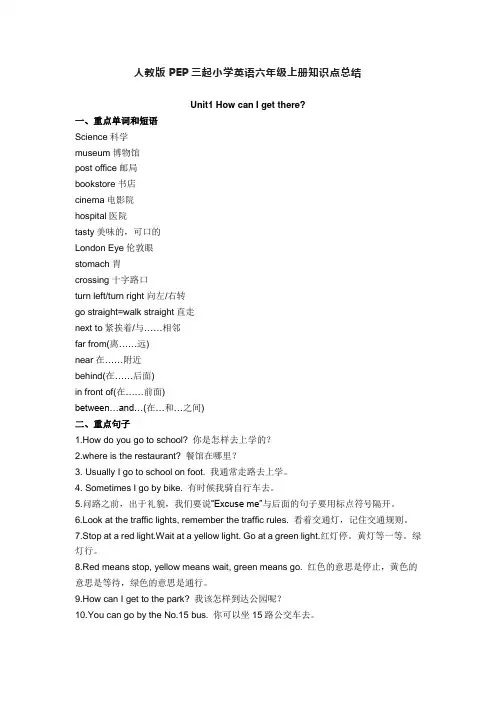
人教版PEP三起小学英语六年级上册知识点总结Unit1 How can I get there?一、重点单词和短语Science科学museum博物馆post office邮局bookstore书店cinema电影院hospital医院tasty美味的,可口的London Eye伦敦眼stomach胃crossing十字路口turn left/turn right向左/右转go straight=walk straight直走next to紧挨着/与……相邻far from(离……远)near在……附近behind(在……后面)in front of(在……前面)between…and…(在…和…之间)二、重点句子1.How do you go to school? 你是怎样去上学的?2.where is the restaurant? 餐馆在哪里?3. Usually I go to school on foot. 我通常走路去上学。
4. Sometimes I go by bike. 有时候我骑自行车去。
5.问路之前,出于礼貌,我们要说“Excuse me”与后面的句子要用标点符号隔开。
6.Look at the traffic lights, remember the traffic rules. 看着交通灯,记住交通规则。
7.Stop at a red light.Wait at a yellow light. Go at a green light.红灯停。
黄灯等一等。
绿灯行。
8.Red means stop, yellow means wait, green means go. 红色的意思是停止,黄色的意思是等待,绿色的意思是通行。
9.How can I get to the park? 我该怎样到达公园呢?10.You can go by the No.15 bus. 你可以坐15路公交车去。
小学六年级上册英语知识点归纳总结

小学六年级上册英语知识点归纳总结六年级上册英语语法知识点归纳1.现在进行时表示正在发生的事情或进行的动作,常与now,listen,look等词连用,结构是主语+be动词(am,is,are)+动词ing.如:It is raining now.外面正在下雨It is six o’clock now.现在6点了My parents are reading newspapers in the sitting room.我父母正在客厅看报纸Look! The children are having a running race now.看!孩子们正在赛跑问句将be动词移前,否定句在be动词后+not.2.一般现在时表示经常反复发生的事情或动作,常与often,usually,sometimes,always,every day(week year…) on Sundays等词连用。
结构是主语+动词原形;当主语为第三人称单数即he,she,it,Tom,my mother,theboy等词时,动词后加s或es.如:We have an English lesson every day.我们每天都要上英语课Do the boys run faster than the girls? Yes,they do.男孩比女孩跑的快吗?是的'问句借助于do,does否定句借助于don’t,doesn’t,后面动词一定要还原。
3.一般过去时表示发生在过去的事情或存在的状态,常与just now;a moment ago;…ago;yesterday;last ( week;month;year;Monday;weekend);this morning等词连用。
结构是主语+be动词的过去式(was;were)或主语+动词的过去式。
注意:be动词与动词过去式不可同时使用。
如:My earphones were on the ground just now.我的耳机刚刚还在呢。
(Unit 5)小学英语人教版PEP六年级上册知识汇总

Unit5四会词(会听说读写)考查形式:听力或笔试补全单词题PA factory worker工厂工人postman邮递员businessman商人police office警察PB fisherman渔夫scientist科学家pilot飞行员coach教练三会词(会听说读)考查形式:笔试第一大题选择不同类(同类)一项country国家(复数:countr ies)head teacher校长sea大海healthy健康的stay healthy保持健康work hard工作努力study hard学习努力university大学gym体育馆reporter记者if如果use使用type打字quickly快速地secretary秘书,助理rescue plane救援飞机旧词singer歌手dancer舞蹈家doctor医生nurse护士cleaner清洁工farmer农民driver司机writer作家teacher教师cook厨师football player足球运动员工作内容与工作工作内容工作He/She often goes to other countries.他/她经常去其他国家businessman男商人Businesswoman女商人collect letters收信/deliver letters送信postman邮递员He sees lots of fish everyday.他每天都看见许多鱼。
fisherman渔夫write stories/books写故事书/写书writer作家type quickly打字很快secretary秘书sports运动coach教练重点句型考查形式:连词成句--What does he do?同事做什么工作的?--He’s(He is)a businessman他是一个商人。
He often goes to other countries.他经常去其他国家。
(Unit 1)小学英语人教版PEP六年级上册知识汇总
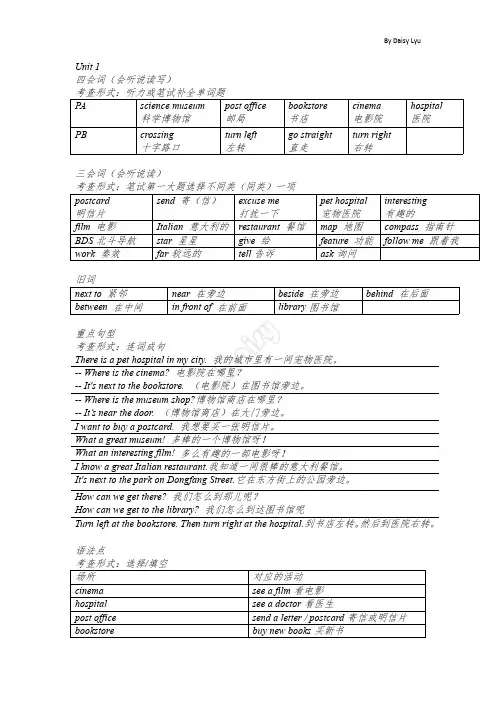
Unit1四会词(会听说读写)考查形式:听力或笔试补全单词题PA science museum科学博物馆post office邮局bookstore书店cinema电影院hospital医院PB crossing十字路口turn left左转go straight直走turn right右转三会词(会听说读)考查形式:笔试第一大题选择不同类(同类)一项postcard 明信片send寄(信)excuse me打扰一下pet hospital宠物医院interesting有趣的film电影Italian意大利的restaurant餐馆map地图compass指南针BDS北斗导航star星星give给feature功能follow me跟着我work奏效far较远的tell告诉ask询问旧词next to紧邻near在旁边beside在旁边behind在后面between在中间in front of在前面library图书馆--It's next to the bookstore.(电影院)在图书馆旁边。
--Where is the museum shop?博物馆商店在哪里?--It’s near the door.(博物馆商店)在大门旁边。
I want to buy a postcard.我想要买一张明信片。
What a great museum!多棒的一个博物馆呀!What an interesting film!多么有趣的一部电影呀!I know a great Italian restaurant.我知道一间很棒的意大利餐馆。
It's next to the park on Dongfang Street.它在东方街上的公园旁边。
How can we get there?我们怎么到那儿呢?How can we get to the library?我们怎么到达图书馆呢Turn left at the bookstore.Then turn right at the hospital.到书店左转。
人教版PEP小学英语六年级上册重点句型及语法知识汇总
人教版PEP小学英语六年级上册重点句型及语法知识汇总Unit 1 How can I get there?重点单词XXX。
post office邮局,XXX。
XXX。
XXX。
crossing十字路口。
turn left左转。
turn right右转。
gostraight直走。
map地图。
compass指南针。
GPS全球定位系统。
stars星星。
XXX意大利餐厅。
getto到达。
重点句型1.---Where is the restaurant?餐厅在哪里?It’s next to the park on Dong fang Street.它在东方路,在公园附近。
2.---How can we get there?我们怎么去哪里?XXX left XXX.书店左转,然后病院右转。
3.He now has GPS.他现在有GPS。
4.What an interesting film!何等风趣的片子!方位词复:XXX紧挨着,near在。
邻近,XXX在。
背面,XXX在。
旁边,in front of在。
前面。
Unit 2 Ways to go to school重点单词on foot走路。
by bike骑车。
by bus乘公交。
by train乘火车。
XXX乘地铁。
by ship搭船。
by XXX乘飞机。
slow down 慢下来。
XXX交通灯。
traffic rules交通划定规矩。
go/come to school上学。
by sled坐雪橇。
byferry坐轮渡。
pay n to留意。
traffic lights交通灯。
and wait at a red light红灯停等一等。
slow downand。
at a yellow light黄灯减速并停下。
Go XXX。
重点句型1.---How do you come to school?你怎么上学?----Usually。
I come on foot.通常我走路来的。
人教版人教版小学英语六年级上册知识点归纳图文稿
人教版人教版小学英语六年级上册知识点归纳集团文件发布号:(9816-UATWW-MWUB-WUNN-INNUL-DQQTY-人教版(PEP)小学英语总复习六年级上册知识点Unit1Howcan I get there一、主要单词:museum博物馆 bookstore书店 cinema电影院 turn 转弯 hospital医院 left向左 post office 邮局 science科学right向右straight笔直地 crossing十字路口二、习惯语搭配:post office邮局 science museum科学博物馆 pet hospital宠物医院Italian restaurant意大利餐馆 Beihai Park北海公园 Palace Museum 故宫博物院 go straight直走 turn right/left右/左转 next to挨着in front of...在...前面 near the park在公园附近 on Dongfang Street在东方大街上三、惯用表达式:Excuse me 打扰一下 Follow me, please!请跟着我!四、公式化句型:1、问路的句型及其答语:问句:Where is the + 地点?···在哪儿?答语:It’s + 表示地点的词语。
它···。
2、询问怎么到某地的句型及其答语:问句:How can +主语 + get (to)+地点···怎么到···同义句型:Can you tell me the way to +地点Where is + 地点Which isthe way to +地点答语:Turn +方向+表示地点的介词短语。
···转。
五、例句:Whereisthecinema,please请问电影院在哪里?It’snexttothehospital. 它与医院相邻。
(完整版)人教版(PEP)小学英语六年级上册复习资料
人教版 (PEP)小学英语总复习六年级上册知识点Unit1How can I get there ?一、主要单词:museum 博物馆bookstore 书店cinema 电影院turn 转弯hospital 医院left 向左post office邮局science 科学right 向右straight 笔挺地crossing 十字路口二、习惯语搭配:post office 邮局science museum 科学博物馆pet hospital 宠物医院Italian restaurant 意大利餐馆Beihai Park 北海公园Palace Museum 故宫博物院go straight 直走turn right/left 右 /左转next to 挨着in front of... 在 ...前方near the park 在公园邻近on Dongfang Street 在东方大街上三、习用表达式:Unit 2 Ways to go to school一、主要:by 乘bus 公共汽on foot 步行plane 机taxi 出租ship(大)船subway 地train 火slow 慢的stop 停下always 是,向来usually 往常often 常sometimes 有候never 素来不二、搭配:by bike/bus/plane/subway/train/ship/taxi/ferry自行 /乘公共汽 / 机 /地 /火 /船 /出租汽 /渡bus 乘 57 路公共汽on foot 步行slow down 慢下来pay attention to 注意traffic lights 交通讯号灯look right 向右看cross the road横穿路get off下at home 在家traffic rules 交通get to 抵达get on 上be far from⋯表示离某地Excuse me打搅一下Follow me, please! 请随着我!四、公式化句型:1、问路的句型及其答语:问句: Where is the + 地址?···在哪儿?答语: It’s + 表示地址的词语。
人教版pep英语六年级上册必考知识点
人教版PEP英语六年级上册必考知识点随着英语教育的不断发展,学生们对英语学习的要求也越来越高。
英语作为一门重要的外语,对于学生来说,掌握好英语知识是非常重要的。
人教版PEP英语六年级上册作为学生学习的重要教材,其中的必考知识点更是学生们需要重点掌握的内容。
下面就让我们来看一下人教版PEP英语六年级上册的必考知识点。
一、语音知识1. 26个字母的大小写形式及发音。
2. 单词中元音字母的发音规律。
3. 辅音字母C和G的发音规律。
二、词汇知识1. 数字的表达方式及拼写。
2. 一些常见的动词和形容词。
3. 表示时间、日期、星期的词汇。
三、句型知识1. 基本的英语句型及其构成。
2. 肯定句、否定句、一般疑问句的基本结构及变化规律。
3. 一般疑问句的提问词和助动词的使用规则。
四、语法知识1. 英文的基本时态(过去时、现在时、将来时)及其构成规律。
2. 形容词的比较级与最高级的构成和用法。
3. 不定冠词、定冠词和零冠词的用法及其特殊情况。
五、阅读技巧1. 词汇量的积累和理解能力的培养。
2. 对于文章中重点词语和句子的把握以及整体理解能力的培养。
3. 阅读短文时的逻辑思维和推理能力的培养。
六、书写规范1. 英文书写的基本规范和要求。
2. 字母大小写的正确使用。
3. 英文句子的书写结构和标点符号的使用规范。
以上就是人教版PEP英语六年级上册必考知识点的内容。
学生们在学习英语的过程中,要重点掌握以上知识点,扎实基础,提高自己的英语水平。
老师们也要在教学中注重对这些知识点的讲解和强化,帮助学生更好地掌握英语知识,提高学生的英语学习能力。
希望学生们在学习英语的过程中,能够充分利用好教材,努力提高自己的英语水平,为将来的学习和生活打下坚实的基础。
人教版PEP英语六年级上册必考知识点从上面列举的知识点中我们可以看出,英语学习需要学生们全方面的掌握,涉及到语音、词汇、句型、语法、阅读技巧和书写规范等多个方面。
下面我们来进一步深入了解这些知识点,并且提供更多的学习建议。