
牛津译林版英语必修二Unit1Grammarandusage1教案
牛津高中英语教学设计
单元:Unit 1 Tales of the unexplained
板块:Grammar
Teaching aims:
Learn the grammar Present perfect tense and Present perfect continuous tense. Teaching important points:
1. Learn how to form and use the present perfect tense.
2. Understand when the present perfect continuous tense is used in sentences.
Teaching methods:
Explaining and practicing.
Teaching aids:
The multi-media.
Teaching procedures:
Step 1Lead- in
Go over the news story on Page 2 and find the sentences using the present perfect tense. Please explain why the tense is used in these sentences.
Step 2 Present perfect tense
1. The form of the present perfect tense: has/ have done.
2. Talk about the uses of the present perfect tense.
A. We use the present perfect tense to talk about things that happened in the recent past, but are
connected to the present. 表示过去发生的事对现在仍有影响。
The disappearance of Justin has made Kelly very unhappy.
(Justin在过去失踪,但Kelly至今仍旧为他的失踪感到不高兴。
)
B. We also use the present perfect tense to talk about something that started in the past, and is still
happening now.表示过去开始的动作一直延续到现在。
I have not seen Justin since last Friday night.(从上周五晚上到现在一直都没有见到过。
)
C. We use the present perfect tense when the exact time of an action is not clear or important. We use it with time expressions such as:
already ever for just lately never recently since yet
Exercise: Complete the following sentences with the proper tense.
(1) We have studied (study) English for about five years.
(2) They have lived (live) in the south since their daughter was born.
(3) I have read (read) your article three times. It’s well written.
(4) The student has finished (finish) her homework already.
(5) Eric has just gone (go) back to his hometown.
We use already for affirmative statements and yet for negative statements.
We use for + a period of time and since + a point in time.
D. We use the present perfect tense to talk about actions that were completed only a short time ago. In this case, just is used. Pay attention to the position of just.
The police have just finished searching the area.
E. We can also use the present perfect tense for repeated actions, that is, we use the present perfect tense with the time expressions once/twice/three times…
3. Read the diary entry and then complete it using the correct forms of the verbs in brackets. Answers: (1) saw (2) has visited (3) loves (4) hasn’t visited (5) has swum (6) has never met (7) has dived (8) has found (9) hasn’t found (10) Has, been
Step 3 Present perfect continuous tense
1. The form of the present perfect continuous tense: have / has been doing
2. Talk about the uses of the present perfect continuous tense
A. We sometimes use the Present perfect continuous tense to talk about actions that started in the past and are still continuing. 表示过去开始的动作一直延续到现在并仍在继续之中。
I have not been sleeping well since I returned home.
“我”回家后一直都没有睡好,现在也没有睡好。
B. We also use the present perfect continuous tense to talk about actions that have just finished but are still connected to the present in some way. 表示过去开始的动作刚结束并在某种情况下与现在有关联。
Kelly:Sorry I'm late.Have you been waiting long?
Sally:Yes.I have been waiting for an hour.
凯利刚到,对方虽然不再等了,但已一直等到现在。
3. Fill in the missing words on page 9
Answers: (1) have been talking (2) have been taking (3) have been watching
(4) have seen (5) have been writing
Step 4 Homework
1. Prepare Grammar and usage on page 10-11.
2. Finish Part C1 and C2 on page 88 in Workbook.。
高二英语译林牛津版必修二:Unit2Grammarandusage(1)教学设计
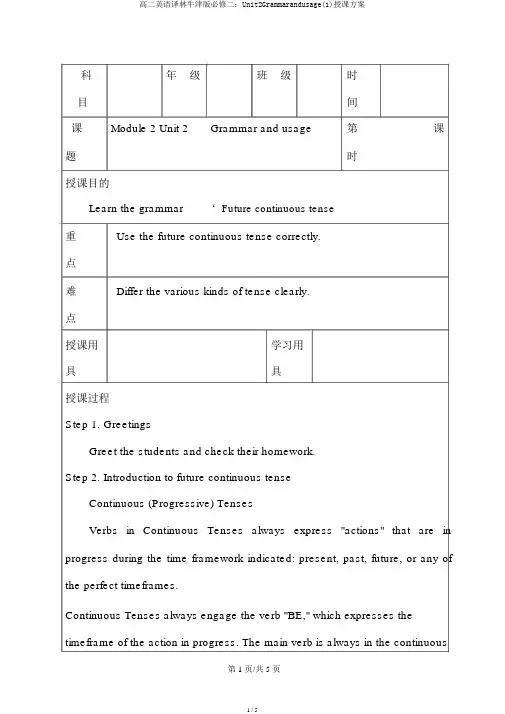
科年级班级时目间课Module 2 Unit 2Grammar and usage第课题时授课目的Learn the grammar‘ Future continuous tense重Use the future continuous tense correctly.点难Differ the various kinds of tense clearly.点授课用学习用具具授课过程Step 1. GreetingsGreet the students and check their homework.Step 2. Introduction to future continuous tenseContinuous (Progressive) TensesVerbs in Continuous Tenses always express "actions" that are in progress during the time framework indicated: present, past, future, or any of the perfect timeframes.Continuous Tenses always engage the verb "BE," which expresses the timeframe of the action in progress. The main verb is always in the continuousform (ING).Future continuous tenseThe Future Continuous Tense applies the verb "BE" in the Future Tense (WILL BE). The main verb is always in the present participle form. Or to make it clear, it is formed by using will be or shah be with the verb form ending in -ing.The Future Continuous Tense is used to express an action expected to be in progress at another relative time in the future or to describe an ongoing or continuous action that will take place in the future. An adverb of time that indicates the future, is often used with the future continuous tense, e.g.:1)I will be eating dinner with my friends at 7 tonight.2)I will be riding the bus at 11:303)At this time next year, I'll be scuba diving off Mexico.4)What will you be doing when new year arrives?4)We 'll be having dinner when the film starts5)Take your umbrella. It will be raining when you return.6)Next week we will be having a party. Can you come?7)The fog shall be covering the land and sea.8) The temperaturewill not be rising above 11 ?C9)Next week, Dr Tanakawill be presenting her ongoing research intogenetically modified plants.10) Dr Tanakawill be investigating issues of biodiversity with colleagues inthe United States when she takes up her scholarship.11)Changes in government funding for universitieswill be aiming to stop Australians who have technical and scientific expertise leaving the country. 12)Many countries shall be signing an agreement on controlling greenhouse emissions in the hope of limiting the depletion of the ozone layer.Step3. More about Future continuous tensepare the following sentences, and find the differences between them.1) Toby will be climbing in the Himalayas all next week.(the action climbing in the Himalayas will be a continuous activity next week and Toby will probably not do other things.)2)Toby will not be in London on 5th September. He will be climbing in the Himalayas.(the action climbing in the Himalayas starts before 5th September and probably continues after it.)3)Toby will go and climb in the Himalayas next week.(will +the base form of a verb expresses future with intention. The speaker announces a deliberate future action in accordance with Toby's wish).2. Go over Point 1 on page 28 to get familiar with situations in which the future continuous tense is usually used.3. Discuss how to form the future continuous tense in statements, in questions and in short answers, and then go over Point 2 on page 28.4.Go over the exercises on page 29. Read the note first to find out what Wang Hailing, the boss, wants David to do. Then read the schedule to find out what David is going to do from 13th June to 30th June.plete the reply by David. Pay attention to the forms of the verbs or auxiliary verbs used.Answers (1) traveling (2) will be (3) will be (4) will (5) will be exploring6. Do Part C1 on page 96 in Workbook to get more practice with the future continuous tense Answers Part C1 (page 96)1 am planning will be helping2 will be waiting will be standing will be having3 have been practicing will be giving4 Will be using will be staying Step 7.Summary andStep4.HomeworkToday we have learned a letter about an adventure in Africa, and we learned the reading strategies of a letter. After class, I ’d like all of you read the letter and try to retell it. And think about the following questions, you may writeyour answers down.1.If you were offered a chance to go traveling around the world, which place would you like to visit most and why is that place your favorite?2.Adventures are demanding and challenging. From your own point of view, why do many people risk their lives for these kinds of adventure? Do you think it is worthwhile for them to do this? Why?板书设计授课后记。
英语-高中-必修2-牛津译林版-Unit 1全套课件:U1_Grammar and usage
that he
did an important and necessary job.
3. A noun clause can be used as the
predicative after the link verb be.
• 1) The question is whether we can rely on him.
• 4) I’ll keep the promise that I will
Noun clauses beginning with
that
• that引导肯定含义的从句,在从句中不充 当成分,没有实际意思。
• 在非正式英语中,以下情况中that可以省 略:
动词后的宾语从句中 be动词后的表语从句中
•
2. A noun clause can be used either as the object of a verb or a preposition in a
sentence.
• 1) They know that the habit will kill them.
• 2) He asked how much I paid for the violin.
• 2) That’s because we were in need of money at that time.
• 3) He looked as if he was going to cry.
• 4) That’s why I was late.
4. Explain to students what apposition
Introduction to noun clauses
Unit+2+Grammar+and+usage+教案 高中英语牛津译林版(2020)必修第一册
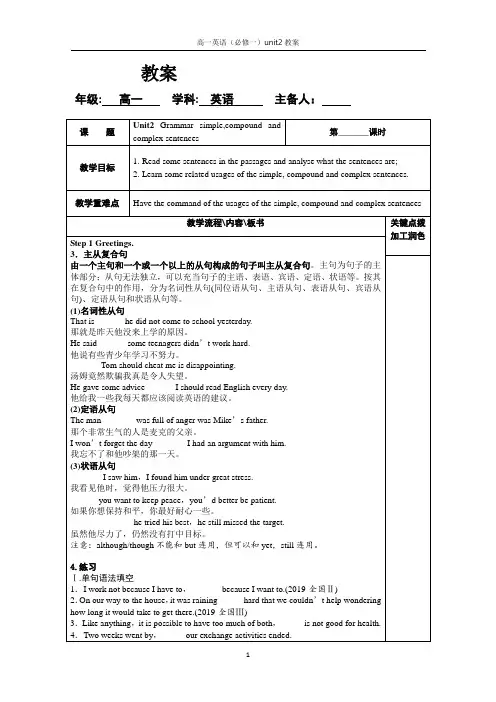
教案年级: 高一学科: 英语主备人:课题Unit2 Grammar simple,compound andcomplex sentences第_______课时教学目标1.Read some sentences in the passages and analyse what the sentences are;2. Learn some related usages of the simple, compound and complex sentences.教学重难点Have the command of the usages of the simple, compound and complex sentences教学流程\内容\板书关键点拨加工润色Step 1 Greetings.3.主从复合句由一个主句和一个或一个以上的从句构成的句子叫主从复合句。
主句为句子的主体部分;从句无法独立,可以充当句子的主语、表语、宾语、定语、状语等。
按其在复合句中的作用,分为名词性从句(同位语从句、主语从句、表语从句、宾语从句)、定语从句和状语从句等。
(1)名词性从句That is ______ he did not come to school yesterday.那就是昨天他没来上学的原因。
He said ______ some teenagers didn’t work hard.他说有些青少年学习不努力。
_______Tom should cheat me is disappointing.汤姆竟然欺骗我真是令人失望。
He gave some advice ______ I should read English every day.他给我一些我每天都应该阅读英语的建议。
(2)定语从句The man _______ was full of anger was Mike’s father.那个非常生气的人是麦克的父亲。
Unit1GrammarandUsage句子成分和结构课件高中英语牛津译林版(2020)

基本句型一 主+谓
① The sun rises. ② Time flies. ③ The man smokes heavily. ④ They stopped when the phone was ringing. ⑤ They talked for half an hour. Conclusion: 这类动词叫做 不及物动词 , 后面不跟宾语,但 是可以带状语。
系动词分类
1) 表状态的be动词:be,is,am,are,was,were 2)表感官的动词: look, sound, taste, smell, feel, 3)表变化的动词: 4)表持续的动词: remain, stay, keep, continue 5)表表像的动词: seem, appear (似乎,好像) 6)表终止的动词: prove, turn out(证明 always makes his parents angry.
A
D定
状 频率
B
定
C
补
英语中一共两种修饰成分:
修饰名词的叫“定语” 修饰名词以外的其他成分的统统叫“状语”
Leona
Practice 学法P26-30
Leona
P6 A Exploring the rules: 1. I agree. 2. Setting goals gives you a focus. 3. These habits will be helpful. 4. Setting goals makes you more confident. 5. You will live a happy life.
现在分词 doing
They found the house broken in.
牛津译林版英语必修一Unit2Grammarandusage1教案

牛津高中英语教学设计单元:Unit 2 Growing pains板块:Grammar and usageThoughts on the design:本节课是以读、写为主的语法教学课。
语法教学的方法各有不同,本节课的设计除了语言知识的传输外,还着眼于培养学生对于学习策略的掌握。
本节课按照“呈现—思考—归纳—巩固”的模式,在语言知识的传授过程中,强调让学生独立思考并归纳语言规则,从而掌握独立的学习策略。
此外,本节课在内容的选择上参考了05-08年各地高考题,对教学内容作了适当增补。
Teaching aims:After learning this session, the students will be able to grasp the basic rules for attributive clauses —“prep.+which/whom”used to begin attributive clauses. Besides, the students will be able to learn the studying strategy for language learning.Teaching procedures:Step 1Review what the students have learned in the previous unit —relative pronouns —with a blank-filling exercise.Fill in the blanks with relative pronouns.1. This is the story __________ we wrote for our storytelling contest. (which/that)2. The book __________ I borrowed from the library is very interesting. (which/that)3. He likes the birthday gifts _________ his friends gave him. (which/that)4. The girl _________ you have just seen is very good at English. (who/whom/that)5. I don’t know the name of the teacher _________ I met in the computer room. (who/whom/that) After finishing the exercise, ask the students to think about the grammatical principles in the sentences, and then make a conclusion as follows: The relative pronouns serve as the objects of the __________. (verbs)[Explanation]第一和第二步是对第一单元中学习的关系代词引导定语从句的复习。
整合英语-高中-必修2-牛津译林版-Unit 1全套课件:U1_Grammar and usage

A. There; that
B. It; what
C. There; whether
D. It; whether
3. A computer can only do ____you have instructed it to do.
A. how B. after C. what D. when 4. Can you tell me ______?
C. did they live
D. did they live in
6. To get the job started, ____I need is from here.
A. only what
B. all what
C. all that
D. only that
7. In some countries ________is called “equality” doesn’t really mean equal rights for all people.
4. Explain to students what apposition means.
• 1) The news that he failed in the exam surprised his parents.
• 2) Word came that we would have two days off next week.
高中英语 模块二 unit1 Grammar and usage 1课件 译林牛津必修2
2. We use the present perfect continuous tense to talk about actions that started in the past and are still continuing.
· I _h_av_e_n_o_t_s_e_e_n_ (not see) Justin
since last Friday night.
2. We also use the present perfect tense to talk about something that started in the past, and is still happening now.
3.We use the present perfect tense when the exact time of an action is not clear or important. We use it with time expressions such as:
already ever for just lately never
• We use already for affirmative statements and yet for negative statements.
• We use for + a period of time and since + a point in time.
• The police have just finished searching the areas.
Unit 1
牛津英语必修二unit 1 Grammar and Usage教学设计
Tales of the UnexplainedGrammar and Usageby Jia Liyi课堂设计指导思想:本节课是一节语法课。
基于任务型教学法的理念,在设定的情境中培养学生运用语言解决问题的能力。
本节课将语法学习与学生的生活实际联系起来,激发学生学习兴趣,重视学生的体验与参与。
基于语法课的特点,本节课借助多媒体开展教学活动,围绕核心语法项目——现在完成进行时和现在完成时设定任务,通过图片展示、名言警句欣赏、角色扮演等方式,让学生在小组合作和讨论中完成任务,实现预设的教学目标。
Teaching aims:1.Learn the form and usage of the present perfect continuous tense and review the presentperfect tense.2.Learn to know when the present perfect tense and the present perfect continuous tense is usedin sentences through context.3.Learn to cooperate with classmates during activities.4.Develop thinking habit of discovering and analyzing.Important and difficult points:1. Compare the differences between the present perfect continuous tense and the present perfect tense.2. Learn to distinguish different usages between the two tenses.3. Learn how to use the two senses to describe things and express opinions and attitudes.Teaching methods:Students-centered method; Communicative method; Task-based methodTeaching aids: Multimedia facilities; BlackboardTeaching procedures:Step 1 Lead-in1.Show a picture of a famous movie Music and Lyrics and play the song Way Back into Love. Before that, ask Ss to appreciate the repeated lyrics:I have been living with a shadow overheadI have been sleeping with a cloud above my bedI have been lonely for so long trapped in the pastI just can't seem to move onI have been hiding all my hopes and dreams awayJust in case I ever need them again somedayI've been setting aside timeTo clear a little space in the corners of my mindAll I want to do is find a way back into love......I've been watching but the stars refuse to shineI've been searching but I just don't see the signsI know that it's out thereThere's got to be something for my soul somewhereI've been looking for someone to shed some light……2. Ask Ss a question Have you found any similar patterns in this song? after playing the song.【设计意图】以歌曲激发学生的学习兴趣,听歌的同时引入主题,引导学生自主发现本课将要重点讲解的内容,以及语法结构have been doing。
牛津译林版高中英语必修2精选教案Unit 1 Tales of the unexplainedgrammar and usage
●Grammar and UsagePresent perfect tense1. Use different methods to present the present perfect tense. Here are some ideas:1) Please look at the screen. Pay attention to the different forms of the verbs:2) Let’s complete the following sentences, in which the predicate part is missing.We_____(study) English for about five years.They_____(live) in the south since their daughter was born.I_______ (read) your article three times. It's well written.The student________(finish) her homework already.Eric__________(go) back to his hometown today.Answers: have studied have lived have read has finished has gone3) Read the following sentences and point out what tense or tenses are used in them and the reasons why they are used.We have studied English for about five years. We began to study it five years ago.They moved to the south in 1990 and have lived there since then.The student is doing her homework. She hasn't finished it yet.Eric left home last year and has just come back.2. We may wonder why some verbs can't be used in the present perfect tense. Let’s read the following sentences, and try to find different usages of some verbs.Justin has been away from home for several days. He disappeared last Friday.They bought this house three years ago and they have lived here since then.My brother went to see my grandpa last week. He has visited him three times this month.So you see when an action happens over a period of time that began in the past and continues to the present, the present perfect tense is often used. When an action happened at a definite time in the past, the past simple tense is often used.3. Read Points 1 and 2 on page 8 to make sure why the present perfect tense is used in these two sentences.4. Go over Point 3 on page 8 to learn what time expressions can be used with the present perfect tense. Pay attention to the different usages between already and yet, or for and since.5. Read Point 4 on page 8 to learn that the present perfect tense can be used in a situation where the action was completed only a moment ago. In this case, just is used.6. Go over Points 5 and 6 on page 8 and note that when we want to express a repeated action, we use the present perfect tense with the time expressions once/twice/three times ...7. Let’s read the diary entry and then complete it using the correct forms of the verbs in brackets.Answers:(2) saw (3) has visited (4) loves (5) hasn't visited (6) has swum (7) has never met(8) has dived (9) has found (10) hasn't found (11) Has, beenSummary of The Present Perfect tense:1.We use the present perfect tense to talk about things that happened in the recent past, but areconnected to the present.Daniel has lived(live) in Beijing since he came to China.(Connection with the past: Daniel came to China. Connection with the present: Daniel is living in China.)2.We use the present perfect tense to talk about something that started in the past, and is stillhappening now.came has lived________________________________________past now future3.We use the present perfect tense to talk about actions that were completed only a short time ago.I went to Egypt in 1986. I went to Egypt in 2004.I have been (be) to Egypt twice.4.We can also use the present perfect tense for repeated actions.Has it ever snowed(snow) in Hong Kong?No, it has never snowed(snow) there.5.We use the present perfect tense when the exact time of an action is not clear or important. We useit with time expressions such as: already, ever, for, just, lately, never, recently, since, yetNotes:1. We use already for affirmative statements and yet for negative statements and interrogativesentences.2. We use for + a period of time and since + a point of time.3. Structures connected with the present perfect tense:1) It is (has been) +a period of time +since-clause.2) This (That/It) is the first (second…) time + that-clause (present perfect tense).3) This (That/It) is the only ) … + that-clause (present perfect tense).4) This (That/It) is the best/ finest /most interest ing … + that-clausePresent perfect continuous tenseHere we will look at two situations in which the present perfect continuous tense is used. Note how the tense is formed and try to understand how the tense is used in sentences. We will practise forming verbs in this tense and complete sentences.1. We sometimes use the present perfect continuous tense to talk about actions that started in the past and are still continuing, or have just finished but are still connected to the present in some way. For example,I've been waiting for an hour and he still hasn't turned up.I'm so sorry I'm late. Have you been waiting long?2. Go over Points 1 and 2 on page 9 to understand this tense better.3. Go over Point 3 to see how the tense is formed.4. Fill in the missing words. Pay attention to the verb form in the example given in the first picture (all the verb forms here are the present perfect continuous tense, except for the one in Sentence 5). It is a trap and does not require the present perfect continuous tense.Answers:(2) have been talking (3) have been taking (4) have been watching (5) have seen (6) have been writing5. Do with Part C1 on page 82 in Workbook to become familiar with the present perfect tense and the present perfect continuous tense.Present perfect or present perfect continuous?1. Go over Point I on page 10 to identify why the two different tenses are used in the two sentences.In the first sentence, the present perfect tense is used, which means that the action read isn't continuing, and Li Jia knows what the book is about now. In the second sentence, the present perfect continuous tense is used, which means that the action read is still continuing.2. Go over Point 2 on page 10. Note that the present perfect continuous tense can't be used with time expressions such as twice or how many times, because in this tense the action is continuous, not stopped and then started again.3. Go over Point 3 on page 10 to define the meaning of a state verb or an action verb. Note that a state verb doesn't mean an action, so it can't be used in a continuous tense.4. Note that the present perfect continuous tense can't be used when the words always, never, yet, already or ever are used in a sentence.5. Finish the two exercises on page 11.Answers:A (1) heard (2)been doing (3) been researching (4) been doing (5) started (6) done (7) read (8) found (9) started (10) been doing (11) been makingSample answers:B 1. He has been waiting at an underground station.2. They have been traveling in a UFO. It looks like a saucer. (Answers may be various.)3. They probably have talked to animals or plants on the Earth as well as creatures on other planets. (Answers may be various.)4. They have visited Mars, Venus, Jupiter and some other planets. (Answers may be various.)6. Do with Part C2 on page 82 in Workbook to have one more chance to practise the usage of the two different tenses.ConsolidationI. Relative items in recent y ears’ college entrance examinations:1. My friend, who ____ on the International Olympic Committee all his life, is retiring next month.(2006浙江)A. servedB. is servingC. had servedD. has served2. John and I ________friends for eight years. We first got to know each other at a Christmas party. Butwe ________each other a couple of times before that. (2002北京春季招生)A. had been; have seenB. have been; have seenC. had been; had seenD. have been; had seen3. With the rapid growth of population, the city ________in all directions in the past five years. (2003北京春季招生)A. spreadsB. has spreadC. spreadD. had spread4. --How long ________at his job? --Since 1990. (2003北京春季招生)A. were you employedB. have you been employedC. had you been employedD. will you be employed5. How can you possibly miss the news? It ________on TV all day long. (2004 北京春季招生)A. has beenB. had beenC. wasD. will be6. Now that s he is out of a job, Lucy ________going back to school, but she hasn’t decided yet. (2004 北京高考)A. had consideredB. has been consideringC. consideredD. is going to consider 7.--How are you today? (2000全国高考)--Oh, I ________as ill as I do now for a very long time.A. didn’t feelB. wasn’t feelingC. don’t feelD. haven’t felt8. I _______ Ping-pong quite well, but I haven’t had time to play since the new year. (2001全国高考)A. playedB. will playC. have playedD. play9. I wonder why Jenny ________us recently. We should have heard from her by now. (2002全国高考)A. hasn’t writtenB. doesn’t writeC. won’t writeD. hadn’t written10. Although he has lived with us for years, he ________us much impression. (2004上海春季招生)A. hadn’t leftB. didn’t leaveC. doesn’t leaveD. hasn’t left11. The first use of atomic weapons was in 1945, and their power ________increased enormously eversince. (2004上海高考)A. isB. wasC. has beenD. had been12. She has set a new record, that is, the sales of her latest book ________50 million. (2004福建高考)A. have reachedB. has reachedC. are reachingD. had reached13. More patients ________in hospital this year than last year. (2004江苏高考)A. treatedB. have treatedC. had been treatedD. have been treated14. --The window is dirty. --I know. It ________ for weeks. (2004广西高考)A. hasn’t cleanedB. didn’t cleanC. wasn’t cleanedD. hasn’t been cleaned15 Years ago we didn't know this, but recent science ______ that people who don't sleep well soon get ill.(2005广东高考)A. showedB. has shownC. will showD. is showing16. The coffee is wonderful ! It doesn’t taste like anything I _____ before. (2005全国卷I)A.was having B.have C.have ever had D.had ever had17. My brother is an actor. He _________ in several films so far. (2005浙江卷)A.appears B.appeared C.has appeared D.is appearing18. I ____ in London for many years, but I’ve never regretted my final decision to move back toChina. (2006重庆)A. livedB. was livingC. have livedD. had lived19. Although medical science ____ control over several dangerous diseases, what worries us is thatsome of them are returning. (2006江苏)A. achievedB. has achievedC. will achieveD. had achieved20. I won’t tell the student the answer to the math problem until he ____ on it for more than an hour.(2006湖北)A. has been workingB. will have workedC. will have been workingD. had workedII. Translation1 我已经看了说明,但我还是不理解。
译林版高中英语必修一Unit1 Grammar and usage (I) 教案(雅礼)
3.Clearly, talking to him is a mistake.Adverbial(状语)
4. We should developgood study habits.Object(宾语)
ask, bring, buy, cost, give, hand, lend, pass, pay, read, return, sell, send, show, take, teach, tell, write…
(2)Make sentences using S+V+IO+DO structure.
Practice
Complete the following sentences with proper object complements.
1. She felt somethingclimbingon her skin.
2. Justine named his grandsonMax.
3. My classmates painted the back wallwhite.
本课教学内容为句子成分和句子结构。学生对于定状补可能不太熟悉,需要在教学过程中着重强调。教学过程中应关注学生的课堂反应,对其不太熟悉、存有疑虑的地方进行重点讲解。本课需帮助学生形成英语句子的整体观,为学生日后建立英语语法体系打下良好基础。
教学目标:
本节课课型为:语法课
1.语言能力层面:重点培养学生分析长难句成分的能力;
3.Find thesubjectsandthe verbsof the following sentences.
(1)Youwill discoveryour potential while you develop as a student and as a person.